


Domestic violence (DV) is one of the great challenges that society faces today, and it has been recognized as a public health problem and a priority area of social action. Both national and international studies have demonstrated the devastating consequences of DV for women, their children, the whole family, and society in general (Burnette & Cannon, Reference Burnette and Cannon2014; Calvete, Estévez, & Corral, Reference Calvete, Estévez and Corral2007; Gámez-Guadix, Almendros, Carrobles, & Muñoz-Rivas, Reference Gámez-Guadix, Almendros, Carrobles and Muñoz-Rivas2012; García-Moreno, Jansen, Ellsberg, Heise, & Watts, Reference García-Moreno, Jansen, Ellsberg, Heise and Watts2006; Koziol-McLain et al., Reference Koziol-McLain, Webster, McFarlane, Block, Ulrich, Glass and Campbell2006; Pico-Alfonso et al., Reference Pico-Alfonso, García-Linares, Celda-Navarro, Blasco-Ros, Echeburúa and Martínez2006). A particular subset of victims who have suffered severe abuse and lack independent financial and social resources need to be accommodated in temporary shelters for victims of DV (Bosch & Ferrer Reference Bosch and Ferrer2003; Fiol & Pérez, Reference Fiol and Pérez2004; Jonker, Sijbrandij, & Wolf, Reference Jonker, Sijbrandij and Wolf2012; McFarlane, Maddoux, Nava, & Gilroy, Reference McFarlane, Maddoux, Nava and Gilroy2015). Shelters aim to provide a safe environment and assistance in different areas (e.g., legal, financial, medical, and psychological) for women and their children (Jonker, Jansen, Christians, & Wolf, Reference Jonker, Jansen, Christians and Wolf2014), and research on the impact of DV on them is essential to guide the interventions implemented in these centers. In fact, as most abused women have children, some authors have stressed the need to consider the joint impact of DV on both of them (McFarlane et al., Reference McFarlane, Maddoux, Nava and Gilroy2015; Menéndez, Pérez, & Lorence, Reference Menéndez, Pérez and Lorence2013). However, little is known about what are the needs of DV shelter users, especially the children (Chanmugam & Hall, Reference Chanmugam and Hall2012; Poole, Beran, & Thurston, Reference Poole, Beran and Thurston2008). Therefore, the present study aimed to explore the consequences of DV on the mental health of women in shelters, along with the mother-child relationship, mother’s parenting practices, child victimization and the physical and psychological health of children.
Domestic Violence and Mental Health
The results of studies on the effects of DV have showed that female victims of DV had a greater risk of mental health problems than those who had not been victims (e.g., Pico-Alfonso et al., Reference Pico-Alfonso, García-Linares, Celda-Navarro, Blasco-Ros, Echeburúa and Martínez2006). Depression and post-traumatic stress disorder were reported to be the most prevalent mental symptoms (Buesa & Calvete, Reference Buesa and Calvete2013; Helfrich, Fujiura, & Rutkowski-Kmitta, Reference Helfrich, Fujiura and Rutkowski-Kmitta2008; Woods, Reference Woods2005; for reviews see Campbell, Reference Campbell2002; Dillon, Hussain, Loxton, & Rahman, Reference Dillon, Hussain, Loxton and Rahman2013). DV has also been linked to other mental problems, such as anxiety (Ansara & Hindin, Reference Ansara and Hindin2011; Pico-Alfonso et al., Reference Pico-Alfonso, García-Linares, Celda-Navarro, Blasco-Ros, Echeburúa and Martínez2006), suicidal thoughts and attempts (Devries et al., Reference Devries, Watts, Yoshihama, Kiss, Schraiber, Deyessa and García-Moreno2011; Ellsberg, Jansen, Heise, Watts, & García-Moreno, Reference Ellsberg, Jansen, Heise, Watts and García-Moreno2008; Pico-Alfonso et al., Reference Pico-Alfonso, García-Linares, Celda-Navarro, Blasco-Ros, Echeburúa and Martínez2006), sleep disorders (Ansara & Hindin, Reference Ansara and Hindin2011), and abuse of alcohol and other substances (Lacey, McPherson, Samuel, Sears, & Head, Reference Lacey, McPherson, Samuel, Sears and Head2013).
Most of the studies that focused on the mental health of female victims of DV employed either telephone macro-surveys (e.g., Ansara & Hindin, Reference Ansara and Hindin2011; Lacey et al., Reference Lacey, McPherson, Samuel, Sears and Head2013) or were based on women who has sought assistance from specialized centers (Buesa & Calvete, Reference Buesa and Calvete2013; Pico-Alfonso et al., Reference Pico-Alfonso, García-Linares, Celda-Navarro, Blasco-Ros, Echeburúa and Martínez2006). Only a few studies consisted of women from shelters. The results of those studies indicated that, overall, the prevalence of mental disorders of women in shelters was higher than that of women victims of DV who were not in shelters. For example, Helfrich et al. (Reference Helfrich, Fujiura and Rutkowski-Kmitta2008) interviewed 74 women in shelters and found a very high prevalence of symptoms of anxiety (77%), anxiety disorder (32.4%), major depression (51.4%), phobias (35%), post-traumatic stress disorder (16.2%), personality disorders (14%), schizophrenia (3%), and alcohol abuse (10.8%). In addition, the results of that study indicated that mental problems had an adverse effect on the social functioning of the women, including their working lives.
Impact of Domestic Violence on Children
Recently, both intervention programs and research studies have begun to pay greater attention to the impact of DV on the children of victims (Calvete & Orue, Reference Calvete and Orue2013; de la Vega, de la Osa, Ezpeleta, Granero, & Domènech, Reference De la Vega, de la Osa, Ezpeleta, Granero and Domènech2011; Gámez-Guadix et al., Reference Gámez-Guadix, Almendros, Carrobles and Muñoz-Rivas2012; Izaguirre & Calvete, Reference Izaguirre and Calvete2015; Matud, Reference Matud2007). Research has shown that children may be subject to both direct and indirect victimization. Studies have demonstrated that many children of battered women were direct victims of the perpetrator, suffering physical, psychological, or sexual abuse by the same offender who abused their mothers (Arata, Langhinrichsen-Rohling, Bowers, & O’Brien, Reference Arata, Langhinrichsen-Rohling, Bowers and O’Brien2007; Menéndez et al., Reference Menéndez, Pérez and Lorence2013), with the percentage of direct victimization about 20–70% (Lundy & Grossman, Reference Lundy and Grossman2005). In addition to direct victimization, in most cases of DV, children are subjected to indirect victimization by witnessing violence. According to a number of studies, an estimated 70–90% of children of women who experienced DV were witnesses of the attacks that took place in the home (Fusco & Fantuzzo, Reference Fusco and Fantuzzo2009; Graham-Bermann, Gruber, Howell, & Girz, Reference Graham-Bermann, Gruber, Howell and Girz2009; Menéndez et al., Reference Menéndez, Pérez and Lorence2013).
Both direct victimization and indirect victimization (i.e., witnessing violence perpetrated against the mother) have been shown to cause severe emotional and behavioral problems in children, including depression, post-traumatic stress, and aggressive behavior (Gámez-Guadix et al., Reference Gámez-Guadix, Almendros, Carrobles and Muñoz-Rivas2012; Kearney, Reference Kearney2010; Stanley, Miller, & Richardson, Reference Stanley, Miller and Richardson2012). These problems can spill over into the academic area, with many boys and girls experiencing problems at school and difficulties in their social relationships (Izaguirre & Calvete, Reference Izaguirre and Calvete2015). Some studies also showed that DV negatively affected the process of parenting (Izaguirre & Calvete, Reference Izaguirre and Calvete2014; Levendosky & Graham-Bermann, Reference Levendosky and Graham-Bermann2001; Yoo & Huang, Reference Yoo and Huang2013). For example, some of the previous studies found that because of their emotional difficulties several female victims of DV displayed more negative parenting behaviors, such as greater use of spanking as a disciplinary behavior, and even abusive behaviors (Taylor, Guterman, Lee, & Rathouz, Reference Taylor, Guterman, Lee and Rathouz2009). However, others studies found that mothers of children subjected to DV implemented positive strategies (positive discipline, warm and nurturing, and consistent parenting) to offset the situation (Letourneau, Fedick, & Willms, Reference Letourneau, Fedick and Willms2007) and displayed high quality mother-child relationship (Jarvis, Gordon, & Novaco, Reference Jarvis, Gordon and Novaco2005).
The Present Study
This is one of the few studies exploring the consequences of DV in a large sample of women and their children in shelters and the first one carried out in Spain. All the records of women who had used an emergency shelter and/or a medium-long stay shelter in Bizkaia from 2006 to 2015 were analyzed. The objectives of this study were as follows: (1) To explore the presence of mental health problems in female victims of DV in shelters; (2) to examine the sociodemographic profile of children in the shelters, characteristics of the mother-child relationship, and mother’s parenting style; (3) to examine the impact of the violence (direct and indirect victimization) on children and the consequences for their physical and psychological health; (4) to analyze changes in the studied variables over the last 10 years (2006–2015), thereby identifying future trends in the needs of women and their children. Given the scarcity of previous studies with samples of DV victims in shelters, this study was essentially exploratory. However, based on previous research on women victims of DV, we expected a high prevalence of mental health problems in our sample of women in shelters. With regard to child victimization, our hypothesis was that a high percentage of children had suffered either direct or indirect victimization, with prevalence rates even higher than those found in previous studies with samples of children whose mothers were not necessarily in a shelter. The presence of emotional problems in the children was also expected. Finally, due to the mixed previous findings regarding parenting and mother-child relationship (Jarvis et al., Reference Jarvis, Gordon and Novaco2005; Levendosky & Graham-Bermann, Reference Levendosky and Graham-Bermann2001), we did not state any specific hypothesis.
Method
Participants
The sample consisted of 834 records of women who had been admitted to an emergency shelter and 84 records of women who had been admitted to a medium-long stay shelter from 2006–2015 in Bizkaia (Spain). The numbers of records analyzed per year for the emergency shelter were as follows: 2006, n = 107; 2007, n = 112; 2008, n = 99; 2009, n = 88; 2010, n = 55; 2011, n = 70; 2012, n = 100; 2013, n = 78; 2014, n = 65; and 2015, n = 60. The numbers for the medium-long stay shelter were as follows: 2006, n = 9; 2007, n = 12; 2008, n = 9; 2009, n = 6; 2010, n = 3; 2011, n = 12; 2012, n = 9; 2013, n = 9; 2014, n = 11; and 2015, n = 4. The mean age of the women who entered the emergency shelter was 33.96 years (SD = 10.23) and, for the women who entered the medium-long stay shelter, it was 33.93 (SD = 9.83). Regarding ethnicity, 48.8% of the women from the emergency shelter and 38.1% from the medium-long stay shelter were Spanish, versus 55.2% of the women from the emergency shelter and 61.9% from the medium-long stay who were from other countries (mostly from South America and Africa).
Design and Procedure
A descriptive study was carried out by systematic observation through the technique of document analysis. Specifically, the records of women who had used at least one of two types of shelter (an emergency shelter and a medium-long stay shelter) in the Provincial Council of Bizkaia (Basque Country, Spain) from 2006–2015 were evaluated. The emergency center serves the immediate needs of women for shelter, providing support services and access to other resources, if necessary. The medium-long stay shelter admits victims of DV who require protection and temporary residential care due to the seriousness of the abuse and lack of socioeconomic resources.
The records were compounded from the standardized forms filled out by the shelter staff (psychologists and social workers) and available reports (from the police, hospitals, former institutions, etc.). Specifically, the records contained information about the following aspects: Entry and exit (date and reasons, previous entries in the same or different centers); sociodemographic data of the woman and, if applicable, of her children and other persons in her charge; economical, employment, legal and administrative situation of the woman; characteristics of the maltreatment suffered by the woman and her children; characteristics of the abuser; information about denunciations, protection orders and children’s custody; the woman’s physical health, disabilities, and mental health; her social support, competences and skills (cognitive, linguistic, social, etc.); and parenting and mother-child relationship.
Several psychologists who were part of the research team reviewed the records at the offices of the Provincial Council of Bizkaia. The records were registered using an identifier, which consisted of the woman’s birth date and initials of her first name and surname. All the reviewed records were included in the study and the data were coded and entered into a database for further analysis. In conducting this research, all data protection procedures adhered to current regulations and the principles of research ethics.
Instrument and Variables
The information in the records was gathered using a data collection sheet designed according to the research objectives. With regard to the variables of interest in this study, the following information was collected: Mental health of the women (a description of the information contained in the records about psychological disorders and the psychological state of the women); women with children (yes/no); number of children per woman; women with children in the shelter (yes/no); number of children in the shelter per woman; gender of children in the shelter; age of children in the shelter; mother-child relationship (a description of the information contained in the records regarding the bond and attachment relationship of the mother with her children); mother’s parenting (a description of the information contained in the records regarding mother’s parenting practices); if children witnessed the abuse suffered by the mother (yes/no); if children were victims of abuse (yes/no), and, if so, the type of abuse suffered by the children (classified into five categories of physical, psychological, sexual, physical and psychological, and physical, psychological and sexual); and children’s problems (a description of the information contained in the records related to physical and psychological problems of the women’s children).
Data Analysis
First, the data collected for the variables mental health of the women, mother-child relationship, mothers’ parenting, and children’s problems were categorized. The authors reviewed all the information independently, identifying possible categories for each variable. Following a discussion, they agreed upon the final categories. Next, two of the authors (Fernández-González and Mauri) encoded the data separately, and the kappa coefficient for the inter-rater agreement index was calculated. The coefficient ranged from .72 to 1.00 for the variables related to the mental health of women (with exception of a kappa coefficient of .64 for nonspecific psychological symptoms), which showed good-to-excellent agreement (Landis & Koch, Reference Landis and Koch1977). The kappa coefficients for the mother-child relationship, mother’s parenting, and children’s problems were .86, .93, and .84, respectively, which showed excellent agreement (Landis & Koch, Reference Landis and Koch1977).
For the quantitative analysis of the data, SPSS 23 was used. The data from each of the two shelters (i.e., the emergency and medium-long stay shelters) was analyzed separately. The percentages of each category were calculated for the qualitative variables, and means and standard deviations were derived for the quantitative variables. To detect significant differences in the percentages obtained over the last 10 years (2006–2015), Pearson’s chi-square statistic and the linear by linear association test were used (Mantel-Haenszel chi-square) for the qualitative variables. For the quantitative variables, a one-way ANOVA was conducted. When significant differences were found, polynomial contrasts were performed to explore the trend across years. The results were based on the weighted solution, considering the different sizes of the groups (i.e., number of records per year).
Results
Women’s Mental Health
The variable mental health of the women was classified in 13 dichotomous (yes/no) and inclusive categories (see Table 1), such that the sum of the categories’ percentages was greater than 100. In addition, a variable was created called any disorder or clinical symptom, which specified whether the woman had any psychological disorder or clinical symptoms. The latter was found in 292 of the 834 (35%) emergency shelter records and in 67 of the 84 (79.8%) medium-long stay shelter records. We found significant differences between the percentages obtained for this variable across 2006–2015 in the emergency shelter, χ2(9) = 18.49, p < .05. As displayed in Figure 1, the number of women with mental health problems showed a decreasing tendency between 2007 (45.5%) and 2010 (20%), when it began to rise again, with a peak of 46.2% in 2014.
Mental Health of Female Victims of Domestic Violence in Shelters

Note: The percentages of the different disorders were calculated relative to the total number of records that indicated the existence of any disorder or clinical symptom (n = 292, emergency shelter; n = 67, medium-long stay shelter). The categories are not mutually exclusive, so that the sum of percentages may be greater than 100.
1 n refers to the total number of cases analyzed for each variable/category.
2 Records that indicated the woman was receiving psychological or psychiatric treatment but did not specify the problem.
Percentage of Women with Psychological Disorders or Symptoms in the Emergency Shelter.

With regard to specific mental health problems, anxiety-depressive disorders or symptoms were most common. According to the records of the emergency and medium-long stay shelters, 8.2% and 6% of women, respectively, had attempted suicide. Psychotic and personality disorders, trauma- and stressor-related disorders, addictive disorders, eating disorders, bipolar disorders, and other psychological disorders related to sleep and behavioral problems were also recorded, albeit to a lesser extent. In addition, about 20% of the records of both shelters indicated that the women had clinical symptoms, although they did not specify any particular disorder. For example, the record stated: “The woman seems insecure, unassertive, and seeking external approval, with affective flattening and poor expression of emotions.”
Mother-Child Relationship and Parenting
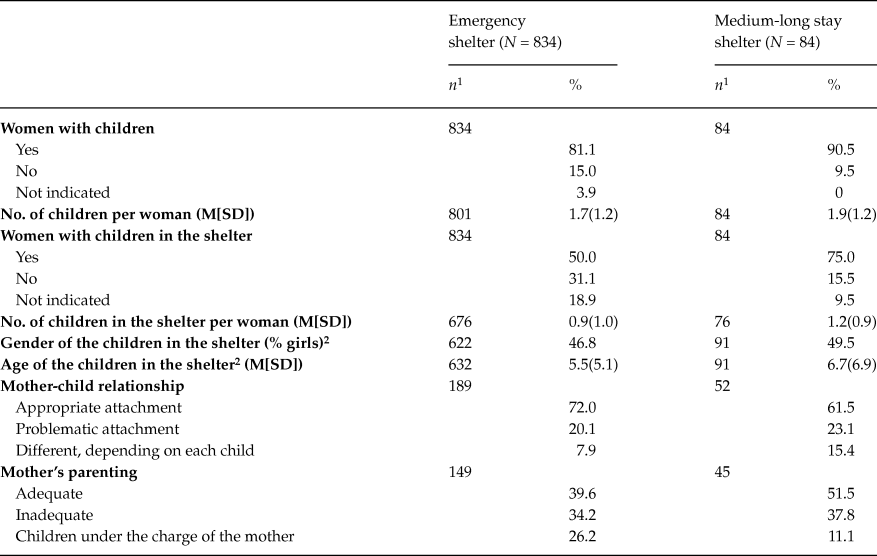
As can be seen in Table 2, most of the women had their children with them in the shelters: 50% of the women in the emergency shelter and 75% in the medium-long stay shelter. Throughout the period of 2006–2015, in the emergency shelter, there were significant differences in this variable, χ2(9) = 22.41, p < .01. The percentage of women who entered the shelter with their children increased from 2006 to 2011, when it started to decrease until 2015 (see Figure 2). The trend in the specific number of children in the shelter per woman was similar, F(9, 666) = 2.40, p < .05; and the ANOVA with polynomial contrasts showed that the quadratic trend was statistically significant, F(1, 666) = 11.52, p < .01. In the medium-long stay shelter, there were significant differences across years in the mean age of the children in the shelter, F(9, 81) = 2.07, p < .05 (Figure 3). The ANOVA with polynomial contrasts demonstrated that both the quadratic trend, F(1, 81) = 5.46, p < .05, and cubic trend, F(1, 81) = 7.03, p < .05, were statistically significant.
Children’s Profiles, Mother-Child Relationship, and Parenting
1 n refers to the total number of cases analyzed for each variable.
2 A total of 635 children were admitted to the emergency shelter, and 92 were admitted to the medium-long stay shelter.
Percentage of Women who Entered the Emergency Shelter with Children.

Mean Age of the Children Admitted to the Medium-Long Stay Shelter with Their Mothers.

Regarding the mother-child relationship, the information was coded into three mutually exclusive categories: (1) Appropriate attachment relationship (i.e., when a secure mother-child emotional bond exists, with verbal and physical expressions of affection, and the children show closeness and confidence); (2) problematic (i.e., when an insecure mother-child emotional bond exists, with few verbal and physical expressions of affection, and the children show distance and/or anxiety) or nonexistent (i.e., when the mother does not have a relationship with the children because, for example, they live in another country or with other caregivers) attachment relationship; and (3) different, depending on each child (i.e., appropriate relationship with some of the children but problematic or nonexistent with others). In about two-thirds of cases, the records indicated that the mothers had an appropriate attachment relationship with their children, whereas the attachment relationship was problematic or nonexistent in about 20% of cases. The emergency shelter records reported some differences in the mother-child relationship across years, but there was no definite trend, χ2(9) = 36.59, p < .01. The origin of the mother-child relational problems was mainly attributed to difficulties and emotional problems of the children as a result of the DV. For example, one of the records indicated that the mother “has lost all authority and emotional closeness with the eldest daughter, and the relationship with the youngest daughter is close but overly dependent.” Another record referred to “difficulties in the mother-child relationship. The girl idealizes the father and blames the mother for the situation in which they find themselves.” A few records mentioned a strong emotional detachment of the mother (e.g., “[The mother] does not exhibit affection [toward the children] or have any physical contact with them”).
Regarding the mothers’ parenting practices, the information was coded into three mutually exclusive categories: (1) Adequate parenting practices (i.e., when the mother takes care of the children’s physical [food, sleep, clothing, safety], social and emotional needs; and she is also efficient at setting limits), (2) inadequate parenting practices (i.e., when the mother does not take care of the children’s physical [food, sleep, clothing, safety], social and emotional needs; and/or she is not efficient at setting limits), and (3) none of the children were under the charge of the mother. Inadequate parenting patterns were reported in 34.2% of emergency shelter records and 37.8% of medium-long stay shelter records. A number of records highlighted problems experienced by some mothers in presenting themselves as authority figures and setting limits for their children. For example, one of the records included the following information: “Problems in setting limits for the children. [The mother] delegates responsibilities for setting limits to the educational staff at the shelter when the child refuses to obey the rules.” With regard to setting limits for her child, another record stated: “The child does not accept them, and he responds aggressively (he kicks her, he insults her, etc.).” In addition, some records noted that the woman did not take adequate care of the children’s physical and emotional needs. For example: “There are no regular eating, sleeping, and hygiene habits and no supervision or control of the child.” However, in most cases (39.6% in the emergency shelter and 51.5% in the medium-long stay shelter), the parenting practices were adequate. Finally, it is notable that many of the children were not under the direct care of the mother. In most of these cases, another family member was caring for the children or the father or social services (when custody had been withdrawn).
Child Victimization
Around 80–90% of the children had witnessed the abuse suffered by the mother at home (Table 3). According to the records that contained information on child’s direct victimization (32.6% of the records in the emergency shelter and 44% of the records in the medium-long stay shelter), 55.9% of the children in the emergency shelter and 62.2% of those in the medium-long stay shelter had been direct victims of abuse. The type of abuse suffered by the children was predominantly psychological (about 40% of cases), followed by physical abuse (just over 20% of cases) or both together (also around 20% of cases).
Victimization of Children

1 n refers to the total number of cases analyzed for each variable.
Finally, the children’s problems were coded into four mutually exclusive categories: (1) Psychological disorders and/or problems, (2) physical health problems and/or disabilities (physical or intellectual), (3) physical and psychological health problems, and (4) deceased. The records that described the existence of problems with the children (79 in the emergency shelter and 32 in the medium-long stay shelter) showed that these were psychological in more than two-thirds of cases. They were mostly emotional problems of anxiety and depression, behavioral problems, and neurodevelopmental disorders (e.g., communication disorders, motor disorders, autism spectrum disorders, attention-deficit/hyperactivity disorders). In about one-quarter of cases, physical health-related problems and/or disabilities, with or without associated psychological problems, were noted. Six records in the emergency shelter and one record in the medium-long stay shelter indicated that the children had died. In one case, the cause of death was not stated. Of the remaining, three records indicated that the child had died because of HIV infection, and two records indicated that the cause of death was a liver disorder. The other record indicated that “during the stay in the medium-long stay shelter, the woman became pregnant, and the baby was born prematurely and died a few days later.”
Discussion
This study aimed to examine the impact of DV on women and their children. To do so, the records of women who sought shelter between 2006 and 2015 in two centers (an emergency shelter and a medium-long stay shelter) were evaluated. The records showed that about 80% of the women in the medium-long stay shelter had mental health problems, mostly anxious and/or depressive symptoms or disorders. These results are consistent with our hypothesis and the few previous studies of women in shelters (Helfrich et al., Reference Helfrich, Fujiura and Rutkowski-Kmitta2008). Abused women who decide to enter a shelter are usually those who had suffered more severe abuse (Jonker et al., Reference Jonker, Sijbrandij and Wolf2012), and severity of abuse can impact women’s mental health. The emergency shelter records reported significant changes in the percentage of women with psychological disorders in the last 10 years, with 35% of women, on average, recorded as having such problems. The lower prevalence of psychological problems among those in the emergency shelter compared to those in the medium-long stay shelter may be explained by the impact of these problems on their coping skills. Thus, they tend to make greater use of long-stay services. Nevertheless, the difference may also be partly explained by the less amount of information contained in the records of the emergency shelter.
Most of the women who sheltered in these centers had children, with, on average, a slightly higher number than those of Spanish women in the general population (1.32 children per woman in 2014; National Statistics Institute, 2015). The majority of the women entered the shelter with their children, although there were some variations depending on the year. Specifically, the percentage of women who entered the emergency shelter with their children increased from 2006 to 2011, when it started to decrease until 2015. This trend mirrors the one about the percentage of foreign women in this shelter (Fernández-González, Calvete, & Orue, Reference Fernández-González, Calvete and Orue2017), who generally have more children than Spanish women (the percentage of women with children was 86.7% for foreign women and 81.6% for Spanish women in the sample of this study) and less social and family support to raise the children.
The mother-child attachment and mother’s parenting were adequate in most cases, although a problematic attachment relationship was recorded in about one-quarter of cases. The latter seemed to be mostly related to the emotional difficulties experienced by the children and their mothers as a result of an unsafe environment. In about 35% of cases, professionals at the centers described the mother’s parenting practices as deficient. A recent study showed that DV can negatively affect the process of parenting (Izaguirre & Calvete, Reference Izaguirre and Calvete2014), corroborating the results of the present study. These relational and parenting difficulties may be linked to the impact that an abusive environment has on all areas of a woman’s life, including work, economic, and social (Helfrich et al., Reference Helfrich, Fujiura and Rutkowski-Kmitta2008), that result in emotional difficulties and affect the mental health of the mother and children (Levendosky & Graham-Bermann, Reference Levendosky and Graham-Bermann2001; Yoo & Huang, Reference Yoo and Huang2013). To develop effective psychoeducational programs, future studies could determine the factors involved in the origin of these difficulties experienced by female victims of DV and identify what factors could favor the implementation of positive compensatory strategies.
As expected, the majority of the children had psychological problems. About 80–90% of them had witnessed the abuse suffered by the mother, consistent with findings in the literature (Fusco & Fantuzzo, Reference Fusco and Fantuzzo2009; Graham-Bermann et al., Reference Graham-Bermann, Gruber, Howell and Girz2009; Menéndez et al., Reference Menéndez, Pérez and Lorence2013). In addition, more than half of the children had been direct victims of some type of abuse, reflecting the interaction that occurs between different types of violence in the context of intimate and/or family relationships. The findings of this study of female victims of DV in the Basque Country are in accordance with the figures of 20–70% reported in other countries (Lundy & Grossman, Reference Lundy and Grossman2005). This high percentage was expected, given that the study was of a sample of abused women who decided to enter a shelter. Some studies found that the woman’s concern about potential abuse of her children is a motivating factor to leave the relationship (Randell, Bledsoe, Shroff, & Pierce, Reference Randell, Bledsoe, Shroff and Pierce2012). Thus, the perceived risk to the child or direct attacks by the perpetrator on the child could be among the factors that lead women to enter a shelter.
The main limitation of this study relates to the technique of data collection. The analysis of the records allowed us to obtain a broad sample of a population that is difficult to access. However, not all records contained information on the mental health of the women or variables related to the children, as this information depended on the length of time the women had been in the shelters. Thus, the number of cases analyzed in relation to the study variables was less than the total number of records reviewed. Another limitation is related to the smaller sample size in the medium-long stay shelter, which may have prevented the detection of significant differences across time due to the low number of records in some of the years analyzed. Finally, it is important to consider that the study was carried out at two shelters in the province of Bizkaia (Spain) and the results may not apply to shelter users in other areas.
This study provides relevant information for policy makers on the well-being of female victims of DV in shelters and their children. First, it identified a high prevalence of mental health problems among the women, highlighting the need for specialized interventions to improve their psychological well-being, an issue that may not be sufficiently addressed currently (Jonker et al., Reference Jonker, Sijbrandij and Wolf2012). In this regard, it is important to assess whether shelters currently have the necessary recourses, both in house and external services, to handle these problems and to address the needs of these women. Second, the results revealed the negative impacts of domestic abuse on the women’s children and the coexistence of different forms of abuse within the family. Children are frequently overlooked in cases of DV against women. However, as shown by the results of this study, children must be considered in all areas of interventions (e.g., legal, financial, medical, and psychological). This study points to the need for specific interventions aimed at children in shelters, both individually and as a family, including psychoeducational programs to address mother-children attachment issues and promote the establishment of guidelines for proper parenting (as an example of a DV shelter parent training program for mothers with young children, see Keeshin, Oxman, Schindler and Campbell, Reference Keeshin, Oxman, Schindler and Campbell2015). Such initiatives will help to prevent future problems among these children and break the cycle of intergenerational transmission of violence (Poole et al., Reference Poole, Beran and Thurston2008). To ensure that these are implemented properly, shelters must have professionals and resources directed specifically toward children. In addition, continuous evaluations of the work undertaken by shelters, with interventions aimed at women and their children based on empirical data, will favor the adaptation and improvement of those shelters.



