1. INTRODUCTION
Many studies from both sociologist and legal scholars predict that a weak IPR legal system likely reduces innovation or creation, and predict that increasing intellectual properties (IPs) in developing countries will lead to local needs for stronger formal legal IP protection.Footnote 1 However, a few real examples indicate that the situation is far more complex than predicted.
In the summer of 2015, I went to the China International Medical Equipment Fair (CMEF) at Shanghai—the biggest fair in the Chinese medical-device industry—and noticed that, although most companies’ brochures claimed that they had patented products, they seldom mentioned patents during conversations, nor did they show strong awareness or worries of protecting their patents. Later, during an interview, a representative from a medical-device consulting company said intellectual property right (IPR) protection in China is weak, but he also said that this does not worry company managers.Footnote 2Another representative from the legal department of one of the biggest and most innovative pharmaceutical companies in China revealed that the department had not engaged with any IPR-related issue since she had worked there, namely from 2010 to 2015.Footnote 3 It seems that these local companies in the medical sector do apply for patents yet pay little attention to their legal protections.
In October 2016, a Chinese film director named Ping He, the former Secretary-General of the China Film Directors’ Guild, shared a link to the pirated version of his new film, because he thinks that “the film had limited screenings and many people were not able to see it.”Footnote 4 The director only enjoys the right to claim authorship but does not have the copyright of the filmFootnote 5; thus his behaviour is likely copyright infringement. But related news reports and online comments do not raise the question about copyright infringement; almost all of them expressed their sympathy for the director.Footnote 6 This incident might give an impression of weak IP protection in the Chinese film and TV sector. However, since 2014, copyrighted content from online literature and games, or even songs, is being snapped up by film-production companies at more than ten times the price of a few years ago. A manager from a big film and TV production company in China told the press that, around 2010, the adaptation rights for an online novel with more than 10 million reads could be purchased by film and TV producers for only RMB 100,000 ($4,706 (US))Footnote 7 but, in 2015, the adaptation rights for a novel like this could worth more than RMB 2 million ($294,117 (US))Footnote 8; this means a considerable increase of, adjusted for inflation, about RMB 1.64 million ($241,176 (US)).Footnote 9 It seems that film and TV producers in China are willing to spend more and more money to purchase IP resources for film production, without worrying much about piracy.
Another relevant example is the Chinese telecommunications-equipment sector, which is an area of increasing innovation. In terms of patent applications, it is by now the most innovative sector in China.Footnote 10 In 2015, a leading Chinese company in this sector, Huawei, ranked number one in Patent Cooperation Treaty (PCT) applications, namely international patent applications, among worldwide companies, and ZTE, another Chinese company, ranked number three.Footnote 11 In 2011, Huawei’s customers served several billion people in over 140 countries, and Huawei itself had been involved in over half the rollouts of super-fast 4G mobile networks announced in Europe.Footnote 12 These companies are large IP owners and have been actively engaged in lawsuits in the international market. However, according to public databasesFootnote 13 and reported news, they seldom bring charges against potential infringers inside China. It seems that large Chinese telecom-equipment companies rarely need to use legal weapons to defend their IPRs inside China.
The previous examples suggest the following puzzle: there are criticisms about weak legal enforcement of IPR in China from various sources, and reports and studies indicate that financial compensation for infringement lawsuits is far too low; however, there are substantial IP activities, companies invest a lot in IPRs, and they do not worry much about infringements. Specifically, China has remained accused of IPR violations and lack of effective protection by companies, media, and scholars, both domestic and foreign.Footnote 14 However, there are rapidly increasing local patent applications and market for copyrights: patent applications filed in China rose sevenfold between 2004 and 2014; China ranked first in the world in IP filing by origin in 2014 with 2,680,900 patent applications, and it accounted for 89% of total growth of patent filing.Footnote 15 Besides, as my fieldwork indicates, most companies admit the seriousness of IPR infringements in China, but they also express that it is not a threat to them, and they have no incentive to push for stronger legal protection.
Are IPs important for Chinese companies, and is IP protection important for them? Is legal protection for IP strong or weak from their point of view? This study is an attempt to understand IPR law and enforcement in China, as well as the puzzling interaction between the IP legal system and local industries. This study identifies two explanations for the puzzling behaviour of companies in Chinese industries. First, some IP-intensive companies do not care about IP protection and damage compensation because they do not intend to use IPRs for what is commonly considered to be their primary function, namely to appropriate (or to monopolize) returns from the relevant innovation or creation.Footnote 16 Instead, they use these IPRs mainly for what are usually secondary functions, which are not affected by infringements generally. Second, companies with substantial IP activities do care about IP protection and appropriating profit from innovation, but they do not count on formal protections through the courts. Both the two reasons contribute to the lack of motivation in pushing for a stronger formal legal system, while the significance of each varies by industry. In this article, the author discusses the two explanations, elaborate how they take effect, and point out pertinent underlying contextual factors.
2. EXISTING LITERATURE ON IPRs IN DEVELOPING SOCIETIES
The introduction of new and stringent IP rules in the international system, mainly through the establishment of the World Trade Organization (WTO)’s Agreement on Trade-Related Aspects of Intellectual Property Rights (TRIPS) in 1994, has made IPR a global regime.Footnote 17 TRIPS not only set minimum standards for IPR laws, but also require each signatory country to put in place a reasonably effective enforcement mechanism for IPR. Under this background, over the past decades, there has been increasing interest from policy-makers, academics, businesses, and civil organizations in understanding how the IPR system actually takes effect in different socioeconomic contexts. There have been many attempts to explain the working of a transplanted IPR legal system in developing societies like China, especially the unsatisfactory enforcement of the Western-derived IPR laws. The institutional aspect and the development aspect are the most prevalent and influential ones.
2.1 The Institutional Aspect: State Capacity and Bureaucratic Structure
This aspect carries forward the Weberian argument that bureaucratic structure is what makes the law work. In China, an IP owner can choose to have his IPRs enforced by either a civil court or by a particular administrative body, or both. The right of both institutions to enforce IPRs are acknowledged in IP law. This is called “the parallel forms of enforcement” or “the dual system of enforcement.” The works focus on institutions and study the state capacity to enforce laws (either through judicial or administrative enforcement agencies) under the Chinese bureaucratic structure.
Earlier analyses of China’s policy-making and policy-implementation institutions discuss how institutional problems such as bureaucratic fragmentation and decentralization affect the enforcement of policies and laws.Footnote 18 The most influential analysis is the “fragmented authoritarianism” concept and its extension,Footnote 19 which argue that the authority below the very peak of the Chinese political system is fragmented and disjointed.Footnote 20 Following this tradition, some scholars connect these institutional problems specifically to IPR enforcement. For example, Oksenberg et al., using historical records and interview data with Chinese officials and foreign companies from 1994 to 1996, conclude that local officials place a premium on economic growth and employment, rather than the protection of IP; in order to advance (or maintain standing) politically, economic growth and employment are critical; furthermore, there are direct financial benefits flowing to local officials, when they have relationships with local enterprises IPR.Footnote 21 Similarly, Kolton, using legal document data in the early 1990s, and Berkman, conducting interviews with judges, explore how local protectionism plagues both the adjudication process and the enforcement process.Footnote 22 More recently, there are two major political science studies addressing IPR enforcement in China that look at IPR enforcement and bureaucratic structures in a more systematic way; both of these studies focus on the structure of enforcement bureaucracies and how the bureaucracies are affected by foreign and domestic pressures.
Mertha studies administrative enforcement in China and compares enforcement of different IP types (patent, trademark, and copyright).Footnote 23 He conducted fieldwork in different parts in China in 1998–99, returning on trips over the following five years; during his fieldwork, he studied legal documents and interviewed dozens of officials and made cold-calls to some lawyers and business people as well as private-investigation agencies. Mertha studied the behaviour of foreign businesses and private-investigation companies that operate in China and concluded that the pressure they exert on local governments facilitates inter-bureaucratic competition and so brings about a high volume of enforcementFootnote 24; this contrasts with pressure exerted by foreign states on the central government of China; in this second case, the pressure does not lead to a high volume of enforcement because it does not necessarily lead to incentives for enforcement at the local level.Footnote 25
Mertha only studies administrative enforcement and foreign IPR in China, and equates high-volume enforcement with effective enforcement. Dimitrov, on the other hand, compares judicial and administrative enforcement, focuses more on domestic IPR, and pays more attention to enforcement quality. The study covers the period between 2000 and 2008; the data he uses are drawn from public documents and interviews covering Beijing, Shanghai, and Guangdong in China, mainly with officials and legal professionals, as well as a few managers in companies. Similarly to Mertha, Dimitrov points out jurisdictional ambiguity and inter-bureaucratic competitions among IPR-related bureaucraciesFootnote 26; he also admits that pressures may lead to high enforcement volume but, contrary to Mertha, he argues that, in this case, the high enforcement volume does not mean enforcement effectiveness.Footnote 27 Dimitrov brings up three criteria to indicate high-quality or “rationalized” enforcement: consistency, transparency, and procedural fairness.Footnote 28 He concludes that “rationalized enforcement” is most likely to emerge when the enforcement structures are given a chance to develop outside the spotlight of either foreign or domestic pressure.Footnote 29
Although very insightful, both Mertha and Dimitrov’s studies, like the earlier institutional studies, treat state agencies as their focus. As for data usage, first, the time period over which they gathered data ended in 2008, but there have been significant legal revisions since 2008Footnote 30; the map of China’s IP apparatus and the companies’ behaviours has changed a lot since then. Second, they gather data mainly through legal documents, newspaper articles, and interviews with officials; even though they interview companies on a few occasions, the focus is still on their interaction with officials in formal enforcement cases (i.e. cases brought to court or administrative agencies through formal procedure). Although the modern state is a primary locus of law enforcement, scholars in the sociology of law have argued that behaviours of non-state agencies are also quite significant for the protection of private property.Footnote 31 To focus only on state bureaucracies may lead to the neglect of other related agencies and informal factors, such as the behaviour of right-holders; those factors can play an important role in making IP protection work. Besides, this statist view alone cannot explain the varying effectiveness of legal IP protection across industries and time frames, under the same institutional environment. Scholars blaming state capacity need to confront the evidence that the IP protection related to the Beijing Olympics has been quite effectiveFootnote 32; in fact, not a single case of IPR violation of Olympic logos and mascots was reported during the Beijing Olympics.Footnote 33
2.2 The Development Aspect
Many development studies try to relate the IPR-enforcement issue to the self-interest of the developing countries. The difference is, they focus more on industrial growth and domestic companies instead of state leaders; they also see the problem in a more historically dynamic way, and take the status quo as a transitory phase.
Following the tradition of linking property rights with economic growth,Footnote 34 development studies have paid a lot of attention to the link between IPRs and economic catch-up.Footnote 35 It has been pointed out that, while early developing countries, such as the US and Japan, have had enough time (nearly a century) to accommodate the IPR system with their domestic needs,Footnote 36 today’s developing countries have to establish an IPR system fitting international standards, which may not fit their domestic needs, within one or two decades. Thus, from the development aspect, it is natural to have a transitory period when the IPR system does not work effectively in practice, and accusing these countries of not having strong IP protection at present is not fair.Footnote 37
Most development studies admit that strong IP protection, like the one demanded by the TRIPS, may bring minimal benefits to most developing countries at their current stage of development. Some point to the imbalanced IP ownership and ability to innovate between developed and developing countriesFootnote 38; some claim, based on historical analysis, that the opportunity cost is too high for developing countries due to their lack of technical, administrative, and legal human resourcesFootnote 39; some take a more anthropological method and analyze local resistance to TRIPS in developing countries to reveal specific conflicts of interest, especially with regard to accommodating IPR with public health and traditional knowledge.Footnote 40 In sum, from these aspects, most conflicts come from the fact that the developing countries have not developed enough of their own IP; they have not accumulated adequate political and social resources to support the IPR system, or that they have not had time to accommodate TRIPS with their local contexts. Studies from this aspect agree that there is a lack of local commitment to IP protection as long as the economy has not caught up; while some of them suggest reforms to make the IPR regime work better for developing countries,Footnote 41 most of them claim that, as indicated by the historical experiences from the developed countries, with industrial catching-up, more and more local companies in developing countries will seek protection against infringers under local IPR laws. IPR enforcement will eventually improve.Footnote 42
These studies have identified some domestic economic reasons for enforcement problems in developing countries, and have to some extent explained why foreign pressures do not work as predicted in pushing for more effective IP protection—mainly because local industries lack IP interests of their own. But this aspect is mostly based on the incentive or the functional argument of IPR laws—IPR will be desired and beneficial for industries in developing countries in the long run, either because they are the natural and best institution for promoting innovation incentivesFootnote 43 or because they will give domestic interest-groups monopolistic powers in the market. Based on this argument, most development studies assume a general pattern without doing empirical studies about the behavioural patterns of domestic industries. They assume that, as these developing economies and indigenous industries grow, IP protection will be desired and enhanced. The pattern described here suggests an oversimplified linear relationship between the needs of local innovation and IP protection, and ignores intermediating factors.
However, things may be more complicated than that. In fact, this type of argument, which in the end holds a unilinear evolutionary perspective, has been criticized a lot in many, more general, development studies.Footnote 44 In development studies of other economic institutions, it has been acknowledged that, in many cases, Western institutions might not work in developing countries as they do in developed countries, because the political, economic, and social conditions there are different, or there is a lack of complementary institutions.Footnote 45
According to the logic of those development studies of IPR, the large number of patents in today’s China should be accompanied by much better law enforcement. But, in fact, the realization of this prediction relies on many assumed mechanisms, which may not be present in a particular society. First, the number of IPRs may not be an indication of self-interest in IP protection; it is possible that it serves other functions, for example, attracting state subsidies or venture capital investments. Second, even if there is enough self-interest in IP protection, in industrial practice, legal protection may not be the only means of IP protection, or even the most significant one; since IP-related legal institutions are often quickly established and have not been adjusted for local needs in most developing countries, local industries may have already developed other methods to protect themselves. If this is the case, the need for stronger IP law enforcement may not necessarily follow from the growth of indigenous industries and their own IPs.
2.3 A New Focus
The aforementioned literature has some weaknesses in data collection. First, many development studies make use of extensive data formats, including historical records, legal documents, policy statements, newspaper articles, and judicial decisions, but they seldom use interviews. Some institutional studies make extensive use of interview techniques, but their primary focus is on members inside the formal institutions, such as state officials and judges. Second, even when some studies do interview company representatives, the focus is on their interactions with state officials; the information collection focuses overwhelmingly on formal cases, namely the disputed cases that are brought to court or administrative enforcement agencies. This ignores IPR disputes that are never brought to formal institutions, which may constitute the vast majority of IPR-related conflicts.Footnote 46
Due to data-collection limits, they fail to adequately capture some crucial dimensions at work in China: (1) most previous institutional studies of Chinese IPR focuses only on structural problems of IP-related bureaucracies (both judicial and administrative)—they ignore the role of other, more general, factors related to the whole civil-law system (e.g. the evidence-discovery system) and non-governmental supporting institutions (e.g. corporate data-management and accounting systems that are necessary for the calculation of infringement damage); (2) previous studies on IPR in developing countries seldom focus on the behaviour of local companies; when they do realize the importance of domestic companies, most treat them as a whole, simplifying their behaviour, and focusing on their conflicts with foreign companies. This view uses the total number of domestic IPs (especially patents) to measure the countries’ self-interest in IP protection, and ignores the fact that companies do not always get IP for the same reasons. It equates IP protection with simple IPR law enforcement (including both judicial and administrative enforcement based on IPR laws); it assumes that sizable innovators will automatically be supporters of stronger legal IPR enforcement; it ignores the fact that there may be alternative protections that can help companies protect their IPs.
Due to this ignorance of the perceptions and behaviours of companies, the aforementioned views about IPR enforcement in China cannot satisfactorily deal with the puzzling observations I mentioned at the beginning of this article: despite the widely criticized and weak IPR law enforcement in China, most domestic companies are aggressively expanding their IP portfoliosFootnote 47; the average damage compensation for IPR infringement is low and judicial enforcement is weak, but companies invest a lot in IPRs, do not worry about infringement, and have little motivation to push for stronger IP protection. Here, the simple functionalist logic that private innovation will lose steam without effective IPR legal enforcement does not hold, and neither does the development logic that more self-owned IPR will lead to strong incentives to strengthen legal enforcement. Explaining the situation in contemporary China will require a more detailed understanding of the perceptions and behaviours with regard to IPs of Chinese companies, as well as the interaction between the IPR legal system and the right-holders in industries.
To avoid the limits I outlined, and to better explain the working of the IPR system in China, I take a different approach in my study. Besides using documentary resources, I conducted interviews mainly with representatives of companies, and the interview contents are focused on the companies’ behaviours and attitudes, instead of that of government officials. I did not select companies according to their involvement in formal enforcement cases, so I also collected data about privately solved disputes. Based on this method of data collection, my study focuses on local companies’ IP-related perceptions and behaviours in industrial practices, including why they apply for patents, and which alternative IP-protection methods are useful for them in practice. I pay attention to the interaction within the IPR legal system, the industry, and the alternative protections in different industries.
3. DATA AND METHODOLOGY
In general, my starting point and focus are based on the understanding of strategic decisions taken by companies within a specific IP environment. I started with an ideal set of important cases, namely those that are critical to the research question and should never be excluded.Footnote 48 In this study, these cases necessarily represent active industrial IP activities. Among the many industries with active IP activities, I identified three areas to focus on: (1) the medical sector, including the pharmaceutical industries (including Western medicine and Chinese medicine) and the medical-device industryFootnote 49; (2) the film & TV sector (including the film industry, the traditional TV industry, and the online-TV industry)Footnote 50; and (3) the telecom-equipment sector (including customer products, such as mobile phones, and capital products, such as transmission equipment).Footnote 51
The three sectors I have chosen are cases where there are substantial IP activities and IP ought to matter, the in-depth study of which can provide important insight for IPR systems in China. First, within a Western context, such as within US borders, most IP-enforcement pressures are from parts of the medical sector; in China, the medical sector has a quickly increasing number of patents, but it does not exert similar pressure for IPR enforcement. Second, the film & TV sector in China is going through a lot of change right now, from a copyright-free environment to a sector full of copyright enclosuresFootnote 52 and discourse around IP; the film & TV sector is a perfect case to study in order to better understand how an implanted IP system shapes industrial behaviour.Footnote 53 Copyright infringement related to films in China is also considered “the most damaging form of IPR infringement” by the US International Trade Commission,Footnote 54 making the film industry a case worthy of attention. Third, the telecom-equipment sector is where Chinese companies are leading in terms of PCT patents; it is also one of the few industries where IPs are very concentrated, making it highly relevant to any IP-related topic.
I have minimized selection bias as far as possible when pairing industry cases. Based on puzzles mentioned at the beginning of this article, I consider the explained variable that needs explanation to be how certain companies interact with the formal IPR system. (Two important aspects of this explained variable are: why do they accumulate IPRs, and how would they protect their IPRs?) The potential explaining variable I identify here is composed of industrial characteristics, including different aspects such as administrative control, market characteristics, technological nature, and network structure.Footnote 55 To appropriately use a comparative method, I make sure that: the industrial sectors I choose vary in industrial characteristics (the explaining variable) and in industry–IPR interaction patterns (the explained variable), but other potential control factors are largely similar—namely, these cases are “most similar systems.” Regarding the last point, all sectors I choose are facing similar laws and general political settings (although there may be small differences with regard to specific applications among sectors and locations); all the industries I choose are those that generate large numbers of IPs. Facing a similar macro environment and the background of a substantial level of IP activities,Footnote 56 they express different patterns of IP protection. This case pairing provides a great opportunity to explore which non-legal factors affect IPR-related behaviour in China, and how these factors relate to industrial characteristics.
What needs to be kept in mind is that, besides the three sectors I have chosen (medical; telecom equipment; film and TV), there are other industrial sectors that also have significant IPR activities and might be instructive, including, for example, the automotive, food-processing, agricultural, publishing, software, and metallurgy and advanced industrial material sectors. Although it is impossible for one study to deal with all these sectors, and I only focus on three, I am informed by studies of these other sectors.
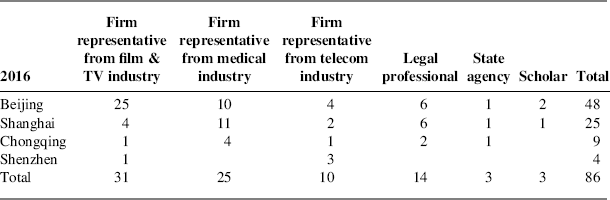
To collect information about how various social actors and various industries interact with the IPR system, during the six months of fieldwork in China, I relied mostly on semi-structured in-depth interviews based on snowball sampling.Footnote 57 A summary of interviewees can be seen in Table 1. Aside from interviews, I also relied on participant observation, mainly in IPR-related fora and seminars attended by scholars, state administrative agencies, legal professionals, and company representatives. To analyze the collected data, this study mainly uses comparative methods and within-case methods to gain insight into the research question.
2016 interviewee distribution

Although the risk of selection bias caused by accessibility issues is always present in qualitative studies,Footnote 58 there are a few strategies I used to reduce the risk. First, while there are many other interesting industries where IPR is expected to be relevant, the three cases I find access to are all commonly recognized as important and typical for studying IPR activities. Second, with respect to interviewee selection inside each industry, because my study focuses on industrial companies, the risk of systematic accessibility bias caused by factors such as political sensitivity of respondents is much lower compared to studies focusing on government agencies.Footnote 59 Besides, I tried my best to distribute interviewees with consideration of company location and company size, to make them more representative. In the end, being conscious of this problem, I refrain from choosing only those cases that conform to a pre-existing theory; I am also explicit about my case selection so that readers will be able to consider whether cherry-picking has occurred. These, to some extent, can limit the bias caused by cherry-picking.Footnote 60
Based on the data I collected, major augments are presented in the following sections.
4. ALTERNATIVE FUNCTIONS OF IPRs IN CHINA
The primary function of IPRs is traditionally seen as a way to enable the right-holder to appropriate returns from the commercialization or licensing of the invention or creation, by excluding others from exploiting it,Footnote 61 which is called appropriability.Footnote 62 For this function to work, protection against infringements is important for IP-holding companies. In China, some companies did accumulate IPRs with appropriability in mind.Footnote 63 Some recent studies suggest that, in many sectors, companies could use patents to serve other indirect functions,Footnote 64 like self-defence, blocking competitors, or building a strong negotiating position. Although these studies are based on Western society, similar functions are sometimes also used by Chinese companies I interviewed, especially those who want to compete in the international market.Footnote 65
These functions still more or less require excluding others from exploiting the IPs, namely relying on the intactness of appropriability,Footnote 66 but, in China, firms often use IPRs for more extended functions, which may not even require appropriability or legal protection per se. I call these functions, which are not dependent on protections of appropriability (thus not threatened by infringements), “alternative functions.” Analyzing these alternative functions helps me better understand why many IP-intensive companies in China do not push for better IP protection, possibly because they use IPRs for functions that are not affected by potential infringements, as discussed in the following.Footnote 67
4.1 Potential Alternative Functions
In China, the following three alternative functions of IPRs (i.e. alternatives to those that require legal enforcement) are identified by companies as the most relevant ones.
4.1.1 Securing Government Supports
With the Chinese state’s policy of emphasizing IPRs, there have also been many policies to encourage innovation.Footnote 68 In recent years, both the central and local governments in China have been providing all kinds of support, subsidies, rewards, and privileges to encourage innovation; at the same time, the qualification to get these benefits is, to a large extent, related to the number of IPRs. My interviews suggest that, in industries where the government has a considerable influence, and for companies that do not have many alternative resources, this is a very important element in decision-making with regard to IPR accumulation.
For example, companies certified as a “high-tech companies” can enjoy various tax preferences and administrative supportsFootnote 69; the certification requires a certain number of IPRs, usually measured by the number of patents. Also, because the number of IPRs generated by companies in a certain location has become a measure of local officials’ performance, different local governments provide various levels of subsidies to patent filings and rewards to patent grants. Besides, companies with patents or “high-tech” companies have a better chance to win all kinds of government procurement biddings because owning patents gives them extra points in the government’s scoring system.Footnote 70 IPR-holding companies or projects also get priority in applying for loans from banks.Footnote 71
Because IPRs can bring all these benefits, many companies, especially start-ups, and small and medium companies, have been enthusiastically applying for patents to get tax preferences, government subsidies, and rewards, or policy privileges. One interviewee from a local chemical drug company mentioned that about one-third of their patents are used to meet certain government qualifications.Footnote 72 Some companies may also divide one patent into dozens of patent parts, just to meet the patent volume criteria.Footnote 73 But, recently, with the growing number of overall patents, in response to the callout by the central government to promote innovation in a more practical way, local states are raising the criteria for subsidies; in many areas, utility models and design patents cannot bring subsidies to the company any longer; for invention patents, the subsidy amount is also starting to go down.Footnote 74 However, other types of government support are still significant.
4.1.2 For Publicity and to Attract Customers
Thanks to the recent efforts of the Chinese government and the media to publicize IPR in China,Footnote 75 IPR has been subject to a lot of attention, which generally attracts more media exposure and influences customers. This promotion effect is significant in China because all major news media are more or less controlled by the state; thus, the media tend to cater to the state’s propaganda for IPRs. First, the mention of the word “IP” itself can bring a lot of public attention; it has become an advertising tool commonly used on the Internet in present-day China.
For example, self-owned IPRs in the media have become a symbol of “high-tech” or “high-class” or “international.” A product promoted as “embedded with various patents” is more likely to impress Chinese customers when they are making purchasing decisions.Footnote 76 Some medical companies even claim that “I only apply for patents so that I can call my product a patented product.”Footnote 77 In the film & TV sector, as one interviewee said, when they pay for the adaptation rights of a novel, what they pay for is just the name of the work, which is a signal of popularity, and the news that they are going to adapt it; without the name and relevant publicity, even the same story would not bring such a big audience.Footnote 78 This is perhaps why recently the price of adaptation rights has become more and more expensive for these popular online novels.Footnote 79 To make use of this function of copyright, some film producers have even revised an original film script into an online novel in advance, and then “get” the adaptation right of that novel after it has accumulated a certain number of readers, to send potential customers a signal that the film has been adapted from a popular novel.Footnote 80 With “IPs” that signal such popularity, it is easier for a film to get more scheduled cinematic screenings, because the cinema managers would expect it to attract a bigger audience; it is also easier for a TV series to licence its right of broadcasting with such “IPs,” because television networks or websites expect it to bring them more clicks and page views.Footnote 81
4.1.3 As a Signal to Investors
Signalling is always an important consideration when a company makes decisions.Footnote 82 Research has already pointed out different types of signalling used to attract capital.Footnote 83 With regard to IPR, its role in attracting capital has already been studied in the West based on signalling theory.Footnote 84 In these studies, this function is mostly still based on the fact that the IPRs provide appropriability and suggest market potentials but, in China, my interviews suggest that it becomes more “form over substance” due to the following reasons.
First, most domestic investors in China lack experience and have a short time horizon; in this case, they need to rely on some straightforward measures such as IPs to guide their investments.Footnote 85 Many fund managers rely on some readily available indicators of likely investment performance in the short runFootnote 86; they treat the volume of “IPs” as one criterion that can indicate a quick investment return.Footnote 87 Second, state-owned funds have been influential in ChinaFootnote 88 and many state-owned funds do not really care about profits, but submit reasonable justification for their investmentsFootnote 89; the ownership of “IPs” can serve as such a justificationFootnote 90 and sometimes cover up the fact that they choose some projects due to personal relations or kickbacks.Footnote 91 Third, the expectation of IP-abundant projects to get state support and promotion advantage also gives investors more confidence in the project.
One representative from a medical-device company mentioned a composition patent to me; he said that this patent could not lead to profitable products in practice, but it still attracted many investments.Footnote 92 In the eyes of some interviewees, these companies are “tricking investors” with patentsFootnote 93; this may not be an objective judgment, but it indicates the fact that companies can use patents to attract investments.
4.2 Industry Comparison
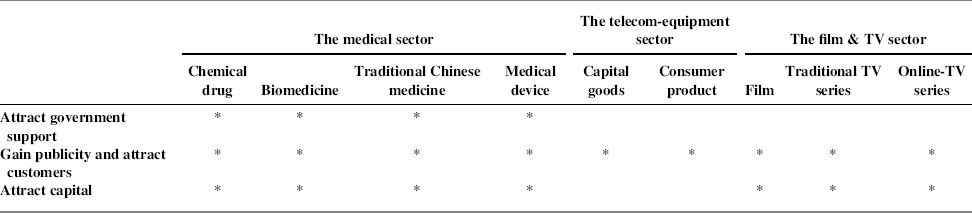
In general, the medical sector more frequently uses IPRs for alternative functions, while the telecom-equipment sector uses them less often (Table 2).
Industry comparison—functions of IPRs

Note: An asterisk indicates that the relevant phenomenon is manifest in that sector based on the interviews.
Specifically, the first alternative function—to attract government support—is important for all industries inside the medical sector, while it is marginal in the telecom-equipment and film & TV sectors. This function is important and useful in the medical sector because there are both a large supply and a massive demand related to the function. With regard to supply, the government does provide support to companies with a large number of patents. With respect to demand, in the medical sector, most companies are medium or small ones (i.e. there is a low concentration rate with a lack of large dominant companies)Footnote 94; they rely heavily on external funds, but their long R&D process makes it harder to get private external funds such as private venture capitals (VCs), so they need a lot of government support. In comparison, in the telecom-equipment sector, there are many large companies that make huge profits or can get support from the stock market, and rely less on government support. As for companies in the film & TV sector, it is very easy for them to get investments nowadays compared to other industries, presumably because of the short return period and the spotlight effect; in this case, they also have lower demand for government support.
The second alternative function of IPRs—to gain publicity and attract customers—is emphasized by many representatives I interviewed in all the industries in this study. The third alternative function of IPRs—to attract capital—is eventually derived from the second one (because usually people are more likely to invest in a project if they think it can attract customers and make a profit); it is prevalent except in the telecom-equipment sector. The exception of the telecom-equipment sector is perhaps due to both industry-level and company-specific characteristics. First, at the industry level, in the telecom-equipment sector, a significant amount of revenue usually goes to new product research that carries a high degree of uncertainty and risk, making it less attractive to outside investors, other things being equal. Second, at the company-specific level, companies in the telecom industry are comparatively less reliant on the external support; for example, the most dominant company in the Chinese telecom-equipment sector is famous for the leader’s insistence on not becoming a publicly listed company and investing in research with its own revenue.
5. GENERAL PATTERNS OF IP PROTECTION IN INDUSTRIES
The previous section discussed how Chinese companies use the IPR system when they do not have the need to ensure appropriability of their IPs. Now the question is, what about those who actually need to appropriate profits from the commercialization or licensing of the invention or creation, and exclude others from infringing upon it? Are they threatened by infringement in China? How have they kept IPRs protected? Are the patterns different or similar among industries?
Many previous studies of Chinese IP rights enforcement focus on formal IP protections carried out by state agencies.Footnote 95 However, according to my fieldwork, we need to combine both the state, or formal, aspect as well as the company, or informal, aspect to understand the Chinese IPR environment. Whether a company can protect its IPRs from being infringed depends on two factors: first, is the formal legal protection effective or not for its IPRs and, second, are there any alternative protections available, and how do they take effect? I will illustrate both in the following.
5.1 When Can Companies Use Courts to Protect IPs?
While the codification of the Chinese IPR law is well developed, there are many limits, caused by a general lack of an IPR legal tradition, immature supporting institutions, as well as inexperienced IP-related professionals. Specifically, although the IPR laws and judicial enforcement structures are the same for all industries, two conditions can vary and affect the effectiveness of formal or legal protection in a particular industry.
5.1.1 Legal Definition Related to IPRs
According to standard definitions, a product or process is referred to as being “of complex technology” when it comprises numerous patentable elements; this contrasts with a product or process that is referred to as being “of discrete technology” when it comprises relatively few patentable elements. For an IPR to be operational, it should effectively define rights over a specific product or category of products,Footnote 96 and be difficult to bypass or invent around.Footnote 97 Under the current Chinese IPR system, products of complex technologies, compared to those of discrete technologies, are less likely to meet these conditions.Footnote 98
For example, electronic products like cellphones are complex-technology products, because one cellphone comprises many patentable elements; chemical drugs are discrete-technology products because one drug comprises only one patentable compound. Most copyright products can be considered “complex,” because usually a copyrighted work includes various components; for example, a novel or a script includes words, scenes, plots, character settings, writing techniques, and themes. For a complex technology, such as telephone patents, one single IPR would not be able to define rights over a specific product; this can create ambiguity in right claims and make it easy to be invented around.Footnote 99 In comparison, in the case of discrete technology, such as a drug-compound patent, one IPR can effectively define rights over a specific product or category of products.
In a more mature IPR system, various customary rules or experiences may develop to reduce the inequality produced by the technical nature of the products or processes. But, in present-day China, sometimes even IPR judges feel that there is no explicit rule to follow in declaring infringement involving discrete-technology products.Footnote 100 In this case, companies are more likely to accumulate IPRs for other functions instead of direct appropriation, or to resort to alternative protections.
5.1.2 Complementary Law Enforcement
A clear right-claim or infringement definition is only one condition and is not sufficient for legal IP protection to be effective. Another condition is effective IPR law enforcement, where the infringing behaviour can be identified and stopped through a formal procedure (either judicial or administrative) with a reasonable cost.Footnote 101 Here, a major difference exists between product innovations (where patents cover the product itself, e.g. a drug-substance patent covering the chemical composition of the active ingredient) and process innovations (where patents cover manufacturing methods). Because processes are less visible to outside scrutiny after production compared to products, process infringements are more difficult to detect by right-holders alone. In this case, when there is no third-party help to detect these hidden infringements, it is very difficult for the right-holder to prove them in court.
For example, in the medical sector, compound patents usually can be effectively enforced through the courts; as a product patent of a discrete technology, a compound patent is clearly defined by a chemical structure, and covers a single product (where financial benefits brought by the patent can be easily determined from sales data of that product). In comparison, in the telecom-equipment sector, although infringement of standard-essential patents can be clearly defined and proved, since a telecom product can comprise thousands of patents, it is usually hard to determine how much one patent accounts for in the final sales price (unless some meticulous calculation system is well developed), and so it is hard to decide on relevant compensation rates. In fact, many company representatives, scientists, and lawyers told me that process patents are “not useful” in appropriability protection due to the difficulty of identifying and proving infringement.Footnote 102
When legal definitions are not clear, or when complementary legal enforcement, through either judicial or administrative institutions, is difficult, legal IP protection is ineffective. However, if there are alternative protection methods, a company is not necessarily threatened by infringements. This issue is explored next.
5.2 Alternative Protection Mechanisms
Aside from legal enforcement, there are other mechanisms that can alleviate the threat of infringement, usually by making infringing behaviour unprofitable. This can be achieved either by reducing infringing benefits, such as distinguishing the original product from infringing products through complementary sales (i.e. bundling), or through increasing the cost of infringement, such as potential punishment from various syndicates and organizations.Footnote 103 A large amount of company strategy literature has discussed alternative methods that Western companies use to protect themselves from competition from imitators or infringers.Footnote 104 These studies have treated alternative protection mechanisms as a strategic choice for companies; however, I found that, in China, such alternative mechanisms usually take effect without action from companies that intentionally targets IP protection. This situation creates an interesting phenomenon: while legal IP protection is criticized a lot for being inadequate, many IPR-intensive companies do not complain about the general IPR environment, and do not worry about infringement.
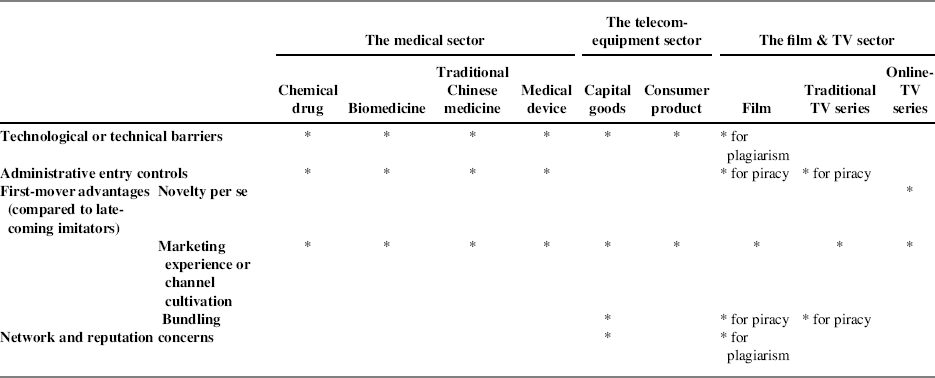
To make sense of this phenomenon, I discuss four major alternatives used by companies (briefly summarized in Table 3): (1) market-access control; (2) first-mover advantage; (3) technological or technical barrier; and (4) reputation concern. As will be elaborated, the significance of each specific alternative enforcement mechanism is shaped by industrial characteristics, especially in four aspects: (1) administrative regulation; (2) market characteristics; (3) technological and product characteristics; and (4) network structure.
5.2.1 Market Access Control
Here, “market-access control” means control exerted by administrative agencies in the government. For certain industries, the government has established special institutions to control the market entry. Even though the control is not based on IPR laws, but mainly product regulations, sometimes it can serve as a barrier to block potential imitators or infringers, giving the IPR-holder a semi-monopolistic advantage. This mechanism has been ignored by most corporate strategy literature about IP protection because it is not a “strategy” adopted by companies, but a policy context that companies need to cope with. However, according to my field study, this could be a very powerful mechanism to curb IPR infringement.
The mechanism of administrative market-entry control is emphasized in industries where there is strict administrative control regarding the examination of the relevant products and regarding the monitoring of distribution channels. Specifically, this mechanism is manifest in all industries in the medical sector, as well as in the film industry and the traditional TV industry (in the film & TV sector).
The distribution of this mechanism makes sense when we know that all drugs must get approval from the China Food and Drug Administration (CFDA) before going to market, and that the distribution of medical products is mainly through state-owned hospitals. Similarly, all films and traditional scripted television series need to get through censorship review from the State Administration of Press, Publication, Radio, Film, and Television before being broadcast and the distribution is mainly through the state-owned cinema chains or state-owned TV networks. In this case, infringing drugs and infringing film and TV products without approval certificates cannot get into the market through these official channels (but plagiarizing products are not affected, because it is not apparent to administrative agencies whether a product is illegally plagiarizing). In comparison, this mechanism was not emphasized by my interview subjects in the telecom-equipment sector or in the online-TV industry (in the film & TV sector), where pre-market examination is not strict; furthermore, in these industries, a large part of product distribution is through the Internet (or e-commerce), which is less strictly controlled by the government.
5.2.2 First-Mover Advantage
The Western literature points out that complementary capabilities or resources can be strategically used by leading companies to keep imitators and infringers at bay.Footnote 105 In China, while companies do not always intentionally explore these capabilities to ensure IP appropriation, a few market characteristics can help the first mover to develop advantages and hinder imitators; these characteristics include a taste for novelty, the importance of marketing experience and channel cultivation, as well as the relevance of bundling.
First, in some cases, the market has a taste for novelty; thus, imitators would not attract many consumers even if they got into the market. For example, the newly developed online-TV industry is directed overwhelmingly at youth audiences, who prioritize novelty and “keeping up with trends” in choosing what to watch. In this case, while scripted series with novel elements can attract a lot of Internet audience attention, it is hard for similar latecomers to attract an equivalent number of clicks. This is part of the reason why there is less plagiarism in the online-TV industry compared to the traditional TV industry, where novel elements and clicks are not the crucial factors to be considered, and the market is tolerant of repeated content.Footnote 106 This factor is less evident in other industries under study, but may still have some effect in some niche markets where target customers are overwhelmingly young people.
Second, when the distribution channel in the market is highly concentrated, it is very hard for imitators to enter the market after the original product has established connections with channel providers. For example, most drug producers need to cultivate relationships with their primary market channel, namely hospitals, through the activity of sales representatives. For a particular kind of drug, one hospital usually only purchases from one or two producers; once one producer has built connections with hospitals and taken up one position in their purchase catalogue, it would be very hard for subsequent imitators to get in.Footnote 107 The importance of marketing experience or channel cultivation is manifest in all industries under study. Almost all representatives from innovative companies I interviewed emphasized their advantages in marketing and channel cultivation in blocking latecomers, including infringers. This reliance on marketing and channel cultivation to some extent reveals the fact that products in the Chinese market in these industries cannot be adequately distinguished through the technological level and quality.
Third, bundling can also be useful in hindering imitators, when the original producers can provide complementary utilities that are important to consumers and that cannot be duplicated by imitators. In certain markets, the product itself requires bundling to become useful to consumers. This mechanism is most manifest in the consumer-product industry in the telecom-equipment sector, and in the film & TV sector regarding hindering piracy. For example, in the capital-goods market in the telecom-equipment sector, buyers need the bundling of technical services, such as one-on-one technical help in setting up the equipment such as a base station; with more experience in problem-solving and customer service, the first mover can provide better services bundles than a copying producer.Footnote 108 In the film industry and the traditional TV industry, cinemas can provide bundles such as food and beverages,Footnote 109 posters, and space for face-to-face social interactions, while TV viewing provides the atmosphere of a family get-together.
5.2.3 Technological or Technical Barrier
The time and resources required to develop production capabilities can serve to forestall infringers. First, the more complex the technology or accompanying know-how is, the more difficult it is for a potential imitator to copy it based on patent description alone; in this case, a longer time would be needed to develop the capability of replicating the original product, or at least not with the same quality. For example, when the author asked Chinese company representatives why they were not worried about IPR infringements, many mentioned that, even if competitors knew about the idea and the related principle, they would not have the capacity to copy it; this is due to the lack of certain level of technical precision,Footnote 110 processing craft,Footnote 111 and production-environment control,Footnote 112 among others. Second, the more rapidly technology changes, the harder it is for imitators to catch up before the product becomes obsolete in the market. For example, in the smartphone industry, since entering the 4G era, companies usually do not worry about scattered copycats as much as before, because they know that the small factories do not have the technical capacity to produce 4G smartphones.Footnote 113 One interviewee mentioned that they do not worry about infringements because they are continually updating their techniques, and imitators do not have enough time to master the process and compete with them.Footnote 114
The effectiveness of technological or technical barriers as a mechanism to prevent imitators is manifest in all industries in the medical- and the telecom-equipment sectors, as well as in the film industry within the film & TV sector. This is because production in both the medical and the telecom-equipment sectors is highly technological and requires a lot of know-how, while film production has a high expertise requirement. In comparison, there is not much of a technical barrier in scripted series production, in the sense that it has a comparatively lower expertise requirement; this is indicated by the fact that there are many scripted series producers and scriptwriters who do not have professional degrees.
5.2.4 Reputation Concern
Sociologists since Simmel have emphasized the significance of trust in economic transactionsFootnote 115; game theorists have further analyzed the role of reputation in repeated games. However, the factor related to networks and reputations has always been neglected in previous IPR literature. In fact, the author found it very prominent in China; its importance mainly comes from the incentive of different parties to reduce transaction costs through personal connections. In some industries in China, the necessity for multilateral co-operation produces the incentive to use reputation information to minimize transaction costs, while close-knit network structure makes reputation information available and reliable; in combination, those two features make reputation a significant factor. In this case, the pressure to maintain a good reputation may serve to prevent IPR infringement; the more frequent multilateral co-operation is, and the more close-knit the network is, the more significant this mechanism is.
A typical example is related to plagiarism in the Chinese film industry. First, the production of a film requires co-operation among various parties, including scriptwriters, directors, actors, and production studios; these may not always belong to the same organizations. With the increasing cost of film production, in present-day China, a film with a high budget usually requires the co-investment of multiple companies. The necessity for both internal and external co-operation imposes an enormous cost for companies to search for co-operators; thus, they tend to rely on networks to get reputation information to reduce information impactedness and the uncertainty brought about by it.Footnote 116 Second, according to reports and my interviews with film directors, producers, and scriptwriters, the film industry in China has a close-knit network where most company leaders know each other, and most directors are alumni of the same film schools.Footnote 117 In this case, many film producers pay extra attention not to be labelled as “infringers,” or else it may give them disadvantages in seeking external co-operation in the future.
Overall, this mechanism is most effective in the capital-goods industry within the telecom-equipment sector and the film industry within the film & TV sector, because both are characterized by frequent multilateral co-operation (e.g. co-investment or shared R&D in next-generation technology) and a relatively close-knit network (which is possibly due to the high level of expertise and technological requirements). In comparison, in principle, companies in the medical sector usually do not co-operate with other companies in developing new drugs; moreover, due to the large number of medical companies in China and their small size, the industry circle is quite extensive. The consumer-product industry in the telecom-equipment sector also has many medium and small participants, possibly because its lower-end market has a low technological requirement. Similarly, due to the relatively low level of expertise required, the industry circles of the traditional and online-TV industries are also quite extensive, making this mechanism less effective.
Industry comparison—alternative protection mechanisms

Note: An asterisk indicates that the relevant phenomenon is manifest in that sector based on the interviews.
6. CONCLUSION
6.1 The Complex Interaction between Industrial Practices and IPRs
In this article, I discussed the alternative functions of IPs in China, the factors that affect legal-enforcement effectiveness, and alternative protection mechanisms available to companies, which are shaped by industry characteristics. Based on my findings, economic development and accompanied accumulation of IPs do not automatically lead to local incentives to push for a stronger legal IP-protection system. In the discussion of the IPR system, we should not presume an oversimplified and linear relationship between local innovation and IP-protection needs, but to keep in mind the specific interaction and intermediating mechanisms between industrial practices and the IPR system.
Overall, it is true that, in China, IP assets owned by local companies have been rapidly growing, and local companies invest a lot in IPRs with industrial growth, but these companies do not necessarily worry about infringements or have adequate motivation to push for stronger IP protection. This is for two reasons. First, local companies may invest in IPRs not necessarily for their function of appropriation or exclusion, but for some other function that would not be harmed by infringements, such as attracting government support and gaining publicity. Second, even if local companies in specific industries want to ensure the exclusion function of IPRs, many alternative mechanisms can be used by them to block infringers and stay “monopolistic”; this has reduced the significance and indispensability of legal IP protection, as well as the motivation to push for changes in formal institutions.
According to many development studies of IPR, the historical experience of developed countries suggests that, with industrial growth and increasing local innovation, local companies with growing portfolios of IPRs will seek protection against infringers under local IPR laws; under this hypothesis, IP enforcement will eventually improve in developing countries.Footnote 118 For example, in his study of China, Peng suggests the following pattern: “as these economies developed, indigenous industries grew, and IP protection was enhanced.”Footnote 119 Massey claims that, in the long run, in an increasingly competitive and unified Chinese market, new interests are growing and that these interests will look to the rules laid down by the “emperor” in Beijing for protection to keep the pirates far away.Footnote 120
However, this type of unilinear evolutionary argument, which basically considers industrialized nations as the unquestionable models for developing countries, has been criticized a lot as Eurocentric in more general development studies; these argue that developmental paths are historically contingent.Footnote 121 In development studies of other economic institutions, it has been acknowledged that, in many cases, Western institutions do not work in developing countries as in developed countries, because the political, economic, and social conditions there are different, or there is a lack of complementary institutions.
My findings resonate with this line of development literature. What I found is that, as many other development studies about economic reforms already reveal, the Western model is not the only one that could work in developing contexts. With regard to IP protection, in China, the effectiveness of the Western-originated formal IPR institution is limited without complementary institutions, including, for example, civil procedure related to evidence discovery, corporate management systems, and relevant accounting standards; this fact makes local alternative protection mechanisms a more common choice than the formal IPR laws in the industries I studied.
Small start-up companies have fewer alternative resources and benefit less from alternative IP-protection mechanisms; in this case, they may have a strong desire for a stronger legal-protection mechanism. However, these small start-up companies are also the ones who have little influence on government action compared to large companies. This has created a dilemma: those that can affect policy do not have enough incentive because they can benefit from alternative protection methods, while those that have enough incentive cannot (or dare not) influence policy and law. This is the reason why it may be unrealistic to assume that local-industry growth and IP-asset growth naturally lead to a push for stronger formal IP protection; the incentive to lobby for formal changes is shaped by the alternative use of IPRs and the existence of alternative protection mechanisms, which are themselves determined by various aspects of industrial characteristics.
What needs to be noted is that the lack of incentives to push for legal changes does not mean that industrial companies do not seek to affect the government at all. Most companies, no matter the size, emphasize “guanxi” (connection) with political authorities; they tend to rely on personal connections with local governments to benefit in specific issues, instead of influencing national policies. For example, most medical companies never considered changing national policies but, because local governments to a large extent determine market entry and the distribution of drugs and medical devices, medical companies indicate that, to do well in business in China, one needs a good “guanxi” with the government.Footnote 122 This type of private connection, although allowing industrial companies to influence the government, may have less to do with changes in the formal legal system in general.Footnote 123
6.2 IPR and the Sociology of Law
In the sociology of law literature, it has been shown that, even in legalistic societies, the vast majority of conflicts are handled without going to court, and alternatives to law are growing.Footnote 124 There are surveys indicating that Americans turn to the legal system only as a last resort,Footnote 125 perhaps due to the existence of legal costs. In a society like China, where the current legal IP-protection institution was transplanted from the West only recently, alternative mechanisms developed in local society may play an even more important role, making the formal protection mechanisms less relevant.
One relevant tradition in the sociology of law studies alternative dispute resolution (ADR) mechanisms, which play a vital role in complementing the formal court system in all countries.Footnote 126 Most studies of ADR overwhelmingly focus on pre-trial negotiation, mediation, and arbitration,Footnote 127 possibly because they are comparatively more formalized (more related to the legal institutions) and more commonly noticed. As a result, although claiming to step outside the traditional rule-of-law perspective focusing on litigation, many ADR studies actually still discuss the problem inside the legal system; the premise of the most discussed alternatives (negotiation, arbitration, and mediation) is the existence of an officially filed dispute, and these alternatives are still guided or mandated by official legal institutions.Footnote 128 However, different social orders are hospitable to different procedures for dispute resolutions and inimical to others.Footnote 129 Outside the context of Western society, other mechanisms, although less noticed than ADR, might be more influential.
In specific areas of law, alternatives to law have been discussed more thoroughly, and less formal arrangements have been studied. One area that has had a lot of discussions is contract law: many studies have examined how people cope with the problem of uncertainty in contracts in a society where the legal framework is non-existent or poorly developed. Studies of contract enforcement in different societies point out alternative coping strategies such as personal relations and social norms,Footnote 130 reliance on reputational consequences,Footnote 131 and ethics.Footnote 132 With regard to the contract system in China, Landa points out that alternatives such as the cultivation of personal relations are used to cope with contract uncertainty in the Chinese environment where contract law is poorly developedFootnote 133; Standifird and Marshall argue that guanxi-based exchange is a significant alternative to contract law.Footnote 134
Resonating with these studies of specific areas of law, the present study on IPR in China expands the scope of alternatives to law, and reveals that, in developing societies such as China, alternatives to law not only include those used in addressing disputes, but also those used in preventing harm (i.e. infringement in the IPR context); these include technological or technical barriers, administrative controls, first-mover advantages based on certain market characteristics and resources, as well as reputational pressures formed through specific social-network structures. These alternatives to legal enforcement are manifested in Chinese industries due to the specific social and industrial characteristics in China, including the immaturity of the legal system, the strictness of administrative market-access controls, the market characteristics accentuating marketing and channel cultivation, and the existence of close-knit networks in certain industries.
6.3 Policy Suggestions and Future Research
Previous analyses could provide insight into how to improve IPR-related institutions in developing countries like China. It seems that an improvement in the text of the law and in the court system is not enough. To improve IP protection, the state may also need to pay attention to both supporting institutions and the alternatives to law, and try to co-ordinate legal institutions with such alternative mechanisms.
Regarding how foreign pressure on IPR enforcement works in China, many previous studies have discussed this issue from various viewpoints and suggested many ways for foreign countries to influence the Chinese IPR system. For example, as mentioned in Section 2, Mertha points out that top-down external pressure in the form of confrontational negotiations may have an immediate impact on the formal legislation but may be less effective in promoting effective and sustained enforcementFootnote 135; lateral pressureFootnote 136 between foreign actors and local Chinese enforcement agencies may have little impact on the national legislation, but it is crucial in establishing effective enforcement by facilitating local inter-bureaucratic competition.
From this study, it has become apparent that the improvement of IPR enforcement is not just about formal enforcement (both administrative and in the courts). Although top-down national pressure may lose momentum in specific industrial or local contexts, lateral pressure focusing on private connections with the government may also not do much good to institutional improvements to IPR enforcement. Foreign companies who want better IP protections should not only focus on pushing the government for IPR-related policies or legal changes, but also pay attention to other relevant aspects. They need to understand how the weaknesses in the complementary institutions constrain legal institutions. In addition, it may also be beneficial for foreign companies in China to make use of alternative protection methods in the current context, including, for example, channel developing and bundling.
This research builds a framework for understanding the interaction between specific industries and the IPR institution in China; I studied the medical sector, the telecom-equipment sector, and the film & TV sector in China. A lot of follow-up research based on this framework can be done. For example, more industry participants in each sector can be interviewed to make the sample more representative, or more sectors can be explored. In such a case, there are more details that can be brought out to confirm or expand the framework. Comparative studies may also be valuable after a corresponding field study of Western IPR institutions.