Introduction
What we in the United States now call the Southwest has had a Hispanic presence for more than 400 years. Only in the early twentieth century, however, did it become a truly Mexican American region. Before 1848, indigenous peoples dominated this vast area. After the war between the United States and Mexico, greater security led to a modest expansion of the Hispanic population. Mass immigration between 1900 and 1930 then created a Mexican American Southwest. Migration has continued to shape the history of this region and this ethnic group. Large flows from Mexico in the 1920s provoked a sharp, racialized nativism and the economic crisis of the 1930s led to a substantial reverse migration. The 1940s brought renewed population growth, as well as extraordinary economic achievement for the native born of Mexican origin. That decade also witnessed a unique challenge to an emerging ethnic community, an explosion of illegal immigration and deportation, reigniting a debate over Mexican immigration that is yet to be concluded.
This immigrant-driven story emerges from evidence rarely used in Mexican American history, found in representative data from samples of the United States censuses (Gratton and Gutmann Reference Gratton and Gutmann2000; Ruggles et al. Reference Ruggles, Trent Alexander, Genadek, Goeken, Schroeder and Sobek2010a).Footnote 1 This evidence reveals that the history of persons of Mexican origin, largely framed by historians through themes of colonization and economic exploitation, with racism driving the narrative, is first and foremost a story of immigration, one much like that of other groups who have come to the United States.
The Mid-Nineteenth Century
The historiography of the Southwest (defined here as Arizona, California, Colorado, New Mexico, and Texas), while detailed in its portrayal of early Hispanic settlements, and attentive at times to immigration, has yet to fully convey the transformative impact of Mexican immigration in the early twentieth century. What appears in the literature to be a progressive expansion from a colonial Spanish past to a fully realized present began instead as tentative imperial extensions followed by sharp contractions in Spanish-controlled territory, due to the military prowess of indigenous polities. Accounts of Hispanic settlements before 1848 do reveal long residence in Northern New Mexico and South Texas. Still, in most parts of the Southwest, there were no Hispanics, and in others, such as in California and Arizona, settlements were vanishingly small. Census data reveal these characteristics of the Southwest in the mid-nineteenth century, after the establishment of an independent Mexico in 1821 and that nation's loss of its northern provinces in the Mexican-American War. Birthplace, language, and surname variables permit the identification of persons of Mexican origin from 1850 forward, providing representative evidence for this population across all areas of the Southwest.
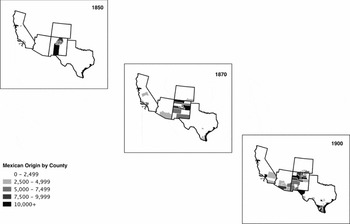
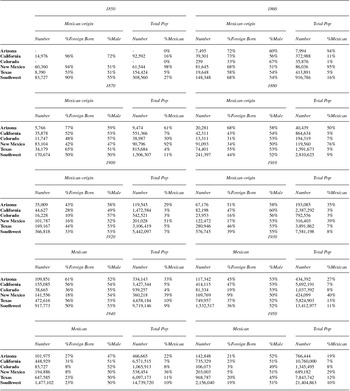
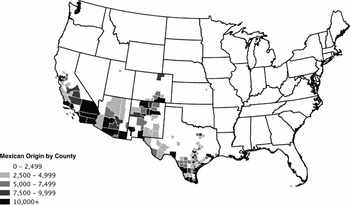
As maps generated from these data show (Figures 1a–c), the vast region that became the American Southwest was largely empty of Hispanic settlers in the mid-nineteenth century, with the scarce population concentrated in isolated districts. The first US Census taken in the area, in 1850, reveals a Mexican-origin population in these five states and territories of only 83,727 persons, yielding a population density of less than 0.12 persons per square mile (see table 1 for estimates of Mexican-origin and total population in the Southwest, 1850–1950). Indigenous persons were rarely counted in the census. Enumerators did not register “Indians not taxed,” so the size of often still nomadic indigenous groups cannot be estimated with satisfactory accuracy. Ubelaker argues that, despite centuries of decline, the indigenous population exceeded 200,000 in 1850, more than twice the number of Hispanics (Ubelaker Reference Ubelaker, Verano and Ubelaker1992).Footnote 2
Mexican Origin by County

Mexican-origin and total population of the US Southwest by state, 1850–1950.

Source: Ruggles et al. Reference Ruggles, Trent Alexander, Genadek, Goeken, Schroeder and Sobek2010a.
Thus table 1 and these maps depict population levels primarily for nonindigenous inhabitants. The maps shade counties with at least 2,500 persons of Mexican origin; the large county areas in early censuses exaggerate substantially the geographic scope of settlement. It was unregistered indigenous groups, empty space, and isolated pockets of Hispanic populations that American forces encountered in the northern campaigns of the Mexican-American War, despite 250 years of effort by both Spanish and Mexican governments to populate and govern an area they claimed in their imperial and national maps (Nostrand Reference Nostrand1992).Footnote 3
Before that war, beleaguered by powerful indigenous polities, Hispanics maintained large settlements, and these precariously, only in northern New Mexico and southern Texas, with smaller populations on the coast of California and in what became southern Arizona after the Gadsden Purchase of 1854. The explanation for the failure of demographic and geographic purchase in the region lies in the capacity of indigenous groups to restrain, even to reverse, Hispanic colonization. This is the vital lesson in a brilliant new literature on the Southwest, as seen in the work of Ned Blackhawk, Brian DeLay, Pekka Hämäläinen, Peter Brooks, and other historians (Blackhawk Reference Blackhawk2008; Brooks Reference Brooks2002; DeLay Reference DeLay2008; Gratton et al. Reference Gratton, Reid, Jacoby, Tutino, John and Hämäläinen2013; Hämäläinen Reference Hämäläinen2009). The stories they tell, of cycles of theft, violence, and enslavement, expose the roots of the demographic and geographic failure of Spanish and Mexican regimes.
In contrast, as table 1 indicates, the Mexican-origin population grew under American jurisdiction. By 1900, the population was 50 percent larger than it had been in 1880. What had changed? In the wake of the Mexican-American War, though interrupted by the Civil War, the military and bureaucratic authority of the United States opened the region to settlement. By waging effective war against indigenous groups, forcing them onto reservations, and expropriating their territory and resources, the US government removed the core impediment to nonindigenous settlement. While Americans had no affection for the Hispanic population, official policy treated those of Mexican origin—who were guaranteed American citizenship under the provisions of the Treaty of Guadalupe Hidalgo—very differently than it treated the indigenous population. US rule thus provided the first sustained period of physical security for Hispanics since the original Spanish entrada in the sixteenth century. Nearly all of the demographic increase occurred through reproduction in the resident population rather than through immigration. In 1880 and 1900, only about a quarter of the Mexican-origin population born after 1848 had been born in Mexico. Despite the growth of the population, the Hispanic community's geographical expansion was modest, remaining largely within the highly circumscribed boundaries of the pre-1848 period (Haverluk Reference Haverluk1997), although there are geographical advances into southern Colorado, central Arizona, and previously unsettled parts of New Mexico and Texas.
An extensive literature demonstrates the expropriation of the land and resources of many persons of Mexican origin in the late nineteenth century, and reveals a decline in their political and civic power in most regions (de León Reference de León1982; Gomez Reference Gomez2007; Gutiérrez Reference Gutiérrez1995; Montejano Reference Montejano1987; Weber Reference Weber1973 summarize this body of work). Nonetheless, census data suggest that American jurisdiction also enhanced their physical security, fostered unprecedented population growth, and permitted a limited geographical extension into areas not settled before 1848.
Despite this demographic and geographic expansion, the period between 1850 and 1900 also witnessed migration of non-Hispanics into the Southwest, drawn by the same security and economic opportunity. This process had already occurred in Texas, where non-Hispanic whites and African Americans outnumbered Mexican-origin residents even before independence in 1836. In the region as a whole, having once been almost the only nonindigenous settlers, persons of Mexican origin made up only 7 percent of the total population in 1900. Table 1 shows the rising domination of non-Hispanics. As many accounts of southwestern subregions have shown, late-nineteenth-century investment in railroads, mines, and commercial agriculture enriched the area, but at the cost of the status of native Hispanics (Montejano Reference Montejano1987).Footnote 4 Only in New Mexico was decline checked, with Hispanics remaining a majority until 1900, largely because economic development was slowest there, and the territory attracted fewer non-Hispanic migrants.
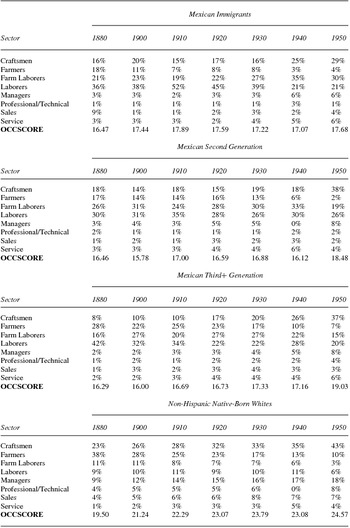
In the new, capitalist regime, persons of Mexican origin had relatively low socioeconomic status. Nineteenth- and early-twentieth-century censuses offer few means by which to accurately assess economic circumstances. However, census variables can be used to construct a consistent occupational score based on the relative wages of different occupations (Ruggles et al. Reference Ruggles, Trent Alexander, Genadek, Goeken, Schroeder and Sobek2010b).Footnote 5 Table 2, for male workers aged 20 to 64, provides these scores and the proportional distribution of Mexican-origin and non-Hispanic native-born whites in various occupations, from 1880 to 1950. In 1880 and 1900, when workers of Mexican origin were largely in the second or third generation, their occupational scores were 15 to 25 percent lower than those of non-Hispanics. Indeed their comparative position fell across these two decades. The source of low occupational status, and accompanying low incomes, is fully apparent: about 60 percent of all Mexican-origin workers were farm laborers or laborers (the latter category including semiskilled railroad, factory, or mine workers), versus about 20 percent in the laboring category among non-Hispanics.
Occupational distribution and scores, Mexican-origin and non-Hispanic native-born white males, 1880–1950.

Source: Ruggles et al. Reference Ruggles, Trent Alexander, Genadek, Goeken, Schroeder and Sobek2010a.
The Great Immigration: 1900 to 1930
After 1900, Mexican immigration sharply increased the Hispanic population of the Southwest and vastly expanded its geographic range of settlement: it was Mexican immigrants who created a Southwest broadly identified with persons of Mexican origin. The Porfirio Díaz dictatorship (1876–1911) in Mexico had promoted rapid economic modernization and industrial, agricultural, and transportation enterprises that, once developed, made “emigration. . . a part of Mexican life” (González and Fernandez Reference González and Fernandez2002: 43). Population growth in Mexico abetted the migratory impulse (Bergad and Klein Reference Bergad and Klein2010). Life expectancy rose modestly in the late nineteenth century while birth rates remained at very high levels. Mexican workers first moved to northern states of that country, where wages were substantially higher than in central Mexico, and many then crossed the border into the United States.Footnote 6
Intense demand for Mexican workers in the United States emerged at the same moment, concordant with economic expansion in the Southwest and with the decline in immigration from Europe, a decline that began with World War I and was hastened by restrictionist legislation in the 1920s. As Secretary of Labor James J. Davis argued in 1924: “The greater the restriction against Europe the greater will be the number of Mexican and Canadian admissions. . . . If a demand exists for common labor and that labor is not permitted to come in from Europe, the employers of labor are going to look toward Mexico and Canada as a source of supply” (US Congress 1924, 65, pt. 7: 6476). Mexico became the answer to deficiencies of supply in the Southwest, and extreme differences in wages across the border brought supply to demand. Mexican enterprises were closely linked to American ones (Cardoso Reference Cardoso1980; Meyers Reference Meyers1994; Mora-Torres Reference Mora-Torres2001; Sanchez Reference Sanchez1993) and international labor market mechanisms quickly appeared. Mexican workers, quite knowledgeable about the different opportunities offered by distinct locales, took advantage of them (Peck Reference Peck2000). A young Mexican contemplating his future quickly came to realize what these differences could mean. Victor Clark calculated cross-border wage differentials in 1907 as in excess of 2 to 1 for railroad section work, cotton picking, and mining, rising to 3 to 1 farther north in the United States from the frontier, increasing still further when compared to wages in central Mexico, from which most migrants came (Clark Reference Clark1908). For the first decade of the twentieth century, Lawrence Cardoso estimates a wage differential between 3 and 13 to 1 (Cardoso Reference Cardoso1980). Manuel Gamio's study in the 1920s finds no differences in cost of living between the countries, and wages 3 to 10 times higher in the United States (1969). Thus, emigration promised an immediate and striking upward economic mobility, and Mexican workers eagerly made that choice.
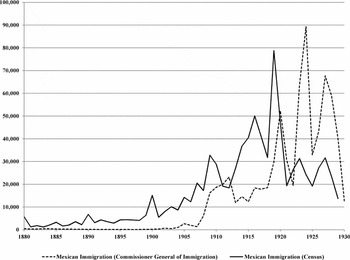
These economic conditions provoked sharp increases in emigration, and the Mexican Revolution added to the stream between 1910 and 1920. In the nineteenth century, though individuals casually crossed an unmarked border, more permanent entry was rare; census data indicate fewer than 5,000 immigrants from Mexico per year before 1900. The annual rate of arrivals clearly rose after that date, though its exact level is difficult to determine. Figure 2 provides two measures. The first is based on the year of arrival reported by Mexican immigrants in the 1900 to 1930 censuses. The second counts arrivals at US ports of entry, as reported by the commissioner general of immigration.Footnote 7 Each measure has its faults. While the census data include undocumented immigrants, they underestimate annual rates and disproportionately represent both those with the most tenure and those with the least, because they fail to capture immigrants who entered and left between censuses. Moreover, many immigrants arrived more than once, but could report only one year of entry. Immigrants tended to report years ending in 10, a phenomenon similar to age heaping, well-known to demographers, in which respondents frequently round their age to a figure ending in 5 or 10. The chief failing of the commissioner general's data is that they only report border crossing for those who passed through official ports of entry, missing all undocumented entrants.
Trends in Mexican Immigration, 1880–1930

While immigration from Mexico was limited neither by the stringent quotas applied to European immigration after 1921 nor by the outright exclusion faced by would-be Asian immigrants, border crossing became more tightly regulated in the first decades of the twentieth century. Requirements for entry rose, in the form of visas, fees, literacy tests, and medical inspections. Some scholars think these regulations marked immigrants from Mexico as aliens whose entry was to be restricted and who, if they did cross the border, were not to be allowed to remain (Fairchild Reference Fairchild2003; Ngai Reference Ngai2003; Stern Reference Stern1999). Examining the El Paso port of entry, Alexandra Minna Stern concludes, “Entry into the United States had become a highly medicalized conversion. . . [that] racialized, counted, and often excluded entrants” (1999: 72). Perhaps so, but attention to these regulations constitutes a distinction without much of a difference; border procedures did not lead to high rejection rates, and Mexicans enjoyed access to the United States that was denied to most other national groups after 1921. While there is no evidence that new procedures reduced immigration, they did make undocumented immigration more attractive, as contemporary observers remarked. US entry records indicate about 500,000 Mexicans entered in the 1920s; more accurate Mexican government data found more than that number had returned (Alanis Enciso Reference Alanis and Saúl2007), attesting to considerable undocumented entry. Louis Bloch estimated that 200,000 illegal Mexican immigrants arrived between 1901 and 1920 (in his view exceeding the number of legal entries), and suggests that still larger numbers came in the 1920s (Bloch Reference Bloch1929).
World War I also brought to the theater of migration a powerful actor. Southwestern commercial farmers used the war's purported effect on their Mexican labor supply (and their power in Congress) to convince the secretary of labor to void the 1917 Immigration Act's literacy, contract labor, and head tax provisions, each of which might reduce their access to Mexican workers (Kiser Reference Kiser1974; Reisler Reference Reisler1976; Scruggs Reference Scruggs1960; Weber Reference Weber2013). On May 4, 1917, less than a month after the United States declared war and one day before the Immigration Act's provisions would go into effect, the chairman of the Arizona “Council of Defense,” speaking for the Phoenix area Chamber of Commerce and cotton growers, informed the secretary of labor of the “very serious shortage of agricultural labor” in the Salt River Valley, and of farmers' desperate need for “laborers from old Mexico” (Arizona Republican 1917, 1918, 1920; New York Times 1917, 1918). Pressed by commercial farming interests across the Southwest, Secretary W. B. Wilson suspended the provisions on May 22, 1917, and a year later extended the suspension to railroad workers and miners, meeting demands by those industries. As would occur with another guest-worker program justified by war, the 1940s Bracero Program, this policy continued well after hostilities in Europe ended (until March 1921), despite considerable protest by union leaders and other restrictionists (US Department of Labor 1919, 1920, 1923; US Senate Reference US1921). When the severe recession of 1921 made farm labor superfluous, most growers simply dismissed workers whom they had promised to return to Mexico. The Mexican government had to assist in their repatriation (Aguila Reference Acuña2007; Arizona Republican 1921). Like the later Bracero Program, rather than reduce illegal immigration, this guest-worker regime prompted it, encouraging the arrival of thousands of workers without official permits, who “entered the country surreptitiously”; it also led to the rapid movement of contracted Mexican workers away from official guest-worker sites (US Congress 1924, 65, pt. 7: 6476).
The recession temporarily stalled emigration, but this slowdown was short-lived. By the mid-1920s, demand for Mexican labor extended far from the border, and competition between employers had a direct and positive effect on these workers’ wages and mobility. The Beet Growers Association of Colorado lamented the range of opportunities awaiting an adventuresome Mexican in 1923. It reported to its members that competing beet growers in Michigan would demand thousands of Mexican workers from the Texas labor pool (one directly linked to Mexico). Steel companies posed the more serious threat, however; they would pay “40c to 50c per hour, offer steady work for a year, free transportation, if labor works 90 days, opportunity for promotion, etc.” The association recognized this as “an especially hard line of competition for agents recruiting field labor” (Taylor Reference Taylor1929: 140–41, in Weber Reference Weber2008: 128).
Initially, those leaving Mexico were young male sojourners. They adopted a strategy conventional to European and Canadian immigrants in an era of fast and cheap transportation. Intent on using American wages to build a better life in Mexico, young men moved back and forth between the two countries. Along with Canadians, Mexicans enjoyed the lowest cost for repeated trips, and nothing is more evident than their intent to return to Mexico. US Vice Consul Oscar C. Harper, stationed in Torreón, Mexico, in 1925, interviewed migrants: “I often ask them why they are going to the United States.” Harper concluded that “[a]pproximately 85 percent of them have previously been to the United States,” and that the “general aim of the Mexican laborer. . . is only to make and save there a sufficient amount to return to Mexico—live up his funds and he is ready to return. . . for a repetition of the same thing” (Harper quoted in Jungmeyer Reference Jungmeyer1988: 30). A survey taken in the mid-1920s in Los Angeles found that nearly 80 percent of those who responded indicated that they expected to return. Excellent data gathered by the Mexican government at ports of entry confirm that their wish was acted upon. Nearly 1 million Mexicans passed south through these ports in the 1920s, these repatriates comprising perhaps three in every four immigrants (Alanis Enciso Reference Alanis and Saúl2007; García y Griego Reference García y Griego1988; Romo Reference Romo1983; Taylor 1933–34).
Recent scholarship has argued that patterns of circular migration were produced and enforced by American employment practices and immigration policies, which “constructed both Mexican Americans and Mexican immigrants as foreigners, as ‘aliens,’ to be sent back to their home country” (Guerin-Gonzales Reference Guerin-Gonzales1995: 45–47, 77; see also Ngai Reference Ngai2003). It appears more likely that these young men made their own history. Like their European peers, their nostalgic gaze back toward the home country, captured in the phrase “the México Lindo generation,” fit their strategy, as it fit the needs of many employers (Rosales Reference Rosales1999).
While the initial tendency toward circular migration was clear, more permanent settlements soon appeared—a transition that echoed the experience of other immigrant sojourners. These settlements facilitated family and coethnic networks—readily seen in the transnational labor market in South Texas—that some migration theorists argue strongly influence migration choices.Footnote 8 From 1900 until 1920 one sees a population in flux, characterized by a high level of cross-border mobility among young men. Signs of more permanent settlement can be observed in the number of Mexican immigrants in the census who report having been in the United States for more than four years, rising from 134,000 in 1910 to 548,000 in 1930. Most important, women began to arrive. In 1910, among those aged 18 and over, there were 182 Mexican-born men for every 100 women. By 1920 the adult sex ratio had fallen to 144, and by 1930 to 131. The children of these men and women also signaled the increasing permanence of residence. In 1930, immigrants' American-born children under 21 years of age made up 29 percent of the Mexican-origin population, as compared to 19 percent in 1900.
The location of these emerging Mexican-origin communities and the activities of their residents reveal the force of immigrant decision making. Mexican men and women followed paths common to immigrants; family forms, intermarriage, work, and economic fortunes in this population correspond to those observed in other immigrant groups (Alvarez Reference Alvarez1966; Skop et al. Reference Skop, Gratton and Gutmann2006). While single men clustered in the boarding houses and extended households characteristic of other sojourning immigrants, settled families had much more conventional structures. In 1910 and 1920 only a marginally lower propensity to live in nuclear families consistently distinguished Mexican children from non-immigrant-origin white children (Gratton et al. Reference Gratton, Gutmann and Skop2007).
Like other migrants, Mexicans sought economically developed areas with higher wages, avoiding traditional Hispanic regions, such as New Mexico, where pay was low.Footnote 9 Wages for Mexican-origin persons were 25 percent higher in urban than in rural places, attracting immigrants to cities. By 1930, when 56 percent of the American population lived in urban places, 54 percent of Mexican immigrants did so. In contrast, the descendants of the earlier Hispanic populations remained rural, with only 36 percent in urban places. This rapid urbanization had a potent gender dimension; urban areas had high male-to-female ratios in the early stages, but these ratios had fallen sharply by 1930. Accounts of Mexican women's lives suggests that this trend may reveal the preference of female immigrants for places that offered them better employment opportunities and offered their children better schools (Ruiz Reference Ruiz1987).
As table 2 shows, seasonal agricultural work remained an important sector and drew large numbers of itinerant Mexican workers. Indeed, itinerancy and circular migration means that decennial censuses are unlikely to capture fully Mexican agricultural workers. In the census data, the percentage of immigrant men engaged in farm or general labor rose sharply as immigration increased, and as late as 1930 encompassed two-thirds of all immigrant workers. More than half of these men's sons were laborers (including farm labor) and only in the third generation did that sector claim less than 50 percent by 1930. Occupational scores reflect these characteristics. While scores rise steadily for non-Hispanics across the early twentieth century, they are static for Mexican immigrants and their sons. Only in the third generation is improvement seen by 1930. The gap between Mexican-origin men and their non-Hispanic counterparts widened in the period of high immigration, largely because of the former's concentration in laboring jobs.
Still, the working world of the Mexican immigrant was not confined to stoop labor in the fields. Between 1900 and 1930, data on the sectors in which men worked shows that the percentage with jobs in railroad, construction, and manufacturing, where laborers' jobs paid much more than in agriculture, rose from 24 to 42 percent. The lure was even more evident for Mexican women, with factory employment alone increasing from 3 to 20 percent of women workers between 1910 and 1930.Footnote 10 Those Mexican immigrants who turned to nonagricultural occupations nonetheless reported lower socioeconomic status than did non-Hispanics and most other foreigners. Contemporary accounts record graphic discrimination against Mexican workers, including instances in which they received lower wages for the same work. The Dillingham Commission's 1911 report on workers in mining, smelter, railroad, and other industries in the western states details the low wages earned by Mexicans and other recent immigrants. Describing two mining companies in Arizona, investigators found that “Discrimination was exercised against Mexicans and the North Italians,” because their “wages were lower than those paid native-born and North Europeans engaged in the same or similar occupations” (Reports of the Immigration Commission 1911: 131).Footnote 11
If Mexican immigrant workers were equally productive, otherwise avaricious employers would have had to exercise considerable taste for discrimination, and sacrifice of profits, to exclude them from certain jobs or pay other workers more for the same work. Competing workers, however, would have rational, not simply racial, reasons to want to exclude and discriminate. Discriminatory wages in mining were largely the product of growing antagonism on the part of veteran, skilled mine workers to the influx of Mexicans and other immigrants. Resulting wage inequities appeared in some work sites but not others, as Victor Clark's and other contemporary accounts attest. Other factors affected Mexican wages: the commission reports show that Mexicans had very high rates of illiteracy, few spoke or read English, and almost none had naturalized. While wages in the Southwest were substantially higher than in Mexico, they did not equal those available to European immigrants in the labor markets of the industrial Midwest, where Mexicans had only begun to arrive by 1930. Among all immigrant groups, Mexicans had the shortest tenure in the United States and, as the commission remarked for one district, “most of the immigrant Mexicans employed are part of a nomadic labor supply which travels back and forth through the border States and northern Mexico” (ibid.: 148). Mexican immigrants' recent arrival in the United States and the inclination of many young men to return to Mexico after brief sojourns north of the border constrained their ability to improve their wages. Using the Dillingham Commission data for railroad workers, and controlling for literacy and marital status but not English proficiency or in-kind payments, Zadia M. Feliciano finds that Mexican immigrants with less than six years' experience in the United States had wages half that of natives. Those with six years or more had wages nearly equivalent to those of non-Hispanic workers (Feliciano Reference Feliciano2001).
For immigrant Mexicans then, impediments to higher wages consisted of low human capital, circular migration, concentration in the Southwest, racism, and union hostility. As table 2 indicates, in 1910, Mexican male immigrants had a mean occupational score of 17.9, while among non-Hispanics it was 22.3, and in a comparison not displayed, among other white immigrants 23.2. There is scant evidence of upward movement in this score for Mexican immigrants between 1900 and 1930, and certainly less than that observed in other immigrant and native-born populations. Synthetic age cohorts (e.g., tracking those aged 25 to 34 in 1910 as those aged 35 to 44 in 1920) also show little upward mobility by age among those of Mexican origin (no synthetic cohort mobility appears for any immigrant or native group). Year of arrival allows an alternate assessment of returns to stability, similar to Feliciano's analysis. Among Mexican immigrants aged 25 to 39, those who had been resident for three to five years had higher occupational scores than those more recently arrived. Further tenure, however, did not lead to higher scores, and in several comparisons, resulted in lower ones.
Relative socioeconomic status clearly remained low, and there was no guarantee of upward mobility across time in the United States. Nonetheless, the aggressive orientation of Mexican immigrants toward higher-wage labor markets made their status superior to that of Hispanics long resident in the United States, and substantially superior to that of persons who remained in Mexico. In 1920, third-generation men of Mexican origin had an occupational score of 16.73, versus 17.59 for Mexican immigrant men, and the superior occupational achievement of immigrants in comparison to long-resident Mexican Americans is seen at every census in the early twentieth century until 1930. Still more evident was superiority to conditions in Mexico. As the Mexican anthropologist Manuel Gamio observed for the 1920s, Mexican laborers in the United States could spend “money for education, recreation, and so on” and “often own[ed] property they never succeed[ed] in acquiring in Mexico, such as automobiles, phonographs, and refrigerators” (Gamio Reference Gamio1969: 41). Moreover, as Gamio's study of remittances proved, they managed to save money. Studies of the budgets of Mexican families in the late 1920s by the Heller Committee confirm Gamio's observations (Panunzio Reference Panunzio1933).Footnote 12 While immigrants may have experienced little upward mobility once established in the United States, crossing the border had improved their economic circumstances beyond expectation in Mexico, and beyond that achieved by Hispanics already in the United States.
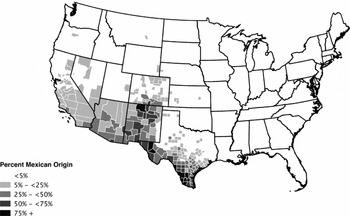
Figures 3 and 4 show the geographical effect of this wage-seeking behavior in the Southwest. By 1930 the traditional, circumscribed geography—still visible in the map for 1900—had given way to a region that was Mexican both geographically and demographically. Figure 3 provides the absolute numbers of Mexican-origin persons by county, while figure 4 indicates the proportion of the population of each county that was of Mexican origin. As a result of immigration, persons of Mexican origin had a visible presence in nearly all of California, all but northern Arizona, in diverse parts of Colorado, and in north and central Texas. In certain areas, persons of Mexican origin now constituted very large fractions or a majority of the population. Despite continued migration into the Southwest by non-Hispanics, mass immigration had reversed the steep decline in the ratio of Hispanic to non-Hispanic populations: from the nadir of 7 percent of the Southwest's population in 1900, the Mexican-origin population had risen to 11 percent by 1930.
Mexican Origin by County, 1930

Percent Mexican Origin by County, 1930

Mexican-origin communities had developed outside the Southwest, such as in Chicago and Detroit, and the growth rate of Mexican American populations in nonsouthwestern states exceeded all but that of California. Had immigration continued, high-wage labor markets in the industrial Midwest would have drawn many enterprising Mexican workers. The confident verses of the ballad “El Corrido Pensilvanio,” recorded in 1929, speak eloquently to that promising future. Under work arranged by an enganchista or contractor, the narrator and his companions journey by rail across the United States, leaving behind the farms of Texas “Por no pizcar algodón” (“so that I don't have to pick cotton”). Pennsylvania, Indiana, and Chicago offered richer opportunities; the narrator promises to return to his sweetheart, even though the Italian girls crowd around the Mexican men as they get off the train in Bethlehem, Pennsylvania.Footnote 13
These midwestern colonias and the newly Mexican American Southwest were products of immigration, rather than original settlement. In this sense, Mexican American history is more similar to that of the Irish, the Italians, and the Poles, rather than to that which emerges from the “colonization” model once common in historical accounts (Barrera Reference Barrera1989; Gutiérrez Reference Gutiérrez2004). Previously established Hispanic societies in the Southwest influenced the story, but immigrants wrote their own chronicle.
Repatriation and Revival: 1930 to 1950
The year 1930 marked the peak of immigrant-driven change. By the late 1920s, two factors braked its momentum. The first was a nativist reaction to rising numbers of Mexicans in new settlement zones. The second was economic and more powerful: the Great Depression ended the era of high wages and plentiful jobs. Together, these factors halted immigration and initiated a temporary but substantial demographic retrenchment.
Xenophobic reaction to Mexicans grew across the 1920s. Rising levels of immigration from Mexico had depended in part upon the illogical exception of the Western Hemisphere from the racially inspired immigration restrictions imposed on Europeans in the 1920s. Open borders for Mexico had only two strong advocates: southwestern employers who relied on labor from that country, and the politicians who represented those employers (Kim Reference Kim2012; Reisler Reference Reisler1976; Weber Reference Weber2013). Unrestricted Mexican immigration was opposed by ideological restrictionists, resident workers hostile to foreign competition, southwestern welfare agencies that saw Mexicans as costly, and racists who saw them as inherently unacceptable (Fox Reference Fox2012; Hoffman Reference Hoffman1976). Mexican Americans also feared the social and political liabilities that they might face as a result of mass immigration from Mexico, and their most influential civic organizations opposed it (Blanton Reference Blanton2009; Gutiérrez Reference Gutiérrez1995). Like its counterpart in Mexico, the Spanish-language press in the United States, often dominated by journalists born in Mexico, rejected racially devised quotas and restrictions, but saw Mexican emigration as evil, destructive to la madre patria, and a clear sign of the failure of the Mexican government (El Heraldo de México 1928; Gratton and Merchant, Reference Gratton and Merchantforthcoming; La Prensa 1930).
The xenophobic view found an official voice in the 1930 Census, which—for the first and only time—included a Mexican category on the race variable.Footnote 14 Yet hostility to immigrants and racial animus were hardly sui generis to the United States. Antagonism toward foreigners had appeared in all countries marked by heavy immigration, and rose quickly as economic conditions deteriorated in the 1930s (Hatton and Williamson Reference Hatton and Williamson2005). Canada and Mexico instituted severe restrictions on immigration in 1931, and both countries had explicit national and racial prohibitions (Green and Green Reference Green and Green2004; Liwerant Reference Liwerant1995). The violent, government-aided expulsion of the Chinese from northwestern Mexico in 1931 and 1932, covered in both the English- and Spanish-language press, stands out as an extreme example of domestic hostility to foreigners (Chao Romero Reference Chao Romero2011; El Heraldo de México 1927; Hu-DeHart Reference Hu-DeHart1982; New York Times 1932). Nativism waxed in the United States and in most countries as unemployment rose during the Great Depression.Footnote 15
Unemployment prompted many Mexican immigrants to return to Mexico as they had customarily done in the 1920s. In some locales, immigrants and their families were further encouraged by repatriation campaigns carried out by public welfare officials, who provided financial assistance to those who volunteered to return. As the Depression deepened, these municipal campaigns often became more coercive (Hoffman Reference Hoffman1974). Mexican American mutual aid societies also provided funds and the Mexican government underwrote transportation to and within Mexico, exempting migrants from duties when crossing the border and making the promise, largely unfulfilled, of land in repatriate colonies (Carreras de Velasco Reference Carreras de Velasco1974). In concert with their view about the evils of emigration, the Spanish-language press applauded such good intentions on the part of the Mexican government while criticizing their ineffectuality. The press opposed deportation but saw repatriation as largely voluntary and to the benefit of Mexico, rarely criticizing American authorities (Hispano América 1931; La Cronista del Valle 1929; La Prensa 1931, 1932, 1934, 1935).
While migration to Mexico in the 1930s was substantial, its size and coercive nature have been greatly exaggerated in the historical literature, given the context of a well-established repatriation strategy among Mexican immigrants. Scholars conventionally assert that 1 million persons of Mexican origin were forcibly removed by US government officials, more than half of these being American citizens (e.g., Balderrama and Rodríguez Reference Balderrama and Rodríguez2006). We estimate that permanent migration to Mexico was closer to 355,000 persons across the 1930s (about 28 percent of the first- and second-generation Mexican-origin population in 1920 [Gratton and Merchant Reference Gratton and Merchant2013]). Federal deportation programs targeting Mexicans from 1930 to 1933 added about 34,000 more deportees than might have been expected under conventional circumstances. About 40 percent of the migrants were native born, these overwhelmingly being the children of immigrants repatriating. What proportion would have gone to Mexico without any campaigns is difficult to ascertain. Comparison to French Canadians suggests that perhaps 225,000 left because of financial incentives or repatriation campaign pressure.
As is conventional in periods of economic decline, the 1930s witnessed little new immigration. Federal entry records show that only 35,022 Mexicans crossed the border legally between 1930 and 1940 (Carter et al. Reference Carter, Gartner, Haines, Olmstead, Sutch and Wright2006). Census data find 11,429 persons born in Mexico but less than 10 years of age living in the United States in 1940, another indication of low immigration. Federal immigration reports and deportation records attest to illegal immigration as well, though the number of undocumented entries (and exits) cannot be measured accurately. Certainly, the most important demographic influence in the 1930s was natural increase: 232,600 children of Mexican origin were born in the United States during the 1930s.
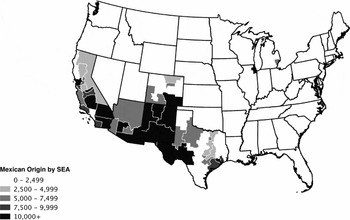
High fertility rates in this ethnic group forecast greater growth in the 1940s, though, again, very few immigrants (other than guest workers) arrived during that decade (fewer than 70,000). As a result of high fertility and low immigration, the foreign-born share of the population fell to its lowest level in the century in 1950, declining to less than a fifth of the ethnic group. By that year, the Mexican-origin population of the Southwest exceeded 2.1 million persons, a level one-third larger than in 1930. Figure 5 shows the continued concentration of the Mexican-origin population in the broader Southwest in 1950, following the pattern set by early-twentieth-century immigrants. (County-specific microdata are not available for the 1950 Census; State Economic Areas—often including several counties—provide the next level of detail. Given their larger size, we require at least 5,000 Mexican-origin residents for display.) Largely native born, the ethnic group was increasingly oriented toward the United States rather than Mexico (Gutiérrez Reference Gutiérrez1995; Sánchez 1993).
Mexican Origin by State Economic Area, 1950

Socioeconomic success in the 1940s reinforced that orientation. The fortunes of Mexican-origin persons in the United States improved with extraordinary speed during that decade.Footnote 16 Socioeconomic advances appear manifestly in educational measures. Only 29 percent of Mexican-origin persons aged 20 to 24 in 1940 had gone beyond the eighth grade. By 1950, when nearly all such persons were native born, 41 percent had done so. Occupational characteristics mirror these advances in schooling. Table 2 demonstrates the rapid shedding of laborers' jobs by men, particularly in the second and third generations. The share of craftsmen more than doubled in the second generation and represented nearly 40 percent of all jobs in the second and the third generation. By 1950, only 15 percent of those in the third generation were farm laborers. While the percentages of Mexican-origin workers in managerial and professional jobs in 1950 remained modest, it had risen dramatically in a single decade. Occupational status calculations follow a similar trajectory, with sharp increases for the native born, suggesting much higher incomes. For those in the second generation, occupational scores improved by 15 percent, more than twice the rate for non-Hispanics.
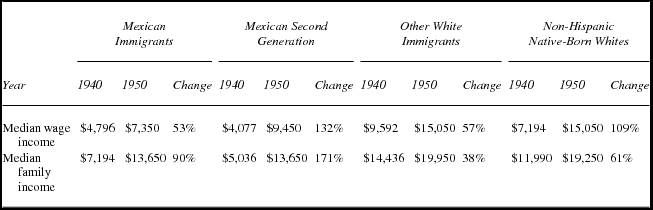
The 1940 and 1950 censuses allow the first direct evaluation of the income of workers. These data, for wage workers aged 18 to 64, do not cover the most highly paid employees nor do they include income or compensation not in the form of wages. They fail to capture certain agricultural workers, and underestimate the income of other farm workers who receive nonwage compensation (e.g., housing).Footnote 17 Within these constraints, the evidence demonstrates striking gains in real income for Mexican-origin male workers and their families, and substantial relative improvement compared to non-Hispanic natives and immigrants. Table 3 shows that the absolute economic status of persons of Mexican origin rose sharply between 1940 and 1950. In this ascent, youth and American birth were served: older immigrants made substantial absolute gains, but their native-born children leapt forward both in absolute terms and in comparison to non-Hispanics.
Income of Mexican-origin and Non-Hispanic native-born white males and families.

Source: Ruggles et al. Reference Ruggles, Trent Alexander, Genadek, Goeken, Schroeder and Sobek2010a.
For immigrant men, the decade saw a 53 percent improvement in individual wage income, and a 90 percent increase in family income; for their children, income more than doubled, with individual and family earnings rising 132 percent and 171 percent, respectively. These gains exceeded those of non-Hispanic native-born whites despite substantial economic improvement for this group (just more than 100 percent for individual earnings and 61 percent for family income). In 1940, second-generation Mexican-origin men made, on average, 57 percent of the income of non-Hispanics. By 1950, their income was 63 percent of that comparative level. For families the relative gain was still greater, rising from 42 percent to 71 percent in a single decade.
If we eliminate all persons on farms to avoid underselection and incomplete measurement of compensation, the story does not change.Footnote 18 In data for these nonagricultural workers, absolute real wage gains for Mexican immigrants exceeded 50 percent, and for the second generation it was 99 percent. Family income increases for the latter were 70 percent. Relative gains were slight for immigrant men in nonagricultural jobs, their wages rising from 72 to 75 percent of non-Hispanic native-born men's wages, but they rose from 55 to 75 percent for the second generation. Isolating agricultural workers, who represent a smaller and smaller share of the Mexican-origin second generation (but among immigrants were augmented by newly arriving guest workers), reveals similarly impressive absolute gains in real income, but little relative gain. Maloney's Reference Maloney(1994) estimation of the actual compensation for African American agricultural workers suggests that Mexican-origin workers probably received greater increases in absolute and relative terms than those we report from uncorrected data.Footnote 19
Synthetic cohorts using the full sample show similar change, one so rapid it meant tangible and sharp improvement in standards of living across 10 years: native-born men of Mexican origin who were 30 to 34 in 1940, and 40 to 44 in 1950, had in 1950 more than double the real income they had 10 years before, a 127 percent increase. Their families had access to still more real income. The 1940s record therefore gives little credence to the view that the World War II era “failed to uplift Mexican Americans from an economically underdeveloped state” (García Reference García1989: 16).Footnote 20 As difficult as the 1930s were, young Mexican-origin men and women made startling absolute and relative gains in educational and economic status in the 1940s. Within 10 years, they achieved a standard of living only to be wished for at the end of the Depression decade.
As one sign of this achievement, their families had the characteristics of a maturing and settled population (Skop et al. Reference Skop, Gratton and Gutmann2006). Sex ratios neared parity, and most immigrants and their children, like their non-Hispanic peers, lived in metropolitan areas. Though larger than those of non-Hispanics, Mexican-origin households exhibited little complexity. The proportion of nuclear families mirrored that in the non-Hispanic population and Mexican-origin children were very likely to live with both mother and father present. There is, in sum, almost no evidence in their family structure or in their economic circumstances of the negative assimilation that some social scientists contend has historically plagued Mexican experience in the United States due to racial discrimination (Portes and Rumbaut 2001). By 1950, Mexican Americans were on a trajectory that looked like that taken by their Italian and Polish counterparts, shaking off the conditions characteristic of immigration, and taking on the economic, educational, and familial traits of native-born sons and daughters.Footnote 21
There was, however, a challenge in their path not faced by their European immigrant-origin peers, whose immigration had largely drawn to a close. Though conventional immigration from Mexico had fallen off radically after 1930, mass immigration of another sort began. During the 1940s, a new guest-worker program emerged, another demonstration of the extraordinary power of southwestern agricultural interests over American immigration policy. The Bracero Program established a system of circular migration like the voluntary strategy developed by Mexican men in the 1920s. Initially under government control, it was soon dominated by growers. It brought more than 400,000 Mexican workers to the United States between 1943 and 1950, all with contracts stipulating that they would be repatriated at the employers' expense at the end of their term. This program, like the World War I program in the United States and guest-worker systems in other countries, immediately stimulated illegal immigration. With illegal immigration came a deportation program leagues beyond that of the 1930s, ultimately expelling more than 1.3 million Mexican nationals by 1950 (Gratton and Merchant Reference Gratton and Merchant2013). Even as the Mexican American community established in the early twentieth century found stability and success in the 1940s, illegal immigration and deportation renewed the debate over the consequences of mass immigration from Mexico to the United States.
Conclusion
The young men and women who appear in the 1950 Census lived in a Mexican American Southwest created by their immigrant parents and grandparents. The imprint of that great early-twentieth-century cohort was different from and deeper than that left by Hispanics in the beleaguered communities created under Spanish rule. Mexicans arriving in the 1900–30 period turned away from traditional zones of settlement. They sought good wages, lived in urban places, and, among those who remained in the United States, set their descendants on paths like those chosen by European immigrants who settled. By 1950, the southwestern Mexican American community, increasingly native born, had in many areas the demographic force sufficient to stake new political and social claims. Rapid economic gains in the 1940s forecast the likely success of those demands.
The members of this community insisted on their rights as American citizens, distancing themselves from Mexico and Mexican immigrants (Blanton Reference Blanton2009; García Reference García1989; García Reference García1991; Gutiérrez Reference Gutiérrez1995). Their encounter with racial classification, repatriation campaigns, and continued discrimination led to an aggressive civil rights movement and to the rise of Mexican American elites in politics and academia. Indeed, the descendants of immigrants filled the ranks of the Chicano movement of the 1960s that celebrated deep roots in the Southwest. In that celebration, they assumed the mantle of a regional history that, while often not theirs in fact, was theirs in the memory of the Mexican nation from which their ancestors had come. Though not the descendants of that thinly populated pre-American region, their ancestors had fought at the Alamo, Buena Vista, and Chapultepec endeavoring to preserve it. From that movement rose an account of Mexican American history based in conquest and expropriation, race and racial prejudice (Acuña Reference Acuña1972; Foley Reference Foley1998; Gomez Reference Gomez2007; Haney-López Reference Haney-López2006; Ngai Reference Ngai2003).
This literature links the immigration history we recount to a process of racialization. Because many states base claims to authority on the ability to speak for a national or “ethnic” group, arguments for admission or exclusion of immigrants are often made in terms of ethnicity (see summary in Hampshire Reference Hampshire2013; Balibar and Wallerstein Reference Balibar and Wallerstein1991). Movements to bar Asian and Eastern and Southern European immigrants from the United States, while originating in labor market competition, also had a powerful ethnic and racial component (Jacobson Reference Jacobson1998). Mexicans became the focus of similar nativism, particularly in the 1920s. Ngai (Reference Ngai2003) argues that the racialization of European immigrants faded after their restriction, with all national groups subsumed into a racial category of white: Asians, and, increasingly Mexicans, however, continued to be constructed as racially distinct in immigration debates and policy (see also Gerstle Reference Gerstle2001; Guglielmo Reference Guglielmo2004; Roediger Reference Roediger2005). The racial view of Mexicans was tightly bound up with their rising immigration—thus, in 1930, at the peak of the early-twentieth-century flow, the Census Bureau added the Mexican racial category (Gratton and Merchant, in press; Haney-Lopez 1996; Molina Reference Molina2006). This was an official expression of a racial view held deeply in some parts of the United States, one that led to the discriminatory practices this literature has documented. As Ngai, Foley, Guerin-Gonzales, and others comment, even employers eager for their services racialized Mexican workers: they described them as suited by nature to certain labor, while also assuring critics they would not become a permanent racial problem because they were temporary “aliens” who would return to Mexico.
Racial theory has its merits. Discrimination against Mexicans reached levels above those faced by most, though not all, immigrant groups. Yet expropriation and racialization have so dominated the account of this people's history that there has been little room for other explanations. Race matters but it provides a curiously narrow view of a group for whom immigration has been fundamental. Despite racist rhetoric, Mexican immigration was never restricted as it was for other groups—theirs remains an immigration tale into the twenty-first century. The migrant impulse that built a Mexican American Southwest is quintessentially economic, a process in which individuals make economic choices, and in which both origin and host societies calculate benefits and costs. Not only did Mexican immigrants construct their and their descendants' history by making decisions—rather than having that history constructed for them—but also much of their geographic and social behavior—and much of the reaction they inspired in the American public—is best understood by comparison to other immigrant groups.
What interrupted this conventional immigrant story were unremitting waves of immigration, illegal immigration, and deportation, initially in guest-worker programs in the 1940s and subsequently in the great surges beginning in the 1970s. These flows constantly replenished ethnicity, and repeatedly replenished nativist resentment, making Mexican American experience distinct (Jiménez Reference Jiménez2010). While the gains of the 1940s can still be seen in the 1950s and 1960s (Grebler et al. Reference Grebler, Moore, Guzmán and Lionel Berlant1970), and while even today considerable economic assimilation can be observed in the second generation (Alba and Nee Reference Alba and Nee2003; Park et al. Reference Park, Myers and Jiménez2014), Telles and Ortiz (Reference Taylor2008) argue that positive trends in economic status, education, and cultural markers falter in the third and fourth generations. Telles and Ortiz conclude that racism explains these outcomes, yet, as Jiménez and others attest, what clearly distinguished Mexican-origin persons from most other immigrant groups, and fueled continued xenophobic reaction and racism, was persistent mass immigration and illegal entry. The repeated arrival of migrants with low human capital, and rising illegal immigration in the group, distinguished Mexican-origin persons from those in most other immigrant-origin populations, and marked them as distinct in the minds of American citizens.
These distinguishing characteristics could first be seen in the 1920s but appeared with full force in the 1940s, at the moment of stabilization of the native-born Mexican American community in the aftermath of mass immigration in the early twentieth century. They were a product of the Bracero Program, a government-sponsored immigration program many in the resident ethnic community feared and opposed. That program stimulated illegal immigration and nativist reaction, and led to mass deportation. By the late 1970s, arrivals from Mexico had become so numerous that their number exceeded that of the community the immigrants of the early twentieth century had founded, as that generation had overwhelmed the Hispanic settlers before them. Illegal immigration grew alongside its legal counterpart, and with it came again the repeated scenario of nativist reaction and campaigns of deportation. In this new, unique Mexican American community, attention turned from citizens' rights to immigrants' rights, from questions about legal equality to the meaning of illegality, from defining that which a nation's border guaranteed, to that which a border should not restrain.