Introduction
Schistophoron was described by Stirton (Reference Stirton1876), based on the single species Schistophoron tenue from Bonny River, Africa. Subsequently two more species, S. variabile (Tibell Reference Tibell1982) and S. aurantiacum (Aptroot & Sipman Reference Aptroot and Sipman2007), were added from Costa Rica. Thus, three species of the genus at present are known. Schistophoron tenue has also been reported from India (Awasthi Reference Awasthi1991).
Zahlbruckner (Reference Zahlbruckner, Engler and Prantl1926) and Nádvorník (Reference Nádvorník1942) placed Schistophoron in Cypheliaceae under Caliciales. Recently, Tehler et al. (Reference Tehler, Baloch, Tibell and Wedin2009) discussed the systematic position and considered it to belong to Graphidales and possibly to the family Graphidaceae. Schistophoron is now characterized by the prominent to sessile lirelliform mazaediate ascomata, with partially disintegrated hymenium at maturity, a non-carbonized, brown excipulum, transversely septate to submuriform, dark brown ascospores and by having Trentepohlia as photobiont.
While studying the Indian Graphidaceae from Arunachal Pradesh in north-eastern India, an interesting new species, Schistophoron indicum, has been discovered. It is clearly distinguished from other known species by its smaller (6·5–9·7×6–7 µm) ascospores.
Materials and Methods
Specimens collected from Arunachal Pradesh, north-eastern India and deposited in ASSAM and BSA have been investigated. The morphological examinations were carried out under a stereomicroscope (Olympus SZ51). Thin hand-cut sections of thalli and ascomata were mounted in water, 10% KOH, and Lugol's iodine solution; all anatomical measurements were made on water mounts and anatomical characters were examined under a light microscope. The lichen substances were identified by thin-layer chromatography following White & James (Reference White and James1985).
The Species
Schistophoron indicum Kr. P. Singh & Swarnalatha sp. nov
Thallus crustosus, albus, subtiliter, farinosus. Ascomata elliptica ad lirellata, sessilia, ad thallum concolorata, plerumque simplicia, interdum sparse ramosa, 0·3–2·1 mm longa, 0·3–0·6 mm lata; excipulum completum, non carbonisatum, intra lateraliter aurantiaco–brunneum; labia convergentia, integra; hymenium non inspersum. Asci 8–spori, ante maturitatem ascosporarum fatiscentes. Ascosporae brunneae biloculares vel tetraloculares, submuriformes, late ellipsoideae ad subglobosae, distoseptatae et euseptatae, pariete crasso et laevigato, 6·5–9·7 × 6–7 µm. Acida stictico et norstictico (pro parte majore) cum substantia indeterminata macula aurantiaco–brunnea–coloratae in Rf 4·2 formante praesentia.
Typus: India, Arunachal Pradesh, East Siang district, Gette Basti, alt. c. 500–700 m, 8 January 1983, K. P. Singh 2858 (BSA—holotypus; ASSAM—isotypus).
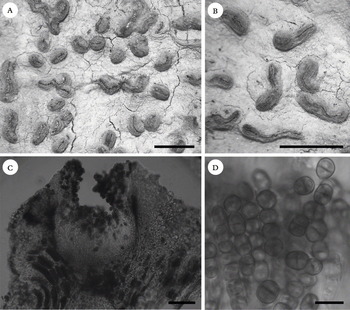
Schistophoron indicum (holotype). A & B, habit; C, vertical section of ascoma; D, ascospores. Scales: A & B = 1 mm; C = 50µm; D = 10µm.

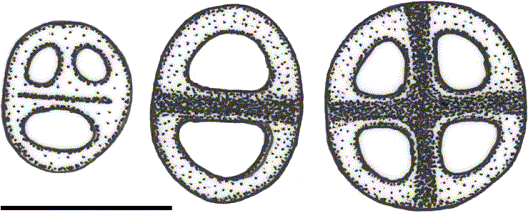
Schistophoron indica, ascospores (holotype). Scale = 10 µm.

Thallus crustose, epiphloeodal, white, finely cracked, farinose, ecorticate, lacking calcium oxalate crystals, homoiomerous, 38–80(–96) µm thick; photobiont Trentepohlia.
Ascomata elliptical to lirellate, sessile, concolorous with the thallus, mostly simple, sometimes sparsely branched, flexuous or curved, with obtuse ends, 0·3–2·1 mm long, 0·3–0·6 mm broad; disc narrow slit–like, sometimes moderately open, externally visible as black due to the accumulation of ascospores in mature ascomata; excipulum complete, non-carbonized, orange-brown and dark brown laterally towards inner side, often with bark cells at base, 42–70 µm thick laterally, 35–58(–90) µm thick at base, completely covered by thalline margin; labia convergent, entire; hymenium hyaline, not inspersed, I−, 38–56(–70) µm high, asciand paraphyses disintegrating with age and only a spore mass remaining; subhymenium brownish, 12–16 µm thick. Paraphyses unbranched, 1–1·5 µm thick; tips simple not thickened. Asci cylindrical to clavate, 8–spored, disintegrating before spore maturity. Ascospores mostly uniseriate, sometimes subbiseriate, brown to dark brown, bilocular to tetralocular-submuriform, distoseptate, with one transverse and one longitudinal incomplete to complete euseptum, broadly ellipsoid when bilocular and subglobose when submuriform, I−, 6·5–9·7 × 6–7 µm; walls thickened, smooth; euseptum 0·8–1·4 µm thick.
Chemistry. Thallus K+ reddish, C−, KC−, P−, UV−; containing stictic and norstictic acids (major) and an unidentified orange-brown pigment at Rf class 4·2.
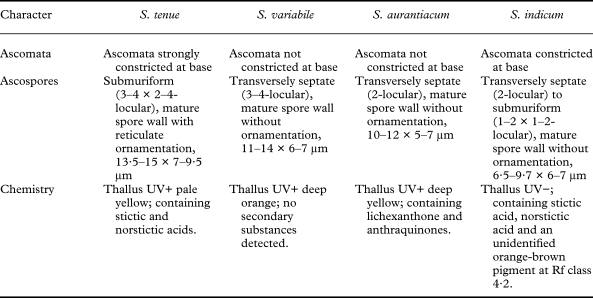
Notes. Schistophoron indicum is distinguished from all other Schistophoron species by its smaller, bilocular to submuriform, broadly ellipsoid to subglobose ascospores. In morphological and chemical characters it comes close to S. tenue Stirt., which has larger ascospores (13·5–15 × 7–9·5 µm) with 2–3 transverse and 1–3 longitudinal septa. In addition, mature ascospores have reticulate ornamentation on their walls (Tibell Reference Tibell1982, Reference Tibell1996). The comparison of some selected characters of all Schistophoron species is provided in Table 1.
Comparison of characters of Schistophoron species.

The authors thank Prof. L. Tibell, Uppsala University, Uppsala, Sweden, for reading the manuscript and his valuable comments; Dr M. Sanjappa, Director, Botanical Survey of India, Kolkata, for facilities and Dr V. J. Nair, Coimbatore, India, for help with the Latin diagnosis. One of the authors (G S) is grateful to the Ministry of Environment and Forests (MoEF), New Delhi, for financial assistance under AICOPTAX.