Introduction
There are over 60 entomological collections in Canada (Evenhuis Reference Evenhuis2018), but only a handful would be considered large, holding more than a million specimens. One of these, the Ouellet-Robert Entomological Collection (QMOR) (Université de Montréal, Montréal, Québec, Canada), is arguably the most important collection of Québec insects in Canada. The entomological collection got its formal start in 1965 when, following the untimely death of Adrien Robert (1906–1964) (Leroux Reference Leroux1964), the head of the Department of Biological Sciences at the time (Pierre Couillard) negotiated with the Clerics of Saint Viator for the donation of the personal collections of Robert and Joseph Ouellet (1869–1952) (Robert Reference Robert1952). It was as teachers at the Saint Viator Catholic Institution des Sourds-Muets (Institute of the Deaf and Dumb) that Ouellet had transmitted his passion for insects to the younger Robert, who later (1953) received a Ph.D. at the Université de Montréal studying the scolytid beetle (Coleoptera: Curculionidae: Scolytinae) vectors of Dutch elm disease (Ophiostoma Sydow and Sydow (Fungi: Ophiostomataceae)). Both entomologists had their own personal collections and had prepared teaching and reference collections on behalf of multiple other institutions (e.g., among others, Institution des Sourds-Muets and Collège Bourget in the case of Ouellet, and the Mont-Tremblant Biological Station in the case of Robert). It became the responsibility of Monique Coulloudon, first assistant to Robert and later entomological collection manager from 1965 to the mid-1980s, to integrate the various collections into a cohesive whole that would formally be named in honour of Ouellet and Robert in 1984.
Ouellet’s contributions of some 250 000 specimens (Bonneau Reference Bonneau1999) were of all insect orders, but especially Diptera. He had collaborated and taught with the Université de Montréal’s first entomologist, Gustave Chagnon (1871–1966) (Jean Reference Jean2009), whose collection was not left with his employer but is today found at Laval University (Ville de Québec, Québec, Canada). Ouellet published several articles on Québec Diptera, including the addition of many new records for the province (Ouellet Reference Ouellet1941). Robert was particularly keen on Coleoptera, especially Staphylinidae, and Odonata, publishing books on both orders (Chagnon and Robert Reference Chagnon and Robert1962; Robert Reference Robert1963). Robert’s already substantial Odonata collection was increased by his entomologist successor and interim collection curator from 1965–1971, Jean-Guy Pilon (Harper Reference Harper1999), who published extensively on Québec Odonata (e.g., Pilon and Lagacé Reference Pilon and Lagacé1998). Pierre-Paul Harper was hired in 1971 as professor and collection curator. Harper’s work focussed on aquatic insects in general, but especially on Ephemeroptera, Plecoptera, and Trichoptera, and was supported in great measure by Louise Cloutier, expert in Chironomidae and manager of the Ouellet-Robert Entomological Collection from 1989–2015 (e.g., Harper and Cloutier Reference Harper and Cloutier1986); Harper retired in 2004 (de Oliveira Reference de Oliveira2008), Cloutier in 2015. Étienne Normandin replaced Cloutier that same year, but the Ouellet-Robert Entomological Collection was without an official curator until the arrival of Colin Favret in 2012.
In addition to the aforementioned collectors and their respective taxa, Laurent Lesage contributed many insects, especially Elmidae (Coleoptera) (Lesage and Harper Reference Lesage and Harper1976); Harper’s limnologist Ph.D. advisor Noel Hynes (Hynes Reference Hynes1971, Reference Hynes1976) contributed an international collection of Plecoptera; Yvon Dulude donated a collection of Québec Ephemeroptera (Dulude Reference Dulude1992). Apart from these taxonomic strengths, the Ouellet-Robert Entomological Collection is also the repository of collections from the 1970s environmental assessments for hydroelectric projects in the Baie-James region of Québec (Hayeur Reference Hayeur2001), representing unique spatial and temporal series from the relatively poorly sampled subarctic. The Ouellet-Robert Entomological Collection also holds collections from around the Hochelaga Archipelago from the Projet Archipel, an ambitious and unrealised plan from the early 1980s to manage the waters surrounding the islands of the Montréal region, including building a hydroelectric dam in the Lachine Rapids (Duhaime Reference Duhaime1997). Many smaller donated collections, taxonomic and regional in scope, flesh out the remainder of the Ouellet-Robert Entomological Collection holdings.
The primary type collection is small, consisting of one Ouellet (Empis latrappensis Ouellet (Diptera: Empididae)), one Robert (Somatochlora brevicincta Robert (Odonata: Corduliidae)), and 18 Harper species (Hemerodromia chilcotti Harper and H. fibrina Landry and Harper (Diptera: Empididae); Rheotanytarsus magnini Cloutier and Harper (Diptera: Chironomidae); Paraleptophlebia aquilina Harper and Harper (Ephemeroptera: Leptophlebiidae); Alloperla acadiana Harper and Utaperla gaspesiana Harper and Roy (Plecoptera: Chloroperlidae); Mortoniella quinuas Harper and Turcotte (Trichoptera: Glossossomatidae); Goera radissonica Harper and Méthot (Trichoptera: Goeridae); Hydroptila eramosa Harper, Ochritricha cuenca Harper and Turcotte 1985, Oxyethira barstoni Harper, O. matadero Harper and Turcotte, and O. roberti Harper and Roy (Trichoptera: Hydroptilidae); Limnephilus nimmoi Roy and Harper (Trichoptera: Limnephilidae); Atopsyche cajas Harper and Turcotte, A. catherinae Harper and Turcotte, A. chirimachaya Harper and Turcotte, A. janethae Harper and Turcotte (Trichoptera: Rhyacophilidae)). The Ouellet-Robert Entomological Collection houses secondary types for 101 species.
The Ouellet-Robert Entomological Collection in the digital age
Natural history collections have long been primary sources of research data for systematists, and technological advances are progressively enhancing the contributions of collections to the systematics disciplines (Wen et al. Reference Wen, Ickert-Bond, Appelhans, Dorr and Funk2015). Collections are also increasingly relevant to comparatively new and emergent research fields such as global change (Kharouba et al. Reference Kharouba, Lewthwaite, Guralnick, Kerr and Vellend2019), biodiversity (Meineke et al. Reference Meineke, Davies, Daru and Davis2019), conservation (Drew Reference Drew2011), evolution (Holmes et al. Reference Holmes, Hammond, Wogan, Walsh, LaBarbera and Wommack2016), and genomics (Buerki and Baker Reference Buerki and Baker2015). Despite their documented value (Suarez and Tsutsui Reference Suarez and Tsutsui2004; Bradley et al. Reference Bradley, Bradley, Garner and Baker2014), or perhaps rather because of it, collections face new resource-limited challenges in providing the services and data requested by the world’s biological researchers; in addition to the traditional obligations of specimen curation and collection growth, natural history collections are called upon to make their specimen data available in electronic form (Council of Canadian Academies and Expert Panel on Biodiversity Science 2010; Kemp Reference Kemp2015; Schindel and Cook Reference Schindel and Cook2018).
The Ouellet-Robert Entomological Collection was late in adopting the informatics technology and modern curatorial practices that underpin much of the modern added value of a collection (Baird Reference Baird2010; Beaman and Cellinese Reference Beaman and Cellinese2012). In 2012, the collection moved across town to new climate-controlled facilities at the Université de Montréal’s Biodiversity Centre, located on the grounds of the Montreal Botanical Garden. Having also hired a new curator (Favret), it was an opportune moment for a thorough appraisal of the collection and for creating a vision of its future development. Up until recently, knowledge of the important holdings of the Ouellet-Robert Entomological Collection was either transferred from person to person or stored within the collection archives. Revitalising the collection and planning for its medium-term to long-term growth and improvement required an accurate understanding of its current status. In order to increase the profile and relevance of the Ouellet-Robert Entomological Collection to systematics and other disciplines, over the past 10 years, collection personnel have sought to acquire, assemble, and systematise electronically data useful both to potential users of the collection and for setting curatorial priorities. Specifically, we profiled the curatorial condition of the collection, inventoried its holdings, and digitised the specimen metadata of select taxa.
Collection profile
A collection profile is a quantitative assessment of the health of a natural history collection. The collection is evaluated in terms of the long-term conservation and stability of the specimens, their labels, and their containers, and the level of preparation, identification, and digitisation of the specimens. Profiling units are identified; in the case of entomological collections, these would typically be insect drawers, vial racks, and slide boxes. Once each profiling unit in the collection has been evaluated, curators have quantitative data with which to make informed decisions regarding the parts of the collection requiring attention. One of the first formal profiling systems, developed by the Department of Entomology at the United States National Museum of Natural History, graded each collection profiling unit on a single scale of 1–10 (McGinley Reference McGinley, Rose, Williams and Gisbert1993). Similar systems were developed specifically for vertebrate (Williams et al. Reference Williams, Monk and Arroyo-Cabrales1996), paleontological (Adrain et al. Reference Adrain, Lewis and Horton2006), slide (Neuhaus et al. Reference Neuhaus, Schmid and Riedel2017), and mammal collections (Rivera-León et al. Reference Rivera-León, Hortelano-Moncada and Cervantes2018). In order to establish curatorial priorities across the multiple biological natural history collections at a single institution, the Illinois Natural History Survey (Champaign, Illinois, United States of America) developed a profiling system that parsed collection health into eight criteria (Favret et al. Reference Favret, Cummings, McGinley, Heske, Johnson and Phillips2007): conservation status (the physical condition and long-term stability of the specimens), processing state (from unprepared bulk samples to fully curated specimens), container condition (e.g., the stability and fitness of unit trays or vial stoppers), condition of labels (i.e., their legibility and permanence), identification level (unidentified or identified to order, family, genus, or species), arrangement level (e.g., mixed taxa or crowded specimens), data quality (presence of all pertinent data on labels), and computerisation level (no computerisation to fully databased specimen data). Most of these criteria are graded on a scale of 1–4: 1 – problematic, generally requiring immediate attention; 2 – substandard, to be addressed when resources allow; 3 – acceptable, stable, and not requiring intervention; 4 – ideal, the best possible scenario. See Favret et al. (Reference Favret, Cummings, McGinley, Heske, Johnson and Phillips2007) for a full description of the profiling criteria and their respective scales.
We began by assigning unique identifiers to three kinds of profiling units – Cornell drawers, vial racks, and slide trays and boxes: identifiers were simple sequential numbers from 1–2962, irrespective of kind, taxonomy, or location. Secondly, in order in the future to be able to quickly find specific profiling units requiring attention, each was identified by kind and located in space by cabinet (1–200) and shelf number (1–24). For example, profiling unit 2285 is the 15th vial rack located on the 11th shelf in cabinet 193. Third, the profile was conducted using the aforementioned eight criteria, data being entered into the FileMaker Pro (Santa Clara, California, United States of America) database described by Favret et al. (Reference Favret, Cummings, McGinley, Heske, Johnson and Phillips2007). As we were examining the Cornell drawers, we took the opportunity to take an overhead photograph of each and upload it to the database. These photographs give us a quick view of approximately how many specimens and unit trays are in the drawer, how tightly packed the specimens are, and whether there are any anomalies (e.g., envelopes or microscope slides in what is otherwise a drawer of pinned specimens, empty or non-standard unit trays).
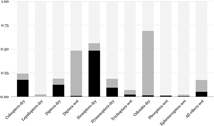
The collection profile provides quantitative data to help inform curatorial priorities. Unsurprisingly, given the attention accorded to them by relatively recent personnel, the aquatic orders Ephemeroptera, Plecoptera, and Trichoptera are in excellent condition. Along most of the eight assessment criteria, the profiling units scored acceptably. Of note regarding the container condition are substandard hard-bottom unit trays in much of the pinned collection. The single most important criterion is conservation status, judging the long-term safety of the specimens. Of serious concern is the condition of certain parts of the pinned collection, especially the Hemiptera (Fig. 1). The poor scores are largely due to specimens having become unglued from their points (Deans Reference Deans2018). Meanwhile, most of the Odonata are contained in paper envelopes and thus not easily examined, and many of the alcohol-preserved Diptera are low on preservative; these two parts of the collection, therefore, received many substandard scores. Thanks to the profiling, we located the exact drawers, scattered in the collection, that contain unprocessed material (e.g., specimens in pill boxes), unit trays with mixed taxa, and unsorted or too-densely-arranged specimens. We upgraded the computerisation level of the entire collection by performing the inventory and the specimen label data capture (see below). The collection profile thus has provided us with specific action items for the contents of specific drawers and vial racks that we can prioritise as collection improvement progresses.
Relative conservation status of parts of the pinned and enveloped (dry) and alcohol-preserved (wet) collection with more than 100 profiling units; in black, grey, and white, the proportion of profiling units scoring 1 (problematic), 2 (substandard), and 3 (acceptable), respectively.

Collection inventory
Rather than focussing immediately on specimen-level data capture, a critical first step in collection computerisation would be an inventory of the holdings of the collection, that is, a simple list of the taxa in the collection, perhaps including the number of specimens and some indication of their geographic provenance. Such a list would inform potential users whether the collection holds specimens of interest and whether to request additional information, submit a loan request, or schedule a visit. An inventory also quantifies the taxonomic and geographic strengths of a collection and therefore helps curatorial staff decide which taxa should be targeted for specimen-level data capture.
We did not have the resources to perform particularly labour-intensive tasks such as updating the nomenclature of all the taxa or recording the full range of geographic provenance of the specimens. We therefore limited our taxonomic data to the names as found with the specimens and the geographic provenance of taxa to three hierarchical categories: “Québec” if at least one specimen of a taxon was collected in the province, “North America” if at least one specimen was collected on the continent (but not in Québec), and “exotic” for all others. For each taxon within each profiling unit, we counted the number of collection objects, that is, the number of insect pins, envelopes, pill boxes, alcohol vials, or microscope slides. We did not record the number of specimens associated with each collection object, although the vast majority of pins held a single specimen. Inventory data were added to a relational table in the same database used for profiling. These data are available for search and download as a spreadsheet-compatible Darwin Core archive (Wieczorek et al. Reference Wieczorek, Bloom, Guralnick, Blum, Döring and Giovanni2012) at Canadensys.net: https://doi.org/10.5886/vehj9v.
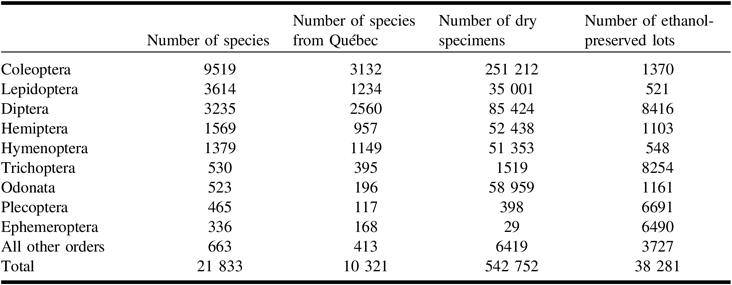
The Ouellet-Robert Entomological Collection houses over 20 000 insect species, of which half include specimens from Québec (Table 1). This latter figure represents 62% of the 16 600 described species recorded from or probably residing in Québec (Loiselle and Francoeur Reference Loiselle and Francoeur1992). There are 542 752 dry specimens in 1735 Cornell drawers identified at least to order on pins or in envelopes and pill boxes; 72% are identified to species level. A rough subsampling of the vials provided a conservative estimate of 25 specimens per vial, although this number varies greatly by taxon and processing state (e.g., a thousand bulk-sampled larvae versus a single holotype). The 38 281 vials in 1198 vial racks in the collection give us a rough estimate of 957 025 alcohol-preserved specimens. Therefore, omitting backlogged material not identified at least to the ordinal level, the collection houses approximately 1.5 million specimens, of which roughly one-third consists of pinned material. The microscope slide collection is negligible, although the aphid collection is growing quickly per Favret’s taxonomic expertise.
Summary of inventory: number of identified species and amount of preserved material of select orders.

Specimen digitisation
Because collections are arranged taxonomically, they are predisposed to be used by their traditional clientele, taxonomists. However, rather than seeking the geographic or temporal provenance of specific taxa, non-traditional users in conservation biology, ecology, and other fields might prefer to see the list of taxa from a specific locale, time period, or host plant, for example. These specimen metadata, data normally found on specimen labels, can only be made available and analysed by computerising them (Shaffer et al. Reference Shaffer, Fisher and Davidson1998; Baird Reference Baird2010). Although the value of specimen metadata is well known (Favret and Dewalt Reference Favret and Dewalt2002; Scoble Reference Scoble2010; Smith and Blagoderov Reference Smith and Blagoderov2012; Meineke et al. Reference Meineke, Davies, Daru and Davis2019), due to their sheer size in terms of number of specimens and taxa, entomological collections lag far behind vertebrate collections and herbaria in their level of computerisation (Constable et al. Reference Constable, Guralnick, Wieczorek, Spencer and Peterson2010; Sikes et al. Reference Sikes, Copas, Hirsch, Longino and Schigel2016; Sweeney et al. Reference Sweeney, Starly, Morris, Xu, Jones and Radhakrishnan2018).
As part of the initial funding for Canadensys.net, a network of Canadian collections and collections-based researchers serving organismal occurrence data (namely museum specimen data) on the Internet, selected taxonomic strengths of the Ouellet-Robert Entomological Collection were targeted for specimen-level metadata capture. One exceptional strength made evident by our inventory is the Odonata collection, including 33 123 museum objects (envelopes, pins, and vials) representing some 60 000 specimens. The label data associated with the Odonata museum objects were electronically recorded in another FileMaker Pro relational database, each object being given a unique identifier label. The taxonomic nomenclature was updated using recent checklists (Garrison and von Ellenrieder Reference Garrison and von Ellenrieder2016; Paulson and Dunkle Reference Paulson and Dunkle2018; Savard Reference Savard2018). North American collection geoposition coordinates were found retrospectively using the Canada Geographical Names Database at Natural Resources Canada and the Geographic Names Information System at the United States Geological Survey. The other aquatic taxa targeted for specimen-level databasing were the Ephemeroptera (7062 records) and Trichoptera (8844 records). All Ouellet-Robert Entomological Collection specimen-level data are available at Canadensys.net: https://doi.org/10.5886/qwvt63fz.
Perspectives
The results of the data capture presented here provide us the information needed to map the way forward. Along with assuring healthy collection growth, the priority clearly is to stabilise and upgrade the problematic parts of the collection, for example, by replacing hard-bottom unit trays and securing specimens fallen from point mounts. As the value of a collection is entirely based on its active use, it is hoped that the inventory will inform interested parties of the collection holdings and stimulate inquiries, loan requests, and visits. The profile and online inventory will be updated as various sections of the collection are re-curated and as new material is added. Likewise, the Odonata data should prove useful to a number of researchers, and we hope their use will help us secure funding to extend specimen digitising to other parts of the collection. The Odonata specimen label data of six other insect collections in Québec have recently been digitised, complementing the Ouellet-Robert Entomological Collection dataset.
In addition to providing collection data to external parties, we are also stimulating local interest in the collection. Natural history collections are unique educational resources (Cook et al. Reference Cook, Edwards, Lacey, Guralnick, Soltis and Soltis2014) and venues for public engagement (Ballard et al. Reference Ballard, Robinson, Young, Pauly, Higgins, Johnson and Tweddle2017). Students from the entomology and insect systematics courses taught at the Université de Montréal contribute to the collection as part of their course activities; a student-led natural history collection club (Gerdes et al. Reference Gerdes, Harris, Beas-Moix and Marsico2017), “Club QMOR”, participates in collection curation on a biweekly basis; a Facebook page and blog (where entomology students publish species pages: http://qmor.umontreal.ca) maintain a social media presence for the collection. An upcoming guidebook to the insects of Québec includes 2300 species, almost all of which are presented with high-quality photographs of Ouellet-Robert Entomological Collection specimens. Having gone through three phases of development, collecting the initial bulk of specimens (1930–1964), the integration of the Ouellet, Robert, and other collections and the official inauguration of the Ouellet-Robert Entomological Collection (1965–1984), and the physical growth, curatorial improvement, and move to new facilities (1985–2012), the Ouellet-Robert Entomological Collection has now entered into a new phase of electronic data capture and dissemination and increased activity.
Acknowledgements
We express our heartfelt thanks and recognition to the former curator, the late Pierre-Paul Harper, deceased as this article went to press and in whose memory we dedicate it, for help with the historical narrative of the collection and especially for his tireless devotion to the Ouellet-Robert Entomological Collection over many years.
The authors are the Ouellet-Robert Entomological Collection’s current curator (C.F.), current collection manager (É.N.; e-mail: qmor.umontreal@gmail.com), and former collection manager (L.C.). Undergraduate student collection workers executed the profiling and inventory work: Marie-Ève Garon-Labrecque, Chloé Laubu, Jeyadarshan Jeyabalaratnam, Paul Mayrand, and Élise St-Pierre. Volunteer Joanie Guillemet extracted metadata from the inventory/profile database. Canadensys personnel Bénédicte Rivière and Carole Sinou uploaded and cross-checked the Ouellet-Robert Entomological Collection inventory online data. Funding for the activities described herein was provided by the University of Montréal Department of Biological Sciences, and Canadensys funding to Anne Bruneau and colleagues from the Canada Foundation for Innovation.