Introduction
In Ethiopia, health is traditionally defined as a state of equilibrium among the physiological, spiritual, cosmological, ecological and social forces associated with a person (Vecchiato, Reference Vecchiato, Kloos and Zein1993). Mental illness is attributed partly to supernatural forces such as spirits that enter a person's body, or the shadow cast by an evil eye (Alem et al. Reference Alem, Jacobsson and Argaw1993; Araya & Aboud, Reference Araya, Aboud, Kloos and Zein1993). Modern psychiatric services are very scarce, inaccessible, and relatively expensive for the majority of the population. Therefore, most people go to priests, magicians, sorcerers and traditional healers to seek treatment for mental illness (Alem et al. Reference Alem, Jacobsson and Argaw1993; Araya & Aboud, Reference Araya, Aboud, Kloos and Zein1993;Giel et al. Reference Giel, Gezahegn and Van Luijk1968a). Patients usually resort to modern mental health-care services only after they have failed to recover after receiving traditional treatments. It is also a common practice in Ethiopia for family members to care for and support the mentally ill at home (Araya & Aboud, Reference Araya, Aboud, Kloos and Zein1993). However, the pathway that patients take to reach mental health care has not been examined systematically.
According to a model of a pathway that was proposed by Goldberg & Huxley (Reference Goldberg and Huxley1980), most patients start psychiatric care by consulting their general practitioner (GP) and then proceed directly to a mental health centre. This type of help-seeking model was supported by the findings of a multi-centre study on pathways to mental health care that was conducted in 11 countries coordinated by the World Health Organization (WHO) (Gater et al. Reference Gater, De Almeida, Sousa, Barrientos, Caraveo, Chandrashekar, Dhadphale, Goldberg, Al Kathiri, Mubbashar, Silhan, Thong, Torres-Gonzales and Sartorious1991). According to this study, patients in countries with well-resourced centres (the UK, Portugal, Spain, Cuba and Czechoslovakia) first sought help from GPs and hospital doctors for their mental health problems, and from there they were referred directly to mental health services. However, it was appreciated that other pathways may also be used. Traditional healers, for example, were consulted as often as primary care professionals, especially in developing countries, and they referred some patients directly to psychiatric services. In some countries, patients referred themselves directly to mental health professionals, whereas others were referred by longer and less direct pathways, perhaps involving multiple care providers (Gater et al. Reference Gater, De Almeida, Sousa, Barrientos, Caraveo, Chandrashekar, Dhadphale, Goldberg, Al Kathiri, Mubbashar, Silhan, Thong, Torres-Gonzales and Sartorious1991; Reeler, Reference Reeler1992; Vazquez-Baraquero et al. Reference Vazquez-Baraquero, Herrera Castanedo, Artal, Cuesta Nunez, Gaite, Goldberg and Sartorius1993; Balestrieri et al. Reference Balestrieri, Bon, Rodriguez-Sacristan and Tansella1994; Kilic et al. Reference Kilic, Rezaki, Ustun and Gater1994; Abiodun, Reference Abiodun1995; Razali & Najib, Reference Razali and Najib2000; Amaddeo et al. Reference Amaddeo, Zambello, Tansella and Thornicroft2001; Pradhan et al. Reference Pradhan, Singh, Singh, Das, Ram, Patil, Jain and Thomas2001).
Pathways that patients take are likely to be influenced by several factors, such as perception of health and diseases, help-seeking behaviour, ability of caregivers to detect psychiatric disorders, conventions governing referral, relationships that exist between mental health services and other sources of help and the availability/accessibility of mental health and other helping agencies (Gater et al. Reference Gater, De Almeida, Sousa, Barrientos, Caraveo, Chandrashekar, Dhadphale, Goldberg, Al Kathiri, Mubbashar, Silhan, Thong, Torres-Gonzales and Sartorious1991; Kilic et al. Reference Kilic, Rezaki, Ustun and Gater1994).
The aim of this study was to describe the routes taken by patients to reach psychiatric care, evaluate the time delay before seeking psychiatric care, and investigate the relationship between delay on the pathway to care and sociodemographic and clinical factors. We hoped that the findings of this study would help mental health service planners to better understand the pathways that patients take to psychiatric services and develop strategies to avoid unnecessary delay in the provision of mental health care.
Method
The area and the psychiatric service
The study was conducted at Amanuel Specialized Mental Hospital in Addis Ababa, Ethiopia. Ethiopia is one of the poorest countries in East Africa, with a total population of 70 million. There are more than 80 languages spoken in the country; the three main languages are Amharic, Oromifa and Tigrinya. Amharic is the official language of the country and has its own unique alphabet. The major religions are Orthodox Christian and Islam, constituting 50.6% and 32.8% of the total population respectively (CSA, 1999).
Amanuel Specialized Mental Hospital, which has a bed capacity of 360, is the only mental hospital that provides out-patient and in-patient services for the full range of psychiatric disorders for clients coming from the entire country. However, out-patient psychiatric services are also being provided at the Psychiatry Department clinic of the Medical Faculty, Addis Ababa University (which is located at St Paul's hospital in Addis Ababa), and other psychiatric centres that are distributed throughout the country in regional and district hospitals. In general, two psychiatric nurses provide mental health services at each psychiatric centre in the regional and district hospitals. There are a total of 17 psychiatrists and 250 psychiatric nurses in the country. Most psychiatrists are based in Addis Ababa, and therefore patients travel several hundreds of kilometres from their homes to seek treatment there. Local people often seek care first from traditional healers, but there is no working relationship between them and mental health services in the country.
There is no systematic referral system for psychiatric patients in Ethiopia; patients can refer themselves directly to a primary care clinic, general hospital, psychiatric clinic or psychiatric hospital. They can also be referred to modern psychiatric services directly from traditional treatment centres, primary care clinics and general hospitals.
Sampling
All new patients who attended Amanuel Specialized Mental Hospital during a 2-month period (May and June 2003) were included in the study. ‘New patients’ were defined as those patients who had never previously sought any service from the hospital. Patients were screened and interviewed in the out-patient rooms before they saw a doctor. Before the interview, informed consent was obtained from all patients. In the case of minors and participants whose mental state was such that they could not give consent or provide information themselves, consent and information was obtained from their caregivers or escorts. Information about diagnosis of patients was obtained from their medical notes.
The interview was conducted by four psychiatric nurses who were working at the hospital. An attempt was made to recruit psychiatric nurses who could speak the three main languages that are spoken in the country so that participants who could not understand Amharic were interviewed in their own language. A one-day training course was given to interviewers on the use of the encounter form by two of the authors (Y.Y. and Y.B.). The training included role-plays, and interview of patients.
Measures
The ‘encounter form’, which was developed by the WHO for the study of pathways to psychiatric care, was used in this study. This form contains basic questions, including enquiries about places where contacts have taken place, source of referral, name and profession of the mental health practitioner who sees the patient and characteristics of the patient (age, sex, marital status, social position, past history of psychiatric care). It also includes questions about the profession of each previous care provider whom the patient was in contact with, along with the total duration of symptoms, length of time since the patient was first seen, the source of each referral, the main problem presented, the main treatment offered, the duration of the patient's journey to the care provider and the diagnosis of the patient made by the mental health practitioner.
Additional sociodemographic variables such as address, religion and ethnic group, level of education, occupation and family size were included in the original encounter form. This instrument was translated from English into Amharic by the principal investigator and backtranslated by one of the co-authors who was blind to the English version. It was also pretested on 20 patients who were attending Amanuel Specialized Mental Hospital out-patient clinic and were not included in the study. No significant problems were encountered with the use of the instrument.
Statistical analysis
The data were checked for completeness and consistency immediately after collection by one of the co-investigators (Y.B.) and entered into a database of SPSS version 12.0.1 (SPSS Inc., Chicago, IL, USA). The types of care sought by patients before they arrived at the psychiatric centre and the routes that each patient took to reach the psychiatric centre were summarized. Then the number of patients that took different paths to the psychiatric care was calculated and the pathway diagram was drawn. As the distribution of delay was highly skewed to the left, the data were normalized by square root transformation. The influence of certain variables such as sociodemographic characteristics, types of first care providers, presenting complaint, and diagnosis on the time delay along the pathway to care was examined using a linear regression model after categorical predictor variables were dummy coded and entered into the model.
Results
Sociodemographic characteristics
During the 2-month study period, a total of 1044 patients who were commencing a new episode of care at Amanuel Specialized Mental Hospital were recruited. Of these, 62.2% of the patients were male, and the mean age was 29 years (range 2–85 years, s.d.=13 years). Most of the patients were from Addis Ababa (44.1%), single (53.7%), illiterate (36.3%), unemployed (20%), Orthodox Christians (57.3%), and came from family sizes of between five and eight persons (48.7%).
The majority (69.6%) of the patients attended the psychiatric centre on the advice of their family members, 10.8% of patients decided to contact the psychiatric centre by themselves, and 9.4% did so on the advice of patients who had previously attended the psychiatric centre. Only 12.4% of the patients came to the hospital with a referral letter from their previous care providers and these were invariably among those who had been to modern health-care services.
Pathways to care
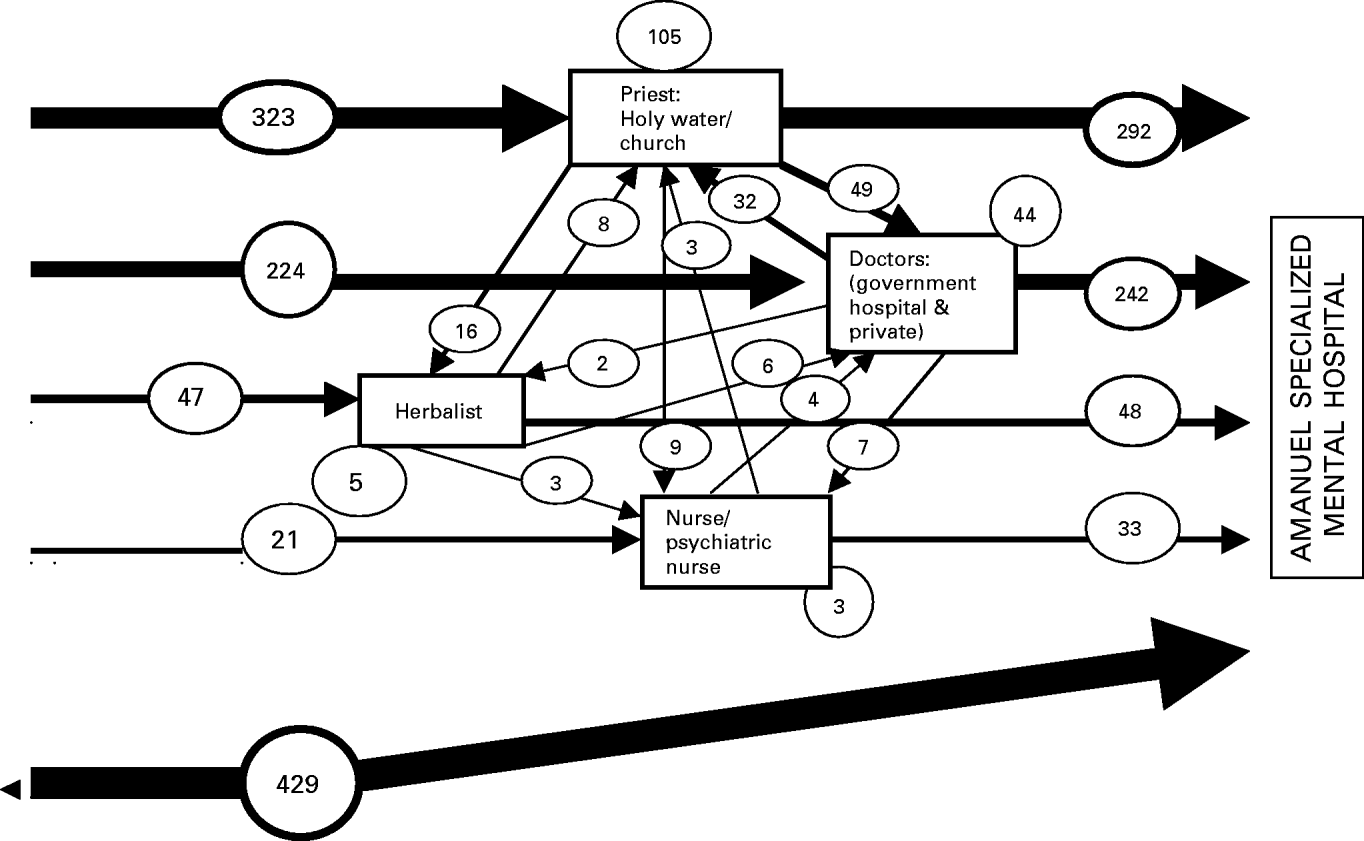
The routes that patients followed to reach the psychiatric centre are shown in Fig. 1. Forty-one per cent of the patients came directly to the psychiatric centre without having previously sought help elsewhere. However, among the remaining patients, 30.9% initially sought help from priests/holy water or church, 21.5% consulted doctors in private or government hospitals, 4.5% contacted herbalists, and 2% saw general nurses or psychiatric nurses, and from there most patients proceeded to the psychiatric centre via recursive pathways that involved several care providers. Recursive pathways were commonly seen, particularly with those patients who went to priests at holy water/church and non-psychiatric doctors.
Pathway diagram that shows the route taken by 1044 patients to arrive at Amanuel Specialized Mental Hospital, Ethiopia. The figures in the circle represent the number of patients taking each step in the pathway.

Delays along the pathway to care
The delay between first developing symptoms and arrival at the psychiatric centre ranged from <1 week up to 45 years, with a mean value of 118.4 weeks (s.d.=195.92) and a modal value of 104 weeks. The median time was 38 weeks, with a 25th percentile of 8 weeks and an interquartile range of 148 weeks. The distribution of delay was highly left-skewed. Thus, the median was used as a measure of central tendency in this study.
Associations between delay and sociodemographic characteristics
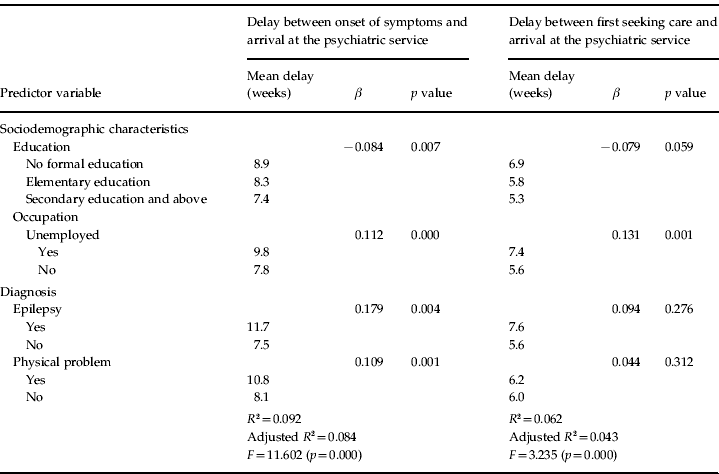
The duration of delay did not differ significantly by any sociodemographic characteristics except level of education and occupation of patients. Regression coefficients of variables that showed significant influence on delay before seeking care are summarized in Table 1. This table shows that joblessness was the only variable that was significantly associated with both overall delay (delay between onset of symptoms and arrival at the psychiatric service) and delay between first seeking care and arrival at the psychiatric service, whereas having no formal education had significant influence only on the overall delay. However, the delay experienced before seeking care at the psychiatric service did not show a statistically significant difference between those patients who came from Addis Ababa and those who came from other regions (p>0.05).
Regression coefficient of variables predicting delay before seeking care at the psychiatric service

Associations between delay and types of first care providers
The time delay between onset of symptoms and first seeking care differed by the type of service/care providers that patients contacted. Patients who came directly to the psychiatric service and those who saw herbalists experienced their symptoms for 16 weeks before seeking care, whereas for patients who first sought care from hospital doctors, priests at holy water or church and nurses/psychiatric nurses the time delay was 8.5, 8 and 8 weeks respectively. However, when other independent variables were controlled, only a direct visit to the psychiatric service has significantly predicted long delay before first seeking care (β=0.120, p=0.001).
Patients who were first seen by herbalists tended to take longer (24 weeks) to arrive at the psychiatric service than those who were first seen by a priest at holy water/church (16 weeks), doctors (12 weeks), and nurses/psychiatric nurses (10 weeks); nonetheless, the difference was not found to be statistically significant (p>0.05).
Associations between delay and the main problem presented to the first carer
The great majority of patients presented to their first carer with disturbed/psychotic symptoms, followed by fit/altered level of consciousness, anxiety symptoms, somatic problems, sleep problems, mood symptoms and suicidal behaviour.
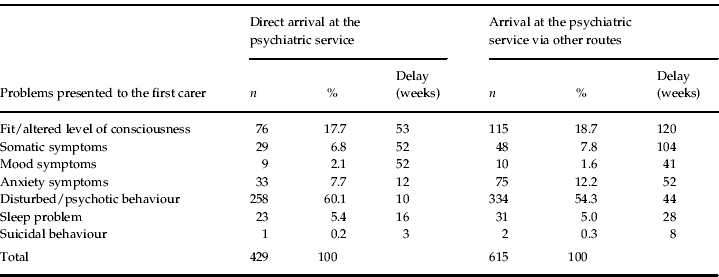
The median delay between first developing symptoms and direct arrival at the psychiatric service and arrival by other routes according to the main problems presented to the first care provider is presented in Table 2. In general, the delay varied according to the problem presented to the first caregiver, thus fits and an altered level of consciousness were associated with the longest median delay (53 and 120 weeks respectively) in both direct referrals and arrivals at the psychiatric services by other routes. However, when other independent variables were held constant, presenting problems to the first carer did not show a statistically significant influence on the duration of delay before seeking care at the psychiatric service (p>0.05).
Median delay (weeks) between first onset of symptoms and arrival at the psychiatric service directly and via other routes versus main problems presented to the first carer

Associations between delay and diagnosis made at the psychiatric service
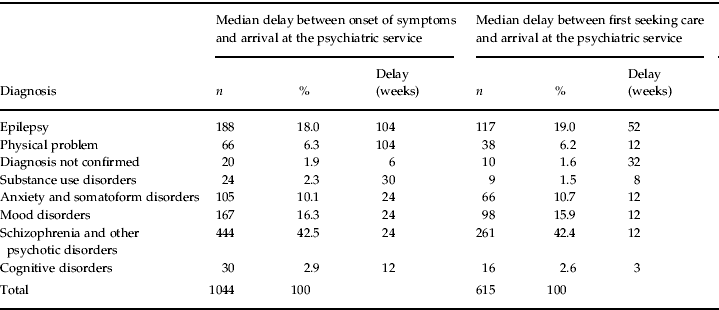
At the psychiatric service, 42.5% of the patients received a diagnosis of schizophrenia or other psychotic disorders, 18.0% of epilepsy, 16.0% of mood disorder, 10.1% of anxiety or somatoform disorder, 6.3% of physical problems, 2.9% of cognitive disorder, 2.3% of substance use disorders, and 1.9% of no confirmed diagnosis. Table 3 shows that the overall delay varied according to diagnosis in that patients who received diagnosis of epilepsy and physical problems experienced the longest delay (104 weeks), and the finding was statistically significant (Table 1). However, both diagnosis of epilepsy and physical problems had not had significant influence on the delay that was experienced between first seeking care and arrival at the psychiatric service (Table 1).
Associations between median delay (weeks) and diagnosis made at the psychiatric service

Discussion
Strengths and limitations of the study
This study, which is the first of its kind in Ethiopia, has important strengths. It has a larger sample size than any previous study of a similar nature and it is the only study to involve patients coming from an entire country. The fact that the study was carried out in the only mental hospital that provides specialist psychiatric care for the entire country created the opportunity for us to include such a large number of patients who came from every part of the country.
However, there are limitations to this study. First, this is a survey of users of a specific mental hospital and therefore the findings might not be generalizable to those patients with psychiatric problems who never sought service at this hospital. Second, the time period of the data collection coincided with the farming season in Ethiopia, and might thus have contributed to the low proportion of patients who visited the hospital from regional states outside of Addis Ababa, where the majority earn a living by farming. Third, we relied on patients' or caregivers' retrospective recall of symptoms and duration of illness, and the various caregivers the patients visited before arriving at the psychiatric service, which might subject some of our data to recall bias. However, interviewers made every attempt to elicit accurate information by using different methods that would facilitate recall, such as using landmark events as reference points, and interviewing accompanying caregivers. A fourth limitation could arise from social desirability bias, in that patients might not truly acknowledge some of their previous source of care, especially traditional healing practices that might be considered unacceptable in certain social and religious settings. Therefore, our finding of rate of visits to traditional healing practices could still be an underestimate of the true value. However, the interviewers did their best to establish good rapport with patients and other informants to obtain reliable information.
Psychiatric service utilization and referral system
The findings of this study have clearly demonstrated the absence of equitable tertiary psychiatric service utilization among patients who come from different parts of the country. The service was mainly used by patients from Addis Ababa in that they constituted almost a half of the total number of patients seen at the hospital during the study period. Patients from distant regions such as Tigrai, Afar, Somali, Benshangul-Gumez, Gambela and Harar represented only 3.9% of service users. The fact that patients from Addis Ababa are close to the service may be one of the reasons why they use the hospital service more than others. Alem et al. (Reference Alem, Jacobsson and Argaw1993), Araya & Aboud (Reference Araya, Aboud, Kloos and Zein1993) andGiel et al. (Reference Giel, Gezahegn and Van Luijk1968b) have demonstrated that scarcity of psychiatric services in the country, problems of access, the cost that is incurred by travelling hundreds of kilometres to reach the psychiatric service, and other expenses are some of the main reasons why most people do not use the psychiatric services. Therefore, strengthening the regional psychiatric services in terms of material and manpower, thereby bringing the service to the community level, must be given the utmost priority.
Even though the sex ratio of the country's population is almost equal, psychiatric service utilization by females is found to be very low compared to that of males in our study. This might be a direct reflection of the difference in prevalence of some mental disorders such as schizophrenia between the two sexes (Kebede et al. Reference Kebede, Alem, Shibre, Negash, Fekadu, Fekadu, Deyessa, Jacobsson and Kullgren2003). Other factors might also explain such a gender difference in health service utilization: first, men tend to be more violent and unmanageable in the community than women when they become psychotic and are therefore more likely to be seen at the psychiatric services. Second, in a paternalistic society such as Ethiopia, where in most cases men are breadwinners of the household and women are economically dependent, it may be the men who make the decisions about health-care seeking of the family. However, further study is necessary to determine the reason for gender differences in psychiatric service utilization.
Because of the lack of a proper referral pathway and the presence of a substantial number of patients bypassing lower levels of care, the mental hospital is seen to be overcrowded by all kinds of patients, including patients with physical problems and others whose problems could be managed at primary or secondary health-care level. The hospital is thus often obliged to play the role of screening, referring and occasionally treating patients with physical problems. The risk of this kind of service delivery is twofold: first, non-psychiatric patients might not receive appropriate investigation and treatment from a hospital designated for specialized psychiatric care, and second, the hospital will fail to meet its role as a tertiary psychiatric care facility for the whole country.
This study suggests that there may be deficiencies in the working relationship or referral system between the psychiatric service and other modern or traditional health practitioners in that only 10% of patients came to the psychiatric service with a referral from their previous carer, whereas more than 66% of patients did so on the advice of a family member. The fact that family members play a major role in making decisions about the type of practitioner patients should consult when they become mentally ill was also documented in a similar study (Abiodun, Reference Abiodun1995). Therefore, this should be taken into account for awareness-raising initiatives.
The pathway in our study is dominated by direct referral, which is similar to that of Rawalpindi, Pakistan and Bangalore, India reported in the multi-centre study by Gater et al. (Reference Gater, De Almeida, Sousa, Barrientos, Caraveo, Chandrashekar, Dhadphale, Goldberg, Al Kathiri, Mubbashar, Silhan, Thong, Torres-Gonzales and Sartorious1991) and that of Ankara by Kilic et al. (Reference Kilic, Rezaki, Ustun and Gater1994). Recursive pathways, whereby patients visit the same kind of carer two or more times, are also a common phenomenon in our study, particularly with patients who visited a priest/holy water/church and doctors. This finding is similar to previous studies from other developing countries such as Indonesia (Gater et al. Reference Gater, De Almeida, Sousa, Barrientos, Caraveo, Chandrashekar, Dhadphale, Goldberg, Al Kathiri, Mubbashar, Silhan, Thong, Torres-Gonzales and Sartorious1991), Malaysia (Razali & Najib, Reference Razali and Najib2000) and Nigeria (Abiodun, Reference Abiodun1995).
Where the first contact was not with the psychiatric service, religious healers played a major role as the first port of call compared with doctors or any other modern health-care providers in our study. Seeking care from religious and traditional healers such as priests and herbalists for mental illness is a reflection of the prevailing belief among the Ethiopian population that mental illnesses are caused by supernatural forces (Alem et al. Reference Alem, Jacobsson and Argaw1993; Araya & Aboud, Reference Araya, Aboud, Kloos and Zein1993). It also reflects the fact that traditional and religious healing services are more accessible, acceptable and affordable than modern treatment for the great majority of the population (Alem et al. Reference Alem, Jacobsson and Argaw1993; Araya & Aboud, Reference Araya, Aboud, Kloos and Zein1993;Giel et al. Reference Giel, Gezahegn and Van Luijk1968a). Hence, people resort to religious and traditional methods of treatment, and only consider modern psychiatric treatment after they have exhausted all other possible alternatives.
Determinants of delay along the pathway to psychiatric care
Unlike the studies of Gater & Goldberg (Reference Gater and Goldberg1991), Vazquez-Baraquero et al. (Reference Vazquez-Baraquero, Herrera Castanedo, Artal, Cuesta Nunez, Gaite, Goldberg and Sartorius1993) and Kilic et al. (Reference Kilic, Rezaki, Ustun and Gater1994) that demonstrated age and sex of patients affecting delay on the pathway to care, all sociodemographic characteristics except level of education and occupation did not significantly affect the delay between onset of symptoms and arrival at the psychiatric services in our study.
Contrary to the findings of a previous study (Gater et al. Reference Gater, De Almeida, Sousa, Barrientos, Caraveo, Chandrashekar, Dhadphale, Goldberg, Al Kathiri, Mubbashar, Silhan, Thong, Torres-Gonzales and Sartorious1991), proximity of residence to the psychiatric service did not predict shorter delay in our study. Thus, apart from accessibility, perhaps other unmeasured variables such as differing beliefs about cause and treatment of mental illness, help-seeking behaviour, fear of stigma, acceptability of psychiatric service, cost and lack of awareness of the existence of psychiatric service in the country could be some of the factors that have contributed to the difference in service utilization and delay in help seeking that was observed among our study population. However, further study is required to substantiate the effect of these and other possible factors on psychiatric service utilization and delay in help seeking.
Patients who had first contact with traditional healers, particularly with herbalists, seemed to take longer before they arrived at the psychiatric service than those who went to see other care providers; however, this finding did not amount to a statistically significant difference. Gater et al. (Reference Gater, De Almeida, Sousa, Barrientos, Caraveo, Chandrashekar, Dhadphale, Goldberg, Al Kathiri, Mubbashar, Silhan, Thong, Torres-Gonzales and Sartorious1991), Kilic et al. (Reference Kilic, Rezaki, Ustun and Gater1994) and Abiodun (Reference Abiodun1995) reported that visits to herbalists were associated with long delay before receiving psychiatric care; however, contrary to these findings and the finding of our study, as well as to the commonly expressed view that visits to traditional healers are associated with longer delay, Reeler (Reference Reeler1992) demonstrated that consultation with traditional healers is associated with the shortest delay before receiving specialist mental health care in Zimbabwe.
Our study also showed that there is no proper referral system between the psychiatric service and doctors and nurses who are practicing in the general medical setting. It is also noted that patients who visited doctors and nurses also spent a very long time before they reached the psychiatric service. Hence, our finding supports previous reports that the majority of psychiatric disorders were unrecognized by general health workers and did not get appropriate treatment or referral to psychiatric services (Harding et al. Reference Harding, De Arango, Baltazar, Climent, Ibrahim, Ladrido-Ignacio, Srinivasa Murthy and Wig1980; Shiber et al. Reference Shiber, Maoz and Antonovsky1990; Al-Jaddou & Malkawi, Reference Al-Jaddou and Malkawi1997).
Unlike the findings of previous studies (Vazquez-Baraquero et al. Reference Vazquez-Baraquero, Herrera Castanedo, Artal, Cuesta Nunez, Gaite, Goldberg and Sartorius1993; Kilic et al. Reference Kilic, Rezaki, Ustun and Gater1994) that demonstrated somatic problems to be the commonest form of presentation to the first carer, and contrary to the notion that somatic complaints are the commonest presentation of mental illness in developing countries (Goldberg & Huxley, Reference Goldberg and Huxley1980), disturbed/psychotic behaviour and fit/altered level of consciousness are found to be the two most common presentations in our study. Likewise, the commonest diagnoses made at the psychiatric service in our study were schizophrenia or other psychotic disorders, and epilepsy. Patients who received the diagnosis of epilepsy and physical problems at the psychiatric service were the ones who experienced the longest overall delay along the pathway to care.
The deep-seated cultural belief among most Ethiopians that epilepsy, and for that matter any kind of mental illness, is caused by evil spirits or some form of supernatural force could be one of the major barriers for seeking early psychiatric treatment. There is strong evidence to suggest that medically unexplained somatic symptoms are related to substantial emotional distress expressing underlying anxiety, depression and adjustment disorders. However, the majority of such cases are unrecognized and do not receive appropriate referral for psychiatric treatment (Harding et al. Reference Harding, De Arango, Baltazar, Climent, Ibrahim, Ladrido-Ignacio, Srinivasa Murthy and Wig1980; Shiber et al. Reference Shiber, Maoz and Antonovsky1990; Al-Jaddou & Malkawi, Reference Al-Jaddou and Malkawi1997). Hence, this might be one of the explanations for the longest delay that was encountered by those patients with somatic conditions before they arrive at the psychiatric service in our study.
Conclusions
Our findings indicate that decentralization and strengthening of the psychiatric services at primary and secondary health-care levels, and developing a robust referral system, will be a crucial step forwards to providing effective mental health-care service in the country. It is important to establish strong working relationships with health professionals at various levels, as well as with traditional healers, and regularly training them about early detection and timely referral of psychiatric patients who may require specialist care. This will reduce the risk of disability and economic burden to the individual and the country, especially by avoiding expenditure on non-effective treatments. Most importantly, raising awareness of the general public about manifestations of common mental disorders, and also epilepsy, and the availability of modern treatments, and designing a service delivery model that particularly targets certain segments of the population such as those who are unemployed and uneducated, will shorten undue delay of treatment and unnecessary suffering of patients and their families.
Acknowledgements
This work was carried out in partial fulfillment of Masters of Medicine in Psychiatry by Y.Y.B. This research was supported financially by the Department of Psychiatry and Mental Health, Faculty of Health Sciences, University of Cape Town, South Africa, and the Schizophrenia and Bipolar Disorders Course and Outcome Study project of the Department of Psychiatry, Addis Ababa University.
Declaration of Interest
None.