Throughout the modern era, health and environmental problems from industrial activity have stubbornly defied national boundaries. As industrial production has been steadily ‘globalized’, the hazards of work have shifted, unevenly and unequally, across the world. Dangerous industries have long tended to arise, more or less independently, in multiple countries. Newer industries, bearing novel hazards, have regularly spilled from one nation to another. Cross-national or ‘global’ literatures, institutions and expert as well as lay networks for addressing many industry-associated hazards have helped ensure or deter their amelioration in nation after nation. But it is the sharpening unevenness with which these dangers have been distributed around the globe that has spurred a search for more explicitly transnational approaches to the history of industrial hazards.
The changing global profile of asbestos production shows just how glaring this dimension of the unequal distribution of wealth and power, as well as knowledge, has become in today's world economy.Footnote 1 Where the devastating harvest of lung disease and asbestos-related cancers was first discovered, in countries such as Britain and the United States, its production and usage has declined. But contacts with the dangerous dust continue to grow in developing countries such as India, engaged in processing and recycling waste products and used goods, such as asbestos-lagged ships, from the global North. Even asbestos mining has flourished anew. Governments in India and other developing countries tried rigorous regulations to protect workers and consumers, but these were poorly enforced. The population of today's India, like that of many nations now rapidly industrializing, inhales more asbestos fibres than did their predecessors two decades ago. Clearly, well-established knowledge about an industrial hazard in one part of the world, or even within the medico-scientific establishment of a given country such as India, is no guarantor of risk control where it matters most.Footnote 2 Worldwide, for many of these same reasons, not just asbestos but also other industrial hazards keep multiplying anew, even into the twenty-first century. An estimated two million deaths (twice those from malaria) are attributable to employment injuries alone, not to mention environmental ones. Every sign suggests that these casualties will increase in the next half-century.Footnote 3
Such trends have posed a profound challenge to historians of asbestos and other industrial hazards. How do we write histories that can better address these supranational patterns in the making, distribution and impacts of hazards themselves, also of the knowledge, networks and laws that would remedy them? That is to say, how can we open up our histories to the ‘central concern with movements, flows, and circulation’ that Isabel Hofmeyr defines as fundamental to transnational approaches? And how can we thereby better weave that ‘world of comparative possibility’ that Patricia Seed sees as the ultimate intellectual fruit of a transnational turn?Footnote 4 Not coincidentally, those of us who have striven to conceive of a more transnational history of industrial hazards have found ourselves making a curious return, in some respects, to the intellectual roots of this field, now more than half a century old.
In the middle of the twentieth century, just as asbestos dangers were being uncovered, accounts like Donald Hunter's encyclopedic History of Occupational Health leapt with relative ease from one nation's literature to another's.Footnote 5 This empirical model of occupational and environmental medicine could so easily ignore differences in national contexts because it assumed both a universality of knowledge about industrial hazards and a cross-national uniformity of industrialization, of its hazards, and of their prevention.Footnote 6 This was a history written by and largely for expert practitioners, from the British Donald Hunter to the American Alice Hamilton to the Austrian Ludwig Teleky, and it showed. If ‘progress’ in these histories gave rise to new workplace hazards, it also produced the instruments of their alleviation: heroic experts, often isolated and individual, the knowledge they turned up, and the controls they espoused.Footnote 7
Starting in the 1980s, social historians of occupational health revised this heroic vision of workplace intervention, but in ways that quickly complicated the earlier readiness to leap from one nation's history to another's. Studies in the United States, Britain and Europe revealed a multitude of groups, themes and conflicts often ignored in the heroic ‘legacy’ of occupational-health history composed by earlier health professionals.Footnote 8 One of the strongest threads in this scholarship has been the emphasis placed on workers' and other laypeoples' agency and advocacy. The contributions of expert knowledge, professionalism and workplace-centred laws have been set in a more contested and less heroic context of struggles around hazards over which scientific authority could claim at best a partial victory. Another result, more institutional, was that the history of industrial hazards was coming to be studied by those in departments of history or of history of science and medicine, not just by former practitioners. Professional historians now applied their attention to the subject, using a widening variety of intellectual tools, in an expanding range of nations. There have nonetheless been trade-offs in this new social history of industrial hazards that have helped steer its practitioners away from more transnational considerations.
To be sure, as with much other social history, they analysed groups and struggles in terms that were at least implicitly comparable across a variety of national and historical contexts, from labour unions, to corporate managers, to industrial hygienists; from physicians to state officials and agencies. The very contingency and complication their findings revealed, mostly through studies of local or national scope, made the sweeping universalism of earlier practitioner historians seem facile. The bar of scholarship rose, as so many more groups and issues now needed to be examined to ferret out basic narratives about recognition and control measures for particular ailments, and the contests that drove them. Even as studies spanning even two nations became more difficult to contemplate, professional historians working in the area faced many subtle pressures to confine their teaching and research to a single nation, well analysed by advocates of transnational history.Footnote 9 Ironically, then, even as social historians revived the study of industrial-hazard history in the United States and Europe, they did so in ways that steered away from the more explicit transnationalism of their predecessors – precisely as the balance of such hazards was shifting dramatically worldwide.
More recently, however, as social scientists as well as other groups of historians have taken up this topic, additional grounds have arisen for the study of cross-national interchange and comparison. In recent years the spectacle of dangerous trades has drawn scholars from different disciplines to what we might term (borrowing from the anthropologist by way of Peter Galison) a ‘trading zone’ of intellectual enquiry.Footnote 10 Economic historians have similarly highlighted the importance of corporate forms and labour migration in the spread of dangers. Environmental historians have mapped the material ecology of landscapes in which industries emerge, thrive and despoil or pollute.Footnote 11 In alliance with geographers these researchers have exposed the influential roles played by extra-workplace participants in industrial-hazard history, from ecologists or geologists to farmers to those living in the vicinity of factories or waste dumps. The new political sociology of science, in particular, has compared traditional political and institutional, as well as cultural, power dynamics which have shaped policy-relevant knowledge.Footnote 12 Feminist accounts of public understanding and use of expertise in science and technology projects have again offered further insights into the gendered character of popular and professional knowledge of industrial dangers.Footnote 13
These many new frameworks and questions, rather than raising further barriers to cross-national analysis, have had the opposite effect. Not coincidentally, their pursuit has put the historical experiences of more nations on the table for study. And their diversity itself has helped make the topic an intellectually stimulating one for conferences and networks of scholars whose composition is not just interdisciplinary, but genuinely international.Footnote 14 As a result, while methodologies have become more various, more of them are evolving in closer conversation with each other. And more questions are being asked about what travels in histories of industrial hazards, about how and why so many of the actors, institutions and dynamics do not stay confined to single locales or nations.
The reasons for this widening of transnational questions begin with the frankly normative character of much of this scholarship. While many historians of science may feel uncomfortable with this, many scholars are drawn to the subject of industrial dangers by the prospect of making a contribution, however indirectly, to efforts which could ameliorate these hazards. The concern of researchers for ‘environmental justice’, a label first forged among minority and working-class mobilizations against hazards in the United States, and since applied to those across the developing world, signals the commitment to defending rights as well as gathering evidence.Footnote 15 Many researchers go still further; for them, the historical analysis of industrial danger is naturally coupled not just to prescriptive questions, but to public activism. Scholars at a 2007 conference on industrial-hazard history, for instance, formulated and endorsed a corporate ‘Code of Sustainable Practice in Occupational and Environmental Health and Safety’.Footnote 16 We would argue that this sympathy and activism have not been obstacles to sustained and critical scholarship. On the contrary, the serious, burning relevance many of us feel our history has to contemporary problems faced in a globalized economy has helped us, if not to overcome our intellectual differences, at least to put them in perspective, disciplinary and academic as most of them are. In this and other ways, such commitments have actually deepened and broadened our understanding what actually happened and why.
We offer a sketch of this new scholarly terrain that seeks to transnationalize the history of industrial hazards, particularly in its relation to the history of science. We then proceed to some principles, heuristics, provisional narratives and questions that may help focus and advance more cross-national and comparative scholarship, in a field where questions of knowledge matter immensely.
Beyond the ‘science wars’: symmetry and scale in the history of the industrial hazard
Enabling the return of explicitly transnational questions in the history of industrial hazards is an object of broad agreement among many interested scholars about the importance of culture, of perceptions and values, to the history under study. The shared disciplinary terrain that has opened here largely takes for granted that discourses mediate the realities of nature and the human body, and that such discourses may themselves dispense and exert power. Acknowledging constructivist arguments, in other words, many of us have sought to move beyond the ideological polarity which marked debates within social studies of science during the 1980s and 1990s. Indeed, the greater challenge for many of us has been to figure out just how, in the face of this commitment, to incorporate more materialist categories and analysis into our arguments.
From the 1970s, many historians of science joined with their science studies colleagues in practising an agnosticism towards natural objects named and debated by scientists. This has been styled by sociologists a ‘principle of symmetry’. Invocations of the material (whether natural or economical) were largely avoided in order to raise the curtain on science's social dynamics and historicity. Out of such stratagems have come a deeper understanding of the impact of society and culture on science, also the familiar ‘science wars’ of the 1990s. Of course, not all historians of the sciences engaged these debates so directly. But historians of science did generally adopt a historicism that was symmetry's close kin. As Lorraine Daston notes, a more or less consensual rejection of the ‘teleological’ evolved that allowed attention to material objects and affects only when these were recognized by doctors and scientists of the relevant era.Footnote 17 Ongoing calls for ‘contextualism’ attended mainly to those ‘contexts’ visible through social or cultural analysis. Deprioritized were not just economic contexts but those of a material world about which scientists, as others who were their contemporaries, claimed to speak.Footnote 18
For the most part, these approaches squared uneasily with the social history of industrial hazards that emerged in the 1980s. They seem to rule out, as too messily or impurely scientific, much of what interested these scholars in the topic. What of diseases like asbestosis or silicosis or chronic lead poisoning that long went unrecognized among doctors and scientists? A compelling finding of the new social historians of industrial health was precisely that those material impacts – for instance of technological change in a workplace – could cause pathologies long before a formal scientific case for cause had emerged. The dust stirred up by the adoption of power drills in mines, the silicosis which its breathing then caused – these past, tragic material realities were precisely what interested the social historians of industrial hazards.Footnote 19 Their confrères in history of science might have branded this kind of interest unduly ‘presentist’ or ‘teleological’, hence naive. But historians of industrial hazard, especially those identifying with labour history, might have countered that it was not just hard but also morally suspect to write about industrial disease as just a matter of shifting ideas or practices among experts, as existing only or principally in the minds and words of the credentialled. To do so was to discount not just the experience and dilemmas of the victims, but the entire human history that had also contributed to the making of these ailments in the first place, before any doctor or scientist ever gave them a name.
More recently, a certain rapprochement between historians of industrial hazards and the history of science has emerged in part through countertrends within the latter field. Following the brutal attrition of the ‘science wars’, scholars in science history have revisited questions of ontology, to ask more about the experience and perception of objects in our world. Recognizing that more than just ‘ideas’ are at stake in the historical trajectories of medical and other sciences, scholars of science and technology now prefer to speak of ‘materiality’. The questions they pose about this materiality are often historical – for instance about how bodies (human or otherwise) have ‘mattered’ in different ways and at different places and times. Lorraine Daston's biographies of scientific objects and Ian Hacking's Historical Ontology seek to reconcile the dynamic historicity of scientific objects with their solidity and durability for historical actors in a given time and place. This work offers powerful insights to historians of industrial hazard, though with a caveat. Daston and Hacking consider only ‘objects or their effects which do not exist in any recognizable form until they are objects of scientific study’, a formidable restriction in the history of industrial hazards.Footnote 20
Not only do many hazards and their victims pre-date, often by many years, any formal scientific study, also the programme of historical ontology offers little clear handle on many other important dynamics shaping the manifestations of hazards in a given time and place, of which the era's medical as well as social scientists were likely even less aware. There is a place here for histories of business and industry, also of technology, and of the state and its regulatory capacities. While scientists or engineers may well have been involved in the construction of workplaces that posed certain dangers, at least part of this history must consider how and why so many failed to foresee the consequences of their handwork. One facet of this history that has become ever more evident since the 1980s has been the environmental hazards that industries have posed, often reaching far beyond workplace confines. In all these realms, historians have sought to integrate their historical ontology with a more projected understanding of various dynamics (health, ecological, technological, economic, political) that have become more clearly seen and understood today, and in retrospect, than they were in the time and place under study.
Easing our ability to do so, an intellectual borderland between environmental history, medical history and the history of science, opening over the last few years, has encouraged more eclectic borrowing and mixing. Environmental historians have long invested in an ecological materialism; their early resolve to ‘write nature into human history’ appealed heavily, some might say naively, to the natural sciences, especially ‘ecology’. But the field itself has recently become more inclined to sociocultural methods. With their ‘cultural turn’ has come increased sensitivity to the historicity of the human body within environmental relationships, drawing insights from cultural history and the history of science and medicine, as well as public health. Bolton Valencius, Nash, Mitman and Langston have blended close attention to specific ecological changes with an exploration of changes in society's understanding of health and environment.Footnote 21 As some of these same works also indicate, historians in more culturally inclined fields like the history of medicine and science have opened more doors to environmental as well as other materialist methods. This kind of openness has proven especially conducive to more transnational approaches. Studies of transnational flows of knowledge, for instance, including Schiebinger's and Cook's investigations, stress the links between such expertise and movements of commerce and trade.Footnote 22
In these and other ways, insights gleaned from other fields more friendly to the positivism of economics have also provided important precedents for the way historians of industrial hazards now study cross-national comparison, transfer and exchange. Within business and economics history, the highlights include work such as Chandler's account of the rise of the modern business corporation, and Williamson's of market integration as the defining feature of economic globalization.Footnote 23 A different tradition of world systems theory, laid out by Wallerstein and more recently exemplified by studies like Beverly Silver's, provides important if also well-criticized hypotheses for relating the historical experience of one country to another's.Footnote 24 Even if we may not accept all their contentions about the shifting global distribution of industries over the centuries, distinctions such as that between core and peripheral places can still prove useful. Scholarly arguments have also abounded on the cross-national interchanges involved in globalizing transformations, from commodity and migration networks to cultural shifts in literature and art. Among the best known is Harvey's analysis of the spatial dynamics, including ‘spatial fixes’, through which politics and economics connect with cultural shifts.Footnote 25 Closely related are theses of a ‘race to the bottom’, in which producers seek out those nations with the cheapest and most vulnerable workforce, exploitable with the least regulation or resistance. The result has been a noticeable transfer of manufacturing and mining hazards to the developing world. Labour histories such as Jefferson Cowie's account of RCA's move from Newark and Indiana to Ciudad Juárez, Mexico, detail the way this ‘race’ is run in local contexts, though such accounts usually say little about the consequent hazards involved.Footnote 26
Environmental historians, as well, have produced a growing abundance of comparative and transnational models, albeit with less focus on the specifically industrial hazards involved. Several operate more on the world level of scale: from Grove's environmental history of colonial empires to McNeill's global environmental history of the twentieth century.Footnote 27 A few environmental histories are also less global or comparative in conception, homing in, instead, on the history of a transnational interchange that forges links between the historical experiences of two or more particular nations. Tyrrell's True Gardens of the Gods, for instance, captures a sense of the contingency, as well as social and ecological complexity, involved in several decades of biotic interchange between California and Australia. A focus on a particular commodity, such as Soluri's on bananas and Anderson's on mahogany, has also opened scholarly doors, to examination of the cross-national flows of funds, corporations and technology, as well as local transformations connecting American economic hegemony to developing nations in Central America and the Caribbean.Footnote 28
It now seems clear to many of us that more materialist varieties of analysis, of economic as well as environmental features, can genuinely enrich our analysis of industrial-hazard history, even if we remain committed to the methodology of historical ontology. Its strict nominalism and historicism can, we suggest, take us only so far into many vital historical questions in this field. Moreover, a willingness to extrapolate our own current scientific and economic knowledge into the past can actually augment the pursuit of historical ontology. How do we know, for instance, that the experienced ontology of a workplace in a given time and place actually involves lead or asbestos exposures when workers themselves make no mention of either? Does it not behove us, as historians, first to draw upon whatever present-day tools are at our disposal to try and ascertain if lead or asbestos, as we know them today, were actually there? Not so paradoxically, a historical ontology of industrial hazards, if it is to grapple especially with such radical differences in perception, actually may require the support of materialist methods.
This methodological alliance helps situate disparate local and national histories not only alongside one another, but in relation to global narratives of hazard history, including those forged by scientists. For instance, Patterson and Nriagu's study of worldwide trends in lead production makes clear that human manipulations of this hazardous material over the last two or three hundred years have imposed much higher and more dangerous levels of exposure than ever before.Footnote 29 Surely histories that we write need to recognize their own embeddedness in this kind of overarching narrative, featuring humanity's longer ecological and evolutionary history. At the same time, the great challenge for historians of industrial hazard is to bring this planetary perspective down to earth, to explore what this kind of global trajectory has meant for specific nations and localities.
Historians of industrial hazards, as they have become more cognizant of this nesting of national and local history within the global, have been trying out new ways of combining and alternating the scales of their own research and narratives. They have discovered, as well, that especially at the lower levels of scale, natural and health sciences, whether ecological or epidemiological, can only go so far. These tell us very little about, among other things, the growth of hazard awareness, the sensory and cognitive experience of pollution, or the emergence of power struggles in response to these conditions. By drawing from both sides of the natural-/social-science divide, by alternating our scale from the global to the national all the way down to the local, we may better follow the evolving fusions of culture and nature that comprise the history of a toxic element such as asbestos or lead. By the same token, any approach which remains too firmly entrenched in culturalist or materialist axioms and methods will risk marginalizing key issues in the history of such lethal toxins.
There is space, then, for drawing on today's scientific consensus, on what is known about the material properties and physiological effects of materials such as asbestos circa 2012, as we explore how industrial hazards ‘matter’ across time and place. To compare these more robustly with other experiences with asbestos or lead, we need to draw distinctions not only of political economy and cultural framework but of the concrete contacts that people have with an industrial toxin and its effects. Rather than adopting a symmetric agnosticism towards scientific claims about exposure, one of us suggests the usefulness of a principle of environmental symmetry, a historical assessment of the actual or potential exposure to a toxin in a given time and place.Footnote 30 Taking those patterns of exposure and effect established in the recent history of the United States or Great Britain as a standard, we may reconstruct what we can, at least, of the distribution and effects of that same industrial toxin in other localities. The point here is not to seek a more scientific and quantitative history of industrial hazards – a will-o’-the-wisp if ever there was one. It is, rather, to add another set of tools to our toolkit, one that may come in handy especially where documentary evidence is hard to come by. Such extrapolations better equip us to ask questions about secular experiences beyond recognized scientific and medical communities, among those who might or might not have known the toxic nature of ‘asbestos’. In particular, they may provide a common yardstick for developing historical inquiries into the industrial hazards across the developing world.
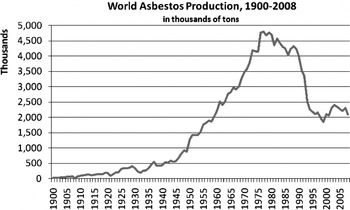
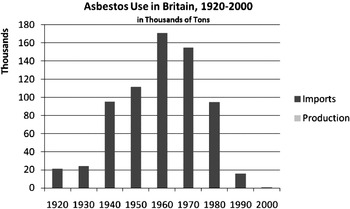
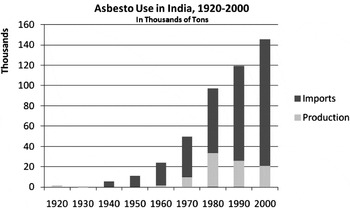
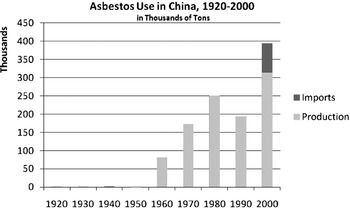
For instance, we may learn something about historical experiences with asbestos in different parts of the world simply by looking at widely available figures on world and national usage. World trends in asbestos production over the past century are revealing in that they document the concentration of ownership and processing in Britain and the United States, though the mineral was mined in former dominions (such as Canada) and developing countries across the southern hemisphere (Figures 1 and 2). Within the developing world we can also chart the distinctive trajectory of asbestos production in countries such as India and China (Figures 3 and 4). Such trajectories map national differences in the experience of hazard tolerance, and also vulnerability. We thereby gain insights into global flows of materials and hazards that cannot be captured from histories of industrial hazard reform that confine themselves to any one nation.
Graph by Christopher Sellers. Source: USGS website, accessed 2 November 2011 at http://minerals.usgs.gov/ds/2005/140/asbestos.pdf.

Chart by Christopher Sellers. Source: Robert Virta, Worldwide Asbestos Supply and Consumption Trends from 1900 through 2003 (USGS, 2006).

Chart by Christopher Sellers. Source: Robert Virta, Worldwide Asbestos Supply and Consumption Trends from 1900 through 2003 (USGS, 2006).

Chart by Christopher Sellers. Source: Robert Virta, Worldwide Asbestos Supply and Consumption Trends from 1900 through 2003 (USGS, 2006).

To situate these diverse but related arenas of history within a framework that is more coherent and meaningful, we have suggested the heuristic notion of an ‘industrial hazard regime’. Through this concept, we seek to encompass the material and institutional contexts within which industrial hazards themselves, as well as knowledge about them, are produced, reproduced and spread, and also the diversity of groups and individuals involved in or touched by these processes. The intention here is to emphasize that every encounter with an industrial hazard, whether or not it is recognized as such, comes embedded within a political economy of risk, characterized by multiple scales. Whether local residents view these dangers as fading remnants of an earlier age, or as rising challenges, hinges on their position within a given era's regional, national and global ‘riskscapes’.Footnote 31 The studies undertaken by historians of the industrial hazard thus far suggest that hazard distribution has long been a significant feature of the world's economy if not its politics. Especially for the actual and potential victims of these dangers, they have remained as influential a part of production as considerations of materials, goods, services and labour.
Industrial hazard regimes: a political economy of danger
Our definition of the ‘industrial hazard regime’ arises out of accumulating case studies in the history of dangerous trades in recent years, also from scholarly discussions surrounding these. Industrial hazard regimes are those arrangements, formal as well as informal, by which public bodies, private interest groups and civic parties mobilize to comprehend, define and deal with the dangers connected with a particular form of production.Footnote 32 The frame of ‘industrial hazard regimes’ is meant at once to summarize and bolster a collective trajectory in our scholarship. We hope thereby to encourage studies of the historical knowledge and experience of industrial hazards that remain more or less comparable, despite vast differences between the places and times each of us studies. While specific enough to encourage studies that speak to one another, it also has an intentional ambiguity that we hope will be flexible enough to help guide the study of hazard conceptions that are radically different from those with which we are familiar. The concept of the ‘industrial’ here draws upon the broader ideas about industrial hazards prevalent in countries like Britain today: that they may extend from afflictions of employees to factory emissions affecting the surrounding area, to damage inflicted via consumer usage and ecological chains of consequence. But the term keeps the door open to a variety of other conceptions that may have prevailed in other times and places, narrower as well as broader, both of the ‘industrial’ and of ‘hazard’ itself. The making of such regimes will depend on the knowledge and agency of many groups of actors: local workers, residents and consumers as well as corporate business, professional experts and government officials, at local, national and international levels of scale.
We recognize that there are intellectual risks in centring our gaze on the production process. Here is where the flexibility of the ‘industrial’ becomes useful. Even if the scientific, political and regulatory focus of historical actors may fall on hazards inside the workplace, for instance, our own contemporary meanings of the ‘industrial’ call upon us to consider attendant environmental damage beyond the production plant. Hazards of industrial activity frequently threaten surrounding residents, and even the consumers of toxic products. Asbestos itself is a case in point. Part of what spurred new knowledge about its effects in mid-twentieth-century Europe and the United States was that mesothelioma, a cancer for which it was the sole known cause, turned up in people without workplace exposure. From the jungles of Malaysia and Mexico to the industrial cities and towns of France and the pastoral fields of rural England, the wider ecological damage inflicted by industrial operations could go little noticed beyond the immediate circle of victims. On the other hand, in some times and places, impacts of these kinds could be just what captures public and scientific eyes. In 1990s France, for instance, exposure to asbestos in schools and public buildings provoked far more intense outrage and mobilized greater political energies than did workplace exposures.Footnote 33 Perhaps the most dramatic examples in recent times were the clouds which spilled from the disasters of Bhopal and Chernobyl, whose ecological devastation and suffering famously extended not just to the surrounding countryside but to fields, markets, cities and even countries far beyond.Footnote 34
Crucial as local and national scales have proven in the study of industrial hazard regimes, the notion also enables contemplation of these and other ways in which hazards can prove transnational. Portable as industrial technologies, expertise and legal prescriptions can be, they may be taken by our contemporary actors to be universal. Yet to work effectively, each must also be attuned to local interests and conditions of a given place. As cultural forms, they are what anthropologists style ‘global assemblages’: ‘global’ because they appear so portable and seamless, but ‘assemblages’ because to be installed in particular locations they require a host of local adjustments and alignments.Footnote 35 The new mid-twentieth-century knowledge about the carcinogenic effects of asbestos is illustrative: as we have shown, it did not become transnational simply through scientific publication in a journal, however widely read. Its spread also hinged on cross-national networks constructed and sustained by experts themselves. On this and other fronts, historians of the industrial hazard have just begun to take up how, especially over the twentieth century, international regimes have evolved the better to know and control industrial hazards. We have begun to learn more, especially about the International Labor Organization (ILO), thanks to Paul-André Rosental and colleagues, but as yet we know less about the World Health Organization or other international institution or network building that has sustained multinational ‘epistemic communities’ of experts.Footnote 36
This budding interest in the transnational dimensions of expertise has coincided with a growing awareness of the impact of transnational actors and dynamics on the local construction of industrial hazards themselves. While imperial nation states were inevitably a powerful force in their colonies, private institutions helped drive or engineer many arrivals and expansions of hazardous processes. Most notable among them was the multinational corporation. Tweedale and McCulloch's study of the asbestos firm Turner and Newhall exemplifies how much we may learn by following corporate migrations from one corner of the world to another.Footnote 37 Workers moved as well, from a home nation or region to where a new industry made wages higher. Especially where these two ‘spatial fixes’ collided, where the arrival of hazardous processes coincided with the inward migration of a vulnerable labour force, exploitation could be especially intense.Footnote 38 Local hazard regimes could also be rendered newly vulnerable through trade in danger-bearing commodities. Among the accumulating examples, anthrax came to be recognized as a hazard in Britain in the late nineteenth century when contaminated wools from the Near East circulated in weaving centres. In the late twentieth century, toxic pesticides banned in the United States found their way to Central American coffee fields, resulting in sterility among plantation labourers.Footnote 39 Whether the hazards converging on a place from abroad were those of commodities or industrial processes, local knowledge, whether missing the dangers or understanding them, and justifying a calculated exposure, often proved an asset to those who most profited from the influx.
In comprehending how the costs of hazard are incurred and who bears them, we can usefully adapt economic theories of ‘externalities’, positivist as they are, in ways that make important room for the historicity of hazard knowledge.Footnote 40 The earliest operators of hazardous processes often found it easy externalize the full bodily and ecological costs of their activities, to make others pay, while reaping greater profits for themselves. Yet we can hardly assume that they knew what today's experts do about these consequences; hence study of just what they knew, or came to know, is critical to understanding their logic. Externalizing theory also raises key questions about what its actual or potential victims knew, and came to know, about the impacts an industry might be having on their bodies, environments and livelihoods. Seen in these terms, the overall history suggested by recent scholarship does affirm some version, however partial and ineffectual, of that tale of progressive ‘enlightenment’ told by the first generation of historians of the industrial hazard. A lack of knowledge about hazards, or delays in its assimilation, contributes to the initiation of dangerous operations.
Combining what we already know about this trajectory with two waves of global economic integration over the last century and a half, as recently sketched by economic historians, enables a tentative outline of the chronology and global geography of hazard history. During the later nineteenth century in much of Europe and North America, the huge expansion of markets via railroads and steamships and the growth of intensive manufacturing and extraction facilitated the making of new regimes of hazard. Exploiting technological and communication innovations, businesses of these nations created rising demand for labour, propelling great migrations; expansive, if easily exploited, workforces; and the rise of labour movements. Across the industrializing world, those who investigated factory and workshop ‘nuisances’, in Europe and America, confronted legal systems heavily tilted in favour of industrial development, whatever the costs. Large corporations that led economic activity in key sectors often intensified long-standing risks in mines and other extractive industries. There and elsewhere, especially in manufacturing, they also pioneered technologies and processes that brought altogether new dangers. Campaigns then arose among unions and allied reformers to strengthen rights to health centred on compensation laws for ‘occupational’ disease and injury, at the state or national level, and, with the ILO, internationally. Among those involved in these changes – spearheading and implementing if also opposing them – were groups of scientific professionals, whose new varieties of expertise were largely confined to the workplace. While the wider environments of industrial cities were also targeted by campaigns for health reform, the dangers that factories or mines imposed on their surroundings, like smoke pollution, generally drew out mobilizations that stayed more localized, and strictly municipal solutions.Footnote 41
We know more about the making and study of hazards in the world's industrial core than its imperial peripheries during this era. As new extractive frontiers were thereby opened, new industries imposed fresh hazards on their workers and on virgin territories, which have been little studied as yet by historians of the industrial hazard. Exemplary of the colonial hegemony arriving in Africa and Asia, Kaur's study of the Malaysian plantations illuminates what could ensue as local peoples were uprooted, land uses shifted and labour was imported from India. Santiago has shown how neocolonial intrusions of British and American oil firms into places such as Mexico could prove heedlessly disruptive. Bridge and Frederickson's study of the opening of Nigeria's mines reveals how the dangers imposed on local labour were bound up with the destruction of a local ecology.Footnote 42 They identify an early strategic role for geologists, pointing to the need for further studies of the ways in which knowledge and expertise, transnational or otherwise, can figure in such projects of exploitation.
A second wave of globalization provided the context for new upsurges of controversy and expertise regarding industrial hazards beyond the workplace. Gaining momentum from the booming conditions of the international economy though the middle and later decades of the twentieth century (though with abrupt downturns in the early 1970s, 1980s and 1990s), it accelerated at least up until the great financial crisis that started in 2008. Through much of the developing world, the confrontations of the Cold War set the climate, and certainly nuclear weapons as well as nuclear power provided a paradigmatic instance of environmental hazard.Footnote 43 But even so these were hardly the only dangers newly imposed or made more unmistakable by the era's fresh economies of speed, scale and scope. As innovations in transport and communications enabled production to be dispersed to unfamiliar regions, competitive pressures on the older economies led to the dismantling of heavier industries such as coal, steel, shipbuilding, textiles and potteries. In Europe and North America, such redundant sectors were replaced by lighter chemicals, synthetic materials, assembly work and soft skills linked to knowledge creation and transfer, including financial transactions, customer call centres and so forth. Heavier industries shed by developed nations, ever more associated with health and environmental problems, were relocated to former colonies and newly industrializing nations. The most glaring example of this recrudescence of dangerous trades remains asbestos. We know much about how, in this era, its carcinogenic and other longer-term effects became well established, and in the litigious and health-conscious countries of the northern hemisphere it was increasingly outlawed.Footnote 44 But where it got a new lease on life, in India and elsewhere, the parallel histories of knowledge, controversy and regulation remain as yet less studied or understood.Footnote 45
It was precisely where the dangerous trades were disappearing that an increasing awareness of the environmental and ecological impact of industrial hazards spurred institutional and legal achievements characterized by some as a progressive ‘ecological modernization’.Footnote 46 The label is misleading: just how ecologically modern can a country be if it remains dependent on ‘non-ecological’ industries beyond its shores? As manufacturing, extractive and even office employment has slipped away from such nations, the ‘flat world’ of global competition described by Friedman has redistributed industrial risks worldwide, with the lion's share now borne by developing nations. In this gravitation of hazards toward the less affluent and more vulnerable, we have much to learn about how knowledge itself, scientific and otherwise, has contributed to the exploitation of those without resources.Footnote 47
What this global evolution in the distribution of industrial risks does suggest is that over the past century, at the national and local levels, two distinct kinds of industrial hazard regime have developed. Some regimes, whether actively or passively, have cultivated the growth of risk-laden industry within their sway. Their political and cultural infrastructure is primarily supportive of and adaptive to the industry in question. Under such regimes, awareness of the possible dangers and actual damages may be minimal, find few outlets, be actively suppressed – or be present but simply shrugged off. Then there are regimes significantly reshaped by social and political controversy over dangerous production. Their laws and oversight are far more searching and formidable, and within their reach knowledge of the deleterious impacts has become much more legitimate, widespread and troubling. The distinction raises an important historical question: when and why have regimes changed from one kind to another? How have industrial communities become more intolerant of risks, both those less known before, and those which may have been recognized before, but also widely accepted?
Exposed bodies, voice, resistance
The problem of change in industrial hazard regimes is one of compelling interest not only to historians of dangerous trades but more broadly to social scientists, health practitioners, activists and policy-makers. Understanding how industrial dangers become intolerable, how a politics of industrial critique and opposition can take shape, requires an examination of just when and how people mobilize to protect their communities against the consequences of toxic output. Recently it has attracted sufficient scholarship to suggest some general directions in which answers may lie. The findings thus far suggest that a certain interplay between knowledge and resistance, involving the inexpert as well as the expert, has contributed at least as much to major reform as have the investigatory and other innovations of groups of scientists.
To explicate these transformative conflicts, historians must at some level acknowledge biological events: what happened, what might even still be happening, in the bodies and environments of the exposed, also the contemporary science that illuminates these events. Experiences of bodily damage often lie at the heart of this history, whether the interests be local or transnational, whether the actors be workers or WHO officials. Many historians of industrial injury have responded to calls by labour specialists to ‘follow the bodies’, to attend more closely to historical variations in bodily experience. Environmental historians have added a further consideration: such experiences may best be understood through close attention to the particular physical environments in which they unfold.Footnote 48 One further step is indispensable: we need to explain how a certain industry's physical make-up and bodily or ecological impacts came to be perceived, and by whom, in a given time and place. This means studying the myriad ways in which human as well as environmental damage came to be deciphered or otherwise known, and given contemporary voice, and not just among recognized experts. Considering the ways in which real or suspected hazards were detected, assessed and articulated among laypeople, as well as among scientists or scientific professionals, allows us to document a fuller context for how dangers become a basis for collective action and political mobilization.
Labour historians have long insisted that we must begin our exploration of the hazardous past by listening to the voices of the victims. Workers and nearby residents without access to the culture and tools of modern science bore the early brunt of so many hazards: workers shipped from India to Malaysia, those living in the wake of Nigerian oil fields, and residents in the lead-smoked streets of Montevideo. Communities of the exposed, whose encounters with industrial risks were often local, direct and immediate, could develop an acute awareness and also a working knowledge of the hazards involved. In many different countries, we know industrial workers and their communities developed a cultural understanding of danger, hazard and illness which contributed to the traditional language as well as to the contemporary speech of such districts. Such terms as ‘grinder's rot’, ‘miner's phthisis’ and ‘potter's asthma’ were recorded by classical authors from Ramazzini onwards, and often betokened a fatalistic recognition that occupations carried their own deadly burden in terms of wrecked health for those taking part. It is worth noting, though, that the most lethal symptoms tended to be associated with older workers, or with an unfortunate (often significant) minority of labourers.
Lay knowledge about production hazards did not inevitably yield a more collective resistance against threats to their health, land or livelihood. Indian migrants to Malaysia in the early twentieth century, for example, had far fewer opportunities to develop collective action and in their case dissatisfaction could as well propel local residents to change jobs or living quarters, rather than risk attracting attention by complaints. Despite the array of problems confronted by Mexican oil workers in the early twentieth century, the movement that they then concocted pressed not just for nationalization of the industry, but for higher wages, in a tacit bargain that the risks should be offset by wage premiums. A similar pattern can be seen in European coal miners' campaigns during the 1920s. Socialist leaders argued for public ownership of an extractive industry that continued to claim the lives of numerous workers, while defending these same jobs, and seeking higher wages for them.Footnote 49 There are now, at the same time, many studies that suggest a strong linkage between victims' awareness of hazards and their mobilizations, from the early twentieth-century struggles against silicosis to the late twentieth-century battles against industrial wastes. One of the most important challenges for historians of hazard is explaining the way in which dangers long familiar and accepted in certain industrial cultures become denaturalized, rendered unacceptable or even politically intolerable.
Questions about the role of experts and their knowledge in this kind of transformation have also received a good deal of attention. Clearly, we learn from this work; claims for greater scientific accuracy and objectivity have often served either as prelude or as dismissive postscript to human and ecological destruction. Expert favouring of more precise methods and rigorous standards could, finally, diminish respect for victims' attitudes and concerns, from the collusion of management techniques and laboratory expertise in Spain during the 1920s to the 1990s rejection of evidence for cancer clusters in Louisiana's notorious ‘Cancer Alley’.Footnote 50 From the mid-twentieth century, scientists seeking precise ‘thresholds’ of bodily and environmental tolerance to dangerous exposures have shored up existing industrial hazard regimes in the face of popular and often well-informed dissent.Footnote 51 Based on such examples, many scholars have drawn sharp contrasts between the professional concerns of the scientific expert and the practical dilemmas of evidence and legitimacy facing the inexpert, as they seek their own conclusions about the hazards they face – hence the concepts of ‘lay epidemiology’ or ‘street knowledge’ describing ways of knowing that unfold outside the community of professional scientists. In many cases, they have shown, such knowledge challenges the abstract rationality of scientists retained by powerful employers or centralized states.Footnote 52
Nevertheless, scientific expertise in industrial hazards has hardly proven monolithic, and does not invariably clash with the concerns of labour movements and local communities. Scientific opinions and disciplines can be as diverse and debated as lay understanding, so too the disposition of experts toward popular knowledge and movements. Analyses of ‘lay epidemiology’ often reveal the strategic facilitating role of sympathetic health experts as well as social scientists, though they might be few in number.Footnote 53 Similarly, mid-twentieth-century reform campaigns addressing problems of industrial dust in Europe, North America and South Africa also featured a distinctive group of experts. Often influenced by left-wing politics during the 1930s, they openly espoused the cause of workers' rights and the protection of employees from substances that ranged from coal to asbestos.Footnote 54 Alliances with medical or scientific experts enabled campaigns of workers or community activists to strengthen their voices, to challenge ‘elite’ knowledge by partial appropriation of its terms and its legitimacy. Just as the knowledge around which lay people mobilized could be produced or facilitated by scientists or doctors, so scientific and medical innovation could arise where experts listened to aggrieved lay people. It may well be that interchanges between lay and expert knowledge, between the subjective, voiced experiences of victims and more objective and codified claims of sympathetic professionals, could yield further-reaching and more effective change than could either alone.Footnote 55
Recent research into the knowledge politics of industrial risks and damages alerts us to the mixture of voices, interests and possibilities that go into the process by which knowledge of industrial hazards is first hatched, converted into science and, on occasion, parlayed into regime change. Ready equations of knowledge with power like Foucault's seem inadequate to describe what historians and allied scholars are finding. There appear to be many steps as well as staircases by which new knowledge about hazards can coalesce, acquire legitimacy and actually help subvert an existing regime. Alternatively, at each step of the way, by virtue of its novelty as well as its critical potential, this knowledge, like the bodies and environments of which it speaks, is vulnerable. To sort out this complexity, historians of industrial hazard will find themselves opening up their studies to a widening range of knowledge makers and users, whether lay, expert or intermediate. They may privilege environmental or communitarian goals or the imperatives of output or higher incomes. As historians of present as well as past dangers, critically evaluating as well as contributing to knowledge, we are necessarily involved in contemporary conversations.
Conclusion
Those who aspire to writing a history of workplace hazards could benefit from advice given to every industrial archaeologist in the 1960s, to ‘dig where you stand’. Recognizing the dangers which confront workers around the world today alerts us to the robust character of production hazards and dispels any idea that dangerous trades belong in a cabinet of historical curiosities. Risks of serious injury remain integral to global production, even if many dirty, difficult and dangerous processes are located at a great remove from most of the authors and readers of this journal. Apologists rationalize these geographic inequalities by arguing that poorer countries should accept hazardous industries as the price of progress, as an early but necessary stage of a longer trajectory toward greater wealth and prosperity.Footnote 56 When firms, consumers and governments in the richer nations are well aware of such dangers and also their remedies, we may well question the moral viability of such propositions. For it is not lack of wealth so much as inequality of knowledge and expertise which often plays a key role in the power exercised by the affluent, so often depriving poor people of the capacity to assess the risks they face. Not they but others often made the key choices that delivered industrial hazards their way. And when the least privileged accepted a risky job or insulated their homes with asbestos, we need to ask hard questions about their awareness of the dangers involved.
Trade in dangerous production has formed part of regional, national and international trade for many decades, even centuries. We urgently need to understand the scale and scope of such hazards. Drawing on fields long friendly to materialist methods, from business history to labour and environmental history to some contemporary sciences, enables us to situate the many relevant knowledge questions within more overarching, even global, narratives. Historians of knowledge in this area cannot neglect, for instance, the workings of transnational capitalism, the relentless search for lower supply costs, mass migration and the swelling flows of capital and technology, as well as toxins, during the past century and a half. In industrial-hazard history, as elsewhere, such a multidisciplinary eclecticism can move historical studies of knowledge beyond the polarities of the late twentieth-century ‘science wars’, and into more transnational pathways of investigation of science's history. Among the questions that may arise: how far has accelerating production and trade contributed not only to the colossal growth of science and technology, but to the rise of specific sciences, whether laboratory or clinical, environmental or medical, engineering or managerial? Examining such disciplines, and the conversations that affected their growth, may raise further transnational questions, about how such communications and networks developed between nations, and between the developed and the developing world.
Among the surest conclusions of recent research is that communities of scientists as well as national capitalisms are riven by myriad divisions and frictions – between and within management as well as workforces, among labour movements as well as community-based and environmental lobbies. The history of science, or perhaps more generally of knowledge, has a vital role to play in helping us unpack these interactions in all their complexity. For though the social alignments and alliances that result have often been far from clear-cut, each such class and interest group has drawn impetus from what they know, or think they know.
Finally, this essay has suggested that we must resist the temptation to counter earlier heroic versions of industrial-hazard history as the triumph of progressive expertise by simply inverting the narrative, by offering fresh triumphalist accounts of lay experience and activism pitched against the massed ranks of scientific power and privilege. Celebrations of popular resistance are indeed reassuring, at least in many circles. But they may have troubling implications. Minimizing the role of those employed in knowledge-intensive work such as scientific research also foists the historical and moral responsibility for improvements onto the shoulders of those in non-expert fields of work and activity. Such labourist and populist interpretations of reform campaigns, as based entirely in industrial or environmental uprisings of the inexpert, risk simplifying the complex loyalties binding capital, labour and citizenry with expertise. And since we too are knowledge workers, as academics, it may tacitly convey an additional message: that the industrial hazards of the present day are not our problem.