1. Introduction
In robot, gripper is one of the most commonly used end effectors since it can grasp different types of objects tightly for potential applications and hence have attracted many research interests while being widely used in practical applications [Reference Kocabas1–Reference Honarpardaz, Tarkian, Olvander and Feng3]. Among the design and realization of grippers, there are two of the most important issues. The first one is to let the grippers fit different rigidity, and the second one is to fit different shapes.
For the first issue, some adaptive control algorithms are introduced. For instance, Maggi et al. [Reference Maggi, Mantriota and Reina4] proposed a novel adaptive underactuated vacuum gripper. Zhou et al. [Reference Zhou, Wang, Tian and Zheng5] developed an observer-based adaptive boundary iterative learning control method. Yang et al. [Reference Yang, Huang, Cheng, Li and Su6] proposed an extreme learning machine based control scheme for uncertain robot manipulation or stopping performing tactile recognition. Mukherjee et al. [Reference Mukherjee, Mahapatra, Kumar and Chatterjee7] worked on a grasp optimization algorithm, for minimizing the net energy utilized by a five-fingered humanoid robotic hand for securing a precise grasp.
For the second issue, some flexible grippers with foldable and bionic structures were proposed in recent years [Reference Shintake, Cacucciolo, Floreano and Shea8]. For example, Abondance et al. [Reference Abondance, Teeple and Wood9] proposed a dexterous three-fingered soft robotic hand that can perform hand manipulations robustly in the presence of uncertainty. Park et al. [Reference Park, Seo and Bae10] developed a hybrid gripper that combines soft and rigid components to simultaneously improve fingertip force and actuation speed. Zhang and Oseyemi [Reference Zhang and Oseyemi11] presented a new SPA with a herringbone chamber design, capable of combined longitudinal and transverse bending deformations that allow for improved conformality in soft gripping. In the field of medicine, grippers with adjustable stiffness were also developed, such as a variable-stiffness robotic gripper by Cardin-Catalan et al. [Reference Cardin-Catalan, Ceppetelli, del Pobil and Morales12] and a foldable manipulator for minimally invasive surgery by Shang et al. [Reference Shang, Ma, You and Wang13]. Meanwhile, some origami patterns were adopted in the design of adaptive grippers due to the foldability with multi-DOF [Reference Mathew, Devasia, Asok, Jayadevu and Baby14–Reference Liu, Maiolino and You17]. Moreover, underactuation is an important approach for simplified designs. Hota and Kumar [Reference Hota and Kumar18] present a study on the effect of design parameters of an underactuated hand on its grasp performance. Su et al. [Reference Su, Wang, Lu and Wang19] proposed a novel self-adaptive underactuated robot hand with rigid-flexible coupling fingers. Furthermore, Marwan et al. [Reference Marwan, Chua and Kwek20] presented a comprehensive review devoted to the techniques related to reaching and grasping objects in different workplaces.
However, these grippers are either assembled of many parts or require a complex-driven system, which is not conducive to reducing cost and ensuring reliability as well as stability. Fortunately, spatial overconstrained mechanisms [Reference Mavroidis and Roth21] have the advantages of simple structure and good rigidity, which always provide solutions for simplified designs with large rigidity. Among the spatial overconstrained mechanisms, those with symmetric properties, such as Myard 5R linkage [Reference Shen, Huang and Ji22], line-symmetric 6R linkage [Reference Song, Chen and Chen23], plane-symmetric Bricard 6R linkage [Reference Feng, Chen, Dai and Gogu24], twofold-symmetric 6R linkage [Reference Yang and Chen25], threefold-symmetric 6R linkage [Reference Song, Guo, Liu, Meng, Chen, Xu and Liu26], are preferred to be chosen in applications. Meanwhile, cable-driven is a convenient way to drive manipulators with simple structures [Reference Xu, Li, Liang and Gao27]. Therefore, in this paper, we will choose a typical overconstrained linkage with great symmetric properties, twofold-symmetric Bricard 6R linkages [Reference Chen, Yang and Zhang28] being easy to be fabricated in the compliant form, to construct a mobile network and to design a conceptual one-DOF compliant gripper.
The paper is organized as follows. In Section 2, the geometric conditions and characteristics of the twofold-symmetric Bricard 6R linkage are introduced. Section 3 is to construct the network with four identical twofold-symmetric Bricard 6R linkages, whose grasping potential is demonstrated by kinematic analysis and a physical prototype. In Section 4, a compliant gripper based on the proposed network is constructed, and the grasping function is realized with the help of a set of designed driven devices. Conclusions are drawn in Section 5.
2. Twofold-symmetric bricard linkage
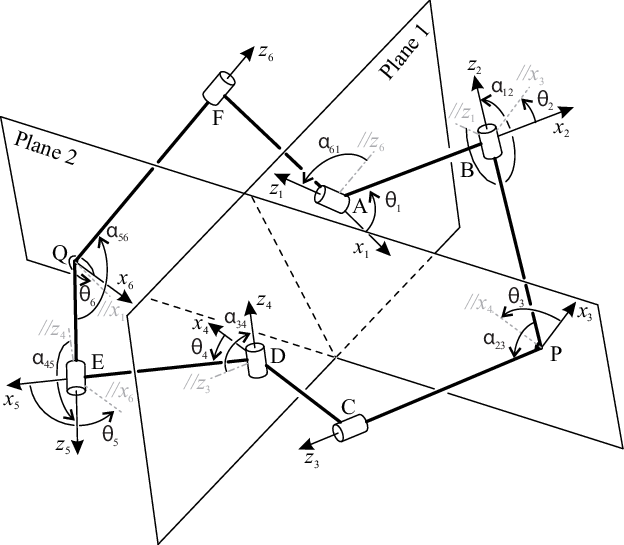
Figure 1 shows a twofold-symmetric Bricard linkage, which is both plane-symmetric and line-symmetric one with six links and six revolute joints (R-joints). There are two symmetric planes, 1 and 2, for these links and joints. The geometric conditions are
 \begin{equation} \alpha _{61}=\alpha _{34}=\alpha, \alpha _{23}=\alpha _{56}=\beta =2 \pi -\alpha, \alpha _{12}=2 \pi -\alpha _{45}=\gamma, \end{equation}
 \begin{equation} a_{12}=a_{45}=0, a_{23}=a_{34}=a_{56}=a_{61}=a ,\end{equation}
 \begin{equation*} R_{1}=R_{4}=r, R_{2}=R_{5}=-r \end{equation*}
 \begin{equation} \left(\left| BP\right| =\left| CP\right| =\left| EQ\right| =\left| FQ\right| =r\right) .\end{equation}
The twofold-symmetric Bricard linkage.

The coordinate frames are set up by the D−H notation [Reference Denavit and Hartenberg29], where
 $\boldsymbol{z}_{i}$
is along the revolute axis of joint i;
 $\boldsymbol{x}_{i}$
is the common normal direction pointing from
 $\boldsymbol{z}_{i-1}$
to
 $\boldsymbol{z}_{i}$
;
 $a_{i(i+1)}$
is the normal distance between
 $\boldsymbol{z}_{i}$
and
 $\boldsymbol{z}_{i+1}$
;
 $\alpha _{i(i+1)}$
is the angle of rotation from
 $\boldsymbol{z}_{i}$
to
 $\boldsymbol{z}_{i+1}$
about axis
 $\boldsymbol{x}_{i+1}$
;
 $R_{i}$
is the normal distance between
 $\boldsymbol{x}_{i}$
and
 $\boldsymbol{x}_{i+1}$
; and
 $\theta _{i}$
is the angle of rotation from
 $\boldsymbol{x}_{i}$
and
 $\boldsymbol{x}_{i+1}$
about axis
 $\boldsymbol{z}_{i}$
. Here, a, r,
 $\alpha$
,
 $\gamma$
are the geometrical parameters of the linkage,
 $\theta _{i}$
is the kinematic variable to show instantaneous configurations.
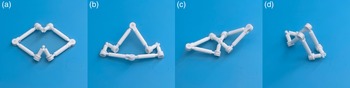
There are four possible motion modes for the linkage, i.e., twofold-symmetric 6R motion mode, plane-symmetric 6R motion mode, spherical 4R motion mode and two-bar mode, as shown in Fig. 2, and their kinematic equations [Reference Yang and Chen25] are as follows.
The prototype with parameters
 $\alpha =\dfrac{5 \pi }{3}, \gamma =\dfrac{ \pi }{3}, a=60\;\textrm{mm}, r=25\;\textrm{mm}$
at (a) twofold- symmetric
 $6$
R, (b) plane-symmetric
 $6$
R, (c) spherical
 $4$
R, and (d) two-bar modes.

-
1. Twofold-symmetric 6R motion mode
 \begin{equation} \theta _{5}=\theta _{3}, \theta _{6}=\theta _{2}, \theta _{4}=\theta _{1}, \theta _{3}=\theta _{2}+ \pi, \tan \frac{\theta _{1}}{2}=\frac{D}{E} .\end{equation}
-
2. Plane-symmetric 6R motion mode
 \begin{equation} \theta _{5}=\theta _{3}, \theta _{6}=\theta _{2}, \tan \frac{\theta _{3}}{2}=\frac{C}{F}, \tan \frac{\theta _{1}}{2}=\frac{G}{H}, \tan \frac{\theta _{4}}{2}=\frac{I}{J} .\end{equation}
-
3. Spherical 4R motion mode
 \begin{equation} \begin{array}{l} \sin \phi _{23}\sin \phi _{35}\cos \phi _{35}\cos \left(\theta _{2}-\psi \right)-\left(\sin \phi _{23}\cos \phi _{35}+\cos \phi _{23}\sin \phi _{35}\cos \left(\theta _{2}-\psi \right)\right)L_{1}\\[5pt] -\sin \phi _{35}\sin \left(\theta _{2}-\psi \right)L_{2}-\cos \phi _{23}\cos ^{2}\phi _{35}+\cos \phi _{23}=0 \end{array} ,\end{equation}
 \begin{equation} \theta _{5}=\theta _{\textrm{2}}+ \pi\;\textrm{or}\;\theta _{5}=2\psi -\theta _{\textrm{2}}+ \pi ,\end{equation}
 \begin{equation} \begin{array}{l} \sin \phi _{35}\sin \phi _{23}\cos \phi _{23}\cos \left(\theta _{2}-\psi \right)+\left(\sin \phi _{23}\cos \phi _{23}\sin ^{2}\phi _{23}\cot \phi _{35}\cos \left(\theta _{2}-\psi \right)\right)M_{1}\\[5pt] +\dfrac{\sin ^{2}\phi _{23}}{\sin \phi _{35}}\sin \left(\theta _{2}-\psi \right)M_{2}-\cos \phi _{35}\cos ^{2}\phi _{23}+\cos \phi _{35}=0 \end{array} .\end{equation}
in which C, D, E, F, G, H, I, J,
 $\phi _{23}, \phi _{35}$
,
 $\psi$
, L
1, L
2, M
1, and M
2 can be found in [Reference Shen, Huang and Ji22].
-
4. Two-bar mode
When
 $\alpha \in \left(\dfrac{3 \pi }{2},\textrm{2} \pi \right)$
and
 $\textrm{2}\alpha -\gamma = \pi +\textrm{2}l_{1} \pi, l_{1}\in Z$
,
 \begin{equation} \theta _{1}=\theta _{4}=q_{5}, \theta _{2}=\theta _{6}= \pi, \theta _{\textrm{3}}=\theta _{\textrm{5}}=0, q_{5}\in \left[- \pi, \pi \right] .\end{equation}
When
 $\alpha \in \left( \pi,\dfrac{3 \pi }{2}\right)$
and
 $\textrm{2}\alpha +\gamma = \pi +\textrm{2}l_{2} \pi, l_{2}\in Z$
,
 \begin{equation} \theta _{1}=\theta _{4}=q_{6}, \theta _{2}=\theta _{6}=\textrm{0}, \theta _{\textrm{3}}=\theta _{\textrm{5}}= \pi, q_{6}\in \left[- \pi, \pi \right] .\end{equation}
When
 $\alpha =\dfrac{3 \pi }{2}, \gamma \in \left({0, \pi }\right), r\neq 0, a\in \forall$
, there is no two-bar mode.
Kinematic equations of twofold-symmetric 6R motion mode and two-bar mode show that the kinematic relationships are related to
 $\alpha$
and
 $\gamma$
, while a and r do not affect the folding properties.
3. The network of four identical twofold-symmetric bricard linkages
3.1. Construction of the network
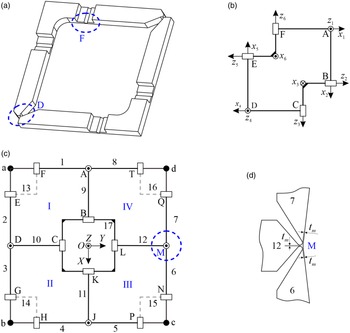
The target of this paper is to design a compliant gripper mechanism [Reference Howell and Midha30] that does not need complicated assemblies. Milling polypropylene (PP) board, which always exhibits the property of good fatigue strength, is a common way to fabricate compliant mechanisms. Therefore, the directions of R-joints in complaint mechanisms are expected to be either parallel to the workpiece plane or perpendicular to the plane to facilitate manufacturing, see hinge D, F in Fig. 3(a). Then,
 $\dfrac{ \pi }{\textrm{2}}$
and
 $\dfrac{3 \pi }{2}$
are preferred to be chosen as the twist angles in the linkage.
The construction of a network by (a) milling PP board to form a compliant linkage showing with (b) its schematic diagram. (c) The network is obtained by four units containing four (d) compound R-joints.

Figure 3(a) shows a physical prototype of a twofold-symmetric Bricard linkage with twist angles
 $\alpha =\dfrac{3 \pi }{2}$
and
 $\gamma =\dfrac{ \pi }{2}$
, whose schematic diagram is shown in Fig. 3(b). Due to the great symmetric property of the linkage, a network can be constructed by taking four identical units, distributing them as a
 $\textrm{2}\times \textrm{2}$
array, as shown in Fig. 3(c).
In this assembly, there are 17 links connected with 12 single R-joints, e.g., joints B, C, K, L, E, F, G, H, N, P, Q, and T, and four compound R-joints, e.g., joint A, D, J, and M. For a single R-joint, it can be realized easily by milling a thin strip, as shown in Fig. 3(a). However, for compound R-joints, it is difficult to manufacture since three thin strips, see three t m in Fig. 3(d), could not coincide at one common position.
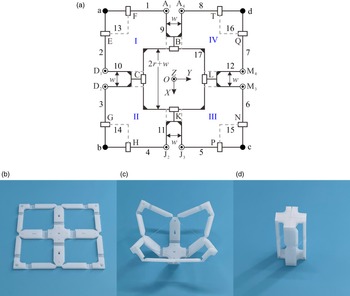
To facilitate the manufacturing of compliant compound R-joints, the network was modified by offsetting the adjacent Bricard units at A, D, J, and M with a distance w, as shown in Fig. 4(a). According to the folding and unfolding characteristics of the network, the mechanism realizes the functions of unfolding and grasping through the cooperation of four Bricard mechanisms, among which a, b, c, and d on links 13, 14, 15, and 16 are 4 grasping points, the link 17 is the frame.
The compliant mechanism to construct a four-finger gripper with (a) structure diagram was manufactured with one PP board (a) at the plane configuration, (b) at the middle folding process, and (c) at the fully folded configuration.

To evaluate the property of the mechanism, mobility and kinematics will be studied to show the potential as a gripper.
3.2. Mobility analysis
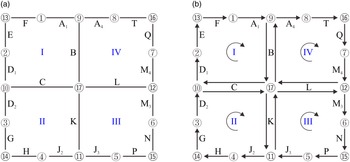
Figure 5(a) gives the topological graph of the proposed network [Reference Wohlhart31], as shown in Fig. 4(a), by taking links as vertices, and joints as edges. There are four kinematic loops, I, II, III, and IV. Among them, the vertices (links) are labeled with numbers, and the edges (joints) with A, B, C, …, T. The directed graph is given in Fig. 5(b) to show the four kinematic loops.
The topological graph of the proposed network by (a) taking links as vertices, joints as edges, and (b) its directed graph to show four kinematic loops.

The global coordinate system O-
XYZ
is established at the center of link 17 to evaluate its kinematic behaviors, where
X
axis directs along
 $\overrightarrow {\boldsymbol{BK}}$
,
Y
axis directs along
 $\overrightarrow {\boldsymbol{CL}}$
, and
Z
axis is determined by the right-hand rule, as shown in Fig. 4(a). Therefore, the coordinate values of all points are
 \begin{equation*} \begin{array}{r@{\quad}r@{\quad}r@{\quad}r} \boldsymbol{A}_{\textrm{1}}=\left(-n_{3}\textrm{,}-\dfrac{w}{\textrm{2}},\;\textrm{0}\right)^{\textrm{T}} & \boldsymbol{A}_{\textrm{4}}=\left(-n_{3},\dfrac{w}{2},\;0\right)^{\textrm{T}} & \boldsymbol{B}=\left(-n_{2},0,0\right)^{\textrm{T}} & \boldsymbol{C}=\left(0,-n_{2},0\right)^{\textrm{T}} \end{array} \end{equation*}
 \begin{equation} \begin{array}{r@{\quad}r@{\quad}r@{\quad}r} \boldsymbol{D}_{\textrm{1}}=\left(-\dfrac{w}{\textrm{2}},-n_{3},0\right)^{\textrm{T}} & \boldsymbol{D}_{\textrm{2}}=\left(\dfrac{w}{\textrm{2}},-n_{3},0\right)^{\textrm{T}} & \boldsymbol{E}=\left(-n_{1},-n_{3},0\right)^{\textrm{T}} & \boldsymbol{F}=\left(-n_{3},-n_{1},0\right)^{\textrm{T}}\\[5pt] \boldsymbol{G}=\left(n_{1},-n_{3},0\right)^{\textrm{T}} & \boldsymbol{H}=\left(n_{3},-n_{1},0\right)^{\textrm{T}} & \boldsymbol{J}_{\textrm{2}}=\left(n_{3},-\dfrac{w}{\textrm{2}},0\right)^{\textrm{T}} & \boldsymbol{J}_{\textrm{3}}=\left(n_{3},\dfrac{w}{\textrm{2}},0\right)^{\textrm{T}}\\[5pt] \boldsymbol{K}=\left(n_{2},0,0\right)^{\textrm{T}} & \boldsymbol{L}=\left(0,n_{2},0\right)^{\textrm{T}} & \boldsymbol{M}_{\textrm{3}}=\left(\dfrac{w}{\textrm{2}},n_{3},0\right)^{\textrm{T}} & \boldsymbol{M}_{\textrm{4}}=\left(-\dfrac{w}{\textrm{2}},n_{3},0\right)^{\textrm{T}}\\[5pt] \boldsymbol{N}=\left(n_{1},n_{3},0\right)^{\textrm{T}} & \boldsymbol{P}=\left(n_{3},n_{1},0\right)^{\textrm{T}} & \boldsymbol{Q}=\left(-n_{1},n_{3},0\right)^{\textrm{T}} & \boldsymbol{T}=\left(-n_{3},n_{1},0\right)^{\textrm{T}} \end{array} ,\end{equation}
where
 $n_{1}=a+\dfrac{w}{2}, n_{2}=r+\dfrac{w}{2}, n_{3}=a+r+\dfrac{w}{2}$
.
At the planar configuration, the unit direction vectors of all joints are
 $\boldsymbol{s}_{\textrm{1}}=(1,0,0)^{\textrm{T}}, \boldsymbol{s}_{2}=(0,1,0)^{\textrm{T}}, \boldsymbol{s}_{3}=(1,0,0)^{\textrm{T}}$
, where
 $\boldsymbol{s}_{\textrm{3}}$
is the direction vectors of joints A1, A4, D1, D2, J2, J3, M3, and M4,
 $\boldsymbol{s}_{\textrm{2}}$
is that of joints B, E, G, K, N, and Q,
 $\boldsymbol{s}_{\textrm{1}}$
is for C, F, H, L, P, and T. According to the definition of the screw [Reference Dai32]

the screws of the R-joints are,


According to [Reference Wohlhart31], the kinematic constraints are

where
 $\omega _{i}$
represents the angular velocity of R-joint i.
The equations can be written in the matrix form
 \begin{equation} \boldsymbol{K}_{24\times 20}\cdot \boldsymbol{\omega }_{20\times 1}=0 ,\end{equation}
where
 $\boldsymbol{\omega }$
is the collection of velocities with a vector,
 $\boldsymbol{K}_{24\times 20}$
is a coefficient matrix composed with screw values from Eqs. (11).
 \begin{equation*} \boldsymbol{\omega }\boldsymbol{=}\left[\omega _{{\boldsymbol{A}_{1}}},\omega _{{\boldsymbol{A}_{4}}},\omega _{\boldsymbol{B}},\omega _{\boldsymbol{C}},\omega _{{\boldsymbol{D}_{1}}},\omega _{{\boldsymbol{D}_{2}}},\omega _{\boldsymbol{E}},\omega _{\boldsymbol{F}},\omega _{\boldsymbol{G}},\omega _{\boldsymbol{H}},\omega _{{\boldsymbol{J}_{2}}},\omega _{{\boldsymbol{J}_{3}}},\omega _{\boldsymbol{K}},\omega _{\boldsymbol{L}},\omega _{{\boldsymbol{M}_{3}}},\omega _{{\boldsymbol{M}_{4}}},\omega _{\boldsymbol{N}},\omega _{\boldsymbol{P}},\omega _{\boldsymbol{Q}},\omega _{\boldsymbol{T}}\right]^{\textrm{T}} \end{equation*}

The mobility of the mechanism M should equal the dimension of the nullspace of
 $\boldsymbol{K}_{24\times 20}$
.
 \begin{equation} M=20-\textrm{rank}\left(\boldsymbol{K}_{24\times 20}\right)=20-19=1 .\end{equation}
Therefore, the degree of freedom of the mechanism is one at this configuration.
Since the unit of the mechanism, twofold-symmetric Bricard linkage, owns four possible motion modes being reconfigurable with some bifurcation points. The mobility and singularity analysis along the whole motion period will be analyzed in the following part.
3.3. Singularity analysis
The mechanism is equivalently transformed into the truss form by the truss-transformation method [Reference Yang, Chen, Kang and Ma33], see Fig. 6. In the proposed network, there are four types of links, e.g., BCKL, A1A4B, A1F, and EF. They can be transformed as spatial polyhedron A0A1E0E1J0J1N0N1U0, polyhedron A0A1B0B1T0T1, tetrahedron B0B1C0C1, and plane triangle C0C1C2, respectively.
The truss form of the mechanism.

For the truss, there are b = 110 bars and j = 34 joints and its equilibrium equations [Reference Pellegrino and Calladine34] can be established conveniently by coordinate values of all vertices.
 \begin{equation} \boldsymbol{H}\cdot \boldsymbol{t}=\boldsymbol{f} ,\end{equation}
where
H
is the equilibrium matrix with dimensions
 $102\times 110$
and can be obtained by Matlab according to ref. [Reference Pellegrino and Calladine34],
t
is the inner tensions along all bars, and
f
is the external force on all vertices. Here, we only consider the truss without external forces, i.e.
 $\boldsymbol{f}=\mathbf{0}$
, Then Eq. (15a) becomes a set of homogenous linear equations
 \begin{equation} \boldsymbol{H}\cdot \boldsymbol{t}=\mathbf{0} ,\end{equation}
The instantaneous mobility is then obtained by the rank of H [Reference Pellegrino and Calladine34].
 \begin{equation} M=3j-\textrm{rank}\!\left(\boldsymbol{H}\right)-6 .\end{equation}
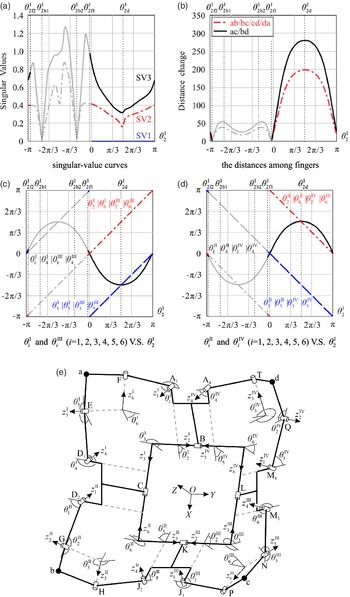
Meanwhile, the singular value decomposition (SVD) method is a convenient way to calculate the rank of a matrix. By a predictor and corrector strategy through SVD [Reference Kumar and Pellegrino35], the motion process of the truss form is obtained. The singularity property can be obtained by recording the singular values, as shown in Fig. 7(a). It can be found that the possible singular positions only occurred in the situations of physical interference illustrated with curves with gray on the left sides. To evaluate the potential of grasping further, the distances among four fingers, ab, bc, cd, da, ac, and bd are calculated in Fig. 7(b). It can be found that when
 $\theta _{2}^{\textrm{I}}$
approaches
 $\theta _{2\textrm{f}1}^{\textrm{I}}=-0.03 \pi$
and
 $\theta _{2\textrm{f}2}^{\textrm{I}}=-0.97 \pi$
, the distances are both close to zero, which indicates that the mechanism is grasping the target object tightly. When
 $\theta _{2}^{\textrm{I}}$
approaches
 $\theta _{2\textrm{d}}^{\textrm{I}}=0.5 \pi$
, the distance among gripping points is the maximum, which indicates that the mechanism returns to the plane state. Further, kinematics equations of each Bricard linkage can be obtained as shown in Fig. 7(c)−7(e). Finally, a prototype was fabricated by 3D printing, where the design parameters are
 $\alpha =\dfrac{3 \pi }{2}, \gamma =\dfrac{ \pi }{2}, a=54\textrm{mm}, r=35\textrm{mm}, w=20\textrm{mm}$
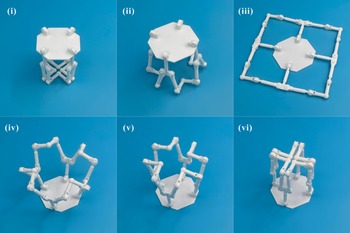
. The folding process, see Fig. 8, shows that the mechanism can work with the ability to grasp.
Kinematics of four-finger gripper. (a) singular-value curves. (b) the distances among fingers. (c)
 $\theta _{i}^{\textrm{I}}$
and
 $\theta _{i}^{\textrm{III}}$
(i =
 $1, 2, 3, 4, 5, 6$
) v.s.
 $\theta _{2}^{\textrm{I}}$
. (d)
 $\theta _{i}^{\textrm{II}}$
and
 $\theta _{i}^{\textrm{IV}}$
(i = 1, 2, 3, 4, 5, 6) v.s.
 $\theta _{2}^{\textrm{I}}$
. (e) schematic diagram of joint variables.

The folding sequence of a rigid gripper prototype.

4. A conceptual four-finger gripper
In the previous sections, the grasping possibility of the proposed network was shown by the kinematic study and the prototype of the network. To confirm the ability to grasp different shapes of objects and to show its advantage, the network will be realized with a compliant one as the skeleton of a gripper, and then the structural design, design parameters, and driven schemes will be discussed as follows.
4.1. The compliant mechanism
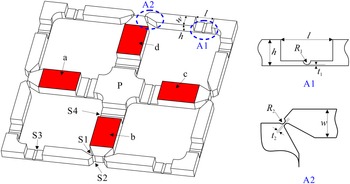
Based on the rigid gripper mechanism with the advantage of twist angle, this section adopts the rigid body replacement method [Reference Howell and Midha36] to transform the linkage into a compliant four-finger gripper mechanism, as shown in Fig. 9. The key to realize the design lies in the design of flexure hinges. Here, circular flexure hinges, which are easy to be manufactured, are adopted. According to the direction of the hinges in the mechanisms, there are two types, horizontal circular hinges and vertical circular ones, see A1, A2 in Fig. 9.
Structure diagram of the compliant gripper.

In twofold-symmetric Bricard linkage, parameters a and r will affect the grasping range and do not affect the kinematics, here
 $a=54\;\textrm{mm}$
and
 $r=35\;\textrm{mm}$
are adopted. The arc radius
 $R_{1}$
of the horizontal circular hinge and its thickness
 $t_{1}$
, the arc radius
 $R_{2}$
of the vertical circular hinge and its thickness
 $t_{2}$
, the thickness of the plate
 $h$
, and the distance of the adjacent Bricard linkage
 $w$
are the design variables. Meanwhile,
 $l=2h, R_{1}=R_{2}=R, t_{1}=t_{2}=t$
are satisfied to simplify the design and avoid physical interference, see Fig. 9.
4.2. Parameters of the flexible hinges
To obtain a set of reasonable parameters, DOE experiments are adopted based on static simulation. Here, R is set to the tool radius available on the market to facilitate future fabrication. Generally, t is located
 $0.05R\leq t\leq 0.8R$
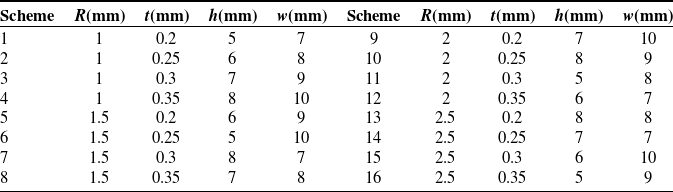
[Reference Yong, Lu and Handley37]. Therefore, the DOE is set with four horizontal parameters listed in Table I, and then a group of 16 Taguchi experimental schemes with four factors is assigned in Table II.
Flexure hinge variable level value.

The arrangement of experiment schemes.

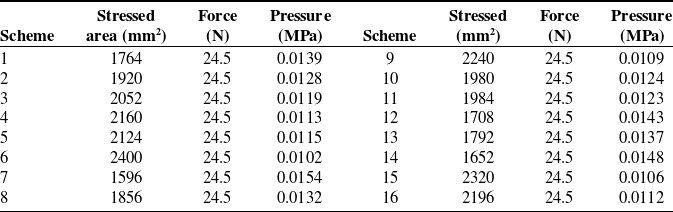
PP plate, which exhibits great flexural fatigue resistance, with the density of 0.92 g/cm3, elastic modulus with 1620 MPa, and Poisson’s ratio with 0.4203, bending strength limit
 $\sigma _{\textrm{b}}=56\;\textrm{MPa}$
is adopted, and simulations are performed in the implicit statics module of ABAQUS. Surface P is viewed as the fixed frame, and pressures are loaded on surfaces a, b, c, and d, see Fig. 9, whose values are listed in Table III to ensure the consistency of the driven forces.
Pressure values for simulations in ABAQUS.

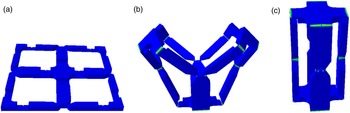
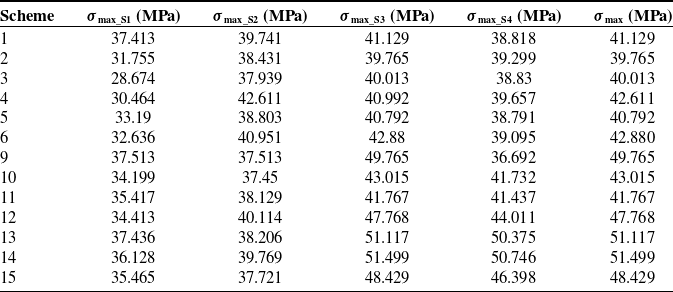
After the simulations in ABAQUS, the results show that most schemes, except schemes 7, 8, and 16, could move from the plane configuration to the fully folded one under the action of the applied load to realize the grasping function, such as the result of scheme 3 in Fig. 10 as an example. The Mises stresses on hinge surfaces S1, S2, S3, and S4, whose locations are labeled in Fig. 9, are taken as the optimized metrics.
Static simulation of the compliant mechanism from (a) its planar configuration to (b) a middle folding process, and then to (c) the fully folded configuration.

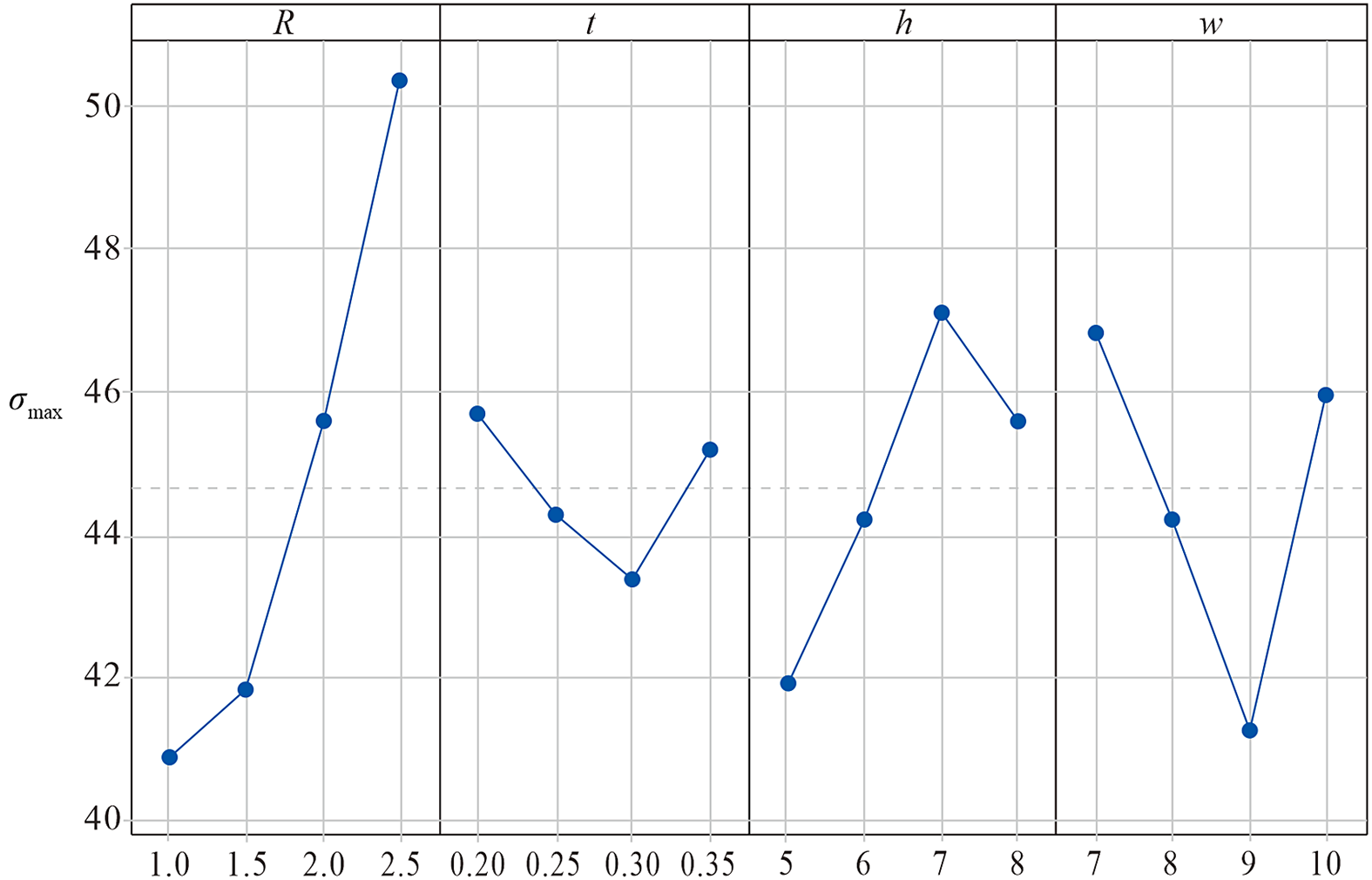
The Mises stresses of 13 groups of experiments are obtained from the results of the finite element analysis (FEA) in Table IV. Then, the analysis of experiment results was carried out in Minitab, and the influence of each parameter on the maximum stress value,
 $\sigma _{\max }$
, is obtained, as shown in Fig. 11.
Experimental records from Minitab.

The result of the DOE Taguchi experiments.

Therefore, the DOE experiment predicts that the compliant mechanism with
 $R=1\;\textrm{mm}, t=0.3\;\textrm{mm}$
,
 $h=5\;\textrm{mm}, w=9\;\textrm{mm}$
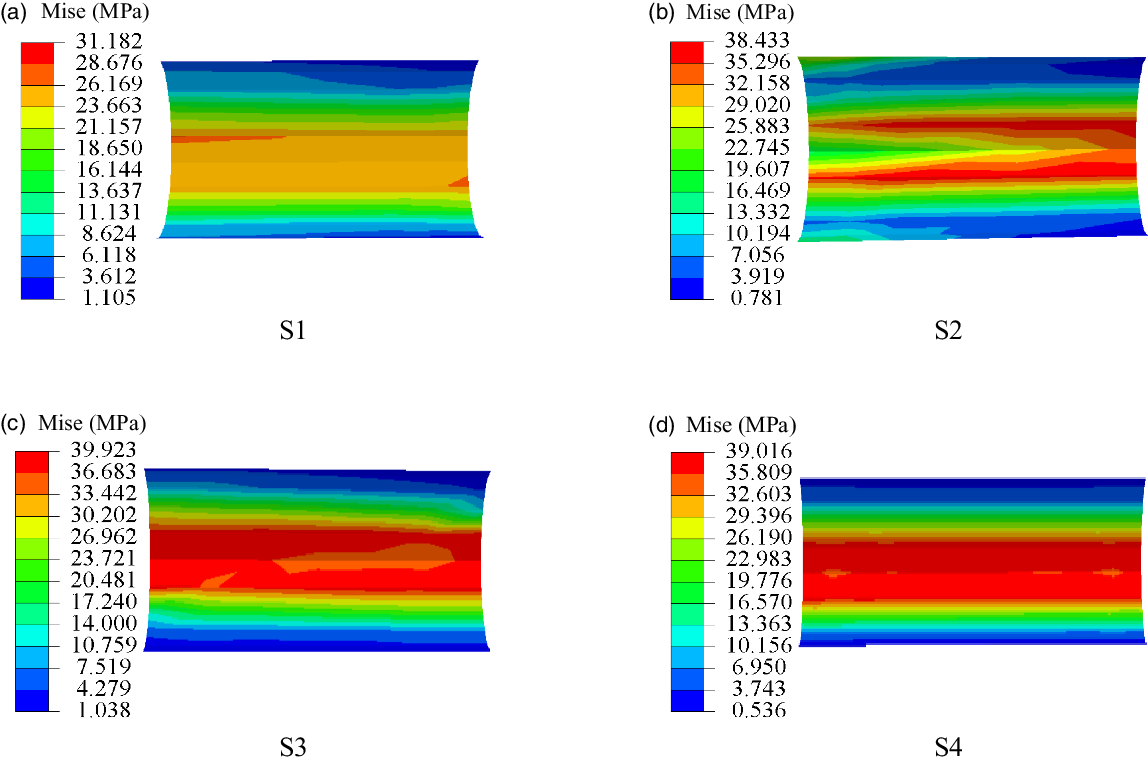
, will own smaller stresses, which is also verified by a further simulation with this set of parameters, as shown in Fig. 12. Meanwhile, the maximum stresses of the four hinge surfaces are
 $\sigma _{\max \_ \textrm{S}1}=31.182\;\textrm{MPa}, \sigma _{\max \_ \textrm{S}2}=38.433\;\textrm{MPa}, \sigma _{\max \_ \textrm{S}3}=39.923\;\textrm{MPa}, \sigma _{\max \_ \textrm{S4}}=39.016\;\textrm{MPa}$
, all of which are smaller than the allowable stress by taking the safety factor
 $n_{\textrm{b}}=1.3$
,
 \begin{equation} \left[\sigma _{\textrm{b}}\right]=\frac{\sigma _{\textrm{b}}}{n_{\textrm{b}}}=\frac{56}{1.3}\approx 43.08\;\textrm{MPa} .\end{equation}
Stress situations of the optimized flexure hinge.

Hereby, a set of parameters
 $a=45\;\textrm{mm}, r=20\;\textrm{mm}, R=1\;\textrm{mm}, t=0.3\;\textrm{mm}, h=5\;\textrm{mm}$
, and
 $w=9\;\textrm{mm}$
is determined, then a ball-end mill with a diameter of 2 mm and a flat-end cutter with a diameter of 2 mm were chosen to process the horizontal circular hinge and vertical circular hinge by an engraving machine, respectively.
4.3. Driven scheme
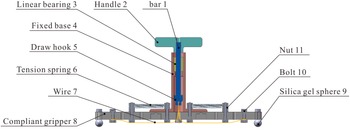
To cooperate with the proposed compliant mechanism, a cable-driven device, composed of four tension springs, a prismatic pair device and four pulling wires, is designed, as shown in Fig. 13.
Schematic diagram of the cable-driven device.

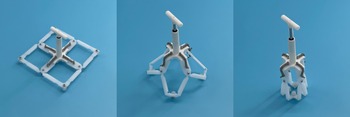
A draw-bar and a linear bearing are used in the prismatic pair device, and the axial movement of the draw-bar is controlled by the handle to drive the gripper. One end of each tension spring is fixed to the bolted connection of the fixed base in the prismatic pair device, and the other end connects the compliant gripper with bolts. Wires are used to transmit the driven force by connecting the draw hook and the compliant mechanism. A cable-driven device was finally fabricated by 3D printing, and it can realize the grasping function by adjusting the height of the handle, see Fig. 14.
Grasping process of the compliant gripper.

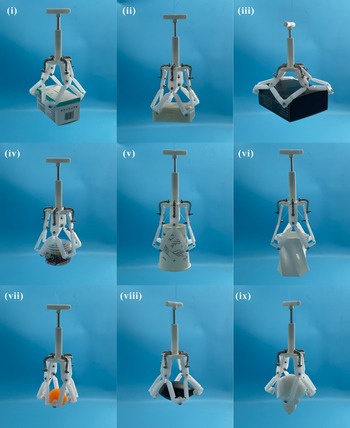
To verify the grasping efficiency of the compliant gripper mechanism, some different shapes of objects, such as square-, cylinder-, spherical, and irregular bodies are selected for the grasping test, as shown in Fig. 15. It can be seen that the gripper has the advantages of simple structure, large working range and strong adaptability, and can grasp different types of articles.
Grasping test of the compliant gripper.

5. Conclusions
In this paper, a novel gripper mechanism based on a compliant network with four identical twofold-symmetrical 6R linkages was proposed. The mobility is analyzed by the topological theory, and shows that the proposed network is with one DOF. The grasping potential was demonstrated with the folding performance by the truss-transformation method, and the results are verified by a physical prototype. By the rigid body replacement method, a compliant four-finger gripper was designed and fabricated. Finally, the function of the compliant four-finger gripper was realized by a cable-driven scheme.
Compared with the existing grippers that can grasp objects with complex shapes, such as five-fingered humanoid robotic hand [Reference Mukherjee, Mahapatra, Kumar and Chatterjee7], underactuated robotic hand [Reference Hota and Kumar18], SAU-RFC hand [Reference Su, Wang, Lu and Wang19], etc., the compliant gripper proposed in this paper has the advantages of compact structure, single degree of freedom and low manufacturing cost, and owns lower stiffness due to the usage of compliant joints.
In the future, the design parameters of the flexure hinges will be optimized by the pseudo-rigid-body-model [Reference Howell and Midha30] to reduce the deformation stress. Due to the property of compliance, the deformation energy on compliant joints should be considered in the evaluation of grasping performance, and the grasping indices, such as G.I. index, C.I. index, and so forth [Reference Carbone38], will be modified to fit compliant grippers.
Supplementary material
To view supplementary material for this article, please visit https://doi.org/10.1017/S0263574722001503.
Author contributions
FY, JZ, and LY conceived and designed the study. KC and TL conducted the derivation of equations, designed prototypes, and carried out the experiments. KC, TL, and FY wrote the draft of the article. FY, KC, TL, JZ, and LY revised the article.
Acknowledgement
The authors appreciate Mr. Weiwei Lin and Mr. Shuailong Lu for the help on the fabrication of the compliant mechanism and Mr. Yuan Gao for the assistance on the application of the truss-transformation method.
Financial support
This work was supported by the National Natural Science Foundation of China (Project No. 51905101), the Natural Science Foundation of Fujian Province, China (Project Nos. 2019J01209, 2020J06010), and Fuzhou University Testing Fund of Precious Apparatus (Project No. 2022T014).
Competing interests declaration
The authors declare none.