“It’s because of me that they know Umm Kulthum, so I’m happy to work with dancers,” Syrian-Argentine Nabil Aldawish explained over Turkish coffee following an afternoon coaching of one of his students (interview, 28 June 2014).Footnote 1 We met frequently during the winter of 2014, and we discussed everything music, including the controversial issue of danza árabe and the Arab art music tradition (Barrionuevo Reference Barrionuevo2014:13–62).Footnote 2 His music and dance studio is located in the Palermo neighbourhood of Buenos Aires, Argentina, an area that is home to many in the Middle Eastern community and hosts the most established and iconic Middle Eastern restaurants in the Argentine capital. As such, Palermo has become an important site for learning, practising, performing, discussing, debating, subverting, and dancing to Arab traditional music. These practices, or the musicking of Arab traditional repertoire,Footnote 3 are entangled with divergent convictions regarding what constitutes traditional music. Although Aldawish is an established performer within the Arab musicking scene, he feels that he must consistently defend his artistic choices and justify the manner in which he chooses to perpetuate Syrian traditional music in efforts to maintain his reputation. His experience is evidence that what many Syrian-Argentine musicians refer to as cherished “tradition” is also a problematic concept that inspires much consideration and debate.
In seeking to understand the differing sentiments behind varied performance practices, I found that diverse perceptions of tradition were inextricably linked to individuals’ particular diasporic experiences. While general commonalities between Syrian-Argentines register geographic origin, it is issues of temporality that dominate the narratives, revealing difference and digression between conceptions of musical tradition and performance. The resulting musicking indexes individuals’ particular subjectivities that manifest from a distinct migratory time and experience, referred to in this article as diasporic generation.Footnote 4
Central to understanding how diasporic generational difference renders diverse considerations of tradition in the Arab community of Buenos Aires are the testimonies of Syrian-Argentine musickers—musicians, dancers, and connoisseurs who are, or who are descendants of, Syrian immigrants.Footnote 5 In order to examine how the migration experience has shaped their perceptions of musical tradition, I apply concepts from three different scholars in diaspora studies. I use the term “diasporic generation” after Mette Berg, who describes the deterritorialised subjectivities expressed by Cuban nationals living near Madrid in her analysis of their varied experiences as migrants, refugees, and those living in exile (Berg Reference Berg2011). Her categorisations of diasporic generations are based on individual migration times and trajectories, placing greater emphasis on connections to the temporally specific social and historical contexts that form distinct migratory experiences, thereby decentralising the geographical homeland in her analysis of diaspora formation (ibid.:42). I extend her application of the term to account for all members of the Syrian-Argentine community, including second- and third-generation Syrian-Argentines in Buenos Aires, who themselves did not migrate but who are active participants within the Arab music scene. In this way, my analysis of diasporic generation serves to measure what Takeyuki Tsuda describes as diasporicity, or “…the relative strength of a geographically dispersed ethnic group’s transnational connections and identifications with both the ancestral homeland and the co-ethnics residing in other countries” (Tsuda Reference Tsuda2016).Footnote 6 The musickers that I have chosen to include in the present analysis each maintain different levels of diasporicity that directly correlate to their diasporic generation and have profoundly affected their approaches to traditional music practice. Their multiple diasporic generations and varying levels of diasporicity result in different versions of what Brian Axel refers to as the “diasporic imaginary” (Axel Reference Axel2001, Reference Axel2002). In exploring the historical formation of the Sikh diaspora, Axel emphasises that it is processes of temporality and corporeality that produce homeland subjectivities and argues that it is the circumstances of displacement that produce notions of the homeland, countering past understandings of the homeland as central to the production of diaspora formation (Axel Reference Axel2001). As a result of discrete diasporic experiences, Syrian-Argentine musickers of different diasporic generations sustain multiple diasporic imaginaries, according to which each maintains different notions of traditional musicking.
Through the application of the aforementioned concepts, this article demonstrates the importance of centralising temporality instead of the geographical in order to better understand the unique perspectives behind the different conceptions of tradition among different diasporic generations. While there are studies that offer understandings of musically active diasporic communities that demonstrate collective efforts to remember and preserve heritage (for example, Meyers Reference Meyers1998; Shelemay Reference Shelemay1998; Reyes Reference Reyes1999; Slobin Reference Slobin2000; Kligman Reference Kligman2009; Aparicio Reference Aparicio2010; Zheng Reference Zheng2010), this article focuses on a sort of diasporic enclave in which members attest to the ways that crucial parts of their cultural heritage have been diluted and even lost, due to the history and unique context of the autonomous capital of Buenos Aires (in contrast to the Syrian diasporic communities throughout the rest of Argentina). The revitalisation of the Arab musicking scene due to popular culture has inspired members of the younger generations to understand and reintegrate what they believe to be lost traditions, and many who seek to embody cultural heritage turn to musicking. However, as the effects of the ever-changing home country and assimilation efforts have manifested differently for, and have had a profound effect on, the cultural practices of members of different diasporic generations,Footnote 7 there are no customs or traditions, real or invented, that have been passed down as unharmed relics within the diasporic community. Currently, as musicians of different diasporic generations bear the onus of tradition (in the name of heritage preservation) within what they consider to be a weakened Syrian community, their individual subjectivities give way to generative performances of heritage that demonstrate it as “a new mode of cultural production in the present that has recourse in the past” (Kirshenblatt-Gimblett Reference Kirshenblatt-Gimblett1995:369). In a world that is increasingly diasporic, this study offers an important example of how diasporic generation affects inner-community relations and the resulting activities that produce “traditional” musicking (Hall Reference Hall and Morely1998:492).
Arab Migration to Argentina
While praxis variance within the Arab music field of Buenos Aires can be attributed to diverse circumstances and subjectivities, evident in the personal narratives of the practitioners is the impact of the history of Arab migration to Argentina. Settled on the western banks of the Rio de la Plata, Buenos Aires, the autonomous capital of Argentina, is a port city that long received millions of immigrants who were in search of opportunity and refuge. After gaining independence from Spain in the nineteenth century, the new Argentina, in the wake of its colonial beginnings and in pursuit of a national identity, maintained an open immigration policy that facilitated what early nationalists considered to be its most crucial import—the immigrant workforce (Gimson and Kessler Reference Gimson and Kessler2005:8). While migrant groups from multiple continents ventured to the port of Buenos Aires, it was the largest contingent, that of the European immigrants, who established the Euro-Argentine “modern” face of the developing nation (ibid.:9). Fuelled by positivist thought, the Argentine government actively recruited Europeans in the late 1880s in order to fortify rural and industrial labour forces that would allow Argentina to develop its economy and export industry (Solberg Reference Solberg1970:8).
Racial theories that were popular at the turn of the century supported preferences for the white European alongside the criollo Footnote 8 population, and they were critical of the dark-skinned, indigenous and mestizo Footnote 9 masses who were dismissed as intellectually and biologically inferior (ibid.:18). Despite political and social movements of the twentieth century that sought to reverse these attitudes and incorporate indigenous and minority populations into the national narrative, European-Argentines predominated socio-political structures and remained synonymous with Buenos Aires. Furthermore, racial-national ideologies that informed the developing mass plurality overlooked ethnicities not able to lay claim to indigenous, African, Iberian, and, primarily, European ancestry. However, the last constitutional revision, completed in 1994, which included recognition of some indigenous rights, has prompted new racial self-identification and social acknowledgement for groups previously repressed and marginalised (Warren Reference Warren2009:769). While this minor shift has affected popular representations of indigenous populations,Footnote 10 the change in overall tenor is perhaps what has also inspired communities of non-indigenous minorities to celebrate a heritage or extraction that previous generations struggled to conceal. One such group is that of the Argentines of Arab descent—broadly known as the Sirio Libanés.Footnote 11
Arab immigration to Argentina began in the late nineteenth century when peoples of what was then the province of Greater Syria—individuals who sought to escape conflict and the stagnant, restrictive conditions of the Ottoman Empire—left their homeland in search of greater economic and educational opportunities (Civantos Reference Civantos2006:6). Events that would eventually lead to the fall of the Ottomans, such as the 1861 Règlemente Organique (resulting from the 1860 riots in Mount Lebanon) and the Young Turk Revolution of 1908, can be viewed as two of the main catalysts for the large surges in emigration from the region prior to 1914. Obligatory military service and the persecution of the Christian population are also often cited as significant push factors. By World War I, at least 450,000 people from Greater Syria (part of the approximately one million èmigrès to the New World from the Ottoman Empire) were working to establish themselves in the mahjar,Footnote 12 or “place of immigration,” in the Americas (Hyland Reference Hyland2017:30).
While it is difficult to obtain the exact number of Arab immigrants who landed in Argentina due to inconsistent record-keeping at both origin and arrival points, it is believed that by 1917 more than 100,000 had settled in the country (Civantos Reference Civantos2006:7). Following an ebb during World War I, Arab immigration numbers rose again (though much less than previous waves), reaching higher levels in the 1930s, as people desired a life outside of the British and French colonial mandates. This surge lasted through the early 1950s when larger numbers of Palestinians arrived, but ebbed again until the exodus of Lebanese began in the 1980s because of the civil war. While historians often cite the Arab population as the fourth largest immigrant group in Argentina, it is possible that it is significantly larger. In an interview I conducted with an official of the Argentine Ministry of Foreign Affairs and Integration, the official stated that he estimated the Arab population to be the third largest after the Italian and Spanish (Anonymous, interview, 23 June 2013). He added, however, that an accurate census continues to be difficult to obtain because historically many Argentines of Arab descent abandoned claiming their heritage for fear of xenophobic prejudice that could result in persecution by the police and other government officials.
Since the earliest arrivals in the late eighteenth century, and throughout the first half of the twentieth century, sentiments towards Arab immigrants and their descendants were generally negative. During this period, most Arabs, regardless of their country of origin, were referred to as “turcos” because of their Ottoman identity papers (Civantos Reference Civantos2006:viii). While Italian, Spanish, and northern Europeans were considered to be desirables who could better the nation by bolstering the workforce and improving mestizo blood, Arabs were regarded as unneeded within the developing society. They were considered to be a nuisance to an already fragile Argentine infrastructure, and were viewed as cunning and shrewd people who, in a country that was in need of agricultural labour, were merely street traders and contributed nothing significant to Argentine society (Klich Reference Klich1993:179). Thus, while the term “turco” is still in use today in Argentina, it is generally pejorative (Civantos Reference Civantos2006:viii; Klich Reference Klich1993:178; Solberg Reference Solberg1970:20). It was not until the 1920s that “Sirio Libanés”Footnote 13 started to gain traction as an umbrella label for the heterogeneous, pan-Arab community (Jozami, Bargman, and Bialogorski Reference Jozami, Bargman and Bialogorski1998:92). While the term homogenised the group identity for the broader Argentine society, it also reflected homeland politics and the budding, national distinctions of Syria and Lebanon (Hyland Reference Hyland2017:133).
Being Sirio Libanés in Argentina
Through personal testimonies, remaining lore, and the establishment of community institutions and publications, we can understand more about the historical formation of a Sirio Libanés identity in Argentina––an identity that was and continues to be contested as it filters through generations. As demonstrated by the various meanings inscribed by novelists and journalists of the Arab diaspora in Argentina, the meaning of “Sirio Libanés” has shifted with the volatile political situations of the homeland, the evolving social climate in Argentina, and developing national narratives of both (Reference Hylandibid.:5, 69). Despite the false cultural homogeneity that it has come to imply, it promotes essentialisms with which musickers of all diasporic origins and generations must reckon.
The ways that members of the Arab community in Buenos Aires self-identify today reflect how a previously established positionality is colliding with shifting values and allegiances influenced by current global affairs. The historical intersections of origin country politics with local social, political, and economic issues for Arab immigrants have been thoroughly explored by Steven Hyland Jr (ibid.). Focusing on the northwestern province of Argentina, he examines emigration patterns and adaptation tendencies surrounding the differential experiences between multiple generations of Arab-Argentines, including how the particular circumstances for each generation affected individuals’ perceptions of identity and thus, recognition of cultural markers such as musical tradition. It is the narrative of the Syrian elite (due mostly to pecuniary and some political success) that dominated representations of the Arab-Argentine community, hence the prevalent use of the term “Sirio Libanés.” In conjunction with transnational literary movements of the mahjar and Greater Syria, they became the cultural brokers between the diasporic community and host society in many ways (ibid.:109). Serving Arabs of any national origin, Syrian organisations such as religious establishments, charities, and social clubs stood as promising sites for the preservation of Arab culture. However, the inclinations of second- and third-generation Arab-Argentines to strive to assimilate in the new home country, and the disruptive infighting within their community, rendered the roles of such institutions impactful, but precarious. This was especially true of the community that resided in Buenos Aires.
Despite their evolving roles, Syrian and Lebanese social clubs continue to thrive in the major urban centres of each state in Argentina. Some serve as cultural centres that host regular programmes and events such as classes on Middle Eastern cooking and dance, and ḥaflāt Footnote 14 and heritage festivals that frequently employ the talent of Arab musicians. But unlike those that provide such activities in the cities of Rosario, Tucumán, and Santiago del Estero, the Club Sirio Libanés of Buenos Aires functions as an upscale sports and social club without Middle Eastern cultural offerings. Aside from housing a reputable Middle Eastern restaurant, it fails to offer events that celebrate a Sirio Libanés heritage. Once, during fieldwork, I proposed that the club offer a Middle Eastern music concert, one that would provide variety among the many Western classical chamber music concerts that are frequently performed there. Seemingly puzzled by the idea, the club secretary explained that it would have to pass through the upper administration for approval—a process that I initiated but for which I never received a response. While visiting the club one evening, I asked one of the council members (who is a successful and prominent businessman) about the absence of any Arab cultural events or activities, and what this meant in terms of the club’s role within the Arab-Argentine community in Buenos Aires. He replied, “Ah, you are from the U.S., and in the U.S., you are salad. You are Syrian-American, [someone else] is Chinese-American…but here in Argentina, we are soup. I am Argentine. I have a Syrian background, but I am one hundred percent Argentine” (Anonymous, interview, 21 July 2014).Footnote 15 He went on to explain that while learning about one’s heritage and past is always good, the members of the club were not particularly interested in participating in or providing Middle Eastern cultural activities. He added, “These [cultural activities] might have been for my grandparents” (ibid.). His reaction to my prompt reflects his position as a third-generation Syrian-Argentine who was raised in a milieu where assimilation was prioritised over the preservation of an Arab identity. As Nabeel Abraham and Andrew Shryock have keenly observed in Detroit, Michigan, when Arabs, as an ethnic minority, have experienced upward mobility and economic success, individuals may choose to remain “mainstream” and imagine themselves within the host, non-Arab society, or remain in the margins, as they position themselves in relation to the Arab world and culture (Abraham and Shryock Reference Abraham and Shryock2000:16). In Buenos Aires, the capital federal and centre of the European face of Argentina, the cultural praxis of the Arab community reflects an overall favouring of the mainstream over the celebration of ethnic difference in order to survive and succeed. This is in contrast to counterparts in other states, where communities and individuals may more easily sway in and out of marginality as they are distanced from the “face” of Argentina and among other minorities, who did not have to suppress their Arabness to the same extent.
The response from the Club Sirio Libanés council member was not unique, but similar to the sentiments expressed by many within the community in Buenos Aires. Most of the people that I interviewed identified as Argentine with some Arab background.Footnote 16 Furthermore, I found that higher levels of resistance to an Arab nationality or duality of a national identity often corresponded with one’s acceptance of orientalist notions and depictions of Middle Eastern culture. As I discuss further in this essay, this inclination has had a tremendous effect on the musicking of Arab-Argentines. The formation of such attitudes, however, are deeply rooted in Arab-Argentine history.
Providing critical insight into the historical representations of the Orient prevalent in Argentine literature, Christina Civantos observes how representations shifted with the arrival of Arab immigrants, and how Argentine orientalisms affected Arab-Argentines’ self-perceptions (Civantos Reference Civantos2006). The textual dialogue between Argentines of European descent and Arab immigrants in Argentina beginning in the mid-1800s through the late twentieth century provides insight into the ways that early Arab immigrants accepted certain orientalisms and reiterated them as truths, leading to a practice of self-essentialism that was passed on to younger generations. This background provides a foundation for interpreting socio-cultural practices of second, third, and fourth generations of Sirio Libanés. Many musickers, in particular, continue to misrepresent an already orientalised past through what they perceive and present as traditional performance practice.
Misrepresentations notwithstanding, the Arab-Argentine community has and continues to thrive and influence Argentine economic, political, social, and cultural spheres. The previously disliked class of Arab-Argentine merchants turned out to serve as important trade liaisons with Middle Eastern countries during the initial neoliberal structural adjustments of Argentina in the 1990s.Footnote 17 The election of Syrian-Argentine Carlos Menem as president of Argentina (his two terms lasted from 1989 to 1999) was initially perceived as an opportunity to bring positive change to popular perceptions of the Arab-Argentine. While Menem managed to achieve a significant turnaround of the economic crisis that he inherited with his induction as president, his legacy was ultimately tainted by another economic fallout towards the end of his second term, in addition to numerous legal and ethical controversies. Currently, the first lady of Argentina, Juliana Awada, serves as what the media perceives as a positive face of Arab-Argentines. She is the daughter of a Lebanese immigrant father and a third-generation Syrian mother who has made waves in popular realms because of her chic fashion and public displays of affection with her husband. Referred to by the media as a “liberal half Muslim,” her persona contrasts with the extremist images overplayed by the media—images that have had an impact on the country’s willingness to participate in relief efforts as a host country to Syrian refugees amid the current crisis (Rebossio Reference Rebossio2015).
As of 2016, Argentina committed to accepting 3,000 Syrian refugees—a commitment that Foreign Minister Susana Malcorra claims is important for Argentina because it is a country of immigrants and must continue to welcome those in need. The country has instituted Programa Siria, a programme that grants humanitarian visas to Syrians affected by the conflict and assists with their settlement throughout their first year in Argentina. However, as of November of 2017, there were only 320 Syrians living as participants in Programa Siria (Bernas Reference Bernas2017).
While it seems the place for the Syrian in Argentine society is precarious, popular entertainment continues to present various facets of so deemed Arab “tradition” that allow Argentines to engage with a perceived Arab culture through various mediums. Despite the misrepresentations and orientalist depictions, popular cultural products such as the megahit telenovela, O Clone,Footnote 18 and the danza árabeFootnote 19 trends, have inspired curiosity about Arab peoples and society. This has led to a rise in the performance activities of Syrian musicians and dancers in Buenos Aires, who are hired for an increasingly large number of cultural events within and outside of the Sirio Libanés community.
Diasporic Generation and Musical Tradition
Today, the Sirio Libanés of Argentina produce a complex, stratified social arena where diasporic generation greatly contributes to perceptions of the self and others within communities and provides divergent cultural platforms through which members may identify as Arab. The current surge of popular Middle Eastern cultural forms is the result of the broad accessibility of relatively recent mediums such as telenovelas, dance trends, and pop song hits that invoke orientalist notions of Middle Eastern culture and music. Thanks to the pervasiveness of danza árabe (Karam Reference Karam2010), or belly dance, performances of Arab musical forms have become popular sites for identification with and contestation of traditional music.
Two relatively recent productions are often cited as responsible for bringing Arab culture into the Latin American popular consciousness: the Brazilian telenovela O Clone, and the music and dance performances of the Lebanese-Columbian songstress known as Shakira (Aidi Reference Aidi2003:44). O Clone, a science-fiction love story that unfolds between Brazil and Morocco, first aired in 2001 on the Brazilian Rede Globo television network. Its popularity was not isolated to Brazil—it was syndicated and aired in more than thirty countries and became one of Spanish language Telemundo’s highest rated telenovelas. Footnote 20 Highly popular from the airing of its first episode, O Clone brought orientalist imagery such as veiled, sexualised women and belly dancers into the homes of Latin Americans as it aired shortly after 11 September 2001 (ibid:45). While it spurred controversy due to both the cultural misrepresentation of Arabs and Islam and the recent terror attacks in the US, it also ignited a belly dance craze and Middle Eastern fashion trends that permeated urban centres throughout Latin America, including Buenos Aires (ibid.).
This coincided with the popularity of Shakira and the increased interest in the Lebanese influence on her music and identity post-September 11. Following the tragedy, rather than downplay the Middle Eastern facet to her performance persona as she was advised, Shakira celebrated it via belly dance, hip scarves, and politically themed concerts (ibid.). She fused Latin American and Middle Eastern culture in a way that resonates with many of the third- and fourth-generation Syrian-Argentine musickers who began to seek to understand their Sirio Libanés heritage through music and dance trends. Without direct contact with the Middle East or even relatives who had migrated, many younger generations of Sirio Libanés turn to popular acts such as O Clone and Shakira—acts that have erroneously portrayed belly dance as central to Middle Eastern life and identity, but have also provided an accessible medium to those who have little to no other contact with Middle Eastern culture. In fact, danza árabe has become so pervasive in Buenos Aires that, whether it was accepted as a conduit for the performance of Arab traditional music, or rejected by musicians who found it irreputable, it made a significant impact on all those I interviewed during my fieldwork.
The cultural misconceptions that these popular mediums engender have nonetheless resulted in an increased interest in perceived traditional Arab music practice. The renewed interest in the Arab music scene in Buenos Aires has attracted more porteños to the neighbourhood where most of the Arab musicking takes place: Palermo.Footnote 21 Located in north-eastern Buenos Aires, Palermo is the largest barrio in the city and was a popular neighbourhood for settlement among the early migrants who arrived from Greater Syria. It continued to grow with Sirio Libanés chain migration throughout the twentieth century and today, although there are few new Syrian migrants arriving, many choose to settle in Palermo where Middle Eastern religious centres and restaurants are still located.Footnote 22
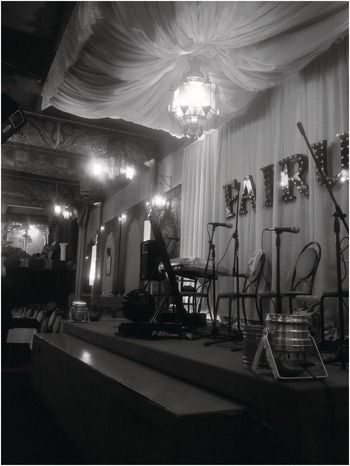
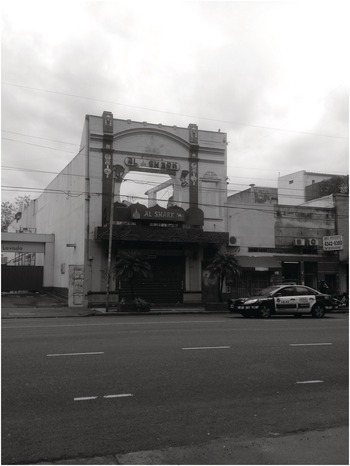
Within Palermo, Sirio Libanés can attend Divine Liturgy at La Catedral Ortodoxa San Jorge—a church that began with the forming of an Antiochian Orthodox worship community of migrants in 1923 and resulted with the construction of the church on Avenida Raúl Scalabrini Ortiz that opened in 1946.Footnote 23 It is also home to the Centro Cultural Islámico “Custodio de las dos Sagradas Mezquitas, Rey Fahad,” the largest mosque in Latin America—a product of the collaboration between Carlos Menem and the Saudi Arabian government.Footnote 24 During his presidency, Menem granted the land for the building of the mosque, and the Saudi Arabian government gifted the entire structure. Also in Palermo are Middle Eastern restaurants, many offering halal cuisine, and a few that regularly showcase Middle Eastern music and dance. For the Arab musicking scene in Buenos Aires, two of the most important venues are the restaurants known as Al Shark and Fairuz, both located on Avenida Raúl Scalabrini Ortiz in Palermo. These two restaurants, decorated with Moorish design elements and orientalist imagery including paintings of pyramids and belly dancers, have stages to host Middle Eastern music ensembles and dance floors both for the audience and professional dancers of danza árabe. The most legendary performers of Arab music and dance in Buenos Aires have all passed through these two venues (Figures 1 and 2).
The ensemble stage at El Restaurante Árabe Fairuz, set for an evening dinner concert (photo by A. Shaheen Espinosa, 2014).

The façade of Restaurante Al Shark on Avenida Raúl Scalabrini Ortiz (photo by A. Shaheen Espinosa, 2014).

El Restaurante Árabe Fairuz—an important centre for Arab-Argentine musicking—opened its doors for the first time on 10 December 1999. Including an upstairs dance academy, it was a dream of the famed Argentine dancer known as Fairuz and husband Gamal Murad. Footnote 25 Fairuz, the dancer, has been performing since the 1970s, but shot to fame when she belly danced with President Carlos Menem on the famed Argentine television series Almorzando con Mirtha Legrand in 1991.Footnote 26 By the time she opened her restaurant, interest in danza árabe was on the rise, and restaurants such as Fairuz and Al Shark became popular sites for porteños curious about Arab culture. Fairuz observes that danza árabe exploded in the early twenty-first century likely due to “menemismo”, fascination with Arab culture post-September 11, and Shakira,Footnote 27 and with it the Arab musicking scene intensified. This forced musicians to rethink how they were representing tradition and what would be accessible to audiences who had no prior contact with the music. Arab music repertoire, instrumentation, and song form became critical topics for consideration.
Arab urban art music, including styles performed by takht ensembles, waṣla suite forms of Aleppo, and film and long-song styles popularised by Umm Kulthum and her contemporaries, dominate the Arab musicking scene in Buenos Aires.Footnote 28 While Syrian-Argentines of multiple diasporic generations perform these genres and claim them as an important part of Syrian heritage, there is much disagreement regarding the manner in which they are traditionally performed. However, tension surrounding traditional performance practice is common among musickers in Syria as well.
Historically, the music and instrumentation of the takht ensemble has served as a basis for these styles and for composers and performers of Arab contemporary Arab art music practice, who proceeded to develop the older traditions into new styles and song forms (Racy Reference Racy2003:75). While features of newer styles can still be traced back to various pre-twentieth century practices that developed in Ottoman-ruled urban centres throughout the Middle East, there is no solid consensus on which twentieth- and twenty-first-century styles constitute traditional music. (Racy Reference Racy1986:414; Shannon Reference Shannon2006). Furthermore, beginning around the mid-twentieth century, “traditional” song styles in Lebanon and Syria began to reflect the incorporation of multiple influences including Western classical and popular, Arab, Russian, and Balkan folk (among other) music (Racy Reference Racy1986:415; Stone Reference Stone2004:20). As Jonathan Shannon demonstrates, Syrian musicians and composers continue to struggle to improvise a modern identity while maintaining an authentic aesthetic within urban art music in a post-colonial Syria (Shannon Reference Shannon2006). He observes that there is no general agreement on what is traditional and authentic in Syria, and while there are regional tendencies towards one genre or another, there are many subjectivities that affect individuals’ considerations of authenticity (ibid.). While these issues are not unique to musicians functioning in diaspora, in diasporic communities the tenor of such discussions is heavier—there is more at stake. Syrian-Argentines are performing traditional styles that have recourse to past practices and therefore, a past Syria. However, as musickers of multiple diasporic generations have formed multiple diasporic imaginaries of homeland, there are multiple Syrias to preserve, and each is represented by a different understanding of tradition.
In the case of the Arab music field of Buenos Aires, individuals’ migratory experiences also inform assessments of peer performances. Whether interviewing a Syrian immigrant, a second, or even third-generation Syrian-Argentine, concepts of tradition directly corresponded to personal alignment with a migration story. Furthermore, when discussing fellow performers, individuals often anchored their subjective assessments to one’s familial proximity to a Syrian migrant. Thus, as musicians and dancers promote and perpetuate various perceptions of tradition, they compete for gigs and cultural legitimacy both within and outside of the Syrian diaspora.
I turn now to individual testimonies and performances that took place in Buenos Aires that are each representative of a specific diasporic generation. As performers describe their varied diasporic experiences, they systematically identify their conceptions of Arab music through their relationship to Syria. Applying Christopher Small’s concept of “musicking” allows for consideration of all of the interrelated processes involved in a musical performance. Small coined the term with his controversial text of the same name in 1998, arguing that music is not an object, or noun, but rather a verb, and that the process of musicking encompasses all actions of every participant in a performance—from the performer, to the audience, to the cashier accepting tickets and the custodial staff that prepares the venue (Small Reference Small1998:9). Thus, in my observations of the Arab music scene in Buenos Aires, I have considered the testimonies of every participant, or musicker, involved: musicians, restaurant owners, patrons, dancers, and audience members. The musickers discussed below are performers, dancers, and connoisseurs who are exemplary of the type of musicking that is critical to understanding how diasporic generation affects notions of tradition within the community.
Syrian-Argentine Musickers
Daniel Binker Duek
Daniel Binker Duek is a second-generation Syrian-Argentine who identifies as Syrian. He is primarily a teacher, composer, and performer of the ‘ud (short-necked fretless lute). Born and raised in Argentina, he lived in Aleppo, Syria (his family’s hometown) during the 1980s. He is fluent in Modern Standard Arabic and makes it a priority to teach it to his children who also speak Hebrew and Spanish. Trained in Arab art music styles prior to his residency in Aleppo, Binker became active as a member of the legendary classical Arab music community in the city famed for its unique waṣla style. After returning to Argentina, he was determined to revitalise the Arab art music scene—one that had been well-established mid-twentieth century, but which had diminished with the passing of its most active singers, such as Selim Zeitune, Elias Hamui, and Said Azar (Binker Reference Binker Duek2011). Once back in Argentina, Binker eventually formed the Wurud Halab Orquesta, which now consists of a few of his children and members of the Syrian-Argentine community.Footnote 29 Wurud Halab performs one to two concerts per year, as learning the repertoire requires a time commitment that is difficult for members of the ensemble, who all work in occupations outside of the music field in order to maintain a livelihood within the precarious Argentine economy. While Binker’s concerts are promoted in Sirio Libanés and Arab cultural centres and embassies, the majority of attendees are members of the Syrian Jewish community in Buenos Aires.
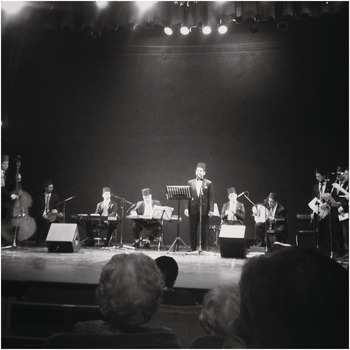
I attended one of Wurud Halab’s concerts at a hall in the historic Centro Cultural Borges in June 2013. The concert was full, and most of the attendees were members of the Syrian Jewish community. Wurud Halab performed songs made famous by Sabah Fakhri, Umm Kulthum, Mohammad Abdel Wahhab, and Abdel Halim Hafez, among others. All members of the takht ensemble were young men of Syrian descent, and a chorus of older men would join for certain songs. At the intermission, the entire audience flocked to tables set up outside the hall, which offered traditional Aleppan fare homemade by Daniel Binker’s wife. Following the approximately 45-minute break, concertgoers returned to their seats to enjoy another hour and a half of Wurud Halab’s stylings (Figure 3).
Wurud Halab performing in the concert hall at Centro Cultural Borges. Daniel Binker Duek is performing qānūn and his son, known as Yacoub Afandy is performing as the vocal soloist (photo by A. Shaheen Espinosa, 2014).

While Wurud Halab is well-known within the Syrian community of Argentina, they have received more international recognition thanks to Binker’s son, vocal soloist Iaaub. He has travelled to Cairo to perform and was most recently featured on the BBC Arabic Radio’s, Ṣunduq al-Nughum, a programme that seeks to promote musical heritage amid the current political turmoil. “There’s no one like him,” states Binker, who glows with pride when speaking about his son. “However, it is hard. Hard to keep performing this tradition when you are a young man. There’s not much interest or money in it here” (pers. comm. 14 July Reference Binker2014).
Because Binker’s earliest exposure to Arab music was through that of mid-twentieth century classical Syrian artists via records that his mother would play in the home, it is the traditional styles of Aleppo’s Mohammad Khairi and Sabah Fakhri that he believes exemplify an authentic Syrian sound.Footnote 30 Encouraged to musick Syrian tradition by his parents, he listened to the records of first-generation Middle Eastern musicians such as Syrian-Argentine Selim Zeitune (1919–1999), which influenced his views of traditional practice. When Binker discusses his position in the Arab music field of Buenos Aires, he explains that his childhood in a musical home and time in Aleppo qualify him to serve as an authority on Arab music. It is his diasporic experience—his musical upbringing as a second-generation Syrian-Argentine, contact with music from first-generation Syrian-Argentines, and later his visit to the homeland—that increases his diasporicity and informs his concept of tradition. For his orchestra, Daniel Binker is not interested in current Syrian popular musics, in fusion styles, or in the popular incorporation of an “org,” or electronic keyboard, that most Syrian musicians in Buenos Aires (along with musicians in the Syria and the global diaspora) employ. When he speaks about the pervasiveness of the org on the Arab musicking scene in Buenos Aires, he expresses an understanding and need for such changes, even though he does not care to incorporate them into his own performances:
Look, if you hear a great young musician performing in traditional styles here, come back in twenty or thirty years and they will not sound or be the same. Why? Because young performers will want to make money. They will need to have a life, buy cars, you know. It is not sustainable to perform or teach traditional music for a living, musicians here will have to do something else or incorporate electronic versions of instruments through the org to save [paying additional players] and rehearsal time. Then you can perform more and for more events, but it is no longer tradition.
(ibid.)He insists on maintaining Wurud Halab as a traditional takht, and one that performs what he considers to be authentic Syrian art music. Binker’s commitment to this tradition is consistent with the musical ideals of the of the Syrian Jewish community of which he is a part. As described by Kay Kaufman Shelemay, for the community that left Aleppo and formed diaspora in the Americas throughout the twentieth century, the Arab musical world, as they left it, continues to be an important source of musical concepts, both for the classical Arab music tradition and other genres and song styles (Shelemay Reference Shelemay1998:104; see also Kligman Reference Kligman2009). Thus, the traditions that Daniel Binker perpetuates are consistent with that of his diasporic generation and the corresponding and diasporic imaginary.
Nabil Aldawish
Nabil Aldawish, a friend and colleague of Daniel Binker, performed frequently with him when he first arrived to Argentina. Aldawish was born in Syria to a Syrian father, and a second-generation Syrian-Argentine mother whose emigrant father returned to Syria with her. He grew up learning to play the ‘ud and studied at the Arab Conservatory of Music (part of an institution that later evolved into the High Institute of Music in Damascus, Syria). From young adulthood, he loved to play Arab art music for various social settings on the ‘ud, but made a living performing the org (electronic keyboard) in restaurants and for parties in and outside of Damascus. He immigrated to Argentina in the 1990s following encouragement from his cousin, who had previously immigrated.
After arriving to Buenos Aires, Nabil Aldawish struggled to find work as a musician. He met Daniel Binker early on and studied maqām and worked with him. He eventually found steady employment performing org, solo or with percussion and/or vocalists (and often accompanying dancers), at well-known local Lebanese and Syrian restaurants, Al Shark and Fairuz. He also gives private lessons on the maqām system, ‘ud technique, and works one-on-one with those wanting to perform danza árabe by providing them with practice sessions and coaching on song form.
When asked why he no longer collaborates with Daniel Binker, Aldawish explained that he respects Binker’s exquisite abilities as a performer, but that he believes that Binker is not realistic in his expectations for the Arab music scene in Buenos Aires. He went on to describe how difficult it was to lucratively perform Arab art music back in Syria today, and that general interest in art music is waning. Additionally, Binker does not perform with dancers, as it is a practice he believes to be distracting to the music. Aldawish acknowledges that performing with dancers would not be acceptable in his community in Syria, but he believes he must adjust to the Argentine culture and submit to the popular demand. He sees danza árabe as a gateway to teach the public about more traditional practices. Furthermore, the owners of the restaurants Al Shark and Fairuz consider danza árabe to be the main draw to their businesses, and both will only permit music performances without dancers on less crowded weekday nights, such as Tuesdays or Wednesdays. He explains, “This is how to play here in Buenos Aires. If I wouldn’t work with dancers, they would not truly know the works of Umm Kulthum and Sabah Fakhri. But because I work with them, they understand the tradition and the music, and they dance better. Then, the people who come to see the dancers get to know the music and get curious about Umm Kulthum and try to learn more” (pers. comm. 28 June Reference Aldawish2014). Performing org frequently at Al Shark and Fairuz, Aldawish typically sits behind his keyboard on a small platform at the back of a dance floor. He is usually accompanied by live percussionists, and sometimes a nāy and string players as well. He performs works such as “Inta ‘Omri,” or “Qadduk Al-Mayyas,” songs famously performed by Umm Kulthum and Sabah Fakhri, respectively. He often starts off with the main refrain, and then follows it with improvisation, as solo or groups of belly dancers perform on the stage. Occasionally, a Sirio Libanés audience member will request a song and sing along, in which case he will perform the song form in the traditional manner. Aldawish typically plays for about an hour before breaking to smoke and eat before performing again.
Aldawish also explains that the use of the keyboard has been used in Syrian performance practice for decades and was incredibly popular when he left Syria for Argentina. He believes it is not only acceptable, but an instrument that has become a necessity for the survival of Arab music.
I can do anything on the org. If we need violin, I have violin. If we need nāy, I have nāy. Even if we need darbuka, I have it. I can do anything with this. I play the ‘ud too, but with org I can do anything. It allows me to be flexible and I am willing to accompany people who prefer to just hire me on the org because I know so much of the music. Because I’m willing to do this, many more people get to know this music.
(ibid.)Aldawish’s diasporic experience provides him with a different perception of the Syrian music field in Buenos Aires. He is performing in mediums that he believes also serve to preserve the tradition to which Binker adheres, in addition to introducing the songs of Umm Kulthum and Sabah Fakhri to new audiences via danza árabe performances. While Binker believes that replacing string instruments with an electronic keyboard gives way to convenience and weakens the classical tradition, Aldawish believes that Binker’s reluctance to use a keyboard only hinders the flourishing of these art music styles for today’s audiences. The beneficial agency that one acquires when open to this innovation, as described by Nabil Aldawish, is not unlike the testimonies of Arab keyboard players in 1990s Detroit documented by Anne K. Rassmusen (Rasmussen Reference Rasmussen1996:360). Accepting the technology of electronic keyboards served as part of an overall effort to make their musical expressions lucrative and available to the widest audience possible. Aldawish’s willingness to accompany dancers on the keyboard is motivated by sentiments in the same vein and reflects his diasporic generation—when he left Syria, the keyboard was a staple instrument, unlike the musical environment to which Daniel Binker was exposed in Aleppo and his familial community in Argentina.
Marlene Toufle
Dancer Marlene Toufle is in her late-twenties and frequently performs with Nabil Aldawish. She connects to a Syrian identity through her paternal great-grandparents, who immigrated to Argentina from Syria in the early twentieth century, and who she believes to be the last generation within her family that knew about Syrian culture beyond the cuisine. She was born and raised in a suburb of Buenos Aires, and frequently travels into the city to perform with bands run by musicians and various dance troupes. She began danza árabe at the age of fourteen, when it became trendy due to the popularity of the Brazilian telenovela O Clone and the recording artist Shakira. She eventually enrolled in classes in the dance academy above the restaurant Fairuz, where she now frequently performs.
Toufle explains her desire to dance as one that came naturally to her when she heard Arab music styles on TV and radio (she recognised it as being similar to the music that she occasionally heard her grandparents play). She feels that the attraction to it could be due to her Syrian heritage and her desire to learn more about the culture. At restaurants and studios in Palermo, she enjoys performing for audiences several times a month and attends and teaches danza árabe classes weekly. In efforts to make her performances more authentic, she has travelled to Chile in order to attend workshops held by dancers from Egypt. While she understands that danza árabe has negative associations in Syria, she believes it is a worldly dance that has a universal appeal to femininity, and that by performing it, she provides audiences with a taste of Arab culture through distinctly female dance. “I am Argentine, but I have a Syrian background. There isn’t much that I know from this heritage, but I always knew that I wanted to dance in the traditional ways—I just felt it,” she explained. When I asked her if she had any experience with the traditional Levantine line-dancing known as dabka, she answered, “Not really. I do know the basic steps, but the more folkloric dances can be found in the provinces. You can find very good dabka dancers in Santa Fe and Tucumán” (pers. comm. 20 July 2014).
Speaking about her performances with Nabil Aldawish, Toufle says she believes he has a good sense of how to accommodate dancers during a performance. She admires his musicianship and enjoys the opportunities to learn traditional music such as Umm Kulthum. She notes, however, that without knowing Arabic, dancing to songs with lyrics makes it difficult to be expressive. For this reason, she hopes to study Arabic in the near future—something she feels she should do anyway because of her background. Nonetheless, she believes that her Syrian heritage and dedication to learning about it help to make her a dancer who is more sensitive than non-Syrian dancers to the classical repertoire that Aldawish performs. Her diasporic generation is one that left her with little direct contact with Syrian culture or diasporicity, and her strong desire to acquire a greater sense of Syrian identity manifested in the orientalist form of danza árabe—a practice that she imagines as a crucial part of Syrian tradition.
Mario Kirlis
Mario Kirlis is an Argentine-born musician of Greek descent trained in both European classical and Arab music styles and plays the piano, ‘ud, and qānūn (trapezoid-shaped plucked zither). He is a prolific performer and composer, and is one of the few contemporary producers of recorded Arab music albums in Argentina (Kirlis Reference Kirlis2008). Kirlis formed an Arab music orchestra that has toured South America, Europe, and the Middle East, performing with icons such as Sabah and Tony Hanna. However, he credits most of his international distribution and popularity to his collaborations with Syrian-Brazilian musician, Tony Mouzayek, in writing the soundtrack to O Clone.
Tony Mouzayek served as one of the few Arab representatives in the production of the telenovela and wrote songs for the series and soundtrack (Karam Reference Karam2010:104). Having known Kirlis for years through the South-American Arab music circuit, he invited Kirlis to co-write many of the songs for the series. The resulting soundtrack and score of O Clone references Arab folk and art music practices in which Mouzayek and Kirlis are versed. Therefore, it is quite similar to what one might hear in certain contexts in the Levant, but not Morocco, where the series takes place. Rife with scenes of danza árabe, the conflation of country-specific traditions plays out (at times) over Mouzayek and Kirlis’ musical stylings. Despite the stereotypes and orientalist depictions, Kirlis explained that O Clone was mostly beneficial for Arab culture in the Americas:
People did not know anything about Arab music or culture before O Clone. Yes, I played many concerts and many shows, even regular television programs. But these were for Arabs, for the diaspora. Now, many people, non-Arabs, are interested in this music in culture. It’s not just because of O Clone. You see, the music here has been influenced by Arab music through Moorish influence for centuries. Arab music was already here, so when [exposed], Latin Americans are drawn to it because there is a familiarity. O Clone helped to expose this music to new audiences
(interview, 24 July Reference Kirlis2014).Kirlis himself continues to perform live in Buenos Aires, but rather than perform at restaurants like Nabil Aldawish, he now holds concerts in separate venues, where his music often accompanies the recitals for multiple danza árabe studios. Kirlis plays org or ‘ud onstage and is accompanied by an entire takht ensemble. He considers himself responsible for the presence of any Arab music scene in Buenos Aires, his career having bridged the gap between the classical performers of the mid-twentieth century to the present-day. He began performing for large venues in the 1980s, and explains that it was easier for him than his Sirio Libanés counterparts during this period because he did not have to face discrimination for being an Arab, and he could provide music for various mediums (talk shows, festivals, etc.)—music that was both exotic and a curiosity. Although he is not Arab, he believes that his performance style is more authentic than most others on the scene because he learned to play the ‘ud from his father who had immigrated from Greece, and who had learned Arab music from the Syrian immigrants of his generation (musicians who were part of the same community and produced the records Daniel Binker studied—he regards Binker as a profoundly skilled musician and musicologist). Furthermore, he believes that he laid the foundation for contemporary Arab musicians in South America because without the explosion of danza árabe following his soundtrack for O Clone, most musicians would not have their current regular engagements.
Binker, Aldawish, Toufle, and Kirlis each describe their current musicking as a product of a diasporic experience, and their individual concepts of tradition and performance practices index a different diasporic generation. Daniel Binker, as a second-generation Syrian-Argentine, has a conservative view of Arab art music tradition because his parents ensured that he learned a Syrian musical practice that complied with their diasporic imaginary. Aldawish is open to adapting the tradition and incorporating technology, as was common in the Syria he left behind. Marlene Toufle struggles to connect to her ethnic heritage via danza árabe because the assimilation efforts of the Sirio Libanés community resulted in little continuation of Syrian cultural practices. Kirlis musicks a version of tradition that is both well-informed but also caters to popular trends. While these musickers express a mutual respect for each other, they also express concern that too many changes, or lack thereof, may lead to the loss of a recognisable musical tradition within their diasporic community.
Conclusion
The subjectivities described by musickers of different diasporic generations reflect diverse perceptions of the Arab-Argentine field. The viewpoints of Daniel Binker, Nabil Aldawish, Marlene Toufle, and Mario Kirlis shed light on the ways that the conceptualised tradition of musickers serves as atemporal marker of migration, as each references the musical practice they last experienced in the homeland, or which they sought out in order to somehow connect to the homeland, forming distinct diasporic imaginaries. Thus, in Buenos Aires, conflicting notions about the integrity and value of a tradition that is perpetuated within the Arab community stem from generational difference and requires that performers constantly negotiate and renegotiate their relationship with what they consider to be traditional practice, as the diasporic community evolves and generations continue to collide.
As an inherently communal activity, musicking and its particular performance circumstances involves people who, in some way, share in a social identity, even if it is one that is contested. By musicking, members of the Arab diaspora in Argentina accept, and can even embody, stereotypical portrayals as being representative of an Arab identity. Everyone in attendance tacitly yields to such representations on some level. For example, all those who musick around the performance of danza árabe, be it the audience, waiters at the restaurant where the dancer performs, or the musicians, such as Nabil Aldawish and Mario Kirlis, accept the image of the dancer as representative of Arab culture. As Aldawish expressed, his musical activities in Argentina would be far from acceptable within the social mores of Syria. Furthermore, he understands that the image of the belly dancer is a misrepresentation of Arab femininity and sexuality—a fetishisation of a custom that has long been essentialised worldwide. However, he accepts this (mis)representation in his effort to assimilate and, furthermore, capitalise on the trend. Meanwhile, he justifies his complicity with danza árabe as it serves what he believes to be an ambassadorial function: if he did not accompany belly dancers, he would not have the opportunity to educate them about seminal Arab works and performers such as Umm Kulthum and Sabah Fakhri. In the same vein, Kirlis composed the soundtrack of a telenovela that would support essentialist portrayals of Arab culture but also bring Arab traditional music to the masses through this pervasive popular medium. As he points out, many people enjoyed the music and went on to purchase the soundtrack of the telenovela, incorporating Arab music into their personal soundscapes. Without his and Mouzayek’s efforts, producers might have selected inauthentic music for the television series.
In addition to one’s identity, identity politics are also tied to diasporic generation. The exploitation that both Aldawish and Kirlis engage with is not only that of women, but of themselves as well. They must constantly reckon with what Tsuda refers to as “identity prostitution,” or the perpetuation of different identities and ethnic or religious loyalties, as is advantageous to any particular situation (Tsuda Reference Tsuda2003:31). Aldawish, whose mother was born in Argentina, can pander to the perpetuation of danza árabe among second- and third-generation Argentines as he plays up the second-generation side of his identity. When he performs for more conservative occasions within the community (such as Syrian Jewish bar mitzvahs), he can uphold and promote the essence of Arab traditional music without the corruption of a belly dancer. Kirlis, who is Greek-Argentine, has emphasised his non-Arab (i.e. non-troublesome) ethnicity when it allowed him to serve as a “safe” cultural ambassador for radio and television programming for the broader Argentine public. However, among the Sirio Libanés, he stresses his insider knowledge and expertise of the music because of his and his father’s proximity to Arab culture both via the Mediterranean and the diasporic community in Buenos Aires. This differs from self-essentialism, in which one accepts essentialist notions about one’s own ethnicity as truths. With identity prostitution, one is cognisant of the essentialisms but manipulates them in order to cater to and profit from different communities and sub-communities.
While the analysis of generational difference provides insight into how issues of temporality affect identity and traditional practice within diaspora, extra-temporal circumstances connect musickers across generations in ways that result in similar musicking responses. Persecution, violence, and martyrdom produce subjectivities and a diasporic imaginary that, as conceptualised by Axel, emphasise not only the temporal, but the corporeal as well (Axel Reference Axel2002:423). As a member of the Syrian Jewish diaspora, Daniel Binker Duek’s diasporic subjectivity links to an imaginary that includes religious persecution and violence differently from Aldawish, Toufle, or Kirlis. The images and remembrances of Jewish bodies, persecuted and killed, inform the Jewish diaspora in ways that invoke an imagined, peaceful past prior to ideological and corporeal persecution. Thus, perhaps Binker adheres to older renditions of traditional music practice that proliferated prior to, or that migrated because of, the Holocaust and the exodus of Jewish communities from the Arab world.
Another example of this intersection is the experience of Vicky Azar,Footnote 31 the daughter of second- generation Syrian-Argentines who lives in Rosario, Santa Fe, Argentina. In Rosario, the Club Social Argentino Sirio supports a number of cultural activities that are meant to ensure that youth of Arab descent in Rosario are able to learn about Arab traditions. Initially, Azar learned danza árabe with Ballet Shams Suria of the Club Social Argentino Sirio. After becoming engaged to Mateo Mansur,Footnote 32 a third-generation Syrian and Palestinian-Argentine, she abandoned danza árabe to focus on the Levantine folk practice of dabka. She explains that Mansur urged her to quit danza árabe because what has become so popular in Argentina is far from any traditional practice in the Middle East. Mansur, a darbuka player, identifies as Syrian and Palestinian and imbues many of his performance opportunities with messages about the occupation of Palestine and the inhumane killing of Palestinians. He frequently posts images of the indiscriminate murder of Palestinians on his Facebook page. The images produced during intensified violence infiltrate the communities of exiled Palestinians and their descendants and reflect a specifically Palestinian diasporic imaginary that prompts the defense and protection of a people who continue to be violated. Having visited Palestine in 2012 and 2018, Mansur has familiarised himself with the folklorist movements within the borders and in exile that serve as a collective resistance to Israeli occupation (McDonald Reference McDonald2013:104). Thus, rather than encourage his fiancée to continue learning what he considers to be a dance of exploitation, he persuaded her to contribute to the preservation of a culturally relevant folkloric dance.
The testimonies of the musickers from (or in the case of Kirlis, connected with) different diasporic generations account for multiple positionalities within the Syrian diaspora of Argentina and reveal how musickers contribute to varied perceptions of tradition via musical reproduction. As the Syrian diaspora across the globe has rapidly expanded, concepts of tradition and performance practices that have developed independently of the home country will inevitably collide with recently migrated music forms. Considerations of diasporic generations will afford important perspectives on the motivations behind agency and practice within these rapidly changing communities. The ways that musicians negotiate these motivations and generational discrepancies will undoubtedly yield varied and variously rich musickers for generations to come.
Acknowledgements
I am grateful to Tong Soon Lee and the reviewers who provided valuable feedback for this project. I am also grateful to all of the musicians I worked with in Buenos Aires, who shared with me their lives in music.
Glossary
- Al-Mahjar
The Arab diaspora
- criollo
a person of pure Spanish descent born in Latin America
- danza árabe
belly dance
- ḥaflāt
concerts or parties
- mestizo
a person of Indigenous (American Indian) and European descent in Latin America
- nāy
end-blown reed flute
- porteño
a person who is from or lives in Buenos Aires
- qānūn
trapezoid shaped, plucked zither
- riqq
tambourine with five sets of jingles
- Sirio Libanés
a term that may be used to refer to immigrants from Greater Syria, their descendants, and the Arab-Argentine community in general
- takht
a small ensemble typically consisting of nay, violin, ‘ud, qānūn, and riqq
- ‘ud
short-necked fretless lute
- ughniya
vocal song form that developed in the twentieth century and was popular amongst urban performers
- waṣla
a suite form in Arab art music