Implications
Tail biting peaked in the second weaner stage (approximately 47 to 82 days after weaning). This stage of production therefore may be particularly important to target with appropriate enrichment type in slatted systems. Compressed straw blocks provided in the manner of the current study did not have beneficial effects on pig welfare, as compared to commercially available plastic hanging toys. Therefore, there is a need to identify the enrichment type that is compatible with slatted systems and non-labour intensive and benefits pig welfare in the same manner as loose straw.
Introduction
Tail biting in pigs is an abnormal behaviour that is characterised by one pig’s oral manipulation of another pig’s tail (Schrøder-Petersen and Simonsen, Reference Schrøder-Petersen and Simonsen2001). It has severe negative economic (Harley et al., Reference Harley, Boyle, O’Connell, More, Teixeira and Hanlon2014) and welfare (Schrøder-Petersen and Simonsen, Reference Schrøder-Petersen and Simonsen2001) consequences and has been described by Irish producers as one of the biggest issues affecting successful pig farming (Haigh and O’Driscoll, Reference Haigh and O’Driscollin prep.). Pigs that receive more tail and ear biting have been observed to grow significantly slower (Camerlink et al., Reference Camerlink, Bijma, Kemp and Bolhuis2012), and substantial reduction in value can also accrue as tail lesion scores are associated with reduced cold carcass weight and condemnations (Lemos et al., Reference Lemos Teixeira, Harley, Hanlon, O’Connell, More, Manzanilla and Boyle2016). Although tail lesion severity was not observed to increase the risk of abscessation, it was significantly associated with carcass condemnation, which accounted for up to 70% of total carcass condemnations (Harley et al., Reference Harley, Boyle, O’Connell, More, Teixeira and Hanlon2014).
Pigs evolve as opportunistic omnivores, and despite being provided ad libitum feed, modern pigs retain a strong motivation to explore their surroundings (Beattie and O’Connell, Reference Beattie and O’Connell2002). If they are not provided access to an appropriate substrate, pigs may redirect their exploratory behaviour towards each other, which culminates in the development of tail and ear biting (Fraser et al., Reference Fraser, Phillips, Thompson and Tennessen1991).
Straw is generally considered to have the highest potential to meet the criteria of an effective enrichment material (Van de Weerd and Day, Reference Van de Weerd and Day2009). Its effectiveness in lowering the performance of abnormal behaviours, such as tail biting, has been shown in several studies (Van de Weerd et al., Reference Van de Weerd, Docking, Day and Edwards2005; Zonderland et al., Reference Zonderland, Wolthuis-Fillerup, Van Reenen, Bracke, Kemp, Den Hartog and Spoolder2008; Scollo et al., Reference Scollo, Di Martino, Bonfanti, Stefani, Schiavon, Marangon and Gottardo2013). However, slatted systems still predominate in many commercial pig farms, and the utilisation of loose straw can be difficult to handle in most vacuum slurry systems (Tuyttens, Reference Tuyttens2005; Amdi et al., Reference Amdi, Lahrmann, Oxholm, Schild, Nelsen, Steinmetz and Hansen2015). Therefore, effective alternatives to straw enrichment that are compatible with slatted systems are needed.
Substrate dispensers providing a limited amount of compressed straw have the potential to be a good alternative to loose straw, because they still allow pigs to direct nosing, rooting and chewing activity towards a biologically relevant stimulus, but the amount is small enough not to interfere with slurry systems (Van de Weerd and Day, Reference Van de Weerd and Day2009). This kind of enrichment also offers the advantage of a double interaction, with the device itself and beneath it on the floor (Speijers, Reference Speijers2014). Stubbe et al. (Reference Stubbe, Beck and Jungbluth1999) investigated the effectiveness of a straw dispenser that is compatible with slatted systems. The dispenser incorporated a piece of wood attached to chains that the pigs could manipulate to release straw into a rooting dish. In this study, no tail biting was observed, even though some groups of pigs had intact long tails.
Sex differences in the propensity to bite have been noted in several studies (Zonderland et al., Reference Zonderland, Bracke, den Hartog, Kemp and Spoolder2010). Faster growing animals, such as uncastrated males, may become extremely competitive and restrict access to resources, potentially leading to a higher number of sudden onset of forceful tail bites on other pigs in the group (Taylor et al., Reference Taylor, Main, Mendl and Edwards2010). Perhaps because of this reason, male pigs seem to be more susceptible to tail damage than female pigs in mixed-sex groups (Hunter et al., Reference Hunter, Jones, Guise, Penny and Hoste1999; Zonderland, Reference Zonderland2011). This finding has also been observed in an abattoir-based research study (Kritas and Morrison, Reference Kritas and Morrison2004), with Harley et al. (Reference Harley, Boyle, O’Connell, More, Teixeira and Hanlon2014) concluding that male carcases had a higher prevalence of severe tail lesions and consequently were also more likely to be condemned than female carcases (Harley et al., Reference Harley, More, Boyle, O’Connell and Hanlon2012). Thus, the effectiveness of enrichment may need to be considered separately for both male and female animals.
Tail and ear biting is a major welfare-reducing behaviour in pigs (Moinard et al., Reference Moinard, Mendl, Nicol and Green2003), which not only causes considerable pain to the victim but may also reflect stress and poor welfare of the biter (Van Putten, Reference Van Putten1979). Stress is also likely to be greater in barren-housed animals than in enriched-housed animals (Camerlink et al., Reference Camerlink, Bolhuis, Duijvesteijn, Van Arendonk and Bijma2014).
Dispensers of compressed straw have not yet been trialled in Irish farms, where fully slatted systems predominate. The aim of the present study was to compare this type of enrichment with hanging plastic devices, which are commonly used (Haigh and O’Driscoll, Reference Haigh and O’Driscollin prep.), and measure the costs associated with their use on a commercial Irish farm, while at the same time reducing harmful behaviours and correspondingly increasing welfare standards. Outcome measures were aspects of pig behaviour, tail and ear lesions and physiological stress level (salivary cortisol). It was hypothesised that because compressed straw blocks are an edible, chewable, investigable and manipulable material (Commission Recommendation 2016/336), they would be more successful in reducing tail biting on commercial, slatted pig farms, when compared with hanging plastic enrichment devices. We also hypothesised that differences in the effectiveness of enrichment and harmful behaviour could be affected by the sex of the pigs.
Materials and methods
Animals and experimental design
A total of 880 pigs (Terminal line PIC, born from Large White × Landrace sows) which were born in two replicates of 440 individuals, 7 weeks apart (440 per replicate) were used in the experiment. Approximately 75% of the tail was docked at three days of age, and males were uncastrated. Docking was carried out under veterinary permission by using a cauterising tail docker and without analgesia. Piglets were weighed and individually ear-tagged just prior to weaning and split into 16 groups of 55 piglets based on sex and weight. Piglets of the same sex and those from the same litters were kept together in order to minimise stress because of remixing at weaning. Only those piglets weighing more than 5 kg and devoid of tail damage (any break in the skin), lameness (unable to place weight fully on any leg) or any other injury alone were included in the experiment.
Piglets were weaned at 28 days of age and assigned to single-sex pens, which were provided one of the two enrichment types. Thus, the experiment followed a 2×2 factorial design with sex (male or female; n = 8 pens) and enrichment type (compressed straw (STRAW BLOCK) or plastic hanging toys (TOY); n = 8 pens each) as the main factors. Both types of enrichment (STRAW BLOCK or TOY) were provided at an allowance of two devices per pen (i.e. approximately 27 pigs per device) in the first and second weaner stages and one device per pen (25 pigs per device) in the finisher stage.
The movement of pigs through the facility followed a trajectory, which is the norm under Irish production systems. Unfortunately, however, the timing of movement between sections for both replicates differed slightly due to unavoidable space constraints in the farm. At weaning, pigs entered the first stage weaner pens (3.30 × 3.45 = 11.42 m2) and remained there for approximately 43 days (Rep 1, 47 days; Rep 2, 39 days). These pens were in a cavern-style house that had solid plastic walls and plastic-slatted underfoot flooring (10 mm, Jetwash, Carrigallen, Co., Leitrim, Ireland). All eight pens in each replicate were in a single room that contained 10 pens in total, five on each side of a central corridor. The experimental pens consisted of the eight closest to the door. Four pens on each side of the corridor contained one of the four experimental treatment combinations in a randomised order.
Next, each group of pigs moved to the second stage weaner pens (3.98 × 4.51, 17.95 m2; Rep 1, 47 to 81 days after weaning; Rep 2, 39 to 67 days after weaning). These pens were in a cavern-style house that had solid plastic walls and fully slatted concrete flooring. Each room had four pens, and thus, two rooms were used within each replicate. Each enrichment type and sex combination was represented once in each room.
In both weaner stages, feed was provided through a trough that ran almost the width of the pen by using a probe feeding system. Thus, feed was provided ad libitum as it was replenished at regular intervals when it fell below a certain level. The feed provided was a home-milled standard barley-based weaner diet. Water was provided in three stainless-steel bowl drinkers per pen in the first stage weaner, placed on the opposite wall to the feeder space (Jetwash). In the second weaner stage, it was provided in three stainless-steel nipple drinkers on the back wall of each pen (Jetwash).
At the end of the second weaner stage, weaner-accommodated pigs were moved to finisher pens (2.45 × 6.15 = 15.07 m2; Rep 1, 81 to 159 days after weaning; Rep 2, 67 to 145 days after weaning), which also had a fully slatted concrete floor. This pen had a long trough feeding system, and the feeding trough ran along the length of the pen on one side (25 cm feeder space per pig). The feed provided was a home-milled, standard barley-based commercial finisher diet, delivered four times per day. These pens were in a large cavern-style house; thus, all pens from both replicates were managed within the same building. At the time of this movement to the finisher stage, each weaner group was split into two groups of 25 pigs for the duration of the finishing stage, as the farm only had pens appropriate for this number of pigs in the finisher stage. Pigs were not remixed at the time of movement to the finisher stage; instead, their original groups were split into two groups. Pigs with severe tail wounds (i.e. an unhealed bite wound where part of the tail was missing) and those were lame (unable to place normal weight on at least one limb while standing or walking) or pot-bellied were removed from the experiment at this time (Supplementary Material S1). If the number of remaining pigs was still above 50, the lightest pigs in the group were also removed so that the group could be evenly split into 25 pigs each, thereby bringing the total number of animals group size to 400 per rep in the finishing stage.
During all stages, the temperature was thermostatically controlled and rooms were mechanically ventilated. Pigs were provided at least 8 h of continuous artificial light per day. There was a window at one end of the first stage weaner rooms, which provided supplementary natural light.
Environmental enrichment
Photographs of all environmental enrichment devices are available in the supplementary material (Supplementary Materials S2 to S6). The straw blocks were cylindrical in shape (6 cm diameter × 38 cm long) and provided in a dispenser attached to the wall of the pen (weaner stage, perpendicular to the wall with the feed trough; finisher stage, opposite to the wall with the feed trough). In the first and second stage weaner pens, the dispenser consisted of a commercially available plastic cylinder (8 cm diameter) (Medinova, Reggio Emilia, Italy) (Supplementary Material S2) with an open bottom into which the straw blocks fitted snugly. The straw block was supported by a metal bar suspended under the cylindrical tube, so that approximately 10 cm of straw was exposed for use by the pigs. These cylinders were 78 cm in length and were placed at 20 cm height from the floor in the first stage weaner pens and at 48 cm height from the floor in the second stage weaner pens, which corresponded approximately to the head height for the pigs.
In the finisher stage, a more robust commercially available stainless-steel straw dispenser was used (modified steel pig toy, Jetwash) (Supplementary Material S3). Moreover, the shape of the dispenser was the same as that used previously (7.5 cm diameter) but had a solid base to adequately support the blocks. Approximately 7.5 cm of straw was exposed for use by the pigs. These cylinders were 60 cm in length and were positioned at approximately 48 cm height from the floor (approximately corresponding to the head height of the pigs). Two short chains were hung (23 cm) down from the base of the tube to either side of the exposed straw block. A maximum of two compressed straw blocks (2.48 kg), one on top of the other, could be put in each type of cylinder at any one time. A new straw block was placed in each dispenser as soon as there was room for it to ensure a continuous supply.
In the TOY enrichment type, pigs were provided with a different type of toy depending on the stage of production, which was appropriate in size so that the pigs of each age group could easily take the device into their mouths. In the first stage weaner pens, the toy consisted of a Porcichew (Ketchum, UK) (Supplementary Material S4) suspended at two points in the centre area of the pen (minimum 1.2 m from any wall). The Porcichew consisted of a coloured rubber ring (12 cm in diameter) suspended at pig head height, with a short length of chain hanging below (Supplementary Material S4). In the second stage weaner pens, pigs were provided with a rubber hanging Easyfix Astro 200 chew toy (Easyfix rubber products, Canada) (Supplementary Material S5), and a hanging plastic barrel, again both suspended in the centre area of the pens (Supplementary Material S6). The Easyfix Astro 200 consisted of a central rubber block with four arms (30 cm) extending outwards (Supplementary Material S5). In the finisher stage, pigs were provided with the same rubber hanging Easyfix Astro 200 chew toy hung by a rope in addition to a chain.
Experimental measures: Economic perspectives
Straw usage
The amount of straw (kg) that was added to each pen was calculated during both the weaner and finisher stages (Table 1). The cost per kilogram was €1.14, and the cost per pig and per day were also calculated for each stage.
Average straw block use (± SD), cost per day and pig for all pens (n = 8) for the duration of the first weaner (0 to 47 days from weaning), second weaner (47 to 81 days from weaning) and finisher (81 to 159 days from weaning) stages

SD = standard deviation.
Abattoir data
Pigs were individually slap marked two weeks prior to death to allow for individual identification in the abattoir. In the week prior to death, each pig was individually tail and ear scored. Immediately following death, the tail damage of each carcass was inspected by a single observer on the processing line, between the scalding and de-hairing stages using the carcass tail lesion scoring system of Harley et al. (Reference Harley, More, Boyle, O’Connell and Hanlon2012). The scoring system consisted of 5 levels as follows: 0: no evidence of tail biting; 1: healed or mild lesions; 2: evidence of chewing or puncture wounds, but no evidence of swelling; 3: evidence of chewing or puncture wounds with swelling and signs of possible infection; and 4: partial or total loss of the tail. In addition, for any carcass, visceral condemnations and the cause were recorded following instructions of the veterinary inspectors on site. The cold carcass weight of each carcass was also recorded.
Body, tail and ear lesion scoring
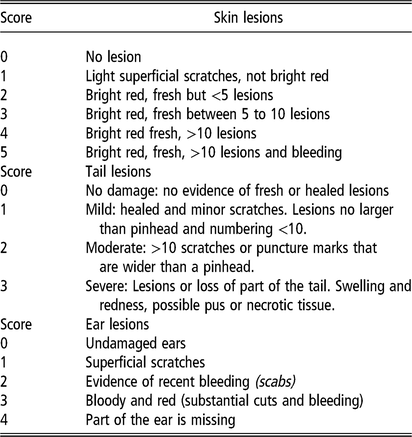
During the movement between the first and second stage weaner pens, individuals were scored for body lesions (Table 2) on the head, shoulders and flank (Burfoot et al., Reference Burfoot, Kay and Corning1995).
Skin lesion scoring system used for the head, shoulders and flank of pigs (Burfoot et al., Reference Burfoot, Kay and Corning1995), tail scores modified from Hunter et al. (Reference Hunter, Jones, Guise, Penny and Hoste1999) (picture reference available on the National Hog Site) and ear lesion scoring system, modified (in italics) from Telkänranta et al. (Reference Telkänranta, Bracke and Valros2014)

The tails and ears of all pigs were examined approximately once every 2 weeks (17 ± 6 days), starting from 2 weeks after weaning. Although the researchers aimed to carry out the inspections every 2 weeks, logistically, this was not always possible due to the necessity to fit in with farm practices (e.g. access during the Christmas vacation) and due to the slight differences in age between the various stages of production. A total of 8 observation days were used in analysis, three in the first weaner stage (18 ± 0, 31 ± 4 and 43 ± 4 days post-weaning), two in the second weaner stage (55 ± 6 and 73 ± 9 days post-weaning) and three in the finisher stage (94 ± 4, 119 ± 4 and 137 ± 4 days post-weaning).
Two experimenters performed the inspection of tails and ears. Both were trained using pictorial guides (Tail lesions: adapted from Hunter et al., Reference Hunter, Jones, Guise, Penny and Hoste1999 (Table 2), Ear lesions, based on Telkänranta et al. (Reference Telkänranta, Bracke and Valros2014), as developed by Diana et al. (Reference Diana, Manzanilla, Calderón Díaz, Leonard and Boyle2017), were modified to include a score of 4 if part of the ear was missing). The experimenters scored all pigs simultaneously, by entering the pens at the same time, and marking the pigs’ backs with livestock markers once they were scored. Hence, It was not possible to blind the experimenters to treatment, as the recordings were carried out in the pen, so that the enrichment devices were visible. It was also evident whether the pigs were male or female. The experimenters walked through the pen and visually inspected each pig individually. Tail lesions were scored using the tail lesion scoring system developed by Hunter et al. (Reference Hunter, Jones, Guise, Penny and Hoste1999) (Table 2). For instance, if part of the ear was missing (score of 4), then the remainder of the ear was scored using the rest of the scoring system. This was because healing of amputated ears had generally occurred by the time pigs entered the finishing stage, yet pigs still sometimes had fresh wounds.
Animal behaviour
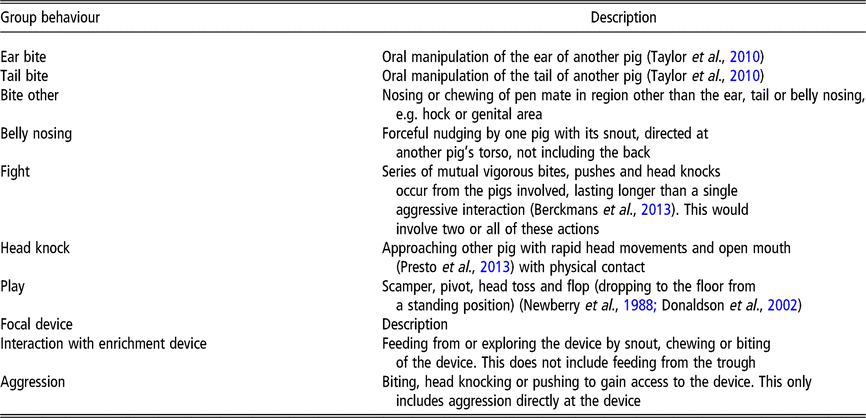
The behaviour of pigs in each pen was recorded directly approximately once every week (9 ± 5 days) by two observers. Inter-observer reliability was tested using Pearson’s correlation (r = 0.849, P < 0.001). A total of 12 observation days were used in the analysis, five in the first weaner stage (9 ± 2, 14 ± 0, 20 ± 2, 28 ± 1 and 38 ± 4 days post-weaning), three in the second weaner stage (46 ± 4, 51 ± 5 and 59 ± 4 days post-weaning) and four in the finisher stage (88 ± 5, 98 ± 1, 119 ± 1 and 124 ± 1 days post-weaning). Observations were carried out four times between 11:30 AM and 15:30 PM. Three trained observers collected all the behaviour data, which were balanced across enrichment type and pens. Observation times were also balanced across enrichment type and pens so that observations for each pen were distributed approximately equally across the recording periods. The behaviour of the entire group was initially observed for 5 min. All incidences of harmful and aggressive behaviour and play were counted (Table 3) by continuous observation. Because of the occurrence of ‘play’ behaviour in all animals in the first stage, this observation was only recorded from the second stage to finishing. After this observation period was complete, the observer spent 5 min for observing interactions with the source of enrichment (i.e. the compressed straw block or hanging toys; Table 3). This equated to a total of 20 min of continuous observation of the group and 20 min of observation of interaction with the enrichment devices, per pen on each recording day.
Ethogram of pig behaviour recorded during continuous observations of the groups and the focal enrichment device. A new event would occur as soon as a behaviour had ceased and another began

Salivary cortisol
The cortisol levels in saliva were investigated as a measure of physiological stress. To represent the entire range of weights within the pen and to objectively select pigs without bias towards appearance, ‘friendliness’, etc., a group (n = 16) of 55 pigs were sorted by weight at weaning, and every fifth pig was selected as a focal pig for salivary cortisol collection. This resulted in 11 pigs from each pen (176 pigs in total). These pigs were tagged with a second ear tag at weaning for identification. During the first week post-weaning, these pigs were habituated to the saliva collection procedure by interacting with them and allowing them to get used to chewing on cotton buds. Subsequently, saliva samples were collected from each focal pig at the same time (08:30 to 10:30 AM) fortnightly, corresponding to approximately 11, 26 and 40 days of age during the first weaner stage, 55 and 70 days of age in the second weaner stage and 88 days of age in the finisher stage. After this stage, it was considered that the pigs were so large that there was a significant risk of injury to the experimenter during collection; thus, saliva collection was ceased. Saliva was collected by allowing pigs to chew on a large cotton bud (Salivette, Sarstedt, Wexford, Ireland) until it was thoroughly moistened (approximately 30 to 60 s/sample). The buds were then placed in tubes and centrifuged for 15 min at 3000 r.p.m. and stored at −20°C until analysed by an enzyme-linked immunosorbent assay (Salivary Cortisol Kit, Salimetrics Europe Ltd, Suffolk, UK).
Data management and analysis
Data were analysed using SAS V9.3 (SAS Institute Inc., Cary, NC, USA). All data were screened for outliers prior to analysis using box plots (Proc Univariate). The pen was the experimental unit. For all measures, data from the first and second weaner stages were analysed as one dataset and separately from the finisher stage, because of the re-composition of the groups upon movement to the finisher stage. In all cases, residuals were examined to verify normality and homogeneity of variances and transformed where necessary to meet these criteria. Degrees of freedom were estimated using Kenwood–Rogers adjustment. Model fit was determined in all analyses by choosing models with the minimum finite-sample-corrected Akaike Information Criteria. Differences in least squares means (LS means) were investigated using the t-test, followed by Tukey’s adjustment for multiple comparisons. Differences were considered significant at P ≤ 0.05. Data are presented as LS means ± standard error. Interactions were removed from the models if they did not tend to be significant (P > 0.1). All model codes are provided in Supplementary Material S7.
Abattoir data
The cold weight of each animal was analysed using a Gaussian linear mixed model. Fixed effects included enrichment type, sex, the interaction and replicate, with the pen as a random effect and weaning weight as a covariate. The number of condemnations in each enrichment type was investigated using Fisher’s exact test.
Body, tail (live and factory obtained) and ear lesions
All lesions were analysed separately. Because of a low number of scores at the higher end of the scale, all tail lesion scores above 2 were condensed into a single category of ≥3, and all ear lesion scores above 1 were condensed into a single category of ≥2. As data were ordinal, they were analysed using generalised linear mixed models (Proc Glimmix). Each experimental day was analysed separately, as the model would not converge otherwise, and post-hoc Bonferroni multiple comparisons adjustment were performed. A cumlogit link function was used, and a multinomial distribution specified. The pen was included as a random effect. Fixed effects in the model included enrichment type, sex, the interaction and replicate.
Animal behaviour
Both replicates of pigs were in the finisher stage accommodation for at least 10 days prior to behaviour recording to ensure that the group structure had stabilised. For the analysis of all behaviours, the four recordings from each observation day were adjusted for the number of pigs in each pen and then averaged. Because of the low number of aggressive incidents recorded when animals were interacting with the enrichment devices, these data were also averaged by stage. Data were analysed using a Gaussian linear mixed model (Proc Mixed). Fixed effects in the model included enrichment type, sex, observation week, all interactions, and replicate. The observation week was considered a repeated effect, and the pen was considered a random effect.
Salivary cortisol
Cortisol values were averaged on per pen basis, on each sampling day, and this value was used in the analysis. Data were analysed using a Gaussian linear mixed model (Proc Mixed). The model included fixed effects of enrichment type, sex, and test day in the weaner stage, and all interactions as well as replicate. Test day was considered a repeated effect in the analysis of the weaner stage. Pen was considered a random effect.
Results
Economical perspectives
Straw use
The highest straw usage was recorded amongst the second weaner stage (Table 1). This resulted in a cost of €2.85 per day (€0.57 per pig) in the second stage, but this value reduced to €0.21 per day (€0.58 per pig) in the finisher stage (Table 1).
Abattoir data
Enrichment type or sex had no effect on tail lesion scores recorded at the abattoir. There was also no effect of enrichment type or sex on cold carcass weight (STRAW BLOCK: 83.6 ± 0.8 Kg; TOY: 83.9 ± 0.8 Kg; male: 84.5 ± 0.9 Kg; female: 83.0 ± 0.9 Kg) or on the likelihood of carcass condemnations. One carcass was completely condemned, and 102 were partially condemned (pneumonia/pleurisy, 52%; pericarditis, 23.5%; abscesses/bursitis, 19.6%; intestinal problems, 2.9%; and other, 2%).
Welfare perspectives
Body, tail and ear lesions
There was no effect of enrichment type or sex on body lesions (Table 4). Moreover, Enrichment type or sex also had no effect on tail or ear lesion scores during either the weaner or finisher stage (P > 0.2 for all comparisons). Median (range) of scores for both enrichment types, at all stages, was 1 (0 to 1) for tail lesion scores, and 2 (1 to 2) for ear lesion scores. Tail and ear lesion scores were higher with age, with the highest scores displayed in the finisher stage.
Body lesions recorded on the head and shoulders and flank region of male (n=440) and female (n=440) pigs exposed to different types of enrichment (TOY or STRAW BLOCKS), represented as median (range) with P-values of the different enrichment groups and sexes

TOY = a plastic hanging toy; STRAW BLOCKS = compressed straw blocks.
Animal behaviour
Harmful behaviour
During the first and second weaner stages, there was an interaction between enrichment type and sex on the display of harmful behaviour (P < 0.05; Figure 1a); female pigs provided STRAW BLOCK showed more harmful behaviour than male pigs (P < 0.001), and within female pigs, those who were provided STRAW BLOCK showed more harmful behaviour than those provided TOY (P < 0.05). However, during the finisher stage, the level of harmful behaviour had dropped, and no effect of sex, enrichment type or interaction was found.
Harmful behaviour (a) and tail biting (b) performed by male (n = 440) and female (n = 440) pigs provided either a plastic hanging toy (TOY) or compressed straw blocks (STRAW BLOCKS). Different superscripts indicate a significant difference within enrichment type (P ≤ 0.05).

Tail biting
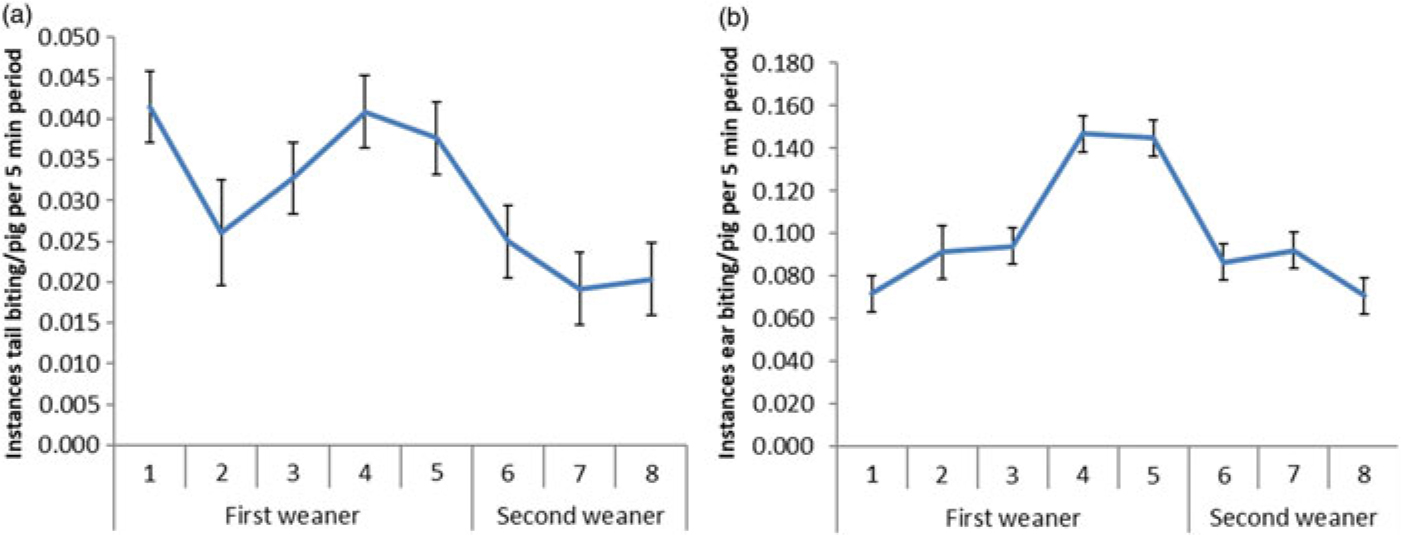
When considering tail biting behaviour alone, there was an interaction between sex and enrichment type in the weaner stage (P < 0.01); female pigs showed more tail biting behaviour than males when provided STRAW BLOCK (P < 0.05) (Figure 1b). There was also an effect of observation week (P = 0.001). The amount of tail biting was high in the first and fourth observation week than that on week 7 and 8 (P < 0.05 for all pairwise comparisons) (Figure 2a).
Instances of tail (a) and ear (b) biting observed in male (n = 440) and female (n = 440) pigs in the first (up to 47 days from weaning), second (about 47 to 81 days from weaning), and finisher stages (about 81 to 159 days from weaning).

Ear biting
In the weaner stages, female pigs showed more ear biting behaviour than males (0.115 ± 0.004 v. 0.084 ± 0.004 instances/pig; P < 0.001), and pigs provided STRAW BLOCK showed more harmful behaviour than those provided TOY (0.108 ± 0.004 v. 0.091 ± 0.004 instances/pig; P < 0.01). There was also an effect of observation week with a pattern similar to tail biting behaviour except for the first observation week (Figure 2b). There were no effects of sex, enrichment type, or time on the amount of tail or ear biting in the finisher stage.
Belly nosing
No effect of enrichment type or sex was found on belly nosing in both the weaner and finisher stages. However, in both stages, there was an effect of observation week (P < 0.001 for both); in both cases, the levels were highest at the start and then dropped.
Aggressive behaviour not associated with the source of enrichment
No effect of enrichment type was found on aggressive behaviour in either stage. However, in both stages, male pigs exhibited more aggressive behaviour than females (P < 0.001 for both stages). There was an effect of observation week, with aggression reaching a peak in the middle of the second stage (P < 0.01).
Although enrichment type had no effect, sex has an effect on the amount of head-knock behaviour observed. Males exhibited more such behaviour than females in both the weaner (0.110 ± 0.006 v. 0.082 ± 0.006 instances/pig; P < 0.01) and finisher (0.070 ± 0.004 v. 0.030 ± 0.004 instances/pig; P < 0.001) stages. Likewise, there was only an effect of sex on the occurrence of fights in both stages (P < 0.001 and P < 0.01 for weaner and finisher stages, respectively) with males showing more fighting than females.
Play behaviour
During the weaner and finisher stages, no effect of enrichment type or sex was found on play behaviour. In the finisher stage, play behaviour decreased over time (P < 0.001), with levels lower in the third and fourth observation week than those in the first and second observation weeks.
Behaviour at the enrichment device
In both the weaner and finisher accommodation, more instances of interaction with enrichment were recorded in TOY pens than in STRAW BLOCK (P < 0.001 for both) (Figure 3a). No effect of sex was found in either stage. There were also more instances of aggression in the TOY enrichment type in the weaner stage (Figure 3b), although the levels were low in both enrichment types (0.006 ± 0.001 v. 0.003 ± 0.001 instances/device; P < 0.05).
Individual interactions with the plastic hanging toy (TOY) or compressed straw (STRAW BLOCK) enrichment device (a) and the amount of aggression expressed by individual pigs in response to access to the enrichment device (b) during the weaner (up to 81 days from weaning) and finisher stages (about 81 to 159 days from weaning). Different superscripts indicate a significant difference (P ≤ 0.05).

Salivary Cortisol
No effect of either enrichment type or sex was found on cortisol levels both during the weaner and finisher stages. There was, however, an effect of sampling week during the weaner stage (P = 0.05). The cortisol level was higher on the first sampling week than on the second week (P<0.05).
Discussion
Tail biting is not reported in sounders of wild boars (Sus scrofa) (Sonoda et al., Reference Sonoda, Fels, Oczak, Vranken, Ismayilova, Guarino, Viazzi, Bahr, Berckmans and Hartung2013), and there is general consensus that tail biting in commercially produced pigs is a redirected exploration behaviour, accelerated by the frustration of being denied the ability to perform natural behaviour such as rooting (Van de Weerd and Day, Reference Van de Weerd and Day2009). This study found that there was no significant difference in the effectiveness of two commercially available enrichment materials considered appropriate for fully slatted systems, when considering expression of damaging behaviour and its effects.
For an enrichment material to be adopted on farms, it is crucial that the material improves welfare at minimal material and labour costs (Telkänranta et al., Reference Telkänranta, Bracke and Valros2014). In the pig production industry, a trade-off exists between the needs of the animals and that of the farming system (Van de Weerd and Day, Reference Van de Weerd and Day2009). In Ireland, Harley et al. (Reference Harley, Boyle, O’Connell, More, Teixeira and Hanlon2014) calculated an economic loss value of €1.69 per pig because of tail biting. While the cost of the compressed straw blocks in the current study, at an average of €1.15 per pig over its lifetime was less than this value, tail biting needs to be significantly reduced to make the use of straw block enrichment feasible, and this was not the case in the current study. In addition, the blocks had to be replaced every few days. Amongst Irish farmers, the main considerations when choosing enrichment were that whether it is effective and lasts longer, with one farmer stating that ‘It should last about 7 months and be effective’ (Haigh and O’ Driscoll, Reference Haigh and O’Driscollin prep.). It is therefore likely that the use of straw block enrichment would be considered very labour intensive for a commercial farm.
Previously, compressed straw dispensers have been shown to be beneficial for pigs of all ages (sows and piglets in farrowing crates, Bulens et al. Reference Bulens, Renders, Van Beirendonck, Van Thielen and Driessen2014; grower pigs, Stubbe et al., Reference Stubbe, Beck and Jungbluth1999). In the current study, we found that females with STRAW BLOCK tended to perform more tail biting and show more harmful behaviour than those with the TOY in the weaner stage, and pigs with STRAW BLOCK performed more ear biting. The reason for this could be the level of access the pigs had to the enrichment; there were 27 pigs for each dispenser, which is much more than in other enrichment recommendations or experiments. For instance, Speijers (Reference Speijers2014) reported one straw block holder per 8 to 10 pigs in a Swiss farm, and 3 to 10 blocks lasted 50 to 60 days.
Another factor is the positioning of the devices; the straw cylinders were fixed against the wall, and generally only two pigs could access them at once. In contrast, the TOY was hanging in the centre of the pen; thus, it could be accessed from all sides, by up to four pigs at once. Van de Weerd et al. (Reference Van de Weerd, Docking, Day, Breuer and Edwards2006) cautioned that as enrichment devices are often restricted to a single location in a pen and are usually of limited size, they do not allow simultaneous access in a group of pigs. This could therefore lead to increased frustration and aggression. Indeed, Zwicker et al. (Reference Zwicker, Gygax, Wechsler and Weber2013) warned about restricted access to point-source enrichment materials such as compressed straw blocks, as there is a potential for aggression due to competition. This was evident in the current study when, even though pigs interacted more with the TOY than with STRAW BLOCKS, more aggression was also recorded in association with the former. A higher incidence of aggression was observed with the TOY, because a higher number of pigs interacted with it; this indicates that this device may have been more valuable (desired) by the pigs than the compressed straw block. However, it is important to note that increased interaction with the TOY could simply be because the location and model of the device facilitated the simultaneous use for four rather than two pigs. A greater level of aggression may also contrarily be due to frustration, because of the TOY not being composed of ingestible, destructible material; pigs favour materials that are edible, chewable, investigable, and manipulable (Commission Recommendation 2016/336). The nature of the current study site on a commercial farm rendered it impossible to install cameras, but future investigation assessing the bout length of engagement with a device could prove to be particularly useful in determining these preferences.
While the provision of extra straw dispensers, so that a higher number of pigs could access the devices simultaneously, could have yielded different results, this would also result in higher cost and labour. O’Driscoll (Reference O’Driscoll2015) observed that pigs had lower ear lesion scores when provided with three rather than one device. Therefore, further research is needed to investigate whether straw dispensers could be more effective at a greater allowance per pig, while still being financially viable.
The highest straw usage occurred in the second weaner stage. The use of the straw likely increased from that used in the first weaner stage due to the increasing size of the pigs. This means that they had a larger mouth and were better able to grip and tear away the straw. During the second stage, incidences of ear and tail biting behaviour also began to reduce compared to that in the first weaner stage, and ear and tail lesion scores were at their lowest; this finding may indicate that the pigs were directing activity towards the STRAW BLOCKS rather than each other at this time.
Females showed more harmful behaviour than males. Although no effect of sex was found in the current study, Zonderland (Reference Zonderland2011) found that in single-sex pens, tail damage developed more quickly in all-female groups. In the current study, this pattern was more evident in pigs provided STRAW BLOCKS and indicates that female pigs may be more motivated to perform tail biting than males in a situation where enrichment is suboptimal or not easily accessible.
Tail lesions were highest in the finisher stage in the current study. This was not expected, as O’Driscoll et al. (Reference O’Driscoll, O’Gorman, Taylor and Boyle2013) reported more tail-in-mouth behaviour during the second weaner stage accommodation than in the finisher stage, and in a survey of Irish producers (Haigh and O’Driscoll, Reference Haigh and O’Driscollin prep.) the second weaner stage period was noted as a peak period for both ear and tail biting. Although the reliability of tail and ear lesion scores could have been possibly affected by having two observers, both observers were present on all experimental days, and both scored half the pigs in each pen on each day to reduce the observer effect. Thus, we were confident that the scoring was consistent across pens and treatments; it is possible that the higher scores in the finisher stage were due to an accumulation of damage over the lifetime of the pigs.
Stress and stressors appear to play a role in the aetiology of tail biting, (Valros et al., Reference Valros, Palander, Heinonen, Munsterhjelm, Brunberg, Keeling and Piepponen2015) which may be due to an associated increase in restlessness and irritability. Valros et al. (Reference Valros, Munsterhjelm, Puolanne, Ruusunen, Heinonen, Peltoniemi and Pösö2013) suggested that prolonged or repeated stress in the form of tail biting causes a blunted stress response, which is possibly a sign of hypocortisolism. Contrarily, Smulders et al. (Reference Smulders, Verbeke, Mormède and Geers2006) recorded significant increases in salivary cortisol levels in ear- and tail-bitten pigs, with a corresponding reduction in growth rate. No effect of either sex or enrichment type was found on salivary cortisol levels, which is perhaps unsurprising because there were no differences in tail lesion scores.
Conclusions
This study investigated the use of compressed straw blocks on a commercial farm with regard to their effectiveness in reducing tail and ear biting relative to plastic hanging toys. When provided at the same allowance per pen, straw blocks in wall-mounted holders did not result in reduced tail or ear lesion scores compared to the hanging toys. Thus, compressed straw blocks provided in this manner did not provide benefits to pig welfare. Furthermore, access to the device (i.e. number of pigs that could access the device simultaneously) may have contributed to the lack of differences. Future work should be carried out to show whether this type of straw block/dispenser could prove to be effective when provided in a more accessible manner.
Acknowledgements
The authors would like to thank the Department of Agriculture, Food and Marine for funding the project, all staff of the Pig Development Department, Teagasc for their assistance at various stages of the project and the staff and owner of the commercial farm where the experiment was conducted.
A. Haigh, 0000-0001-7555-5383
Declaration of interest
The authors declare no conflicts of interest.
Ethics statement
The study was conducted on a commercial farm, approximately 10 miles from the Teagasc Moorepark Research Centre, located at Fermoy, Co. Cork, Ireland. Prior to commencing the experiment, approval was obtained from Teagasc Animal Ethics Committee (TAEC89/2015).
Software and data repository resources
Data and models are not deposited in an official repository, but are available on request.
Supplementary material
To view supplementary material for this article, please visit https://doi.org/10.1017/S1751731119000715.