Introduction
It has been proposed that having a small social network with few social contacts and limited social engagement increases the risk of both cognitive decline and dementia (Fabrigoule et al., Reference Fabrigoule, Letenneur, Dartigues, Zarrouk, Commenges and Barberger-Gateau1995; Wang et al., Reference Wang, Karp, Winblad and Fratiglioni2002; Fratiglioni et al., Reference Fratiglioni, Paillard-Borg and Winblad2004; Saczynski et al., Reference Saczynski2006). One indicator of a social network that has received specific attention is marital status. The beneficial effects of marriage on the health and well-being of elderly people have been demonstrated in several studies (Murphy et al., Reference Murphy, Grundy and Kalogirou2007). These studies show that married people experience less psychological distress, have better physical well-being, longevity, and lower mortality than their unmarried counterparts (for review, see Coombs, Reference Coombs1991). The protective effects of marriage have been suggested as being transferable to preserved cognitive function among the middle-aged and elderly individuals (Van Gelder et al., Reference Van Gelder, Tijhuis, Kalmijn, Giampaoli, Nissinen and Krombout2006; Mousavi-Nasab et al., Reference Mousavi-Nasab, Kormi-Nouri, Sundström and Nilsson2012). However, the association between marital status and risk of dementia is less clear, and only a few studies have examined marital status and its association with the increased risk of dementia (Helmer et al., Reference Helmer1999; Fratiglioni et al., Reference Fratiglioni, Wang, Ericsson, Maytan and Winblad2000; Håkansson et al., Reference Håkansson2009).
The proposed protective role of marriage on cognitive health has been explained in terms of cognitive reserve. The mental and social stimulation that can come by living in a relationship is believed to increase a person's cognitive reserve. According to the cognitive reserve hypothesis, active stimulation throughout a person's life will alter neural tissues, enhance synapse development, and facilitate new neuronal pathways (Scarmeas and Stern, Reference Scarmeas and Stern2003). Support for this notion comes indirectly from experimental studies where animals exposed to a complex and enriched environment (including social interaction) showed better cognitive development and less brain-related dysfunctions than those animals with less stimulation (Jankowsky et al., Reference Jankowsky2005; for review, see van Praag et al., Reference van Praag, Kempermann and Gage1999).
Another suggested mechanism, which put forward to explain the protective role of marriage, is that a social engagement buffers against the harmful effects of stressful life events throughout life (Cohen and Wills, Reference Cohen and Wills1985). Stressful events can lead to glucocorticoid dysregulation resulting from the activation of the hypothalamic–pituitary–adrenal axis, with a deleterious effect in areas known to be sensitive for cognitive function in dementia (Lupien et al., Reference Lupien, Maheu, Tu and Schramek2007). Death of a spouse is considered as one of the most stressful life events for older adults (Holmes and Rahe, Reference Holmes and Rahe1967), and widowhood has a negative effect on the surviving spouse's well-being for many years (Hughes and Waite, Reference Hughes and Waite2009). Widows and widowers have also been shown to have a higher risk of cognitive impairment and dementia than those being single or divorced people (Håkansson et al., Reference Håkansson2009).
The proposed deleterious negative effect of being single, living alone, or being widowed may to some extent be counterbalanced by having children. Adult children may offer social contact and cognitive stimulation, therefore compensating for the effects of a smaller social network that might occur as a result of divorce or death of one's partner. Contact with adult children can also help the surviving spouse cope with the loss, and reduce feelings of loneliness and depression. Adult children may also offer help around the household, provide material as well as financial support, and serve as medical supervision, and act to remind parents to take care of their health (Kendig et al., Reference Kendig, Dykstra, van Gaalen and Melkas2007).
The causality of marital status on dementia may thus be confounded by social network factors, such as parental status, and by exposure to stressful life events. Other factors such as having close friends or frequent visits by family members and acquaintances may also influence a possible association between marital status and dementia (Saczynski et al., Reference Saczynski2006). The present study extends previous research by examining the relationship between marital status and risk of being diagnosed with dementia, while taking parental status and a range of possible confounders into account, including social network size and exposure to stressful negative life events. To the best of our knowledge, this study is the first one to examine the combined association of marital and parental status on the risk of dementia.
Based on previous research, we hypothesized that living without a partner, especially widowed, is associated with increased risk of dementia. We examined this by using data from a large Swedish population-based longitudinal study of more than 1,600 participants, aged 65 years and over, showing no signs of dementia at inclusion, and were followed for an average of 8.6 years. We also investigated the hypothesis that not having children is associated with incident dementia, and also whether the absence of children exacerbates the negative impact of being widowed. Finally, we tested whether potential confounders, including other social network factors and previous exposure to negative life events, would substantially attenuate a potential association between marital and parental status and dementia.
Methods
Data were collected as part of an ongoing Swedish prospective cohort study on aging, memory, and health (Nilsson et al., Reference Nilsson1997; Reference Nilsson, Adolfsson, Bäckman, de Frias, Molander and Nyberg2004). The Betula project, started in 1988, now consists of six independent samples (S1–S6) and five test waves (T1–T5) with five years in-between. All participants were randomly recruited from the population registry in Umeå, a city of 110,000 inhabitants in northern Sweden, using stratified (age and gender) random sampling. For details on sampling design and procedures, see Nilsson et al. (Reference Nilsson1997).
Participants
The 1,677 participants enrolled in this study belong to samples 1–5 (S1–S5) and were aged 65 years and more at baseline examination. In this study, T2–T4 was considered as the baseline as questions regarding quality and size of social networks (close friends, frequency of contacts with friends, and satisfaction with that frequency) were asked for the first time at T2. Excluded participants were those who were lost in follow-up examination (moved from the catchment area; n = 2), had dementia at inclusion (n = 3), had incomplete information on marital or parental status (n = 8), and were diagnosed with dementia after the last follow-up examination at T5 (n = 8) because of a longer follow-up time for these participants compared with the main group. Another 28 participants who died shortly after the baseline assessment (i.e. within one year of follow-up) were excluded from the final analysis. Moreover, a few participants (n = 19) had lost all their children and were excluded from the analysis.
The remaining 1,609 participants were distributed across samples and test waves as follows. At T2, 285 participants were from sample 1, 385 participants from sample 2, and 444 participants from sample 3. At T3, 246 participants from sample 4 were added, and at T4, additional 249 participants from sample 5 were included.
Measures
Social network variables
Information about social network was collected through questionnaires and by personal interviews conducted by trained nurses. Marital status was coded in four categories: married/cohabiting, single, divorced, or widowed. Presence of children was assessed by asking questions about the number of biological, adopted, living, and dead children. Because of low frequency in some subgroups, these variables were coded as having children or not having children.
To assess the quality and size of networks, the participants were asked if they had a close friend or confidante (yes/no), frequency of visits by friends and acquaintances (daily, several times a week, weekly, once a week to once a month, once a month to once a quarter, less than once a quarter, or never), and frequency of contacts with other modes than by visit (e.g. via phone, email), with the same response options as above, and whether they were satisfied with that frequency (yes/no).
Potential covariates
A number of potential covariates were ascertained at baseline, in literature previously shown to be related to dementia: age, sex, education (years), smoking (smokers, non-smokers), and alcohol (yes, no, never drank, or no had quit). Furthermore, four self-reported cardiovascular conditions (heart disease, stroke, hypertension, or diabetes mellitus) and prior mental disorder (yes/no) were also noted. Depressive symptoms were measured by self-report of the following symptoms: feelings of dispirited, fatigue, sleeping problem, feeling lonely, or feeling anxious. Global cognitive status was determined by Mini-Mental State Examination (MMSE; Folstein et al., Reference Folstein, Folstein and McHugh1975).
The occurrence and influence of negative life events during the last five years before inclusion in the study were ascertained using the Life Event Inventory (Perris, Reference Perris1984). The inventory consists of 56 questions about specific life events, including private life, health, relatives and friends, death of relatives or close friends, and social relationship.
Diagnosis of dementia
The diagnosis of dementia was done according to the Diagnostic and Statistical Manual of Mental Disorders (4th ed. Revised; DSM-IV-TR), and was based on the prospective longitudinal measurements at each test wave, including a comprehensive analysis of results from neuropsychological testing, and clinical course. The analyses covered the time period of 1989 to 2010 and were performed by a clinical and geriatric research psychiatrist. Dementia status was available on annual basis. During the study period, repeated prospective and retrospective analyses were done. To increase the validity of the analysis of cognitive status, data were assessed blindly. Furthermore, in 2010, a comparison of each participant's cognitive status (for those who had clinical data available) with their own baseline cognitive status (presumed to be without dementia because of initial cognitive screening at baseline) was made. Given all samples and test occasions, there were only 19 (0.4%) improperly classified participants, suggesting a high validity of the present method of diagnosis.
Statistical analysis
We tested differences in the baseline characteristics by using Student's t-test for continuous variables and χ 2 test for categorical variables. To examine the association between marital and parental status and incident dementia, we used Cox proportional hazards regression models with age as a time scale. When age was used as the time scale, age differences were automatically adjusted for in all the analyses. Univariate Cox regression was performed to evaluate the effects of various potential confounders, including sex, education, smoking, cardiovascular conditions, and depressive symptoms. Covariates with p < 0.10 in the univariate analysis were included in a multivariate analysis.
The proportional hazards assumption was examined using graphical methods, and was met for all the models. Time to event was defined as the age of entry into the study to the age of dementia diagnosis, death, or date of final follow-up (2010), depending on whichever came first.
The results were presented as hazard ratios (HR) with a 95% confidence interval (CI). All statistical analyses were two-sided and were performed using SPSS 20 and R version 2.15.3 (R Core Team, 2013).
Results
Population characteristics
The sample consisted of 1,609 participants without dementia ranging in age from 65 to 95 years at baseline. Sixty-eight participants were excluded because of missing information about marital and parental status, lost in follow-up, dementia at inclusion, diagnosed with dementia after the last follow-up, or died shortly after the baseline assessment. Compared with the included participants, the excluded participants had similar data for all of the included demographic and social network variables.
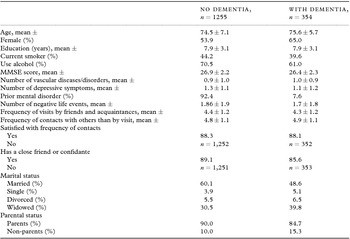
During follow-up, 354 dementia patients were identified. Mean follow-up time was 6.2 years (SD = 3.5) for those who developed dementia, and 9.3 years (SD = 4.9) for those who did not develop dementia. The baseline characteristics by dementia status are shown in Table 1. Participants who developed dementia were older, t (1,607) = –3.21, p < 0.001, were more often females, χ 2 = 14.11, p < 0.001, had a lower baseline MMSE score, t (1,607) = 3.31, p = 0.040, drank less alcohol, χ 2 = 11.41, p < 0.01, had more often a prior mental disorder, χ 2 = 7.08, p < 0.01, were more likely to be unmarried, χ 2 (1, n = 1,609) = 14.93, p < 0.001, and were more often non-parents, χ 2 (1, n = 1609) = 7.83, p = 0.005.
Baseline characteristics of participants who remained or did not remain dementia-free at follow-up

Note: Missing values in the sample: education (n = 32), MMSE scores (n = 2), smoking (n = 17), number of negative life events (n = 28), frequency of contacts with others than by visit (n = 2).
Association between marital and parental status effect on risk of dementia
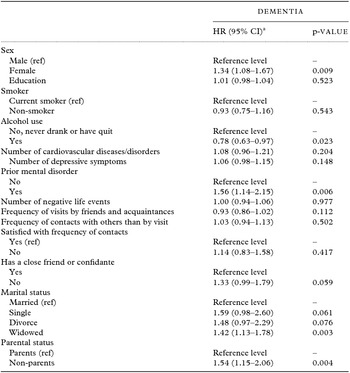
In the univariate Cox proportional hazards regression analysis, female sex (p = 0.009), alcohol use (p = 0.023), prior mental disorder (p = 0.006), having a close friend or confidante (p = 0.059), widowhood (p = 0.003), and non-parents (p = 0.003) were all significantly associated (with p < 0.10) with the risk of dementia, see Table 2. All the significant univariate variables were entered into a Cox multivariate model.
Univariate analysis of prognostic factors of dementia using Cox proportional hazards models

Note: aAdjusted for age (as time scale).
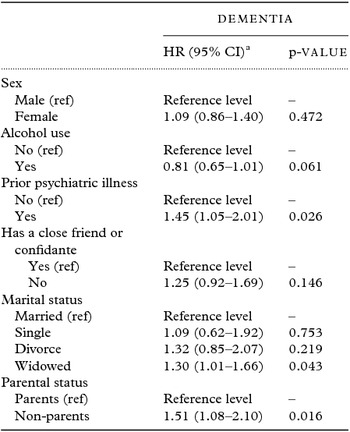
The result from the Cox multivariate model revealed that, compared with married people, widowed were more likely to receive a dementia diagnosis during follow-up (HR 1.30, 95% CI = 1.01–1.66, p = 0.043), and compared with parents, people without children had an increased risk of progression to dementia (HR 1.51, 95% CI = 1.08–2.10, p = 0.016), see Table 3. Among covariates, only prior mental disorder was significantly associated with dementia (HR 1.46, 95% CI = 1.0–2.01, p = 0.023). No other significant associations were found, and no significant interaction was observed between marital and parental status.
Multivariate analysis of prognostic factors of dementia using Cox proportional hazards model

Note: aAdjusted for age (as time scale).
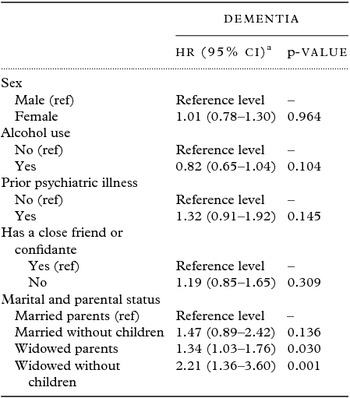
To further evaluate the association between marital and parental status, a group of four combined factors was constructed: married parents (reference group), married without children, widowed parents, and widowed without children, with adjustment for covariates with p < 0.10 in the univariate analysis (e.g. gender, alcohol use, prior mental disorder, and having a close friend or confidante). The single and divorced groups were omitted because of small subgroup sizes. The combined effects of marital and parental status on the risk of dementia are shown in Table 4. Compared with married parents, widowed parents had a 1.3 times higher risk (HR 1.34, 95% CI = 1.03–1.76, p = 0.030) of dementia, and those who were widowed without children had a 2.2 times higher risk (HR 2.21, 95% CI = 1.36–3.60, p = 0.002). There was no significant difference in HR among married people without and with children (p = 0.136).
Multivariate analysis of the combined effect of marital and parental status on risk of dementia

Note: aAdjusted for age (as time scale), sex, alcohol use, prior mental disorder, and having a close friend or confidante.
Discussion
This population-based cohort study examines association between marital status (married/cohabiting, single, divorced, or widowed) and parental status (parents vs. non-parents) and its effect on the risk of incident dementia, taking into consideration a range of potential confounders.
In line with our hypotheses, we found elevated risk of dementia among widowed and people without children, with the highest risk in widows and widowers without children. We also observed a borderline statistically significant increased risk of dementia in the single and divorced groups, compared with the married group. However, when the effect of parental status and covariates was taken into account, this effect of being single and divorced was no longer apparent.
Our finding that widowed elderly people were more likely to develop incident dementia is consistent with one prospective longitudinal study (Håkansson et al., Reference Håkansson2009). In that study researchers measured marital status at both mid-life and later life, and found that those widowed in mid-life and later in life were at especially high risk of Alzheimer's disease compared with those living with a partner at both times. However, not all studies have found that the widowed differ from other non-married groups in terms of their risk factors for dementia (Helmer et al., Reference Helmer1999; Fratiglioni et al., Reference Fratiglioni, Wang, Ericsson, Maytan and Winblad2000). Differences in methodology and sample population may explain some of the inconsistencies in findings among studies. The present study extends previous studies by showing that being without children is an important additional risk factor that needs to be considered when examining the effect of marital status on dementia.
Indirect support of an increased risk of dementia among elderly people without children comes from studies revealing the central role of adult children in parents’ lives as, for example, providers of support and social contacts, household assistance, medical caregivers, facilitators of physical activity, all of which can reduce some of the stress associated with widowhood. Being widowed and without children has also been found to have more negative effects on health and health behaviors than being widowed with children (Dykstra et al., Reference Dykstra2006). Few studies have evaluated the effect of parental status on dementia, and in contrast to our findings, one previous study (Ptok et al., Reference Ptok, Barkow and Heun2002) has reported that for women, having children was associated with a higher probability of having a diagnosis of Alzheimer's disease. However, this study was based on few participants, retrospectively collected, and did not take marital status into consideration, or any other confounders besides age, which limits comparison with the present study.
There may be several possible explanations for our results. The mental and social stimulation that may come from marriage is believed to increase person's cognitive reserve. This hypothesis posits that individuals who have a greater cognitive reserve may tolerate more extensive brain pathology before they exhibit clinical symptoms of dementia (Scarmeas and Stern, Reference Scarmeas and Stern2003). Our results of the beneficial effects of marriage and parenthood are consistent with this hypothesis. Our findings are also indirectly supported by studies showing that elderly people without children have a smaller social network and socialize less with their relatives. These couples often rely on each other and are therefore particularly vulnerable when one spouse dies (Dykstra, Reference Dykstra2006). In agreement with this, we noted the highest risk in those who are widowed without children.
Another mechanism proposed to understand the adverse effect of being unmarried, including widowhood, has been linked to stressful experiences, for example, the loss of a spouse (Håkansson et al., Reference Håkansson2009). Prolonged stress may trigger dementia by interfering with the cortisol regulation and immune response (Lupien et al., Reference Lupien, Maheu, Tu and Schramek2007). To control for the possible mediated effect of stressful life events, we adjusted for these factors, but the association with dementia remained significant. It could also be argued that our findings reflect that people without children were more depressed and in poorer health and therefore were at an increased risk of dementia. Previous research report mixed results on association between childlessness vis-á-vis depression and other health indicators (Jorm, Reference Jorm2001; Koropeckyj-Cox, Reference Koropeckyj-Cox2007; Becker et al., Reference Becker2009; Vikström et al., Reference Vikström, Bladh, Hammar, Marcusson, Wressle and Sydsjö2011). In this study, we were able to control for both depressive symptoms and poorer health. However, adjustments for these variables did not attenuate relationship between non-parents and dementia.
A great proportion of research within this field has identified an association between socioeconomic status and mortality. In explaining the effect of marital status on dementia, one needs to consider prior research on systematic selection on socioeconomic status and health on marriage, widowhood, and remarriage. Married couples share many socioeconomic factors, habits, lifestyle behavior, and other household characteristics (Nakosteen et al., Reference Nakosteen, Westerlund and Zimmer2004; Sullivan and Fenelon, Reference Sullivan and Fenelon2013). Since socioeconomic status correlates between spouses, the survivor often has the same risk factors and thereby may also be at an increased risk of early mortality. After the death of a spouse, the likelihood of the surviving spouse dying increases significantly (Sullivan and Fenelon, Reference Sullivan and Fenelon2013). Systematic selection on health status may also apply for remarriage in that widowed people who remarry are more often healthier widowers; hence, those with poorest health tend to be left as widows (Sullivan and Fenelon, Reference Sullivan and Fenelon2013). Although, the selection effects have been mainly considered in research on mortality, it might have important implications for understanding the association of widowhood with dementia. Research on risk factors for dementia suggests that socioeconomic status (e.g. less education) may be associated with increased risk (Karp et al., Reference Karp2004). In this study, although we did not have data on income or occupational prestige, we were able to adjust for the influence of education, which did not affect our observations.
The results from this study must be interpreted in light of its limitations. The number of participants within some categories was small, thus we were not able to distinguish between the single groups according to parental status, nor were we able to analyze potential sex differences. Moreover, although we have included a number of confounding factors, it is possible that unobserved heterogeneity or unmeasured confounders might have influenced the observed association with dementia. Additional research is required to investigate potential bias in estimates due to widowhood (and marriage) selection effects while taking other markers of socioeconomic status into consideration.
Furthermore, we do not have any information about the quality of relationships between adult children and their parents. That a protective effect of having adult children was found does not necessarily mean that the social interactions are altogether positive. It is reasonable to assume that the interaction between parents and children might also be negative or that some siblings might have better relationship with their parents than other siblings. However, a prior study has shown that even negative social interaction might have a positive influence on cognitive performance (Seeman et al., Reference Seeman, Lusignolo, Albert and Berkman2001).
In summary, we have shown that both marital- and parental status are associated with higher rate of incidence dementia, even after controlling for a range of covariates, including social network size, symptoms of depression, and exposure to stressful negative life events, in a cohort of older Swedes who were cognitively intact at baseline. Notably, a specific increased risk of dementia was observed for widowed participants who did not have children. This research highlighted that the effect of marital status on dementia needs to be studied with consideration of parenthood. Further research is needed to confirm these results and to explore the mechanisms underlying these statistical associations.
Conflict of interest
None.
Description of the authors’ roles
Anna Sundström initiated and designed the study, preformed the statistical analysis, and wrote the first draft. Lars-Göran Nilsson supervised the study and contributed substantially to interpreting the results and revising the text. Olle Westerlund and Hossein Mousavi-Nasab participated in data interpretation and performed critical revision of the manuscript. Rolf Adolfsson was responsible for the diagnosis of dementia, and was involved in interpreting the data.
Acknowledgments
The Betula project is supported by a grant from the Swedish Science Council. A. Sundström is supported by a grant from Riksbankens Jubileumsfond (RJ). The founders had no role in study design, data collection or analysis, the preparation of the manuscript, or the decision to publish.