INTRODUCTION
In the corpus of Izapan monuments, glyphic communication, defined here as the use of a graphic system coding a spoken language, is subservient to iconographic communication, defined as the use of conventionalized pictorial imagery not directly tied to a spoken language. But glyphs do occur, and their characteristics call for detailed examination, a task that has yet to be carried out. This paper attempts to fill in such gap, by carefully evaluating the nature of Late Preclassic Izapa writing. It begins with a background to the site, focusing on aspects of social, cultural, and linguistic context. Then, a review and discussion of the traits that characterize the scripts from the Intermediate (Prem Reference Prem1973) or Southeastern (Justeson et al. Reference Justeson, Norman, Campbell and Kaufman1985) tradition, is provided. The paper proceeds with a description of some of the traits of Izapa writing in connection with those of other Preclassic Mesoamerican scripts, focusing on some of the fruitful contexts for evaluating sign uses.
The paper concludes that Izapa shared innovative formal traits and combinatorial conventions with the Southeastern tradition (Epi-Olmec, Kaminaljuyu, Tak'alik Ab'aj, lowland Mayan). These include the “superfixed” placement of the bar-and-dot numeral with respect to the day sign cartouche, and the presence of positional (place-value) notation for counting. More narrowly, the use of day sign pedestals links the script to the Greater Izapan (Justeson et al. Reference Justeson, Norman, Campbell and Kaufman1985) or Maya-Izapa (Justeson and Mathews Reference Justeson and Mathews1990) sub-tradition (Kaminaljuyu, Tak'alik Ab'aj, lowland Mayan), which also includes the scripts from Tak'alik Ab'aj, Kaminaljuyu, and the Maya lowlands. Other traits are shared with all the Preclassic Mesoamerican scripts and probably harken back to an ancestral Olmec(oid) script or scripts in use by ca. 650–400 b.c.
At present, there is no strong evidence for linguistic affiliation; the structural traits described in this paper are consistent with either Mixe-Zoquean or Mayan. Perhaps this ambiguity was intentional (Guernsey and Love Reference Guernsey, Love, Fields and Reents-Budet2005:37): Izapa could have served as a meeting point for Mixean and Mayan speakers, and perhaps an interlingual use of writing was favored. Only further research, and ideally the discovery of lengthier inscriptions, will allow scholars to isolate a linguistic candidate.
SOCIOCULTURAL AND HISTORICAL LINGUISTIC CONTEXT
Located in the Pacific coastal plain of the state of Chiapas, Mexico, along well-traveled commerce routes, the site of Izapa developed an artistic tradition of great stylistic and thematic cohesion. I generally employ a definition of an artistic genre as a manifestation of both a theme and a style. Theme refers to the content, the ideas expressed in a genre. Style refers to the form, the specific devices utilized to express the theme in a particular genre. Guernsey Kappelman (Reference Guernsey Kappelman1997) appropriately notes that the so-called Izapan Style was unified thematically, not necessarily stylistically. The site was almost certainly within Mixe-Zoquean, and more specifically, (Proto-)Mixean, territory during the Late Preclassic period (300 b.c.–a.d. 200), according to Justeson et al. (Reference Justeson, Norman, Campbell and Kaufman1985) and Josserand (Reference Josserand, Love and Kaplan2011), as well as the assessment by archaeologists (Lowe et al. Reference Lowe, Lee and Espinosa1982:326). Guernsey (Reference Guernsey2006:23–24) cautions that there is a possibility of multilingualism in the region among Mixe-Zoqueans and Mayans. Indeed, proof of close linguistic contact and linguistic diversity within the region lies in the numerous lexical and grammatical loans between Mixe-Zoquean and Mayan languages (Campbell and Kaufman Reference Campbell and Kaufman1976; Justeson et al. Reference Justeson, Norman, Campbell and Kaufman1985; Wichmann Reference Wichmann1995), as well as Xinkan and Lenkan languages (Campbell Reference Campbell1972, Reference Campbell and England1978, Reference Campbell1984). In previous studies (Mora-Marín Reference Mora-Marín2016:Appendix F), I list a total of 81 proposed loans, including 15 newly proposed loanwords between Mayan and Mixe-Zoquean languages. Previously, I argued that out of 28 Mixe-Zoquean loanwords in the Greater lowland Mayan languages (Yucatecan, Ch'olan, Tzeltalan), four can be traced generally to Proto-Mixe-Zoquean, six specifically to Zoquean, and 18 specifically to Mixean, with 12 out of the 18 attributable, more narrowly, to Oaxacan Mixean, which was distributed along eastern Oaxaca and the Pacific coast of Chiapas and Guatemala (Mora-Marín Reference Mora-Marín2010a:8). Given such distribution, the interaction responsible for such diffusion probably took place along the Pacific piedmont of Chiapas and Guatemala, as well as the highlands of Guatemala, especially at sites like Izapa, Tak'alik Ab'aj, and Kaminaljuyu. I (Mora-Marín Reference Mora-Marín2010a:8) also identified four Mixe-Zoquean loanwords exclusive to Yucatecan, of which three can be traced to Zoquean and one to Mixean, although the latter is onomatopoeic. Hence, I agree, in part, with Josserand's (Reference Josserand, Love and Kaplan2011:177) proposal: “where a distinction can be made, it is assumed that Mijean [Mixean] loans represent Izapan or Isthmian influence, while Sokean [Zoquean] loans represent the influence of the Gulf coast Olmec.” A qualification is necessary here: given the work by Justeson and Kaufman (Reference Justeson and Kaufman1993, Reference Justeson and Kaufman1997) and Kaufman and Justeson (Reference Kaufman and Justeson2001), who propose that Epi-Olmec writing was (pre-proto-) Zoquean, Isthmian influence could have been post-Olmec Zoquean just as easily. More recently, Kaufman and Justeson (Reference Kaufman and Justeson2007) have proposed the existence of a third branch of Mixe-Zoquean, which they dub Northern Mixe-Zoquean, putatively located in Central Mexico, and possibly correlated with one of the ethnolinguistic groups present at the multiethnic city of Teotihuacan. If such a hypothesis is correct, many of the Mixe-Zoquean loans into Mayan languages could postdate the Olmec period and be instead the result of Teotihuacan influence. The point made in Mora-Marín (Reference Mora-Marín2010a), however, is that the majority of terms that were diffused between Mixe-Zoquean and Mayan may involve, specifically, Oaxaca Mixean.
As Guernsey (Reference Guernsey2006:24–25) recounts, the site began to develop during the Early Preclassic period (1500–900 b.c.), at the same time that evidence for the emergence of rank societies becomes abundant elsewhere in the region, such as at Paso de la Amada (Clark Reference Clark and Fowler1991). Toward the end of this period, Izapa began to participate in developments that involved the emerging Olmec style, as manifested at San Lorenzo and La Venta. It was during the Middle Preclassic period (900–300 b.c.) that major construction, particularly of monumental works, is first seen at the site. Izapa may have been part of a regional network possibly centered at the major site of La Blanca during this time.
Next, during the transition between the Middle and Late Preclassic periods, Izapa grew larger, and assumed a more prominent regional role, following the decline of La Blanca. Soon after, during the first half of the Late Preclassic, known to archaeologists as the Guillén phase (300–50 b.c.), the site reached its peak, and it was during this phase that most of the Late Preclassic lapidary took place (Lowe et al. Reference Lowe, Lee and Espinosa1982). As points of comparison, Izapa Stela 4 very closely thematically resembles Kaminaljuyu Stela 11, which has been stratigraphically dated to the early Arenal phase (ca. 200–100 b.c.); the baroque day count present on Izapa Miscellaneous Monument 60 very closely stylistically resembles those present on Kaminaljuyu Stela 10, dated stratigraphically to the late Verbena and early Arenal phase (400–200 b.c.); and the San Bartolo murals (ca. 100 b.c.), discussed further below. I have assumed that most, if not all, of the glyphic evidence dates to this period. Also during this time, several sites elsewhere in the region, including Tak'alik Ab'aj, as well as Kaminaljuyu and Chalchuapa farther southeast, were also undergoing dramatic growth and development.
DOCUMENTATION
Two main sources exist for the documentation of the corpus of monuments of Izapa: Norman (Reference Norman1973, Reference Norman1976) and Clark and Moreno (Reference Clark, Moreno, Lowe and Pye2007), both affiliated with the New World Archaeological Foundation. In addition, Lowe et al. (Reference Lowe, Lee and Espinosa1982) describe the archaeological context of the corpus. Regarding the line drawings of the monuments, both Norman (Reference Norman1973, Reference Norman1976) and Clark and Moreno (Reference Clark, Moreno, Lowe and Pye2007) are comprehensive and generally accurate. The line drawings by Norman (Reference Norman1973) are cautious, but there exist clear examples of mistaken renderings. Those by Clark and Moreno (Reference Clark, Moreno, Lowe and Pye2007), which include commentary of documentation methodology in addition to the actual drawings that had been already previously distributed (Moreno Reference Moreno2000), aim to glean details that were not readily visible in the first phase of documentation, and in many cases the new details are certainly an improvement; however, in a handful of cases, the new line drawings may go beyond what may be safely discernible. I have consulted both sets in this study, but primary documentation of selected details will likely be instrumental, at a future date, to confirm some of the most crucial points made in this paper.
PREVIOUS WORK ON IZAPA WRITING
Most work on the corpus of Izapan sculpture has dealt with the pictorial iconography, either from an art historical or a semiotic perspective (e.g,. Quirarte Reference Quirarte1973; Smith Reference Smith1984; Laughton Reference Laughton1997). More recent work, by Guernsey (Reference Guernsey2004, Reference Guernsey2006; Guernsey Kappelman Reference Guernsey Kappelman1997), is art historical in nature, and aims in part to understand more fully the nature of the thematic connections in the art of the Isthmus (Epi-Olmec, Izapa, Tak'alik Ab'aj) and the Maya highlands and lowlands; Guernsey has addressed some of the evidence for possible embedded glyphs, which I return to below. Relatively few researchers, however, have explicitly dealt with the evidence of writing at the site. Norman (Reference Norman1976) offered readings for some of the glyphic expressions. For instance, he read an expression on Stela 1 as a day count “5 Ik” (Norman Reference Norman1976:86); however, the revised rendering by Moreno (Reference Moreno2000; Clark and Moreno Reference Clark, Moreno, Lowe and Pye2007) points to a different analysis of this expression, as discussed below. Another example of the impact of the new documentation by Moreno is the case of Stela 21, which now appears to bear a day count that was previously unrecognizable in the line drawings in Norman (Reference Norman1973, Reference Norman1976).
Lowe et al. (Reference Lowe, Lee and Espinosa1982) studied the corpus in its archaeological and architectural context, arguing that it was part of an elaborate ritual program enacted by Izapa's inhabitants. Coggins (Reference Coggins1996), in her comparison of the iconographic programs at Teotihuacan and Izapa, followed Lowe et al.’s (Reference Lowe, Lee and Espinosa1982) proposal, and further opined that those responsible for the artistic narrative program at Izapa, which she argues captured a cosmogonic narrative, were unconcerned with “esoteric” hieroglyphic writing and its calendrical calculations, and more concerned with a creation mythology reflected in public monuments and architecture as well as an oral, rather than written, tradition. Laughton (Reference Laughton1997) studied the corpus of Izapa sculpture with the goal of interpreting the site's narrative program: he utilized the Popol Vuh of the Colonial Quiché (K'iche’) as an interpretive framework, argued for a ritual procession route defined by the layout of the monuments in the site, and proposed an astronomical model that he claimed supported a dating of the sculptural program to the second half of the second century b.c. He did not address the evidence of inscriptions in detail. Rice (Reference Rice2007) focuses mainly on the iconographic themes that may relate to cosmology but also highlights the evidence for calendrical statements. Some of her statements, though, suggest that the particular nature of the narrative iconographic program in evidence at Izapa may have led several authors to suggest that the sculptures are in a sense ahistorical. Rice (Reference Rice2007:110), for example, asserts: “[i]t is important that, instead of portraying portraits of individual rulers, these monuments are tied to an ideology of myths and creation stories, many of which appear to be events later recorded in the Maya Popol Vuh.” This perspective, although clearly insightful and productive for some objectives, could have inadvertently led scholars to avoid a more thorough scrutiny of the formal traits of the script itself. In the past, similar ideas about the peaceful Mayan calendar priests may have led to some scholars steering clear of linguistic and political approaches to interpreting Mayan texts; and today, this may still be occurring with Teotihuacan writing. Rice (Reference Rice2007:112) also notes the presence of “the day Seven Death” at Izapa (Miscellaneous Monument 60), which she relates to “the name of one of the lords of the Underworld in the Popol Vuh,” and adds that “it is likely that fairly simple glyphic elements appearing in various places on the carved scenes might have served in naming or dating individuals and events.” Despite such remarks, Rice (Reference Rice2007) does not systematically catalog the various uses of writing. Whether narrating political history, or mythic history, the script should be studied systematically.
As mentioned below, there have been at least two suggestions about linguistic affiliation made on the basis of iconographically embedded glyphs or iconographic motifs with plausible linguistic motivations that bear parallels with glyphs in Epi-Olmec writing (Stross Reference Stross1990; Guernsey Reference Guernsey, Love, Fields and Reents-Budet2005:169, n29). Both examples support a Mixe-Zoquean source word for the embedded glyphs or iconographic motifs in question. However, as discussed below, the evidence for both of these examples is not unambiguous.
Before delving more deeply into the details of Izapan writing, it is necessary to understand its place in the history of Mesoamerican scripts. In the following paragraphs, I review some comparative approaches to early Mesoamerican scripts and comment on the place of Izapan writing in such discussions.
IZAPA IN LIGHT OF RESEARCH ON EARLY MESOAMERICAN WRITING
Several formal criteria have been attributed to the major Mesoamerican scripts, including those that developed during the Late Preclassic period, such as Zapotec, Epi-Olmec, and Mayan (Coe Reference Coe and Nicholson1976; Justeson Reference Justeson1986, Reference Justeson, Nichols and Pool2012; Justeson and Mathews Reference Justeson and Mathews1990; Justeson et al. Reference Justeson, Norman, Campbell and Kaufman1985; Marcus Reference Marcus1976, 2006; Prem Reference Prem1973). I will review some of these formal traits that are of relevance to classifying Izapan writing. But first, a few words about Prem's (Reference Quirarte1973) classification of Preclassic Mesoamerican scripts are in order.
Prem's Characterization of Intermediate Writing
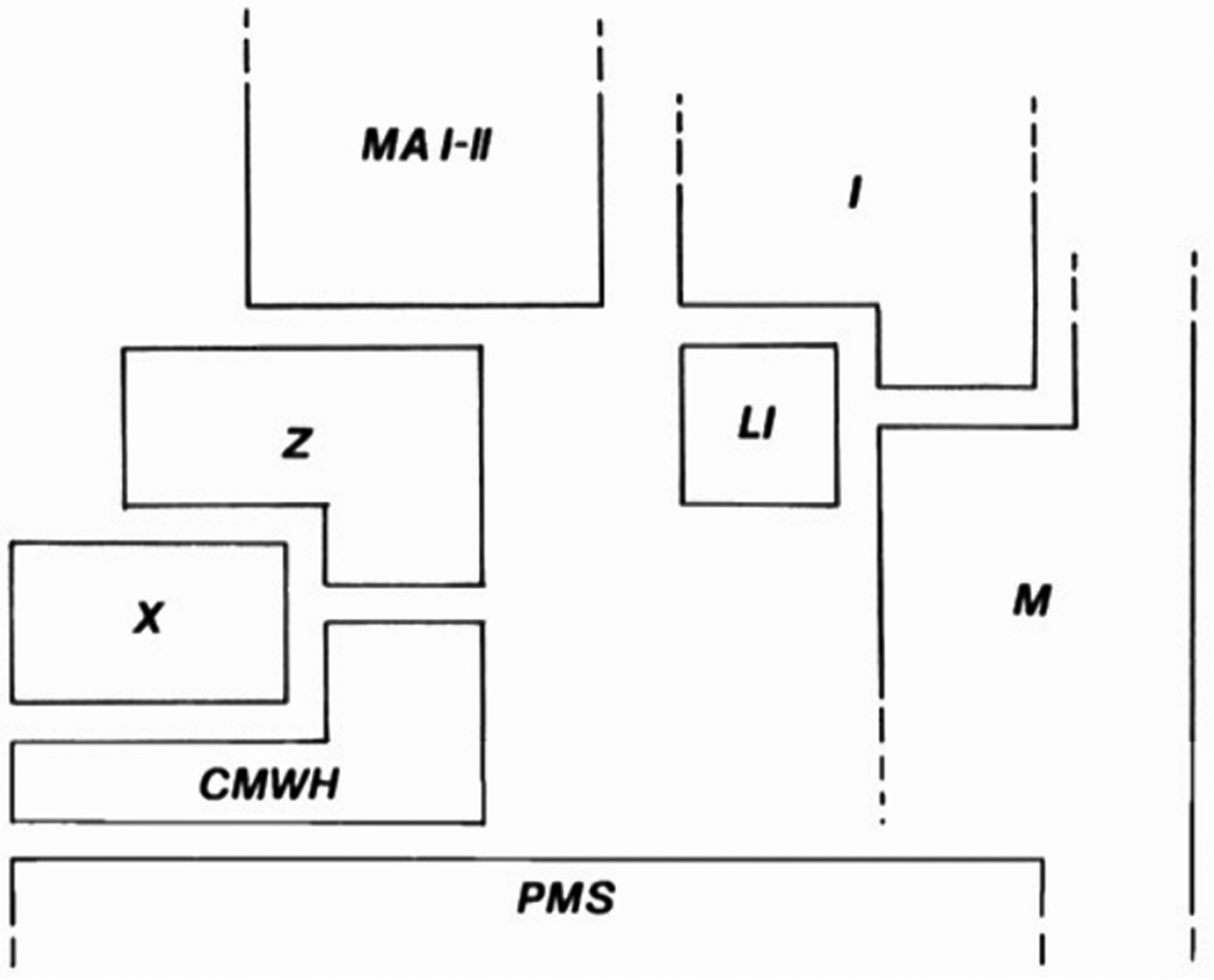
Prem (Reference Prem1973) utilized spatial, temporal, and formal traits to classify the Mesoamerican scripts. For the Preclassic in general, he distinguishes between a Monte Alban Writing System, and an Intermediate Writing System. He further divides the Intermediate Writing System into two groups (Prem Reference Prem1973:48): a northern group, including inscriptions from the “Central Depression of Chiapas” and the “northern Isthmian region”; and a southern group, including inscriptions from the “Southern highlands of Guatemala and Pacific slope.” His detailed classification is shown in Figure 1. The vertical axis indicates time, which progresses downward; the horizontal axis is a rough geographic distinction, with Oaxaca and Central Mexico to the left, and the Isthmus of Tehuantepec region and the Maya region toward the right. The dashed lines at the top suggest the beginnings of the two major “writing systems” or writing traditions of Mesoamerica, the Monte Alban tradition on the one hand, and the Intermediate tradition, on the other. Prem (Reference Prem1973:47) was of the opinion that Monte Alban writing predated Intermediate writing, and, in fact, that it was “the earliest authentic occurrence of a writing system in Mesoamerica.” Evidence discussed by Justeson et al. (Reference Justeson, Norman, Campbell and Kaufman1985:33) regarding the redating of La Venta Monument 13 to ca. 600 b.c. (Berger et al. Reference Berger, Graham and Heizer1967), and by Cahn and Winter (Reference Cahn and Winter1993) suggesting that San José Mogote Monument 3 may date to ca. 500–300 b.c., rather than 700–500 b.c. date, as proposed by Marcus (Reference Marcus1976), point to a different story, i.e. that Olmec writing, as attested on La Venta Monument 13, may have preceded the earliest writing in Oaxaca. Prem's diagram is phylogenetically conservative in the sense that the groups do not evolve into each other: for example, his Late Isthmian Writing System is separated from the Intermediate Writing System, and so is his Classic Maya Writing System. Nevertheless, he does, in fact, comment on possible relationships in the body of the paper. With regard to Late Isthmian, he states: “[t]he [Late Isthmian] writing clearly succeeds to the northern group of the Intermediate Writing Systems” (Prem Reference Prem1973:51). And with regard to Classic Maya, he suggests: “[i]t seems very probable that there is a relationship between the southern group of the Intermediate Writing Systems and the Classic Maya writing” (Prem Reference Prem1973:48).
Developmental classification of Mesoamerican scripts by Prem (Reference Prem1973:54). Abbreviations: MA I-II = Monte Albán Writing; Z = Zapotec Writing; I = Intermediate Writing; LI = Late Isthmian Writing; CMWH = Central Mexican Writing Horizon; X = Xochicalco branch of the Central Mexican Writing Horizon; PMS = Post-Classic Manuscript Style; M = Classic Mayan Writing.

Prem utilized four formal criteria for classification of all the scripts in Mesoamerica. These include: sequences of blocks; direction of sequences; three common types of signs (bar-and-dot numerals, cartouches, and graphic affixes) and the spatial configuration of two of these types of signs with respect to each other (bar-and-dot numerals and cartouches); and the conformity of inventories. He also observed traits that were distinctive of a tradition, however, as in the case of the Intermediate Writing System (Prem Reference Prem1973:48):
Common features of the two groups: reading direction in single, or pairs of, vertical columns. The signs are arranged in symmetrical blocks of frequently uniform size. The cartouche for calendric signs sometimes shows an almost baroque design (Kaminaljuyú). The bar and dot numerals have the Form 2 or 2A and are also used in a place-value system. The existence of a common sign inventory is, however, not probable.
Next, I review each of Prem's four formal traits, as well as those he assigns to the Intermediate Writing System, and comment on their applicability in the case of Izapan writing.
Traits Analyzed by Prem
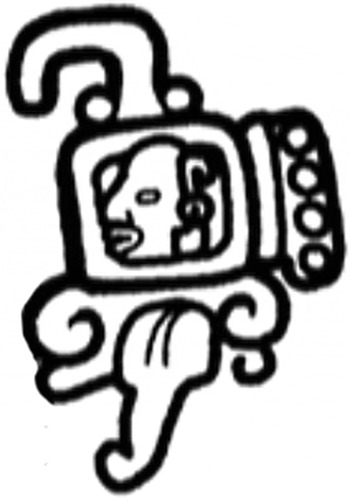
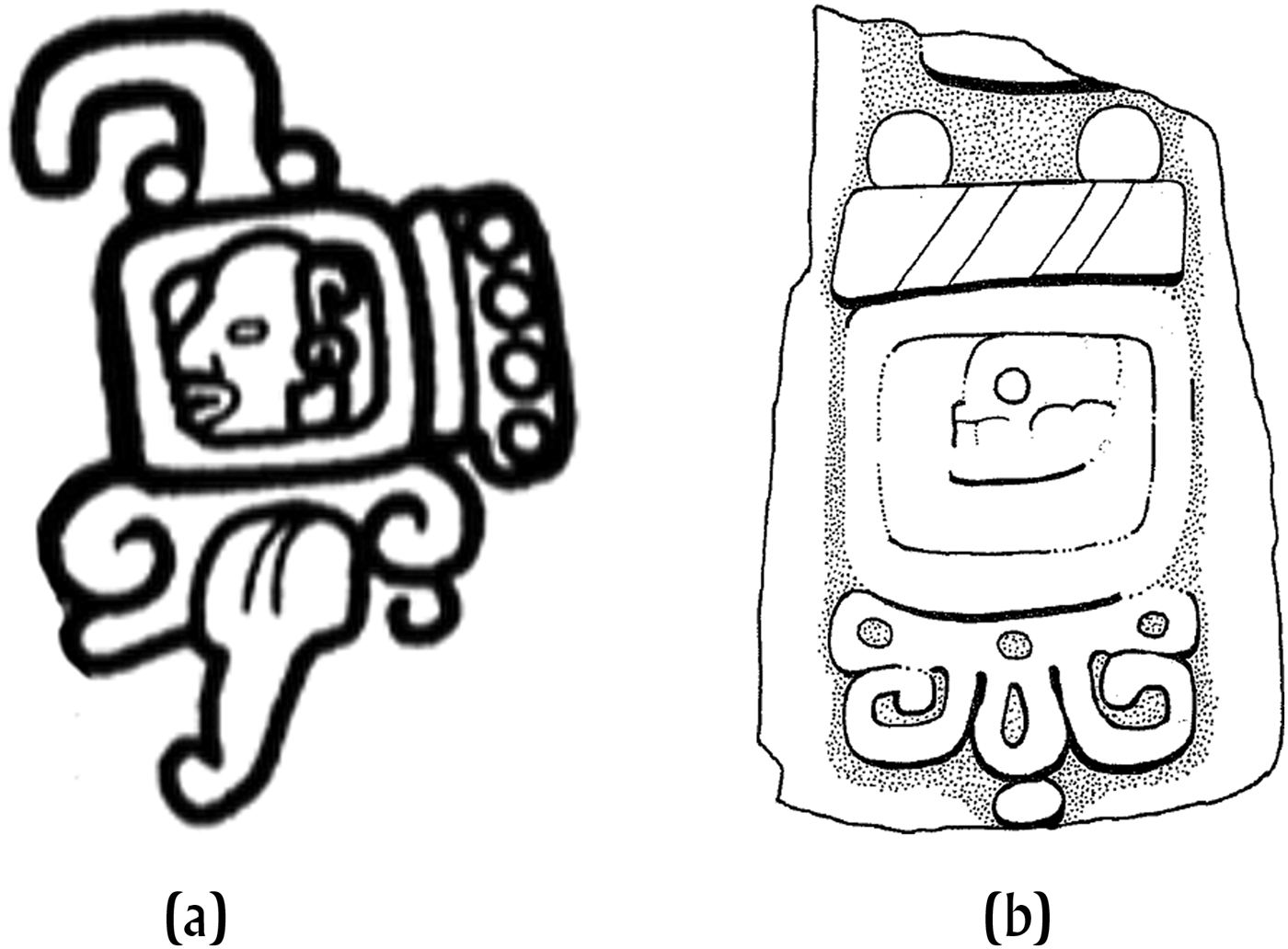
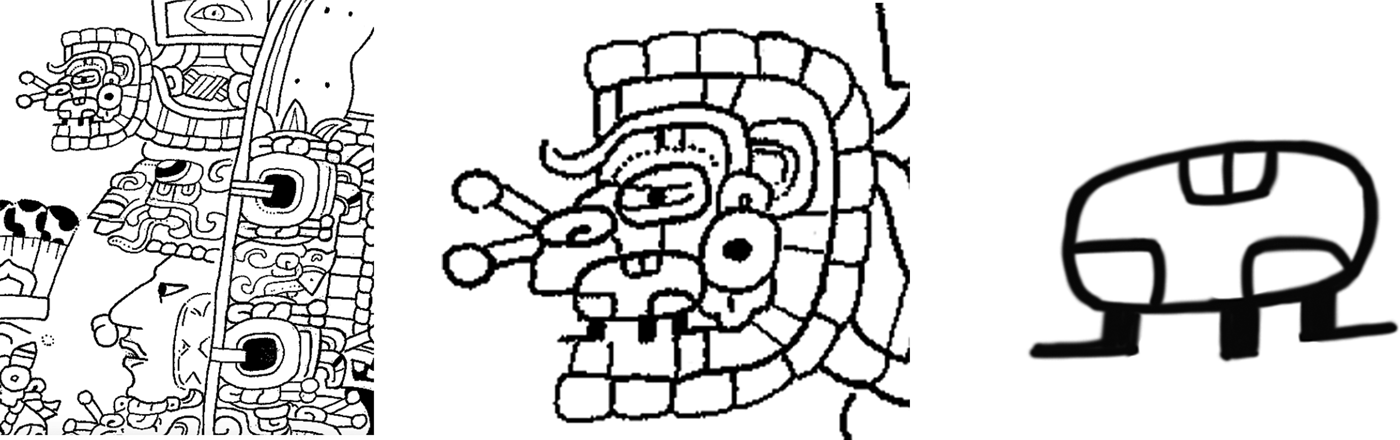
Prem's (Reference Prem1973:39) first criterion pertains to the presence of “isolated blocks or of sequences (series of hieroglyphs which suggest interrelated subject-matters).” This requires qualification. Prem refers to glyph blocks, rather than individual signs. Some texts that consist of a single glyph block may, in fact, contain several signs within that one glyph block. Additionally, as has become well understood since the time of Prem's writing, a single glyph block may constitute a full sentence, especially when one considers that in Mayan and Mixe-Zoquean, for example, the absence of a copula allows for single noun phrases (e.g., a day count) to be interpreted as a predicates. Figure 2 shows a day count from Izapa that exhibits five signs, although perhaps only two of them are meant to be read aloud. The first of these is the bar-and-dot numeral, “9,” placed as a graphic postfix in relation to the cartouche containing the day sign. The second is a hook-shaped sign, with no obvious parallels in Epi-Olmec or Lowland Mayan. This hook-shaped sign currently constitutes the only plausible candidate for a phonetic sign functioning perhaps as a phonetic complement to a logogram, given that it bears no obvious functional parallels to signs otherwise present in Epi-Olmec or Mayan day counts. If so, it could perhaps be a complement to a lexeme for “day” or for “lord.” The third sign is the cartouche, probably unread. The fourth is the day sign, perhaps for the day “lord.” The fifth is the pedestal, probably unread. Of course, this is likely a complete clause in and of itself. In Mixe-Zoquean and Mayan languages, both of which lack copulas, a noun phrase, such as phrase consisting of a day name with its assigned numerical coefficient, perhaps used in this context as a proper name of a depicted individual, could be analyzed predicatively, for it can be implicitly associated with a third person absolutive marker (Ø), which would grant the nominal phrase a predicative structure and interpretation: “S/He/It is 9-Lord.” The difference might lie in the position of the absolutive marker, depending on which stage of Mayan one is dealing with here. If it is Mixe-Zoquean, then the absolutive marker would precede the nominal phrase. If Mayan, it would follow the noun phrase. But, since in the case at hand the third person absolutive marker is null, this is a consideration that cannot be addressed at this point. This is discussed further below.
Possible example of “(S/He/It is) 9 Lord” day count on Stela 21 (Moreno Reference Moreno2000:18).

Prem (Reference Prem1973:39) makes another insightful point. Texts with substantial sequences of glyph blocks occur at Kaminaljuyu and Chalchuapa, but those from Oaxaca “are always shorter, often consisting of a few blocks only (Monte Albán: in the case of the “danzantes” as well as the lápidas the length of the sequences varies from one inscription to the other), or even of isolated blocks (Dainzú and Huamelulpan)” (Prem Reference Prem1973:39). We now know that texts with substantial sequences of glyph blocks occur near Izapa, at Tak'alik Ab'aj, for example, in addition to sites like Kaminaljuyu and Chalchuapa. Obvious examples of substantial sequences of glyph blocks at Izapa are so far lacking, despite the fact the artisans at that site participated in a very similar artistic tradition. Perhaps it would be instructive to compare the site of Izapa to the sites of Dainzú and Huamelulpan in Oaxaca.
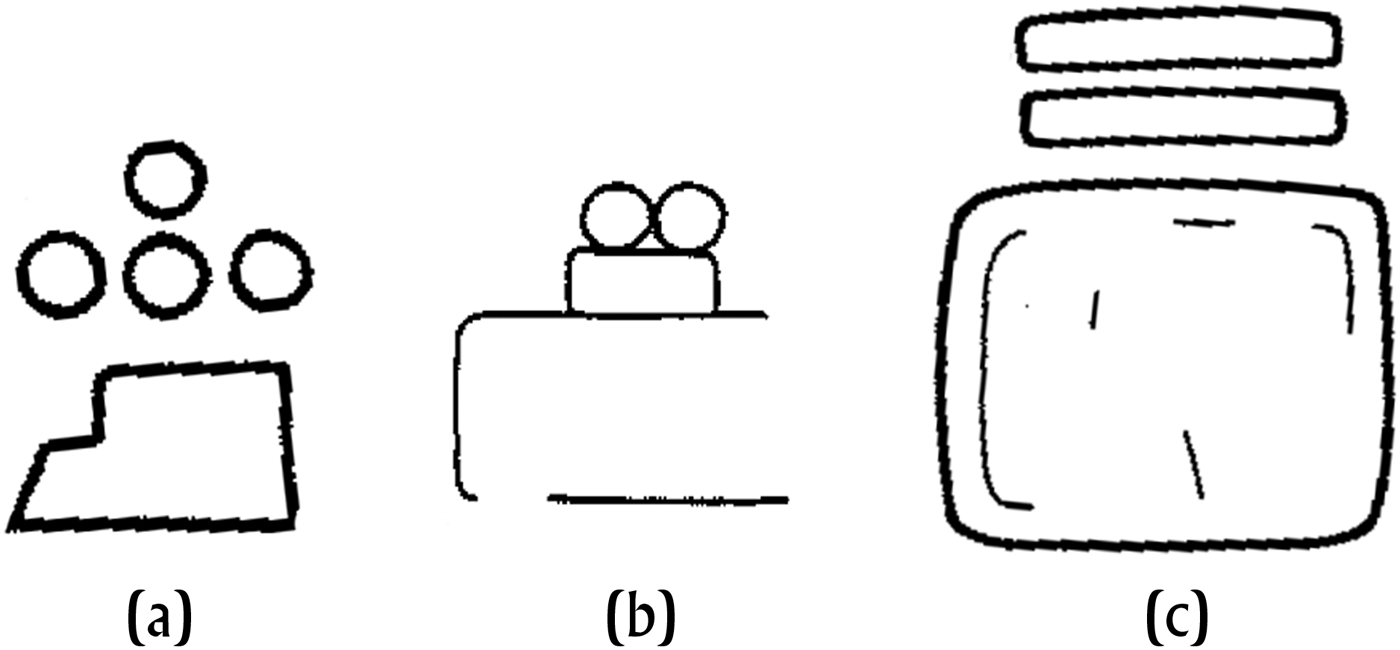
Nevertheless, there is a possible instance of a columnar sequence of three signs at Izapa. Figure 3a shows what could be a positional notation (place-value) of 1.3 for “23.” Previously, Norman (Reference Norman1976:86, 91–92) had read the expression as “5 Ik”; however, such a reading would require a numerical system akin to that of Postclassic Central Mexico, which uses dots, exclusively, with no bars, and also, that one include in the count of five dots a dot that is associated with the head of a snake that is pictorially juxtaposed to, but separate from, the glyphic expression. Assuming then that only four dots are involved in the glyphic expression, a dot for “one” is placed above three dots for “three.” Thus, it would appear that the “one” is in the position of the scores. Below both numerals is a sign that bears no internal details, but it probably constitutes the entity that is enumerated. This is the sign that Norman (Reference Norman1976:91–92) argues to be “identifiable with the Ik profile element,” but I do not regard this as likely. Given this interpretation, this glyphic expression exhibits a columnar format. In fact, when not directly affixed to a graphic main sign (Figure 3b), such as a cartouche (presumably) containing a day sign, a bar-and-dot numeral can be analyzed as constituting its own glyph block; glyph blocks consisting of bar-and-dot numerals are attested in double-column texts on Kaminaljuyu Stela 10, Tak'alik Ab'aj Stela 54, several lowland Mayan texts (e.g., El Mirador Stela 1 and several portable texts, among others), and, of course, in the Postclassic codices. Given this, examples such as that in Figure 3c, where the bar-and-dot numeral is not directly affixed to the cartouche below it, could also be analyzed as a column of two glyphs.
Evidence for columnar formatting. (a) Detail from Stela 1 (Moreno Reference Moreno2000:2). (b) Altar 60 (Moreno Reference Moreno2000:44). (c) Detail from Stela 27 (Moreno Reference Moreno2000:24).

One potential problem with this line of reasoning lies in the fact that the bar-and-dot numeral is not of the same length as the underlying cartouche that probably contained a day sign. That said, Preclassic scripts show characteristics that were subsequently regularized in some, but not all, of the scripts. Thus, while Mayan regularized the vertical size of glyph blocks by the late Late Preclassic period, Epi-Olmec did not. Epi-Olmec, in fact, does not exhibit glyph blocks in the same sense as Mayan; Epi-Olmec instead seems to be defined by vertical columns of regular width, but the columns themselves are not divided up evenly into blocks. Both Mayan and Epi-Olmec regularized the width of signs within a glyph block, in the case of Mayan, or within a column, in the case of Epi-Olmec. In early Mayan texts, however, and in some Epi-Olmec examples, some day counts exhibit superposed numerical coefficients that were significantly narrower, horizontally, than the underlying day sign. In later Mayan texts, scribes increasingly regularized the length of the superfixed numerical coefficients, employing “space fillers” when necessary to do so. Interestingly, Izapa Miscellaneous Monument 60, discussed below, displays a more even width of the superfixed numerical coefficient with respect to its underlying day count.
Prem's (Reference Prem1973:39) second criterion is that of direction of sequences. He notes that, across Mesoamerica, sequences of glyph blocks “are always arranged in vertical columns,” and that “[t]he reading direction from top to bottom can be established in most cases.” There are of course exceptions. Tak'alik Ab'aj, Kaminaljuyu, and lowland Mayan writing, furthermore, exhibit the trait of double-column formatting of texts, read from left to right (Mora-Marín Reference Mora-Marín1996, Reference Mora-Marín2001a, Reference Mora-Marín2005), alongside the earlier, single-column formatting. If examples such as that in Figure 3a are, in fact, cases of glyphic columns, one could argue for a top-to-bottom reading direction, typical of other scripts from the broader region, such as Epi-Olmec, Tak'alik Ab'aj, Kaminaljuyu, and lowland Mayan. This is especially the case if we invoke consistency: several of the glyphs at Izapa bearing bar-and-dot numerals show consistency in the placement of the numeral functioning either as a qualifier or quantifier, i.e., before the entity qualified or quantified. The one exception (Figure 2), discussed further below, where the bar-and-dot numeral is postposed, could be the result of artistic license due to space constraints. Also, as Justeson (Reference Justeson1986:449) observes, a preposed numeral is the expected linguistic order in day counts in Mixe-Zoquean and Mayan languages alike, in contrast with Zapotecan languages, where numerals follow the counted day names. It is possible to suggest, though not to conclude, that Izapa exhibited a columnar format with top-to-bottom reading order.
Prem's (Reference Prem1973:39–40) third criterion is based on three distinctive classes of signs: bar-and-dot numerals, the squarish signs often juxtaposed to bar-and-dot numerals, and a less clearly defined type of sign that corresponds to what Mayanists (e.g., Thompson Reference Thompson1950, Reference Thompson1962) referred to as graphic affixes. The first, Prem (Reference Prem1973:39) notes, “can occur in at most 19 configurations of varying number,” and “[b]y analogy with the better known Maya writing these signs may be safely defined as numerals of a vigesimal numerical system.” Prem also notes that bar-and-dot numerals are a general trait of Preclassic inscriptions; Justeson et al. (Reference Justeson, Norman, Campbell and Kaufman1985:32) refer to bar-and-dot numerals as “the only [graphic system of numeration] in Mesoamerica in the Preclassic.” Clearly, Izapa attests to these. Because of their general distribution in Mesoamerica, however, bar-and-dot numerals are not a diagnostic trait for membership within a specific sub-tradition of Mesoamerican writing.
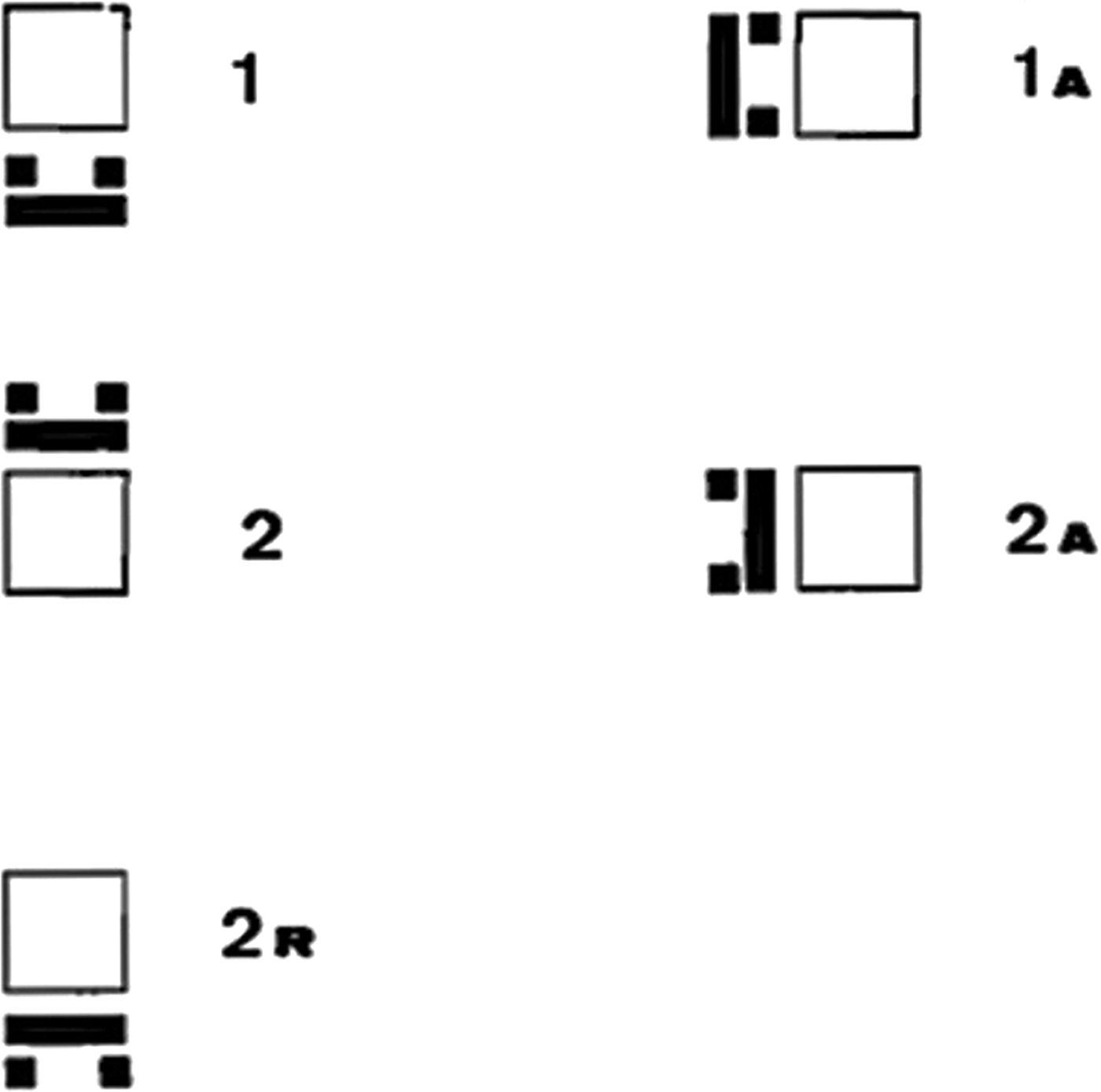
The second distinctive class of sign, the squarish sign juxtaposed to bar-and-dot numerals, may, on occasion, be characterized as a frame, in which case it can be called more properly a cartouche; henceforth, I use the term cartouche (Prem Reference Prem1973:40) for this squarish sign, even when a frame is not clearly depicted (cf. Prem Reference Prem1973:40). Prem (Reference Prem1973:40, 43) states that all Preclassic scripts use cartouches and argues that “it must be assumed that the cartouche is a definitory element within a series of signs of related thematical or functional factors” (Prem Reference Prem1973:43). In Mayan writing, graphic “main signs,” regardless of their orthographic value (logogram, syllabogram), could, in principle, be framed by a cartouche, at least partially. This may have been a development out of the use of cartouches with day signs, which clearly was quite ancient; day signs are the prototypical examples of graphic “main signs.” Prem (Reference Prem1973:37, Figure 2), then outlines a set of possible permutations of bar-and-dot numerals and juxtaposed cartouches or other type of “associated hieroglyph” (in cases where a cartouche was not used), as illustrated in his Figure 2 and tabulated with representative sites and characteristic periodization in his Figure 3 (Prem Reference Prem1973:41, Figure 3). I am hereby reproducing the portion of his Figure 2 (Figure 4) that is of relevance to Preclassic scripts. Prem observed that Forms 2 and 2A are characteristic of the Preclassic inscriptions of Veracruz (Tres Zapotes Stela C and the Tuxtla Statuette), Chiapas (Chiapa de Corzo), and the Pacific coast and highlands of Guatemala (Tak'alik Ab'aj, Kaminaljuyu, and El Baul) and El Salvador (Chalchuapa), not to mention the Lowland Mayan script. Four of the probable and possible day counts at Izapa exhibit Form 2, and one (Figure 5a) exhibits a form not recognized by Prem, with the numerical coefficient postfixed, and thus constituting a mirror image of Form 2A; this anomalous arrangement was probably the result of artistic license triggered by spatial constraints of the sculpture. As already mentioned, Justeson (Reference Justeson1986:449) has observed, this type of arrangement (Prem's Form 2 and Form 2A), are characteristic of Epi-Olmec and Mayan writing, and motivated in Mixe-Zoquean and Mayan languages.
Positions of bar-and-dot numerals relative to the calendrical main sign (from Prem Reference Prem1973:37, Figure 2).

Evidence for left-facing orientation of glyphic heads. (a) Detail from Stela 21 (Moreno Reference Moreno2000:18). (b) Miscellaneous Monument 60. Drawing by the author.

Prem's (Reference Prem1973:40) third type of sign that could be used to classify scripts is what Mayanists refer to as “(graphic) affixes,” which are typically elongated (rather than squarish or cartouche-like) signs that appear to be graphically dependent to what Mayanists refer to as “(graphic) main signs.” Unfortunately, Prem does not provide illustrations for each of the subtypes that he outlines. He notes that such signs “show a certain similarity of position with the bar and dot numerals” with respect to their commonly juxtaposed cartouche. Given the antiquity of day counts in Mesoamerican scripts, and the elongated shapes of bar-and-dot numerals, they may very well have been the models for non-numerical “graphic affixes.” Affixation of non-numerical signs appears to occur at Izapa, in the use of the day sign pedestal sign, for instance. Moreover, the day count on Izapa Stela 21 (Figure 2) appears to show a superfix in the form of a hook-shaped sign.
Prem's (Reference Prem1973:44) fourth and last formal criterion is “conformity of inventories” (the general agreement between two or more inscriptions), with respect to the first three criteria. At Izapa, there is conformity or consistency both in the use of signs, including their combinatorial possibilities, as well as the presence of specific sign types and tokens. Whatever the script type, the corpus at Izapa illustrates the same, codified system.
Traits Analyzed by Justeson et al.
Justeson et al. (Reference Justeson, Norman, Campbell and Kaufman1985:31–32) isolate six conventions common to the major script traditions of Preclassic Mesoamerica: columnar format of texts; left-facing orientation of signs; a left-to-right reading order; bar-and-dot numerals; the use of signs representing heads (of animals, people, and supernaturals); and related to the latter, the characteristic use of segmentation or pars pro toto in the representation of animals, people, supernaturals by their heads instead of their whole body. Justeson et al. (Reference Justeson, Norman, Campbell and Kaufman1985:32) do not isolate the segmentation or pars pro toto principle but, instead, relate it to their fifth convention, the use of head signs. Segmentation was applied not only to heads, however, but also to other parts of the body and to parts of objects. Prem (Reference Prem1973:39) also mentioned bar-and-dot numerals as a shared trait among Preclassic writing systems in Mesoamerica. Although Prem (Reference Prem1973:39) remarked that bar-and-dot numerals “are found in all inscriptions of the Pre-Classic period (except in Chalchuapa and Chiapa de Corzo potsherd fragment),” it is clear to me that they are in fact present on Chalchuapa Stela 1. Izapa writing also partakes in these traits. The columnar format is so far not obvious, with but one suggestive example, already discussed (Figure 3a). The left-facing orientation of signs, particularly of head signs, is also apparent (Figure 5), at least in glyph blocks that appear to be meant as isolated texts; below, I argue that there exists at Izapa a class of pictorially embedded glyphs, attested also in Epi-Olmec and Mayan writing, and in such cases head signs are oriented in a way that is determined by the pictorial composition. The bar-and-dot numerals have already been described; and the same is true for head signs. Last, as in the case in Figure 5a, a plausible instance of the day sign “Lord,” the pars pro toto principle appears to also be in use.
In addition to traits shared by all Preclassic scripts, Justeson et al. (Reference Justeson, Norman, Campbell and Kaufman1985:38–40) compile a list of traits that are present in at least some of scripts in the Southeastern tradition (Prem's Intermediate Writing System), but not outside of that tradition. They argue that these traits are sufficiently arbitrary to be diagnostic of close historical relationships among scripts, and also, that these are exclusive innovations of this tradition. These traits include: a double-column format in addition to the original single-column format; differences in size between “physically separate segments of a single extended text”; the use of the day sign pedestal; enlarged calendrical statements; Long Count dates; position of Long Count dates within their column; and position of day sign numerical coefficient when a day count is present at the end of a Long Count expressed with positional notation.
Of these traits, only one is of direct relevance: the day sign pedestal. It is attested in one clear example, Miscellaneous Monument 60, as already noticed by Justeson et al. (Reference Justeson, Norman, Campbell and Kaufman1985:39), and may be present on the possible “9 Lord” day count present on Stela 21. Laughton (Reference Laughton1997:10) cautions that the small size of Miscellaneous Monument 60 could mean that it could have been transported from elsewhere, perhaps from Kaminaljuyu; if so, the day sign pedestal present on that fragmentary monument could be discounted as part of the evidence for script affiliation. However, I have chosen to assume it is local, especially given the possibility of the presence of another day sign pedestal on Izapa Stela 21. As Justeson et al. (Reference Justeson, Norman, Campbell and Kaufman1985:39) also observed, the day sign pedestal is present also on Kaminaljuyu Stela 10, and it is of course present in lowland Mayan writing. In fact, the style of the pedestal attested on Miscellaneous Monument 60 is very close to that on the two examples from Kaminaljuyu Stela 10, and as pointed out by Benavides and Grube (Reference Benavides C. and Grube2002), to that on Panel 3 from Jaina, as well as to the isolated day counts from the murals at San Bartolo (Mora-Marín Reference Mora-Marín, Laporte, Arroyo and Mejía2008, Reference Mora-Marín2010b). So far, it appears to be absent from Epi-Olmec writing.”
There is another trait, already noted by Prem (Reference Prem1973:48), that is only present in some of the scripts of the Southeastern branch: place-value or positional notation system of counting. This is implicit in Justeson et al.’s (Reference Justeson, Norman, Campbell and Kaufman1985) fifth, sixth, and seventh traits, which involve Long Count dates, and more specifically, Long Count dates expressed positionally by means of a vertical arrangement of bar-and-dot numerals. As already mentioned above, Izapa may attest to a positional notation (1.3 for “23”) of this type, though it does not constitute an example of a Long Count date.
Summary of Classification of Izapan Writing
The script at Izapa appears to bear one example of positional notation, otherwise attested only in the Epi-Olmec (La Mojarra, Tres Zapotes, Cerro de las Mesas, Tuxtla Statuette, and Chiapa de Corzo), Tak'alik Ab'aj, El Baul, and lowland Mayan scripts. It also attests to Form 2 of the position of the bar-and-dot numerical coefficient with respect to the day sign in day counts of the ritual calendar, a characteristic also found in the same list of scripts, as well as at Kaminaljuyu. It also attests to the use of the day sign pedestal, perhaps in two examples, a trait found only in the Tak'alik Ab'aj, Kaminaljuyu, and lowland Mayan scripts. Thus, it is with the latter three scripts that Izapan writing is most closely affiliated.
Prem (Reference Prem1973) distinguished two major Preclassic writing traditions: Monte Alban Writing and Intermediate Writing. Justeson et al. (Reference Justeson, Norman, Campbell and Kaufman1985) and Justeson (Reference Justeson1986) refer to these as the Oaxacan and Southeastern branches, respectively. Furthermore, Prem (Reference Prem1973) distinguished two groups within the region of Intermediate Writing, a Northern group, and a Southern group. The Southern group includes the scripts from Tak'alik Ab'aj, Kaminaljuyu, and Chalchuapa, and is closely affiliated with lowland Mayan, although Prem prefers to define Mayan writing primarily as a Classic phenomenon coeval with the Late Isthmian Writing. Prem's Northern group corresponds to what Justeson et al. (Reference Justeson, Norman, Campbell and Kaufman1985:40–41, Table 16) refer to as the West Isthmian sub-tradition, while Prem's Southern group is what Justeson et al. (Reference Justeson, Norman, Campbell and Kaufman1985:40–41) refer to as the Greater Izapan sub-tradition, also closely affiliated with lowland Mayan. Previously, Justeson et al. (Reference Justeson, Norman, Campbell and Kaufman1985) concluded that there was not sufficient evidence to more narrowly classify the writing of Izapa. Given the evidence reviewed here, as well as new observations also presented here, it is clear that Izapan writing is most closely affiliated with Greater Izapan and lowland Mayan than with Epi-Olmec. Future discoveries will likely provide further support to this proposal.
ARTISAN DEPICTED ON IZAPA STELA 5?
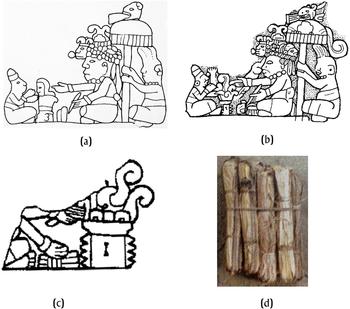
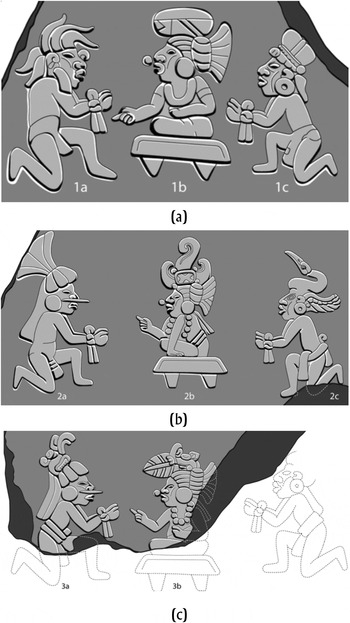
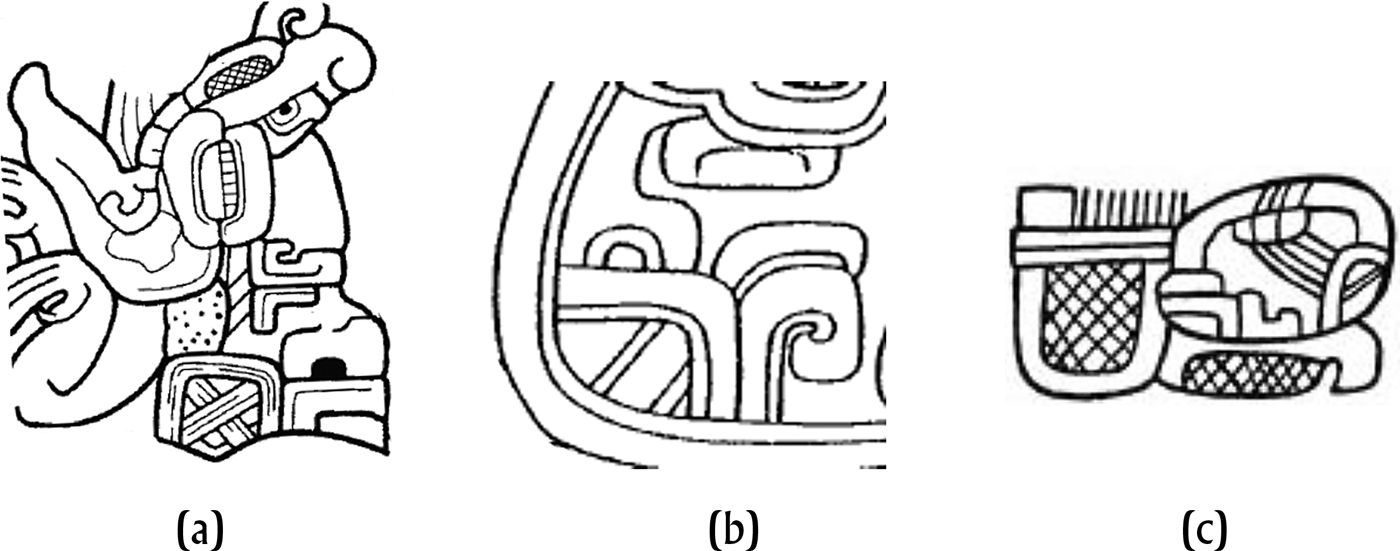
There are depictions of scribes in ancient Maya art that provide insight into the nature of the scribal institution, including its ideological underpinnings. Three decades ago, Schele and Miller (Reference Schele and Miller1986:139–140, Figure III.6) drew attention to a possible representation of a scribe or artisan on Izapa Stela 5. The drawing of the monument (Norman Reference Norman1973:Plate 10) utilized by those authors, shown in Figure 6a, however, differs significantly from that by Moreno (Reference Moreno2000), shown in Figure 6b. Instead of showing part of a scene where “a small figure wearing a spangled turban, the characteristic attire of the scribes, shapes a human body, shown at a stage when it still lacks arms and legs” (Schele and Miller Reference Schele and Miller1986:140), the drawing by Moreno (Reference Moreno2000) depicts two human figures on either side of an incense burner, and the figure that wields an elongated object that, presumably interpreted by Schele and Miller (Reference Schele and Miller1986) to be a carving implement, is more likely an incense stick drawn from a incense stick bundle in front of him.
Depictions of incense burners and incense-burning instruments. (a) Detail of Stela 5 (Schele and Miller Reference Schele and Miller1986:139–140, Figure III.6). (b) Detail of Stela 5 (Moreno Reference Moreno2000:6). (c) Detail of Stela 24 (Moreno Reference Moreno2000:21). (d) Bundle of white copal sticks (Hostnig et al. Reference Hostnig, Hostnig and Vásquez V.1998).

There is a very similar depiction on Stela 24. As in the case of Stela 5, the fragmentary scene on Stela 24, seen in Figure 6c, shows a human figure seated about to place an incense stick into an incense burner, with a bundle of incense sticks lying on the ground before him. The bundle of sticks resembles the white copal stick bundle described in Hostnig et al. (Reference Hostnig, Hostnig and Vásquez V.1998), seen in Figure 6d. Consequently, there is no demonstrable pictorial evidence of the act of carving or writing or the presence of scribes at Izapa.
CLASSIFICATION OF GLYPHIC CONTEXTS
Izapan writing is peculiar for the scarcity of textual formatting, with the possible example of a column with the 1.3 positional notation as the only exception. Typically, glyphic signs appear mainly in one of two contexts: as part of isolated captions, or as embedded captions. Isolated captions are found within the sculptural background of a monument. Embedded captions are contained within the sculptural images, e.g., affixed to a figure's headdress or body.
Most glyphic signs are non-sequential, and most of those that are clearly sequential consist of simple juxtapositions of numerical coefficients with associated day signs. Such juxtapositions are, of course, highly significant, given that they are interpretable linguistically, not pictorially: linguistic structure requires numerals for enumerating entities, rather than repetition of the counted entity. In addition to such clear cases of sequential arrangement of two signs, there may also exist a few instances of two signs combined by means of conflation or infixation, common visual representation strategies in Mayan writing.
Pictorial Motivations and Possible Functions and Values
Most of the glyphs on Izapan monuments include the following pictorial motivations: (1) shark-toothed piscine creatures (typically heads); (2) other non-human animals (typically heads); (3) humans (both heads and other parts of the body); (4) natural elements or forces (flowing liquids); (5) day sign cartouche and pedestal; and (6) numerical bar-and-dot coefficients.
Items 1–4 are merely categories describing the pictorial nature of the signs; they do not allude to their possible orthographic functions or linguistic values. The case of 5 is more transparent, by comparison with Zapotec (cartouches), Epi-Olmec (cartouches), and Mayan (cartouches and pedestal) practices. There are two signs that can be analyzed as day signs: a skull sign could correspond to the day “Death” in the ritual calendar (“7 Death”); a human head sign could correspond to the day “Lord” in the ritual calendar (“9 Lord”). Beyond the bar-and-dot numerals, cartouches and pedestals, and the possible “Death” and “Lord” signs, there are not sufficient constraints to suggest orthographic or semantic values for any other attested signs. If the pictorial embedding approach is correct, it is possible that some signs were used logographically to name individuals or parts of the body. There is simply not enough evidence yet to test possible values for any phonetic signs that may be present, although, as mentioned earlier, the hook-shaped sign superfixed to the possible day sign “Lord” could potentially be a syllabogram functioning as a phonetic complement. Thus, the following categories can be tentatively proposed: (1) logograms for proper names of people and other beings; (2) logograms for day names; (3) logograms for numerals; and (4) semantograms for day signs (e.g., day sign cartouche and pedestal).
It may be possible to exploit visual conventions to isolate additional signs and even to speculate on possible values. In Mayan writing it was common for two signs to be combined graphically either through infixation or conflation. An example of such conflation is seen in the iconographically-embedded spelling of the name Yaʔx-ʔehb’ Xook “Green Step/Ladder Shark,” the founder of the ruling dynasty of Tikal (Figure 7a), compared to the unconflated spelling (Figure 7b). The first example shows a conflation of the logograms yax, for yaʔx “green,” and xok, for xook “shark”; the third logogram, ʔeb’ for ʔehb’ “ladder; step” is unconflated. The second example shows all three logograms sequentially. The conflated example is iconographically embedded: it marks a piece of jewelry, an ear flare worn by Sihyaj Chaan K'awil on Tikal Stela 31, suggesting that the ear flare is an heirloom belonging to the dynastic founder. The two conflated glyphs in the first example are the glyph for “green” and the glyph for “shark”; more specifically, the former is conflated with the snout of the latter. Iconographic examples of the glyph for green often exhibit a jagged edge; early textual examples often do as well (Figure 7c).
Details from (a) Tikal Stela 31 (drawing by Linda Schele, Schele #4091), (b) Tikal Stela 5 (drawings by Linda Schele, Schele #4091), and (c) Hauberg Stela (drawing by Linda Schele).

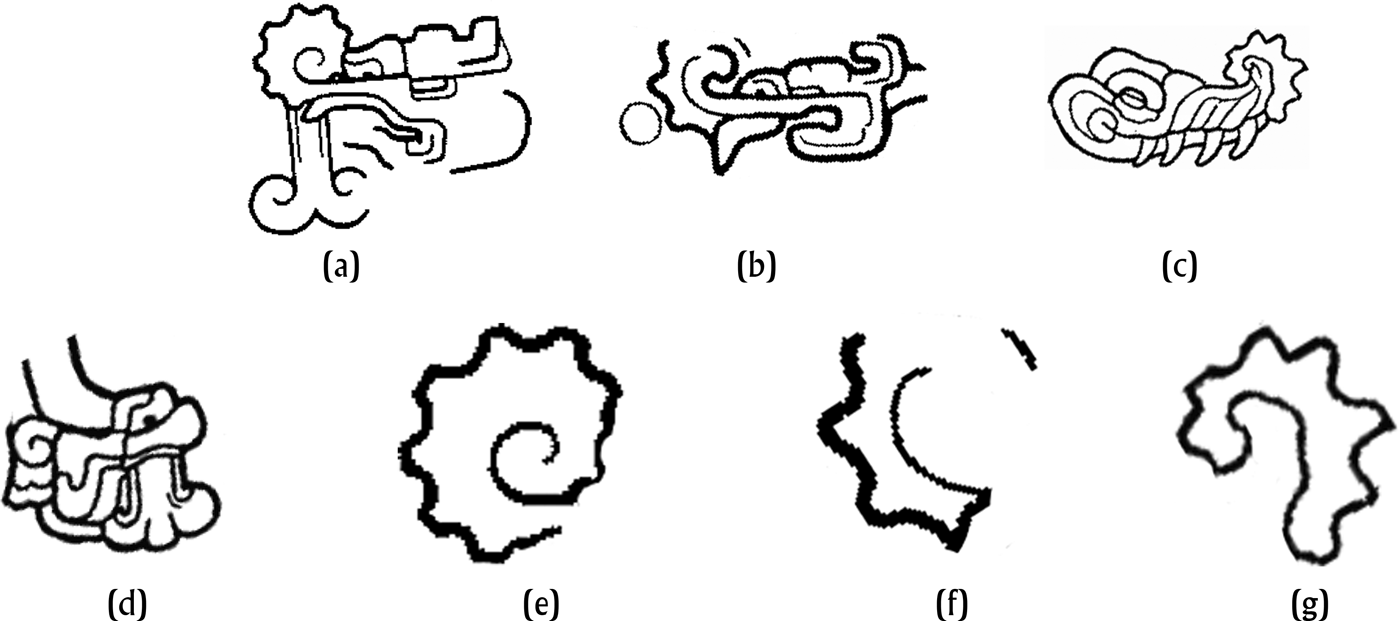
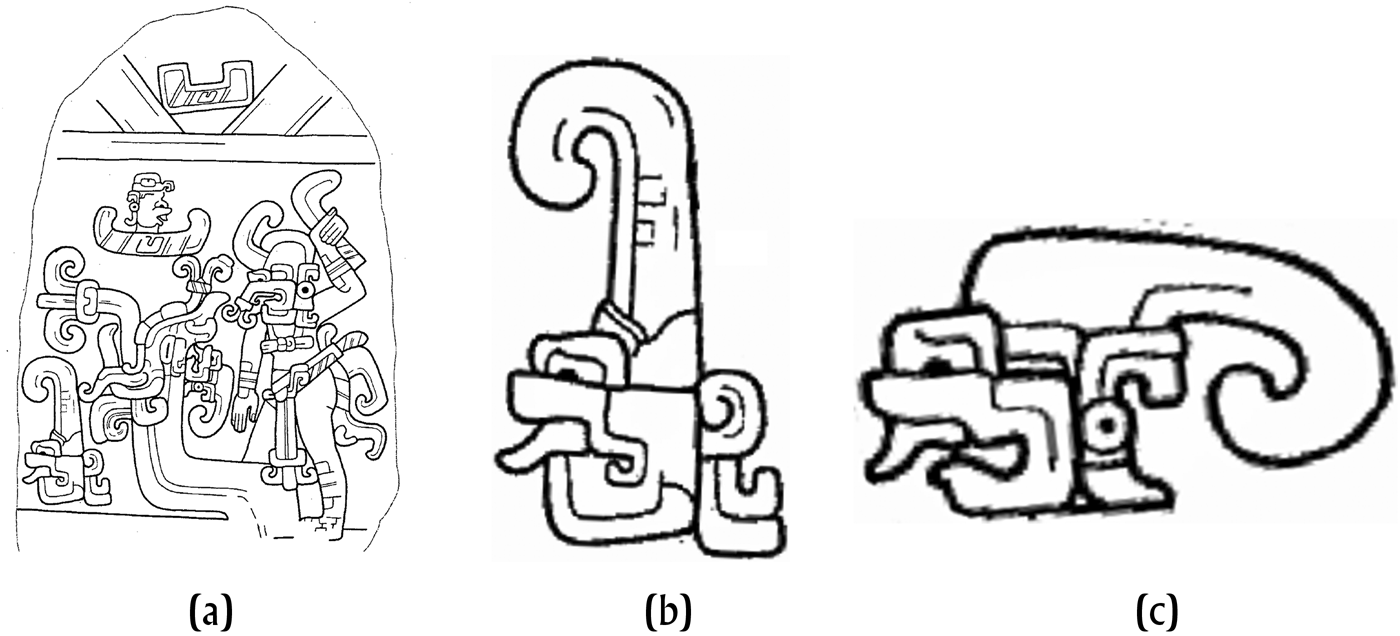
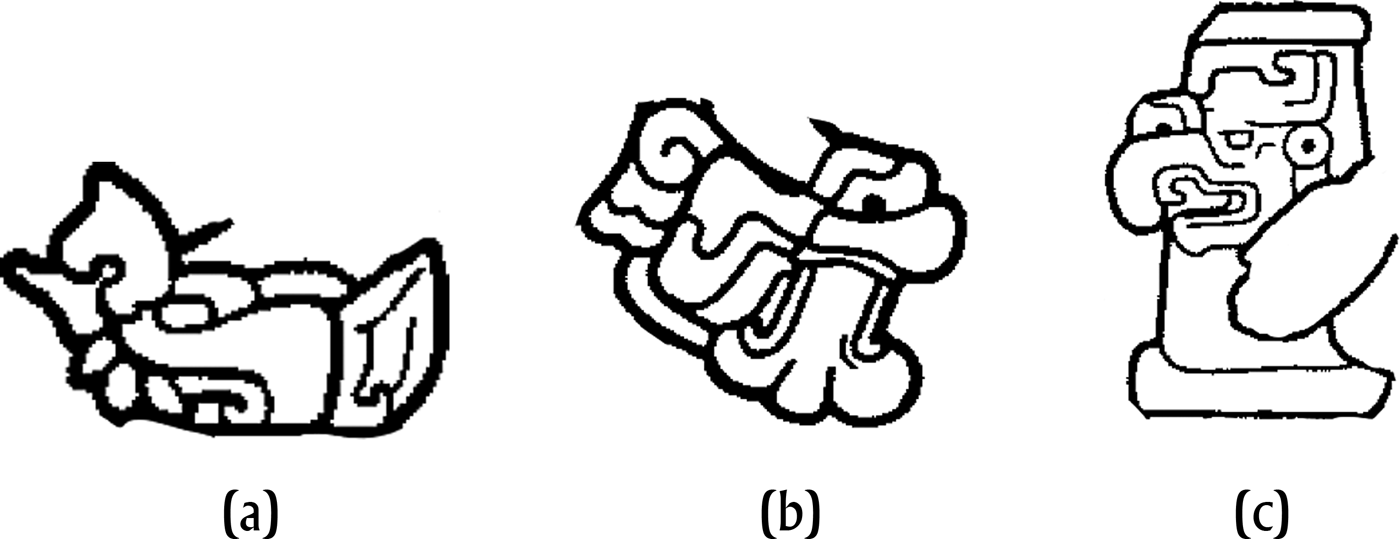
This jagged outline is seen on the snouts of at least two distinct reptiles depicted iconographically at Izapa. In Figures 8a–8b, it may constitute a snake. In the second, Figure 8c, it is a crocodilian, possibly a caiman, given the upturned snout. The jagged edge of the snouts is not a biological trait of any species of snake or crocodilian. And given that it is combined with two different signs, it can be isolated as its own sign. It may constitute an example of the glyph for “green,” which is, of course, consistent with the color of some snakes and certainly with that of caimans. The glyph for “green” appears to be conflated with these creatures’ snouts, much in the same way as in the spelling of Tikal dynastic founder's name. That this glyph appears to be conflated with two distinct types of animals points to the productivity of the practice of conflation, at least in pictorial contexts. At the very least, it allows for the isolation of another glyph, the glyph for “green.” It is worthy of note that the reptilian head in Figure 8b appears to show a dot, possibly for the numeral “1,” in front of the snout. Interestingly, the reptilian head in Figure 8a also shows a liquid flowing from the mouth; this same flowing liquid appears on a different animal head, seen in Figure 8d, which is embedded pictorially as the tail of a toad, possibly serving as a glyphic label for “tail.” This suggests that the flowing liquid “sign” is also distinct, as it applies to two distinct glyphs.
Possible cases of a sign for “green” combined with other signs. (a) Detail from Altar 60 (Moreno Reference Moreno2000:44). (b) Detail from Stela 1 (Moreno Reference Moreno2000:2). c) Detail from Stela 25 (Moreno Reference Moreno2000:22). (d) Detail from Stela 6 (Moreno Reference Moreno2000:7). (e, f) Possible examples of conflated glyph for “green.”

Some of the probable glyphs used as embedded captions closely resemble the entity they seem to name. The apparently redundant fashion in which such signs are used could support the notion that the sculptors were commenting, linguistically, on a pictorially depicted entity; consequently, these signs were probably iconic logograms. In other words, in the case of Stela 3 (Figure 9a), a sign that iconically depicts the head of a shark (Figure 9b), juxtaposed to a pictorial figure representing a shark, constitutes a case of redundancy that can be explained by an iconic logogram used to name the entity it represents. In this case, it seems that the dorsal fin of the creature itself is animated, i.e., it is represented as the head of a shark (Figure 9c), as noted by Flip Arnold (personal communication 2005). This is also a well-known convention in Mayan art and writing.
Possible embedded iconic logograms (a) Stela 3 (Moreno Reference Moreno2000:4). (b, c) Details from Stela 3 (Moreno Reference Moreno2000:4).

Numerical Coefficients and Ritual Calendar Signs
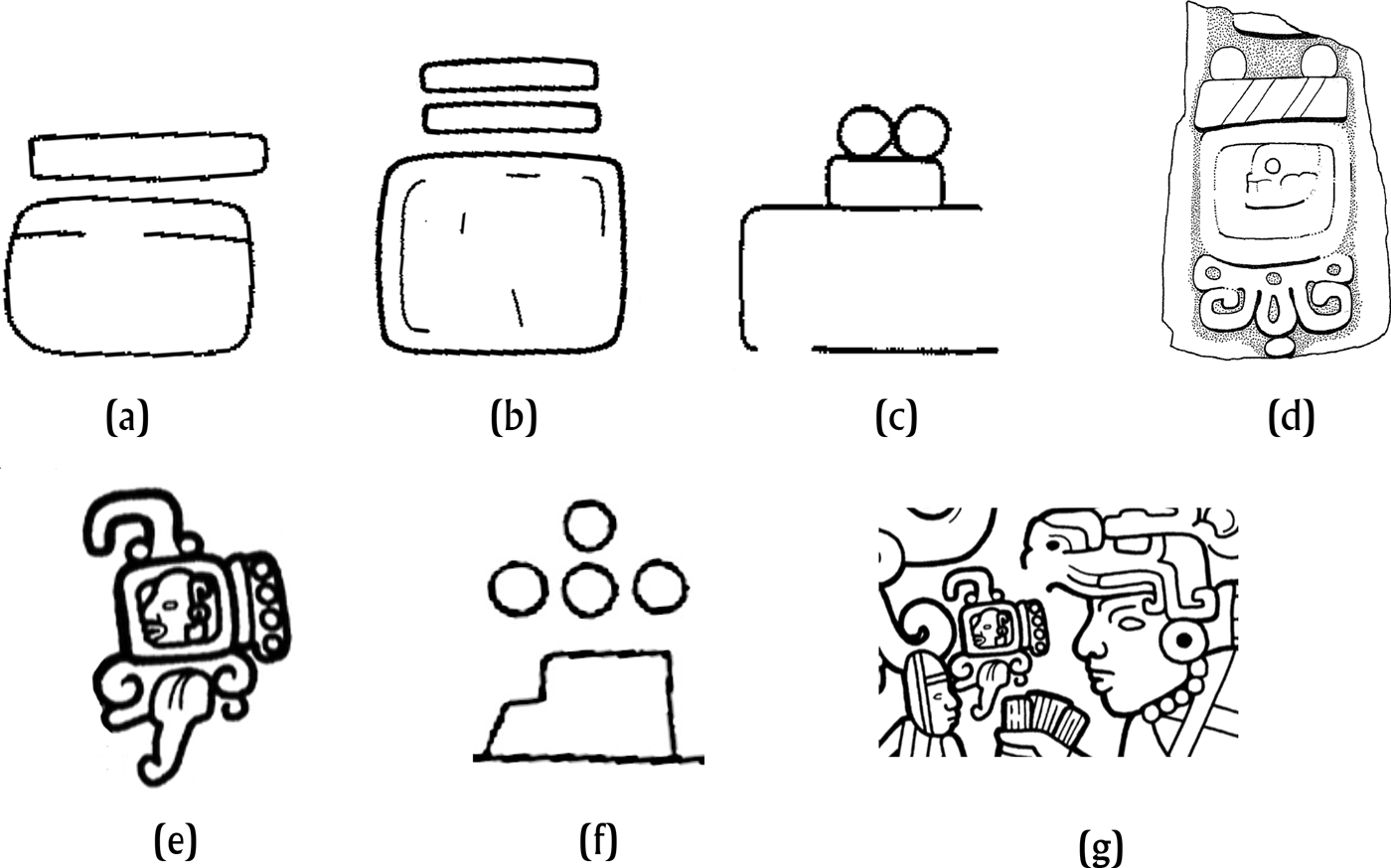
The following are the examples of bar-and-dot numerals (Figures 10a–10e): five, seven, nine, and 10. Norman (Reference Norman1973, Reference Norman1976) does not render the possible day counts on Stela 9 and Altar 60 in his drawings. He did identify the possible day count on Stela 27 (Norman Reference Norman1976:139, 141), noting that “[t]he numerical glyph above the human figure may record the commemorative date of this monument and/or the date of an actual historical event such as the death of a person or persons represented by the human figure at the right.” In addition, there is a possible example of a positional count, 1.3 for “23.” Noteworthy is the fact that, while four of the numerical coefficients in question show up on top of the day sign cartouches (Figures 10a–10d), corresponding to Prem's (Reference Prem1973) Form 2, one is seen beside it (Figure 10e), to the right more specifically, of its corresponding day sign cartouche, in a fashion not conceived by Prem (Reference Prem1973); this could have been due to artistic license, to allow for the numeral sign to be more clearly isolated, given that if it had been placed to the left of the presumed day sign it would have been squeezed between the pictorial human figure and the day sign.
Likely calendrical counts. (a) Detail from Stela 9 (Moreno Reference Moreno2000:10). (b) Detail from Stela 27 (Moreno Reference Moreno2000:24). (c) Detail from Altar 60 (Moreno Reference Moreno2000:44). (d) Miscellaneous Monument 60. Drawing by the author after photograph in Norman 1976:Figure 5.83, 282. (e, g) Details from Stela 21 (Moreno Reference Moreno2000:18). (f) Detail from Stela 1 (Moreno Reference Moreno2000:2).

At least two day signs occur within a cartouche, and in both occasions with a day sign pedestal (Figures 10d–10e). Only the day sign “Death” is recognizable (Figure 10d). The corresponding day count would be “seven death,” as suggested by Norman (Reference Norman1976:283). Another represents a human head, and may have stood for the day “Lord” (Figure 10e). Its corresponding day count may be “9 Lord.” It is underlain by what appears to be a pedestal. Alternatively, instead of a pedestal, the element underneath the cartouche could be a speech scroll, given that the central point of the pedestal is pointing toward the face of the depicted figure. There is a hook-shaped element atop the day sign cartouche that resembles the stem of a pumpkin; this hook-shaped element seems extraneous to the day count, and could constitute the best evidence for a phonetic complement in this writing system so far. If, as suggested earlier, the “9 Lord” day count constitutes a nominal expression naming one of the two (male) individuals that flank it (Figure 10g), and is thus interpretable as “S/He is 9 Lord,” one could be dealing with a practice different from what is known of lowland Mayan texts, where day counts were generally restricted to calendrical functions. The day count would be more like those found in Zapotec inscriptions, for example, where they could be used as proper names of individuals as well as calendrical counts.
Individual Proper Names or Titles
Ancient Mayan art is characterized by the occasional practice of embedded glyphs used to spell out the names of depicted rulers; such glyphs are usually placed within the headdress worn by the ruler. In a typical example, Martin and Grube (Reference Martin and Grube2000:77) illustrate and label the pictorially embedded spelling of K'ahk’ Tiliw Chaan Chahk, a Late Classic ruler of Naranjo, in the representation of his headdress.
This was probably a practice well-established by the middle of the Late Preclassic period, as seen in the case of Kaminaljuyu Monument 65 (Figure 11), where most of the portrayed figures bear what appears to be a glyph on their headdress, possibly naming them; some of the figures do not wear a headdress, perhaps indicating a lower status compared to those who are wearing a headdress.
Possible cases of embedded glyphic names on the headdresses of the depicted personages on Kaminaljuyu Monument 65. From Doering and Collins Reference Doering, Collins, Guernsey, Clark and Arroyo2010:265, Figure 11.2.

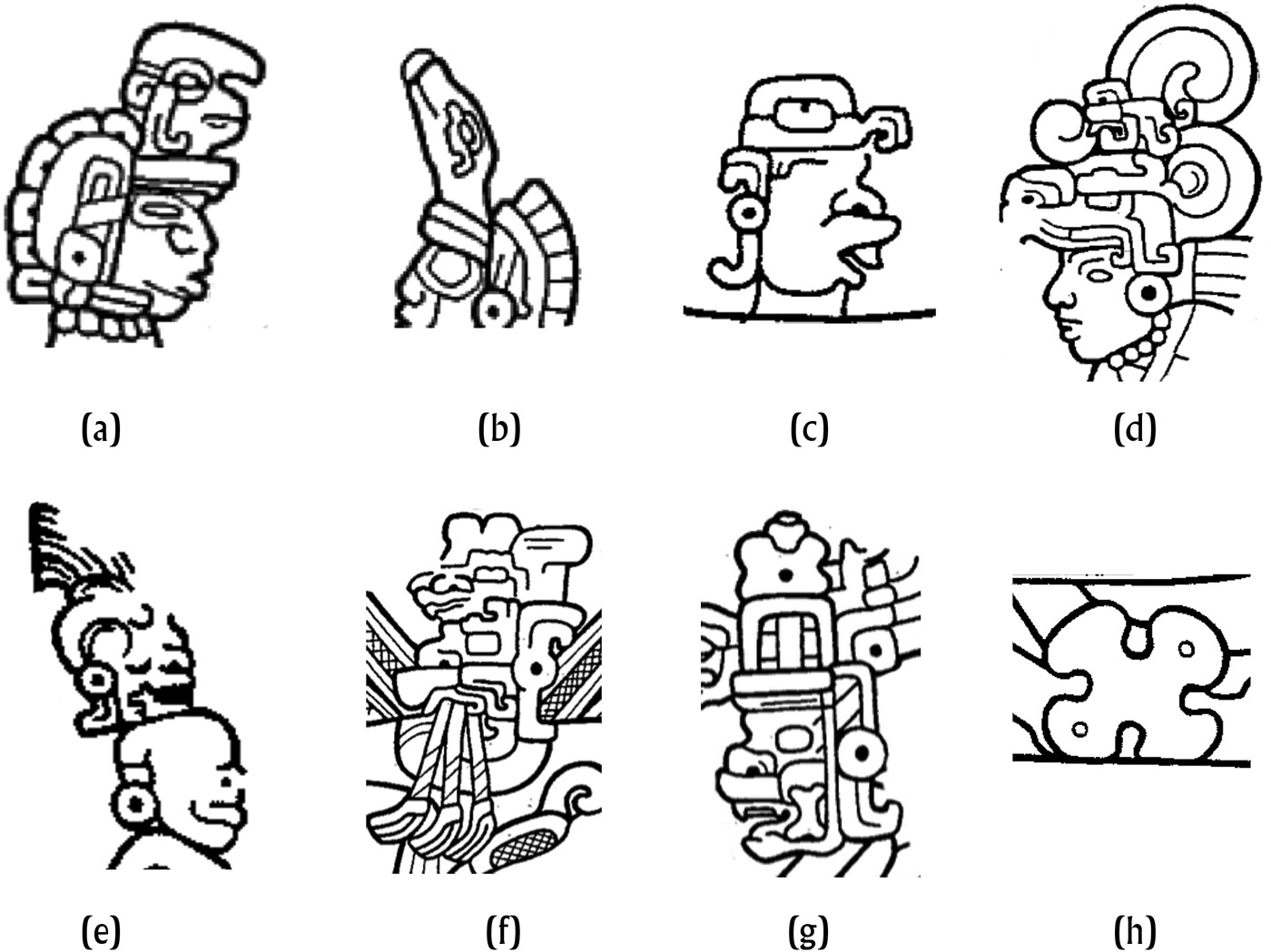
At Izapa, there are several instances of what appear to be iconographically embedded glyphs, placed on the headdresses of human figures, that could represent their names or titles, as seen in Figure 12. Several of these possible glyphs represent heads of animals: spider monkey (Figure 12a), a coati or armadillo (Figure 12b), centipede (Figure 12c), and shark (Figure 12d). At least one appears to be a human head (Figure 12e) and one more represents an animal (Figure 12f), although it is not clear whether it is human or not. There exist several other similar examples. Admittedly, some of these may very well have been merely ornamental components of headdresses, perhaps associated with specific occasions or ceremonies, rather than the individuals wearing them. At least one example, however, may be a case of two signs not depicting animal heads (Figure 12g), one perhaps a stylized assemblage of the pelvic bones, like the one prominently seen on the figure wearing this headdress (Julia Guernsey, personal communication 2016), and the second a crossed-bands sign inside a cartouche: these two signs could potentially be spelling a name.
Possible instances of embedded glyphic names on headdresses of figures at Izapa. (a, b) Details from Stela 18 (Moreno Reference Moreno2000:15). (c) Detail from Stela 3 (Moreno Reference Moreno2000:4). (d) Detail from Stela 21 (Moreno Reference Moreno2000:18). (e) Detail from Stela 24 (Moreno Reference Moreno2000:21). (f) Detail from Stela 11 (Moreno Reference Moreno2000:12). (g) Detail from Stela 50 (Moreno Reference Moreno2000:27). (h) Detail from Stela 50.

Part-Of-The-Body Labels
Mayan writing occasionally exhibits the practice of embedded captions for the names of objects present in a scene, even when those objects are generic, present in many scenes of different kinds, rather than specific to the scene. Thus, these captions do not appear to play a major narrative role but, instead, appear to be opportunistic. One example (Figure 13) shows a maskette placed atop a headdress with the embedded caption cha-ma in the mouth, probably for proto-Ch'olan *chaʔam “fang, eye-tooth” (Kaufman and Norman Reference Kaufman, Norman, Justeson and Campbell1984:115).
Opportunistic embedded glyphic spelling cha-ma for Proto-Ch'olan *chaʔam “fang, eye-tooth” on Rio Azul jadeite plaque. Drawings by the author.

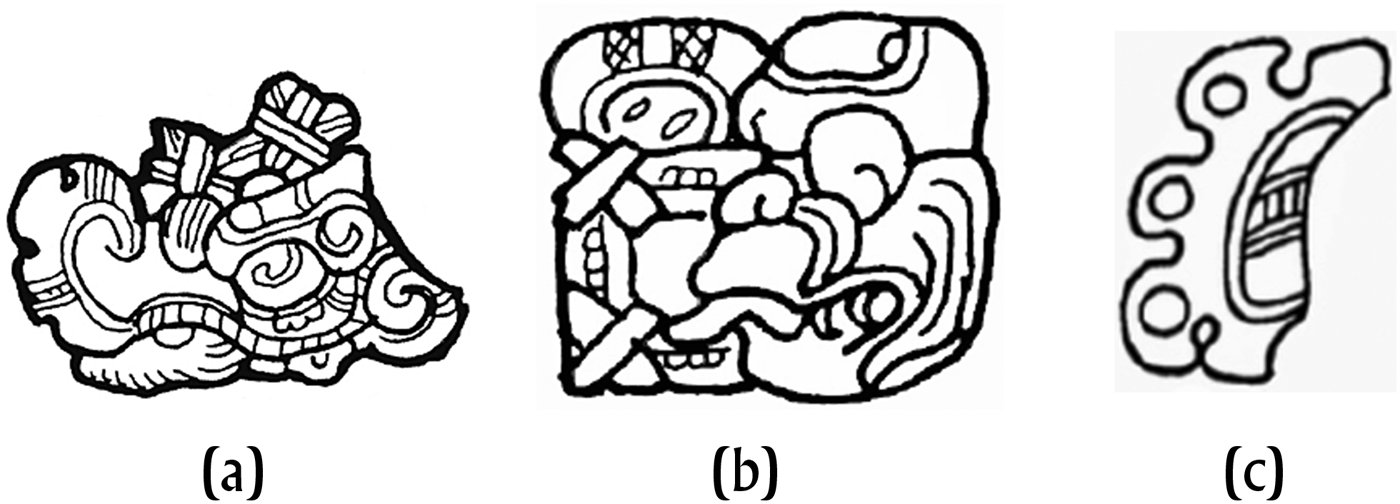
Similar, potentially opportunistic captions may appear at Izapa in the torsos, wings, or tails of creatures. One of these, present on Stela 11 (Figure 14a), was already mentioned by Taube (Reference Taube1992:29–30, Figure 11), who observed the presence of what appears to be the equivalent of the face of “God C” (Figures 14b and 14c): it appears affixed to the back of a “squatting toad” that constitutes the zoomorphic variant for the “month” glyph. If this identification is correct, then a Mayan identification may be possible, via the practice of rebus phoneticism and rebus logography. Kaufman and Justeson (Reference Kaufman and Justeson2003:306) reconstruct the Central Mayan term *k'uʔj “barriga, estómago, pecho, tórax (belly, stomach, chest, thorax).” If one assumes a Mayan lexical identity, it is possible that a logogram k'uh for k'uh, “god,” could have been used, through the practice of rebus logography (Justeson Reference Justeson, Hanks and Rice1989), to stand for the near-homophone *k'uʔj “belly, stomach, chest, thorax.” Central Mayan is a high-order grouping of all the Eastern Mayan and Western Mayan languages. This does not mean that the language written in such texts was proto-Central Mayan, which had already diversified significantly by this point but, instead, a descendant of Central Mayan. While Ch'olan-Tzeltalan is one such descendant, the available dictionaries for the Ch'olan-Tzeltalan languages do not attest to such a term in a form that would allow for a credible near-homophony between “god” and “belly, stomach, chest, thorax.” Its reconstruction to Central Mayan as *k'uʔj is instead based on its attestation in Eastern Mayan (Greater Mamean, Greater K'iche'an) and one branch of Western Mayan (Greater Q'anjob'alan). It is likely that a form of pre-Ch'olan-Tzeltalan retained the term: Kaufman and Justeson (Reference Kaufman and Justeson2003:307) do present evidence from Tzeltal and Tzotzil that supports the reconstruction of Proto-Tzeltalan *ch'uht “barriga (belly),” presumably from earlier **k'uʔjt (having observed the regular *k(’) > *ch(’) shift), exhibiting the addition of a final t that cannot be accounted for at this time (i.e., it is not the result of a regular sound change, but, instead, probably the result of a derivational morphological process). The term would have disappeared completely from the Ch'olan branch of Ch'olan-Tzeltalan, for it is not attested in any dictionary of a Ch'olan language (Ch'ol, Chontal, Ch'olti, or Ch'orti’). At present, there is no basis for a Mixe-Zoquean analysis based on a (near-)homophony between the terms for “god” and “belly, stomach, chest, thorax.” In my opinion, the evidence presented here for a Mayan linguistic affiliation must remain speculative: it is extremely limited, and it relies on the assumptions that the face on the toad's torso is, in fact, a form of God C and that it functions as a type of rebus for a term for the body part itself (i.e., torso). Nor does this limited evidence, even if proven correct at some point in the future, allow for a narrow linguistic determination, but only for a rather general one, i.e., one of several Central Mayan languages from four different subgroups (Greater K'iche'an, Greater Mamean, Greater Q'anjob'alan, or Ch'olan-Tzeltalan) of the Mayan language family spoken during the Late Preclassic period. Furthermore, as shown below, the evidence for the down-turning basal motif could support a Mixe-Zoquean, rather than Mayan, affiliation.
Instances of God C on Late Preclassic and Classic art and writing. (a) Detail from Stela 11 (Moreno Reference Moreno2000:12). (b) Detail from Kaminaljuyu Altar 10. Drawing by the author. (c) Detail from Bagaces Slate Disk. Drawing by the author.

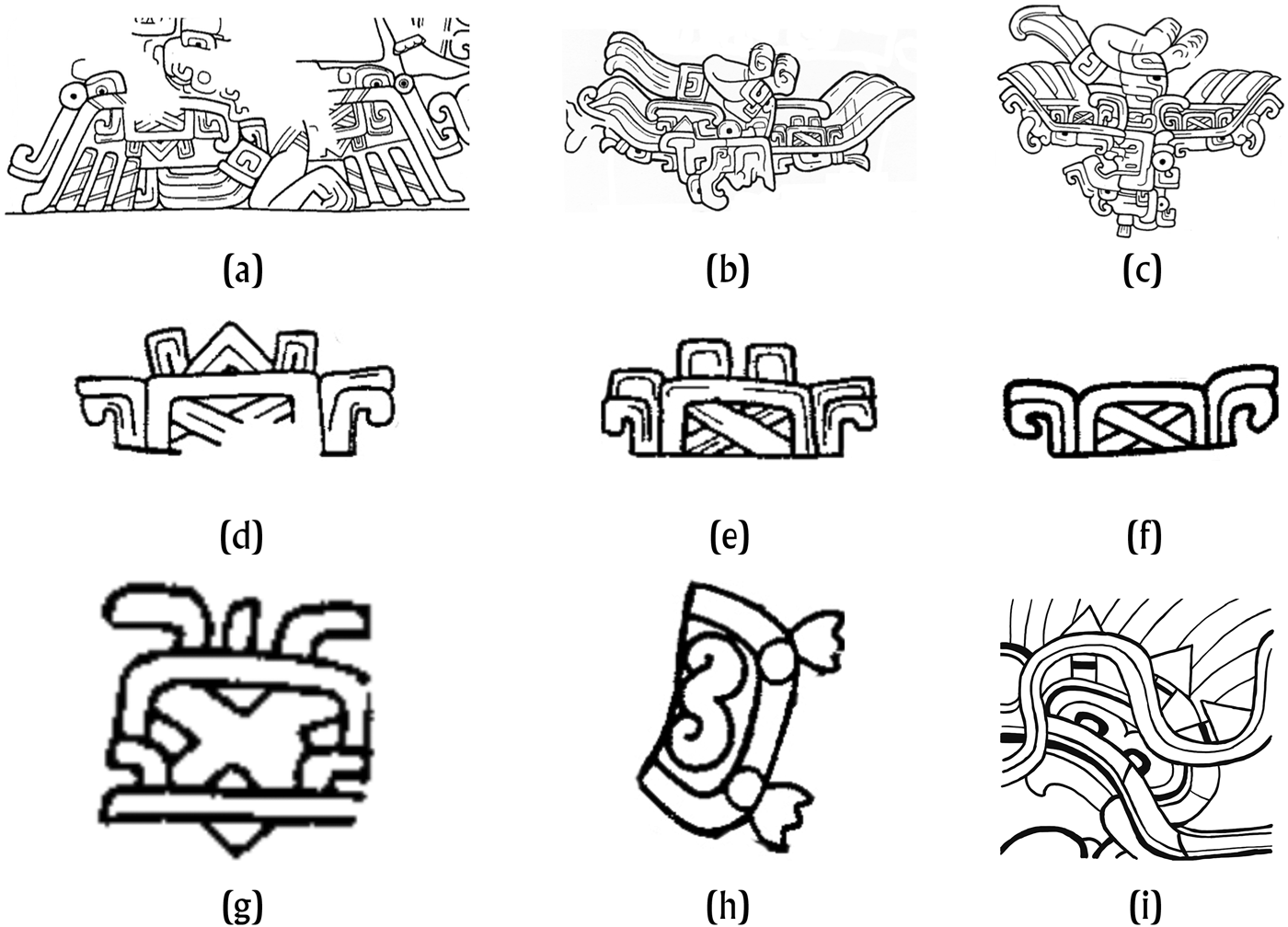
Another sign that appears to function as an embedded glyph is seen on the wings of three “bird men” (Figures 15a–15c). The signs affixed to the wings vary in the form of the element present above the crossed-bands element. There are three versions of this sign: Figure 15d shows a version with two rectangular elements separated by a triangular element; Figure 15e shows only the two rectangular elements; and Figure 15f shows neither the rectangular elements nor the triangular element. A different sign or motif appears embedded on the wing of an avian figure on Stela 25 (Figure 15g), somewhat resembling the ʔahk'ab‘(al) “night, darkness” logogram of Mayan writing, which may also appear in the wings of avian figures at Kaminaljuyu (Figure 15h) and San Bartolo (Figure 15i); interestingly, the case at hand more closely resembles that on the San Bartolo murals than the Kaminaljuyu examples, in that both the Izapa and San Bartolo versions of the ʔak'ab‘(al) sign appears upside down (rotated 180 degrees) with respect to the standard Classic Mayan version.
Signs embedded on wings. (a) Detail from Stela 61 (Moreno Reference Moreno2000:31). (b, e) Details from Stela 4 (Moreno Reference Moreno2000:5). (c, f) Details from Stela 2 (Moreno Reference Moreno2000:3). (d) Detail from Stela 61 (Moreno Reference Moreno2000:31). (g) Epi-Olmec spelling ʔo-wa for ʔowa "macaw" (Kaufman and Justeson Reference Kaufman and Justeson2001:7). (h) Wing motif or glyph on Stela 25 (Moreno Reference Moreno2000:22). (i) Wing motif on San Bartolo mural. Drawing by Heather Hurst.

Importantly, the sign or motif in Figures 15d–15g is the same sign that Guernsey (Reference Guernsey, Love, Fields and Reents-Budet2005:108–109) points out resembles a possible syllabographic spelling ʔo-wa for ʔowa “macaw” (Figure 15g) that is attested in Epi-Olmec writing (Kaufman and Justeson Reference Kaufman and Justeson2001:7). Nevertheless, although there is a resemblance between the variable element in Figures 15d–15f and the possible syllabogram ʔo, on the one hand, and between the cross-bands sign in Figures 15d–15f and the possible syllabogram wa on the other, it is difficult to reconcile the details of the graphic shapes of the comparanda at this point, as well as the fact that the variable element, possibly equivalent to Epi-Olmec ʔo, is absent from the spelling in two instances (Figure 15c).
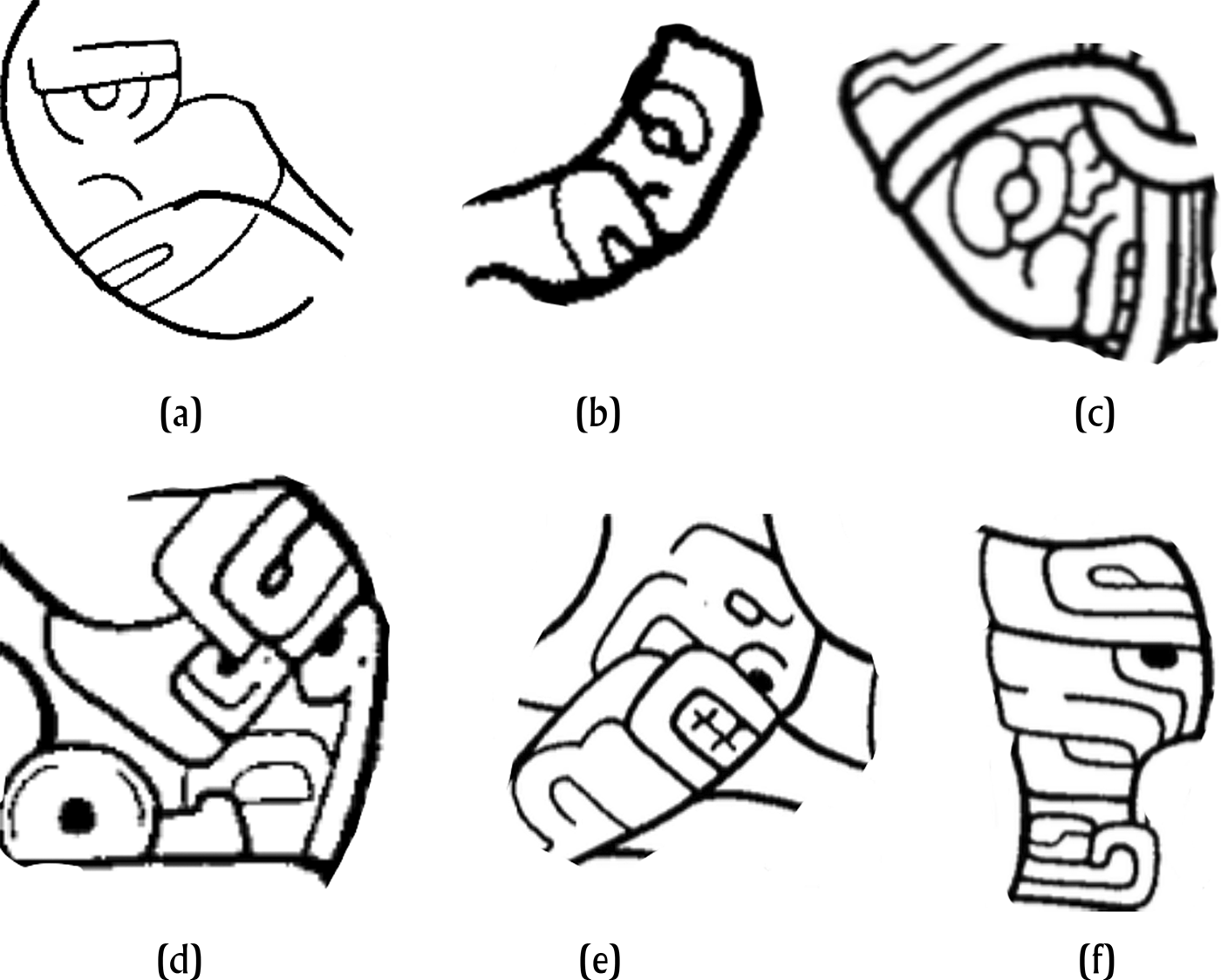
Another likely case of an embedded glyph is seen in Figures 16a–16f. It consists of a face, possibly human, placed on the belly of birds (Figures 16a–16b) or humans in the guise of birds (Figures 16c–16f). I suspect that some of the details in some of these examples are not all accurately rendered by Moreno (Clark and Moreno Reference Clark, Moreno, Lowe and Pye2007). The consistency with which a seemingly human face, however, appears on the chests of birds or humans transformed into birds, on its own, suggests that this is a valid trait.
Human face sign embedded on abdomens. (a) Detail from Altar 20 (Moreno Reference Moreno2000:42). (b, c) Details from Stela 25 (Moreno Reference Moreno2000:22). (d) Detail from Stela 4 (Moreno Reference Moreno2000:5). (e) Detail from Altar 3 (Moreno Reference Moreno2000:39). (f) Detail from Stela 2 (Moreno Reference Moreno2000:3).

Lastly, there are two types of signs that could also constitute embedded glyphs referring to parts of the body (Figures 17a–17b) or, in at least one case, perhaps a label for a crafted object (Figure 17c). On Stela 1 (Figure 17a) the Rain God personage appears to have fish for feet; this could be simply an iconographic connection, given the association of water and fish with the Rain God (Norman Reference Norman1976; Taube Reference Taube1992). On Stela 6 (Figure 17b), however, a more interesting example is seen: a zoomorphic head with liquid flowing from its mouth, replacing the tip of the tail of a creature resembling a toad. Since toads normally lose their tails after metamorphosis, it is not clear that this is in fact a tail that is represented. But the zoomorphic head and the liquid flow are separable elements, as already mentioned (Figure 8). Lastly, a zoomorphic head exhibiting an avian beak and possibly crest feathers in the form of a flame-eyebrow-like element, seems to function as a label on a drum or ceramic vessel on Stela 18 (Figure 17c). Although some avian censers are attested at the site (Julia Guernsey, personal communication 2016), even if that is the case, it is possible that such censers could have used the avian head as a kind of glyphic label. This avian head closely resembles another mentioned below.
Additional examples of embedded signs. (a) Detail from Stela 1 (Moreno Reference Moreno2000:2). (b) Detail from Stela 6 (Moreno Reference Moreno2000:7). (c) Detail from Stela 18 (Moreno Reference Moreno2000:15).

Possible Placenames and Geographic Features
Lowland Mayan pictorial art occasionally utilizes glyphs, particularly glyphs naming a polity or city, i.e., Emblem Glyphs as a means of indicating the location of a portrayed event, as described by Stuart and Houston (Reference Stuart and Houston1994). Those authors also examined cases of toponymic registers from Izapa and Tak'alik Ab'aj and, perhaps in an overly pessimistic fashion, stated that “in contrast to the bands from the southern lowlands, those from sites on the Pacific piedmont pose a near insuperable obstacle for future investigation: they are unaccompanied by texts and are thus unlikely to be anything other than a subject for conjecture” (Stuart and Houston Reference Stuart and Houston1994:64). Previously, Quirarte (Reference Quirarte1973:9–18) and Norman (Reference Norman1976:23–31) described both the top and bottom registers in significant detail, the former referring to them as “top-line and base-line panels,” the latter as “sky and ground ‘jaguar mask’ panels,” although this category o/-e subsumes the water panels. I believe it is possible that some of the components in these registers or panels could correspond to toponyms and, by analogy with the Classic Mayan examples discussed by Stuart and Houston (Reference Stuart and Houston1994), could be composed in part of actual glyphs for place names, perhaps full-figure versions of them.
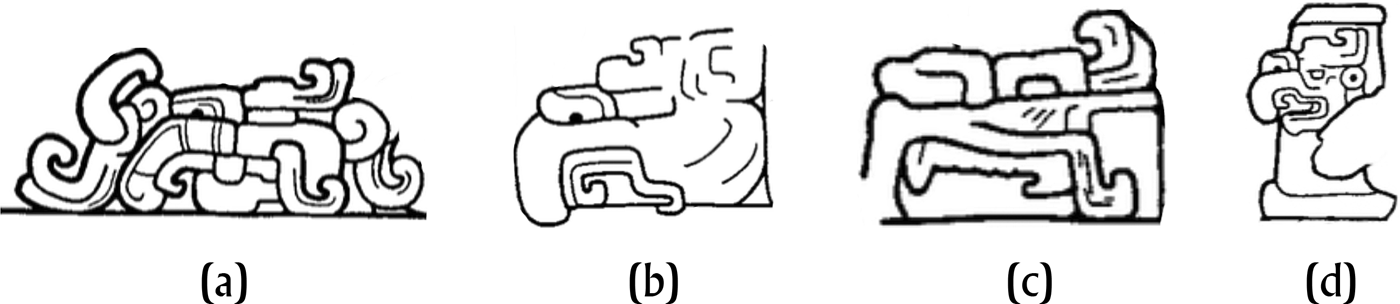
For now, I prefer to focus on two more specific types of signs. One type could refer to a component of the natural environment, namely trees, or a part thereof, and the other, to the ground. As seen in Figure 18, there are three instances of trees with a zoomorphic head at the bottom. These zoomorphic heads show strong similarities: a long, down-turning snout or beak, with prominent gums, a bulbous nose, and what appear to be standing feathers (resembling flame-eyebrows) on the head. It is possible that this could be a glyph referring to the foot or base of a tree, or perhaps the trunk of the tree, or the tree itself. This bird resembles the avian head in Figure 17c, reproduced here as Figure 18d. If the object depicted there is a log drum, then perhaps it shares the same motivation with the examples in Figure 18: a tree trunk or log. This association could underlie a linguistic motivation (in either Mayan or Mixe-Zoquean) worth exploring.
Examples of trees with zoomorphic heads at the base. (a) Detail from Stela 2 (Moreno Reference Moreno2000:3). (b) Detail from Stela 27 (Moreno Reference Moreno2000:24). (c) Detail from Stela 10 (Moreno Reference Moreno2000:11). (d) Detail from Stela 18 (Moreno Reference Moreno2000:15).

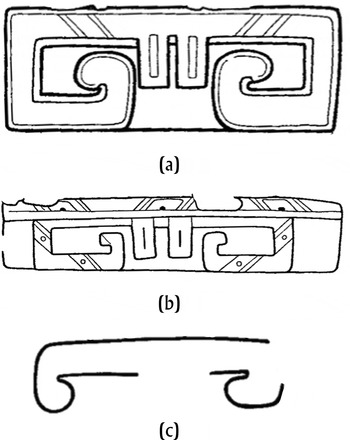
Several scholars interested in the iconography of Izapa and Kaminaljuyu have discussed the down-turning basal motif, seen in Figure 19. It has also been related to the Epi-Olmec syllabogram na, which suggests that the down-turning basal motif was based on the Mixe-Zoquean term *naas “earth, land.” Stross (Reference Stross1990) first suggested that the Epi-Olmec sign had been borrowed by Mayans as T23 na, an argument further supported and elaborated in Mora-Marín (Reference Mora-Marín2001a, Reference Mora-Marín2003) and Kaufman and Justeson (Reference Kaufman and Justeson2001). Figure 19 illustrates merely a few of the down-turning basal motifs in the Izapa corpus. This may seem like a strong linguistic motivation for a Mixe-Zoquean affiliation of Izapa; however, the down-turning basal motif is also found on Kaminaljuyu Stela 11, which exhibits traits consistent with a Mayan (Ch'olan-Tzeltalan) affiliation (Mora-Marín Reference Mora-Marín2005). Stronger evidence for linguistic affiliation should be sought in textual passages with more explicit phonological, lexical, and morphosyntactic evidence.
Examples of down-turning basal motifs. (a) Detail from Stela 4 (Moreno Reference Moreno2000:5). (b) Detail from Stela 18 (Moreno Reference Moreno2000:15). (c) Detail from Stela 28 (Moreno Reference Moreno2000:25).

LINGUISTIC AFFILIATION?
There exist a few hints for linguistic structure in the extant Izapan corpus, based on two kinds of evidence: (1) day counts and (2) embedded or iconographically contextualized signs or motifs with plausible linguistic motivations.
Day counts are characterized by a numeral coefficient that precedes the day sign. However, as this is the typical pattern in both Epi-Olmec (pre-proto-Zoquean) and lowland Mayan (Ch'olan, Yucatecan), it is not possible to distinguish between the two basic options (Mixe-Zoquean, Mayan) based on this trait. Even if we assume that these day counts constitute nominal predicates using an absolutive marker, and that such an absolutive marker differed in its placement with regard to the nominal predicate in Mixe-Zoquean (preposed) and Mayan (postposed), the fact that the absolutive marker for third person singular is null (Ø) in both languages makes it impossible to tell the difference. The lengthiest textual sequences attested for the moment are these day counts (e.g., (“S/He/It is 9 Lord,” “S/He/It is 7 Death”) and the possible place-value notation (“It is/was 23 (of) [Counted Object]”); given the likelihood that they constitute nominal predicates, they are “complete” linguistic utterances even by the strictest standards. But they simply do not allow for a narrow linguistic affiliation, given the two probable options available.
Regarding the second type of evidence, the more common sign or motif embedded in the bird men wings is roughly similar to the Epi-Olmec spelling ʔo-wa for ʔowa “macaw,” but there are differences and patterns of variation and absence of components that call for further research on this matter. The embedded God C-like face on the toad's torso could be explained by a Mayan linguistic motivation (Central Mayan *k'uʔj “belly, stomach, chest, thorax”), but there is only one example, and thus it is very limited and tentative in nature. The down-turning basal motif, with its clear iconographic connection to the Epi-Olmec syllabogram na, and its likely motivation based on Mixe-Zoquean *naas “earth, land” (Stross Reference Stross1990; Mora-Marín Reference Mora-Marín2001a, Reference Mora-Marín2003) or Mixe-Zoquean *nɨɨʔ ‘water’ (Lacadena García-Gallo Reference Lacadena García-Gallo2010b), is a clearer case; however, this iconographic usage occurs also at Kaminaljuyu, and as Stross (Reference Stross1990) and Mora-Marín (Reference Mora-Marín2001a, Reference Mora-Marín2003) have argued, it was probably borrowed into Mayan with its phonetic value, and possibly also its iconographic value. Given this possibility, one could argue that perhaps it was at Izapa where such diffusion occurred. What is most needed is evidence of linguistic motivations within the actual textual passages (i.e., the day counts, the possible positional notation for counting an object), perhaps in the form of phonetic complements or phonetic signs used to mark grammatical morphemes.
Evidence of connected discourse, ideally including verbal phrases, would allow one to distinguish, for example, between the basic V(O)S constituent order of sentences in Mayan writing and the basic S(O)V constituent order of sentences in Epi-Olmec writing. There is simply no evidence at this time for such constructions.
CONCLUSIONS
The present paper constitutes the first thorough discussion of Izapan writing and its classification. Although it was facilitated significantly by the improved documentation by Moreno (Reference Moreno2000), there remain details, some of them rather crucial, that merit further first-hand inspection of the monuments, and likely revisions to existing drawings. Pending such inspection and, ideally, future discoveries of lengthier texts, the following can be regarded as relatively conservative conclusions.
The monuments at Izapa provide evidence of a writing system, one that represents a spoken language, as suggested by the limited evidence of day counts, which exhibit linguistic structure typical of what would be expected in a Mixe-Zoquean or Mayan language, and a possible positional count. It can be classified broadly as part of Southeastern script tradition and, more narrowly, as part of the Greater Izapan sub-tradition, based on specific, arbitrary, innovative formal traits: the superfixed position of the numerical coefficients with respect to their corresponding day signs in ritual calendar counts; the presence of days sign pedestals; and the possible presence of positional numerical notation. In addition, it bears stylistic traits that are shared with Late Preclassic texts from Tak'alik Ab'aj and Kaminaljuyu in the Pacific coast and highlands region, as well as San Bartolo and Jaina in the Maya lowlands region, in particular with regard to the “baroque” versions of the day counts. There is also limited but suggestive evidence of graphic conventions akin to conflation, as well as the more generalized practice of embedded glyphs used to name portrayed individuals, as well as parts of the body of individuals, or parts of objects, whether human or non-human, conventions characteristic of Kaminaljuyu and lowland Mayan writing.
What is lacking at the present is sufficient evidence that would allow for a narrow linguistic affiliation; the little evidence that exists is either ambiguous or contradictory. Future excavations might yield examples of lengthier texts, but perhaps Izapa was a site where speakers of different languages intentionally sought a type of interlingual literacy by maximizing shared traits of their respective languages and scripts.
RESUMEN
En este trabajo se examina la evidencia para la clasificación de la escritura atestiguada en el sitio de Izapa, un tema que ha recibido muy poca atención, debido a la escasez de textos del sitio. Sin embargo, existen datos suficientes para evaluar la los rasgos formales diagnósticos, algunos de los cuales han sido clarificados gracias a la documentación más reciente del corpus escultórico (Clark y Moreno Reference Clark, Moreno, Lowe and Pye2007), la mayoría del cual ha sido fechado para la fase Guillén (300–50 aC). Después, se reseña en detalle la historia de la investigación sobre la clasificación de los sistemas de escritura de Mesoamérica (Prem Reference Prem1973; Justeson et al Reference Justeson, Norman, Campbell and Kaufman1985; Justeson Reference Justeson1986; Justeson y Mathews Reference Justeson and Mathews1990), enfocada en la Tradición Sudeste, con el fin de caracterizar la evidencia de Izapa. Tres rasgos diagnósticos permiten una asignación de la escritura de Izapa, tal y como era de esperarse, a la subtradición Izapa Mayor o Maya-Izapa (Justeson et al Reference Justeson, Norman, Campbell and Kaufman1985; Justeson y Mathews Reference Justeson and Mathews1990) de la Tradición Sudeste: la colocación de los números punto-y-barra como superfijos sobre los cartuchos de los signos de días del calendario ritual, la notación para el conteo posicional y el uso de pedestales para los signos de días. Otras características incluyen el uso de signos “incrustados,” los cuales podrían ser signos logográficos o incluso silabográficos insertados en la iconografía para etiquetar partes de las imágenes pictóricas, como nombres de individuos prepresentados pictóricamente, nombres de partes del cuerpo de un ser animado, e incluso nombres de objetos inanimados. En algunos casos se puede observar la fusión de dos signos, una convención relativamente común en la escritura maya. También existen posibles indicios de filiación lingüística basados en el uso de signos para etiquetar partes del cuerpo de animales o partes de objetos inanimados, pero hasta el momento estos indicios no son concluyentes. Las frases más extensas registradas hasta el momento se hubieran expresado de manera prácticamente idéntica, desde un punto de vista sintáctico general, tanto en los idiomas mixe-zoqueanos como en los idiomas mayas. Se concluye que la evidencia es por ahora insuficiente para distinguir entre las dos opciones más probables, mixe-zoque y maya. Es posible que la ambigüedad lingüística haya sido intencional (Guernsey and Love Reference Guernsey, Love, Fields and Reents-Budet2005), que los escribas de Izapa hayan promovido el entendimiento interlingüístico entre hablantes de idiomas mixe-zoqueanos y mayas de esta forma. Sin embargo, el presente autor no descarta la posibilidad de hallazgos futuros de textos continuos más extensos, los cuales serían cruciales para establecer la filiación lingüística de la escritura de Izapa. Finalmente, se añade un apéndice que provee un catálogo preliminar del inventario de signos de la escritura izapeña.
Acknowledgements
I am indebted to John Clark for his generosity in making the drawings by Ayax Moreno available since 2000, as well as for his comments on this manuscript. I am extremely grateful to Julia Guernsey for her detailed comments on this manuscript, which clarified many points and pushed me to consider alternatives to some interpretations. I also want to thank Erich Fox Tree, for his detailed comments and discussion of points of detail. I would like to thank Marion Popenoe de Hatch, Marilyn Masson, Robert Rosenswig, Bárbara Arroyo, Michael Love, Christa Schieber de Lavarreda, and John Justeson for reading and commenting on my paper. Lastly, I am very grateful to the reviewers for their counterpoints to some of my proposals, and their suggested corrections, as well as the journal's staff, for their guidance and patience.
APPENDIX: SIGN CATALOG BASED ON CONTEXT
The following is a preliminary, non-exhaustive sign catalog. The alphabetic characters in the code are based on the categories (e.g., N1 = numeral sign for “1”; E1 = pictorially embedded sign number 1). Some or perhaps most of the pictorially embedded signs could turn out to be iconographic motifs, rather than glyphs. They are all from a single site, Izapa.
Numeral Signs

Cartouches
C1 is used for cartouches with no frame, C2 for cartouches with a frame.

Possible Day Signs

Pedestals

Other Signs in Probable Glyphic Statements or Captions

Signs Possibly Used as Iconographically Embedded Glyphs