1. Introduction
When one thinks of German or Czech beer, the lager classification comes to mind. England is known for its ales. Ireland is known for producing stout and red ales. While all major beer-producing countries produce multiple types of beer today, most are known for one or two specific varieties. Belgium, however, produces a diverse assortment of varieties made using different fermentation methods and with sundry ingredients (Jackson, Reference Jackson1991). Patroons (Reference Patroons1979: 7) writes, “Just as we call France the ‘wine’ country [of the world], we could consider Belgium as the ‘beer’ country. After all, nowhere will you find so many different types of beer.”Footnote 1 While Belgian beer continues to win many prestigious international prizes, what the nation is truly known for is the vast diversity of beer that Belgium produces.
Belgium's reputation for beer diversity is not new. In 1851 French brewing engineer Georges Lacambre (Reference Lacambre1851: 302) noted that many regions within Belgium produced their own distinctive beer giving the small nation the greatest variety of beer in the world. We believe that there is a compelling institutional story behind Belgium's historically strong beer diversity.
Our study boils down to the demonstration of a chain of causality between the following three observations. First, as noted above, there is a strong consensus that the small nation of Belgium has historically produced a highly diverse assortment of beer varieties. Second, many (but not all) of Belgium's beer varieties are today still produced in geographic sub-regions within Belgium. Third, the geographic area that today comprises Belgium – itself only a country since 1830 – has experienced a heterogeneous and variable array of institutional regimes over the last millennium.
We examine the development and persistence of the production of several of Belgium's important beer varieties and find that a heterogeneous array of institutions that affected pre-independent Belgium, which regulated ingredients or production processes, had important influences on well-known varieties such as Old Brown, Red Brown, Trappist, Lambic, Saison, and Gruitbier. We also find that institutions in post-independent Belgium affected beer diversity. For example the 1918 Vandervelde Act, which prevented spirits from being sold in pubs until it was repealed in 1983, influenced the development of key high-alcohol volume varieties, such as Belgium's well-known Dubbles and Tripels. Our findings suggest that Belgium's unique beer diversity can be explained by the diverse institutional history of the areas that comprise the nation.
2. Theoretical background: new institutional economics and path dependence
North (Reference North1990: 3) defines institutions as “humanly devised constraints that shape interaction [and] structure incentives in human exchange.” Institutions can exist in the form of legal regulations or via social customs, traditions, or conventions. Voigt (Reference Voigt2013) breaks institutions into categories based upon who does the sanctioning – “external” institutions are those whereby the state sanctions, whereas “internal” institutions pertain to those where members of society sanction.Footnote 2 Engel and Weber (Reference Engel and Weber2007) develop a framework whereby institutional background (internal or external) can affect human behavior at each step of the decision-making model.
The general conclusion of new institutional economics (NIE) is that institutions matter with respect to driving economic outcomes in the geographic regions that they affect. For example, Olson (Reference Olson1996) contends that nations with high-quality institutions are better able to reach their economic potential than others. In empirical examinations of this hypotheses, Hall and Jones (Reference Hall and Jones1999) show that the quality of a nation's institutional framework is strongly correlated with output per worker across 127 countries. Similarly, Rodrik et al. (Reference Rodrik, Subramanian and Trebbi2004) show that the quality of institutions trumps other factors such as geography and trade when it comes to determining income levels around the world.Footnote 3 Greif (Reference Greif2006) explores institutional formation in the late medieval era and shows why many historic institutions persist and continue to affect economic outcomes in the modern era. Such studies suggest that institutional frameworks go a long way toward explaining the economic development of a geographic location over time. We employ these aspects of NIE in the context of beer production in the Belgian area.
The NIE framework also highlights the importance of “path dependence” – the theory that temporally remote events influence current economic activity because the old methods become entrenched or locked in. Thus economic activity may continue in a certain manner even long after the reason (institutional or otherwise) for its development in this manner has ceased. Generally, to show that an outcome was the result of path dependence one must demonstrate (1) that multiple paths were possible (i.e. specify a counterfactual), (2) that historical events influenced which path was followed, and (3) that society remained on that path because of the presence of a self-reinforcing mechanism that makes deviations from the path costly (Arthur, Reference Arthur, Anderson, Arrow and Pines1988, Reference Arthur1989). For example, the presence of network externalities, whereby the usefulness of an item or process rises as more people adopt it, could create a self-reinforcing mechanism. Likewise, Levi (Reference Levi, Lichach and Zuckerman1997: 28) notes that path dependencies can develop when the “entrenchment of certain institutional arrangements obstructs an easy reversal of the initial choice.” North (Reference North1993: 3) contends that path-dependent outcomes may persist because change may be resisted by actors who have “a crucial stake in perpetuating the system.” Heikkila (Reference Heikkila2011) extends the model of path dependence to show that current decisions can be shaped by knowledge of the past. Thus information about the historical path, and not just the path itself, is an important determinant of behavior.
While the concept of path dependency has its critics (for example Liebowitz and Margolis, Reference Liebowitz and Margolis1990, Reference Liebowitz and Margolis1995), it has been suggested that it has affected several economic outcomes. For example, Hansen and Hansen (Reference Hansen and Hansen2007) show that debtor-friendly bankruptcy law arose in the United States in the late 19th and early 20th centuries as a result of a path-dependent process. Puffert (Reference Puffert2002) demonstrates the role that path dependence has played in railway track gauges around the world. Cowan (Reference Cowan1990) shows that light water reactors emerged as the dominant technology in nuclear power, and they have remained dominant via path dependency, even though superior technologies have been developed.
More recently, following Garud and Karnoe (Reference Garud, Karnoe, Garud and Karnoe2001), scholars have emphasized the role economic actors play in shaping their environment – thus rather than treating the process of lock-in as a random event or historical accident, it is viewed endogenously via the concepts of “path creation” and “mindful deviation.” In this model, actors can mindfully direct and shape practices, laws, or other institutions that then create locked-in paths. To illustrate, Stack and Gartland (Reference Stack and Gartland2005) note that large, high-cost breweries gained market share in the postwar United States due to laws that favored this scenario. While an analysis relying on path dependence would highlight this less efficient outcome becoming locked in, Stack and Gartland (Reference Stack and Gartland2005: 428) employ path creation to show how large breweries mindfully shaped the competitive environment after the repeal of Prohibition to bring about “the curious result of higher cost producers gaining greater and greater market share.”
Stack et al. (Reference Stack, Gartland, Keane, Cabras, Higgins and Preece2016) note that path dependency need not be caused by technological lock-in – as is generally posited in case studies of path dependence – but could instead arise from what they call “behavioral lock-in.” Once a region's consumers have become comfortable with a specific practice or taste, they will be less likely to try new alternatives. Thus, consumers often develop deep-seated behavioral roots that cause them to cling to their native foods or drinks. As this relates to beer, the authors argue that consumers in many countries are extremely loyal to their traditional styles and that this behavioral lock-in can explain why the vast majority of beer today is consumed within the country where it was made. They also employ behavioral lock-in to explain why the internationalization strategies of many large brands have failed in recent decades. In a similar vein, Dighe (Reference Dighe2017) notes that regional beer production often becomes locked in by the “customs and tastes that stabilized over the course of centuries.”Footnote 4 We will show that insights from these studies can be applied to the case of Belgian beer.
3. The diversity and spatial production of Belgian beer
We acknowledge that many industrialized countries have experienced a boom in craft brewing over the last two decades and this has led to a worldwide beer diversity revolution (Garavaglia and Swinnen, Reference Garavaglia and Swinnen2018).Footnote 5 Although other nations have begun to catch up to Belgium in terms of diversity, understanding the underlying roots of Belgium's historic diversity remains important. In fact, its native beer varieties have had a large influence on the growing beer diversity brought by the craft-brewing movement in many countries today.Footnote 6
Belgium has a very strong historic beer culture. While it is the seventh largest beer producer in the European Union by volume, Belgium ranks first in the world in production per capita (Belgische Brouwers, 2014). In 2015, Belgium had 199 breweries, producing nearly 2,500 different beer products.Footnote 7 Its largest producer, Anheuser Busch InBev, produces around 57% of Belgian output. The Dutch Heineken (which owns Alken-Maes since 2008), has 12% of market share. The next three largest producers include Haacht (8%), Duvel-Moortgat (around 5%) and Palm (4%).Footnote 8 None of the other 194 brewing companies had more than 3% of the market and thus the vast majority of Belgian producers are small-scale breweries. Sixty-two percent of the beer Belgium produces is exported.
Webb and Beaumont (Reference Webb and Beaumont2012: 52) note that Belgium produces “over 400 discernably different styles of beer.” While it is beyond the scope of this paper to list every distinct variety of Belgian beer, the following paragraph provides the reader an overview of the ten broad categories of Belgian beer employed by several beer institutions (such as the Belgian Brewers and Zythos) – Lager, Lambic, Trappist, Abbey, Witbier, Saison, Strong Blonde, Old Brown, Red Brown, and a tenth category that includes many Special/Regional/Theme beers.Footnote 9
Lager beer, of which Pilsner is a sub-category, is brewed under bottom fermentation (Stella Artois is certainly the best known brand of these from Belgium). Lambic, and its associated sub-categories of Gueuze, Faro, and Fruit beers, are brewed with spontaneous fermentation, as opposed to adding brewer's yeast. Top-fermented Trappist beer must be made within the walls of a Trappist monastery or in the vicinity of a monastery, either by monks or under the direct supervision of monks. Abbey beer is brewed in a similar style to Trappist beer, but its producers do not have to abide by the strict production rules of the Trappist brewers.Footnote 10 Witbier, often called “Belgian White” in other countries, is an unfiltered, cloudy wheat beer, which often has extra barley added. Saison (Season) beer is both heavily hopped and strongly seasoned with herbs, which provides this variety with a unique flavor profile. Belgian Strong Blonde beer (for example, Duvel) is a lighter version of a pale ale similar to those brewed in England. Old Brown is an acidified beer that is very lightly hopped, instead relying upon lactic and acetic acids for preservation. It is brewed under mixed fermentation. Red Brown is produced using methods that are similar to Old Brown, but employs red malt and has a strong fruit flavor (plum, raspberry, raisin, or prune). Finally, with respect to the tenth category, Belgium produces numerous unique varieties that are broadly categorized as Regional, Special, Christmas, or Theme. Many of these key varieties have been copied by brewers in other countries, particularly since the craft beer movement took off, producing their own variations of Belgian styles such as Molsen Coors’ Blue Moon (which is a Belgian Witbier), Abbey Dubbel from New Jersey's Flying Fish Brewing Company, or Transatlantique Kriek Sour Ale (a beer that would fit under the Lambic category) produced by the New Belgian Brewing Company in Fort Collins, Colorado.
The spatial distribution of beer production in Belgium today
Many of Belgium's historic and unique beer varieties are produced largely in geographic sub-regions within Belgium. The best way to demonstrate this geographic production is via maps that show the precise location of producers today. We create these maps using ArcGIS Pro, whereby each brewery is added as a geo-referenced feature.Footnote 11 From the ten above-mentioned broad categories of beer varieties in Belgium we are effectively able to plot only eight of them as Regional (which also includes Special/Christmas/Theme beers) and Strong Blonde beer varieties are generally categorized under one of the remaining eight mapped varieties.
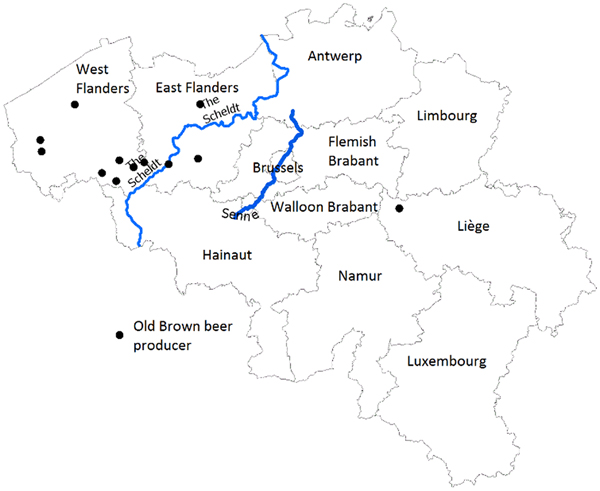
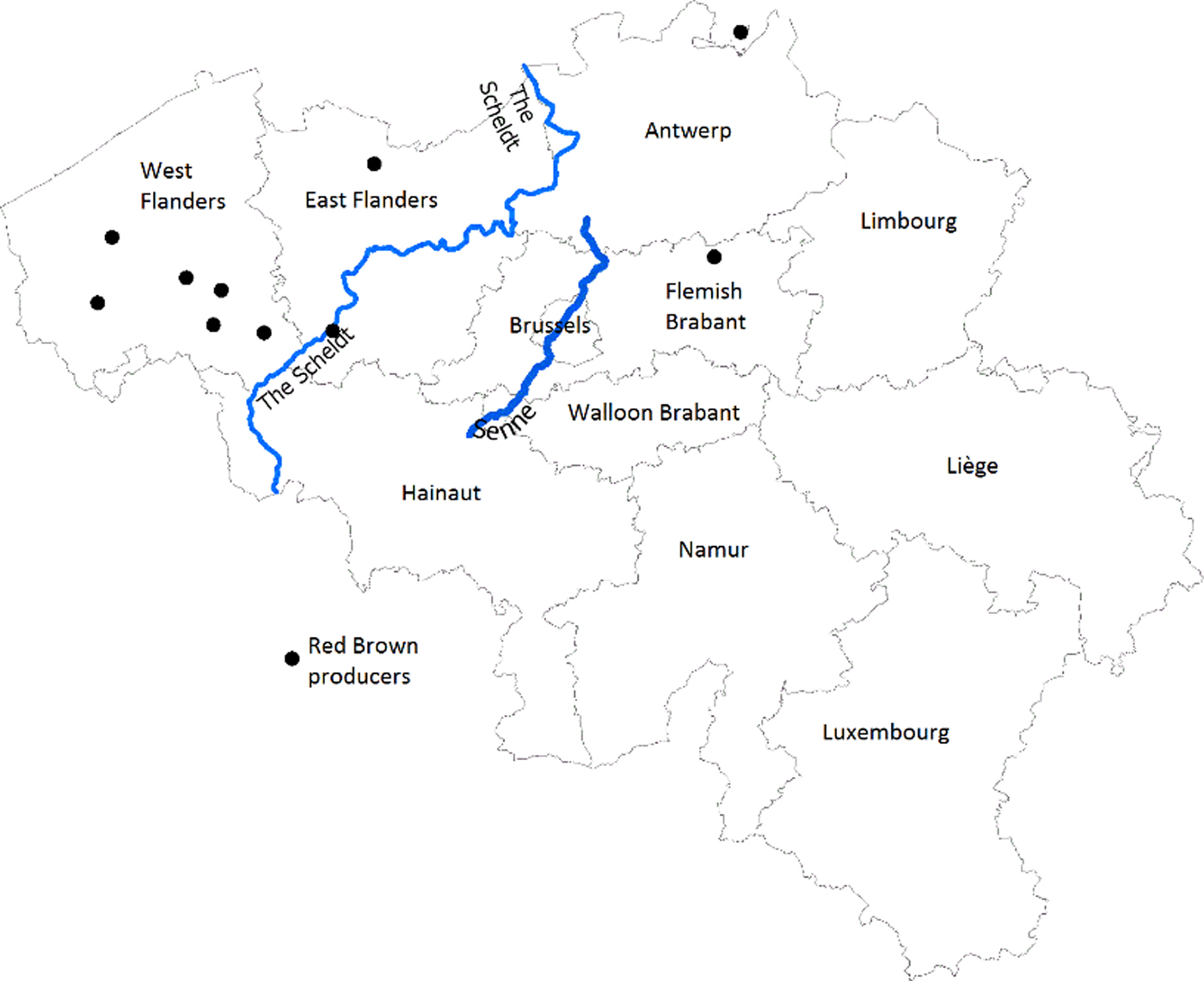
Belgium's land area is only around 30,000 square kilometers (12,000 square miles), which is just smaller than the state of Maryland in the United States. The country can be divided into three regions – Wallonia, in the south, which speaks French and German, Flanders in the north, which speaks Dutch, and the Brussels Capital Region, which is officially bilingual (Dutch and French) – and into ten provinces. Figure 1 shows the 2016 location of the 12 producers of Old Brown (Oud Bruin) beer. Some producers make multiple brands of this variety. For example, the northeastern-most dot in East Flanders represents the brewery De Proefbrouwerij, which produces two Old Brown beers: Totentrekker and Zoetzuur. Figure 2 shows the location of the ten producers of Red Brown beer. Note that in the cases of both Old and Red Brown, production today is almost exclusively west of the Scheldt River, in the northwest part of the country. Some of the breweries producing these varieties are several centuries old, while others are simply following the longstanding brewing traditions of the region.
Location of Old Brown beer producers in 2016

Location of Red Brown beer producers in 2016Footnote 12.

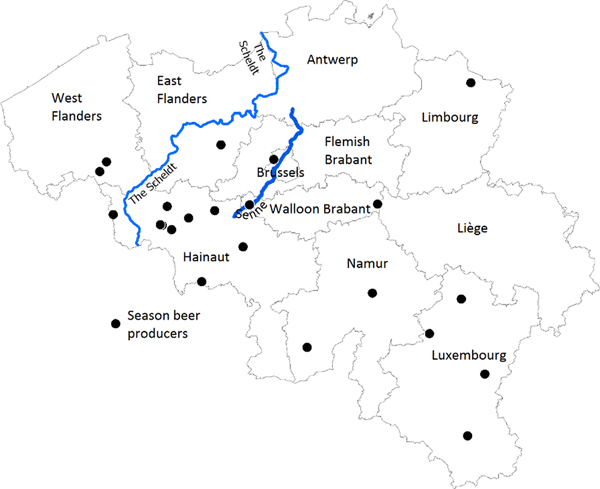
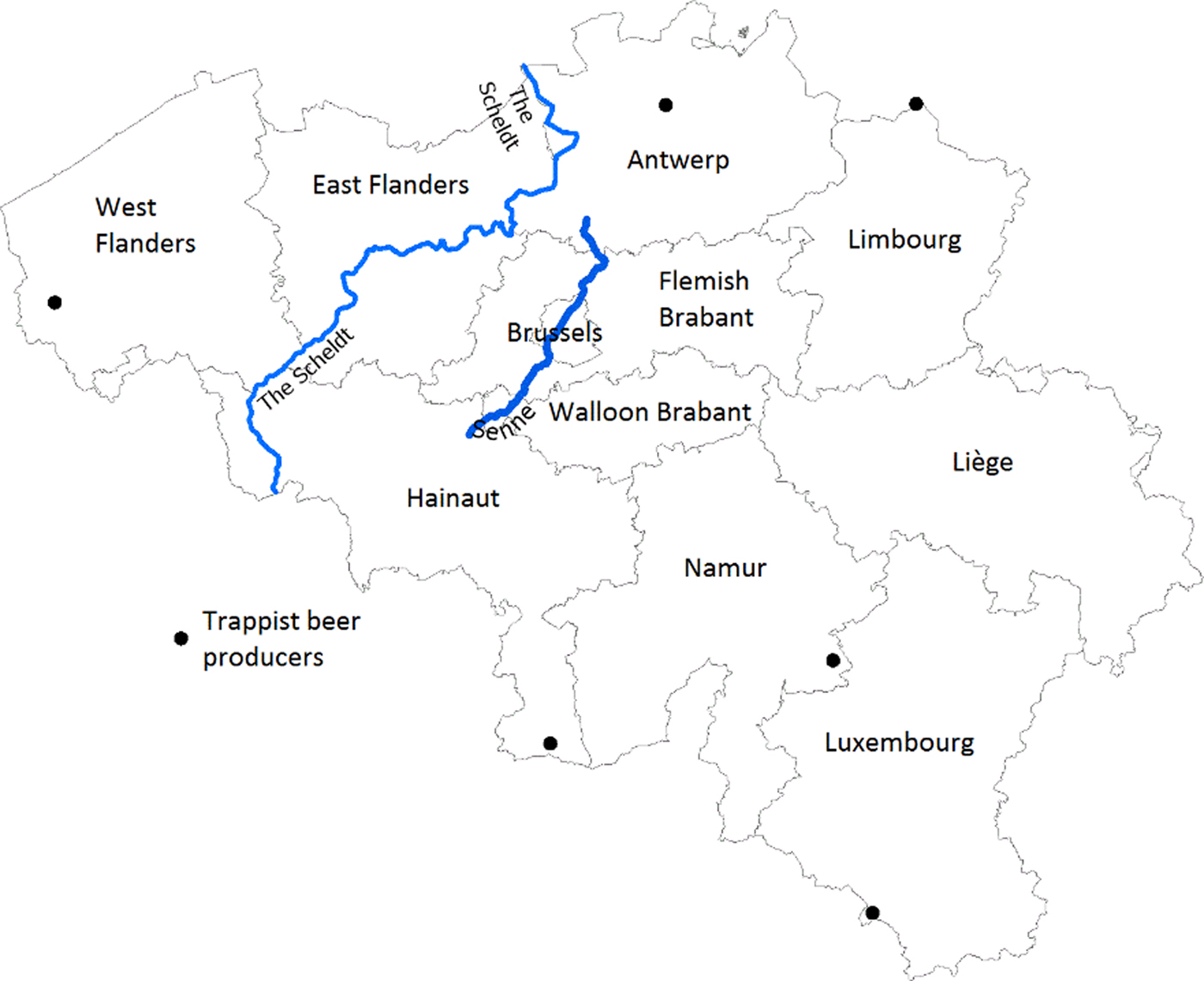
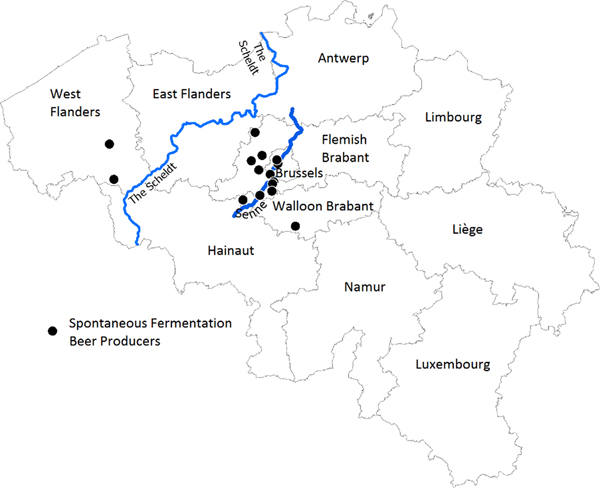
Figure 3 shows the location of the 22 producers of Saison beer. It is notable that a large proportion of producers are in or near the province of Hainaut. Moreover, 77% of them are situated in Wallonia, the French speaking part of the country. Figure 4 plots the location of the six Trappist breweries in Belgium today – all of these are located near the national border. The location of the 16 producers of Spontaneous Fermentation beer are shown in Figure 5. With just three exceptions, all these breweries are located within 15 kilometers (9 miles) of the Senne River, in the Brussels Capital Region, Flemish Brabant, and Walloon Brabant.
Location of Season (Saison) beer producers in 2016

Location of Trappist beer producers in 2016

Location of Spontaneous Fermentation beer producers in 2016

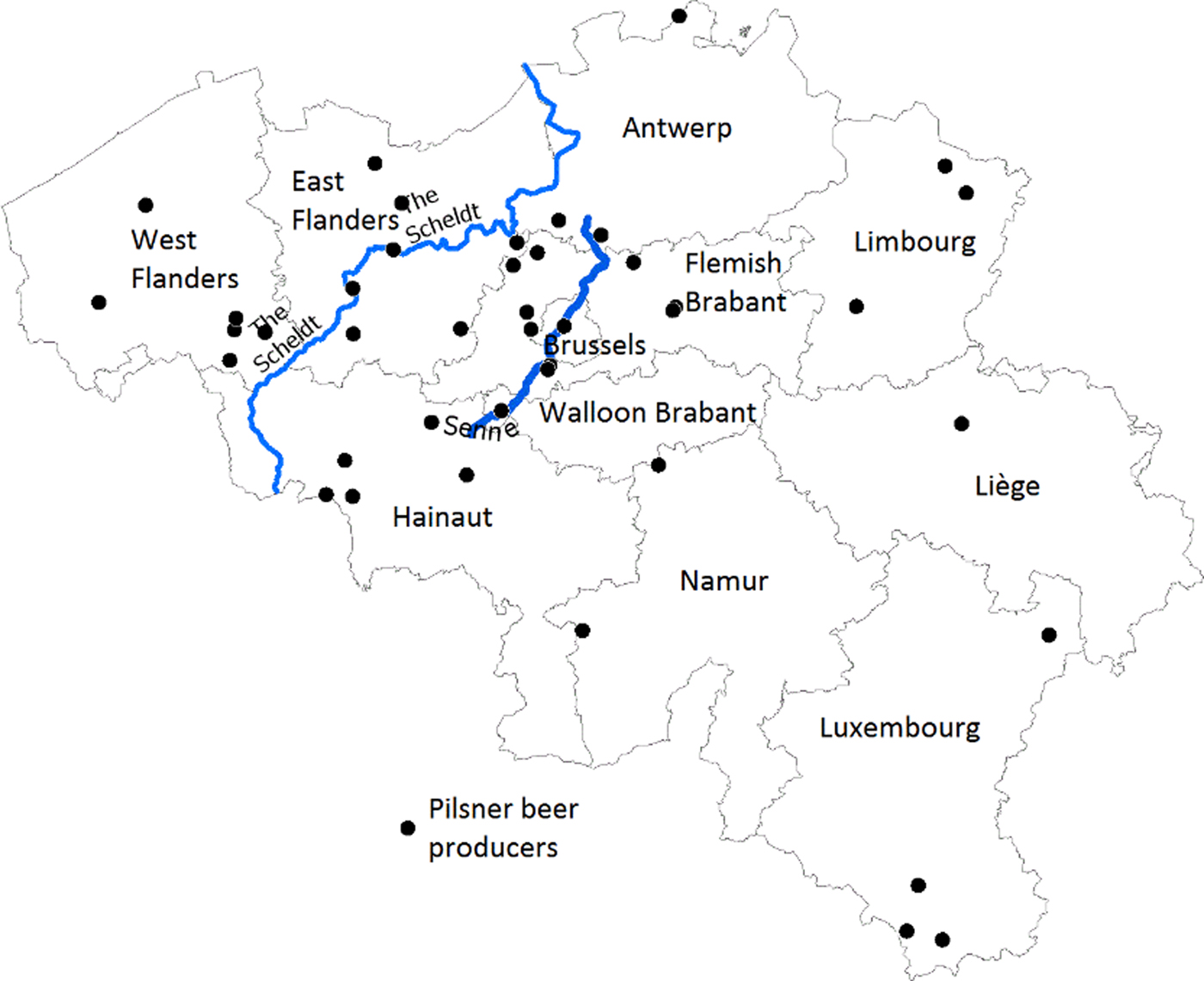
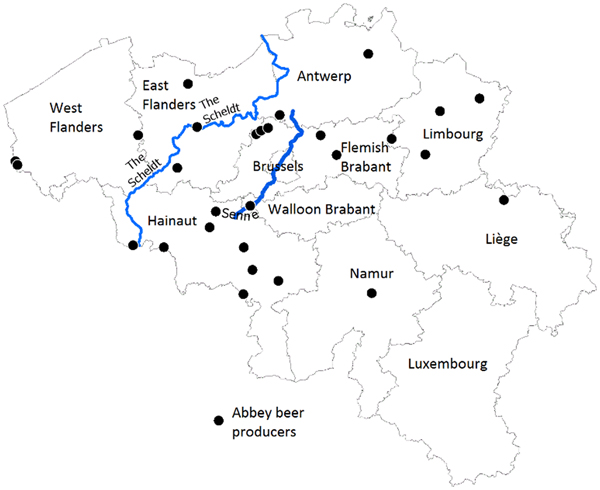
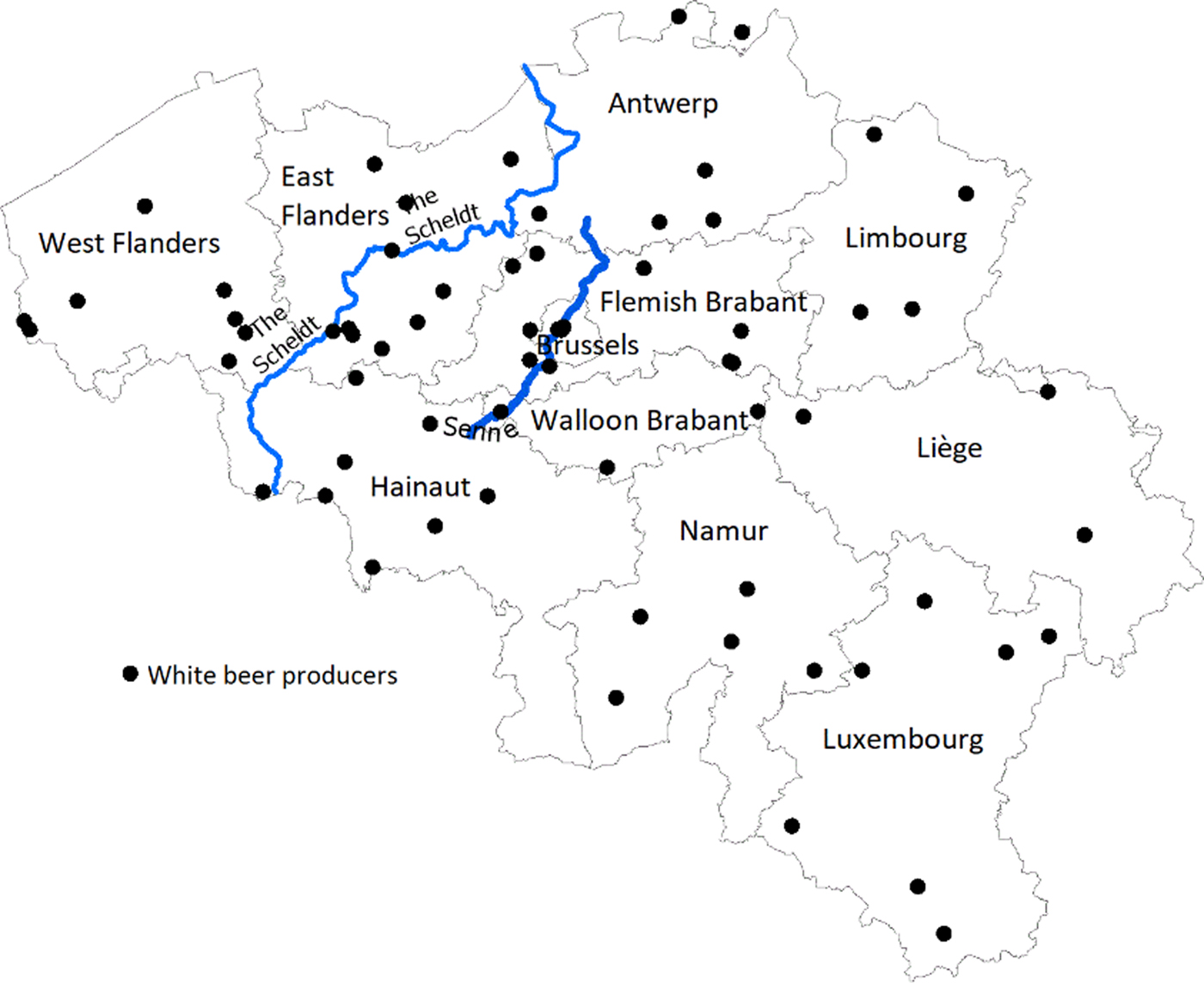
Figures 6, 7, and 8 show the geographic dispersion of Pilsner, Abbey, and Witbier, respectively. In contrast to the beer varieties reported in Figures 1 through 5, brewers of these three varieties are dispersed throughout all of Belgium. Each of these varieties is produced in all of Belgium's ten provinces (the one exception is that no Abbey beer is produced in the Luxembourg province). As we will explain later, there are compelling institutional reasons why the production of five of the eight varieties is geographically specific and why production of the remaining three is not.
Location of Pilsner beer producers in 2016

Location of Abbey beer producers in 2016

Location of Belgian White (Witbeer) producers in 2016

4. The Belgian area's institutional history prior to 1830 and its effect on beer
The area that today comprises Belgium – itself only a country since 1830 – experienced a geographically heterogeneous array of institutional regimes over the last millennium. For interested readers, the online appendix details the long and complex institutional history of the area between 843 and Belgian independence.Footnote 13 To make a long story short, control of the area – or various parts of it – changed hands many times between the ruling kingdoms of Europe throughout these thousand years. Importantly, in many cases borders between ruling families cut through present-day Belgium.
Institutions can affect beer production through the presence of laws specifying what ingredients or production processes must be used. In fact, we will show that some Belgian beer varieties can be traced to such local laws. In other cases, we will show that Belgian varieties developed because institutions slowed the adoption of key ingredients such as hops, and thus local producers had to rely on alternatives. The area that is today Belgium has been the subject of territorial dispute and has changed hands many times in the last millennium. Olson (Reference Olson1982) suggests that such institutional instability creates more dynamic (and better) economic outcomes since there is less chance of interest groups developing and succeeding in collective action that would hinder development. The lack of stable “centralized” control has allowed Belgian brewers the freedom to engage in heterogeneous beer production methods to a far greater extent than in many other regions, where pervasive regulations dominate like the Reinheitsgebot, which for over 500 years has allowed only barley, hops and pure water to be employed in Bavarian beer.Footnote 14
Institutions affecting the speed and extent of adoption of hops in beer production
Hops are a key staple in the production of beer today. Prior to the use of hops, brewers generally employed “gruit” to flavor and preserve beer against spoilage. The contents of gruit varied from place to place, but its primary component was bog myrtle. It also generally included some mixture of herbs and spices such as aniseed, bay leaf, cinnamon, clove, coriander, juniper berry, orange and lemon peel, resin, rosemary, saffron, sage, and yarrow.Footnote 15 The Holy Roman Emperor, as owner of the uncultivated land where these ingredients grew, treated the monopoly on the gruit as a royal right. This right could be extended to bishops, local noblemen, or other town leaders who would then produce and sell their gruit, which often contained secret combinations of different herbs, to local brewers.Footnote 16 Since brewing without gruit was illegal, those given this right could make large profits from the ability to produce and sell gruit to captive buyers.
The use of hops, whose bitterness helped balance the sweetness of malt and also acted as a superior preservative to gruit, was a major innovation in the late Middle Ages. However Unger (Reference Unger2004: 53–57) and Poelmans and Swinnen (Reference Poelmans and Swinnen2011a: 199) note that for several reasons – technical, cultural, and commercial – it took decades, or in some regions centuries, for hops to become widely used. Trade-oriented German villages such as Bremen, Wismar, Rostock, and Hamburg, saw the strong economic advantage of producing beer with a longer shelf life and thus the widespread adoption of hops generally began in these areas in the 13th century. To maintain gruit revenues, rulers in the Low Countries initially prohibited the domestic production of hopped beer and heavily taxed imports from “Germany.” However, Unger (Reference Unger2001: 74–75) notes that in 1321 the count of Holland acquiesced to brewers’ demands and allowed hops to be employed in beer production. For the next two and a half centuries taxes from both gruit and hops were collected in Holland.Footnote 17
In the Southern Low Countries, which largely encompasses current-day Belgium, however, the adoption of hops was much slower. Degrande (Reference Degrande2009) and Verdonck and De Raedemaeker (Reference Verdonck and De Raedemaeker2016) highlight the importance of the 1364 Novus Modus Fermentandi Cerevisiam, which translates to “New Method to Brew Beer.” This proclamation from Holy Roman Emperor Charles IV helped clear the way for the quicker adoption of hops as it permitted local rulers to tax hops rather than relying only on the sale of gruit for revenues.Footnote 18 Around 75% of present-day Belgium – specifically land east of the Scheldt River – was a part of the Holy Roman Empire at that time. Hence Brabant, located east of the Scheldt, was faced with an institutional regime in which hops were legally embraced much faster than they were in Crown Flanders, west of the river, and in Imperial Flanders on the east bank of the river,Footnote 19 which were both under French rule and hence not affected by the Novus Modus Fermentandi Cerevisiam.
Unger (Reference Unger2004: 92) notes that in the first half of the 15th century the Flemish cities of Bruges, Ghent, and Ypres, which were not affected by the Novus, fought vigorously to keep out imported hopped beers by increasing the taxes on these imports. In the parts of present-day Belgium that were affected by the Novus, hops began to be employed. In Leuven (Brabant) hops began to be used almost immediately after the Novus, and Swinnen and Briski (Reference Swinnen and Briski2017: 21) note that Leuven brewers had switched completely to hops by 1436. The use of hops began in Mechelen and Vilvoorde around 1370, in Lier around 1400, and in Antwerp in 1408.Footnote 20 Thanks to the stabilizing quality of hops, beer made in Brussels, Antwerp, and Leuven was transported around the region and by 1450 Leuven had become an important center of brewing. Of course it remains so today, hosting the headquarters of the world's largest brewer, AB InBev.
Because of these differing institutional conditions, the use of hops remained less pronounced in Flanders than in other parts of Belgium for centuries – even long after hops were allowed there. This can be seen via the subsequent development of beer types where brewers employed alternative ways to preserve beer rather than simply adding hops. Old Brown beer is an example of a beer variety that rather than being hop-centric is highly acidified. Production of Old Brown beer can be dated back to at least 1545 in the village of Oudenaarde.Footnote 21 As shown earlier, production of Old Brown beer (and the closely related Red Brown beer) takes place today where it has historically always been – in areas west of the Scheldt River where the Novus of 1364 had no effect.
Village-specific institutional regimes and their effect on beer diversity
Beer historians have given the Bavarian/German Reinheitsgebot of 1516 major attention because of its large geographic scope, however, village-specific laws regulating beer ingredients date at least as far back as 1143 when Augsburg passed the world's first “purity law” specifying what ingredients could be employed in beer.Footnote 22 Throughout the Middle Ages, authorities all across Europe employed Reinheitsgebot-like restrictions that outlined what methods and ingredients could be used in beer production. When these affected large regions – as was the case of the Reinheitsgebot – they made for less diverse beer offering. In the region that is modern-day Belgium, however, such beer regulations were both heterogeneous and village-specific, so they actually promoted beer diversity.
Village-specific regulations on brewing were primarily enacted to help local governments fight tax avoidance. This was important since generally around half of Belgian villages’ revenues came from beer taxes in the 15th and 16th centuries – a contemporary Flemish expression noted that “a city treasury floats on beer.”Footnote 23 If, for example, taxes were based upon the use of barley, brewers might reduce their tax burden by employing other grains.Footnote 24 Some villages imposed higher beer taxes as alcohol content rose. As there was no way to accurately assess the volume of alcohol in beer, however, brewers sometimes classified their beer as having lower alcohol content than it truly had. To combat such attempts at tax avoidance, villages created strict rules specifying who could produce beer, what ingredients could be used, and what production processes could be employed (Unger, Reference Unger2001). This may be viewed an application of Yandle's (Reference Yandle1983) and Smith and Yandle's (Reference Smith and Yandle2014) “bootleggers and the Baptists” story. Yandle notes that regulations are more likely to emerge and endure when both the “bootleggers” who seek the private benefits from the regulation, and the “Baptists,” who wish to serve the public interest, support them. In this case the existing local brewers had incentives to lobby their rulers to standardize beer recipes as a means of limiting potential competition from new, differentiated products. The rulers likewise had incentives to keep beer standardized since it helped them avoid tax evasion.
To illustrate, regulations regarding the production of Old Brown beer in Oudenaarde and Red Brown beer in Roeselare specified how long the malt was to be dried and how long the wort had to be cooked.Footnote 25 Likewise, in Halle, just south of Brussels, a 1559 law stipulated that the mash had to use 300 liters of wheat and 500 liters of barley and oats.Footnote 26 In the city of Namur, a 1606 charter explicitly stated the ingredients that could be used in order to produce bière de Namur. The beer had to be “brewed with only good grain and hops” and “without the addition of any other ingredients, herbs or other illegal substances, that could harm the human body [or] lead to blasphemy.”Footnote 27 Today, Lambic-style beers such as Kriek, Lambic, and Gueuze are made in Halle using a mash that follows these same proportions, while Old Brown beer in Oudenaarde and Red Brown beer in Roeselare is likewise produced with methods very similar to those that were mandated by law in the past.
Similarly, a decree in 1615 in the small village of Hoegaarden (in Flemish Brabant) mentioned both rules on who could brew and on the ingredients of the beer. Brewers in this village had to be Catholic and had to “pledge allegiance to the bishop and his successors.”Footnote 28 With regard to the ingredients that could be used in the brew, the decree specified the following proportions – “4 parts of barley malt, 4 parts of wheat and 2 parts of oats.”Footnote 29 Furthermore, beer in Hoegaarden could only be made with the water from the local river. Interestingly, in 2005 production of the well-known Hoegaarden beer was moved away from the village of Hoegaarden to the city of Jupille in the Walloon province. In 2007, however, AB InBev moved the beer's production back to the original cite in the village of Hoegaarden because it felt that the change in water (the main ingredient in beer) had altered the flavor profile too much.Footnote 30
The revitalization of the production of Belgian beer made with gruit over the last decade provides another example of past village-specific institutions affecting beer production today. In the Middle Ages, villages generally employed unique combinations of herbs and spices in their gruit so that each area produced its own distinctive beer. Since brewers were obliged to buy gruit only from their local rulers the geographic diversity of gruit made it difficult to cheat by buying gruit from a nearby town. This limited competition and kept gruit prices high. Belgian brewers who produce Gruitbeer today generally employ their village's specific recipe from the past. Examples include the breweries Gageleer from Wommelgem, Gruut Stadsbrouwerij from Ghent, and De Gouden Boom from Bruges.
5. Institutions since Belgian independence in 1830 and their effect on beer
The prior section suggests that the institutional heterogeneity that the Belgian area experienced before it became a country in 1830 promoted diversity in beer production both by affecting the speed with which hops were employed and via heterogeneous village-specific regulations affecting the ingredients and production processes that could be employed in beer. Next we address how institutions that impacted the whole of post-independent Belgium helped maintain the locality and variety of Belgian beers. We also show how they led to the creation and proliferation of other beer types.
Monastic brewing
A case could be made that the most famous Belgian beer variety today is Trappist beer. Monastic brewing has occurred in the area that comprises Belgium since the Middle Ages, but the specific Trappist order was founded in the 1660s. When France took control of the Belgian area in the 1790s, corporations, guilds, and monasteries were generally confiscated or destroyed and monastic brewing ceased in the region. However, the Belgian Constitution of 1831 reinstated religious freedom and monasteries were able to return. In 1831, just after the Constitution's enactment, Westvleteren became the first monastery to start brewing Trappist beer. Westmalle (1836), Achel (1846), Chimay (1862), Rochefort (1899) and Orval (1931) followed, and today these six producers make some of Belgium's most sought-after, award-winning, and distinctive beer.Footnote 31 The early decision of independent Belgium to allow monasteries to return played a key factor in the subsequent development of one of Belgium's most renowned beer types.
Belgian tax policy and beer production in the 19th century
In the early to mid-19th century, the average Belgian brewery was very small, producing around 200,000 liters per year. To provide context, in the 1980s the United States defined a “microbrewery” as a brewery producing less than 1.8 million liters per year. Furthermore, rather than bottle and distribute beer, Belgian brewers typically sold beer poured from wooden barrels directly to consumers in their own pub, which was typically adjacent to the brewery. In 1845 there were 3,089 breweries, i.e. one for every 1,500 Belgian citizens. Only 2% of these breweries employed steam technology. By 1880, when the use of steam was common in breweries across Europe only a third of Belgian brewers were employing it. Belgium was notably slower to adopt mass production brewing techniques than neighboring countries.Footnote 32 As a result, Belgian beer production and consumption remained local and villages generally produced distinctive varieties employing local ingredients and traditional production methods.
Two important institutional factors played a major role in keeping 19th-century Belgian beer production so local and artisanal. First, beer taxes in Belgium were tied to the size of the fermentation tubs employed (Van Velsen, Reference Van Velsen1900: 78). Alworth (Reference Alworth2015) notes that this tax policy favored traditional fermentation methods over modern ones and thus brewers had less incentive to switch from traditional methods and styles. Second, until 1860 Belgian villages were allowed to tax not only the production, but also the transport of beer.Footnote 33 This transport tax also created incentives for local brewers to produce on a small scale for local consumers.Footnote 34 These external institutions kept most Belgian brewers small, local, and tied to their traditional methods rather than encouraging them to modernize and produce for larger markets.
Belgium's socio-political climate: an internal institution affecting beer diversity
Another institutional factor in post-independent Belgium that impacted beer diversity was the nation's socio-political climate. This climate would fall under Voigt's (Reference Voigt2013) definition of an internal institution. Because beer was so important, both socially and economically, it was common for the mayor of a city/village to be a brewer – beer quality was viewed as an important way to earn votes. As there were generally two dominant political parties, most villages had at least one Catholic and one Liberal brewer who competed, among other ways, through beer.Footnote 35 This contributed heavily to the fact that by 1900, the number of Belgian breweries had risen to 3,223 – in comparison there were 1,816 breweries in the United States, a country with over 300 times the land mass and 11 times the population of Belgium.Footnote 36 Furthermore Belgian breweries in 1900 were producing a diversity of more than 15,000 different beer brands and the nation had 185,036 pubs, or one per every 32 inhabitants.Footnote 37 We cannot be sure which way the causality runs – i.e. whether the socio-political climate of politicians competing with beer production drove the diverse beer climate, or alternatively, whether the diverse beer climate drove the socio-political institution of politicians competing through beer. In any case, the importance of beer in the 19th-century Belgian democratic process impacted that nation's beer diversity.
The Vandervelde Act leading to a proliferation of high-alcohol beer
Belgium today is also widely known for its production of high-alcohol beer. So-called Belgian Dubbels generally have around double the alcohol content of what most beer traditionally had (i.e. around 7%). Belgian Tripels generally go even higher with alcohol percentages that are typically 9 to 11%. The proliferation of these beer varieties can be traced back to an institutional change from Belgium's Prohibition movement. In Belgium, spirits were viewed by Temperance forces as the key villain. Hence the Vandervelde Act of 1918 banned the production, export, import, transport, purchase, or sale of all distilled spirits, however, it permitted beer up to 5% alcohol by volume (ABV) as well as wine up to 15% ABV. In 1919, the ABV cap was lifted on beer, and spirits were allowed to be purchased, but only in large quantities (a minimum of two liters) and only for off-premises consumption – importantly, spirits could not be sold in restaurants or pubs.Footnote 38 This act was in effect until 1983.
With spirits off the menu at the pub, high-alcohol beers were developed as an alternative.Footnote 39 For instance, in 1921 the Westmalle monastery started to produce the Westmalle Dubbel (7% ABV) and in 1923, the Moortgat brewery introduced Victory Ale, which would later become Duvel (8.5% ABV). In response to the popularity of these high-alcohol beers, brewers made still higher-alcohol products. In 1933, Westmalle released a 9.5% ABV beer under the name Superbier. It later renamed the brew Westmalle Tripel and many other brewers subsequently produced Tripels such as Rochefort 10 (10% ABV), Westvleteren 12 (10.2% ABV), and Kasteelbier Tripel (11% ABV). These are among the best-known Belgian beers today and they were created as a direct result of the Vandervelde Act.
6. Path dependence: brewing today based on brewing in the past
We contend that a heterogeneous set of institutional regimes helped create a beer environment in Belgium that was acknowledged to be the most diverse in the world in 1851, and one that continues to be described as such by contemporary sources. But the institutional story is not complete without a discussion of path dependence – the notion that temporally remote events affect current economic activity because the old methods have become entrenched either through technological or behavioral lock-in.
Poelmans and Swinnen (Reference Poelmans, Swinnen and Swinnen2011b) highlight several beer-related scientific discoveries that transformed the beer industry worldwide between the 18th and 20th centuries. Among these are increased knowledge about the function and composition of yeast, the improvement of the steam engine, advances in refrigeration techniques, new methods of sealing beer bottles, and the introduction of metal cans. Despite these advancements, many Belgian breweries have remained faithful to the fermentation methods and ingredients they have employed for centuries. For example, brewers of Lambic beer continue to employ the naturally occurring airborne yeast of the Senne River Valley to ferment their product spontaneously even though fermentation methods have advanced dramatically. Indeed, Figure 5, shown earlier, reveals that the vast majority of Spontaneous Fermentation beer breweries are located where they have always been – along or near the Senne River. Likewise, laws no longer require beer in the village of Halle to employ a mash with 300 liters of wheat and 500 liters of barley and oats, but brewers continue to follow this 1559 regulation since a change in recipe could be costly in terms of upsetting loyal customers. We attribute this to “behavioral lock-in” as outlined by Stack et al. (Reference Stack, Gartland, Keane, Cabras, Higgins and Preece2016) and Dighe (Reference Dighe2016). Similar examples of such behavioral lock-in can be found in the production of Old Brown and Red Brown beer in the cities of Oudenaarde and Roeselare, which both institutionalized specific production methods. Brewers in these cities continue to follow the old methods and largely employ the same ingredients, even though these rules are no longer binding.
Another example of path dependence in Belgian brewing can be found in the top-fermented Saison (Season) variety, which originated in the French part of Belgium. The oldest Saison recipe dates from 1785, from a brewery in Hainaut. Farm workers in Hainaut had little to do in the winter months so they used this time to produce a beer that could be stored and consumed in the summer. As modern refrigeration methods were not yet invented, the brew was strongly seasoned in ways consistent with the gruit of past brewing and it was also heavily hopped. The combination of these two preservation methods dramatically enhanced the beer's longevity. The use of both hops and gruit-like herbs in these beers is particularly interesting in light of the fact that the Hainaut region changed hands (and institutional regimes) several times between the “French,” who were slower to adopt hops (and hence employed gruit longer), and the “Germans,” who were early adopters of hops in beer. Of course refrigeration and beer stabilization methods have improved dramatically over the last two centuries, but Saison beers, which have seen a major resurgence in the last two decades, are still both heavily hopped and seasoned. Figure 3, which was shown in section 3, shows that today's Saison beer producers continue to be disproportionately located in the French part of the country, and mostly in or near the Hainaut province where farmers first made the variety nearly 250 years ago.
The Trappist breweries are also still producing their beers on the locations (see Figure 4) that are a function of past institutional upheaval. All six Belgian Trappist breweries, which were founded after the Belgian Constitution reintroduced freedom of religion, are located close to the national border. Van den Steen (Reference Van den Steen2011) argues that the abbeys choose such locations so that it would be easy to flee in the event of another regime change that ceased to welcome them.
Path dependence in the postwar era: many historic brews remain
Between World War II and 1980, the percentage of imported beer in Belgium rose from under 1% to 7.5%. German lagers and English ales made up the vast majority of these imports. Many Belgian brewers responded to this rising competition, however, not by becoming more like the Germans and English, but instead by doubling down on the production of their historic beer varieties. In fact, Belgian consumers have remained largely loyal to their local brews while lager beer, which was introduced to Belgium in the interwar years, has remained less popular. Lager consumption did rise in the 1960s as it was seen as the “brew of progress.” However, during the 1970s there was an increase in so-called “nostalgic consumption,” whereby Belgium saw a sharp rise in the production of its longstanding native varieties – Old Brown, Lambic, Saison, Witbier, Red Brown, and Gruitbeer, among others.Footnote 40
Since the 1980s, Belgium, like most other major beer-producing countries, has seen a surge in the entry of small breweries. A large literature exists that discusses the global emergence of these small-scale breweries (see Carroll and Swaminathan, Reference Carroll and Swaminathan1992, Reference Carroll and Swaminathan2000; Swaminathan, Reference Swaminathan1998; Cabras and Bamforth, Reference Cabras and Bamforth2016; Garavaglia and Swinnen, Reference Garavaglia and Swinnen2018). Interestingly, however, Belgium does not have a term for the phenomenon coined “craft beer” in the United States and “real ale” in the United Kingdom (Poelmans and Swinnen, Reference Poelmans, Swinnen, Garavaglia and Swinnen2018). We believe that this is because Belgian consumers have long been accustomed to a wide diversity of locally produced beer that employs a variety of ingredients – something that was certainly not true in most other countries where the craft-brewing movement has taken off both in numbers and in nomenclature. As Swinnen and Briski state (Reference Swinnen and Briski2017), Belgium “has to some extent always been a craft beer nation.”Footnote 41
In an application of Garud and Karnoe's (Reference Garud, Karnoe, Garud and Karnoe2001) “path creation,” whereby economic actors play an important role in shaping their environment, and Heikkila's (Reference Heikkila2011) insight that a player's knowledge of the earlier path shapes current decisions, the trend of Belgian brewers emphasizing their historic production has been widely promoted by the Belgian national government and the local governments of several Belgian cities. Many localities have attempted to attract beer tourism through the establishment of beer museums that highlight the long history of brewing in their regions. Furthermore, many cities today produce their own “city beer” by following an historic recipe unique to the area. Notable examples include Aarschotse Bruine in Aarschot, Seefbier in Antwerp, and the five different Gruitbeers in Gent, which duplicate the gruit used centuries ago.Footnote 42 This has further added to Belgium's reputation as a mecca of beer diversity.
Explaining beer varieties that are produced all across Belgium
That is not to say that all Belgian brewing is tied to historic varieties. Belgium's bestselling exported beer, Stella Artois, is a Pilsner that was created in 1926. Today, Lager beer, which includes Pilsner as a sub-category, makes up around two-thirds of all Belgian beer production.Footnote 43 Figure 6 shows that unlike most other major beer varieties, Pilsner is produced in all of Belgium's ten provinces. This geographic production pattern is consistent with our institutional story. Pilsner is not native to the Belgium area as it was not produced in Belgium until the end of the 19th century, and then only in very small quantities – it was not until the interwar era that production of Pilsner took off in Belgium. When Pilsner production began in the area, Belgian land mass was all under the same institutional regime. Hence there is no compelling institutional reason why its production should be region specific.Footnote 44 It is also noteworthy that the Belgian Abbey beer producers, which tend to produce higher-alcohol brews, are also widely dispersed throughout Belgium, appearing in nine of the ten provinces (Figure 7). Again, this geographic distribution is consistent with our story. The institution that brought about the proliferation of high-alcohol beer in the post-World War I era – i.e. the prohibition of sales of spirits in restaurants and pubs – affected the whole of Belgium rather than having a heterogeneous effect on sub-regions within the nation.Footnote 45
A third beer variety that can be found all over Belgium today is the Witbier (Figure 8). Although Witbier is a variety that is native to 16th-century Brabant, by the mid-20th century its production had died out. In 1966, Pierre Celis started producing Hoegaarden beer in a village by the same name in Flemish Brabant, near where the first Witbiers were historically produced. This started a major Witbier revival. In fact, many Belgian breweries today produce at least one Witbier. We posit that the reason this beer is produced nationally – whereas other historic varieties such as Old Brown and Saison are generally produced in their places of origin – is that the breweries that had previously made Witbier had completely vanished or moved on to other varieties. In contrast, many of today's producers of other historic varieties such as Old Brown and Saison have been producing this variety of beer for centuries.Footnote 46
7. Conclusion
Institutions matter. The legal regimes that operate in the background play a large role in the economic development of a geographic area. This paper shows that institutions played an important role in shaping the direction of Belgium's beer industry over time. Despite its relatively small size, Belgium has historically been considered to have the most diverse array of beer varieties in the world. Many of the varieties for which Belgium is well known, such as Old Brown, Red Brown, Gruitbeer, Saison, Lambic, and Trappist, continue to be produced today in the geographically specific regions within the nation in which they began. We argue that many of these beer types were developed in response to specific institutional changes that heterogeneously affected the areas in which they were created. That these historic varieties continue to be produced in these areas can be viewed through the lens of path dependence – the old methods have become entrenched through either technological or behavioral lock-in, as outlined by Stack et al. (Reference Stack, Gartland, Keane, Cabras, Higgins and Preece2016) and Dighe (Reference Dighe2016).
To illustrate, institutions directly influenced the speed and extent with which hops were employed in beer production in different parts of Belgium. The 1364 decree Novus Modus Fermentandi Cerevisiam of Holy Roman Emperor Charles IV permitted local rulers to tax hops rather than relying, as they had previously, only on the sale of gruit (a mixture of herbs traditionally employed to preserve and flavor beer) for revenue. Around three-quarters of present-day Belgium – generally land east of the Scheldt River – was affected by the Novus. Brewers in Brabant, who were impacted by the Novus, quickly adopted hops and the region became a large hub of brewing production. In the western part of Belgium, where the Novus had no effect, the use of hops remained less popular for centuries, even long after hops were formally allowed there. For example, Old Brown beer, whose production can be traced to 1545 in the village of Oudenaarde, is highly acidified rather than being hop-centric. Old Brown beer continues today to be produced west of the Scheldt River. Furthermore, today many Gruitbeers are produced west of the Scheldt River in homage to the recipes of the past.
Legal restrictions on the ingredients and brewing methods of beer also played a role in creating Belgium's diverse beer production. In Bavaria the Reinheitsgebot has for five centuries restricted brewers to the use of three ingredients – water, hops, and barley (and later yeast). Such strict limitations on ingredients stifle the diversity of beer varieties in their affected regions. While Belgian villages were sometimes subject to Reinheitsgebot-like legal restrictions on brewing – which were generally imposed to limit tax evasion – these restrictions varied widely from village to village. For example, a 1559 law in the village of Halle required brewers to use a mash with precise quantities of wheat, barley, and oats, while a 1615 decree in the village of Hoegaarden required brewers to use malt, wheat, and oats in proportions that were different than those in Halle. In Namur, a 1606 charter explicitly outlined the ingredients that could be used in bière de Namur. Similarly, the villages of Oudenaarde and Roeselare specified precisely how long the malt had to be dried and how long the wort had to be cooked when brewing Old Brown and Red Brown beer. Today, brewing in many of these villages continues to follow these traditions even though these regulations are no longer applicable.
While beer varieties whose formation can be tied to institutional changes prior to Belgian independence generally continue to be primarily produced in the sub-regions where they began, there have been important institutional changes since 1830 that have homogeneously affected the entire nation. For example Belgium's Vandervelde prohibition law forbade spirits to be sold in restaurants or pubs, but allowed beer. To fill this gap, brewers produced beer with higher alcohol content, and today Belgium is well known for its Dubbels and Tripels, which are generally between 7 and 12% ABV. Because this institutional change affected the whole of Belgium, these beer types, many (but not all) of which fall under the category of Abbey beer, are today produced all over the country.
Institutional change is certainly not the only factor that has influenced the development of Belgian beer. Still, this paper argues that it is no coincidence that the relatively small Belgian nation has such strong diversity in both its institutional history and its historic beer varieties – we show that the former contributed heavily to the latter. This paper adds to the broader literature arguing that institutions are an important factor in a region's economic development (Olson, Reference Olson1996; Hall and Jones, Reference Hall and Jones1999; Rodrik et al. Reference Rodrik, Subramanian and Trebbi2004; Greif, Reference Greif2006). Furthermore, the fact that local governments within Belgium today promote their area's historic brewing tradition via museums and campaigns to advance its historic beer varieties offers a real-world application of Garud and Karnoe (Reference Garud, Karnoe, Garud and Karnoe2001) and Heikkila (Reference Heikkila2011), who argue that economic actors often play an important role in shaping and maintaining path dependencies. Thus, the historical development of Belgian beer provides economists with another valuable real-world example of how institutions shape the world.
Author ORCIDs
Eline Poelmans, 0000-0002-2008-8682; Jason E. Taylor, 0000-0001-9680-2478.