Introduction
There is strong consensus that trauma-focused cognitive behaviour therapy (CBT) that typically comprises some forms of exposure, and often cognitive restructuring, is the treatment of choice for post-traumatic stress disorder (PTSD) (National Institute for Clinical Excellence, 2005; Australian Centre for Posttraumatic Mental Health, 2007; Foa et al. Reference Foa, Keane, Friedman and Cohen2009). Despite this, meta-analysis indicates that at least one-third of patients do not respond to this treatment (Bradley et al. Reference Bradley, Greene, Russ, Dutra and Westen2005). This has led some commentators to suggest that enhancing the response to CBT may be facilitated by providing patients with preparatory skills so that they are better equipped to manage the demands of CBT (Trusz et al. Reference Trusz, Wagner, Russo, Love and Zatzick2011). The need for some PTSD patients to require participatory training may be suggested by observations that PTSD patients have elevated rates of substance abuse and disability (Monson et al. Reference Monson, Schnurr, Resick, Friedman, Young-Xu and Stevens2006; Schnurr et al. Reference Schnurr, Friedman, Engel, Foa, Shea, Chow, Resick, Thurston, Orsillo, Haug, Turner and Bernardy2007). Initial evidence for this approach has been provided by one study that found that preparing childhood abuse survivors with emotion regulation training prior to CBT resulted in fewer treatment drop-outs and better treatment gains than standard CBT (Cloitre et al. Reference Cloitre, Stovall-McClough, Nooner, Zorbas, Cherry, Jackson, Gan and Petkova2010). This evidence suggests that PTSD patients generally, not only those who experience marked emotion tolerance difficulties as a result of childhood trauma, may benefit from preparatory training in emotion regulation prior to commencing CBT.
Accordingly, the current study represents a phase II randomized controlled trial to evaluate the utility of providing civilian survivors of adult trauma with PTSD with training in emotion regulation strategies prior to commencing exposure and cognitive restructuring. We hypothesized that preparing PTSD participants with emotion regulation strategies prior to CBT would enable them to more effectively manage any distress elicited through exposure therapy. Patients were randomly allocated to either supportive counselling followed by CBT (Support/CBT) or emotion regulation training followed by CBT (Skills/CBT). Whereas in both conditions CBT comprised identical sessions of cognitive restructuring and exposure, this was preceded in the Skills/CBT condition with four sessions of emotion regulation training (and with four sessions of supportive counselling in Support/CBT). We predicted that Skills/CBT would result in fewer treatment drop-outs, and that intent-to-treat analyses would reveal greater treatment gains in participants receiving Support/CBT.
Method
Patients
Participants were consecutive civilian trauma survivors who self-referred to the University of New South Wales Traumatic Stress Clinic between 1 August 2005 and 30 June 2008. If patients indicated during a telephone screening interview that they satisfied the study criteria, they were invited to attend the clinic for a full structured assessment. Following the full assessment, appropriate participants completed written informed consent procedures.
Study entry criteria
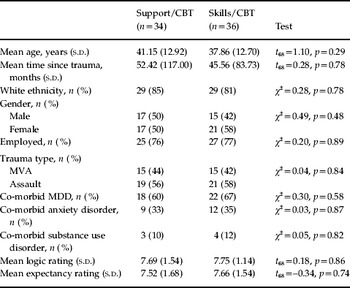
Study criteria included were experience of a DSM-IV (APA, 1994) stressor, primary diagnosis of DSM-IV diagnosis of PTSD, and aged between 18 and 65 years. Exclusion criteria included recent history of psychosis, organic brain syndrome, current substance dependence (required to be free of substance dependence for at least 2 months), borderline personality disorder, severe suicidal risk, or inability to converse in English. At the time of entering the study, participants who were prescribed pharmacological treatment were required to maintain a stable dose for the 2 months prior to the initial assessment and to maintain this level throughout the study. Participants were not allowed to participate in additional psychotherapeutic interventions for the duration of the study. The sample characteristics of patients are presented in Table 1.
Participant characteristics

Support/CBT, Supportive counselling followed by cognitive behaviour therapy; Skills/CBT, emotion regulation training followed by CBT; s.d., standard deviation; MVA, motor vehicle accident; MDD, major depressive disorder.
Design
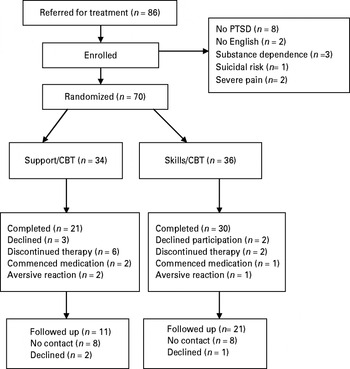
Participants were informed that they would be randomly allocated to one of two treatment conditions. Randomization was conducted by a process of minimization stratified on gender, trauma type and Clinician Administered PTSD Scale-2 (CAPS-2; Blake et al. Reference Blake, Weathers, Nagy, Kaloupek, Gusman, Charney and Keane1995) total score. Participants were randomly assigned according to a random numbers system administered by an individual who was independent of the study and who worked at a site that was distant from the treatment centre. Patients were considered drop-outs if they commenced medication after commencing treatment to ensure that observed changes could not be attributed to medication. Fig. 1 summarizes the participant flow. A total of 70 patients were randomized into the study and were allocated to either Skills/CBT (n = 36) or Support/CBT (n = 34). Of the participants, 51 (73%) completed treatment and 32 (46%) completed the 6-month follow-up assessment.
Patient participation in the study. Support/CBT, supportive counselling followed by cognitive behaviour therapy; Skills/CBT, emotion regulation training followed by CBT.

Initial assessments were conducted at pre-treatment, prior to randomization. Post-treatment and 6-month follow-up assessments were conducted by independent clinicians who were unaware of the treatment condition of participants. Blindness was maintained by ensuring that clinicians who conducted assessments did not have access to (a) participant notes or (b) condition allocation of participants.
Treatment conditions
Individual therapy was conducted by one of six experienced Masters-level clinical psychologists, who were trained to use treatment manuals and who received weekly supervision from R.B.; all therapists provided each type of treatment. Treatment comprised 12 once-weekly 90-min sessions with structured daily homework activities.
Support/CBT
Session 1 focused on psychoeducation, and providing treatment rationale. Sessions 2–5 reviewed the participants' activities of the past week, and provided non-directive supportive counselling. These sessions adopted a patient-led approach in which the patient discussed issues that arose during the week; therapists avoided providing direct input related to specific strategies or any components provided in the emotion regulation sessions. Session 6 introduced cognitive restructuring, which included identification of appraisals that were maladaptive. Session 6 also commenced imaginal exposure, which occurred for 40 min; patients were instructed to verbalize reliving the trauma experience in a vivid manner that involved all perceptual and emotional details. Imaginal exposure was not audiotaped but participants were given explicit instructions on how to complete the exercise. Participants were asked to engage in imaginal exposure on a daily basis for homework. Session 7 included review of homework, introduction of in vivo exposure and development of a hierarchy of feared events, a 40-min session of imaginal exposure, and commencement of challenging of maladaptive appraisals. Cognitive restructuring involved daily monitoring of thoughts and affective states, modifying thoughts by Socratic questioning, probabilistic reasoning, and evidence-based thinking (Beck et al. Reference Beck, Rush, Shaw and Emery1979). Sessions 8–11 continued imaginal exposure, commenced homework tasks for in vivo exposure, and cognitive restructuring. Session 12 focused on relapse prevention strategies that instructed participants to rehearse the strategies in preparation for future stressful situations.
Skills/CBT
Session 1 focused on psychoeducation. Sessions 2–5 comprised emotion regulation training. Rather than uniformly providing all participants with the same strategies, therapists and participants decided which strategies would be most helpful given the participants' primary problems with emotion regulation. Participants were provided with either emotion tolerance skills (emotional labelling, mindfulness, distraction and activity scheduling; 73%), breathing retraining (34% of participants completed this module), or progressive muscle relaxation (22%). Participants were informed that these skills could be employed during episodes of distress, when they wished to achieve greater control of emotional reactions. Sessions 6–12 followed the exact format of the CBT components of the Support/CBT programme.
Measures
Diagnostic interview
PTSD symptoms were assessed using the CAPS-2 (Blake et al. Reference Blake, Weathers, Nagy, Kaloupek, Gusman, Charney and Keane1995). The CAPS is a structured clinical interview that indexes the 17 symptoms described by the DSM-IV PTSD criteria. Each symptom is rated on a five-point scale in terms of the severity and frequency of the symptom in the past week. The CAPS possesses good sensitivity (0.84) and specificity (0.95) relative to the Structured Clinical Interview for DSM-IV (SCID) PTSD diagnosis, and also possesses sound test–retest reliability (0.90–0.80; Blake et al. Reference Blake, Weathers, Nagy, Kaloupek, Gusman, Charney and Keane1995). Co-morbid Axis I disorders were assessed by the SCID (Spitzer et al. Reference Spitzer, Williams, Gibbon and First1995).
Self-report measures
Additional psychopathology measures included the Beck Anxiety Inventory (BAI; Beck et al. Reference Beck, Epstein, Brown and Steer1988), the Beck Depression Inventory – 2 (BDI-2; Beck et al. Reference Beck, Steer and Brown1996), the Impact of Event Scale (IES; Horowitz et al. Reference Horowitz, Wilner and Alvarez1979), and the Posttraumatic Cognitions Inventory (PTCI; Foa et al. Reference Foa, Ehlers, Clark, Tolin and Orsillo1999) to index negative cognitions about self, the world, and self-blame. At the commencement of each session, participants were requested to rate the distress they had experienced during the previous week on a 100-point Likert scale (0 = ‘not at all distressed’, 100 = ‘extremely distressed’). At the completion of session 1 and after the rationale had been explained, patients completed the Credibility/Expectancy Questionnaire (Devilly & Borkovec, Reference Devilly and Borkovec2000); patients rated their confidence in the treatment (1 = ‘not at all confident’, 10 = ‘extremely confident’) and the logic of the treatment (1 = ‘not at all logical’, 10 = ‘extremely logical’). All measures were administered at each assessment, with the exception of the therapy confidence and logic ratings, which were only administered at baseline.
Treatment fidelity
Audiotapes of 130 therapy sessions (18% of all therapy sessions) were randomly selected and rated by five CBT clinicians who were independent of the study. Raters listened to audiotapes and rated the presence or absence of each of 51 treatment components, without regard to treatment condition or treatment session. Raters indicated the quality of the therapy provided on a seven-point scale (1 = ‘unacceptable’, 7 = ‘very good’). Importantly, no participants in the Support/CBT condition received any of the emotion regulation components. All participants who remained in therapy beyond session 5 received exposure and cognitive restructuring. The mean quality rating for treatment components across conditions was 6.11 (s.d. = 1.32).
Data analysis
Power analysis was calculated on the follow-up means and standard deviations of the study by Cloitre et al. (Reference Cloitre, Stovall-McClough, Nooner, Zorbas, Cherry, Jackson, Gan and Petkova2010), which found a clinically significant difference between CBT versus CBT combined with emotion tolerance training with 15% difference in symptom reduction (Cloitre et al. Reference Cloitre, Stovall-McClough, Nooner, Zorbas, Cherry, Jackson, Gan and Petkova2010). With an α set at 0.5 to obtain 85% power, we required 35 participants per cell. Analyses focused on intent-to-treat data; missing values were imputed using Systat 13 (Systat Software, Inc., USA) to generate 20 imputed datasets. We initially performed multivariate analyses of covariance (MANCOVAs) for each of the two sets of continuous measures: the primary PTSD symptoms (CAPS and IES) and associated symptoms (BDI, BAI, PTCI) using the pre-treatment scores as covariates. If multivariate effects of condition were significant, we conducted univariate ANCOVAs. We derived Cohen's d effect size by calculating the mean difference between assessments of each treatment condition and dividing this by the pooled standard deviation (Cohen, Reference Cohen1988); we used Hedges' g effect sizes to correct for variations due to small sample sizes (Hedges, Reference Hedges1982). Finally, we calculated high end-state adjustment as being below 19 on the CAPS (combining frequency and intensity scores) as a measure of the absence of PTSD (Weathers et al. Reference Weathers, Keane and Davidson2001), and below 10 on the BDI-2 (Kendall, Reference Kendall, Hollon, Beck, Hammen and Ingram1987). We also calculated the number of patients needed to treat as 1 divided by the proportion responding in Skills/CBT as an estimate of the number of patients who would need to be given Skills/CBT for one of them to achieve a response outcome who would not have achieved it with Support/CBT. Efficacious treatments typically have a number needed to treat between 2 and 4 (Chatellier et al. Reference Chatellier, Zapletal, Lemaitre, Menard and Degoulet1996).
Results
Patient flow
Fig. 1 presents the patient flow from screening to follow-up. Most potentially eligible participants (70, 82%) were enrolled into the study. The reasons for not participating in the study were not meeting criteria for PTSD (n = 8, 9%), substance dependence (n = 3, 3%), inadequate English (n = 2, 2%), severe chronic pain (n = 2, 2%), and severe suicidal risk (1, 1%). Of the participants, 34 and 36 were randomized to the Support/CBT and Skills/CBT conditions, respectively.
Patients in Skills/CBT (mean = 3.12, s.d. = 1.26) received a comparable number of sessions prior to CBT as those in the Support/CBT condition (mean = 2.98, s.d. = 1.22) (t 68 = 0.51, p = 0.61). Patients in the Skills/CBT condition (mean = 5.97, s.d. = 3.00) completed more CBT sessions than those in the Support/CBT group (mean = 4.24, s.d. = 2.96) (t 68 = 2.43, p = 0.02). There were three reported adverse effects resulting in treatment drop-out: two patients in Support/CBT (one became suicidal after a family crisis and one could not manage increased pain) and one patient in Skills/CBT (increased distress resulting from marital discord).
Primary outcomes
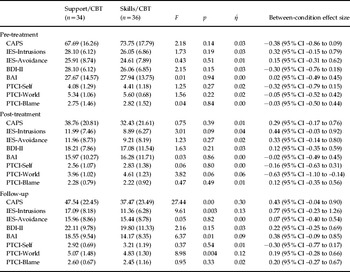
Table 2 presents the mean psychopathology scores for the intent-to-treat sample. The MANCOVA on the post-treatment scores of primary PTSD outcomes (CAPS, IES-Intrusions, IES-Avoidance) indicated a non-significant main effect (F 3,63 = 1.03, p = 0.38, ή = 0.05). In terms of follow-up analyses, the MANCOVA of primary outcomes indicated a significant main effect (F 3,63 = 16.37, p < 0.001, ή = 0.44). Follow-up ANCOVAs indicated that participants in the Skills/CBT condition had lower CAPS and IES-Intrusions scores than those in Support/CBT.
Psychopathology measures on intent-to-treat sample

Support/CBT, Supportive counselling followed by cognitive behaviour therapy; Skills/CBT, emotion regulation training followed by CBT; CI, confidence interval; CAPS, Clinician Administered Posttraumatic Stress Disorder Scale; IES, Impact of Event Scale; BDI-II, Beck Depression Inventory, 2nd edn; BAI, Beck Anxiety Inventory; PTCI, Posttraumatic Cognitions Inventory.
Data are given as mean (standard deviation).
Analyses indicated that at post-treatment comparable participants in Skills/CBT (19%) met criteria for PTSD as participants in Support/CBT (26%) [χ2(n = 70) = 0.49, p = 0.48]. At follow-up, fewer participants in Skills/CBT (28%) met criteria for PTSD than participants in Support/CBT (50%) [χ2(n = 60) = 3.65, p < 0.05]. In terms of follow-up status, the number needed to treat was 4.50.
Secondary outcomes
The MANCOVA on post-treatment scores of secondary symptoms indicated a non-significant main effect (F 5,59 = 1.73, p = 0.14, ή = 03). The MANCOVA on follow-up scores of secondary symptoms indicated a main effect (F 5,59 = 4.10, p < 0.005, ή = 0.26). Follow-up ANCOVAs indicated that participants in the Skills/CBT condition had lower BAI and lower PTCI-World than those in Support/CBT.
Effect sizes
Skills/CBT led to larger effect sizes on the CAPS, IES-Intrusions and BAI at follow-up (Table 2). In terms of patients achieving high end-state functioning at follow-up, more participants in the Skills/CBT condition (31%) achieved high end-state functioning than participants in the Support/CBT (12%) condition [χ2(n = 70) = 3.67, p < 0.05].
Between-session distress ratings
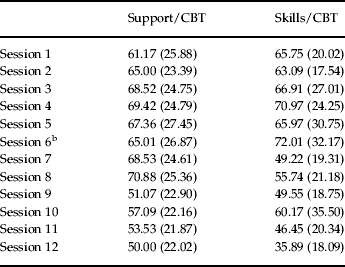
At the commencement of each session, participants provided a Subjective Units of Distress (SUDS) rating of the distress they had experienced during the previous week (Table 3). A MANCOVA of SUDS ratings indicated a significant main effect (F 12,57 = 3.58, p = 0.001, ή = 0.43). There were no differences in distress ratings between conditions in the weeks following the preparatory sessions prior to CBT (sessions 1–5). In contrast, participants in the Skills/CBT condition reported less distress in session 7 (the week following commencement of exposure) (F 1,68 = 7.38, p = 0.008, ή = 0.10), session 8 (F 1,68 = 13.41, p = 0.000, ή = 0.17) and session 12 (F 1,68 = 8.62, p = 0.005, ή = 0.11] than those in the Support/CBT condition.
Distress ratings across sessionsa
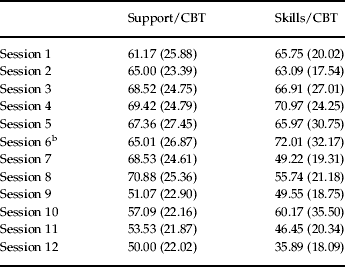
Data are given as mean (standard deviation).
Support/CBT, Supportive counselling followed by cognitive behaviour therapy; Skills/CBT, emotion regulation training followed by CBT.
a Range of Subjective Units of Distress Rating: 0 = not at all distressed; 100 = extremely distressed.
b Exposure therapy commenced in session 6.
Treatment completer analyses
In recognition of the significant drop-out rate in this study, and its impact on multiple imputation methods (see Discussion), we replicated the significant MANCOVAs with the treatment completer dataset. A MANCOVA of primary outcomes indicated a significant main effect (F 3,25 = 4.26, p < 0.02, ή = 0.39). Follow-up ANCOVAs indicated that participants in the Skills/CBT condition had lower CAPS scores than those in Support/CBT. The MANCOVA of secondary outcomes indicated a non-significant main effect (F 5,21 = 1.73, p = 0.17, ή = 0.29) (see Supplementary Table S1).
Discussion
Preparing PTSD patients with skills in emotion regulation resulted in less treatment drop-out, and greater reduction in PTSD symptoms, anxiety, and negative cognitions about the world at follow-up relative to providing patients with CBT without such preparation. The observation that patients who received the emotion regulation training prior to CBT eventually received more sessions of CBT than those who did not receive this preparation supports the conclusion that these initial sessions facilitated greater retention in therapy that focused on cognitive restructuring and exposure components. This finding accords with the finding that emotion regulation preparation led to greater treatment adherence and treatment response to CBT in women who developed PTSD following childhood abuse (Cloitre et al. Reference Cloitre, Stovall-McClough, Nooner, Zorbas, Cherry, Jackson, Gan and Petkova2010).
Efficacy and mechanisms
The finding that distress ratings did not differ between conditions in the weeks during the preparatory sessions but were reduced in sessions in weeks following introduction of exposure in the participants who initially received skills training suggests that emotion regulation training was efficacious. Specifically, it appears that learning to tolerate one's emotional reactions assisted patients to master the distress associated with exposure. This interpretation also supports the outcome of the study by Cloitre et al. (Reference Cloitre, Stovall-McClough, Nooner, Zorbas, Cherry, Jackson, Gan and Petkova2010), which was interpreted in terms of enhanced mastery of exposure-related distress.
Several explanations exist for this finding. First, CBT (and exposure in particular) typically elicits distress in PTSD patients. Although there is evidence that exposure strategies do not result in greater drop-outs or adverse reactions than other therapy techniques (Foa et al. Reference Foa, Zoellner, Feeny, Hembree and Alvarez-Conrad2002), rehearsing skills in managing distress may enable some patients to tolerate these reactions and benefit more from CBT. Second, receiving emotion regulation training may enhance patients' sense of self-mastery and expectancy, which enhances motivation to adhere to CBT. Third, emotion regulation training itself may assist patients to master emotional reactions they experience to daily stressors (other than those related to recalling trauma memories). Fourth, preceding the CBT with supportive counselling and emotional regulation skills may have resulted in different motivational sets being applied to the CBT components; specifically, the shift from the passive nature of supportive counselling to the highly demanding content of CBT was potentially less comfortable for participants than those who spent the initial sessions engaged in active emotion regulation training. Moreover, the passive nature of the supportive counselling may have diminished motivation for some patients, and this may have carried over to the CBT components.
Similar to a finding by Cloitre et al. (Reference Cloitre, Stovall-McClough, Nooner, Zorbas, Cherry, Jackson, Gan and Petkova2010), the enhanced treatment response in the Skills/CBT condition was observed at follow-up rather than immediately after treatment. It is possible that enhanced emotion regulation skills resulted in better management of stressful experiences in the months after treatment terminated. Alternatively, greater participation in CBT sessions following emotion regulation training led to more substantial mastery of traumatic memories and correction of maladaptive appraisals, which led to longer-term gains.
Methodological limitations
The outstanding limitation of this study is the considerable attrition over time. Many participants were lost to follow-up, despite strong attempts to contact them at 6 months following treatment. This pattern poses challenges for imputing missing values because of the small proportion of completers upon whom the intent-to-treat analyses were based. This issue means that the conclusions drawn from this study must be strongly qualified, and that the study requires replication with larger sample sizes. Second, our participants were survivors of motor vehicle accidents and non-sexual assault, and implications for different trauma populations remain questionable. Third, we did not directly index emotion regulation strategies, and so it is difficult to identify the specific role of emotion management processes in treatment outcome. Dismantling studies that compare emotion regulation with exposure-based treatments would shed light on their relative impact on outcome. Fourth, our assessments focused on psychopathology responses; future studies should also assess the impact of treatment on functioning. Fifth, the allocation of seven sessions to CBT in the current study is less than typically provided in CBT trials, which usually provide at least 10 sessions (Foa et al. Reference Foa, Rothbaum, Riggs and Murdock1991).
Clinical implications
This phase II randomized controlled trial provides tentative evidence that the efficacy of trauma-focused psychotherapy may be enhanced by preparing patients with skills in managing distress. Although previous studies indicate that most PTSD patients respond well to CBT without prior emotion regulation training (Cahill et al. Reference Cahill, Rothbaum, Resick, Follette, Foa, Keane, Freidman and Cohen2009), there is a need to enhance treatment response in the third of patients who do not respond to treatment (Bradley et al. Reference Bradley, Greene, Russ, Dutra and Westen2005). The current pattern of results raises the possibility that emotion regulation training represents one way forward to maintain patients in treatment, and may potentially facilitate treatment response in those who would otherwise not benefit from CBT. We emphasize that the current data should be considered tentative because of the excessive drop-out rates through the study; however, these findings are encouraging and point to the utility of larger-scale phase III randomized controlled trials to test this approach.
Supplementary material
For supplementary material accompanying this paper visit http://dx.doi.org/10.1017/S0033291713000068.
Acknowledgements
This research was supported by a National Health and Medical Research Council Programme grant (no. 568970). The Australian New Zealand Clinical Trials Registry no. is ACTRN12608000298314.
Declaration of Interest
All authors have received payment for CBT training workshops.