Introduction
Having been in place now for well over a decade, parenting support is more established in England than it is in any of the other four countries considered in this themed issue. The English case therefore provides a very good opportunity to examine both a relatively mature configuration of policy in this field and the process of policy evolution. Oriented to this general objective, the article has three main aims: to consider in turn what is in place, the factors driving policy and the significance of developments. The article's overall purpose is to inquire into how deeply parenting support, as concept, policy and provision, has penetrated the English landscape and critically consider why it has proved so popular with policy makers.
The article is organised as follows. The first section outlines the existing policy configuration. It seeks to reveal the constituent elements and forms of parenting support that exist and pinpoint how these have developed over time. The second section identifies some key factors precipitating the roll-out of parenting support. Particular attention here will be given to the needs that are seen to be met by the provisions. In particular, evidence from fieldwork with both practitioners and a range of decision makers and expert observers of developments will be interrogated to reveal the ‘problems’ that parenting support is envisaged to solve. A third section gives an overview of the significance of the developments from a social and family policy perspective. Among the issues considered here are the extent to which parenting support is acting to reconfigure the field of family and other domains of social policy in England. The argument advanced is that the growth and expansion of parenting support is explained by a coming together of a set of political exigencies and a set of policy ‘solutions’ which are seen to have high promise.
The article reports the results of original research, being part of the PolChi project described in the introduction to this themed section. Funded by the Economic and Social Research Council, the research undertook two types of empirical exercise.Footnote 1 The first consisted of interviews with forty-two people (in late 2013 and 2014) who are active in the general field of parenting support. They included practitioners (such as social workers or facilitators/managers of parenting interventions, both state employees and voluntary organisations staff), decision makers (senior directors of services within national government and two local authority areas) and ‘experts’ (mainly academic commentators and activists). Most of the evidence reported here draws from the opinions of the former two, mainly because the focus of enquiry is on the field as viewed and experienced through the eyes of those who run the services and make decisions about them. In a second empirical exercise, the research mapped service provision in two low-income areas, one in a regional city and another in a borough of London. This research was undertaken as a type of ethnographic exercise to reveal the services available on the ground for families, and was intended to fill a gap in the evidence about the operation and planning of relevant services and activities. The fact that only two local areas were examined is a limitation that should be noted at the outset, not least because a ‘localness agenda’, pursued in England for nearly a decade now, has led to great variation from place to place, and also because of the rapid changes being forged by heavy budget cuts under the sitting government (Family and Parenting Institute, 2012). A second limitation to be noted is that we do not look at the services through the eyes of those receiving them.
In its understanding and framing of parenting support, the article takes its cue from the definition offered by Daly in the opening piece of this themed section (Daly, Reference Daly2015). Hence, parenting support as considered here focuses on the practice of parenting and largely treats parents as conduits to effecting more ‘positive’ family-related behaviour. In the English case in particular, it is necessary to differentiate parenting support from family support, which has a long-established and well-researched history in services for children.
The nature of parenting support
Over the last fifteen years, parenting support has developed apace in England, promoted first by the different Labour governments and more recently by the Conservative/Liberal Democrat coalition. Parenting support comprises a loose portfolio of services offered by public providers and, increasingly under the current government, by the voluntary and private sectors. Local government typically provides a portion of parenting support services directly, but also commissions or funds a significant proportion from non-governmental organisations, faith-based organisations and commercial entities. There is also some provision which is not publicly funded or initiated. The core orientation of provision is to ‘support’ and ‘educate’ parents in their child-rearing role. Both of these endeavours are laden with particular meaning which will be elucidated later. For now, suffice to say that the twin goals of education and support lead to some diversity, if not divergence, in the field. On the one hand there is a large tranche of services oriented to training parents through parenting programmes, and on the other a (smaller) sector devoted to providing more general support to parents.
The actual services involved in parenting support include information services, home-visiting, parent counselling, parenting programmes, drop-in sessions for parents and children (modelled play, early years education, nutrition) and advice clinics (in which a professional, such as a nurse, speech therapist or educational psychologist, is available). Social work services are also core to the field (although they are oriented also to other objectives), as is the work of the Family Nurse Partnership.
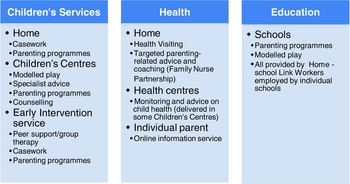
It is not easy to categorise parenting support on the ground as there are many overlapping services. We suggest differentiating both the policy domain and the mode or ‘location’ of delivery, while recognising overlaps. In the former regard, parenting support in England can be said to be encompassed within three main domains of service provision: children's (social) services, health and education. With regard to the mode of delivery, parenting support is delivered in various locations, including the home, schools, Children's Centres and in a range of other ‘public’ settings. The following is the composite picture.
The group-based activities take place through two main channels. The first is parenting programmes. Often referred to as ‘parenting courses’, they mainly comprise generalised education programmes for parents stratified according to the age of children (infants, children and adolescents), as well as targeting particular family or parental situations or needs. The latter reflects the increasing specialisation of parenting-related interventions aimed at specific groups of parents who are seen to be in need, including teenage mothers, parents with learning disabilities, those whose children have special educational needs, as well as those from specific language or cultural sub-groups. Information and skill-building on the part of parents is emphasised, aiming towards the acquisition or extension of a range of techniques and strategies for managing parent–child interactions and improving child-related outcomes. Parenting programmes are typically administered to a group of six to twelve parents through weekly sessions lasting up to two hours and running for an eight to thirteen week period. The majority focus on child behaviour management, while some prioritise children's physical health or emotional well-being.
A further form of collective provision is through the open access ‘Stay and Play’ and ‘advice clinics’. Oriented to parents of toddlers and pre-school children, their aim is to model forms of interaction with children that stimulate attachment and positive development, and to give parents a space or setting as well as time and practice to imitate these. In both study areas, these drop-in sessions at the time of interview were run several times a week for up to half a day in generally well-resourced, often purpose-built rooms within Children's Centres and to a lesser extent schools. Staff prepare play-dough to welcome parents and children, involve them in cooking a lunch and use the walls to display children's art as well as posters for parents explaining healthy lifestyles and the government's Early Years framework. They may also serve the purpose of providing parents with access to a range of professionals (including midwives, speech therapists, educational psychologists and financial advisors) who attend a weekly advice clinic.
The second main form of parenting support is home-visiting. It will be seen from Figure 1 that this mode of engagement occurs across all sectors and encompasses a range of types of engagement and goals. One goal is oriented towards outreach, in this guise it is used by a range of service providers (such as schools or Children's Centres) to inform likely families of services and undertake background work that is designed to enable them to avail of the services (like information sharing and confidence building). Home visits are also used to carry out assessments. In more highly targeted forms of parenting support (such as the Family Nurse Partnership or the Troubled Families initiative), home-based work is more than visiting. Here the home is the locus of intervention. Among the functions undertaken are the monitoring of parental and child well-being, conveying information and advice to the parent, changing relevant practices in the home or local setting and deepening the provider–parent relationship. To take one example, home-school link workers see themselves as ‘wearing many hats’ but as being primarily concerned with the home as a learning environment and parents as potential educators of their children.
Main types of parenting support services

A third type of service is multi-modal, involving types of engagement that occur across settings. These include case work, family mediation, individual counselling or psychotherapy, and multi-systemic therapy. Here, parenting support is only one element of a larger portfolio of services. Offered mostly to parents whose children are at risk of being taken into care, one-to-one counselling or psychotherapy focuses specifically on the individual parent's history and psychological state. It is viewed by those interviewed as ‘aiming to achieve a level of insight and healing that will enable parents to work in a healthy way with their children’. Some provision is difficult to classify because different modes of delivery are used. For example, the content and form of parenting support offered under the Troubled Families initiative varies considerably. At one end, there is intensive home-visiting as described above. At the other end of the scale is a much looser befriending of parents, often by lay volunteers.
As parenting support has developed, it has been hallmarked by a number of signature features or processes. In some senses, these can be depicted as ‘learning’ from policy as it matures; viewed through an alternative lens, they can be thought of as functional responses to dealing with issues and challenges that arise.
One hallmark is a widening of the locations in which parenting support is offered. Primary schools, churches and community centres are common venues of parenting support, along with the Children's Centres which were (at the time of interview) the most widespread formal location of parenting support. Respondents were of the view that parenting support may be increasing in prominence in the education sector, both as a service promoted by schools to meet observed need and as a new element within the curriculum for adolescents (prior to their becoming parents). The home is also a very important site of parenting support, and its significance is increasing. The practitioners and decision makers interviewed for this study highlighted over and over how important it is to get ‘into the home’. This ‘colonisation’ of the home as a place for intervention reflects learning on the part of those involved in service provision and planning, and is also informed by the results of evaluations of Sure Start (Melhuish et al., Reference Melhuish, Belsky, MacPherson and Cullis2010; Eisenstadt, Reference Eisenstadt2011; Wastell and White, Reference Wastell and White2012).
The diversification of settings dovetails with and in part takes forward a second trend: for parenting support to become generalised over time. When it was introduced by the first Blair government in 1999 under Sure Start, it was a delimited service, centred largely on parenting programmes and parent counselling (Eisenstadt, Reference Eisenstadt2011). Over time, parenting support has been increasingly integrated into family and child services (as they themselves have become further established and integrated). This in itself is an important achievement. But the thrust towards parenting support does not stop there, it has established a presence also in services directed at parents and children in health and education. The outstanding examples here are in relation to health (under the Family Nurse Partnership) and general social work with high-need families (being taken forward by the Troubled Families initiative as just one example). That said, it is important to point out that our evidence suggests large operational gaps between the three service areas (children's social services, education, health) with ‘ownership’ remaining largely sectoral.
A third signpost in the unfolding of parenting support as a policy field relates to the role and perceived value of parenting programmes. Initially these dominated the field, to the extent that one could argue that the relatively ready availability of parenting programmes was a major factor enabling the kind of mass rollout of parenting support that took place in England within a relatively short space of time. Now, ten years on, the research suggests increasing questioning of the utility of parenting programmes. Significant numbers of those interviewed expressed the view that parenting programmes work well for some participants but questioned their value in terms of depth of engagement and capacity to achieve real change in people's lives and parenting practices. They pointed out also that high attrition makes group sessions almost as expensive as one-to-one support, which is regarded as more consistently effective in contexts of varying parental need, and particularly amongst groups of parents considered ‘hard to reach’ or whose children are deemed as high need. That said, parenting programmes retain importance, albeit with a rather different profile now as compared with the early years. Our review of recent commissioning in both the study areas shows a trend towards specialised parenting programmes for sub-groups of parents, such as those who share minority cultural backgrounds or who have specific challenging circumstances relating to their children (such as learning difficulties) or in their own lives (for example, domestic violence). This and other evidence suggests a shift from a generalised suite of parenting programmes to those designed for, and made exclusively available to, specific groups of parents. Providers and decision-makers view (and to some extent champion) this development as an outcome of knowledge accumulation about both the (limits of) parenting programmes and the optimum ways of meeting underlying need. This development should also be placed in the context of the huge cuts that have been made to early years and other budgets.
We now turn to the question of why parenting support has had such a rapid rise and what it is about parenting support that has allowed it to be generalised in this way.
Why did parenting support takes root and grows so quickly?
The question of why is rather complicated, and is we suggest best treated in a two-fold, chronological manner: why parenting support was introduced initially and why it has spread and become established in a relatively short space of time.
With regard to the question of why parenting support was introduced and supported to the degree that it was, this is partly answered by the nature of the Labour governments' concern with widespread and entrenched poverty among children, families and neighbourhoods and inequality in children's life chances. This set of concerns spearheaded the growth, not just of parenting support, but of a suite of interventions (cash as well as services) oriented to early child development and familial well-being and support. In sum, there was a perceived policy exigency. The reasons for the prominent role given to parenting support in meeting that need have been documented elsewhere and only need brief mention here (Gillies, Reference Gillies2004; Clarke, Reference Clarke2006; Churchill and Clarke, Reference Churchill and Clarke2010; Eisenstadt Reference Eisenstadt2011; Lewis, Reference Lewis2011a, Reference Lewisb; Daly, Reference Daly2013). Among those highlighted are Labour's push to modernise public policy and provision and their desire to establish a robust platform of children's and family services. A series of high-profile child abuse cases was represented by the media, and to some extent also by government, as a failure of existing services. This fed a sociological (and often moral) critique of perceived weaknesses in parents' and families' support systems. Parenting support was, however, trumpeted as more than a replacement for capacities that once existed informally; it was especially heralded as a way of directly intervening in inter-generational cycles of poor parenting and poor child outcomes. In effect, parenting support was seen as something of a magic bullet for a range of different ‘problems’ that were, and remain, at the forefront of public discourse and political thinking. The availability of a number of evidence-based interventions, through parenting programmes, was another catalyst as was the turn to evidence-based policy making generally. In this regard, mention has to be made of the burgeoning use of quasi-experimental design and the consequential rise of evidence-based programmes. The impact of the rise of such programmes, programme fidelity and implementation science cannot be underestimated. Respondents were conscious of this, although it was the experts who viewed it most critically.
Moving to the current scenario, one very powerful factor in the generalisation of parenting support is that providers and policy makers believe in it. The majority of those interviewed consider it both appropriate and, in many cases, necessary to help parents with the everyday challenges of raising children. This kind of cultural shift is an element or dimension in the process of institutionalization - parenting support has become established in the mindsets of policy makers and practitioners. This does not mean that it is accepted unquestioningly or that its future is secure. But there is a striking degree of acceptance of parenting support among those interviewed. Hence, respondents rarely saw the need to explain or justify what they were doing in regard to parenting support, and the impression gained from their narratives is that practitioners work in contexts where there is little internal questioning about the general endeavour of parenting support. The dominating concerns are functional: to increase access and take-up, improve efficiency and demonstrate outcomes in order to justify continued funding in a climate of cuts to public services.
But the appeal of parenting support to policy makers itself has to be further mined for explanatory purposes. When we do this, we find that there are features inherent in parenting support, both as a concept or philosophy and as a form of policy, that are crucial to explaining its appeal. We highlight here three such factors.
One is the capacity of parenting support, as a concept and policy promise, to sustain very different sets of expectations about what its problem orientation is and what it can achieve. Our evidence makes clear that there are (at least) four conceptualisations of parenting support and what it can achieve. While all four are not always held simultaneously, parenting support is universally seen as meeting more than one set of needs or exigencies.
One conceptualisation sees the primary aim of parenting support as the improvement of child outcomes generally, especially with regard to education and health. In this framing, the purposes of intervention are to offer knowledge and instruction to parents about the significance of various everyday practices in child-rearing and child development. In its low intervention guise, the aim is to acquaint parents with the latest scientific and professional thinking about optimum child development; in its more heavily interventionist modality the goal is to impart the practical skills to enable parents to apply such knowledge at home. The latter is directed at those parents who are considered to be unable to develop such skills and orientations on their own. Behavioural and attitudinal change on the part of parents is the preferred outcome here, with the long-term goal close to a kind of a social investment frame whereby the human capital development of the forthcoming generations is prioritised as the leading function of (and justification for) social policy (Jenson, Reference Jenson2010).
In an alternative conceptualisation, the primary aim of parenting support is early intervention and prevention towards minimising child risk. This targets the current generation of children and is close to a classic child protection exigency. The key function of parenting support in this orientation is to mitigate or reduce the effects of threats in the child's environment, specifically domestic violence, substance abuse and poor mental health among family members (described by several provider respondents as the ‘toxic trio’). Reduced rates of child risk and of interventions to remove the child from the home are among the desired outcomes here.
Less widespread as compared with the former two, there is another conceptualisation which sees parenting support as focused on parents and parental well-being. The latter is not necessarily a goal in its own right, but rather perceived as essential to child well-being. In this view, the function of parenting support is primarily about enabling parents to experience some measure of psychological healing and self-care, and to achieve a more highly evolved and ultimately satisfying understanding of their own relationship with their children. This view of parenting support was sometimes framed by providers and practitioners in a therapeutic language. Among the perceived desired outcomes mentioned were increased enjoyment of and fulfilment attained through the role and practice of parenting, improved empathy/relations between parents and children and reduced conflict within the family.
Finally, respondents' narratives revealed a fourth conceptualisation which is more social (even sociological) in nature. Here the primary role of parenting support was seen to be in the direction of social inclusion, and the building of social capital among and by parents (and by association in families, including children) on the basis that stronger social relationships improve parental mental health and reduce child risks. The function of parenting support in this view is to connect parents to each other, build social networks and increase familiarity with and demand for both formal and informal services and sources of support. Related services are designed to bring a cross-section of parents together from the same neighbourhood to follow a process of learning and exploration of different parenting skills in ways that encourage mutual sharing and support.
It will be obvious that parenting support is more than polysemic, it is multi-expectational in that it plays host to a very high promise and takes forward widely differing sets of policy orientations and goals. Whether it can sustain these is open to question. This is not just because, for example, child development and child protection are very different types of policy goal requiring different types of policy, but also because there are tensions and potential contradictions among the four. In particular, the balancing of the needs of parents with those of children is not thought through, and there is a strong sense in the field of parents as a conduit to child-related outcomes.
A second source of appeal in parenting support inheres in the type of service involved and its political range and depth. Some of its notable features here include the fact that it is primarily framed as a supportive rather than professional service, which means that it can be taken on without undermining the roles of professionals, and that it is in England delivered mainly by people with minimal training and non-professional backgrounds.
Thirdly, parenting support fits with the thrust of developments in the contemporary welfare state. In this regard, it is in tune with a number of core tendencies, including localism. Classically, welfare state support for families took the form of both cash benefits and services. Today, there is some downgrading of cash benefits in favour of services. Parenting support is part of this trend and has to be located in a growing interest amongst national and local government providers in services designed to offer a multi-dimensional set of ‘supports’ to families. Furthermore, the growth of parenting support also fits with the moves towards activation, the notion that the core function of the welfare state is to enable or compel people to be active in the labour market and generally in charge of their lives. As well as leading to other changes, this frames social policy in terms of outcomes and achievements (or ‘results’).
Interrogating the significance of developments
There are a number of points to note about the significance of parenting support as a development in social and family policy. The first is that it is a source of innovation. While it would be an exaggeration to see parenting support as a totally new domain of policy, not least because it has historical antecedants in maternity and aspects of child/family policy, it is taking forward a policy on parents and parenting and opening up a new frontier of the welfare state (Eisenstadt, Reference Eisenstadt2011). A vital part of the broader context is what Gillies (Reference Gillies2011) calls a new politics of family in which some old ideas are reworked alongside new ideas and expectations. The boundaries between state and family are being shifted in this highly interventionist phase of family policy, and parenting support is playing a central role (as idea and policy aim and modality). The perceived necessity of knowledge, skills and other assets to the task of parenting gives parents a new legitimacy as foci of social and economic investment and raises the significance of private behaviours and locations previously considered as more or less out of bounds for public intervention. While the use of the word ‘support’ tends to imply a needs-led engagement with parents, much of what is offered in practice are interventions developed by experts to address what are perceived by them as deficits in child-rearing practices. Hence, parents, especially those who are vulnerable, are rendered objects of social control and subject to particular value systems (which are often represented either as ‘common sense’ or universal) (Ramaekers and Suissa, Reference Ramaekers and Suissa2011). Good parents are constructed as ‘resourceful, agentic and ethically responsible, able to recognise and learn what is best for their children and tailor their behavior accordingly’ (Gillies, Reference Gillies2004: 85).
A second aspect of the social policy significance of parenting support is the extent to which it involves a move away from structural interventions towards those that are more behavioural in orientation and intent. The focus on changing behavior is in tension (if not competition) with a more structuralist response which focuses on changing background conditions and improving people's material resources. One could argue, and several of our respondents did, that poor parenting results from too little income and too much stress, and so should be addressed by measures that act to change this situation rather than those focused mainly on how one responds to one's environment (Morris and Featherstone, Reference Morris and Featherstone2010). It is also worth pointing out here that parenting support individualises the difficulties that parents encounter in caring for and bringing up children. More structural interventions would include protection from stigma and discrimination, economic relief and collective measures to tackle ill-health and unemployment and low wages. The development and popularity of parenting support needs to be set, therefore, in this kind of broader political and economic context. Such a context is marked by the persistence of significant inequalities which parenting support does little to address. To take just one example of the weakness of parenting support as a measure to address inequality, there is a strong sense in it of reinforcing traditional gender roles. While some efforts are being made to engage fathers, the extent to which the provisions actually seek to change gender roles in practice is weak and insubstantial. This lack of structural orientation in parenting support is true in regard to other lines of inequality as well (such as those arising from social class or ethnicity).
A strong thrust of the analysis presented in this article is that parenting support is now well established in the policy landscape in the two areas studied. It would be wrong to convey a sense that it is a settled field though. There are many tensions and sources of indecision, especially around whether parenting support is a general need or a specific one and how it is best taken forward. All respondents consider parenting support within family services and social care to have reached a peak in the final years of Labour's period in office and now to be on the wane. Moreover, there is a move away from a universal platform of provision, with increased targeting of ‘needy’ individuals and families by current government policy. The Troubled Families initiative and Family Nurse Partnership are exemplary in this respect. These two programmes, and particularly the former, have reportedly brought about a narrowing of the eligibility criteria and a much stronger focus on demonstrating high impact. Outcomes are highlighted in the payment by results framework that has been put in place.
Funding constraints dominate the landscape at the present time. Providers and decision makers are under pressure to significantly redesign and reframe services in a climate of diminishing resources, with funding to local authorities being reduced by 28 per cent over four years. Funding constraints are known to have led to significant change, including cut-backs in services but also integration and innovation in services at local level (Family and Parenting Institute, 2012). This is also the case in the two study areas examined for the research reported here. But it would be wrong to represent changes in the field as determined solely by funding issues. While convinced about many of the merits of parenting support, those interviewed for this study revealed ongoing doubts about parenting support. There is, for example, uncertainty about the outcomes and impact of parenting support. On the one hand those involved in providing and deciding on services stand by its value on the basis of provider feedback and their own knowledge of the intersection between services and family life. But on the other they struggle to ascertain precisely how it improves the lives of parents, families and specifically children.
A second source of doubt is around the demand for parenting support from those who (supposedly) need it. While it is known that Children's Centres are popular locally (Family and Parenting Institute, 2012), providers frequently commented on the low uptake of parenting support services as the years go by. Perhaps these services have reached saturation point, or perhaps their rapid rise can be explained by their appeal to the middle classes and the higher-income sectors of the population. Providers working in a range of service contexts spoke about difficulties in broadening the appeal of parenting support, and specifically in recruiting and retaining those (typically low-income) parents who are seen to be most in need of it. Against this backdrop, effectiveness increased in importance and providers consistently referred to the necessity of building relationships with parents prior to offering the intervention. It is for this as well as other reasons that they have to reach deeper and deeper into people's lives and want to engage more in the home.
Concluding note
There are at least two striking points about parenting support in England. The first is the rapidity of its growth. In little more than a decade parenting support has grown from being a peripheral or niche policy to a core component of the family and child policy landscape. The second is the diversity of parenting support as a field, covering on the one hand education and training of parents, and on the other a more general and amorphous ‘support’. These are quite different and are not easily reconciled either at a philosophical or praxis level.
The institutionalisation of parenting support in England has been enabled by both its characteristics and orientation as a type of policy and specific exigencies of the wider policy environment. Most significant among the former are the generalisability of parenting support in the form of programmes across sectors and the promise attached to parenting support as a ‘solution’ to a range of problems which resonate in today's risk-oriented societies. At the same time, parenting support as a type of service aligns with several current developments of the welfare state, towards the activation of individuals, the provision of support through services and an interest in localism.
This article suggests that the institutionalisation of parenting support in England is serving to reconfigure the field of family policy in two key ways. First, it has consolidated the current, highly interventionist phase of state policy in England towards individuals and families. Parents are positioned as recipients of the state's exigencies about raising children and, if deemed to require instruction, expected to participate in a range of highly interventionist projects. The use of the term ‘parenting support’ implies that provisions are demand or needs led, when in fact they are often service led and people have little choice about participating. Second, parenting support has flourished amidst a broader behavioural and individualising orientation in social policy interventions. This is to the relative neglect of more structural issues and approaches that seek to counter inequality, including that arising from gender- and ethnicity-related factors.
What can we learn from the English case of salience to the development of parenting support in Europe and more widely? Our research suggests that parenting support can retain currency in contexts of significant threat. Despite diminishing resources and respondents querying the evidence base underlying current practice, parenting support retains credibility as a focus of investment amongst those working in and funding the field in England. While it is not necessarily playing a leading role in policy development, it retains appeal as a link or bridge policy on the one hand and as a constituent element of a range of policies with social, health and educational orientations on the other.
Acknowledgements
We would like to thank the two referees for excellent comments and feedback. Mary Daly would also like to acknowledge the invaluable contribution of Professor Jane Lewis of the LSE to the project.