Background
Ever since the first report of a total atriopulmonary shunt by Fontan and Baudet in 1971, modifications of the Fontan procedure have extended the indications for this operation to a wide range of congenital cardiac defects unsuitable for biventricular repair.Reference Fontan and Baudet1 Operative mortality has significantly decreased despite application of the operation to patients with complex forms of single ventricle and to those with haemodynamic or other parameters previously considered to carry higher risk. There has been a significant improvement in early survival from 75% to 83% in the 1970s to over 90% in the current era.Reference Khairy, Fernandes and Mayer2–Reference Hosein, Clarke and McGuirk6 Despite improvements in surgical techniques that reduce perioperative mortality, these patients are far from “cured”. Following modified Fontan procedure, patients face a lifetime risk of atrioventricular valve insufficiency, ventricular dysfunction, arrhythmias, thromboembolic complications, protein-losing enteropathy, functional deterioration, and reduced life expectancy.Reference Khairy, Poirier and Mercier7–Reference Bartz, Driscoll and Dearani9 Atrioventricular valve regurgitation is a known perioperative risk factor for Fontan operation.Reference Driscoll, Oxfford and Feldt8, Reference Gentles, Mayer and Gauvreau10 In the majority, atrioventricular valve regurgitation is dealt with prior to or at the time of Fontan operation. There are limited data on the outcomes of late atrioventricular valve surgery following Fontan operation.
The objective of this study was to evaluate the early and late results of atrioventricular valve surgery after Fontan operation and to assess the effects of variables traditionally known to correlate with poor outcome, as well as the current health status of survivors.
Methods
Patient population
A total of 61 patients underwent atrioventricular valve surgery following Fontan operations at the Mayo Clinic from 1972 to 2007. These patients were identified from the Mayo Clinic Fontan database. We obtained institutional review board approval for this study. No patients who had atrioventricular valve surgery following Fontan procedure were excluded. Hospital and outpatient records were abstracted for pre-operative, operative, and post-operative clinical and haemodynamic data. In addition, all patients who were not known to be deceased were sent health status questionnaires. Atrioventricular valve anatomy and systemic ventricular morphology were classified on the basis of findings from the pre-operative cardiac catheterisation and echocardiogram, as well as from operative findings. Discrepancies were settled by consensus of the authors. Current addresses and date of death were cross-referenced with Accurint, a locate-and-research database. Patients who did not return their questionnaires after the first mailing received two additional mailings and a reminder by telephone. Atrioventricular valve regurgitation was judged as absent (0), mild (1), moderate (2), or severe (3) from pre-operative angiograms or from echocardiograms when angiographic information was not available. The various modifications of the Fontan operation were classified into three groups depending on the type of atriopulmonary connection conduit (if an atriopulmonary or atrioventricular conduit had been used), direct atriopulmonary anastomosis, and total cavopulmonary anastomosis with an intracardiac lateral tunnel. In all cases, the operation involved separation of the systemic and pulmonary venous return by excluding the systemic venous return from the systemic ventricle. If a patient was no longer alive with a Fontan circulation, the reason for failure was elicited from the medical record, referring physician, post-mortem report, and/or death certificate.
The primary outcome variable in this study was transplant-free survival, in other words absence of death or cardiac transplantation. Death was classified as either early or late, with early failure occurring within 30 days of the atrioventricular valve surgery. Relationships between survival and perioperative variables were evaluated. We used the same independent variables of interest that were used in previous outcome studies of the Fontan operation from the Mayo Clinic.Reference Driscoll, Oxfford and Feldt8, Reference Humes, Feldt and Porter11–Reference Cetta, Feldt and O’Leary14 Univariate assessment of the association of variables with mortality was performed using chi-square and Wilcoxon rank sum tests. Cumulative survival was estimated using the Kaplan–Meier method. Models were constructed with Cox proportional-hazard models using a stepwise elimination of the non-significant variables performed using a p-value cut point to retain variables <0.05. For all other comparisons, two-tail p-values of ⩽0.05 were taken as evidence of findings not attributable to chance.
Results
Patients
Of the 61 patients included in this study, 28 (46%) were females. The median age at atrioventricular valve surgery was 14 years with a range of 3–41 years. The median duration between Fontan and atrioventricular valve surgery was 4.7 years with a range of less than 1 year to 20.2 years. The median follow-up was 9 years with a range of 0–28 years.
Anatomy
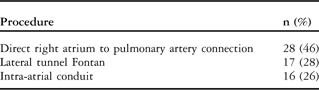
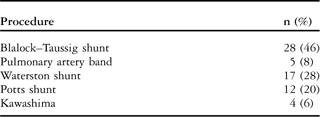
Tricuspid atresia was the most common anatomic diagnosis and was seen in 23 patients (38%), followed by double inlet left ventricle in 14 (23%), unbalanced atrioventricular septal defect in four (7%), double outlet right ventricle in four (7%), and other causes in six (10%). Of the patients, 11 (18%) had heterotaxy syndrome. The type of Fontan connection and previous palliative surgeries are listed in Tables 1 and 2.
Type of Fontan connections.

Type of palliative surgical procedures before modified Fontan operation.

Atrioventricular valve and other surgeries
Left atrioventricular valve or mitral valve surgery was performed in 40 patients (66%) and right atrioventricular valve or tricuspid valve surgery in 14 patients (23%); a common atrioventricular valve morphology was seen in seven patients (11%). The atrioventricular valve was repaired in 38 patients (62%) and replaced in 23 (38%). In the repair cohort, post-operatively, the median atrioventricular valve regurgitation grade reduced from 3 to 1 (p < 0.001). In the repair group, five patients (four replacements and one re-repair; 13%) underwent atrioventricular valve reintervention on follow-up.
Fontan revision or takedown was performed in 19 patients (28%) at the time of atrioventricular valve surgery. Classic right atrium to pulmonary artery Fontan was converted to a lateral tunnel in four patients, and intra-atrial conduit was performed in five others. We performed one and a half ventricle repair in eight patients and the Fontan was taken down in two patients.
Mortality
Overall, 32 patients (52%) died during the follow-up period. Of them, eight patients (13%) died within 30 days of surgery (early death); cardiac failure was the most common cause of delayed mortality and was responsible for 12 deaths (20%); two patients (3%) died of sudden cardiac death; protein-losing enteropathy was responsible for four deaths (6.5%) and four patients (6.5%) underwent cardiac transplant. Clinical or autopsy data could not be obtained for two of the 32 patients. However, accurate dates of death were available for all the 32 patients.
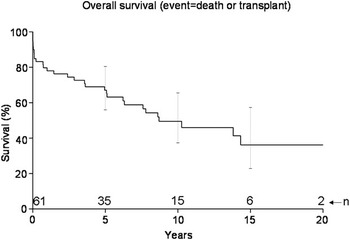
Actuarial cumulative survival at 5, 10, and 15 years was 67%, 57%, and 45%, respectively (Figs 1 and 2).
Kaplan–Meier survival curve displays the overall transplant-free survival following atrioventricular valve surgery following Fontan procedure. (n = number at risk).

Univariate and multivariate predictors of mortality
The variables that correlated significantly with mortality were ventricular dysfunction (subjectively assessed systolic function) before surgery (p < 0.001; hazard ratio = 5) and development of protein-losing enteropathy (p < 0.0001; hazard ratio = 6.1). The important factors not affecting survival included patient demographics, underlying anatomic diagnosis, heterotaxia syndromes, ventricular morphology, atrioventricular valve repair versus replacement, degree of atrioventricular valve regurgitation before surgery, bypass time, type of Fontan, concomitant surgeries, and era of surgery.
Current health and functional status
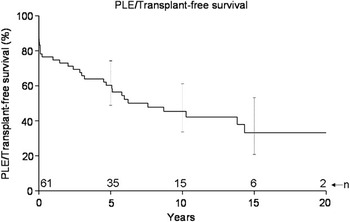
On follow-up, 44 patients (72%) developed arrhythmias, 17 (28%) required pacemaker placement, and 12 (20%) developed protein-losing enteropathy. All patients who developed protein-losing enteropathy did so within 7 years following atrioventricular valve surgery (Fig 2). Thromboembolic episodes occurred in nine patients (15%), including two with residual neurological deficits. Excluding the 32 total deaths, current health and functional status were available in 25 patients (86%). Of them, 16 (64%) reported having no or mild symptoms with ordinary physical activity; 14 (56%) were employed, and of these 50% worked full time and the remaining were part-time employees. All patients were on greater than 1 medications. The most common medications were angiotensin-converting enzyme inhibitor or angiotensin II receptor blocker (85%), beta-blockers (45%), digoxin (35%), warfarin (30%), and diuretics (25%). There were four patients who had successful pregnancies following atrioventricular valve surgery.
Kaplan–Meier survival curve displays transplant- and protein-losing enteropathy (PLE)-free survival following atrioventricular valve surgery following Fontan procedure. (n = number at risk).

Discussion
Ever since the initial description of selection criteria for Fontan operation by Choussat et al, advances in pre-operative risk evaluation, surgical technique and experience, and post-operative management have liberalised these criteria for Fontan patients.Reference Choussat, Fontan and Besse15 However, atrioventricular valve regurgitation is considered a risk factor for operative mortality in patients with single ventricles undergoing modified Fontan procedure.Reference Driscoll, Oxfford and Feldt8, Reference d’Udekem, Iyengar and Cochrane16–Reference Imai, Takanashi and Hoshino20 Moderate-to-severe atrioventricular regurgitation has been demonstrated in up to 20% of patients with single ventricle physiology.Reference Anderson, Sleeper and Mahony5 In the majority of single ventricle patients with atrioventricular valve regurgitation, the valve is repaired or replaced at the time of Fontan procedure.Reference Kerendi, Kramer and Mahle3 In some studies, the concomitant repair of the atrioventricular valve during Fontan procedure increased the mortality rate while other studies report no significant change.Reference Kerendi, Kramer and Mahle3, Reference Uemura, Kawashima and Yamamoto21–Reference Sallehuddin, Bulbul and Otero23 In addition, studies have observed a progressive deterioration in the competency of the atrioventricular valve following the Fontan operation in patients without any prior atrioventricular valve operation.Reference Gentles, Mayer and Gauvreau10 However, there is a lack of systematic studies looking at the long-term outcome of this high-risk cohort. This study confirms our suspicion of the poor long-term outcome of patients undergoing late atrioventricular valve repair or replacement following Fontan procedure. Patients achieved a significant reduction in the degree of regurgitation following surgical repair. However, 10-year survival was only 57%. The incidence of protein-losing enteropathy is significantly high in this cohort. On follow-up, 20% of patients developed protein-losing enteropathy. All patients who developed protein-losing enteropathy did so within 7 years following atrioventricular valve surgery. Cardiac failure was the most common cause of delayed mortality. In survivors, late morbidity and mortality remain substantial.
Mechanistic origins of protein-losing enteropathy following the Fontan operation are not fully understood. However, two factors – low cardiac output and mesenteric inflammation – are thought to be primarily responsible for protein-losing enteropathy following Fontan.Reference Rychik24 Low cardiac output resulting from inefficient Fontan circulation leads to reduced mesenteric blood flow and elevated mesenteric vascular resistance resulting in protein-losing enteropathy.Reference Rychik24 Incidence of protein-losing enteropathy in this study cohort was significantly higher (20%). We speculate that, in this cohort, a combination of factors including atrioventricular valve regurgitation, reduced ventricular function, and elevated ventricular end-diastolic pressure lead to further reduction in cardiac output and higher incidence of protein-losing enteropathy. Atrioventricular valve regurgitation increases atrial pressure, resulting in decreased ventricular preload and diminished cardiac output. A myriad of treatment strategies including high-dose steroids, low molecular weight heparin, sildenafil, and catheter fenestration were tried with no significant or sustained improvement. On follow-up, four out of 12 patients died secondary to protein-losing enteropathy and two patients underwent cardiac transplantation. The incidence of protein-losing enteropathy in Fontan patients requiring AV valve surgery is high. The onset of protein-losing enteropathy heralds poor prognosis with limited treatment options.
In this study, two key factors modulated long-term mortality. These two factors include the presence of ventricular dysfunction and development of protein-losing enteropathy. Several previously recognised factors such as type of Fontan, ventricular morphology, underlying diagnosis, valve repair versus replacement, and era of surgery were not predictive of outcome.
Conclusion and limitations
We conclude that late onset atrioventricular valve regurgitation in patients with Fontan circulation is amenable to repair or replacement. However, late morbidity and mortality remain substantial in this group of patients. The incidence of protein-losing enteropathy is significantly higher than that for the rest of the Fontan group. Issues related to the atrioventricular valve may be best addressed prior to or at the time of Fontan operation. Patients needing atrioventricular valve surgery after Fontan have a long-term outcome that is inferior to other patients.
This was a retrospective review and the selection process was not randomised. The groups were not free from selection bias as the choice of intervention depended on the degree of atrioventricular valve regurgitation as well as the surgeons’ preference. The repair techniques were also not standardised. Patients with very severe degrees of atrioventricular valve regurgitation and ventricular dysfunction may not have been referred for surgery and therefore this study group could not be representative of every patient with this problem.
Acknowledgements
Disclosure: None.
Funding: None.
Appendix
List of factors assessed that were “non-significant” in the univariate model
1. Age at surgery
2. Gender
3. Era of surgery
4. Primary cardiac lesion
5. Heterotaxy syndrome
6. Number of previous palliations
7. Ventricular morphology
8. Valve morphology
9. Type of Fontan connection
10. Age at Fontan
11. Duration between Fontan and atrioventricular valve surgery
12. Bypass time and cross-clamp time (minutes)
13. Post-operative duration of hospitalisation
14. Post-operative renal failure
15. Concomitant surgeries
16. Arrhythmias
17. Use of antiarrhythmic or diuretic medications
18. Pacemaker