Implications
Growth performance of weaned pigs is reduced if heat-damaged soybean meal (SBM) or heat-damaged distillers dried grains with solubles (DDGS) is used without correcting the standardized ileal digestible values for amino acids reduced by heat damage. Results indicate that supplementation of diets with crystalline amino acids may ameliorate some of the negative effects of feeding heat-damaged SBM or DDGS to weaned pigs. Further research is needed to identify ways of estimating the degree of heat damage in SBM and DDGS.
Introduction
Successful feed formulation and nutrition of farm animals require accurate information about the nutritional value of feed ingredients. Whereas several nutritional criteria are routinely considered in feed ingredient evaluation, the ability to assess the impact of heat damage that may occur during processing of particular ingredients has received less attention. Legumes, including soybeans, contain anti-nutritional factors (ANFs), which reduce nutrient utilization in animals (Jezierny et al., Reference Jezierny, Mosenthin and Bauer2010). Heat treatment is used to de-activate ANFs in legumes and heat is also used in the processing of co-products produced from the grain-based ethanol production. However, overheating may destroy nutrients, especially amino acids, and result in formation of Maillard reaction compounds that are biologically unavailable (Fontaine et al., Reference Fontaine, Zimmer, Moughan and Rutherfurd2007; Pahm et al., Reference Pahm, Pedersen and Stein2008).
The concentration and the digestibility of amino acids by growing pigs in feed ingredients decrease gradually with increasing degree of heat treatment (Fontaine et al., Reference Fontaine, Zimmer, Moughan and Rutherfurd2007; Pahm et al., Reference Pahm, Pedersen and Stein2008; González-Vega et al., Reference González-Vega, Kim, Htoo, Lemme and Stein2011). Whereas amino acid analysis of raw materials by rapid methods such as near-IR spectroscopy (NIRS) can identify amino acid losses in heat-damaged ingredients, which may be considered in diet formulation, rapid estimations of changes in amino acid digestibility in different sources of ingredients is more challenging. Lack of adjustments of amino acid concentrations in diets containing heat-damaged ingredients, however, may result in reduced performance of pigs. It is, therefore, necessary that the degree of heat damage for a feed ingredient is taken into account in diet formulation. Effects of adjusting concentrations and values for the standardized ileal digestibility (SID) of amino acids to ameliorate reduced performance of broiler chickens fed heat-damaged soybean meal (SBM) have been reported (Helmbrecht et al., Reference Helmbrecht, Redshaw, Elwert, Veldkamp and Lemme2010). In contrast, effects of adjusting concentrations and SID of amino acids in diets containing heat-damaged SBM or heat-damaged corn distillers dried grains with solubles (DDGS) fed to pigs have not been determined. We hypothesized that the negative effects of feeding heat-damaged SBM or DDGS to weanling pigs may be reduced if values for the concentrations and the SID of amino acids used in diet formulation are adjusted according to the degree of heat damage in the ingredients. Therefore, the objectives of the present experiments were to investigate if inclusion of crystalline amino acids in diets containing heat-damaged SBM or DDGS may compensate for the reduced concentration and digestibility of amino acids in the heat-damaged ingredients, and result in pigs being able to maintain growth performance similar to that of pigs fed diets containing SBM or DDGS that was not heat damaged.
Material and methods
Protocols for the experiments were reviewed and approved by the Institutional Animal Care and Use Committee at the University of Illinois. Pigs used in both experiments were the offspring of G-performer boars mated to F-25 females (Genetiporc, Alexandria, MN, USA).
Experiment 1: heat-Damaged SBM
SBM
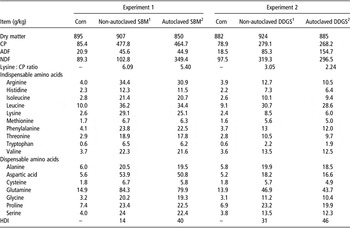
A single source of conventional (i.e. processed according to standard industry practices), de-hulled SBM (Solei, Gibson City, IL, USA) was obtained and divided into two batches that were either untreated or autoclaved at 125°C for 60 min to create heat-damaged SBM. Time of autoclaving (i.e. 60 min) started counting after 2 min heating-up and terminated 58 min thereafter. The autoclave was opened 2 min later, after pressure from the autoclave was released. Samples were then removed and allowed to cool down and dry at room temperature for 60 min. The analysed amino acid concentrations in the two batches of SBM are shown in Table 1.
Analysed nutrient composition of ingredients (g/kg, as-fed basis) used in Experiments 1 and 2

SBM=soybean meal; DDGS=distillers dried grains with soluble; HDI=heat damage indicator.
1 This source of SBM was also included in diets fed to pigs in Experiment 2.
2 Autoclaved at 125°C for 60 min.
Diet formulation
Four corn–SBM diets were formulated to contain similar concentrations of net energy (NE) and CP (Supplementary Table S1). Diet 1 contained the non-autoclaved SBM and this diet was formulated on the basis of analysed amino acid concentrations and using SID values from the AminoDat® 4.0 database (Evonik Degussa GmbH, 2010), which are the average of SID values from 95 digestibility experiments. The AminoDat® 4.0 summarizes the analysed amino acid composition of more than 130 feed ingredients carried out by Evonik over the past 5 years as well as the SID amino acids values of major ingredients used in animal nutrition. Three additional diets were formulated using the autoclaved SBM rather than the non-autoclaved SBM. Diet 2 was formulated similar to Diet 1 in terms of ingredient composition, except that the untreated SBM was replaced by autoclaved SBM at 1 : 1 (weight basis) resulting in lower dietary SID amino acid content. This treatment would represent a situation wherein heat-damaged SBM is not identified and used as regular quality that might occur if not every single batch of ingredient is analysed. Diet 3 was formulated by adjusting amino acid inclusion in the diet on the basis of analysed total amino acid concentrations in the autoclaved SBM. Adjustments for the concentration of amino acids in Diet 3 were achieved by adding increased quantities of crystalline lysine, methionine, threonine and tryptophan to the diet. Diet 4 also contained autoclaved SBM, but formulation of this diet was adjusted on the basis of analysed concentrations of amino acids in the autoclaved SBM and SID values that were adjusted according to the degree of heat damage in this source of SBM. Crystalline lysine, methionine, threonine and tryptophan were also added to Diet 4, but in greater quantities than in Diet 3. The proprietary heat damage indicator (HDI) was previously developed based upon the patterns of NIRS calibration carried out for a large population of a given heat-processed raw material (Redshaw, Reference Redshaw2010). The HDI value indicates the degree of damage, that is, the higher the number the greater the damage. The SID of amino acids in a given heat-processed ingredient are adjusted by combining the HDI values and the corresponding SID of amino acids derived from the in vivo digestibility studies with ileal-cannulated pigs. The calculated SID lysine was 10.0 g/kg in all diets if heat-damaged SBM was not used. However, the use of heat-damaged SBM in Diets 2, 3 and 4, and adjustments in amino acid supplementation to account for the detrimental effects of heat damage, yielded actual calculated values for the SID lysine of 8.8, 9.5 and 10.0 g/kg, respectively.
Animals, experimental design and housing
A total of 160 pigs (initial BW: 10.4±1.3 kg) were weaned at ∼21 days of age and fed a common phase 1 diet during 14 days adaptation until they reached ∼10 kg BW. Pigs were then allotted to four dietary treatments with eight replicate pens per treatment in a randomized complete block design. Four replicates of each treatment consisted of a pen with three barrows and two gilts whereas the other four replicates of each treatment consisted of a pen with two barrows and three gilts. Pigs were fed treatment diets for 21 days. Pigs were housed in an environmental controlled room in pens (1.2×1.2 m) with fully slatted floors. Feed and water were provided ad libitum.
Performance measurements, sample analyses and data processing
The individual BW of pigs was recorded at the beginning of the experiment and every 7 days thereafter. The amount of feed provided to each pen was recorded daily and the feed left in the feeders was recorded on the same days as pig weights were recorded. At the conclusion of the experiment, values for ADG, average daily feed intake (ADFI) and gain to feed ratio (G : F) for each 7-day period and for the overall experimental period were calculated. On the last day of the experiment, feeders were weighed and emptied at 0700 h. On the same day, at 1300 h, blood samples from the heaviest barrow and the heaviest gilt in each pen were collected via jugular venipuncture in EDTA tubes. Tubes were stored on ice and centrifuged (2000 rpm at 5°C for 15 min). Plasma was then collected from the centrifuged tubes and analysed for plasma urea nitrogen (PUN) on an Olympus AU680 Chemistry Analyzer (Olympus Life Science Research Europa GmbH, Sauerbruchstr, Munich, Germany).
Ingredients and diets were analysed for dry matter by drying in an oven at 103°C for 4 h (Method 935.29; AOAC International, Gaithersburg, MD, USA), ADF (Method 973.18; AOAC International, 2007), NDF (Holst, Reference Holst1973), CP according to the Dumas procedure (Method 968.06; AOAC International, 2007), and amino acids as previously described (González-Vega et al., Reference González-Vega, Kim, Htoo, Lemme and Stein2011). Diets were also analysed for gross energy using bomb calorimetry (Model 6300; Parr Instruments, Moline, IL, USA).
Data were analysed by ANOVA using the GLM procedure of SAS (SAS Institute Inc., Cary, NC, USA). The model included dietary treatment and initial BW as the fixed effect, whereas replication was included as the random effect. The pen was the experimental unit. Differences were considered significant if P<0.05 and were described as tendencies if 0.05<P<0.10 using the LSMeans statement.
Experiment 2: heat-damaged corn DDGS
Corn DDGS
A single source of conventional corn DDGS was sourced from Poet LLC (North Manchester, IN, USA) and separated into two batches. One batch was not autoclaved, whereas the other batch was autoclaved at 125°C for 60 min (Table 1). The autoclaving process for DDGS followed the same protocol as described for autoclaving of SBM in Experiment 1.
Diet formulation
Four experimental diets based on corn, SBM (85 g/kg) and DDGS (220 g/kg) were formulated following the same principles as described for Experiment 1 (Supplementary Table S2). Adjustments for the concentration of SID amino acids in Diet 3 were achieved by adding crystalline lysine, methionine, threonine, tryptophan, valine and isoleucine to a diet that was otherwise similar to Diet 2. Crystalline lysine, methionine, threonine, tryptophan, valine and isoleucine were also added to Diet 4, but in greater quantities than in Diet 3. The calculated SID lysine was 10.0 g/kg in all diets if heat-damaged DDGS was not used. However, the use of heat-damaged DDGS in Diets 2, 3 and 4, and adjustments in amino acid supplementation that accounted for the detrimental effects of heat damage, yielded actual calculated values for the SID lysine of 9.5, 9.7 and 10.0 g/kg, respectively.
Animals, experimental design and housing
A total of 144 pigs (initial BW: 9.9±1.5 kg) that were weaned at ∼21 days of age and fed a common phase 1 diet during 14 days adaptation until they reached ∼10 kg BW. Pigs were allotted to four dietary treatments with eight replicate pens per treatment in a randomized complete block design. Four replicates of each treatment consisted of a pen with three gilts and two barrows whereas the other four replicates of each treatment consisted of a pen with two gilts and two barrows. Pigs were fed the treatments for 21 days, and were housed as outlined for Experiment 1.
Sample analysis, performance measurements and data processing
Ingredients and diets were analysed as described for Experiment 1. Performance measurements and data processing were also similar to those described for Experiment 1.
Results
Experiment 1
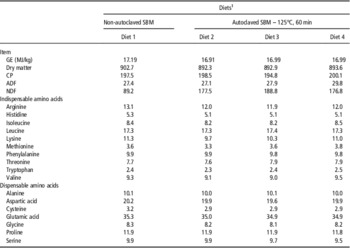
The concentration of CP was 477.8 and 464.7 g/kg in the non-autoclaved SBM and the autoclaved SBM, respectively (Table 1). The concentration of NDF was 102.8 g/kg in the non-autoclaved SBM v. 349.4 g/kg in the autoclaved SBM. The non-autoclaved SBM contained 29.1 g/kg lysine, whereas the autoclaved SBM contained 25.1 g/kg lysine. The calculated lysine : CP ratio was 6.09 for the non-autoclaved SBM and 5.40 for the autoclaved SBM. The concentration of CP in Diets 1, 2, 3 and 4 were 197.5, 198.5, 194.8 and 200.1 g/kg, respectively (Table 2). The analysed concentration of lysine was 11.3, 9.7, 10.3 and 11.0 g/kg in Diets 1, 2, 3 and 4, respectively.
Analysed nutrient composition (g/kg, as-fed basis) of diets used in Experiment 1
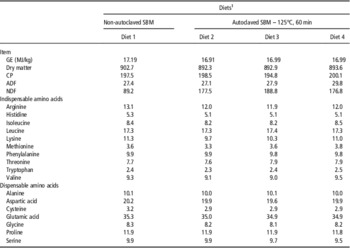
SBM=soybean meal; GE=gross energy.
1 Diet 3=diet that was formulated taking into account the negative effects of heat damage on the concentration of amino acids; Diet 4=diet that was formulated taking into account the negative effects of heat damage on the concentration and on the digestibility of amino acids.
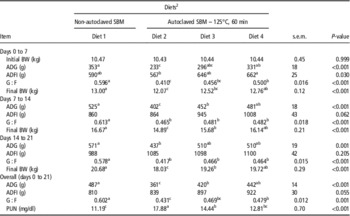
Pigs that were fed Diet 2 had reduced (P<0.05) BW on days 7 and 14 compared with pigs fed Diets 1 and 4, but the BW on days 7 and 14 for pigs fed Diet 4 was not different from the BW of pigs fed Diet 1 (Table 3). The final BW on day 21 for pigs fed either Diet 3 or Diet 4 was greater (P<0.05) than the final BW of pigs fed Diet 2, but the final BW of pigs fed Diet 4 was not different from that of pigs fed Diet 1. Overall, the ADG between pigs fed Diets 1 and 4 were not different, but was greater (P<0.05) than the ADG of pigs fed Diet 2. For the overall period, the ADFI tended (P=0.055) to be greater for pigs fed Diets 3 and 4 than for pigs fed Diets 1 and 2. The G : F (days 0 to 21) was greater (P<0.05) for pigs fed Diet 1 than for pigs fed the other diets. Pigs fed Diet 4 had greater (P<0.05) G : F compared with pigs fed Diet 2. The concentration of PUN was less (P<0.05) in pigs fed Diet 1 than in pigs fed Diet 2 or Diet 3, but not different from the PUN of pigs fed Diet 4. Pigs fed Diet 2 had the greatest (P<0.05) concentration of PUN among all treatments.
Performance and concentration of plasma urea nitrogen of weanling pigs fed diets containing non-autoclaved or autoclaved soybean meal (SBM)Footnote 1

PUN=plasma urea nitrogen; ADFI=average daily feed intake; G : F=gain to feed ratio.
a,b,cLSMeans within the same row lacking a common superscript letter are different (P<0.05).
1 Data are means of eight observations per treatment.
2 Diet 3=diet that was formulated taking into account the negative effects of heat damage on the concentration of amino acids; Diet 4=diet that was formulated taking into account the negative effects of heat damage on the concentration and on the digestibility of amino acids. The dietary standardized ileal digestible lysine level corrected for the negative effect of heat damage was 9.9, 8.1, 8.7 and 9.3 g/kg for Diets 1, 2, 3 and 4, respectively.
Experiment 2
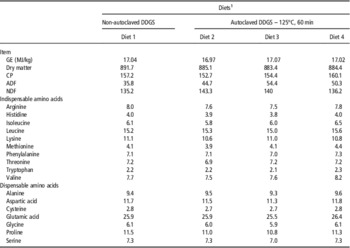
The analysed ADF concentration was 85.3 g/kg in non-autoclaved DDGS, whereas autoclaved DDGS contained 154.7 g/kg ADF (Table 1). The lysine : CP ratio in non-autoclaved DDGS was 3.05, but 2.24 in autoclaved DDGS. The analysed lysine concentration in Diet 1 was 11.1 g/kg, whereas the concentration of lysine was 10.6, 11.0 and 10.8 g/kg for Diets 2, 3 and 4, respectively (Table 4).
Analysed nutrient composition (g/kg, as-fed basis) of diets used in Experiment 2

DDGS=distillers dried grains with soluble; GE=gross energy.
1 Diet 3=diet that was formulated taking into account the negative effects of heat damage on the concentration of amino acids; Diet 4=diet that was formulated taking into account the negative effects of heat damage on the concentration and on the digestibility of amino acids.
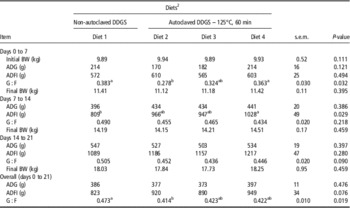
No differences were observed for initial BW among treatments (Table 5). For the entire period (days 0 to 21), pigs fed Diets 2 or 4 had tended to have a greater (P=0.076) ADFI than pigs fed Diet 1, but no differences in ADFI were observed among pigs fed the diets containing autoclaved DDGS. Pigs fed Diet 1 had greater (P<0.05) G : F than pigs fed Diet 2, but not different from pigs fed Diets 3 or 4.
Performance of weanling pigs fed diets containing non-autoclaved or autoclaved distillers dried grains with solubles (DDGS)Footnote 1

ADFI=average daily feed intake; G : F=gain to feed ratio.
a,bLSMeans within the same row lacking a common superscript letter are different (P<0.05).
1 Data are means of eight observations per treatment.
2 Diet 3=diet that was formulated taking into account the negative effects of heat damage on the concentration of amino acids; Diet 4=diet that was formulated taking into account the negative effects of heat damage on the concentration and on the digestibility of amino acids. The dietary standardized ileal digestible lysine level corrected for the negative effect of heat damage was 10.0, 9.5, 9.7 and 10.0 g/kg for Diets 1, 2, 3 and 4, respectively.
Discussion
Ingredients
SBM is the protein source most utilized in diets fed to pigs, but because inactivation of ANFs in SBM requires heat processing, some variation in the nutritional value of different sources of SBM may exist (Stein et al., Reference Stein, Berger, Drackley, Fahey, Hernot and Parsons2008). The concentrations of dry matter, CP and indispensable amino acids in the non-autoclaved SBM used in this experiment are in agreement with values reported by Fontaine et al. (Reference Fontaine, Zimmer, Moughan and Rutherfurd2007) and González-Vega et al. (Reference González-Vega, Kim, Htoo, Lemme and Stein2011). Based on Evonik’s database (AminoDat® 4.0) an SBM with an HDI around 12 represents an average quality SBM. Thus, the fact that the non-autoclaved SBM used in this experiment had an HDI of 14 indicates that this source of SBM was of average quality. In contrast, the autoclaved SBM had an HDI of 40, which confirms that this SBM was heat damaged. Likewise, a lysine : CP ratio in SBM above 6.0 indicates that the SBM has not been heat damaged, whereas a lysine : CP ratio of <6.0 indicates heat damage (González-Vega et al., Reference González-Vega, Kim, Htoo, Lemme and Stein2011). The fact that lysine : CP ratios of 6.09 and 5.40 were calculated for the non-autoclaved and autoclaved SBM used in this experiment clearly indicates that the autoclaved SBM was severely heat damaged, whereas the non-autoclaved SBM was not heat damaged. The DDGS used in this experiment had concentrations of CP, NDF and most amino acids that were in agreement with previously published values (Spiehs et al., Reference Spiehs, Whitney and Shurson2002; Stein et al., Reference Stein, Gibson, Pedersen and Boersma2006; NRC, 2012). Based on Evonik’s database (AminoDat® 4.0) it is estimated that DDGS with an HDI of 34 or less represents an average quality DDGS. Thus, the fact that the non-autoclaved DDGS used in this experiment had an HDI of 31, which indicates that this was an average quality DDGS. In contrast, the autoclaved DDGS had an HDI of 46, which indicates that this source of DDGS was heat damaged. The observation that the lysine : CP ratio was 3.05 in the non-autoclaved DDGS also indicates that this DDGS was not heat damaged because a lysine : CP ratio above 2.80 is usually observed for non-heat-damaged DDGS (Stein et al., Reference Stein, Connot and Pedersen2009; Kim et al., Reference Kim, Kil, Zhang and Stein2012; Almeida et al., Reference Almeida, Htoo, Thomson and Stein2013). However, the lysine : CP ratio of 2.24, which was calculated for the autoclaved DDGS, clearly indicates that this ingredient was heat damaged.
The reason the lysine : CP ratio can be calculated to estimate heat damage is that the concentration of lysine is reduced in heat-damaged ingredients whereas the concentration of CP remains relatively constant during heat damage (Fontaine et al., Reference Fontaine, Zimmer, Moughan and Rutherfurd2007; González-Vega et al., Reference González-Vega, Kim, Htoo, Lemme and Stein2011). The reduction in the concentration and the SID of lysine in heat-damaged feed ingredients is likely a result of Maillard reactions (Pahm et al., Reference Pahm, Pedersen and Stein2008; González-Vega et al., Reference González-Vega, Kim, Htoo, Lemme and Stein2011).
The increased concentration of NDF in the autoclaved SBM compared with the non-autoclaved SBM that was observed in this experiment is in agreement with observations by Hussein et al. (Reference Hussein, Demjanec, Merchen and Aldrich1995). Some of the products from the Maillard reactions form a ‘lignin-like matrix’, which is analysed as fractions of NDF (Hussein et al., Reference Hussein, Demjanec, Merchen and Aldrich1995). Thus, it is likely that the observed increase in the analysed concentration of ADF in autoclaved DDGS compared with non-autoclaved DDGS was also a result of this artefact. The concentration of NDF increased from 143.0 g/kg in non-autoclaved SBM to 171 g/kg in SBM autoclaved at 127°C for 10 min (Sadeghi et al., Reference Sadeghi, Nikkhah, Shawrang and Shahrebabak2006). These observations indicate that the concentration of NDF within a source of SBM may serve as an indicator of heat damage. When SBM is heat processed, the combination of heat, reducing sugars and the ‘free’ amino groups of proteins and amino acids may initiate Maillard reactions (Fontaine et al., Reference Fontaine, Zimmer, Moughan and Rutherfurd2007; González-Vega et al., Reference González-Vega, Kim, Htoo, Lemme and Stein2011). Lysine that reacts with reducing sugars through Maillard reactions becomes unavailable to pigs (Nursten, Reference Nursten2005; Pahm et al., Reference Pahm, Pedersen and Stein2008). In heat-damaged feed ingredients, however, lysine that initially reacted with reducing sugars is partially recovered under traditional amino acid analysis (Fontaine et al., Reference Fontaine, Zimmer, Moughan and Rutherfurd2007; Pahm et al., Reference Pahm, Pedersen and Stein2008). The analysed concentration of total lysine in heat-damaged feed ingredients is, therefore, believed to overestimate the concentration of reactive lysine, which is the lysine that can potentially be used for protein synthesis by the pig. The concentration of reactive lysine and the digestibility of lysine in heat-damaged SBM is reduced (Fontaine et al., Reference Fontaine, Zimmer, Moughan and Rutherfurd2007; González-Vega et al., Reference González-Vega, Kim, Htoo, Lemme and Stein2011) compared with SBM that is not heat damaged. Thus, if heat-damaged SBM or DDGS is used in diet formulation assuming the same concentration and digestibility of lysine and other amino acids as in non-heat-damaged SBM, diets that are deficient in digestible amino acids are formulated.
Diets
The diets that contained autoclaved SBM or DDGS without additional crystalline amino acids were formulated to simulate a situation where a batch of heat-damaged SBM or DDGS is used as regular (not heat-damaged) SBM or DDGS. Thus, in these diets, the concentrations of analysed amino acids from SBM or DDGS that are not heat damaged were used. The concentrations of digestible amino acids in these diets, therefore, were overestimated, because the concentration and the digestibility of most amino acids in autoclaved SBM and DDGS is reduced compared with SBM or DDGS that has not been autoclaved (Fontaine et al., Reference Fontaine, Zimmer, Moughan and Rutherfurd2007; González-Vega et al., Reference González-Vega, Kim, Htoo, Lemme and Stein2011). This observation is supported by the reduced concentrations of analysed amino acids in Diet 2 in both experiments compared with concentrations in the diets containing non-autoclaved SBM or DDGS. When formulating Diet 3, the reduced concentrations of amino acids, but not the reduced digestibility, was corrected by supplementation of crystalline lysine, methionine and threonine (Experiment 1), or supplementation of crystalline lysine, threonine, methionine, tryptophan, valine and isoleucine (Experiment 2). Thus, Diet 3 in both experiments simulated a situation where ingredients were analysed for concentrations of amino acids before diet formulation but no corrections for the reductions in amino acid digestibility that resulted from heat damage were made. This has resulted in lower total amino acids concentrations in Diet 3 compared with that of Diet 1 because the SID values for good quality SBM were used for the autoclaved SBM in Diet 3. However, in Diet 4, additional crystalline amino acids were supplemented to compensate for both the reduced concentrations and the reduced digestibility of amino acids in the heat-damaged SBM or DDGS. Diet 4, therefore, simulated a situation where it was recognized that SBM or DDGS was heat damaged, and that expected reductions in amino acid digestibility were taken into account in diet formulations. It was expected that this approach would result in concentrations of SID amino acids in Diet 4 that were similar to concentrations in Diet 1. To achieve this, a greater concentration of total lysine in Diet 4 was necessary.
Growth performance
The difference in the final BW observed between pigs fed Diet 1 and Diet 2 at the end of Experiment 1 was expected because of the reduced concentration and digestibility of amino acids in Diet 2. Supplementation of practical diets with crystalline amino acids is a common practice, but because of the overestimation of the concentration of lysine in feed ingredients that have been heat damaged, the quantity of digestible amino acids added to diets containing such ingredients may not meet the requirement of the pigs, which may result in decreased growth performance. This is likely the reason for the reduced growth performance of pigs fed Diet 2. The fact that pigs fed Diet 4 had greater final BW, ADG and G : F than pigs fed Diet 2 indicates that by taking both the reduced concentration of amino acids and the reduced digestibility of amino acids in heat-damaged SBM into account in diet formulation, the negative effects of heat damage may be partly ameliorated. Despite the improvements observed in performance measurements, the G : F of pigs fed Diet 4 was relatively less than that of pigs fed Diet 1. This was somewhat surprising as Diets 1 and 4 were formulated to contain the same SID lysine. One of the possible reasons for the lower G : F may be that the SID values used to formulate this diet were determined from experiments using growing pigs whereas weanling pigs were used in this experiment. The digestibility of amino acids may be lower for weanling pigs compared with growing pigs. For example, Mariscal-Landin et al. (Reference Mariscal-Landín, Reis de Souza, Parra, Aguilera and Mar2008) reported a lower apparent ileal digestibility of lysine (60.1% v. 84.2%) and methionine (61.3% v. 88.0%) for weaned pigs compared with growing pigs. It is also possible that the impact of heat damage on the digestibility of amino acids may be greater in weanling pigs compared with growing pigs, but to our knowledge, this hypothesis has not been investigated. Nevertheless, the results of the present experiment with pigs are in agreement with the data observed with broilers (Helmbrecht et al., Reference Helmbrecht, Redshaw, Elwert, Veldkamp and Lemme2010).
The ADG and G : F of pigs fed Diet 4 were not different compared with pigs fed Diet 1 containing good quality DDGS in Experiment 2. A factor that may have contributed to the lack of a response to adjustments in diet formulation in Experiment 2 is that the differences in lysine concentration among diets were less than that observed for Experiment 1. This was likely a result of the relatively low inclusion level of DDGS in the diets. In the present experiment, DDGS was included in diets at a level of 220 g/kg to be consistent with what is recommended for weanling pigs (US Pork Center of Excellence, 2010).
The differences in G : F among treatments is likely a result of the tendency of an increased ADFI of pigs fed diets containing autoclaved SBM or DDGS compared with pigs fed the non-autoclaved ingredients. The reasons for the greater ADFI in pigs fed diets containing autoclaved SBM or DDGS may be that diets were more palatable because of the formation of Maillard reaction products (Ames, Reference Ames1998) and because pigs were trying to compensate for the deficiency of lysine and NE in the diets. Micronizing or roasting (110°C to 130°C for 2 to 5 min) decreased the digestible energy content of the extruded full-fat SBM in 17 to 62 kg pigs (Marty and Chaves, Reference Marty and Chavez1993). Thus, heat treatment may have negative effect not only on raw materials amino acids but also on NE concentrations. Adjustment for dietary NE was not made for the diets used in our experiments, which is also a possible reason for the lower G : F for Diet 4.
As a consequence of the reduced concentration and digestibility of amino acids in heat-damaged SBM and DDGS, an imbalance of amino acids is expected in such ingredients, but PUN was only measured in Experiment 1. As a consequence of imbalanced amino acids, some amino acids may have been absorbed in quantities that are less than the requirement. Protein synthesis, therefore, may have been limited by the concentrations of the limiting amino acid. The remaining amino acids that are absorbed in excess of what is used for protein synthesis, which is limited by the first-limiting amino acid, will be catabolized and the amino group will be used in the synthesis of urea, which then is excreted via urine (Klindt et al., Reference Klindt, Thallman and Wise2006). Thus, the differences observed in Experiment 1 in PUN between pigs fed Diet 1 and Diet 2 were expected because in the diet containing non-autoclaved SBM, amino acids were expected to be more balanced, therefore, leading to increased protein synthesis and less PUN. The PUN concentrations observed for pigs fed Diet 4 were not different from those of pigs fed Diet 1, which confirms the need for adjustments in total amino acid concentrations and SID amino acid values according to the degree of heat damage in SBM. This observation also indicates that if such adjustments are accomplished, not only growth performance, but also protein synthesis, may be improved if heat-damaged SBM is included in diets.
Conclusions
Results from these experiments indicate that heat treatment with autoclaving at 125°C for 60 min reduced concentrations of amino acids in both SBM and DDGS. BW gain and G : F of weaned pigs decreased if heat-damaged SBM or DDGS was used without correcting for the detrimental effects of heat damage in feed formulation. The current results also demonstrate that the negative effects of heat damage may be partly ameliorated if the reduced amino acid concentration in heat-damaged feed ingredients is noticed before diet mixing, because this will allow for adjustments in diet formulation to compensate for the reduced concentration and digestibility of amino acids in heat-damaged SBM and heat-damaged DDGS. Further research is needed to identify procedures for determining the degree of heat damage in feed ingredients.
Acknowledgement
Financial support for this research from Evonik Industries is greatly appreciated.