INTRODUCTION
As a requirement for participation in the Medicare Hospice Benefit program (Centers for Medicare and Medicaid Services, 2008), which accounts for 84% of all hospice care in the United States (National Hospice and Palliative Care Organization, 2012), hospice agencies must provide caregiver bereavement support following a patient's death. Such services can include mailed educational materials, personalized letters of support, staff/volunteer home visits and funeral attendance, annual memorial services, and support groups and workshops; a small number of agencies provide individual or group therapy. Although required by Medicare, hospice programs receive no reimbursement for providing bereavement services, creating variation in the nature and scope of services offered across the nation, and leaving few caregivers actually receiving any formal bereavement support or information (Barry et al., Reference Barry, Carlson and Thompson2012). Medicare budget sequestration further complicated provision of hospice bereavement support and tested interventions related to these services, which were already limited (Schut & Stroebe, Reference Schut and Stroebe2005).
Online health communities—such as blogs, chat rooms, forums, collective libraries, and wikis—offer one potential solution for providing low-cost hospice bereavement support. Early research on these social media platforms shows that online health communities facilitate support for disease self-management (van der Eijk et al., Reference van der Eijk, Faber and Aarts2013). Facebook, for example, has been found to be a platform where individuals share health-related information, share advice and give opinions, and find value in peers' personal experiences (Bender et al., Reference Bender, Jimenez-Marroquin and Jadad2011; De la Torre-Diez et al., Reference de la Torre-Diez, Diaz-Pernas and Anton-Rodriguez2012; Zhang & Lane, Reference Zhang and Lane2013). This paper focuses on evaluating the bereavement experiences of hospice caregivers who participated in a pilot study using a secret Facebook group for online bereavement support.
Theoretical Model
Our secret Facebook group intervention was based on the Dual Process Model (DPM) of coping with bereavement (Stroebe & Schut, Reference Stroebe and Schut1999). This online asynchronous intervention had the goal of helping participants with coping processes related to bereavement, thereby aiming to improve the consequences of the bereavement experience. Coping was defined in this model as the process of developing strategies, or ways of managing bereavement-related stressors. The consequences or outcomes of coping processes included such things as anxiety and depression (or lack thereof) resulting from the degree of success with the coping process (Stroebe & Schut, Reference Stroebe and Schut1999). The DPM holds that there are two categories of stressors associated with bereavement that drive the coping process: loss-oriented stressors and restoration-oriented stressors. Coping with loss-oriented stressors occurs when the bereaved individual processes the loss experience itself. Loss-oriented coping involves such things as painful dwelling on the deceased person, looking at old photographs, and ruminating about the circumstances surrounding the death. Conversely, individuals coping with restoration-oriented stressors are managing the challenges associated with rebuilding life without the deceased person. Restoration-oriented coping may include attention to practical matters such as learning to manage finances or prepare meals if these tasks were previously managed by a now-deceased spouse or partner; however, it may also involve rebuilding on a deeper level, such as developing an identity as a “widow” rather than a “wife” and discovering ways to be socially active without a deceased significant other. The DPM suggests that a dynamic process of oscillation in which an individual alternately confronts and avoids these different stressors is key to adapting to loss in a healthy manner, increasing positive bereavement outcomes, and reducing negative outcomes.
Recommended guidelines for testing the DPM urge researchers to undertake longitudinal investigations and to carefully differentiate among stressors, coping processing, and outcomes of coping efforts (Stroebe & Schut, Reference Stroebe and Schut2010). This study explored bereavement over time among hospice caregivers using a secret Facebook group developed to provide bereavement information and support. Our goal was to show how bereaved individuals experience loss- and restoration-oriented stressors and how they cope with these distinct types of stressors, and to explore the outcomes of participation in a secret Facebook group for bereavement. As background for this intervention, our study sought to answer the following research questions within the DPM framework: (1) What are loss-oriented stressors experienced by bereaved hospice caregivers? (2) How does a secret Facebook group for bereaved hospice caregivers facilitate restoration? (3) What are the reported outcomes of bereaved hospice caregivers participating in a secret Facebook group?
METHOD
This mixed-methods study relied on the self-reported measures and online communication (comments and postings) of a secret Facebook group of bereaved hospice caregivers during a pilot study of this intervention. The specifics on the intervention are published elsewhere (Author EWL, in review), but, in summary, a secret Facebook group was created and caregivers from three hospices invited to participate in the online support group following their hospice experience. Participants were given a list of guidelines for appropriate participation and supplied with educational information and discussion questions as a means to facilitate discussion. At the conclusion of the nine-month pilot study, the postings were transferred into Word® documents for qualitative analysis. In addition, participants were asked to complete instruments screening for anxiety and depression, two potential negative outcomes of coping processes. We employed two screening tools—the nine-item Patient Health Questionnaire (PHQ-9) (Kroenke et al., Reference Kroenke, Spitzer and Williams2001) and the seven-item Generalized Anxiety Disorder screening tool (GAD-7) (Lowe et al., Reference Lowe, Decker and Muller2008).
Data Analysis
Two members of the research team coded the secret Facebook group online communications using content analysis methods. A caregiver's post or comment was the unit of analysis for the study. “Comments” were defined as remarks made in response to material posted by the group facilitator (a member of the research team) or another bereaved caregiver, whereas bereaved caregivers' original statements that were typically self-prompted and consisted of new topics were referred to as “postings” or “posts.” Comments and posts were first coded as either loss- or restoration-oriented, as described in the DPM (Stroebe & Schut, Reference Stroebe and Schut2010). Initially, a one-hour coder training session was held to jointly review a sample from the data and discuss specific coding definitions. Several discussion sessions were held between coders to review differences in coding and resolve discrepancies. Once coding was refined, with 92% inter-coder reliability, the data were split between coders, who independently coded the remaining sample. Within loss- and restoration-orientation categories, we explored patterns and themes using constant comparative processes (Creswell, Reference Creswell1998). The final coded comments and posts were reviewed by a third research team member, and a peer debriefing was done with all investigators to ensure consensus on assignment of codes. To assess reported outcomes among bereaved caregivers in this study, self-reported measures on anxiety (GAD-7) and depression (PHQ-9) were entered into SPSS and average mean scores were calculated at baseline (time 1) and completion of the study (time 2).
RESULTS
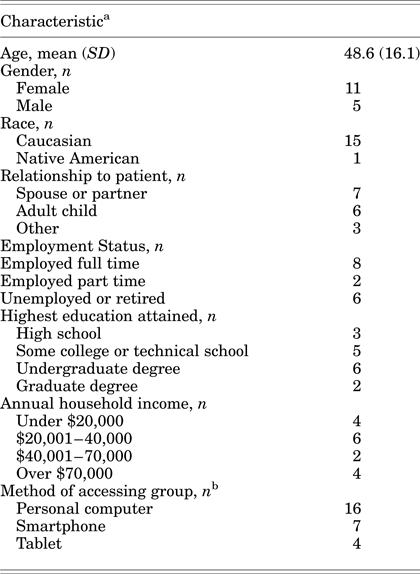
A total of 16 bereaved hospice caregivers participated in the group. Group members were predominantly female (n = 11) and Caucasian (n = 15). Half were employed outside the home on a full-time basis. Nearly equal numbers of bereaved spouses/partners (n = 7) and adult children (n = 6) were included. Other participants had experienced the loss of a mother-in-law (n = 1), a father-in-law (n = 1), and a grandmother (n = 1). The group was relatively diverse with regard to highest level of education achieved by participants and annual household income. While all participants were able to access the group using their personal computers, some also participated via Internet-enabled smartphones (n = 7) and/or tablets (n = 4). A summary of participant characteristics is provided in Table 1.
Participant characteristics

aDemographic information is provided as it was reported upon entry to the group.
bValues exceed total sample size due to some participants accessing the group via multiple methods.
Online Communication
There were 71 posts and 268 comments made by bereaved caregivers in the secret Facebook group. The research coordinator executed 45 posts and 191 comments. Bereaved caregivers affixed 315 “likes” to a post or comment. Posts from bereaved caregivers ranged from 0 to 24, and their comments ranged from 0 to 64, with no comments or posts from three of the caregivers in the study. To help facilitate community, nearly all posts or comments by caregivers were liked by the research team member who facilitated the Facebook group. Coding of online communications revealed that the majority of caregiver comments and posts were restoration oriented (n = 172), followed by loss oriented (n = 84), and the remaining talk was categorized as social small talk (n = 83). Social small talk among bereaved caregivers included shared appreciation for hospice services and staff and small talk about current events, anniversary of deaths, and brief posts welcoming others to the group.
Triggers of Loss-Oriented Stressors
In online communication, bereaved caregivers shared loss orientation experiences by describing two different types of emotional triggers that reminded them of their loss. Abrupt triggers were experienced when remnants of the past intruded into the present, evoking emotional distress (e.g., “certain things trigger the sadness”). Belongings and other “little things”—perfume, music, commercials, handwriting, and the weather—were frequently described as abrupt triggers that stirred up painful memories, causing both emotional and physiological responses. Although aware that such emotional triggers existed within their everyday life, they were unaware of the impact it would have on them (“I literally gasped and could feel my breathing get rapid”). Bereaved caregivers described feeling unprepared and unguarded to protect themselves from the random remnants of their loved one. In one woman's post she explained, “It is the little things that I have a problem with; they tend to sneak up on me.”
The reactions and comments of other individuals were shared during online communication and articulated by bereaved caregivers as abrupt triggers that precipitated emotional distress. Caregivers commiserated that “‘well-intentioned’ but regurgitated quips often have the opposite affect [sic]” on the bereavement process, noting that such sayings are often not heartfelt. One bereaved caregiver described how a lack of acknowledgment of her loss was considered hurtful and disrespectful:
I find it very unsettling when there is not an acknowledgment. Acknowledgment (. . .) validates the value of your loved one with others [and] yourself (. . .) I just want to shout to the world, “He is gone. He was special. I miss him.”
Comments, especially about further illness diagnoses or additional deaths, were also considered abrupt triggers that agitated enduring sentiments regarding their caregiving experience and late loved one.
The abruptness of suddenly being alone was one of the most prolific triggers of loss shared by bereaved caregivers. Silence, uselessness, absence of joy, and loneliness were all used to summarize the void of loss. A primary post by one caregiver posed the question to others thus:
Okay (. . .) Not sure if this is just me or not (. . .) but I tend to do pretty well during the day. But nights? (. . .) Wow (. . .) Not so much. Just seems like I've got more time to think and replay things. The quiet is quieter and the aloneness is a little more “alone.”
Being alone was an abrupt trigger that reflected recognition and reflection of loss. Still, loneliness was also experienced when in the company of others, reminding caregivers of their loss and causing caregivers to feel alone in a crowd. As one caregiver put it,
The feeling of being alone isn't what I have a problem with; it is being without [my] other half (. . .) I had been part of a couple for 30-plus years, and now no matter where or whom I am with, I am alone.
Unlike abrupt triggers that were unforeseen and emotionally distressing, bereaved caregivers also discussed anticipated triggers that reminded them to prepare for feelings of loss. Anticipated triggers included a loved one's well-known artifacts, family activities, estate planning, and holiday/family celebration preparations that evoked specific memories. Bereaved caregivers conversed about how to approach these with great intention and empathized with each other about the difficulty of preparing for these types of expected reminders of loss. Deliberate steps were shared about how best to cope with and respect their deceased loved one. Many caregivers talked about the need to keep things consistent (such as leaving their loved one's things in place), especially in regard to clothing and personal items. Participation in organized support group discussions was also described as an anticipated trigger, yet bereaved caregivers continued to participate knowing ahead of time to prepare.
Preparation was a prevalent coping approach shared among caregivers to handle loss-oriented stressors resulting from anticipated triggers. Bereaved caregivers were aware that certain events would mean confronting loss and engaging in restoration (“The big days I am prepared—knowing I will feel sad and miss the person”). Regarding an upcoming holiday, one caregiver explained, “I'm trying to make some plans with friends so I won't feel quite so alone.” Being aware of the “daily challenge to find purpose and meaning” was shared among caregivers, who felt the “daily push to get out and about” without their loved one.
While coping efforts were intentionally described to navigate anticipated triggers and engage in restoration, caregivers described abrupt triggers as opportunities to embrace loss and deliberately seek out ways to obtain permission to grieve. One caregiver explained, “I keep cycling through mad, sad, acceptance and so forth (. . .) When I realized the tears wouldn't stop, I got out the pictures, cards, and albums and let it go; sometimes you just need to cry.” In a post to the group one caregiver summarized, “‘Moving forward’ is, more times than not, a sideways, aimless stagger (. . .) occasionally falling forward just enough to call it a ‘step.’” Abrupt loss-oriented triggers enabled caregivers to contemplate their loss; as one caregiver stated, “The concept of ‘gone forever’ is just a damned long time and one that my emotional brain doesn't want to accept even though my logical brain knows it to be true.”
Restoration
Bereaved caregivers participating in the secret Facebook group engaged in storytelling, advice giving, and seeking, and encouraged restoration during online communication. Given that bereaved caregivers joined the group at different times over a six-month period, self-introduction posts included details of their caregiving story as part of their primer to the Facebook group. Details included their relationship to the patient, how long the patient had been ill and/or receiving hospice care, the disease, date of death, story of getting to hospice, caregiving tasks, and sacrifices (e.g., “giving up my job”). These introductions concluded with summary statements about restoration efforts. One caregiver ended her introduction post and stated, “Now I can move on, and do for myself. Yes, there is that void, but as each chapter of our lives draws to an end, the next chapter begins.” Throughout their participation in the Facebook group, several caregivers posted turning points in their own bereavement coping process, sharing personal statements of restoration (e.g., “I have to share this”), coping mechanisms such as rearranging living room furniture (“somehow grief is easier”), difficult restorative tasks (“It was hard for me to deal with his clothes hanging in the closet and on the dresser”), and doing things to help ease the pain (“Music has always been my go-to”). These posts and comments showcased restoration in progress and captured relatable experiences among participants.
By sharing similar stories and experiences with each other, bereaved caregivers established a sense of community without knowing each other personally. One caregiver posted, “I have personally found that ‘telling my story’ [to an appropriate audience] (. . .) has really helped me.” Similar experiences created a synergy among participants, who realized that they did not have to meet face to face to find support. Several caregivers posted comments directed to other caregivers (“I've never met you [caregiver's name], but I'm thinking about you today”), expressed concern (“I don't know you, but you have my sympathies”), and acknowledged turning points. “Thank you for your kind thoughts and thank you for this page, which allows me to voice my thoughts and know I am not alone and my feelings are normal,” shared another caregiver.
Bereaved caregivers also offered and sought advice from group members. Online communication between group members included suggestions on ways to celebrate memories of loved ones lost, to make new friends, and to attend the hospice memorial event. All of the suggestions were meant to assist each other with loss-oriented stressors (“When the feelings come up, acknowledge them”) and provide coping suggestions (“just let the people who love you help you through it”). Still, several caregivers used the group as a place to seek advice from similar others (“I need advice, thoughts, something”). One caregiver inquired about the impact of caregiving:
It has been 3-1/2 months since [loved one's name] passed, and I am starting to have minor problems with my health (. . .) It is like the stress of the last two years has slammed into me (. . .) I didn't have any problems when [husband's name] was sick—almost like I wouldn't allow myself to be ill because he needed me. Anyone else having the same problems?
Caregivers used the Facebook group to seek advice on how to engage in restoration.
Supporting and encouraging restoration was also a prominent message throughout the group's online communications. Caregivers talked about the various ways they grieved, sharing whether or not they cried at funerals, and instances where uncontrollable crying occurred. Posts and comments reflected the idea that “everyone grieves differently,” as one caregiver informed another, “Don't let anyone tell you that your [sic] doing it wrong.” Supportive words were offered (“keep smiling and be kind to yourself”) and shared understanding about the difficulty of the process (“the first time (. . .) was kind of hard (. . .) but it won't be as bad next time”). Caregivers shared personal memories, including poems, videos, and artwork. “One day it will bring more happiness than sorrow,” reminded one caregiver.
Reported Outcomes
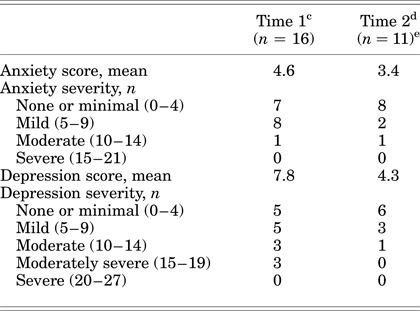
Data related to participants' scores on the anxiety (GAD-7) and depression (PHQ-9) measures are summarized in Table 2. Overall, participants reported low levels of anxiety at both times 1 and 2. The mean GAD-7 score was 4.6 at time 1 and 3.4 at time 2; both these scores correspond to a minimal level of anxiety. Only one person at time 1 and one person at time 2 were determined to be moderately anxious; no participants' reports were consistent with severe anxiety at either timepoint. The mean PHQ-9 score at time 1 (7.8) corresponded to a mild level of depression, while at time 2 the mean PHQ-9 (4.3) fell into the range of minimal severity. Six of the 16 participants reported moderate or higher levels of depression at time 1 compared to only one at time 2.
a GAD-7 = Seven-item Generalized Anxiety Disorder Scale
b PHQ-9 = Nine-item Patient Health Questionnaire Scale
cTime 1 = Date on which participant joined group.
dTime 2 = Date on which participant completed final measures.
en=10 for the PHQ-9 at time 2.
DISCUSSION
This study extends work on the DPM by analyzing the longitudinal bereavement experiences of hospice caregivers, going beyond outcome measures to discern stressors shared among a community of bereaved caregivers (Stroebe & Schut, Reference Stroebe and Schut2010). Bereaved caregivers in this study predominantly engaged in restoration-oriented online communication, suggesting that caregivers were acutely aware of their restoration efforts in the first six months of bereavement. While bereaved individuals may consult supportive others (friends, family) for restorative issues and restorative coping may be individualistic (Carr, Reference Carr2010), our findings suggests that an online asynchronous platform that unites individuals with similar experiences can sustain a supportive environment where face-to-face meetings are not required to establish community.
The majority of interactions within the secret Facebook group came through comments rather than posts, depicting new roles and relationships developed post-bereavement, an area of DPM research that has gone unaccounted (Carr, Reference Carr2010). The large variation between posts and comments indicates that the majority of interaction came from caregivers responding to other caregivers. External support resources and informational and social support that come from outside the caregiver's personal support system of family and friends may be helpful, as caregivers report not wanting to burden family and friends with talk about bereavement (Diamond et al., Reference Diamond, Llewelyn and Relf2012). More research is needed to explore how unknown supportive others (i.e., those not personally known through face-to-face interactions) are beneficial to the bereavement process.
According to the Dual Process Model, oscillation is a process where loss- and restoration-oriented stressors are either confronted or avoided. However, it has been proffered that these two types of stressors are not separate but rather overlap and activate each other (Shear, Reference Shear2010). Our analysis of online communication depicts coping processes triggered by one of these types of stress, with engagement in both loss and restoration as a cognitive process that is intentional. Although the certainty of emotional loss was recognized by bereaved caregivers as they described anticipated triggers, and the uncertainty of abrupt triggers was also described as emotionally distressing, caregivers in this study did not disclose avoidance as a coping strategy. Rather, our study illustrated the fact that bereaved individuals actively and purposely choose coping strategies.
The restricted sample size and exploratory design of this small pilot study limit the conclusions that can be drawn from our available data. Still, the study has findings similar to that of an earlier study of an online hospice community that also had a small sample, a similar number of posts, and a majority of emotional support messages (Buis, Reference Buis2008). Scores for anxiety and depression should be regarded as descriptive only and cannot be attributed to participants' involvement in the secret Facebook group. There is no causality between the intervention and related outcome measures; the outcome assessment merely served as pilot measures for possible use in future controlled studies. The innovative study approach facilitated data collection during active bereavement rather than retrospective accounts. One of the strengths of the study was the length of time involved in the group (all caregivers participated for at least three months, with the majority participating for more than six months). Caregivers were able to use the Facebook group to share events as they unfolded in their life (compared to recalled events captured through retrospective interview). The length of time of study participation allowed us to capture bereavement experiences as they occurred across the bereavement trajectory, which has been noted as a research strength (Bennett et al., Reference Bennett, Gibbons and Mackenzie-Smith2010).
There remains a strong need to establish guidelines for hospice bereavement care and to minimize the resources used to provide bereavement services (Barry et al., Reference Barry, Carlson and Thompson2012). Our study demonstrates the promise of using a secret Facebook group to facilitate comprehensive services for hospice bereavement. Future research should include measuring the benefits of discussing loss- and restoration-oriented stressors and explore the positive impact on health outcomes in addition to changes in negative outcomes.
ACKNOWLEDGMENTS
This project was supported by award number R01NR011472 from the National Institute of Nursing Research. The content is solely the responsibility of the authors and does not necessarily represent the official views of the National Institute of Nursing Research or the National Institutes of Health.