Introduction
Resistance to one or more classes of anthelmintic (AH) drug is a worldwide phenomenon affecting small ruminant farms (Jabbar et al., Reference Jabbar, Iqbal, Kerboeuf, Muhammad, Muhammad and Afaq2006) and cattle holdings (Sutherland & Leathwick, Reference Sutherland and Leathwick2010). The presence of AH-resistant gastro intestinal nematode (GIN) populations on small ruminant farms has gained importance in recent years as it may lead to the failure of parasite control programmes. As a result, several alternative approaches for controlling GIN have been studied with a view to reducing current dependence on conventional AHs on small ruminant farms (Torres-Acosta & Hoste, Reference Torres-Acosta and Hoste2008). Few of these, however, have been validated under field conditions. Meanwhile, farmers remain reliant on synthetic AHs such as the benzimidazoles (BZ). In Mexico, BZ-resistant worms have been reported on many farms located in different geographical locations (Torres-Acosta et al., Reference Torres-Acosta, Mendoza-de-Gives, Aguilar-Caballero and Cuéllar-Ordaz2012). BZ-resistant worm populations do not readily revert to susceptibility even if use of this AH class is suspended for a long period (Sangster & Dobson, Reference Sangster, Dobson and Lee2002). Therefore, if BZs are to be used effectively on these farms once again, other means must be found to ensure a susceptible worm population.
Phenotypic resistance has been reduced experimentally on farms by deliberately introducing susceptible strains of Haemonchus contortus (Van Wyk & Van Schalkwyk, Reference Van Wyk and Van Schalkwyk1990) and Teladorsagia circumcincta (Moussavou-Boussougou et al., Reference Moussavou-Boussougou, Silvestre, Cortet, Sauve and Cabaret2007). Most protocols for achieving this aim require the use of suppressive AH treatments to eliminate established worm populations from livestock, which are then kept indoors until external life-cycle stages disappear from pasture through natural environmental processes. The hosts are subsequently re-infected with BZ-susceptible worms, either artificially (Bird et al., Reference Bird, Shulaw, Pope and Bremer2001) or by grazing a naturally infected pasture (Sissay et al., Reference Sissay, Asefa, Uggla and Waller2006). This process is termed ‘parasite substitution’ (Moussavou-Boussougou et al., Reference Moussavou-Boussougou, Silvestre, Cortet, Sauve and Cabaret2007).
There is as yet no evidence to show that phenotypic susceptibility can be improved without prior elimination of the pre-existing BZ-resistant strain. The present in vivo study used goats harbouring established H. contortus populations with known levels of resistance to evaluate the influence of a single artificial infection with a BZ-susceptible H. contortus isolate on the phenotypic BZ resistance of eggs subsequently passed in faeces.
Material and methods
Haemonchus contortus isolates
Two strains of H. contortus infective larvae were used. These included a BZ-susceptible strain (BZS) and a BZ-resistant strain (BZR). Both were obtained from the Helminthology Laboratory at the National Center for Research in Veterinary Parasitology (CENID-PAVET INIFAP, Mexico). Genotypic characterization of the strains had been determined by the detection of the allele at amino acid 200 mutated from gene β-tubulin isotype 1 (F200Y) as described by Winterrowd et al. (Reference Winterrowd, Pomroy, Sangster, Johnson and Geary2003). In the BZR strain, the rr, Sr and SS genotypes were in the proportion 61.5%, 11.5 % and 27.0%, respectively, with an r allele frequency of 67.3%. Corresponding figures for the BZS strain were 4.0, 52.0 and 44.0%, with an r allele frequency of 28%.
Infection protocols
Eight female goats from 3 to 6 months of age were used in the trial. They were raised free of nematode infection from birth and were kept in individual pens with concrete floors before and during the course of the experiment. They were fed a balanced diet based on Pennisetum purpureum grass and a commercial concentrate feed made with grains and dry hay. Water and minerals were available ad libitum. Individual faecal samples were obtained before the trial on three consecutive days ( − 3, − 2 and − 1) and on the day of the initial artificial infection, to confirm that all goats were free of natural GIN infection.
For the initial artificial infection, each of eight goats received a single oral dose of 2000 H. contortus L3 larvae. Each inoculum was composed of one or both isolates in the following proportions: 100% BZS (one goat), 75% BZS/25% BZR (two goats), 50% BZS/50% BZR (two goats), 25% BZS/75% BZR (two goats) and, finally, 100% BZR (one goat). This first infection protocol was intended to establish a series of H. contortus populations with a gradient of phenotypic expression of BZ resistance from fully susceptible to fully resistant. On day 28 post-infection, faecal samples were obtained directly from the rectum of each goat. Faeces were analysed using a modified McMaster technique (Rodríguez-Vivas & Cob-Galera, Reference Rodríguez-Vivas and Cob-Galera2005) to confirm that each goat had been infected successfully and to quantify its excretion of eggs per gram of faeces (EPG). The phenotypic BZ susceptibility of the H. contortus population that was established in each goat was determined on days 30 and 36 post-infection using the egg-hatch assay (EHA) described below. Results from the two EHAs were used to calculate the 95% effective inhibitory concentration of thiabendazole (EC95) with respective 95% confidence intervals (95% CI) using six repetitions per concentration and a drug-free control.
On day 42 post-infection, EPGs were again determined to confirm the continued presence of the initial infection. On day 49 post-infection each goat received a second artificial infection. In all cases, this comprised a single oral dose of 2000 L3 of the BZS isolate. The aim of this second phase of the trial was to introduce susceptible worms that might establish among or replace existing H. contortus adults. A second set of EHA bioassays was performed 28 days and 34 days after re-infection (day 77 and day 83 of the study) as described previously.
Recovery of Haemonchus contortus eggs
For the recovery of H. contortus eggs, faeces collected from the rectum of each goat were immediately refrigerated in plastic bags with air excluded and kept at 4°C. All samples were processed within 3 h. Nematode eggs were recovered as described by Coles et al. (Reference Coles, Bauer, Borgsteede, Geerts, Klei, Taylor and Waller1992). Briefly, 10 g of faeces were macerated in a mortar with 100 ml of water that had been purified by reverse osmosis. The suspension was filtered using gauze and the filtrate placed in 15-ml Eppendorf tubes. These were centrifuged at 1500 rpm for 5 min and the supernatant removed, leaving approximately 0.5 ml of sediment. A saturated sugar solution of density 1.300 was added to each tube to a total volume of 12 ml. The tubes were shaken in a vortex to re-suspend the solid material before being centrifuged again. Next, the surface layer of the liquid was recovered with a bacteriological loop and added to 8 ml of purified water. Eggs were washed and concentrated by centrifugation twice in a single tube. A final suspension was prepared and 12 aliquots of 20 μl taken for microscopic examination to estimate the number of eggs/ml. The suspension was diluted to attain a concentration of 150–200 eggs/ml for further evaluation in the EHA.
Egg hatch assay
Stock solutions and working solutions of thiabendazole (TBZ) (T8904 Sigma, St. Louis, Missouri, USA) were prepared with dimethyl sulphoxide (DMSO) (D8418 Sigma). The EHA procedure was that described by von Samson-Himmelstjerna et al. (Reference von Samson-Himmelstjerna, Coles, Jackson, Bauer, Borgsteede, Cirak, Demeler, Donnan, Dorny, Epe, Harder, Höglund, Kaminsky, Kerboeuf, Küttler, Papadopoulos, Posedi, Small, Várady, Vercruysse and Wirtherle2009). Multi-well plates with 24 wells were used with 990 μl of purified water pipetted into each well, followed by 10 μl of the appropriate TBZ working solution, i.e. 0.01, 0.025, 0.05, 0.1, 0.2, 0.3 or 0.5 μg TBZ/ml. The series was prepared in triplicate on each plate, with the final three wells receiving DMSO without TBZ as a control. Finally, 1000 μl of the egg suspension was added to each well. The plates were incubated at 28°C for 48 h, after which a single drop of iodine was added to each well to kill and stain hatched larvae and any remaining eggs.
Data analysis
Eggs and first-stage larvae (L1) were counted in each well to determine the hatch rate for each concentration, using results from six repetitions per TBZ concentration for each goat after first and second infection protocols. Only those plates with a hatch-rate in control wells of 70% or more were included in the analysis (von Samson-Himmelstjerna et al., Reference von Samson-Himmelstjerna, Coles, Jackson, Bauer, Borgsteede, Cirak, Demeler, Donnan, Dorny, Epe, Harder, Höglund, Kaminsky, Kerboeuf, Küttler, Papadopoulos, Posedi, Small, Várady, Vercruysse and Wirtherle2009). The larval hatch-rate (LH%) was calculated as: LH% = [(no. of L1)/(no. of eggs +L1)] × 100. Percentage inhibition of larval hatching (LH-I%) was calculated using the following formula: LH-I% = 100–LH%.
The effective concentration required to inhibit 95% of hatching (EC95) with respective 95% CI was determined for each H. contortus population using the PoloPlus 1.0 software (LeOra Software, 2004). The criterion to declare resistance was an EC95 > 0.1 μg TBZ/ml. This level is considered sensitive enough to detect a low proportion of BZ-resistant individuals in the worm population (von Samson-Himmelstjerna et al., Reference von Samson-Himmelstjerna, Coles, Jackson, Bauer, Borgsteede, Cirak, Demeler, Donnan, Dorny, Epe, Harder, Höglund, Kaminsky, Kerboeuf, Küttler, Papadopoulos, Posedi, Small, Várady, Vercruysse and Wirtherle2009). The % reduction of EC95 between the first and second infections was obtained as follows: EC95% reduction = [1–(EC95 second infection/EC95 first infection)] × 100. Significant differences between the first and second infections were determined by comparing the 95% CI.
Results and discussion
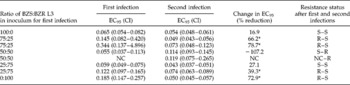
This study investigated the in vivo effect of superimposing a single artificial infection with a BZ-susceptible H. contortus isolate upon established populations with known phenotypic BZ-resistance levels. An egg hatch assay was used to compare the phenotypic susceptibility of eggs excreted by goats before and after re-infection with BZS H. contortus. EC95 values ( ± 95% CI) calculated for H. contortus populations resulting from the first and the second infections are shown in table 1.
Effective concentration of thiabendazole (μg/ml) required to achieve 95% inhibition of larval hatching of Haemonchus contortus eggs (EC95) obtained following a first infection with benzimidazole-susceptible (BZS) and -resistant (BZR) isolates and a second infection with the BZS isolate. CI, 95% confidence interval; *, level of significance P<0.05; NC, not calculated as hatching was <70%; L3, infective third-stage larvae; S, phenotypically susceptible; R, phenotypically resistant.

After the first infection, four H. contortus populations were classified as BZ resistant (EC95>0.1 μg TBZ/ml) with similar EC95 values (P > 0.05) obtained for the one goat infected with 100% BZR, the two goats with 75% BZS/25% BZR and one of the two goats with 25% BZS/75% BZR. Meanwhile, eggs recovered from the faeces of each of three goats with 100% BZS, 50% BZS/50% BZR and 25% BZS/75% BZR, respectively, were classified as phenotypically susceptible to BZ. One worm population formed from an L3 mix of 50% BZS/50% BZR was excluded from this calculation because the percentage hatch recorded from control wells was consistently lower than 70%. It is evident that BZ susceptibility after the first infection did not reflect exactly the proportion of BZS and BZR larvae used in each inoculum. These results suggest a difference in the ability of BZR and BZS infective larvae either to establish within the host, develop directly to the adult stage or to remain arrested in abomasal tissue. Other BZ-susceptible strains of H. contortus have been reported to be more successful than resistant larvae in establishing within their host (Maingi et al., Reference Maingi, Scott and Prichard1990; Königová et al., Reference Königová, Hrčkova, Velebný, Čorba and Várady2008). In the current work, however, phenotypic susceptibility was not evident in the two goats infected with 75% BZS/25% BZR and was observed in only one of the populations formed with 25% BZS/75% BZR. Thus, random establishment may provide a more feasible explanation.
After the second artificial infection, comprised entirely of BZS L3, a change in phenotypic susceptibility of subsequently excreted eggs occurred in all but two of the seven goats for which results could be calculated. The exceptions were the 100% BZS goat and one of the two goats in the 25% BZS/75% BZR group, which both remained susceptible throughout. Of the others, changes in phenotypic expression from resistant to susceptible were indicated by significant percentage reductions in EC95 values (P< 0.05) in four cases, i.e. in both 75% BZS/25% BZR goats, one 25% BZS/75% BZR goat and the 100% BZR goat. The worm population of one goat in the 50% BZS/50% BZR group appeared to change from susceptible to resistant, although this result was not statistically significant. The egg output of the other member of this group, for which no initial EC95 value was available, was classified as resistant in the second stage of the study.
The second evaluation of phenotypic susceptibility to BZ was performed 28 and 34 days after the second infection. This interval was chosen to allow establishment of a new generation of BZ-susceptible adult worms. It was expected that the introduction of susceptible H. contortus into a pre-existing partly resistant population would increase the proportion of reproductive individuals carrying the susceptibility allele, thereby diluting the frequency of the corresponding resistance allele in subsequently produced eggs. This, in turn, could increase the phenotypic susceptibility of eggs passed with faeces from these goats. Indeed, all goats initially harbouring BZ-resistant populations started to shed eggs phenotypically susceptible to BZ after the second infection. Even the worm population formed with 100% BZR showed a significant shift to phenotypic susceptibility (table 1). As expected, the initial susceptibility of the worm population formed with 100% BZS was maintained after a second infection with the same isolate.
There are two main processes that could explain the observed increase in BZ susceptibility of eggs from initially resistant populations. First, the incoming susceptible worms may have replaced the pre-existing phenotypically resistant population (‘substitution’). Second, the superimposed BZS infection could have developed into adults that mated with the established population, increasing the frequency of susceptible alleles (‘cross-breeding’). In this case, the shift towards BZ susceptibility in worm populations originally formed with 75% BZS/25% BZR or 25% BZS/75% BZR could be considered the result of backcrossing, as suggested by previous H. contortus resistance studies performed by Le Jambre et al. (Reference Le Jambre, Royal and Martin1979). Each of these mechanisms could have increased the frequency of SS and Sr genotypes, which are both expressed as susceptibility to therapeutic BZ doses (Silvestre et al., Reference Silvestre, Cabaret and Humbert2001). Molecular analysis of eggs arising from each population could help to unveil the extent to which substitution and cross-breeding are each involved in the restoration of phenotypic BZ susceptibility. Such underlying genetic mechanisms warrant further research, as the present work could lead to new possibilities for controlling BZ-resistant worm populations.
It is interesting to note that, while the second infection was generally successful in reducing BZ-resistance levels, both H. contortus populations in the 50% BZS/50% BZR group were classified as BZ resistant after re-infection. Such an outcome could be related to the relatively high frequency (52%) of heterozygous (Sr) worms in the BZS isolate. Thus, although the BZS strain was phenotypically susceptible, many BZS worms were carriers of BZ-resistant alleles (r). Consequently, mating heterozygous worms from the incoming BZS strain, with homozygous worms in the previously established population could have resulted in a higher proportion of BZR eggs simply by random mating (Le Jambre et al., Reference Le Jambre, Royal and Martin1979). It is possible that this phenomenon could be eliminated or reduced in future studies by using a BZS isolate with a lower proportion of Sr genotypes and a higher proportion of SS genotypes. Future studies could also employ a BZR strain with a larger proportion of the homozygous resistant genotype (rr). In any event, the molecular analysis of the frequency of resistant and susceptible alleles in resulting eggs is essential to complement these results.
The protocol for restoring BZ susceptibility investigated in this paper does not depend on the elimination of pre-existing resistant worm populations, a task difficult to achieve on most farms. It should therefore be easier to implement than previously attempted worm substitution schemes (Van Wyk & Van Schalkwyk, Reference Van Wyk and Van Schalkwyk1990; Bird et al., Reference Bird, Shulaw, Pope and Bremer2001; Sissay et al., Reference Sissay, Asefa, Uggla and Waller2006; Moussavou-Boussougou et al., Reference Moussavou-Boussougou, Silvestre, Cortet, Sauve and Cabaret2007). Further studies are required to explore the potential of this approach for application in practical worm-control strategies.
Acknowledgements
Dr Pedro Mendoza-de-Gives, Dr Maria E. López-Arellano and Dr Enrique Liebano-Hernández (deceased) from CENID-Veterinary Parasitology, INIFAP, Mexico, are acknowledged for providing the H. contortus infective larvae. We also thank Professor D.E. Jacobs for his detailed revision and valuable comments for the present manuscript.
Financial support
J.I.C.-P. is grateful to Consejo Nacional de Ciencia y Tecnología (CONACyT), Mexico, for funding his postgraduate studies.
Conflict of interest
None.
Ethical standards
The authors assert that all procedures contributing to this work comply with the ethical standards of Mexico (compatible with NOM-062-ZOO-1999) and the Institutional guides of the Universidad Autónoma de Yucatán on the care and use of laboratory animals (goats).