“It is a fine thing to feel that we have in the army… modest, efficient, gallant gentlemen… doing such disinterested work for the honor of the flag and of the Nation.”Footnote 1 Theodore Roosevelt awarded some of his highest praise to military officers, for he believed that they were “on the whole about the best citizens we have.”Footnote 2 They embodied a higher sense of duty and sacrifice, virtues that were governing principles in Roosevelt's own life. Service in far-flung lands after the imperial spasm of 1898 tested that dedication at the turn of the twentieth century. Whether they were fighting to secure colonial rule in the Philippines, working to cement American influence in Caribbean lands, or simply representing an expanding national profile abroad, army and navy officers faced fresh challenges in the new century. Roosevelt recognized the importance of their work, but he assigned even greater significance to the activities of military officers that went beyond the imperatives of diplomatic and military affairs. These men had a cultural mission, upon which hinged, Roosevelt believed, not just national security and overseas interests but the success of the American republic in the twentieth century. According to this vision, the best of the officer corps was to inspire other Americans to greater civic purpose and action. Whether they sailed or marched, officers would be exemplars of virtue to an increasingly urban, industrial, and wealthy America at the dawn of the twentieth century, and, thus, they would help save their fellow citizens from the cultural and moral degeneration that, Roosevelt feared, were by-products of rapid industrialization and the myriad social changes it generated. In the bargain, they would also become more effective military leaders.
Were officers ready to stand on such a pedestal? For Roosevelt, the answer was “no,” but a qualified “no.” He judged the navy's ranks to be in better shape than the army's, thanks in part to personnel reforms that he had helped to enact while assistant secretary of the navy in the late 1890s. The army presented a different story. Based on his service as a volunteer cavalry officer in the war with Spain in 1898, Roosevelt found many army officers wanting both professionally and physically. As a result, he made reforming the army officer corps a priority during his presidency. This article, therefore, will focus on Roosevelt's army reform effort because his great interest and involvement exposed the president's motives and actions for scrutiny.
An examination of Theodore Roosevelt's quest to uplift the army officer corps provides the opportunity to explore more than simply an interesting facet of Roosevelt's tenure as commander in chief. In fact, several historical issues may be addressed. First, such a study refines our understanding of Roosevelt as a political tactician. Any permanent changes to the army personnel system had to pass Congress, but that body proved reluctant to revise the existing army officer promotion system. Roosevelt emerges here in his usual role as a compelling and often artful politician, thus fitting perhaps the dominant historiographical treatment of him. Whether in popular works or those more scholarly, Roosevelt's commanding personality stands at center stage. Such explorations have a lineage dating from the time of Roosevelt's death. An often careful politician, however, despite a reputation for rashness, Roosevelt deliberately acted outside the established political precedents in this case, which, at best, provided mixed results on changing the army personnel system and actually proved counterproductive in many ways. Thus, this treatment also fits into the trend of placing Roosevelt within the broad institutional developments of the early twentieth century. Presidential historians have considered the ways in which he was an architect of the modern presidency, whereas others, such as Stephen Skowronek, have discussed how Roosevelt advanced the administrative organs of the modern state.Footnote 3 The overall theme struck from these analyses seems to be of an insightful, forwarding-looking president trying to propel governmental institutions into the light of the twentieth century, despite sometimes spirited resistance from conservative forces that refused to part with the outdated practices of the past. Such an impression draws inspiration, perhaps, from the more popular presentation of Roosevelt as a combative reformer and from the fact that he, indeed, did represent a new generation of leadership. Roosevelt was more complex than that image suggests and combined both old and new in his political vision. Questions remain, for example, as to just what degree was Roosevelt a force for modernization, what were the influences on him as a political actor, and what was the effect on the institutions that he attempted to alter?Footnote 4 This article will address those questions in terms of Roosevelt's attempt to overhaul the army promotion system. The picture that emerges is of a president who embraced ideas both old and new. Roosevelt, in this instance, was so dedicated to change that he would advance his goals even at the cost of disrupting the institutions that he was trying to build, but at the same time he embraced a model for the ideal officer that derived more from a romanticized past than from an informed idea of the requirements of modern officership.
A larger issue regarding army reform during the Progressive Era also demands consideration. The nearly two decades following the Spanish-American War were marked by a series of army reforms, and attempts to implement them. Many of the most important measures, which came in the years immediately after the war with Spain, were associated with Secretary of War Elihu Root. The Root Reforms included changes to the army educational system, a militia reform act, and, most significantly, the creation of an army general staff. Why then after a spate of reform, which included the nearly eight years of Roosevelt's presidency, would the army come up short as a modern force when called upon to mobilize again for war in 1917? Military historian Brian Linn supplies one explanation in the lingering influence of the frontier mindset as the army conducted operations in the Philippines, whereas Paul Koistinen in his study of the political economy of American warfare sees an army bureaucracy in transition but not developed enough yet to handle the rigors of modern war.Footnote 5 This study explores Roosevelt's contribution to those deficiencies, focusing on how, despite his efforts to ensure the army possessed an officer corps fully ready to command in the next conflict, he did not reach that goal. Thus, although the United States would ship a mighty force to Europe, the army experienced difficulties in World War I that echoed those encountered during the war with Spain in 1898.
The theme that connects all of these threads is ideology and a cultural vision. In particular, Roosevelt possessed a well-defined body of belief that amounted to a comprehensive strategic and cultural outlook for the American people and nation. Roosevelt's world view tied together past, present, and future in charting a destiny of expanding greatness for the United States and its people. His ideas linked concepts of manliness, civic virtue, imperial expansion, and social Darwinism into a recipe for preserving republican virtue in the twentieth century and making the next generation worthy of the legacy bequeathed to it by the revolutionaries of 1776 and the pioneers who had conquered the frontier. Military officers played a central role in this vision, for not only would they guard the imperial frontier and keep the nation safe, but they would also serve as exemplars of virtue for the rest of the country. Historians have often pointed to ideology and culture to elucidate Theodore Roosevelt, but Roosevelt's military policies have not been explored in these terms before.Footnote 6 An ideological and cultural perspective helps to explain why Roosevelt wanted to reform the army officer corps and what he hoped to accomplish by doing so. Moreover, it helps to explain why Roosevelt would act with such passion and determination to achieve reform to the point of bypassing an apparently obstructionist system, thereby doing more harm than good to his cause. Overall, then, this case study illustrates that the very ideals that propelled Roosevelt's political career could launch him into counterproductive and politically self-destructive behavior, despite his reputation as a political realist.
The 1890s: Crises and Lessons
Theodore Roosevelt made improvement of the army officer corps a priority because he saw such reform as one response to a crisis facing the United States in the 1890s. Not unlike many others of his background and social standing, he felt that America had arrived at a critical juncture in its history. In Roosevelt's romanticized view, the end of the frontier meant that future generations would not benefit from the hardening experience of life in a primitive environment. Americans, he feared, would become physically and spiritually “soft” and quit the struggle for national greatness in the pursuit of luxuries. “The glorified huckster or glorified pawn broker type,” in Roosevelt's alarmist tones, “would bring this country down to the Chinese level.”Footnote 7 He fretted, in other words, that Americans, lacking moral fiber and direction, could one day be among the dominated of the world. His reading of historian Frederick Jackson Turner's thesis on the importance of the frontier only confirmed these notions.Footnote 8 Economic and labor turmoil in the mid-1890s supplied additional evidence of something wrong with the country. For Roosevelt, of course, the solution for many of these problems lay with expansion outside the continental domain—in a word, imperialism. The assertion of overseas interests and the acquisition of territories promised new markets and fresh resources. For a social Darwinist like Roosevelt, however, the very struggle for such goals was all-important. Struggle built character, and the struggle for empire would preserve the frontier virtues—courage, physical hardihood, and initiative—that Roosevelt deemed essential for continued national greatness. He claimed, for example, that “it is through strife, or the readiness for strife, that a nation must win greatness.”Footnote 9 The army would, by necessity, play a major role in this expansion, just as it had shielded the settlers of the West.
In the age of imperialism, however, military men would have an even more crucial role to play as examples of unselfish national service. The American frontier had become a mass experience, but a similarly large number of Americans would never have firsthand exposure to the new imperial struggles. Instead, the infusion of a higher character from empire building would come indirectly, and Roosevelt believed army officers had an important inspirational role to play as paragons of virtuous public service.
The revolutionary generation's fears, and hopes, about the future of the republic echoed throughout this thinking. Just as the country's founders had done a century earlier, Roosevelt made frequent pronouncements during the 1890s about civic virtues and the proper duties of citizens, or, as he put it, about “the men who did speak in deeds.”Footnote 10 More specifically, his concerns about the distracting and dissipating effects of wealth seemed to be influenced by some revolutionaries' hopes that America would become a “Christian Sparta.” The founders' vision of a land of austere, public-spirited, and heroic people now seemed, in Roosevelt's opinion, on the verge of being forever lost.Footnote 11
Roosevelt's general anxiety over the future was compounded by his belief that another prime national attribute stood endangered, American manliness. Although much of his concern about moral fiber, descending to the “Chinese level,” and frontier qualities addressed civic virtues, it also expressed worries over the condition of American manhood, especially the state of manhood among the elite from which Roosevelt sprang. Roosevelt worried that effeteness was setting in among the pampered rich who, instead of rising to the call of leadership, often surrendered to the temptations of self-interest and self-indulgence. His concern over declining manliness was a much more distinctly nineteenth-century value than his worries about the state of classical virtue, but for proof that the danger to American manliness was real, he needed to look no farther than his younger brother Elliott. By the early 1890s, Elliott had spiraled into a dissipated life of alcoholism and infidelity, and in 1894 he died. Thus for the future president, imperialism represented more than a struggle for national prestige and a way to preserve frontier qualities. It meant to Roosevelt that he, and others of his ilk, were, as Kristin Hoganson has put it, “fighting for American manhood.”Footnote 12
Having worked himself up nearly to the point of intellectual hysteria, Roosevelt welcomed the tensions with Spain over Cuba in the late 1890s. War was just the tonic that the nation needed. It would also allow Roosevelt to test his own mettle in battle and live out the doctrines that he had been preaching. He proclaimed in March 1898 that “a man's usefulness depends upon his living up to his ideals in so far as he can” and “that it would be a good deal more important from the standpoint of the nation as a whole that men like myself should go to war than that we should stay comfortably in offices at home.” This hunger for battle also likely stemmed from his father's failure to bear arms during the Civil War. The elder Roosevelt had acceded to the wishes of his Southern-born wife and hired two substitutes rather than join the Union forces. Thus nearly forty years later, when war arrived in the spring of 1898, the younger Roosevelt immediately volunteered. Failure to do so would open him to charges of being an “armchair and parlor” jingo and would also, in his opinion, amount to a personal failure of the most abject sort.Footnote 13
Roosevelt relished his experience at war in Cuba. An engagement at Las Guásimas, Cuba, and his famous “crowded hour” on the San Juan Heights outside Santiago de Cuba gave him the test of a lifetime, and he found himself the stronger for it. He boasted to Henry Cabot Lodge in July 1898 that he felt “as strong as a bull moose,” even as the tropical climate and disease felled his men.Footnote 14 The war also allowed him to observe regular army officers in action. Many, he felt, had failed the test of combat. The highest-ranking officers exhibited a glaring lack of the virtues that Roosevelt held so dear and, consequently, fell short in terms of military effectiveness. He would spend the next decade, and beyond, attempting to salvage the army's officer corps and stoke the raw and primitive qualities that he believed made the American people so superior.
One can imagine Roosevelt, garbed in his volunteer colonel's uniform, seething with righteous indignation at the appalling physical and mental state of many of the senior officers of the Cuban expedition. In his estimation, these men were barely able to command, much less be paragons of a manly imperial ethic. Advanced age was part of the problem, but Roosevelt also pointed to a much more insidious cause of their degeneration. These men were evidence of a precipitous erosion in frontier virtues, which, for Roosevelt, represented nearly all that was good in the American character. Officers whom “civilized country” had ruined were ineffective during the short time they were needed in Cuba.Footnote 15 In contrast, he claimed that officers who had the benefit of recent Western experience “were accustomed to long marches, privation, risk, and unexpected emergencies”—and he did see many such officers in Cuba.Footnote 16 For example, Roosevelt described the first major of the Rough Riders, Alex Brodie, who was in the regulars, as “dandy” and a “grizzled old frontier soldier.”Footnote 17 Brodie, Roosevelt claimed, “had become a thorough Westerner without sinking the West Pointer—a soldier by taste as well as training.”Footnote 18 As for the incompetents, however, Roosevelt singled out the commander of the Cuban expedition, Major General William R. Shafter, as the leading example of an unfit officer. Shafter had made his reputation fighting on the frontier, but at age sixty-two and obese, he failed to match Roosevelt's ideal and made an easy target. A myriad of supply, medical, and equipment problems confirmed for Roosevelt the complete mishandling of the campaign. He wrote that “not since the campaign of Crassus against the Parthians has there been so criminally incompetent a General as Shafter.”Footnote 19
Most of Shafter's problems actually stemmed from a hastily prepared expedition and thirty years without a major war—much less the trials of an overseas conflict. Also a system of promotion that operated strictly on the basis of seniority represented a difficulty, for by the time officers reached the highest ranks they were near the mandatory retirement age of sixty-four. For Roosevelt, Shafter's physical state alone represented what could happen to even the best of citizens without constant vigilance in keeping up a proper fighting spirit and physical hardihood.
William Shafter (right). From John C. Hemment, Cannon and Camera (New York, 1898)

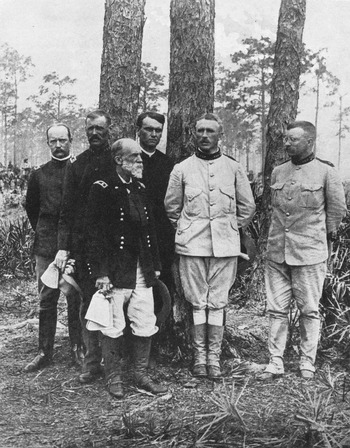
If Roosevelt saw grave problems with the senior officers of the army in Cuba, then he also witnessed the army's salvation there. The performance of junior officers such as John J. Pershing impressed him. Younger, physically vigorous, courageous, and mentally acute, these men mirrored his own personality. He peppered The Rough Riders, his account of the Spanish war, with their names and aimed as president to promote them. Above all others, though, Roosevelt's model officer for the new army of empire was Leonard Wood.Footnote 20 Wood had started his career as an army contract surgeon, but as an officer he showed exceptional drive and physical rigor. He had helped track down Geronimo over rough terrain in the 1880s, for which he won the Medal of Honor, and in peacetime he constantly engaged in physical exercise.Footnote 21 In fact, when Roosevelt was assistant secretary of the navy, the two men had enjoyed “various small athletic exercises, including the solemn kicking of [a] football round an empty lot.”Footnote 22 Beyond the realm of the physical, Roosevelt admired Wood's capacity for action and marveled at how well Wood organized the Rough Riders as their first commander and later became a military governor in Cuba. Roosevelt described Wood as “a man of high ideals” who was “by nature a soldier of the highest type” and who “scorned everything mean and base.”Footnote 23 Altogether, Wood was an officer who “combined… the qualities of entire manliness with entire uprightness and cleanliness of character.”Footnote 24
Front row, from left to right, Joseph Wheeler, Leonard Wood, and Theodore Roosevelt. Courtesy of the National Archives.

Wood served as a volunteer officer in the war with Spain (later he obtained a general's stars in the regular army from William McKinley), and if Roosevelt had lived in his ideal universe he likely would have made volunteers the mainstay of land forces. They were his natural preference. After all, they represented for him one of the best expressions of national spirit, and his own experience in them had proved both self-validating and, ultimately, politically rewarding. The incorporation of a large number of amateur warriors into wartime forces would help preserve the martial spirit and counter the onset of national effeteness. To ensure that a pool of ready volunteers existed, Roosevelt later advocated that every young man should “prepare himself so that in time of need he may speedily become an efficient soldier” and promoted programs designed to preserve “fighting qualities” in the American populace so that if war came, America would again have soldiers of the right stripe to flesh out its forces.Footnote 25 In short, by the time of World War I, Roosevelt was a proponent of universal military training.Footnote 26
Practicality, however, dictated the necessity of a substantial force of regulars, and the reality of imperial commitments demanded larger and more capable forces than traditionally maintained in peacetime. In March 1899, for example, Congress authorized a regular army strength of 65,000, up from 28,000 before the war with Spain.Footnote 27 This increase reflected, in part, the resistance to American rule in the newly acquired Philippines. Changing technology also demanded an increasing reliance on professionals. When he had been assistant secretary of the navy, Roosevelt demonstrated his recognition of the degree to which industrialization was changing military implements. More powerful weaponry, aviation experiments, and greater mechanization meant that military “preparation is much more difficult, and requires a much longer time.”Footnote 28 At the same time, Roosevelt believed that technological change had made the conduct of warfare a much swifter process. “Wars are so much quicker, they last so comparatively short a period, and can be begun so instantaneously that there is much less time than formerly in which to make preparation.”Footnote 29 Because major wars seemed to occur once in a generation and lesser crises during every administration, Roosevelt recommended that Americans always maintain in peacetime “an efficient fighting navy” and that “our small army should always be kept in first-class condition.”Footnote 30 He also stressed the necessity of increased professional training in the “vast and complicated engines with which war is waged.”Footnote 31
As important as the Spanish-American War was to validating Roosevelt's ideas and to his formulating a critique of the army officer corps, his experience in the 1890s also taught him important lessons about the practical operation of governmental machinery. Roosevelt had started his federal service as a civil service commissioner during Benjamin Harrison's administration. He attempted to fit civil service practices to an ideal standard, and his work was so respected that the Democratic administration of Grover Cleveland retained him in 1893. Roosevelt's move to the police commission of New York City in 1895 returned him to familiar turf, and as president of the board he cultivated publicity in the media center of the nation. After two years, he departed to become assistant secretary of the navy before resigning after a year to fight Spaniards. These offices, including his subsequent governorship of New York, were significant for giving Roosevelt a variety of administrative experience, but even more so for showing him what worked and what did not work in governmental bureaucracies. Roosevelt, for example, had signed on to the New York City police commission to clean up that notoriously corrupt force, but he found two other commissioners limited his efforts, as did the very rules by which the commission operated. When blocked in his reform effort, he characteristically judged his nemesis on the police board, Andrew D. Parker, in moral terms, labeling Parker “a liar a dozen times.”Footnote 32 Roosevelt's work in the Navy Department gave him greater satisfaction because of the sense that he was doing important work as trouble brewed with Spain. Also given the more hierarchical structure of the Navy Department, he had greater ability to act even in the secondary position of assistant secretary.
Roosevelt was also in a position to make a direct comparison between the operation of the Navy Department and the War Department after conflict erupted. He rushed to equip the Rough Riders in the spring of 1898, and the War Department bureaucracy did not work fast enough to suit him. On May 21, he railed against incompetence: “The blunders & delays of the Ordnance bureau surpass belief. They express us stuff we do'n't need, and send us the rifles by slow freight! There is no head, no energy, no intelligence in the War Dept.”Footnote 33 Roosevelt did see firsthand, however, that dividends could be reaped by working outside the normal channels of authority. Given his high position in the Navy Department, he was able to gain access to War Department bureau heads that others would have been denied, an advantage helped by the fact that unit commander Leonard Wood was the personal physician of William McKinley. As a result, the Rough Riders were able to equip themselves before other regiments. This use of personal influence ran counter to the good government practices that Roosevelt preached, but he could justify such actions because of his view of himself as an upright man working for a worthy cause. Also more practically, this “end-run” had gained results and brought him his hour of glory in Cuba and national fame.
During his presidency, Roosevelt would revert to such practices when he acted to ensure that army officers met a higher standard of performance than he had witnessed in Cuba. Roosevelt believed he could make the army officer corps both more effective and a truer example of patriotic and manly virtues by pushing professional and physical improvement. Because he felt that the stakes were high—national security and the cultural vigor of the nation were involved after all—Roosevelt would push the limits of his presidential prerogatives when he encountered stiff congressional and military resistance. The fact that he tried to bypass what he considered unreasonable and shortsighted opposition would only roil civil–military relations and undermine, ultimately, his larger goal of reform. Roosevelt would persist because, for him, improving the officer corps was not primarily about changing organizations and promotion systems, but about getting people of the highest moral and physical stripe in the right place. This campaign invoked Roosevelt's self-righteous streak, for he was fighting for something that seemed inherently right and obvious to him, and it also appealed to his vanity because he wanted men of “push and intelligence” in top commands. In other words, he wanted more men like himself in charge—men who, not coincidentally, would form natural allies in pushing a reform agenda.
In Highest Office: Commander in Chief
Almost as soon as he became commander in chief, Roosevelt set about modernizing the equipment and institutions of the military. He involved himself in both large and small matters. One day he might suggest changes to uniforms, and the next he would be weighing in on battleship designs and fleet organization.Footnote 34 However, his goal of improving the quality of the army officer corps was more intangible and, thus, perhaps, more ambitious than his other military projects. He aimed, in essence, to change the soul of an institution by elevating, as he saw it, the character of its individual members. That task would prove difficult to complete. The goal, though, fit into a larger pattern for a chief executive who aimed often at the grandiose. He would set about to realign industrial and labor relations, forge a new federal regulatory role, and even reform the American system of spelling.Footnote 35
Roosevelt sought first to gain congressional support for changing the statutes regarding promotion. In so doing, he respected the constitutional prerogative of Congress for making rules for the military. Thus, from his first annual message to Congress in 1901 to his last in 1908, Roosevelt pushed for a merit-based system of promotion, stressing that “the present system of promotion by seniority results in bringing into the higher grades many men of mediocre capacity who have but a short time to serve.”Footnote 36 The emphasis on seniority led not only to antiquated officers in the top ranks but also prevented the most capable from moving forward during their prime years. Under Roosevelt's plan, those officers who failed to gain promotion after a certain number of years in each rank would be “selected out” and retired. In making his pleas to Congress, Roosevelt resorted at one point to a business analogy, stating that “no business firm could succeed if those responsible for its management were chosen simply on the ground that they were the oldest people in its employment.”Footnote 37
Roosevelt's ideas were not particularly new, and certainly did not originate with his presidency. Rather, his proposals occurred within a continuum of ongoing change, which was the case with so many of his reform efforts. He added, simply, a fresh and emphatic voice. Since the first half of the nineteenth century, military leaders had been concerned with the slow rate of promotion. Officers could not anticipate rapid advance in the small peacetime military establishment of the nineteenth century when they had to wait for vacancies to open in the ranks above them. A study prepared for the secretary of war in the 1830s estimated that a member of the Military Academy graduating class of 1836 would require fifty-eight years to become a colonel. The influx of officers in the 1860s—the so-called “Civil War hump”—ensured a slow rate of promotion in the shrunken postwar army. This frustrating reality inspired the imposition in 1882 of mandatory retirement at age sixty-four and, in 1890, promotion within each branch of the army (artillery, infantry, cavalry, etc.), as compared to within regiments. The latter change broadened somewhat the prospects for promotion, yet strict seniority remained the major criterion for advancement.Footnote 38 After the Spanish-American War, in addition to revising the army's educational system, endorsing a general staff, and other reforms, Secretary of War Elihu Root had encouraged President McKinley to reward younger, promising officers with commissions as generals in the regular forces, an effort about which more will be discussed later. For his part, Roosevelt had been a prime mover behind what became the Naval Personnel Act of 1899 during his year at the Navy Department. The legislation that resulted provided for a selection-out system of retirement for naval officers based on fitness but was limited to the rank of captain. This limited program influenced Roosevelt's thinking as president when he called for a selection-out system that applied to all of the army's ranks.Footnote 39
Neither past changes moved Congress nor did Roosevelt's appeals. Strong currents ran against the proposed reform. Some considerations were philosophical and reflected concern for the welfare of the officer corps, whereas others revealed more political, institutional, and personal interests. Although promotion on the basis of seniority alone was subject to strong criticism, the system did offer some benefits. It helped to shield promotions from political pressures, which could prove poisonous to the integrity of the officer corps. Even under the seniority system, many officers turned to political patrons in an attempt to gain an advantageous assignment or speed a promotion.Footnote 40 Revocation of strict seniority promotion might encourage even more blatant attempts to curry political allies and introduce new jealousies and antagonisms to the officer corps. In addition, the seniority system, although it did not encourage fresh thinkers to advance into high positions, had the effect of maintaining a deep well of experience, which could be equally important for an institution to sustain itself. Finally, some members of Congress felt that a merit system of promotion would prove more harmful than helpful. In their minds, it would be better to continue with the flaws of the relatively objective seniority system than to risk a system where personal preferment could become the reigning principle. Nothing guaranteed that internal military politics would not prejudice the selection process and that officers who were the most astute at currying favor would be promoted, even if they were not the best leaders.Footnote 41
At the same time, narrower interests also fostered resistance to promotion reform. At the center of this opposition were mutually beneficial relationships between members of Congress and the military. Many senators and representatives maintained other priorities related to officer promotion, and Roosevelt's merit-based scheme ran counter to them. Members of the House and Senate military affairs committees, in particular, cultivated strong, often rewarding, ties to army officers, and they did not wish to see those relationships altered. The bond was particularly tight with the officers in the War Department staff bureaus who managed the day-to-day administrative and logistical requirements of the army. Staff officers looked to Capitol Hill to protect their respective bureaus and hence their status and position. In return, bureau officers cast a friendly eye on military projects and facilities in home districts. Roosevelt's proposed promotion policy could conceivably weaken, or even destroy, this relationship. Other congressional objections were less self-serving but just as powerful. The president's scheme to remove older officers threatened one of the most honored generations of American soldiers, the Civil War veterans. Although increasingly old, many veterans of the Civil War still wore the uniform, and Roosevelt was essentially proposing their wholesale and perhaps inglorious retirement. This prospect particularly stung the members of Congress who had spent their youths wearing Union blue or Confederate gray. Indeed, if Roosevelt was worried about quality of character, then he, they felt, was perhaps misguided in wanting to remove officers who had forged their characters at places such as Fredericksburg, Missionary Ridge, or Spotsylvania.
Nothing, perhaps, conveyed this generational conflict better than the animosity between the president and the commanding general of the army, Lieutenant General Nelson Miles. Vain, irascible, and politically ambitious, Miles had earned fame in the Civil War and then had become a fixture of the frontier army before rising to the top rank of the army. He resented the myriad changes that Roosevelt was attempting to bring to the military establishment and regarded the new imperial policies with distaste.Footnote 42 To him, Roosevelt must have seen like an upstart and a poseur, given his comparatively slight experience in the West and his few days of glory in Cuba. Miles sought, therefore, to rally his congressional allies against the president and to embarrass Roosevelt whenever an opportunity presented itself. In 1902, Miles threatened to publicize American army atrocities in the Philippines unless he received the top command in the islands. Miles also accused the president of trying to make the army into a personal organization because of the administration's promotions program. Roosevelt readily confronted the general. He refused Miles's attempt to coerce him into giving him command in the Philippines and reminded the general of his association with the 1890 massacre of Sioux at Wounded Knee, South Dakota. During the West Point centennial celebration in June 1902, Roosevelt snubbed the commanding general by barely acknowledging his presence at the ceremony.Footnote 43 Such evident hostility did not, of course, do much to advance Roosevelt's argument that merit promotions would be divorced from personal feeling and made Congress even more reluctant to move on reform.
In an ironic twist, the congressional refusal to act actually helped to make concerns about preferment a reality. Roosevelt would have welcomed new legislation on promotions, as demonstrated by his repeated calls for reform in his annual messages. In the meantime, he stood ready to use his own powers as commander in chief, which had the added appeal of circumventing the complexity of the lawmaking process. He could nominate certain officers for advancement, and, then, he needed approval only from the Senate, primarily the Senate Committee on Military Affairs, and not from a majority of Congress. Roosevelt's nominations would amount to his own merit system. The president knew that this way of proceeding was a stopgap measure and that legislation was the ultimate goal. His patience, though, was limited when he believed that the stakes were so high. For him, after all, this issue involved more than just the army. It went straight to the nation's ability to pursue imperial involvements and the preservation of vital national qualities. In his first annual message to Congress in 1901, Roosevelt had praised the army as “a great constructive force, a most potent implement for the upbuilding of a peaceful civilization” in Cuba, the Philippines, and Puerto Rico.Footnote 44 He would use, therefore, his considerable powers of appointment and persuasion to elevate officers who would serve as models of the benefits that a merit system of promotion would bring. As a result, he would select men with whom he was personally acquainted because he wanted to have confidence both in their ability to perform and their moral nature.
The fact that a political precedent existed for the president to conduct his own ad-hoc system of merit promotions made the bypassing of the legislative process much more tempting. Existing law mandated seniority as the basis of promotion for the ranks below that of general. Roosevelt could, however, nominate whomever he wanted for brigadier general. Although he claimed that he would have preferred to advance men in their turn, the idea of jumping officers over tens or even hundreds of their seniors appealed to his sense of drama. Furthermore his predecessor, William McKinley, guided by Secretary of War Root, had already started the process of promoting officers out of their regular turn in the aftermath of the war with Spain. James Franklin Bell, Arthur MacArthur, Leonard Wood, and Frederick Funston had all been generals in the volunteers before gaining stars in the regular army. They would leap sometimes over hundreds of others in the regular ranks. Bell, for example, jumped over the heads of 981 seniors, for, although he was a general in the volunteers at the time, he held a commission in the regulars as a cavalry captain.Footnote 45 As a result, examples of dramatic elevations existed, and Roosevelt would seize on them and make them his own practice. He would be helped by the able Root, a longtime family friend, who would remain after McKinley's death to guide the new president in selecting promising officers.
Root, in fact, ensured continuity with the McKinley promotions and guided Roosevelt's hand in identifying officers for advancement. Although Roosevelt's actions would have more flair to them than McKinley's and be framed as promoting a much greater good—a reflection of the new president's political style—careful calculation and consultation occurred every time that an officer's name was considered. Roosevelt would ask Root for the names of candidates, and Root would provide not just recommendations about the men to promote but also the best time and method in which to present the nominations. He would sometimes act as a restraint on the president. For example, Roosevelt wanted to promote Captain John J. Pershing to brigadier general in 1903 as a reward for his pacification work in the Philippines. Root, however, thought the time was not right for such a leap in rank. The administration was already involved in other political fights, had made dramatic promotions previously, and had expended a considerable amount of political good will on recently passed general staff legislation.Footnote 46 Roosevelt saw the wisdom of Root's advice and agreed to defer on Pershing until the political environment was more favorable. All in all, then, Secretary Root's role was to smooth, not alter, the trajectory of the president's promotion practices.
When his presidency had started, Roosevelt had been eager to move on promotion reform. His first rapid elevation of an officer occurred within two months of taking office. In acting so fast, he wanted not only to extend McKinley's work but also to make a point shortly before he delivered his first annual message to Congress in December 1901. He would make an appeal in that message to overhaul the promotion system, and the elevation of an officer beforehand would highlight the beneficial effects on the high ranks. Roosevelt was also asserting early in his presidency a pattern of trying to get what he wanted through the use of a fait accompli, whether the issue was the promotion of an officer, a canal zone in Panama, or the conservation of natural resources.Footnote 47 Thus in November 1901, scarcely two months in office and eager to convert ideas into action, he nominated Captain William Crozier as chief of the bureau of ordnance at the War Department. The fact that he wanted a new man in charge of the bureau upon which he had heaped such scorn in 1898 was striking. Crozier was forty-seven years old and had distinguished himself in several ways, which qualified him both for this post and made him a man of action in Roosevelt's mind. He designed heavy artillery, was a coastal defense expert, had served as a delegate to The Hague Conference of 1899, and had been a field officer in China and the Philippines.Footnote 48 Crozier had also urged Roosevelt to lobby for a merit system of promotion in 1899. In short, the two men were kindred spirits. The new ordnance chief represented the innovative, intelligent, and inspiring younger officers that Roosevelt wanted at the head of the army.
The obvious advantages of having more dynamic individuals in leadership positions would, Roosevelt apparently hoped, ease the passage of promotion reform legislation. He likely knew that such actions would provoke protests in the short term, but he embraced controversy as a means of galvanizing support for an issue. When Roosevelt thought he was on a crusade for a cause linked directly to the economic, political, diplomatic, and moral health of the nation, controversy was a price to be paid and indeed relished.Footnote 49 Crozier's nomination did provoke an outcry against promotion of a captain to brigadier general. The Senate Military Affairs Committee delayed action for three months, but Crozier's qualifications spoke for themselves. Also a desire to work with the new president likely helped, along with the fact that the respected Elihu Root remained at the War Department. For his part, Crozier would serve at his new post until 1918.Footnote 50
The next promotions indicated Roosevelt's desire to balance attention-getting appointments with measured changes in order to gain like-minded men in the War Department and still advance toward his larger goal of personnel reform. The year after he had elevated Crozier to the head of the Ordnance Department, Roosevelt decided to push up two more officers as part of his program of improvement. In 1902, he offered the names of Tasker Bliss and William Harding Carter for general's stars in the regulars. Although the president pushed these two officers out of turn, both of whom were under fifty years of age, he had apparently decided against stoking further the fires of controversy, at least at this time. Crozier's promotion had attracted notice, but Roosevelt's overall goal remained wholesale promotion reform, and he did not wish to arouse insurmountable resistance against it. Bliss and Carter boasted records that would ease approval of their new commissions and continue the precedent of promotion by selection, albeit presidential style. Bliss was collector of customs during the occupation of Cuba, and his work had helped put the new republic on a sound fiscal basis. He held a permanent rank as major in the Commissary Department, but as collector he was a brigadier general in the volunteers. Thus Bliss officially jumped 271 other officers upon promotion, but his advancement seemed a rather natural thing. Carter was also a respected figure, and his promotion raised even fewer eyebrows. Carter was a protégé of the respected Adjutant General Henry Corbin and had impressed others with his ideas for army reform. Moreover, he had recently become a colonel, so even though he was moving up faster than others, he would bypass only eighty-nine officers. Carter later would become one of the architects of the Army General Staff.Footnote 51
The president spelled out particularly the qualities that he looked for in his new generals in his elevation of Colonel Thomas H. Barry in 1903. At forty-seven, Barry was relatively young, and he had amassed a good military and administrative record.Footnote 52 He had been assigned to the frontier as a second lieutenant and later served in the Philippines and in the China relief expedition of 1900. One periodical described him as “firm, opinionated, gruff, inexorable” and also “one of the quickest minds in the service.”Footnote 53 Roosevelt wrote to Barry in July 1903 to tell him why he had been picked. “From my association with you I believe you have the energy, the intelligence, the courage, and the power of immediate decision in any crisis, no less than the willingness to take responsibility, which are vital to welldoing.”Footnote 54 This letter told Barry not only that Roosevelt thought highly of him but that he also possessed the personal attributes that the president valued. In Roosevelt's mind, a person with the experience and qualities of Barry could just as easily have been one of the eighteenth-century heroes conquering the American West about whom Roosevelt had written in The Winning of the West.Footnote 55
The deliberations over Barry's appointment, indeed, highlight the romanticized nature of Roosevelt's thinking in making his appointments. In 1903, he had been considering the elevation of John J. Pershing rather than promoting Barry, until Secretary Root convinced him that the attempt to jump Pershing over so many seniors would not be well received at the time. Before deciding on Barry, Roosevelt commented to former Secretary of War Daniel Scott Lamont on Pershing's “striking bit of service in the Philippines” and “how desirable it is to make officers on active service in the remote regions of the earth feel that if they do an exceptionally hazardous and important duty well, they may expect an exceptional reward.” Roosevelt's stress on the dangerous nature of Pershing's service in “the remote regions of the earth” was telling about his criteria for judging an officer's performance and character. Also indicative of this mindset was a mention to Lamont of his wish to promote yet another officer, Colonel Albert Mills, “who was shot beside me at Santiago.”Footnote 56
Roosevelt's writing about Mills, Pershing, and Barry reinforces the notion that the president tended to promote men of whom he had personal knowledge. From his perspective, absent a new merit system of promotion, he needed to select individuals in whom he had great personal confidence to ensure their success. Also, because he was interested equally in experience and character, Roosevelt could not identify individuals who met his standards solely from personnel records. Indeed, he most frequently drew upon his former branch of service, the cavalry, when advancing officers.Footnote 57 “The American cavalryman,” he claimed, “trained to manoeuvre and fight with equal facility on foot and on horseback, is the best type of soldier for general purposes now to be found in the world.”Footnote 58 Mills, Barry, and Pershing all had experience in the cavalry. One result of this feeling was that Roosevelt's promotions smacked of personal favoritism, which, in turn, weakened the chances for congressional action on promotion reform.
Barry's promotion and Roosevelt's musings about Pershing and Mills also suggests why the army was still transitioning from a frontier force to a more modern organization when the United States intervened in World War I. The officers that Roosevelt chose for promotion were younger, but they remained products of the frontier army. Moreover, their experiences in the Philippines only tightened the grip of the frontier ethos, as historian Brian Linn has illustrated.Footnote 59 That frontier experience was directly applicable to pacification of the Philippines, but it was not necessarily transferrable to war with a great power. Even if the pool of candidates had contained rising military managers, Roosevelt's personal inclinations still resided with “frontier virtues,” which doubtlessly would have governed his selections.
By the midpoint of his presidency, Roosevelt modified his campaign for improving the army officer corps. He still wanted younger men such as Barry in top commands; however, he had surrendered nearly all hope of getting promotion reform legislation. He was conscious of his self-imposed restriction against seeking another term in 1908, and he also confronted rising resistance to his leadership from conservative Republicans. He still went through the motions of requesting promotion reform in his annual messages, but by this time he wished mainly to award general's stars to at least one more soldier. Roosevelt now approached the problem of securing new generals almost entirely as an exercise in practical politics and seemed ready to discard idealistic notions about a merit system. He would, in fact, not only ignore the charges of favoritism but unabashedly embrace a favorite officer to win another dramatic promotion. Captain Pershing's turn to advance had arrived.
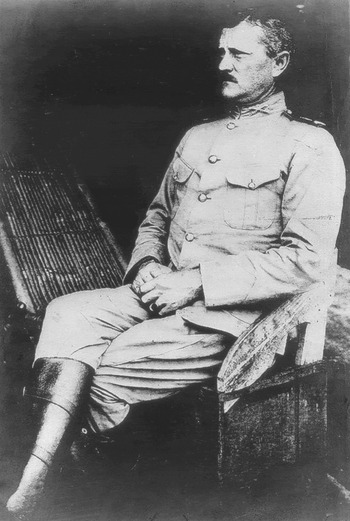
Roosevelt knew that Pershing's promotion would generate resistance.Footnote 60 When he had first considered the move in 1903, he explained that he would have to jump Pershing “much higher than any one else has been jumped.”Footnote 61 A promotion in 1906 would still rocket Pershing past many of his comrades. In fact, if the promotion were successful, the advance from captain to brigadier general would leap Pershing over the heads of 862 others.Footnote 62 Admittedly, Roosevelt might yet have hoped that the resulting controversy would prod Congress into putting merit promotions on a systematic basis, but, more likely, he just wanted to promote Pershing and had found a way to do so. He knew Pershing and could make a strong case for the promotion. Pershing had proved to be an intelligent and energetic officer, with a good field record in Cuba and the Philippines. These qualities, combined with his age of forty-six, made him just the sort of man that Roosevelt wanted to elevate. Pershing had most recently gained praise for an effective pacification campaign in the Philippines when he attacked the strongholds of the rebellious Moro people and secured their allegiance without a bloodbath.Footnote 63
John J. Pershing. Courtesy of the Library of Congress.

Pershing possessed more than just a good service record. He had friends in high places, beginning with the commander in chief himself. Roosevelt more than just knew of Pershing's exploits. He had witnessed the man in action in 1898 when Pershing participated in the charge of the Tenth Cavalry up San Juan Hill. Pershing's unit lost the most officers that day.Footnote 64 After the war with Spain, Roosevelt's old ally on the New York City Police Board, Avery Andrews, who had also been Pershing's West Point classmate, kept the captain's name before the president. Roosevelt thought so highly of Pershing that he attended his wedding in 1905.Footnote 65 That wedding turned out to be crucial to Pershing's promotion prospects. The captain had married the daughter of Senator Francis Warren of Wyoming, who in 1906 became the head of the Senate Military Affairs Committee. Roosevelt counted on that familial tie to get Senate approval, and although this act of blatant favoritism sparked protest, it worked in securing general's stars for Pershing. Roosevelt would claim years later that he had forgotten about the marriage by the time he nominated Pershing, writing, “To promote a man because he marries a Senator's daughter would be an infamy; and to refuse him promotion for the same reason would be an equal infamy.”Footnote 66 This claim seemed doubtful with only one year intervening between the marriage and the promotion, especially for a man with the intellectual gifts of Theodore Roosevelt. Although he was certainly convinced of the merits of promoting Pershing, and no evidence exists of a direct political arrangement with Senator Warren, Roosevelt would likely have contemplated that Pershing's relationship to the senator would help confound congressional opponents.
The loudest protests to the promotion, as a consequence, rose not from Congress, but from within the army. For Roosevelt, this development had to be somewhat unexpected. To this point, resistance to his promotions had been centered in Congress, but Pershing's elevation provoked great resentment within military ranks. If nothing else, seniority promotions offered to officers a more objective, and predictable, standard of advancement. Roosevelt's promotions, in the minds of many officers, represented undue political interference in a sensitive area regarding not only rank, but also prestige. One officer complained that the president lifted Pershing for no good reason and that such promotions were arbitrary and discouraging. Another informed Pershing that “the principle is bad… d_ _n bad,” but he did not fault Pershing for accepting the promotion when offered.Footnote 67 Left unsaid in these complaints was the implication that other men who had good records were overlooked and that personal politicking and favoritism must explain why a few men received stars while many others remained in lesser ranks. Pershing's promotion, along with those that preceded it, had the effect of roiling civil-military relations. Roosevelt had failed to move Congress and managed instead to sow dissent, along with the belief that he had usurped professional autonomy in a vital area.
Although Roosevelt's effort to bypass political and institutional barriers had produced some results, the promotions campaign, overall, caused disruption and resistance to more sweeping reform. If the president had still harbored some hope that Pershing's nomination might create just enough controversy to trigger movement on reform, then that hope was now completely dashed. The promotion of Pershing, in fact, marked the climax of Roosevelt's effort. After Pershing's promotion, the president made no more controversial nominations. He did get Major James B. Aleshire and Lieutenant Colonel W.W. Wotherspoon moved up out of turn in 1907, but these nominations did not provoke the same passions that Pershing's promotion had the previous year. Aleshire, who became quartermaster general, had been an assistant in the quartermaster's office and worked closely with his predecessor for years. He was also considered “one of the best judges of horses in the army,” an important skill in the army of that day.Footnote 68 Wotherspoon had been serving in a prominent post in Washington. He was acting head of the Army War College, and his promotion followed a recommendation to have brigadier generals in charge of the most important army schools.Footnote 69
In total, Roosevelt succeeded in winning eight promotions in which he elevated officers in an extraordinary fashion. There were other men whom he promoted out of turn, but these eight were the officers who mattered the most.Footnote 70 For Roosevelt, they served twin purposes. They represented allies in the campaign for military modernization and, more profoundly, were the type of officer best able to lead the army in the twentieth century. None were more than fifty years old at the time of promotion, so all had a number of years to serve. They were often distinguished for their intellect, as well as their military and administrative abilities. Having grown up in the frontier army, they embodied the work ethic and values that Roosevelt believed had built the country and would ensure its continued greatness. However, rather than serving as an inspiration for further change, specifically the enactment of a system of merit promotions for all ranks, they became lightning rods for opposition. Members of Congress, many of whom had served in the Civil War themselves, were reluctant to slight comrades who still wore the uniform by allowing a new generation to pass them and thus deny the older men the honor of gaining a generalcy, even if it was merely an honorific.Footnote 71 The political power of Civil War veterans' organizations such as the Grand Army of the Republic also remained an important consideration for vote-conscious politicians. Moreover, fears of a full-blown merit system, at least as demonstrated by the operation of Roosevelt's promotion policy, contained some legitimacy. The president's promotions suggested to many that a new system would increase outside political interference in the army and could cause division, rancor, and diminished morale within the officer corps. Partiality, especially in the case of John J. Pershing, had indeed slipped into Roosevelt's promotions.
What remains unknowable is whether promotion reform legislation would have stood a greater chance if Roosevelt had not courted controversy in such a direct fashion. His actions resembled somewhat the tactics of the muckrakers that he condemned in other areas of public life.Footnote 72 He used the promotions to call attention to the problem of overage and unfit senior officers, and, at the same time, offer a solution, all in a manner that would attract popular notice. He hit the issue hard because he had witnessed personally the problems of the Cuban expedition, and he had equated the age and physical dilapidation of some of the senior commanders with intellectual incompetence and moral degradation. The contempt that he had heaped on Major General Shafter in 1898 carried over into his fight for more vital commanders during his presidency. Roosevelt believed that he was unusually qualified because of his military experience and moral compass to get the right officers in the top commands. He expressed as much in 1904 when he wrote to Leonard Wood, “The public naturally cannot know who the best officer is, and all the mutton heads in the army… naturally object to anything resembling promotion by merit.”Footnote 73 Such comments suggested a self-righteous unwillingness to compromise.
For their part, members of Congress likely felt as if enough had been done to alleviate problems in the officer corps without sacrificing the principle of seniority promotions. They had acceded to Roosevelt's wishes to reward selected officers, and more importantly, had worked to clear the way for younger men to advance within the existing promotion system by encouraging the retirement of older officers. An amendment to the Army Appropriations Act of 1904 had permitted the president to promote Civil War veterans one rank upon mandatory retirement at age sixty-four, upon voluntary retirement at age sixty-two, or upon voluntary retirement after forty years of service.Footnote 74 The measure also applied to officers already retired and to former volunteer generals of the Civil War or the Spanish-American War. Overage officers left in droves as a result, with 134 retiring from the active list by 1906. The law affected 115 active and retired colonels and thus lessened pressure to reward long-serving men with general's stars.Footnote 75 This legislation, along with a declining sense of urgency as memories of the Spanish-American War receded, combined to neutralize Roosevelt's calls for more action on officer promotions.
As a consequence, the army retained a promotion system that did not move men forward fast enough. That fact was apparent at the outset of American entry into World War I, when many of the generals whom Roosevelt had installed remained in high command, but at this point, a number were not up to the test of conflict. To be fair, a similar winnowing of officers had occurred in European forces earlier in the war, which suggested the difficulty of the task that Roosevelt had taken upon himself.Footnote 76 He had attempted to alter personnel practices and an institutional culture that apparently transcended the American experience. Among the Roosevelt appointments, John J. Pershing and Tasker Bliss distinguished themselves. William Crozier, however, was eased out of the Ordnance Department, and James Aleshire of the Quartermaster's Bureau demonstrated unfamiliarity in congressional hearings with the economic requirements of a modern military mobilization.Footnote 77 Granted, even if Roosevelt had succeeded in placing more of his type of officer in top commands or in winning wholesale merit promotions, the result may not have been much different. The culture of the army in the early years of the twentieth century remained that of a frontier constabulary. After all, most officers had their first military experience in the American West late in the nineteenth century, and that experience was readily applicable to the Philippines, where it helped ensure the success of the American pacification campaign. Moreover, the army remained a small institution despite its expanded imperial mission. It numbered about 98,000 in 1914, and thus the rapid mobilization of 1917 and 1918 was bound to lead to stress.Footnote 78 The demands of such a conflict were needed, indeed, to impress a modern cast on the army. Still, the mobilization might have gone more smoothly if fresher blood had been regularly moved into the top ranks in advance of the conflict.
Living the Strenuous Life
The regular army generals and colonels of 1917 also demonstrated another way in which the effort to remake the officer corps fell short of the mark that Roosevelt had set. The men at the top of the army in 1917 were either in their late fifties or in their sixties, and many were in poor physical condition. Historian Edward Coffman records that when division commanders visited France in 1917–1918 on observation tours, John Pershing, by then the commander of the American Expeditionary Forces, was unhappy with what he saw. He had more than half of these officers relieved, including some who had been former heads of the Army General Staff.Footnote 79 One of Roosevelt's primary goals for the officer corps, aside from moving talented younger men forward, had been to impart a regime of physical fitness. The dilapidated condition of many senior officers when America entered the Great War indicated that he had lost that battle as well.
Roosevelt's inability to create inspiring physical specimens at the highest levels was in some ways a greater disappointment than his ineffectiveness in changing the promotion system. A physical fitness program did not require congressional approval and could be instituted upon the orders of the commander in chief. Thus, it was a much more personal project for the president. The idea of strenuous living also went straight to the core of Roosevelt's own behavior and the qualities he wanted to see other Americans embrace. Roosevelt belonged to the school of thought, so typical of an era in which the Young Men's Christian Association proliferated, that physical fitness not only made people more effective in life, but was also essential for moral living. He reflected in his Autobiography that “out of [experience] grew my philosophy… of bodily vigor as a method of getting that vigor of soul without which the vigor of the body counts for nothing.”Footnote 80 His ultimate goal in pushing promotion reform, after all, had always stretched beyond the overhaul of administrative procedures. That effort, in fact, was essentially a means to a larger end. In typical Progressive Era fashion, Roosevelt wanted to reform people's behavior, even their character. Character, in his opinion, was where good officership started, and the discipline and physical benefits that came from pursuing regular exercise were key elements in hardy souls.
In Roosevelt's opinion, the need for physical vitality among army officers was unquestionable. In 1898, in a typical burst of self-righteous outrage, he had privately castigated the overage and unfit senior officers of the Cuban expedition to the point that if they had heard his blasts they might, indeed, have believed themselves to be morally defective. He equated expedition commander William Shafter's physical unwieldiness with mismanagement, and he found the commander of the cavalry division, General Joseph Wheeler, to be “an old dear,” but still felt that Wheeler was “very little more fit than Shafter to command.”Footnote 81 Later during his presidency, Roosevelt learned that “a cavalry colonel proved unable to keep his horse at a smart trot for even half a mile; a Major-General proved afraid even to let his horse canter.”Footnote 82 If officers of the twentieth-century military were to carry out any missions, at home or abroad, much less be model citizens, then they had to be exemplars of physical fitness. Roosevelt determined that he would force officers to meet a certain standard of physical exercise. Those men who could not, or would not, undertake more physical activity would presumably rush to retirement—in effect, a selection-out system that could be instituted exclusively by executive order.
In December 1907, Roosevelt ordered an annual physical fitness test for army officers. They were to travel thirty miles a day for three successive days under conditions of a forced march, which meant that they could ride some of the time but at others they needed to lead their mounts at a run. The tests were unpopular. Officers resented the arbitrary nature of the exams, which made no allowances for age, terrain, or climate. Soldiers stationed in the tropics faced the same requirements despite oppressive heat. A chorus of naval complaints, however, soon drowned out the voices of army resentment when the president imposed a similar standard on naval officers the following year. They had to walk a total of fifty miles over three successive days. Naval officers, who were used to sailing the seas and not marching in the dust, resented the indignity of the test.Footnote 83
Roosevelt dismissed complaints about the fitness test. “There has been a good deal of talk in Congress and in the papers and among the grumblers in the army and navy about my physical exercise order, which as a matter of fact was very moderate.” In the president's view, such discontent, especially from military officers, displayed a character defect. Officers reluctant to take the test betrayed sloth and a lack of the rugged, manly virtues that Roosevelt espoused. The press criticism of the standards also stung. To deflect opposition, Roosevelt decided on a spectacular gesture. He would take the army test ride himself, but in one day, not three! Such a stunt would surely attract journalists' attention and refute arguments that the president's tests were unreasonable. Taking the army test was a natural choice for Roosevelt, who was a practiced horseman, as it allowed for a more commanding presence than the walking required for the navy test. On January 13, 1909, a party of four departed the White House for Warrenton, Virginia. Roosevelt took time for some politicking at mid-day in Warrenton, and then the party turned back to Washington. They were hit by a predicted blizzard on the return but, despite sleet and a whipping gale, completed the 104-mile round trip after nightfall. Displaying his usual exuberance, Roosevelt claimed that he felt better than when he had departed that morning and boasted “that if we had not met this sleet storm, it would have been like taking candy from a child.”Footnote 84
Unfortunately for Roosevelt and his effort to reshape American officers, he could not get his commanders to take the particular candy that he was offering. His paragons of physical and moral virtue resisted the president's brand of strenuous living. The physical test lasted longer in the army than in the navy. By 1911, the navy test was reduced in length and later abandoned altogether. Roosevelt's standard for army officers remained until the spring of 1917 when the demands of World War I compelled its abandonment. At no time did the army or navy display the spirit Roosevelt intended to accompany the physical test. A new dedication to physical exercise failed to emerge. Rather, many officers viewed the requirement merely as an obstacle to get by so that they did not have to worry about it for another twelve months. The test also did not trigger an exodus of the unfit from either service. The Army and Navy Journal reported in June 1909 that the physical test had not yet caused a single officer to retire from the navy, and five years later the Journal estimated that the test eliminated only one to two officers each year. Preliminary medical examinations caught more, but such examinations could continue without the physical test.Footnote 85
World War I was hardly a replay of the war with Spain. The American army that confronted Germany during the Great War bore scant resemblance to the force that took on Spain in 1898. It was a massive force, numbering nearly four million men, and the vast bulk were draftees. This army reflected the industrial and popular mobilization required for the first total war of the twentieth century, whereas the Spanish-American War, with its rush of volunteers to the colors, recalled an earlier era of warfare.Footnote 86 By this standard, the American performance was tremendous. One year after the declaration of war, the United States had moved from an authorized force of 235,000 to an army deploying, at least, 245,945 soldiers per month across the expanse of the Atlantic Ocean.Footnote 87 This accomplishment was a proud testament to the energy with which the American population mobilized.
The army of World War I, however, had not yet conquered all of the problems of 1898. Rapid mobilization brought pressures that again embarrassed the War Department, as shortfalls and confusion occurred despite the reforms that followed the war with Spain.Footnote 88 Moreover, as General Pershing could testify, the officer corps remained peppered with men who were overage and physically unfit.Footnote 89 If the Wilson administration had granted Theodore Roosevelt's appeals for a command in 1917, the old Rough Rider, now showing the ravages of time and disease himself, would likely have railed once again at the poor physical condition of the senior American military leadership. Such difficulties were going to occur in any rapid mobilization, but the fact that there were some marked similarities to the 1898 experience suggested that Roosevelt had been unable during his presidency to alter something much larger than personnel practices and bureaucratic architecture.
Roosevelt had struggled to do two things that stood at odds. He had tried to employ a set of traditional values—his frontier virtues—to build a more modern military organization capable of carrying out the new imperial mission. He saw himself engaged in a struggle of the most profound sort, and as a result he pushed so hard that he helped to undermine his case for reform and brought on frustration instead. Merit promotion and physical vigor were what he talked of, but, for Roosevelt, beneath that surface, American values and cultural vitality were at stake. He believed that such attributes as honor, physical hardiness, independence, and a larger civic mindedness had allowed the United States to endure its first 125 years and must be imprinted on subsequent generations for the nation to prosper in the decades to come. As a prominent instrument of the new American empire, the army provided a means for him to imbed the ideals of an earlier age into the modern republic. To achieve this goal, he needed to alter deeply rooted practices, as well as the institutions and people invested in them.
Roosevelt did not understand that the prospects for such reform were not particularly propitious at this time. He was working as commander in chief in an environment in which civil–military institutions had absorbed a good deal of change in a short period of time and were not prepared to take much further reform. Roosevelt did not seem to comprehend that reality. The president believed, apparently, that productive change was most likely to occur under his watch, which meant he faced a fixed deadline—his departure from office—to accomplish all that he wanted. The army, though, had endured many alterations since the war with Spain: new imperial missions, principally the pacification of the Philippines; the Root reforms; increasing mechanization; and the retirement of many from the Civil War generation. Such periods of adjustment typically bring strains to civil–military relations, and Roosevelt was pushing one step too far. Sentiment for further change did not exist on Capitol Hill or in the military, which might have assisted Roosevelt's efforts. Confronting institutional interests can be hard in any era, but in a time of evolving missions and in the wake of the Root reforms no consensus emerged to revise personnel policies, other than offering incentives to retire.
Although a man of considerable political talent, Theodore Roosevelt was not particularly well suited to lead a fight to revamp institutions and their culture. True, he had been involved with civil service reform since the 1880s, and he had helped to reform naval personnel practices while assistant secretary of the Navy in the 1890s, but he was not completely at home in an age of organizations and associations. Roosevelt had opposing forces tugging at him that he never reconciled. He was a modernizer who understood the need for new institutions and practices, but his ideas also carried the sensibility of a nineteenth-century moralist. As in the case of army personnel, he had little tolerance for precedents or prerogatives when he believed that they were based on self-interest at the expense of the national well-being. For him, government was principally a vehicle to allow good people to do good things. More than changing organizational architecture and processes, he felt that if right-minded, energetic people could be put in charge, they would be able to compensate for institutional shortcomings. He did contribute to the rise of modern government, but his primary inclination was not to reform agencies but to improve the people who staffed them. In other words, Roosevelt sought to advance not so much the administrative state, but the qualitative state. He wanted, indeed, forms of government that were more efficient and effective, which often included an extension of executive powers. He did so not because it rationalized operations but because it allowed moral attributes to emerge. Thus even as he looked forward to continued American greatness in the twentieth century, he was looking backward to the moral lessons of his youth in the 1860s and 1870s to ensure the nation achieved the right destiny. Although he straddled two centuries, in the end he stood more in the nineteenth century than in the twentieth.
Not surprisingly, therefore, Roosevelt's promotion reform did little to modernize the U.S. Army. Even if he had succeeded in installing a merit system of advancement, he still might not have accomplished much change to the officer corps, because the tenor of his goals remained so rooted in the mid-nineteenth century. Also, his method of spurring legislators to act proved counterproductive and helped account for why the pool of senior officers in 1917 was not conspicuously better than the group that had led the army in the war with Spain.Footnote 90 The tactic of jumping selected officers over the heads of others achieved some results—most notably putting John J. Pershing on the path that led to his command of the American Expeditionary Forces—but smacked so much of favoritism as to cement distaste in Congress and in the military for the proposed merit system. Passage of legislation that promised to move men forward more quickly seemed remote at best, and Roosevelt's actions actually helped ensure that no change would occur.
Were Roosevelt's efforts, then, a complete failure? The record suggests a mixed judgment. He undermined the larger goal of changing the promotion system, but his efforts did result in leavening the upper ranks with new commanders. His inability to change the overall method of advancement meant, however, that one day many of these men would become like the “fossils” that he had disparaged in the 1890s. For example, William Crozier, the beneficiary of Roosevelt's first dramatic promotion in 1901, betrayed an inability to deal with the demands of great power war in 1918. According to Paul Koistinen, Crozier possessed, at best, “some narrow awareness of modern military problems.”Footnote 91 To a certain degree, such woodenness was bound to set in without the exigencies of war to hasten the weeding out of the less capable. Still, some of Roosevelt's appointments, most notably Tasker Bliss and John Pershing, would rise to international prominence during World War I. Also, Roosevelt's instincts on physical conditioning were correct, for a link existed between effective leadership and physical training. One day a culture of physical fitness would take hold in the military. Again, though, Roosevelt's methods failed to encourage the development of such a culture. His physical test standards were rigid, as they did not make any allowances for age, climate, or other variables. Moreover, he had imposed the test in an arbitrary fashion, and he treated individuals who questioned it as morally defective. Roosevelt, in fact, achieved the best results on personnel matters when he worked in a collaborative fashion. The retirement policy that he commenced received the blessing of the Senate, which wanted the program expanded as scores of officers had taken advantage of the incentive to move up a rank upon leaving active service.Footnote 92
Theodore Roosevelt, for his part, measured himself in much grander terms, and, for him, the preservation of the martial spirit in modern America provided the standard of success. No objective measure exists to judge the impact of his efforts to make army officers into agents of national inspiration. The small peacetime size of the army and the growing awareness during his presidency of the costs of imperialism, at least for ventures outside the western hemisphere, meant that the effect of putting military officers on any sort of cultural pedestal was bound to be minimal. Roosevelt, though, was buoyed by other evidence. He took heart at the pre-1917 Preparedness movement and told men training at Plattsburgh, New York, in 1915 that they had “added to [their] value as citizens.”Footnote 93 Roosevelt was equally delighted with the men who rushed to enlist after the United States declared war in 1917 and was proud to see his four sons go off to war.Footnote 94 He was especially thrilled when his boys went into battle, and he hoped that they too would now have their crowded hours. In August 1917, he wrote to his oldest son, Theodore Junior, “I am overjoyed that you four have your chance, whatever the cost.”Footnote 95 He did learn, however, that war imposed the highest of fees when the youngest, Quentin, perished in combat in 1918. Roosevelt revealed an anguished spirit and doubts about his treasured martial values when he wrote: “To feel that one has inspired a boy to conduct that has resulted in his death, has a pretty serious side for a father.”Footnote 96 Still, he maintained a brave face to the nation, lest he betray the values by which he had lived and had tried to impart on a new generation of leaders.
By the time of his death in early 1919, Roosevelt was an anachronism. His notions of warfare seemed, at best, quaint given the killing fields of the Great War. Whether Roosevelt's priorities were evolving by the end of that conflict would remain unknown because his death followed so quickly after the armistice. If he had lived long enough to see new conflicts, one wonders if his older notions of warfare and military virtue would have held steady. The transition from Victorian-era concepts to the harsh logic of the mid-twentieth century can be seen in a man who was a protégé of Elihu Root and an admirer of Theodore Roosevelt. Henry Stimson would be secretary of war in two eras. He would be secretary of war for the final two years of the Taft administration, and he would serve again as part of the coalition cabinet that Franklin Roosevelt assembled when war threatened in 1940. Stimson would move from following in the progressive footsteps of the first Roosevelt to the unrelenting total war of the second Roosevelt. In his first stint as secretary of war, Stimson would extend Roosevelt's physical fitness test for army officers and continue to advocate promotion by selection. During World War II, Stimson attempted to marry his Victorian notions of morality to the demands of global war, an effort that Sean L. Malloy has assessed in his study of Stimson. This follower of Roosevelt and Root helped to organize a vast military machine and became one of the authors of the use of the atomic bomb against Japan, and, as Malloy notes, confronted an irreconcilable tension between his values and the engines of destruction over which he presided.Footnote 97 Theodore Roosevelt did not live long enough to face the same dilemma. Still, even at the time of his death, the notions of war and officership that he so treasured belonged to a different age.