


1. INTRODUCTION
The interaction of electron beam with plasma plays a key role in various fields of physics and the theoretical study of the linear regime of beam-plasma instabilities has loomed large within most plasma physics textbooks. When an electron beam passes through a plasma, it quickly induces a return current. This current which fully neutralizes the beam current is carried by the plasma electrons. The resulting system undergoes various instabilities, multi-stream, two-stream, filamenation, and Weibel, that can disrupt beam propagation (Weibel, Reference Weibel1959; Fried, Reference Fried1959; Davidson et al., Reference Davidson, Hui and Kapetanakos1975; Bret, Reference Bret2009; Michno & Schlickeiser, Reference Michno and Schlickeiser2010). The two-stream parallel unstable mode is found when the wave vector becomes aligned with the direction of beam propagation, while for the filamentation and Weibel modes the wave vector aligned perpendicular with the streams. In rather high density relativistic beams, filamentation modes grow fastest. On the other hand, for Maxwellian electron beam-plasma system in the non-relativistic regime, two-stream modes grow faster than any other unstable mode. These two instabilities are beam based which means they need a beam to exist. Two-stream instabilities are traditionally known to be important for the electron heating in intense laser-plasma interaction experiments (Thode & Sudan, Reference Thode and Sudan1973) as well as in astrophysical relativistic shocks (Nakar et al., Reference Nakar, Bret and Milosavljevic2011), and could be important for pulsar glitches (Andersson et al., Reference Andersson, Comer and Prix2003; Samuelsson et al., Reference Samuelsson, Lopez-Monsalvo, Andersson and Comer2010), where super fluid neutrons and super conducting protons co-exist with relativistic electrons (Andersson et al., Reference Andersson, Comer and Prix2004).
On the other hand, the topic of quantum plasmas has received considerable attention in the recent advances. The main reason for this is that the quantum plasma has wide ranging applications in solid state physics, nano-scale objects such as nano-wires, quantum dots (Shpatakovskaya, Reference Shpatakovskaya2006; Wei et al., Reference Wei and Wang2007; Ang et al., Reference Ang, Koh, Lau and Kwan2006), ultrasmall electronic devices in microelectronics (Markowich et al., Reference Markowich, Ringhofer and Schmeiser1990), dense astrophysical plasmas (Chabrier et al., Reference Chabrier, Douchin and Potekhin2002; Opher et al., Reference Opher, Silva, Dauger, Decyk and Dawson2001; Jung, Reference Jung2001), laser fusion plasmas(Glenzer et al., Reference Glenzer, Landen, Neumayer, Lee, Widmann, Polainae, Wallce, Gregori, Holl, Bornath, Thiele, Schwarz, Kraeft and Redmer2007), and in next-generation high intensity light sources (Marklund & Shukla, Reference Marklund and Shukla2007; Mourou et al., Reference Mourou, Tajima and Bulanov2006). It is well known that the quantum plasmas are characterized by their low temperatures and high densities in sharp contrast to the high temperatures and low densities of the classical plasmas (Shukla, Reference Shukla2006; Shukla et al., Reference Shukla, Steno and Bingham2006; Haas et al., Reference Haas, Garcia, Goedert and Manfredi2003a). The quantum fluid equations have been further used to describe the properties of the instabilities associated with the three-stream quantum plasmas (Haas et al., Reference Haas, Manfredi and Goedert2003b), the quantum dusty plasmas (Ali & Shukla, Reference Ali and Shukla2007), the electron-positron-ion quantum plasmas (Mushtaq & Khan, Reference Mushtaq and Khan2008), and the magnetized quantum multi-stream (Ren et al., Reference Ren, Wu, Cao and Chu2008). The hydrodynamic formalism has also been used to investigate the quantum filamentation instability in field configurations with and without axial guide magnetic field (Bret, Reference Bret2008; Reference Bret2007; Hasanbeigi et al., Reference Hasanbeigi, Saberi and Mehdian2012; Reference Hasanbeigi, Moghani, Azimi and Mehdian2014; Mehdian et al., Reference Mehdian, Hajisharifi and Hasanbeigi2013a; Reference Mehdian, Hasanbeigi and Hajisharifi2013b).
Although, many researcher have asseassed the electron beam plasma instability, to the author's knowledge the effects of the transverse helical magnetic field on the quantum two-stream instability have not been considered yet. The main purpose of this paper is to show how the quantum two-stream instability can be affected by external helical wiggler magnetic field. Due to importance of wiggler magnetic field, especially in free electron lasers and accelerators, we devote the present research to the evaluation of quantum effects on the two-stream instability in the presence of helical wiggler. The wiggler is used to induce a perpendicular wave motion in the electron beams. Here the direction of the wiggler magnetic field is perpendicular to the beam propagation direction. A cold fluid model for a cold electron beam passing through a cold quantum magnetized plasma, accounting for a wiggler magnetic field and a return electronic current. The plasma is assumed to be cold so that before the passage of the electron beam, the plasma electrons are at rest and the magnetic field does not affect them. Collisions as well as thermal motion of the beam and plasma electrons are also neglected. The layout of this paper is organized as follows. A description of the physical model and the equilibrium configuration are presented in Section 2. The system of equations that govern the motion of a non-relativistic electron beam through a background plasma and external magnetic field are also derived in this section. The full three-dimensional dispersion relation of two-stream instability is obtained in Section 3. Finally, Section 4 is devoted to the numerical results and discussion.
2. EQUILIBRIUM CONFIGURATION OF SYSTEM AND FIRST EQUATIONS
The equilibrium configuration illustrated in Figure 1 corresponds to a cold non-relativistic electron beam of density n b0 and velocity v b propagating through background magnetized plasma in a configuration which consists of a helical wiggler,  ${\bf B}_w = B_w \lpar \hat e_x \cos k_w z + \hat e_y \sin k_w z\rpar $, and a uniform axial solenoidal field, B 0e z. Here B w and k w are the magnitude of the helical magnetic field and wave number, respectively. When the beam enters the magnetized plasma, it is deflected by Bw. The solutions of the electron orbits for this configuration can be obtained as
 $${\bf v}_{0b} = \displaystyle{{v_b \Omega _w } \over {\Omega _0 - k_w v_b }}\lpar \cos\lpar k_w z\rpar {\bf e}_x + \sin\lpar k_w z\rpar {\bf e}_y \rpar + v_b {\bf e}_z \comma \;$$
where Ω0,w≡ q B 0,w/mc, and the symbol q and m are used to denote the magnitude of electron charge and electron rest mass, respectively. The beam density and current are assumed to be sufficiently low, so that the effects of equilibrium self-electric and self-magnetic fields can be neglected (Davidson, Reference Davidson2001). On the other hand, a sufficiently dense plasma can also neutralize the injected current. Due to the changing magnetic flux of a propagating bunch, return current is induced in the plasma. Therefore, the current carried by the injected beam electrons is neutralized by a return current in the plasma. The plasma electrons have the density and drift velocity n p0 and vp0, respectively, so that n b0vb0 = −n p0vp0. The ions form a motionless neutralizing background represented by a positive charge density n i = (n p0+ n b0)/Z, where n p0, v p0, and Z are plasma electron density, plasma electron velocity and ion charge, respectively. The above imposed relations imply that the plasma system is both charge and current neutralized.
(Color online) Schematic diagram of a beam plasma system to be adopted in the present paper.

3. DISPERSION EQUATION
To study the propagation of wave in this system, the Maxwell equations will be used along with the the cold electron momentum transfer equation,
 $$\displaystyle{{\partial {\bf v}_j } \over {\partial t}} = - \displaystyle{q \over m}\lpar {\bf E} + \displaystyle{{{\bf v}_j \times {\bf B}} \over c}\rpar + \displaystyle{{\hbar ^2 } \over {2m^2 }}\nabla \lpar \displaystyle{{\nabla ^2 \sqrt {n_j } } \over {\sqrt {n_j } }}\rpar \comma \;$$
and equation of continuity,
 $$\displaystyle{{\partial n_j } \over {\partial t}} + \nabla .\lpar n_j {\bf v}_j \rpar = 0\comma \;$$
where the index j for the beam and plasma component is b and p, respectively. Quantum corrections are clearly contained within the so-called Bohm potential by means of the  $\hbar^2$ term in the above equation, which can be obtained from the momentums of the non-relativistic Wigner function. In order to develop a first order perturbation theory, the electron number density n j, the electron velocity v j, the electric field E, and the magnetic field B will be expressed in the form
 $$\eqalign {& \quad n = n_{\,j0} + n_{\,j1} \comma \; \cr & \quad {\bf v}_j = {\bf v}_{\,j0} + {\bf v}_{\,j1}\comma \; \cr & \quad {\bf E} = {\bf E}_1 \comma \; \cr & \quad {\bf B} = {\bf B}_0 + {\bf B}_1 \comma \; }$$
where the unperturbed magnetic field  ${\bf B}_0 = B_0 \mathop {\hat e}\nolimits_z + {\bf B}_w $ consists of the transverse helical wiggler and the axial field of magnitude B 0. We express the axial and time dependence of all perturbed parameters by application of Floquet's theorem (Sadegzadeh et al., Reference Sadegzadeh, Hasanbeigi, Mehdian and Alimohamadi2012; Hwang et al., Reference Hwang, Mehdian, Willett and Aktas2002; Jha & Kumar, Reference Jha and Kumar1998) for periodic systems in the general form
 $F = \sum\nolimits_{n = - \infty }^{ + \infty } \, f_n e^{i\lpar k_n z - {\rm \omega} t\rpar } $ , where k n and ω are the wave numbers and frequency of wave and k n = k + nk w. As a consequence, the linearized continuity and momentum transverse equations yeild
 $$\eqalign{v_{\,jxn} =& - \displaystyle{{ei} \over {m\Omega _{\,jn} }}\lpar - \displaystyle{{B_w \lpar v_{zn + 1} - v_{zn - 1} \rpar } \over {2ci}} + \displaystyle{{B_0 v_{\,jyn} } \over c} \cr& + E_{xn} \lpar 1 - \displaystyle{{{\rm \beta} _0 ck_n } \over {\rm \omega} }\rpar \rpar \comma \;}$$
 $$\eqalign{v_{\,jyn} =& - \displaystyle{{ei} \over {m\Omega _{\,jn} }}\lpar - \displaystyle{{B_0 v_{\,jxn} } \over c} + \displaystyle{{B_w \lpar v_{zn - 1} + v_{zn + 1} \rpar } \over {2c} }\cr&+ E_{yn} \lpar 1 - \displaystyle{{{\rm \beta} _0 ck_n } \over {\rm \omega} }\rpar \rpar \comma \;}$$
 $$\eqalign{v_{\,jzn} & = - \displaystyle{{ei} \over {m\Omega _{\,jn} }}\lsqb \displaystyle{{B_w \lpar v_{xn + 1} - v_{xn - 1} \rpar } \over {2ci}} - \displaystyle{{B_w \lpar v_{yn - 1} + v_{yn + 1} \rpar } \over {2c}} \cr & \quad + \displaystyle{{S_j \lpar k_{n + 1} E_{yn + 1} - k_{n - 1} E_{yn - 1} \rpar } \over {2i{\rm \omega} }} \cr & \quad + \displaystyle{{S_j \lpar k_{n - 1} E_{xn - 1} + k_{n + 1} E_{xn + 1} \rpar } \over {2{\rm \omega} }}\rsqb + \displaystyle{{\hbar ^2 n_{\,jn} k_n^3 } \over {4m^2 n_{0j} \Omega _{\,jn} }}\comma \; }$$
 $$n_{1j} = \displaystyle{{n_{0j} k_n } \over {{\rm \omega} - v_{\,jz0} k_n }}v_{\,jzn}$$
where
 $$S_j = \displaystyle{{v_{\,jz0} \Omega _w } \over {\Omega _0 - k_w v_{\,jz0} }}\comma \; \Omega _{\,jn} = {\rm \omega} - v_{\,jz0} k_n \comma \;$$
and B1 has been eliminated in momentum transverse equations by use of B1= c/ωk × E1. Making use of Eqs. (5)–(8), the linearized current density, ∑j(n 1jvj0 + n j0vj1), component amplitudes are given by
 $$\eqalign{& \quad J_{xn} = - e\lsqb n_{{\rm j}0} v_{\,jxn} + \displaystyle{1 \over 2}n_0 S_j \left({\displaystyle{{k_{n - 1} v_{\,jzn - 1} } \over {\Omega _{\,jn - 1} }} + \displaystyle{{k_{n + 1} v_{\,jzn + 1} } \over {\Omega _{\,jn + 1} }}} \right)\rsqb \comma \; \cr & \quad J_{yn} = - e\lsqb \displaystyle{{n_0 S_j \left({{\textstyle{{k_{n + 1} v_{\,jzn + 1} } \over {\Omega _{\,jn + 1} }}} - {\textstyle{{k_{n - 1} v_{\,jzn - 1} } \over {\Omega _{\,jn - 1} }}}} \right)} \over {2i}} + n_{{\rm j}0} v_{\,jny} \rsqb \comma \; \cr & \quad J_{zn} = - ev_{\,jzn} n_{{\rm j}0} \left({\displaystyle{{v_{0jz} k_n } \over {\Omega _{\,jn} }} + 1} \right).}$$
Substituting Eqs. (5)–(10) into the wave equation, ∇ × (∇ × E1) + c −2∂2E1/∂t 2 + 4πc −2∂J1/∂t = 0, then gives a dispersion equation with the form  $det \mathop{\bf D}\limits^{\leftrightarrow} = 0$ with
 $$\mathop{\bf D}\limits^{\leftrightarrow}= \left({\matrix{ {D_{11} } & {D_{12} } & 0 \cr {D_{12}^ \ast } & {D_{22} } & 0 \cr 0 & 0 & {D_{33} } \cr } } \right)\comma \;$$
where the superscript * refers to the complex conjugate and the elements of the dispersion tensor  $\mathop{\bf D}\limits^{\leftrightarrow}$ are complicated functions of the system parameters. The dispersion equation is a polynomial in x and can be simplified to the form
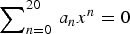 $\sum\nolimits_{n = 0}^{20} \, a_n x^n = 0$, where the coefficients a n are very complicated, x = ω/ωp and
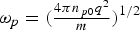 ${\rm \omega} _p = \lpar {\textstyle{{4{\rm \pi} n_{\,p0} q^2 } \over m}}\rpar ^{1/2} $. It should be noted that in the limit of zero magnetic field, Ω0,w → 0, the dispersion equation is the same as the one found by Hass et al. (Reference Haas, Manfredi and Feix2000; Reference Hass, Bret and Shukla2009). The dispersion properties of cold quantum magnetized plasma in the presence of the transverse wiggler magnetic field can be described by analyzing the 20° polynomial in ω. Owning to complicated nature of the dispersion relation, we will only treat it numerically.
4. NUMERICAL RESULTS AND DISCUSSIONS
A numerical study has been made to illustrate two-stream instability of quantum magnetized plasma with transverse wiggler magnetic field. Results of numerical solutions of the 20° polynomial dispersion equation for the complex normalized wave frequency, x, are described below. Classical and quantum limit correspond to the case 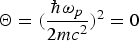 $\Theta = \lpar {\hbar {\rm \omega} _p \over 2mc^2 }\rpar ^2 = 0$ and Θ = 9 × 10⁻⁶, respectively. First the results of quantum and classical treatments will be compared numerically, including the effects of wiggler on the dispersion relation. The normalized growth rate Im(x) as a function of the normalized wave number
 $K = {k_n v_b \over {\rm \omega} _p}$ is shown in Figure 2 for (a) quantum magnetized plasma, (b) classical magnetized plasma, and (c) classical plasma. Here Ωw ,α = n b0 /n p0,k w ,Ω, and β = v b /c were taken to be 3.51 × 10¹¹ Hz, 0.1, 2π/3 cm −1, 3.51 × 10¹¹ Hz, and 0.1, respectively. It is easy to see that the increasing the wave number of classical plasma, Θ = Ω = 0, results in a higher wave growth rate until it reaches a saturation value. The behavior of magnetized plasma is completely different compared to the non-magnetized plasma case. This is evident in the figure since, for example, the growth rate increases with increasing K, achieves a maximum value at K = K max and then decreases to zero with K for its values within a higher range, K > K max. It is also seen from this figure that there is no saturation for classical magnetized plasma and its growth rate is grater than that of for quantum magnetized plasma. The basic differences between the growth rate of a quantum and a classical magnetized plasma are illustrated in Figure 3. The dashed and solid curves in this figure correspond to the classical and quantum magnetized plasma, respectively. For quantum magnetized plasma, two peaks are observed. The larger peak is occurring in long wave lengths whereas the smaller peak corresponding to short wave lengths. The smaller peak is not seen in the classical regimes (Bret & Hass, Reference Bret and Hass2010). Figure 4 shows the variation of the growth rate with K in a quantum plasma in the presence of the wiggler magnetic field. When Ωw, α, Θ, and β are assumed to be constant, Figure 4 shows the effect of axial magnetic field on the growth rate of quantum plasma. It is obvious from this figure that the growth rate and the instability bandwidth are increased due to a decrease in the axial magnetic field.
(Color online) Plot of normalized growth rate in term of normalized wavenumber K n for (a) quantum magnetized plasma, (b) classical magnetized plasma, and (c) classical non-magnetized plasma. The parameters are α = 0.1, β = 0.1, Ω = Ω w = 3.51 × 10¹¹ Hz, Θ = 9 × 10⁻⁶.

(Color online) Graph of normalized growth rate versus normalized wavenumber K n for quantum limit (the solid curve) and classical limit (the dash curve). The parameters are: α = 0.15, β = 0.15,. The other parameters are the same as in Figure 2.

(Color online) Graph of normalized growth rate as a function of normalized wavenumber for quantum plasma with and without axial magnetic field. Parameters are the same as in Figure 2.

To further understand the effects of wiggler on properties of the growth rate, we compare in Figure 5 the growth rate of instability in the presence of wiggler for different values of wiggler frequency. Shown in Figure 5 are plots of the growth rate versus K for three cases corresponding to Ωw = 8.7 × 10¹¹ Hz (curve 1), 7.02 × 10¹¹ Hz (curve 2), and Ωw = 0.8 × 10¹¹ (curve 3). It is evident from the Figure 5 that the growth rate is improved substantially by the presence of the wiggler magnetic field and the instability bandwidth becomes wider. The growth rate of instability can be affected significantly by the ratio of electron beam density to the plasma density, α. This is illustrated in Figure 6 where the normalized maximum growth rate of quantum plasma, Im(x), is plotted versus the density ration α. Each curve corresponds to a fixed value of α. Note from the figure that the increased density ration, α, will increase the growth rate of instability and cut-off wave number. Therefore, the bandwidth of the instability is quite broad at large values of α.
(Color online) Effect of external periodic magnetic field on the growth rate of magnetized plasma for (a) quantum limit, (b) classical limit and (c) classical non-magnetized plasma. The curves 1, 2, and 3 correspond to the case where Ωw = 8.7 × 101 1 Hz, 7.02 × 101 1 Hz, and 0.8 × 101 1 Hz. The parameters are α = 0.5, β = 0.5. The other parameters are the same as in Figure 2.

(Color online) Plots of growth rate of quantum magnetized plasma versus K n for for β = 0.1, Ω = Ωw = 3.51 × 10¹¹ Hz, Θ = 9 × 10⁻⁶ and several values of α.



