I. INTRODUCTION
Since the discovery of shape memory effect (SME) in 1982, Reference Sato, Soma and Mori1 Fe–Mn–Si-based shape memory alloys (SMAs) have attracted considerable attention due to their advantages including low cost, good mechanical properties, excellent weldability, and wide transformation hysteresis. However, some of their structural applications have been limited by the low shape recovery ratio and poor wear resistance. To solve this problem, it is necessary to carry out some special treatments.
It is usually suggested that the mechanism of SME in Fe–Mn–Si-based SMAs is related to the transformation of γ (fcc) →ε (hcp) induced by external stress and the subsequent reversion of ε (hcp) →γ (fcc) occurring in heating process. Reference Sato and Mori2,Reference Inagaki3 Thus, the recoverable ε martensite induced by stress is essential to the good SME of Fe–Mn–Si-based SMAs. Factors that affect the formation of recoverable ε martensite will further influence the SME of Fe–Mn–Si-based SMAs. It is acknowledged that thermal mechanical treatment, involving the so-called training (several cycles of deformation and heat treatment), ausforming Reference Liu, Kajiwara, Kikuchi, Shinya, Wang and Liu4 and prestrain, Reference Kırındıa, Sarı and Dikici5 contributes to the improvement of SME. In addition, niobium carbide (NbC), Reference Baruj, Kikuchi, Kajiwara and Shinya6–Reference Liu, Wen, Li and Yang8 VN, Reference Farjami, Hiraga and Kubo9,Reference Kubo, Nakamura, Farjami and Maruyama10 vanadium carbide (VC), Reference Dong, Klotz and Leinenbach11 and Cr23C6 Reference Wen, Xiong, Li and Zhang12,Reference Peng, Wen, Ye and Li13 precipitates obtained during aging process are favorable to improve SME by strengthening the matrix and acting as nucleation sites for recoverable ε martensite.
On the other hand, the stress-induced γ (fcc) →ε (hcp) transformation during wear process can absorb some friction energy to reduce plastic transformation, preventing the formation and development of crackle theoretically. The ε (hcp) martensite has higher hardness and lower adhesion coefficient than the γ (fcc) austenite. Therefore, the Fe–Mn–Si-based SMAs are expected to be more resistant to wear. Wen et al. Reference Bu, Peng, Wen and Li14 and Lin et al. Reference Lin, Wang, Wu, Wang and Zhang15 studied the effect of aging with and without predeformation on wear resistance of Fe–Mn–Si-based SMAs, respectively. The results showed that aging with predeformation improved the wear resistance more efficiently than aging without predeformation, and the ε martensite induced in friction process also promoted the wear resistance.
In view of the facts above, Fe–Mn–Si-based SMA with precipitation of second-phase particles after aging treatment is expected to improve the SME and wear resistance simultaneously. In this study, aging treatment was carried out on a Fe–20Mn–5Si–10Cr–5Ni–0.7V–0.2N (mass%) alloy. The phase composition and microstructure, especially the type, size, and distribution of VN precipitates, with different aging time were investigated. Properties of SME and wear resistance of the aged samples were systematically studied, which is aimed at understanding the effects of aging on SME and wear resistance of this alloy.
II. EXPERIMENTAL DETAILS
The alloy of Fe–20Mn–5Si–10Cr–5Ni–0.7V–0.2N (mass%) was prepared by vacuum induction melting under an argon atmosphere. After homogenization at 1473 K for 5 h, the ingot was hot-forged at 1373 K into a plate with a thickness of 20 mm, and then underwent solution treatment at 1398 K for 5 h. From the as-solution plate, strips were cut with the size of 50 mm × 3 mm × 0.7 mm for SME tests, and square bulks were cut as 7 mm × 7 mm × 3.5 mm for wear measurements. The samples were aged at 1073 K for 0, 4, 8, 16, and 24 h, respectively, followed by quenching in water.
The shape recovery was characterized by bending tests. All samples were bent to a certain angle corresponding to a maximum strain of 4%. Recovery was induced by heating to a certain temperature and subsequent cooling to room temperature. The shape recovery ratio was determined by measuring the returning angle of the samples after heating. Wear tests were carried out on a general wear test machine with pin-on-disc conduct sliding friction at 200 r/min. The friction coupled pairs consisted of a test sample and a friction ring of GCr15 steel. The average hardness of these rings was 63HRC. The samples underwent sliding friction for 30 min under dry condition and for 150 min under oil-lubricant condition, respectively. After friction, the samples were cleaned and weighed again to obtain the wear mass loss. All the results of shape recovery ratio and mass loss were the average results of three samples for each aging time.
The martensite phase transformation start temperature, M s, of samples was measured in a physical properties measurement system Quantum Design, PPMS-9 by using the four-point probe method. X-ray diffraction (XRD, Rigaku D/max 2500 Cu Kα, Rigaku Corporation, Tianjin City, China) was used for phase identification. The hardness of samples aged for different time was carried out on a Vickers Microhardness Tester. The microstructure was observed using optical microscope, scanning electron microscope (SEM), and transmission electron microscope (TEM), respectively. To prepare foils for TEM observation, the samples were ground mechanically and then polished in a mixed solution of sulfuric acid and methanol (20%) at −20 °C using a twin jet polisher.
III. RESULTS
A. Effects of aging on SME
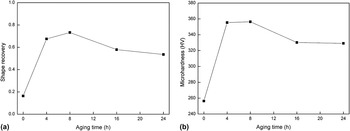
Figure 1(a) shows the shape recovery ratio of the samples aged for different times. It can be seen that the shape recovery ratio improved significantly after aging and reached a peak of 75% (4% deformed at room temperature and followed by heating up to 573 K) at 8 h, then declined with further aging. The variation tendency of the samples' microhardness with the aging time is extremely similar to that of the shape recovery ratio, as shown in Fig. 1(b). The microhardness reached the maximum value of 355 MPa at 8 h (increased by 39% compared to the unaged sample), while further aging resulted in a drop of the value.
(a) Shape recovery of the samples with different aging time at 1073 K. (b) Microhardness of the samples from (a).

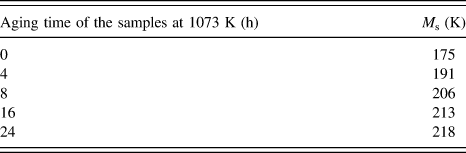
Table I gives the M s temperatures of samples before aging and after aging for different times. Distinctly, the M s temperatures of aged samples were higher than that of unaged. Meanwhile, the M s temperature was increased with increasing aging time.
M s temperatures of samples before aging and after aging for different times.

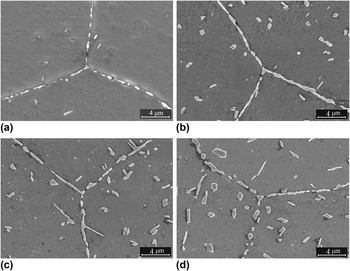
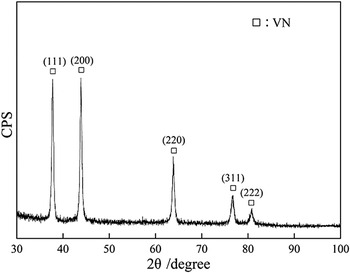
Figure 2 shows the SEM images of samples with different aging time. It can be noted that precipitates were formed in the matrix, and the amount and size of precipitates increased with prolonged aging time. With prolonging the aging time, more and more precipitates aggregated at grain boundaries rather than inside the grain. According to the alloy composition, the element content of the second phase is just a small amount (0.9% mass), which is too small to be detected by XRD. Therefore, the particles were extracted by immersing the sample into dilute sulfuric acid (20%). Figure 3 shows the XRD patterns of the extracted particles, which can be identified as the second phases of VN.
SEM images of samples aging at 1073 K for (a) 4 h; (b) 8 h; (c) 16 h; and (d) 24 h.

XRD pattern of extracted compound from the sample aged at 1073 K for 24 h.

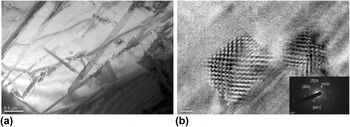
Figure 4 shows TEM micrographs of a sample aged at 1073 K for 30 min. It is observed that clusters of fine particles were associated with many stacking faults. The stacking faults were probably artifact produced during the sample preparation as the result of low stacking energy. The large elastic strain around the VN precipitates promotes the formation of new stacking faults, growing along an orientation different from the preexisting one. It is assumed that the precipitates, which nucleated on top of stacking faults, can act as nucleation sites of stacking faults with different orientation, the γ to ε transformation would in consequence takes place while the sample underwent high enough stress. The interface energy of the VN particle and matrix can promote the formation of stacking faults and ε-martensite. Figure 4(b) shows a high-resolution electron micrograph of the precipitates observed in [001] zone. They can be recognized by their moiré pattern. The precipitates were formed coherently to the matrix phase with a rectangular projected shape. The VN particles have a NaCl-type crystal structure and the orientation relationship between the austenite and the VN precipitate is (001)γ//(001)VN and [100]γ//[100]VN, a cube–cube orientation relationship. Reference Farjami, Hiraga and Kubo9
TEM micrographs of a sample aged at 1073 K for 30 min. (a) Overview of VN precipitates at stacking faults, (b) high-resolution electron micrograph of VN precipitates. Image of [001] zone.

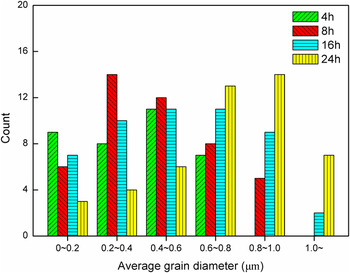
The amount and size distribution of VN precipitates with different aging time were obtained by Gatan DigitalMicrograph as shown in Fig. 5. It is evident that, compared to those in further aged samples, the precipitates in samples aged for 4 and 8 h were less with smaller size. Most of the precipitates have average diameters between 0.2 and 0.6 μm. Particles with average diameter more than 1 μm were only found in samples aged for 16 h or more. The number of precipitates in the sample aged for 16 h was almost the same as that in the 24 h-aged sample, while the particle size in the latter was much bigger.
Cartogram of count and average grain diameter of the precipitates in Fig. 2.

B. Effects of aging on wear resistance
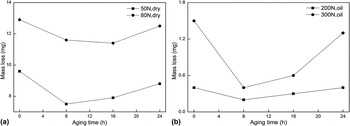
Figure 6 illustrates the mass loss of samples in dry wear condition for 30 min under 50 N and 80 N, and in oil-lubricant wear condition for 150 min under 200 N and 300 N. All the curves exhibit a similar shape of saddle, that is, the mass loss declined to the minimum after aging for 8 h, and then increases with increasing load under both the wear conditions.
Mass loss of the samples with different aging time under different friction conditions: (a) dry friction for 30 min at 50 N and 80 N; (b) oil-lubricant friction for 150 min at 200 N and 300 N.

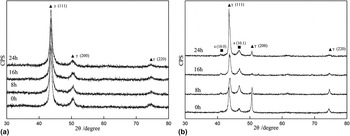
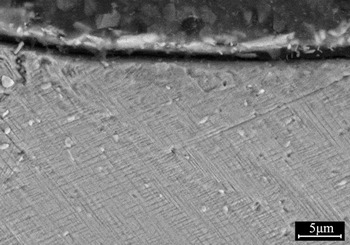
Figure 7 shows XRD patterns for the worn surfaces of samples under 80 N in dry friction for 30 min and under 300 N in oil-lubricant friction for 150 min. It is clear that ε martensite was introduced in the worn surface under oil-lubricant wear condition. It should be noted that the intensity of ε martensite phase diffraction peaks of the aged sample was distinctly stronger than that of the unaged sample, indicating that more ε martensite was induced in these aged samples. The results of XRD analysis also can be confirmed by SEM observation. Figure 8 presents the SEM image for the cross-section of 8 h aged sample after oil-lubricant friction for 150 min at 300 N. There does exist certain amount of ε martensite beneath the worn surface. These results agree well with the findings of Lin et al. Reference Lin, Wang, Wu, Wang and Zhang15
XRD patterns for the wear surface of samples aged at 1073 K for 0, 8, 16, and 24 h after different friction conditions. (a) Dry friction for 30 min at 80 N; (b) oil-lubricant friction for 150 min at 300 N.

SEM image for cross-section of the sample aged at 1073 K for 8 h after oil-lubricant friction for 150 min at 300 N.

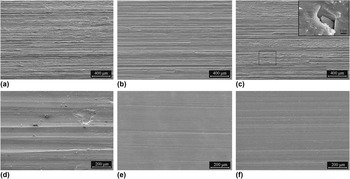
Figure 9 shows the worn surface morphology of samples aged for 0, 8, and 24 h after dry friction for 30 min at 80 N and oil-lubricant friction for 150 min at 300 N. It can be seen from Figs. 9(a)–9(c) that, after dry friction, serious tears and furrows appear in the samples aged for 0 and 24 h, while shallow furrows and mild tears exist in the 8 h-aged sample. In oil-lubricant friction, the lubrication prevented direct contact between the friction coupled pairs. As a result, the surfaces of all the samples are smooth and neat except a few tears appearing in the unaged sample, as shown in Figs. 9(d)–9(f).
SEM images of the worn surfaces for samples subjected to different aging time: (a) 0 h; (b) 8 h; (c) 24 h, after dry friction for 30 min at 80 N. (d) 0 h; (e) 8 h; (f) 24 h, after oil-lubricant friction for 150 min at 300 N.

IV. DISCUSSION
As mentioned in Sec. III, the VN precipitates can be potential nucleation sites for the stress-induced martensite, but they are also probable to be obstacles for martensite growth, which will generate a back stress acting on the martensite plate tip. This back stress may help the reverse movement of the Shockley partial dislocations at the tip of the martensite plate, resulting in good shape recovery. In addition, the precipitation of VN particles depleted N and V element in austenite and caused the increase of M s temperature, as can be seen in Table I. As a result, the formation of stress-induced martensite was easier, which also can contribute to the improvement of SME. This is the reason why the SME of samples aged for 4 and 8 h was markedly increased from that of unaged.
These VN precipitates would also increase the strength of austenite, and then effectively prevent slip deformation when an external force is applied to produce shape change of the sample. According to the Orowan theory,
 $\Delta \tau = {{\alpha f^{0.5} } \mathord{\left/ {\vphantom {{\alpha f^{0.5} } \gamma }} \right. \kern-\nulldelimiterspace} \gamma }$
(where Δτ is the strengthening or hardening effect, α is a constant, f is the volume fraction of the second phase, and γ is the average grain diameter of the second phase), larger volume fraction (f) and/or smaller size (γ) of precipitates will lead to greater strengthening effect on the matrix. Therefore, the microhardness of samples subjected to aging for 4 and 8 h was much greater than that of longer aged samples. Owing to the larger size of the precipitates, the microhardness value of samples aged for 16 and 24 h showed a sudden drop. The similar microhardness values of 4 and 8 h aged samples are attributed to the similar effects of
 ${{f^{0.5} } \mathord{\left/ {\vphantom {{f^{0.5} } \gamma }} \right. \kern-\nulldelimiterspace} \gamma }$
. The matrix with improved strength associating with the precipitates could also assist the formation of recoverable ε martensite
Reference Dong, Klotz and Leinenbach11,Reference Kajiwara16
and suppress the occurrence of permanent deformation. Accordingly, the SME in the sample was expected to be promoted after aging treatment. As shown in Fig. 1(a), the best shape recovery ratio was achieved after aging for 8 h. It is noted that the recovery ratio increased from 68.6 to 74.1% as the aging time increased from 4 to 8 h. This could be ascribed to the increased number of the fine precipitates in 8 h aged sample. However, further aging led to larger amount and bigger size of the precipitates, which in turn weakened the strengthening effect and inhibited the stress-induced γ → ε transformation and/or the ε martensite reverse-transformation to austenite. Therefore, the shape recovery ratio decreased when the sample was aged for 16 h or more.
The SME in Fe–Mn–Si-based alloys resulted from the stress-induced γ → ε martensitic transformation. Accordingly, the stress-induced ε martensitic transformation would preferentially occur during friction in the Fe–20Mn–5Si–10Cr–5Ni–0.7V–0.2N SMA. From the XRD analysis and SEM observation, there does exist certain amount of ε martensite beneath the worn surface after oil-lubricant friction, as shown in Figs. 7 and 8. It is speculated that, in the process of dry friction, the temperature on the worn surface might be above A f (approximate 110 °C), and the heat energy obtained was large enough to drive the ε martensitic → γ transformation completely. However, during oil-lubricant friction, the continuous lubricant oil drops would reduce the friction strength and cool the friction coupled pairs, which could benefit the formation of friction-stress-induced ε martensite and prevent the reverse transformation of ε → γ. Thus large amount of ε martensite with higher strength than that of the austenite matrix was maintained beneath the worn surface during oil-lubricant friction. This may be the main reason why the mass loss reduced by 75% in oil-lubricant friction under 300 N, but only by 20% in dry friction under 50 N, compared to the unaged sample.
In dry friction, the seriously worn surface was closely associated with the characteristics of adhesive wear. Due to the low strength of unaged sample, the contact surface was seriously torn, resulting in a tremendous mass loss. After aging, the occurrence of adhesive wear was effectively restrained in the strengthened matrix. However, further aging treatment would no longer make contribution to enhance the wear resistance. A cavity resulted from peeling of precipitates is found in the worn surface of the sample aged for 24 h, as shown in the inset of Fig. 9(c). In contrast, after oil-lubricant friction, the worn surfaces were smooth and neat except a few tears appearing in the unaged sample. Furthermore, the Fe–20Mn–5Si–10Cr–5Ni–0.7V–0.2N SMA showed better wear resistance in both dry wear and oil-lubricant wear conditions than that in Lin's study on Fe–17Mn–5Si–10Cr–4Ni alloy. Reference Lin, Wang, Wu, Wang and Zhang15 The reason can be attributed to the strengthening effects of VN precipitates in the matrix.
The sample aged for 8 h exhibited the best wear resistance. The major reasons might be: on the one hand, the high-strength matrix of 8 h-aged sample could reduce the plastic deformation to restrain adhesive wear; on the other hand, more friction-stress-induced γ → ε martensite transformation in 8 h-aged sample would absorb part of the friction energy and release the crack-tip stress to suppress stretching of cracks, and more stress-induced ε martensite could also block adhesive wear because of its high hardness and low adhesive coefficient. Reference Lin, Wang, Wu, Wang and Zhang15,Reference Ye, Lai, Wen and Li17,Reference Ni, Sun, Xue, Zhou and Bai18 For 24 h-aged sample, excessive growth of the precipitates made themselves more likely to be peeled off from the matrix, Reference Yang, Yu, Li and Li19 remaining cavities served as origin of cracks during the friction, thus enlarging the area of the worn surface and weakening the wear resistance. As a result, the mass loss of long time (24 h) aged sample was almost equal to that of the unaged.
V. CONCLUSIONS
-
(1) Aging treatment remarkably influenced the SME and wear resistance in the V and N bearing Fe-SMA via precipitating VN particles. TEM observation clarified that the VN particles precipitated with stacking faults and kept a cube–cube orientation relationship with the fcc matrix and acted as nucleation sites for the γ (fcc) →ε (hcp) phase transformation.
-
(2) The optimal shape recovery [around 74% (4% deformed at room temperature and followed by heating up to 573 K)] of the alloy was achieved in 8 h-aged sample. Aging for longer time was not always beneficial, even detrimental to SME, because the large-sized precipitates could impair the strengthening effect and hinder the stress-induced transformation of γ → ε and/or the reverse-transformation of ε martensite to austenite.
-
(3) The eight-hour aged sample exhibited the best wear resistance both in dry friction and in oil-lubricant friction. The remarkably higher wear resistance of the alloy in oil-lubricant friction was attributed to the maintained ε martensite beneath the worn surface. Over aged samples displayed lower wear resistance since the strength of matrix was decreased and the large-sized VN precipitates were peeled off from the matrix.
ACKNOWLEDGMENTS
The authors are grateful to the Natural Science Foundation of Tianjin City (No. 13JCZDJC31900), the China National Funds for Distinguished Young Scientists (No. 51325401), the International Thermonuclear Experimental Reactor (ITER) Program Special Project (No. 2014GB125006), and the Major State Basic Research Development Program (973 Program No. 2014CB046805) for grant and financial support.