








1 Introduction and main results
In recent papers, Okuyama and Vigny showed that the asymptotic value distribution of a sequence of mth derivatives of iterates of a polynomial is generically the same as that of the sequence of iterates itself, see [Reference Okuyama7, Reference Okuyama8, Reference Okuyama and Vigny10]. It raises the question whether this behavior is special for sequences of iterates or if this could be true in more general families of polynomials. This question was partly answered affirmatively by Totik in [Reference Totik13], where he provides conditions on a sequence of polynomials
 $(q_k)_k$
, which ensure that the sequence of derivatives
 $(q^{\prime }_k)_k$
has the same asymptotic zero distribution as the sequence of polynomials itself. Furthermore, in [Reference Henriksen, Petersen and Uhre5], we have complemented Totik’s result by providing different conditions, leading to the same conclusion.
In the current paper, we continue this line of work by exploring the important special case where the asymptotic measure is the equilibrium measure of a compact set K. This allows for stronger results, which we will state in this section.
Throughout this paper, we employ the following conventions. We let
 $K \subset \mathbb C$
be a compact, non-polar, polynomially convex set. Then,
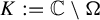
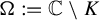 $\Omega := \mathbb C \setminus K$
is a domain admitting a Green’s function
 $g_\Omega $
with pole at
 $\infty $
. Let
 $J:=\partial K=\partial \Omega $
and let
 $\omega $
denote the equilibrium measure for K.
We study sequences
 $(q_k)_{k>0}$
of polynomials, where
 $$ \begin{align} q_k(z)=\gamma_k z^{n_k}+O(z^{n_k-1}),\quad n_k> 0 \end{align} $$
with degree
 $n_k \to \infty $
.
A non-constant polynomial q can be written
 $$ \begin{align*} q(z) = \gamma \prod_{j=1}^n (z-z_j), \end{align*} $$
where
 $\gamma $
is the leading coefficient and
 $(z_j)$
are the roots, repeated with respect to multiplicity. We define the root distribution of q to be the (Borel) probability measure
 $\mu _q$
defined by
 $$ \begin{align*} \mu_q = \frac{1}{n} \sum_{j=1}^n \delta_{z_j}, \end{align*} $$
where
 $\delta _z$
denotes the Dirac point mass at z. Then, for any set
 $U \subset \mathbb C$
, the integer
 $n\mu (U)$
equals the number of roots of q in U counted with multiplicity.
To alleviate notation, we denote the root distribution of
 $q_k$
by
 $\mu _k := \mu _{q_{k}}$
.
For many important families studied in the literature, the number of roots of
 $q_k$
in a closed set L not meeting K can be uniformly bounded above (see [Reference Henriksen, Petersen and Uhre5, Examples 6 and 7] for two important examples). In view of this, we make the following definition.
Definition 1. (Centering)
We say that
 $(q_k)_{k>0}$
centers on the compact set C if there exists N such that the following two conditions hold.
-
(1) There exists
 $R> 0$
such that for all
$k\geq N$
,
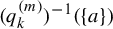
$$ \begin{align*} q_k^{-1}(\{0\})\subset \mathbb D(R). \end{align*} $$
-
(2) For every closed set L with
$L\cap C=\emptyset $
, there exists
$M = M(L)>0$
such that
$$ \begin{align*}n_k \mu_k(L) \leq M\quad \text{for all } k\geq N.\end{align*} $$




We will say that
 $(q_k)_{k>0}$
weakly centers on the compact set C if condition (2) is replaced with the following weaker condition.
-
(2) (Weak) For every closed set L with
$L\cap C=\emptyset $
,
$\mu _k(L)=o(1)$
as
$k\to \infty $
.


Centering on K, which by our standing assumption is compact and polynomially convex, is inherited by the sequence of derivatives, see [Reference Henriksen, Petersen and Uhre5, Corollary 3]. We include this result here for completeness.
Theorem 1. Let
 $K \subset \mathbb C$
be compact and polynomially convex. If a sequence of polynomials
 $(q_k)_{k>0}$
centers on K, then so does the sequence of its derivatives
 $(q^{\prime }_k)_{k>0}$
.
We recently studied the root distribution of the sequence of mth derivatives
 $(q^{(m)}_k)_{k>0}$
of a family of polynomials
 $(q_k)_k$
centering on a compact set, see [Reference Henriksen, Petersen and Uhre5]. Adding control over the asymptotics of
 $q_k$
near infinity as
 $k \to \infty $
allows us to obtain stronger results. The control alluded to is the following.
Definition 2. (K-regularity)
Let
 $K \subset \mathbb C$
be compact. We say that a sequence of polynomials
 $(q_k)_{k>0}$
is K-regular if, for some
 $R> 0$
,
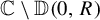
 $$ \begin{align*} \lim_{k\to\infty}{\frac{1}{n_k}}\log|q_k(z)| = g_\Omega(z) \end{align*} $$
uniformly on
 $\mathbb C\setminus \mathbb D(0, R)$
.
Notice that if the root locus of
 $q_k$
is uniformly bounded, then uniform convergence on
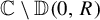 $\mathbb C\setminus \mathbb D(0, R)$
is equivalent to local uniform convergence on
 $\mathbb C\setminus \mathbb D(0, R)$
. Also notice that our definition of K-regularity is a generalization of nth-root regularity as defined in [Reference Stahl and Totik12, Definition 3.1.2]. We have that K-regularity is inherited by the sequence of derivatives.
Theorem 2. Let
 $K \subset \mathbb C$
be a compact, non-polar, and polynomially convex set. If
 $(q_k)_k$
is K-regular, then so is
 $(q_k')_k$
.
When
 $\mu _k$
converges weak star to
 $\mu $
, we write
 $\mu _k \stackrel {\mathrm {w}^*}{\to } \mu $
. The following theorem establishes under which conditions
 $\mu _k$
converges weak star to the equilibrium measure
 $\omega $
on K. This is a generalization of Brolin’s theorem [Reference Brolin2, Theorem 16.1].
Theorem 3. Let
 $K \subset \mathbb C$
be a compact, non-polar, and polynomially convex set and let
 $\omega $
be the equilibrium measure on K. Suppose that the sequence of polynomials
 $(q_k)_{k>0}$
is K-regular. Then,
 $\mu _k\stackrel {\mathrm {w}^*}{\to } \omega $
if and only if
 $(q_k)_{k>0}$
weakly centers on
 $J := \partial K$
.
(Weakly) Centering on J is not in general inherited by the sequence of derivatives unlike centering on K. It is clear that centering on K is the same as centering on J, when K has no interior. The next theorem shows that there is a more general class of compact sets (than those with empty interior), where weakly centering on K implies weakly centering on J, when
 $(q_k)_k$
is K-regular.
Theorem 4. Let
 $K \subset \mathbb C$
be a compact, non-polar, and polynomially convex set. Suppose the equilibrium measure
 $\omega $
of K satisfies
 $\omega (\overline {V}) = 0$
for every component V of the interior of K. If
 $(q_k)_k$
is K-regular and weakly centers on K, then
 $(q_k)_k$
weakly centers on
 $J:=\partial K$
.
The following theorem shows that centering on K is fairly robust for K-regular sequences. Define
 $\log ^+$
by
 $\log ^+(w) = \max \{0, \log (w)\}$
.
Theorem 5. Let
 $K \subset \mathbb C$
be a compact, non-polar, and polynomially convex set and let
 $(a_k)_k\subset \mathbb C$
be a sequence with
 $\log ^+ \lvert {a_k}\rvert = o(n_k)$
as
 $k\to \infty $
. If
 $(q_k)_{k>0}$
centers on K and is K-regular, then
 $(q_k-a_k)_k$
centers on K and is K-regular.
The above theorem extends our previous results on zero distributions to value distributions, since zeros of
 $q_k - a_k$
are clearly just the preimages of
 $a_k$
under
 $q_k$
.
Combining the previous theorems yields the following theorem.
Theorem 6. Let
 $K \subset \mathbb C$
be a compact, non-polar, and polynomially convex set and let
 $\omega $
be the equilibrium measure on K. Suppose K has the property that
 $\omega (\overline {V}) = 0$
for every component V of the interior of K. Let
 $(a_k)_k\subset \mathbb C$
satisfy
 $\log ^+ \lvert {a_k}\rvert = o(n_k)$
. If
 $(q_k)_k$
is K-regular and centers on K, then for every
 $m = 0, 1, \ldots ,$
the sequence of perturbed mth derivatives
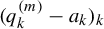 $(q_k^{(m)} - a_k)_k$
is K-regular, centers on K, and has root distributions converging weak star to
 $\omega $
.
This result generalizes [Reference Okuyama and Vigny10, Theorem 1] to the vastly larger non-dynamical setting, at the expense of the condition that
 $\omega (\overline {V}) = 0$
for every component V of the interior of K.
2 Proofs of the results
The potential of a finite Borel measure
 $\mu $
on
 $\mathbb C$
is given by
 $$ \begin{align*} p_\mu(z) = \int \log \lvert{z-w}\rvert\, d\mu(w), \end{align*} $$
where we have used the sign convention of [Reference Ransford11].
The Green’s function
 $g_\Omega $
with pole at infinity is
 $g_\Omega = p_\omega - I(\omega )$
, where
 $I(\omega )$
is the energy of the equilibrium measure for K, see [Reference Ransford11]. In particular, we have
 $$ \begin{align*} g_\Omega(z) = \log\lvert{z}\rvert - I(\omega) + o(1)\quad \text{as }z\to \infty. \end{align*} $$
We start with the proof of Theorem 2.
Proof. If q is a non-constant polynomial, it is well known that the roots of
 $q'$
lie in the convex hull of the zero locus of q. In particular, the zero locus of
 $q_k'$
is contained in
 $\mathbb D(0,R)$
for k sufficiently big. We can assume
 $K \subset \mathbb D(0,R)$
by possibly increasing R.
Take
 $R_2> R$
. We will show that
 $({1}/({n_k-1})) \log \lvert {q_k'}\rvert = g_\Omega + o(1)$
uniformly outside
 $\mathbb D(0, R_2)$
. Since for each k,
 $({1}/({n_k-1})) \log \lvert {q_k'(z)}\rvert = \log \lvert {z}\rvert + O({1}/{\lvert z \rvert })$
as
 $z \to \infty $
and
 $g_\Omega (z) = \log \lvert {z}\rvert + O({1}/{\lvert z \rvert })$
as
 $z \to \infty $
, the function
 $h_k = ({1}/{(n_k-1)}) \log \lvert {q_k'}\rvert -g_\Omega $
is harmonic outside
 $\mathbb D(0, R)$
for sufficiently large k and extends harmonically to
 $\infty $
, by letting
 $h_k(\infty ) = \lim _{z\to \infty } h_k(z) < \infty $
. By the maximum principle for harmonic functions, it is enough to show that
 $h_k \to 0$
uniformly on
 $\partial \mathbb D(0, R_2)$
as
 $k \to \infty $
. That is, if
 $({1}/{(n_k-1)}) \log \lvert {q_k'}\rvert \to g_\Omega $
uniformly on
 $\partial \mathbb D(0, R_2)$
, then
 $({1}/{(n_k-1)}) \log \lvert {q_k'}\rvert \to g_\Omega $
uniformly on
 $\mathbb C \setminus \mathbb D(0, R_2)$
.
Since
 $g_\Omega $
is harmonic on
 $\Omega $
,
 $g_\Omega ' := 2 ({\partial }/{\partial z}) g_\Omega $
is a holomorphic function. Also, since
 $g_\Omega = p_\omega - I(\omega )$
,
 $g_\Omega $
has no critical points for
 $\lvert {z}\rvert \geq R$
.
Taking
 $2 ({\partial }/{\partial z})$
derivatives on both sides of
 $$ \begin{align*} \lim_{k\to\infty}{\frac{1}{n_k}}\log|q_k(z)| = g_\Omega(z), \end{align*} $$
we get by local uniform convergence
 $$ \begin{align*} \frac{1}{n_k} \frac{q_k'(z)}{q_k(z)} = g^{\prime}_\Omega(z) + o(1), \end{align*} $$
where
 $o(1) \to 0$
as
 $k \to \infty $
locally uniformly on
 $\lvert {z}\rvert \geq R$
. Hence,
 $q_k'(z) = (g_\Omega '(z) + o(1))n_k q_k$
, so
 $$ \begin{align*} \frac{1}{n_k-1} \log \lvert{q_k'(z)}\rvert = & \phantom{+} \frac{1}{n_k-1} \log(n_k) \\ & + \frac{1}{n_k-1} \log(\lvert{g_\Omega'(z) + o(1)}\rvert) \\ & + \frac{1}{n_k-1} \log \lvert{q_k(z)}\rvert. \end{align*} $$
Now, as
 $k\to \infty $
,
 $({1}/{(n_k-1)}) \log (n_k) = o(1)$
. Also,
 $g_\Omega '(z) \neq 0$
when
 $\lvert {z}\rvert \geq R$
, so
 $({1}/{(n_k-1)})\log \lvert {g_\Omega '(z) + o(1)}\rvert = o(1)$
. Finally,
 $({1}/{(n_k-1)}) \log \lvert {q_k(z)}\rvert = g_\Omega (z) + o(1)$
. Here, the
 $o(1)$
term in each of the three expression is uniform on
 $\partial \mathbb D(0, R_2)$
. So, we get
 $$ \begin{align*} \frac{1}{n_k-1} \log \lvert{q_k'(z)}\rvert \to g_\Omega(z) \end{align*} $$
uniformly on
 $\partial \mathbb D(0, R_2)$
, which finishes the proof.
We will use the following lemma to prove Theorem 3.
Lemma 1. Suppose
 $\mu $
and
 $\nu $
are finite Borel measures supported on J. If
 $p_\mu (z) = p_\nu (z)$
, outside
 $\mathbb D(0,R)$
for some R, then
 $\mu = \nu $
.
Proof. Since both
 $\mu $
and
 $\nu $
are supported on J, the potentials
 $p_\mu $
and
 $p_\nu $
are harmonic on
 $\Omega $
. Since
 $p_\mu $
and
 $p_\nu $
agree on
 $\lvert z \rvert> R$
, they agree on all of
 $\Omega $
, by the identity principle of harmonic functions.
Since
 $\Omega $
is connected, it follows from [Reference Ransford11, Theorem 3.8.3] that for every
 $z \in \partial \Omega = J$
, we have
 $$ \begin{align*} p_\mu(z) = \limsup_{\substack{\zeta \in \Omega\\ \zeta \to z}} p_\mu(\zeta) = \limsup_{\substack{\zeta \in \Omega\\ \zeta \to z}} p_\nu(\zeta) = p_\nu(z). \end{align*} $$
So,
 $p_\mu = p_\nu $
on J.
We know that
 $p_\mu = p_\nu $
except possibly on components of the interior of K. Towards a contradiction, suppose that there exists a component U of the interior of K, on which
 $p_\mu \neq p_\nu $
. We have already shown
 $p_\mu = p_\nu $
on
 $\partial U \subset J$
. Also,
 $p_\mu $
and
 $p_\nu $
are harmonic on U. We can assume that there exist
 $z_0 \in U$
and
 $\epsilon> 0$
so that
 $p_\mu (z_0)> p_\nu (z_0) + \epsilon $
, possibly by exchanging the roles of
 $p_\mu $
and
 $p_\nu $
. Let V be a connected component of the set
 $\{z \in U: p_\mu (z)> p_\nu (z) + \epsilon \}$
. Applying the maximum principle to
 $p_\mu - p_\nu $
, we see that V is not compactly contained in U. Let
 $w \in \partial U \cap \partial V$
. Then, again by [Reference Ransford11, Theorem 3.8.3],
 $$ \begin{align*} p_\mu(w) = \limsup_{\substack{\zeta \in V\\ \zeta \to w}} p_\mu(\zeta) \geq \limsup_{\substack{\zeta \in V\\ \zeta \to w}} p_\nu(\zeta) + \epsilon = p_\nu(w) + \epsilon, \end{align*} $$
which contradicts
 $p_\mu (w) = p_\nu (w)$
.
We have shown that
 $p_\mu = p_\nu $
on
 $\mathbb C$
. By uniqueness (see [Reference Ransford11, Corollary 3.7.5]),
 $\mu = \nu $
.
We can now prove Theorem 3.
Proof. The ‘only if’ part of the theorem is straight forward. The K-regularity of the sequence
 $(q_k)_k$
implies weakly centering condition
 $1$
on K. So, if
 $(q_k)_k$
does not center weakly on J, we can find a compact set L in the interior of K not meeting J and
 $\delta> 0$
, so that for some subsequence, we have
 $\mu _{k_j}(L)> \delta $
. Any limit point
 $\mu $
of this subsequence will have to charge L, so we cannot have
 $\mu _k \stackrel {\mathrm {w}^*}{\to } \omega $
.
To show the ‘if’ part, assume that
 $(q_k)_k$
weakly centers on J. By the centering assumption, the root locus of
 $q_k$
is contained in
 $\mathbb D(R)$
for
 $k \geq N$
. Hence,
 $\mu _k$
has uniformly bounded support for
 $k \geq N$
and thus forms a precompact family. So, we only need to show that the only possible limit point is
 $\omega $
.
Replace
 $(q_k)$
by a subsequence such that
 $\mu _k \stackrel {\mathrm {w}^*}{\to } \mu $
. By weak centering,
 $\mu $
is supported on J.
Notice
 $$ \begin{align*} \frac{1}{n_k} \log \lvert{q_k(z)}\rvert & = \frac{1}{n_k} \log \lvert{\gamma_k}\rvert + \frac{1}{n_k} \log \bigg\lvert{\prod_{j=1}^{n_k}(z-z_{k,j})}\bigg\rvert \\ & = \frac{1}{n_k} \log \lvert{\gamma_k}\rvert + \int \log \lvert{z-w}\rvert\, d\mu_k(w) \\ & = \frac{1}{n_k} \log \lvert{\gamma_k}\rvert + \log \lvert{z}\rvert + o(1) \quad\textrm{as}\ |z|\to\infty, \end{align*} $$
where
 $z_{k,j}$
are the roots of
 $q_k$
repeated with multiplicity.
When
 $\lvert {z}\rvert> R$
, we have
 $\int \log \lvert {z-w}\rvert \, d\mu _k(w) \to p_\mu $
(since
 $\mu _k\stackrel {\mathrm {w}^*}{\to }\mu $
) and
 $({1}/{n_k}) \log \lvert {q_k(z)}\rvert \to g_\Omega (z) = p_\omega (z) - I(\omega )$
by K-regularity. Hence,
 $({1}/{n_k}) \log \lvert {\gamma _k}\rvert \to -I(\omega )$
and
 $p_\mu = p_\omega $
on
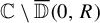 $\mathbb C \setminus \overline {\mathbb D}(0, R)$
. It now follows by Lemma 1 that
 $\mu = \omega $
, which completes the proof.
The proof of Theorem 4 hinges on a lemma by Buff and Gauthier.
Proof of Theorem 4
We will show that any weak-star limit of
 $\mu _k$
equals
 $\omega $
. Since
 $(\mu _k)_k$
is precompact, it follows that
 $\mu _k \stackrel {\mathrm {w}^*}{\to } \omega $
. Then, Theorem 3 shows that
 $(q_k)$
weakly centers on J.
Let
 $\mu $
be a limit point of
 $(\mu _k)_k$
and pass to a subsequence such that
 $\mu _k \stackrel {\mathrm {w}^*}{\to } \mu $
.
Arguing as in the proof of Theorem 3, we obtain
 $p_\mu = p_\omega $
on
 $\Omega $
. With
 $u = p_\mu $
and
 $v = p_\omega $
, we get that
 $u = v$
on
 $\mathbb C$
by [Reference Buff and Gauthier3, Lemma 3]. So,
 $p_\mu = p_\omega $
on
 $\mathbb C$
, and by uniqueness,
 $\mu = \omega $
(see [Reference Ransford11, Corollary 3.7.5]).
Proof of Theorem 5
Outside
 $\overline {\mathbb D}(0, R)$
, we have
 $({1}/{n_k}) \log \lvert {q_k}\rvert> \tfrac 12 g_\Omega $
for k sufficiently big, and hence,
 $\lvert {q_k}\rvert> \exp (\epsilon n_k)$
for
 $2\epsilon = \min \{g_\Omega (z) : \lvert {z}\rvert = R\}> 0$
. Combining this with the assumption on
 $a_k$
, we obtain
 $({a_k}/{q_k}) \to 0$
uniformly outside
 $\overline {\mathbb D}(0, R)$
. Therefore,
 $$ \begin{align*} \frac{1}{n_k} \log \lvert{q_k - a_k}\rvert = \frac{1}{n_k} \log \lvert{q_k}\rvert +\frac{1}{n_k} \log \lvert{ 1 - a_k/q_k}\rvert = g_\Omega + o(1), \end{align*} $$
uniformly outside
 $\overline {\mathbb D}(0, R)$
, so
 $(q_k - a_k)_k$
is K-regular.
Before proving that
 $(q_k - a_k)_k$
centers on K, we note that since
 $({1}/{n_k})\log \lvert {q_k}\rvert = ({1}/{n_k})\log \lvert {\gamma _k}\rvert + p_{\mu _k}$
, where
 $\mu _k$
is the zero distribution of
 $q_k$
, we have that
 $({1}/{n_k})\log \lvert {\gamma _k}\rvert \to -I(\omega )$
.
Let
 $r> 0$
be arbitrary and let
 $\Omega _r = \{z \in \Omega : d(z, K)> r\}$
, where the semi-distance
 $d(z, K) = \inf _{\zeta \in K} \lvert {z - \zeta }\rvert $
.
To show that
 $(q_k - a_k)_k$
centers on K, it is enough to show that for every subsequence of
 $(q_k - a_k)_k$
, there exists a subsubsequence such that the number of zeroes of
 $q_k - a_k$
in
 $\Omega _r$
is uniformly bounded.
So, suppose we have passed to an arbitrary subsequence. Possibly passing to a further subsequence, we can assume
 $\mu _k$
converges weak star to a probability measure
 $\mu $
. By K-regularity,
 $p_\mu =p_\omega $
on
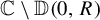 $\mathbb C\setminus \mathbb D(0,R)$
and by centering,
 $\operatorname {supp}(\mu )\subseteq K$
. Hence, arguing as in the proof of Lemma 1, we obtain
 $p_\mu =p_\omega $
on
 $\Omega $
.
Let
 $\zeta _{k,j}$
for
 $j=1,\ldots , n_k$
, be the roots of
 $q_k$
, numbered so that
 $d(\zeta _{k,i}, K) \geq d(\zeta _{k,j}, K)$
, whenever
 $1 \leq i < j \leq n_k$
. By the centering assumption,
 $\lvert {\zeta _{k,j}}\rvert < R$
for
 $k \geq k_0$
. Hence, by a standard diagonal argument, we can pass to a subsequence such that each of the sequences
 $(\zeta _{k,j})_k$
converges and we let
 $\zeta _j = \lim _{k\to \infty } \zeta _{k,j}$
. By our numbering,
 $d(\zeta _i, K) \geq d(\zeta _j, K)$
whenever
 $1 \leq i < j$
.
Since
 $(q_k)_k$
centers on K, there is a minimal
 $m \geq 1$
such that
 $\zeta _{m} \notin \overline {\Omega _r}$
. By decreasing r slightly if necessary, we can suppose that
 $\zeta _j \in \Omega _r$
for every
 $j < m$
, while retaining
 $\zeta _{m} \notin \overline {\Omega _r}$
. Let
 $\delta> 0$
be such that
 $d(\zeta _j, \partial \Omega _r)> \delta $
for
 $j = 1, \ldots , m$
.
There exists
 $k_0$
such that when
 $k \geq k_0$
,
 $d(\zeta _{k, j}, \partial \Omega _r)> \delta /2$
for
 $j=1, \ldots ,m$
. By the numbering of
 $\zeta _{k, j}$
, we also have
 $d(\zeta _{k,j}, \partial \Omega _r)> \delta /2$
for
 $j> m$
, whenever
 $k \geq k_0$
. So, the open set
 $U = \{ z \in \mathbb C: d(z, \partial \Omega _r) < \delta /2 \}$
does not meet any zero of
 $q_k$
, when
 $k\geq k_0$
.
It follows from [Reference Henriksen, Petersen and Uhre5, Lemma 3] that
 $({1}/{n_k})\log \lvert {(1/\gamma _k) q_k}\rvert $
converges uniformly to the potential
 $p_\mu =p_\omega $
on
 $\partial \Omega _r$
. Since
 $({1}/{n_k})\log \lvert {\gamma _k}\rvert \to -I(\omega )$
, we get that
 $({1}/{n_k})\log \lvert {q_k}\rvert $
converges uniformly to
 $g_\Omega $
on
 $\partial \Omega _r$
. As
 $g_\Omega $
is positive and continuous on
 $\partial \Omega _r$
, there exist
 $k_1$
and
 $\epsilon> 0$
so that
 $\lvert {q_k}\rvert> \exp ( \epsilon n_k )$
on
 $\partial \Omega _r$
, when
 $k \geq k_1$
.
By assumption on
 $a_k$
, we have that
 $\lvert {a_k}\rvert + 1 \leq \exp ( \epsilon n_k )$
, when k is sufficiently big. In particular, when k is sufficiently big, the preimage
 $q_k^{-1}(\mathbb D(0, \lvert {a_k}\rvert +1))$
does not meet
 $\partial \Omega _r$
. Hence, each connected component V of
 $q_k^{-1}(\mathbb D(0, \lvert {a_k}\rvert +1))$
is either contained in
 $\Omega _r$
or disjoint from
 $\Omega _r$
. Additionally, since the restriction
 $q_k : V \to \mathbb C$
is proper,
 $q_k$
and
 $q_k-a_k$
have the same number of roots in V, counted with multiplicity. Since this holds for every connected component of
 $q_k^{-1}(\mathbb D(0, \lvert {a_k}\rvert +1))$
, we get that
 $q_k$
and
 $q_k - a_k$
have the same number of roots in
 $\Omega _r$
. Finally, since
 $(q_k)_k$
centers on K, the latter number of roots is uniformly bounded for k sufficiently big.
It only remains to prove Theorem 6.
Proof. By Theorem 1 and induction,
 $(q_k^{(m)})_k$
centers on K for all m. By Theorem 2 and induction,
 $(q_k^{(m)})_k$
is K-regular for all m. Since
 $\log ^+ \lvert {a_k}\rvert = o(n_k)$
implies
 $\log ^+ \lvert {a_k}\rvert = o(n_k - m)$
, Theorem 5 shows that also the sequences
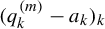 $(q_k^{(m)}-a_k)_k$
are K-regular and center on K for all m. Theorem 4 implies that
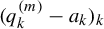 $(q_k^{(m)} - a_k)_k$
weakly centers on J for all m. Finally, by Theorem 3, the zero distribution of
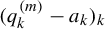 $(q_k^{(m)} - a_k)_k$
converges weak star to
 $\omega $
for all m.
3 Two applications in dynamics
In this section, we derive a few convergence results to demonstrate the usefulness of Theorem 6.
For the first result, we consider a fixed polynomial
 $P(z) = z^n + o(z^n)$
of degree
 $n> 1$
. Such a polynomial generates a dynamical system via its iterates
 $P^k$
, where
 $P^0$
is the identity and
 $P^k = P \circ P^{k-1}$
for
 $k> 0$
.
The basin of infinity is defined as
 $$ \begin{align*} \Omega(P) = \{ z \in \mathbb C: (P^k(z))_k \text{ is unbounded} \} = \{ z \in \mathbb C: P^k(z) \to \infty \}, \end{align*} $$
while the filled Julia set
 $K(P)$
is the complement
 $K(P) = \mathbb C \setminus \Omega (P)$
.
It is known that
 $K(P)$
is compact, polynomially convex, and of capacity
 $1$
, see [Reference Milnor6]. The equilibrium measure
 $\omega $
on
 $K(P)$
has a special dynamical meaning, in that it is the balanced invariant measure, in the sense that if
 $P^{-1}_j$
,
 $j=1,\ldots ,n$
, is a complete assignment of inverse branches, then
 $\omega (P^{-1}_j(U)) = ({1}/{n})\omega (U)$
for every
 $j=1,\ldots , n$
and every Borel set
 $U \subset \mathbb C$
.
The components of the interior of
 $K(P)$
and
 $\Omega (P)$
are called the Fatou components of P, and their union form the Fatou set of P. By Sullivans no-wandering domains theorem, every Fatou component is eventually periodic and by the Fatou–Shishikura theorem, there are at most
 $2n-2$
cycles of periodic components. The complement of the Fatou set is the Julia set
 $J(P) = \partial \Omega (P)$
. We start by showing that the condition that every component V of the interior of
 $K(P)$
satisfies
 $\omega (\overline {V}) = 0$
, which appears in Theorems 4 and 6, is not an exceptional occurrence in polynomial dynamics.
Theorem 7. Let P be a polynomial of degree
 $n> 1$
. Let
 $L\subset J(P)$
be a compact subset with
 $P(L) = L$
. Then, either
 $L = J(P)$
or
 $\omega (L) = 0$
.
Proof. For the proof, we use two facts both due to Brolin [Reference Brolin2, Theorem 17.1] (see also [Reference Ransford11, Corollary 6.5.7]). First, P preserves
 $\omega $
, in the sense that
 $\omega (P^{-1}(U)) = \omega (U)$
for any Borel set U. Second, P is strongly mixing and, in particular, if for some Borel set U we have
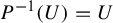 $P^{-1}(U) = U$
, then either
 $\omega (U)=0$
or
 $\omega (U)=1$
.
Suppose
 $L\subset J(P)$
is a compact subset with
 $P(L) = L$
and
 $L \not = J(P)$
. We must show that
 $\omega (L) = 0$
. The hypothesis
 $P(L) = L$
implies
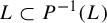 $L \subset P^{-1}(L)$
. Then,
 $$ \begin{align} \omega(P^{-1}(L) \setminus L) = 0, \end{align} $$
since P preserves
 $\omega $
. Let
 $$ \begin{align*}V = \bigcup_{k \geq 0} P^{-k}(L) = L \cup \bigcup_{k \geq 0} P^{-k}(P^{-1}(L) \setminus L). \end{align*} $$
By (2) and preservation of measure, we have
 $\omega (\bigcup _{k \geq 0} P^{-k}(P^{-1}(L) \setminus L)) = 0$
. So,
 $\omega (V) = \omega (L)$
. By construction,
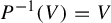 $P^{-1}(V) = V$
, and hence ergodicity implies that
 $\omega (L) = \omega (V) \in \{0, 1\}$
. The Julia set
 $J(P)$
is Dirichlet regular, which implies
 $\operatorname {supp}(\omega ) = J(P)$
, see e.g. [Reference Ransford11, Corollary 6.5.5]. Thus, if
 $\omega (L)=1$
, then
 $L= J(P)$
, since L is compact, which contradicts the assumption
 $L \neq J(P)$
. Hence,
 $\omega (L) = 0$
as required.
Corollary 1. Let P be a polynomial of degree
 $n> 1$
. If
 $\partial U \neq J(P)$
for each of the finitely many bounded periodic Fatou components, then
 $\omega (\partial U) = 0$
for every bounded Fatou component
 $U\subset K(P)$
.
It is currently unknown if there exists a nonlinear polynomial that has more than one bounded Fatou component and for which at least one of them, U, satisfies
 $\partial U = J(P)$
. See [Reference Okuyama9] for an exposition of this problem.
Proof. Assume
 $\partial U \neq J(P)$
for each of the finitely many bounded periodic Fatou components. Let
 $U\subset K (P)$
be a bounded Fatou component.
Consider at first the case where U is periodic with some minimal period
 $k \geq 1$
. By replacing P with the kth iterate
 $P^k$
, we can assume
 $k = 1$
, that is, U is fixed by P. Then,
 $P:U \to U$
is a proper map and hence,
 $L = \partial U\subset J(P)$
satisfies
 $P(L) = L$
. Therefore,
 $\omega (L) = 0$
by Theorem 7.
Next, consider the other case where U is not periodic. By Sullivan’s no wandering domains theorem, there exist
 $k> 0$
such that
 $V = P^k(U)$
is a periodic Fatou component. We have already shown
 $\omega (\partial {V}) = 0$
and since
 $\partial {U} \subset P^{-k}(\partial {V})$
, we get
 $\omega (\partial {U}) \leq \omega (\partial {V}) =~0$
, which finishes the proof.
Here follows our first application.
Theorem 8. Let
 $P(z) = z^n + O(z^{n-2})$
be a monic and centered nonlinear polynomial such that
 $\partial U \neq J(P)$
for each bounded periodic Fatou component U. Let
 $\omega $
be the equilibrium measure of
 $K(P)$
and
 $\mu $
a Borel probability measure on
 $K(P)$
with
 $\omega \ll \mu $
. Also, let
 $q_k(z) = z^k + o(z^k)$
be the orthogonal polynomials associated to
 $\mu $
. Then,
 $(q_k^{(m)} - a)_k$
has the asymptotic zero distribution
 $\omega $
for arbitrary
 $a \in \mathbb C$
and
 $m=0,1,2,\ldots .$
Remark 1. It follows from [Reference Barnsley, Geronimo and Harrington1] that if we take
 $\mu = \omega $
, then
 $P^{j} = q_{n^j}$
, so the iterates sit naturally within a sequence of orthogonal polynomials, and we recover Okuyama’s and Vigny’s result ([Reference Okuyama and Vigny10, Theorem 1], [Reference Okuyama8, Theorem 1]) except in the case where P has a bounded Fatou component U, with
 $\partial U = J(P)$
.
Remark 2. With the same proof, the theorem generalizes to admissible measures
 $\mu $
in the sense of Widom, [Reference Widom14, §4. p. 1001] and families
 $(q_k)_k$
of extremal polynomials in the sense of Widom [Reference Widom14, §3. pp. 999–1001], which includes the extremal families in
 $L^p(\mu )$
for any
 $p>0$
.
Proof. Widom has shown that
 $(q_k)_k$
centers on K (see [Reference Widom14, Lemma 4]) and, since the logarithmic capacity of
 $K(P)$
is
 $1$
, that
 $(q_k)_k$
is
 $K(P)$
-regular (see [Reference Widom14, Corollary, p. 1007]). Finally,
 $\omega (\overline {V}) = 0$
for every component V of the interior of
 $K(P)$
, by Theorem 7. Hence, the result immediately follows from Theorem 6.
Our next application concerns the parameter space of quadratic mappings. Denote by
 $P_c$
the quadratic polynomial
 $P_c(z) = z^2 + c$
. The Mandelbrot set M is defined to be the set of
 $c \in \mathbb C$
such that the sequence
 $0, P_c(0), P_c^2(0), \ldots $
is bounded.
It has long been known that the asymptotic zero distribution of
 $(P_c^k(0))_k$
equals the equilibrium distribution
 $\omega _M$
. In a recent paper (see [Reference Okuyama7, Theorem 3]), Okuyama showed that the same holds true for the sequence of derivatives
 $P_c'(0), (P_c^2)'(c), \ldots .$
However, it follows from Theorem 6 that the same holds true for the sequence of mth derivatives
 $P_c^{(m)}(0), (P_c^2)^{(m)}(c), \ldots .$
Theorem 9. Let
 $q_k = P_c^{k}(0)$
for
 $k = 1, 2, \ldots ,$
and let
 $a_k \in \mathbb C$
be such that
 $\log ^+ \lvert {a_k}\rvert = o(2^{k-1})$
. Then, the sequence
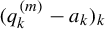 $(q_k^{(m)} - a_k)_k$
has asymptotic root distribution
 $\omega _M$
for all
 ${m = 0, 1, \ldots .}$
Proof. First, we have that
 $\omega (\partial W) = 0$
for every connected component W of the interior of M, see [Reference Buff and Gauthier3, proof of Lemma 2] and [Reference Zakeri15].
Second,
 $(P_c^k(0))_k)$
centers on M. Indeed, if
 $c_0$
is a zero of
 $P_c^k(0)$
, then
 $0$
is a periodic point of
 $P_{c_0}$
and it follows that
 $c_0 \in M$
. Hence, every zero of
 $P_c^k(0)$
for all
 $k = 1, 2, \ldots, $
is an element of M.
Third,
 $(P_c^k(0))_k$
is M-regular (see [Reference Douady and Hubbard4]).
We can therefore apply Theorem 6 and arrive at the desired conclusion.
We have heuristically located the zeros of
 $q_k^{(m)}$
for
 $m=1$
for various values of k in Figure 1. Even if we surely have not located every zero of
 $q_k$
for
 $k> 10$
, we still see the zeros accumulate on
 $\partial M$
.
Letting
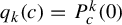 $q_k(c) = P_c^k(0)$
, with
 $P_c(z) = z^2 + c$
, we have illustrated the zeros of
 $q_k'$
for
 $k = 5, 10, 40, 80, 640$
. The zeros are indicated by black dots (we have chosen smaller dots in the last image, so the emerging shape of the Mandelbrot set is better seen), while the potential associated to the equilibrium distribution of the Mandelbrot set is illustrated with varying shades. The asymptotic zero-distribution is the equilibrium measure on the Mandelbrot set, by a result of Okuyama. We show that this is also true for the derivatives of order m, that is,
 $\mu _k^m \stackrel {\mathrm {w}^*}{\to } \omega _M$
(color online).

Acknowledgements
The authors would like to thank Yûsuke Okuyama for helpful discussions and the referee for helpful suggestions. We also thank the Independent Research Fund Denmark — Natural Sciences for support via the grant DFF–1026–00267B.



