


Introduction
CBT for psychosis is not good enough
The National Institute for Health and Care Excellence (2014) recommends cognitive behavioural therapy (CBT) for all people with a diagnosis of schizophrenia (CBTp), and the Access and Waiting Times Standards (2014) specify timeframes for delivery of services to people with first-episode psychosis, to be achieved by 2020. These are welcome guidelines and set clear expectations for parity of esteem. While national policy demands have increased access, clinical and quality of life outcomes for CBTp remain modest, and may be no better than other less sophisticated and less expensive psychosocial interventions (Jones et al., Reference Jones, Hacker, Meaden, Cormac, Irving, Xia, Zhao, Shi and Chen2018). There are likely to be a number of reasons for this. Psychosocial interventions are undoubtedly beneficial and should arguably be routinely available. Additionally, we need to improve the effectiveness of CBTp. The intensity of distress associated with paranoia, voices and other anomalous experience often makes it hard for people to apply therapeutic insights and skills when in the grip of psychosis. Incorporating emotion regulation skills into CBTp may be one way to improve outcomes. Attachment theory provides a model for understanding how emotion regulation can become problematic, and means of addressing this.
How might attachment theory be relevant?
Attachment theory (Bowlby, Reference Bowlby1973, Reference Bowlby1988) assumes that we are predisposed to form bonds with caregivers to manage distress and stay safe. Repeated interactions early in life generate mental representations or ‘internal working models’ – cognitive-affective systems, which include memories as well as beliefs about self, others and relationships, and initiate congruent behaviours, including emotion regulation responses (Dykas and Cassidy, Reference Dykas and Cassidy2011). In this way, our attachments act as a homeostatic system for emotion regulation and interpersonal safety.
Secure attachments are most likely to result from consistent and responsive caregivers. Insecure anxious attachments and ‘activating strategies’ (such as increasing distress to regain proximity) may result from unreliable or unavailable caregivers. Insecure avoidant attachments and ‘deactivating strategies’ (such as avoiding close relationships) may result from punitive or rejecting caregivers (Shaver and Mikulincer, Reference Shaver and Mikulincer2002). The now well-recognised link between psychosis and childhood adversity is relevant here; people with psychosis are more likely to have experienced early trauma and neglect than those in the general population (Varese et al., Reference Varese, Smeets, Drukker, Lieverse, Lataster, Viechtbauer and Bentall2012). These interpersonal patterns will be familiar to clinicians, and are typically formulated in cognitive behavioural terms – as beliefs about self and others derived from early social learning, and corresponding affective and behavioural responses. We have perhaps paid less attention to emotion regulation difficulties.
Attachment insecurity has been linked with psychosis in cross-sectional (Berry et al., Reference Berry, Barrowclough and Wearden2007; Gumley et al., Reference Gumley, Taylor, Schwannauer and MacBeth2014b) and prospective (Gumley et al., Reference Gumley, Schwannauer, Macbeth, Fisher, Clark, Rattrie and Birchwood2014a) studies, and with paranoia specifically in non-clinical (Ciocca et al., Reference Ciocca, Collazzoni, Limoncin, Franchi, Mollaioli, Di Lorenzo and Jannini2017; Darrell-Berry et al., Reference Darrell-Berry, Bucci, Palmier-Claus, Emsley, Drake and Berry2017), at-risk (Russo et al., Reference Russo, Stochl, Hodgekins, Iglesias-Gonzalez, Chipps, Painter and Perez2017) and clinical populations (Korver-Nieberg et al., Reference Korver-Nieberg, Berry, Meijer, de Haan and Ponizovsky2015; Ponizovsky et al., Reference Ponizovsky, Vitenberg, Baumgarten-Katz and Grinshpoon2013; Wickham et al., Reference Wickham, Sitko and Bentall2015). There is also evidence that attachment insecurity fluctuates more in clinical groups, and predicts paranoia even when controlling for hallucinations (but not viceversa) (Sitko et al., Reference Sitko, Varese, Sellwood, Hammond and Bentall2016).
The exact nature of these relationships, and whether attachment insecurity constitutes a general or specific vulnerability to psychopathology (Davila et al., Reference Davila, Ramsay, Stroud, Steinberg, Hanklin and Abela2005), remains unclear. What is clear is that people with psychosis are more likely to report cognitive, affective and behavioural patterns associated with early interpersonal adversity, as predicted by attachment theory.
Attachment imagery as a means of regulating emotion in psychosis
If an insecure attachment style is associated with increased risk for psychopathology, then secure attachment may be associated with mental wellbeing and recovery. In a systematic review of attachment styles in psychosis, Gumley and colleagues found that attachment security was linked to fewer symptoms and interpersonal difficulties, and better engagement with services (Gumley et al., Reference Gumley, Taylor, Schwannauer and MacBeth2014b).
Facilitating a secure attachment style may therefore have an impact on cognition and affect associated with distressing psychosis or psychotic-type experience. Preliminary experimental studies have used imagery tasks to prime interpersonal safety or ‘felt security,’ and compared this with interpersonal threat primes, in analogue groups (or sub-samples) with high levels of non-clinical paranoia. This research indicates that secure attachment imagery reduces state paranoia and anxiety, and improves mood compared with insecure attachment imagery (Bullock et al., Reference Bullock, Newman-Taylor and Stopa2016; Newman-Taylor et al., Reference Newman-Taylor, Kemp, Potter and Au-Yeung2017). These results are promising but limited by a lack of follow-up data. By contrast, a study of the potential buffering effects of secure attachment priming prior to a paranoia induction task found no benefits compared with positive affect and neutral primes (Hutton et al., Reference Hutton, Ellett and Berry2017). However, the primes may not have been effective in this study, and the general student sample may have masked specific effects.
These preliminary attachment imagery studies build on a growing body of work demonstrating the prevalence of intrusive images in psychosis (Schulze et al., Reference Schulze, Freeman, Green and Kuipers2013), and benefits of therapeutic imagery for this group (Morrison, Reference Morrison2004; Ison et al., Reference Ison, Medoro, Keen and Kuipers2014; Paulik et al., Reference Paulik, Steel and Arntz2019; Sheaves et al., Reference Sheaves, Onwumere, Keen and Kuipers2015; Taylor et al., Reference Taylor, Bee, Kelly and Haddock2019). There is also evidence that people with psychosis report positive imagery which might be developed in therapy (Laing et al., Reference Laing, Morland and Fornells-Ambrojo2016), and that imagery interventions impact the same cognitive and emotional processes as are affected in other presentations (Newman-Taylor et al., Reference Newman-Taylor, McSherry and Stopa2019).
The present study aimed to examine the impact of a secure attachment imagery task on paranoia and mood using a single case design, for two people with diagnoses of schizophrenia.
Method
Design
The study used an A-B-A design with matched follow-up length (following Morley, Reference Morley2017). Participants were recruited for a 6-week period. One participant completed a 2-week baseline (pre-intervention), 1-week intervention, and 3-week follow-up phase. The other participant completed a 3-week baseline (pre-intervention), 1-week intervention, and 2-week follow-up phase. The independent variable was use of secure attachment imagery, and the dependent variables were state paranoia and state affect, measured daily over the 6-week period.
ParticipantsFootnote 1
Participant A was a 52-year-old white English man with a history of early interpersonal adversity. He had 12 years’ formal education, and was unemployed and single at the time of the study. He had a diagnosis of schizophrenia, and presented with persecutory delusions, voices, visual hallucinations and chronic pain. He described these experiences as having a considerable impact on his life, and rarely left the house. He was taking a range of medications including anti-psychotics (paliperidone and amisulpride), an anti-depressant (sertraline) and pain killers (pregabalin). Participant A had had no previous psychological input.
Participant B was a 49-year-old Pakistani woman who also had a history of early interpersonal adversity. She had 25 years’ formal education, and was unemployed and single at the time of the study. Participant B had a diagnosis of schizophrenia, characterised persecutory delusions, voices and unusual physical sensations, which she described as affecting her ability to ‘feel like myself.’ Participant B had engaged in 6 months of CBT for psychosis (completed 4 years previously) and over 2 years of counselling (20 years previously). She had found these helpful but remained highly distressed by her paranoia and voices. She did not recall using any imagery exercises in previous therapies. Participant B was not taking any medication at the time of the study.
Measures
State paranoia – Paranoia Checklist (5-item state version, PC-5; Schlier et al., Reference Schlier, Moritz and Lincoln2016)
This brief version of the PC was developed to keep participant burden low. Items are rated on a 5-point scale (1, not at all; 5, very strongly), with higher scores indicating greater levels of state paranoia. The 5-item PC has good internal consistency (α = .83).
State affect – Positive and Negative Affect Scale (PANAS; Watson et al., Reference Watson, Clark and Tellegen1988)
The 20-item PANAS measures positive (10 items) and negative (10 items) affect ‘right now.’ Items are rated on a 5-point scale (1, very slightly; 5, extremely), with higher scores indicating stronger emotion. Both scales have good internal consistency [positive affect (PA) α = .89; negative affect (NA) α = .85] (Crawford and Henry, Reference Crawford and Henry2004).
Trait paranoia – Green Paranoia Thoughts Scale (GPTS; Green et al., Reference Green, Freeman, Kuipers, Bebbington, Fowler, Dunn and Garety2008)
The 32-item GPTS assesses trait paranoia in clinical populations, and yields two subscales – social reference and persecution. Items are rated on a 5-point scale with respect to the previous month (1, not at all; 5, totally), with higher scores indicating greater levels of trait paranoia. The scale has excellent internal consistency for social reference (α = .90), persecution (α = .90) and total scores (α = .90).
Trait attachment – Psychosis Attachment Measure (PAM; Berry et al., Reference Berry, Wearden, Barrowclough and Liversidge2006)
The 16-item PAM was developed to assess attachment style in adults with psychosis, and yields two sub-scales – insecure anxious and insecure avoidant. Items are rated on a 4-point scale (0, not at all; 3, very much), with higher scores indicating greater levels of attachment insecurity. The sub-scales show acceptable to good internal consistency (anxiety: α = .82; avoidance: α = .75).
Procedure and intervention
The two participants were recruited through the local community mental health team (CMHT). Inclusion criteria were: to meet diagnostic criteria for schizophrenia (as assessed by the participant’s psychiatrist); to be experiencing current paranoia; not to be at high risk of harm to self or others (as assessed by their care co-ordinator); to have the ability to consent and complete daily measures in English; and not to be currently engaged in psychological therapy.
CMHT clinicians were informed of the study and asked to approach people on their caseloads who met criteria and might be interested in participating. Once participants had agreed to be approached, the first author (C.P.) made contact and sought informed consent. Participants initially completed the trait measures. They were then randomised to baseline (using an online randomiser) and completed state measures daily over this period. Following baseline, they met with C.P. to develop a personalised attachment-based imagery recording. Participants were asked to recall an interpersonal memory of a time when they felt relaxed, safe, secure and trusting. The researcher then used a standard script adapted from Bullock et al. (Reference Bullock, Newman-Taylor and Stopa2016) to develop an individualised audio-clip of between 4 and 5 minutes, designed to evoke the secure attachment image simply and vividly. Participants were asked to listen to the guided imagery recording each day for 7 days, and continue to complete the daily state measures. Following the intervention phase, participants completed the daily state measures for the follow-up period (of 3 or 2 weeks, dependent on baseline length, to give a total of 6 weeks involvement in the study). They then met C.P. once more to complete their final set of measures and debriefing. Participants were reimbursed for their time and travel expenses.
Data analysis strategy
We used standard visual and statistical analyses for single case designs (following Morley, Reference Morley2017): visual exploration, Mood’s median test and Tau-U. The Tau-U was calculated using the online calculator at www.singlecaseresearch.org (Vannest et al., Reference Vannest, Parker and Gonen2011).
Results
Methodological rigour
Methodological quality was assessed using the Single Case Experimental Design (SCED) Scale (Tate et al., Reference Tate, Mcdonald, Perdices, Togher, Schultz and Savage2008), an 11-item measure completed by two independent raters. Method scores of 8/8 and 7/8 (two items were not applicable), and inter-rater agreement of 87.5%, indicated a robust study design.
Participant characteristics
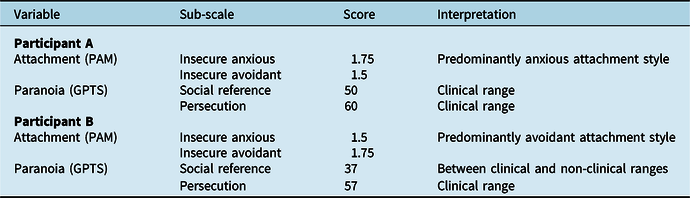
Participant A was randomised to a baseline length of 3 weeks and matched follow-up of 2 weeks. Participant B was randomised to a baseline length of 2 weeks and matched follow-up of 3 weeks. Table 1 gives descriptive statistics for the trait measures. These show that participant A had a predominantly insecure anxious attachment style and high level of trait paranoia, and that participant B had a predominantly insecure avoidant attachment style and a high level of paranoia.
Descriptive statistics for trait measures

PAM, Psychosis Attachment Measure; GPTS, Green Paranoia Thoughts Scale.
Impact of attachment imagery on paranoia and affect
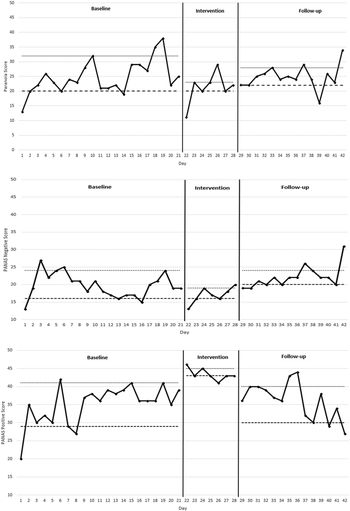
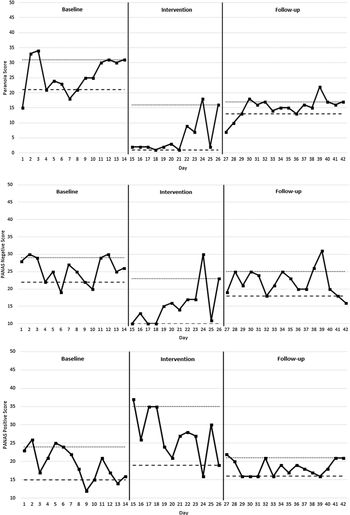
Figures 1 and 2 illustrate participants’ daily paranoia and affect scores over the 6-week period. The trimmed ranges are recommended to reduce the impact of extreme scores (Morley, Reference Morley2017).
Daily state paranoia and affect scores for participant A (trimmed ranges).

Daily state paranoia and affect scores for participant B (trimmed ranges).

Visual analysis of the data indicates high and variable levels of paranoia over the baseline, a reduction in paranoia during the intervention phase, and a return to baseline scores at follow-up. Negative affect shows a similar pattern across phases. Positive affect scores are high and variable over the baseline, increase over the intervention phase, and a return to baseline at follow-up.
Statistical comparison of phases: participant A
Mood’s median test and the Tau-U were used to compare differences across phases. Mood’s median test indicated no difference between baseline and intervention (χ2 = 2.45 (1), p = 0.118), and a difference between intervention and follow-up (χ2 = 3.88 (1), p = 0.049) for state paranoia. Visual inspection suggests a possible upwards trend in baseline data, which can affect the validity of this test. The Tau-U was therefore preferred, and showed a difference between baseline and intervention (u = –0.82, z = –3.21, p = 0.001), controlling for baseline trend. The Tau-U also allows for comparison of non-adjacent phases, and showed no evidence of difference between baseline and follow-up (u = –0.14, z = –0.69, p = 0.49). Consistent with the visual inspection of data, this pattern of results indicates a reduction in paranoia from baseline to intervention, and subsequent increase in paranoia from intervention to follow-up.
In terms of negative affect, Mood’s median test showed no difference between baseline and intervention (χ2 = 2.45 (1), p = 0.118), and a difference between intervention and follow-up (χ2 = 7.00 (1), p = 0.008. To control for possible trend within phases, the Tau-U was calculated and showed a non-significant trend between baseline and intervention (u = –0.48, z = –1.88, p = 0.060), a difference between intervention and follow-up (u = 0.91, z = 3.32, p < 0.001), and a difference between baseline and follow-up (u = 0.42, z = 2.09, p = 0.037). Taken together with the visual inspection of data, these results indicate a possible reduction in negative affect from baseline to intervention, and an increase from intervention to follow-up phase.
For positive affect, Mood’s median test showed differences between baseline and intervention (χ2 = 7.00 (1), p = 0.008), and between intervention and follow-up (χ2 = 10.07 (1), p = 0.002). To control for possible trend within phases, the Tau-U was calculated and showed a non-significant trend for difference between baseline and intervention (u = 0.48, z = 1.86, p = 0.063) and a difference between intervention and follow-up (u = –0.84, z = –3.06, p = 0.002), but not between baseline and follow-up (u = –0.16, z = –0.77, p = 0.439). Together with visual inspection, these results indicate a possible increase in positive affect from baseline to intervention, and a decrease from intervention to follow-up.
Statistical comparison of phases: participant B
Participant B continued to use the imagery intervention for 5 days beyond the 7-day intervention phase, reducing the follow-up period to 16 days. She reported that this was for two reasons: she had forgotten to stop the intervention, and had found the intervention helpful.
Mood’s median test indicated a difference between baseline and intervention (χ2 = 6.69 (1), p = 0.01), and a difference between intervention and follow-up (χ2 = 109.11 (1), p < 0.001), for state paranoia. Given possible trend within phases, the Tau-U was preferred and showed a difference between baseline and intervention (u = –0.97, z = –0.419, p < 0.001), between intervention and follow-up (u = 0.75, z = 3.34, p < 0.001) and between baseline and follow-up (u = –0.88, z = –4.07, p < 0.001). This pattern of results indicates a reduction in paranoia from baseline to intervention, and an increase from intervention to follow-up.
Mood’s median test showed a difference between baseline and intervention (χ2 = 5.257 (1), p = 0.022) for negative affect, and a difference between intervention and follow-up (χ2 = 9.33 (1), p = 0.002). The Tau-U showed a difference between baseline and intervention (u = –0.80, z = –3.45, p < 0.001), between intervention and follow-up (u = 0.52, z = 2.32, p = 0.02), and between baseline and follow-up (u = –0.51, z = –2.37, p = 0.018). Together with the visual inspection, these results indicate a reduction in negative affect from baseline to intervention, and an increase from intervention to follow-up.
For positive affect, Mood’s median test showed a non-significant trend between baseline and intervention (χ2 = 3.16 (1), p = 0.075), and a difference between intervention and follow-up (χ2 = 12.44 (1), p < 0.001). Given possible trend within phases, the Tau-U was preferred and showed a difference between baseline and intervention (u = 0.95, z = 4.11, p < 0.001) and between baseline and follow-up (u = –0.77, z = –3.44, p < 0.001), but no difference between baseline and follow-up (u = 0.05, z = 0.23, p = 0.819). Together with the visual inspection, these results indicate an increase in positive affect from baseline to intervention, and a decrease from intervention to follow-up.
Additional comments
Subjective feedback received from participants support the visual and statistical analyses, indicating that the task had notable though transient effects. Participant A ‘[n]oticed a temporary difference for a couple of hours. I felt more relaxed and settle[d] and felt less paranoid … Probably will continue using the imagery task every few days mainly when I feel really bad. It might be useful just before I go out.’ Similarly, participant B ‘noticed that the intrusive behaviour of some of the neighbours became less noticeable after completing the imagery task … It was very helpful during the actual task. The effects did not last long unfortunately. But I am considering doing it again in the future, maybe more than once a day.’
There were no adverse effects reported during the study.
Discussion
This study utilised a single case A-B-A design to assess the impact of an attachment-based imagery task on self-reported paranoia and mood, in two people with a diagnosis of schizophrenia. For both participants, the baseline phase indicated high and variable levels of paranoia. Visual inspection of the data and statistical comparisons across phases show that paranoia reduced during the intervention phase, and then increased again at follow-up. This is supported by participants’ subjective feedback. The data indicate a similar pattern for negative affect. Following high and variable levels over baseline, negative affect reduced over intervention (with partial evidence of this for participant A), and then increased again over follow-up. A reverse pattern was seen for positive affect; following high and variable levels over baseline, we found an increase during intervention and subsequent decrease over the follow-up phase (again, with partial evidence for participant A).
The results support the hypothesis that secure-attachment imagery reduces paranoia and negative mood, and increases positive mood. Participants described the task as easy to use, and there was no evidence of adverse effects. These findings are consistent with analogue studies showing that secure attachment priming reduces paranoia and distress (Bullock et al., Reference Bullock, Newman-Taylor and Stopa2016; Newman-Taylor et al., Reference Newman-Taylor, Kemp, Potter and Au-Yeung2017), and is the first to demonstrate the impact of attachment imagery in clinical participants.
Importantly, these gains were not maintained once practice ceased. Further studies are needed to examine the feasibility and impact of continued use, to prevent a return to baseline. It is also of note that for both participants, paranoia and affect changed from the first intervention session. Qualitative exploration of participants’ experience of the task would be valuable to understand this more fully.
These results add to the growing body of literature demonstrating the impact of imagery for people with psychosis, within a broadly cognitive behavioural framework (Ison et al., Reference Ison, Medoro, Keen and Kuipers2014; Morrison, Reference Morrison2004; Paulik et al., Reference Paulik, Steel and Arntz2019; Sheaves et al., Reference Sheaves, Onwumere, Keen and Kuipers2015; Taylor et al., Reference Taylor, Bee, Kelly and Haddock2019), and show that a task designed to facilitate interpersonal safety was beneficial to people with a diagnosis of schizophrenia characterised by persecutory delusions.
Attachment theory proposes that repeated priming can activate secure working models of self and others (Bowlby, Reference Bowlby1973, Reference Bowlby1988), which in cognitive theory terms we would understand as beliefs about the self and others, and associated affective and behavioural responses, including emotion regulation. For people with psychosis who report cognitive, affective and behavioural patterns associated with early adversity, repeated and vivid recall of safe relationships may be an effective emotion regulation strategy.
Attachment imagery might augment trauma interventions, cognitive behavioural therapies more broadly, and facilitate access to wider services. Trauma interventions are currently recommended but infrequently offered to people with psychosis, possibly due to clinicians’ concerns about triggering short-term distress (cf. Sin et al., Reference Sin, Spain, Futura, Murrelis and Norman2017); improved emotion regulation through attachment-based imagery may give us the confidence to offer trauma work safely. In terms of augmenting CBTp more broadly, we would recommend a formulation-based approach to determine when attachment imagery might be utilised. This would involve eliciting and naming any emotion dysregulation in the formulation (e.g. ‘difficulty managing my feelings’ or ‘feeling overwhelmed by fear/despair/fury’), and incorporating the imagery task in the treatment plan. It is likely that this would be an early task in therapy, which might also facilitate behavioural and cognitive interventions designed to tackle feared situations and reconsider distressing appraisals of the self and others, for example. We also know that many with psychosis struggle to access services. This makes sense when we consider people’s beliefs about others (unfortunately, too often compounded by past experiences of mental healthcare); further research might examine the impact of the imagery task on attachment-congruent behaviours such as help-seeking and thus engagement with services (cf. Gumley et al., Reference Gumley, Taylor, Schwannauer and MacBeth2014b).
Finally, it is interesting to note that both participants, one of whom presented with a predominantly anxious attachment style and one with an avoidant style, were able to make use of the imagery task. Future research might compare the impact of the task between groups, including those who are securely attached, to examine whether different attachment styles lead to differential effects.
Limitations
The study is limited by the lack of stable baselines, extended intervention period for participant B, and including just two people. Establishing a stable baseline is desirable in single case research (Gast, Reference Gast2010), but not always possible with clinical participants. This may be particularly difficult in psychosis given frequent fluctuations in symptoms (Bak et al., Reference Bak, Drukker, Hasmi and van Os2016) and attachment insecurity (Sitko et al., Reference Sitko, Varese, Sellwood, Hammond and Bentall2016). While we did not achieve stability over these phases, we did ensure baselines of at least the gold-standard minimum of five data points (Kratochwill et al., Reference Kratochwill, Hitchcock, Horner, Levin, Odom, Rindskopf and Shadish2010).
Participant B found the intervention helpful and continued the intervention for longer than 7 days, and we need to be cautious about drawing firm conclusions from a study involving just two people. Although participant B’s extended intervention phase was unplanned, and the generalisability of the results from two participants cannot be assumed, a great strength of single case methodology is that participants act as their own controls and so comparisons between phases remain legitimate – we can have confidence in the changes observed for the participants involved (cf. Morley, Reference Morley2017). A sample size of two is also consistent with previous single case publications (e.g. Townend, Reference Townend2003; Wain et al., Reference Wain, Kneebone and Cropley2011) including psychosis studies (e.g. Ellett, Reference Ellett2013; Newman-Taylor et al., Reference Newman-Taylor, Harper and Chadwick2009).
Conclusions
This is the first study to examine secure attachment imagery in people with psychosis. The robust single case design provides rich data and allows for close monitoring of change over time in small and ecologically valid samples. We found that a brief attachment-based imagery task was effective in reducing paranoia and improving mood. Continued use is likely to be needed to maintain gains. We suggest that the task may function as a safe and effective emotion regulation skill for people with psychosis characterised by persecutory delusions.
Acknowledgements
We would like to thank participants A and B for taking part in this study, and agreeing for us to write up the work.
Financial support
This research received no specific grant from any funding agency, commercial or not-for-profit sectors.
Conflicts of interest
The authors have no conflicts of interest with respect to this publication.
Ethical statements
The authors have abided by the Ethical Principles of Psychologists and Code of Conduct as set out by the APA: http://www.apa.org/ethics/code/. Ethical approval for the study was granted by the University of Southampton (Study ID: 31666), NHS Research Ethics Committee (Study ID: 17/WM/0420), and the Health Research Authority (IRAS project ID: 225815).



Comments
No Comments have been published for this article.