Clostridioides difficile infection (CDI) leads to increased morbidity and mortality, extended hospital stays, and increased healthcare utilization and costs.Reference Magill, Edwards and Bamberg1–Reference Lucado, Gould and Elixhauser4
In July 2012, the VA, the largest integrated healthcare system in the United States, introduced a CDI prevention initiative (i.e., a CDI bundle) within its acute-care facilities with a goal of reducing CDI rates to zero within two years of implementing the program. The CDI bundle includes practice recommendations for four CDI prevention areas: (1) environmental cleaning, in which various products could be used, such as bleach or hydrogen peroxide; (2) hand hygiene using water and soap; (3) contact precautions for patients with suspected or confirmed CDI; and (4) cultural transformation in which everyone becomes a stakeholder in infection prevention. This initiative was a VA national directive mandating participation and was implemented by all VA facilities nationwide.
An analysis of the period July 2012 to March 2015 showed that the CDI bundle was associated with reduced hospital-onset healthcare facility-associated (HO-HCFA) CDI rates across the VA system.Reference Evans, Kralovic, Simbartl, Jain and Roselle5 However, the impact of individual CDI prevention practices on CDI rates (eg, duration of isolation precautions for known CDI cases, bleach disinfection contact time, and monitoring of cleaning and isolation practices) has not been described. Understanding the impact of these individual factors may help in designing targeted prevention strategies and determining an optimal bundle of prevention practices.
In this study, we assessed existing CDI prevention practices within VA acute-care facilities and examined the relationship between infection prevention practices and HO-HCFA CDI rates reported routinely by VA facilities.
Methods
To gather information about their facility’s CDI prevention practices, a cross-sectional electronic survey was sent to infection prevention staff who perform and support infection prevention and control functions in VA acute-care facilities. The survey was pilot-tested with 6 VA facilities and deployed to acute-care inpatient VA facilities from January 2017 to February 2017. We linked facility-level survey data with facility-level HO-HCFA CDI (henceforth referred to as CDI) rates for the period January 2015 to December 2016. Perceived CDI rates were cross-checked with the actual reported CDI in the VA system. The CDI data were obtained from the VA national centralized database. The survey targeted four key areas of interest: CDI prevention practices, carbapenem-resistant Enterobacteriaceae prevention practices, decolonization using chlorhexidine gluconate bathing, and general infrastructure of the infection prevention program.Reference Keating, Obasi and McKinley8 In this study, we focused on CDI prevention practices.
The survey instrument was developed by a technical advisory group (TAG) of subject-matter experts comprised of infectious disease specialists, infection preventionists, implementation scientists and researchers in the field of infection prevention. The VA Healthcare Analysis and Information Group provided project management, survey administration, and data management. The survey included forced choice, multiple choice, Likert, and open-ended questions to assess the content areas identified by the TAG as critical to understanding current infection prevention and control activities related to preventing emerging and multidrug-resistant organisms (MDROs) in VA healthcare facilities. This study was deemed a quality improvement project by the institutional review board of record.
Case definition for CDI
Similar to Evans et al,Reference Evans, Simbartl, Kralovic, Jain and Roselle9 we used the HAI case definitions in the VA acute-care user manual; they were analogous to those of the Centers for Disease Control and Prevention (CDC) National Healthcare Safety Network MDRO/CDI module for facility-wide inpatient areas.10
The time of onset of CDI was defined as the time at which a stool was collected for C. difficile laboratory testing. A CDI laboratory event was defined as any nonduplicate positive CDI laboratory test result collected >48 hours after admission to the acute-care facility. During the time when the data used for this manuscript were collected (January 2015 through December 2016), 83.2% of facilities used polymerase chain reaction (PCR) alone; 5.3% used the stool toxin assay alone; and 6% used other tests for the diagnosis of CDI.
CDI prevention practices
Data on VA CDI prevention practices were obtained from survey responses. Similar to the approach by Daneman et al,Reference Daneman, Guttmann, Wang, Ma, Gibson and Stukel11 two investigators (an infectious disease physician [N.S.] and an infection preventionist [L.M.]) selected the variables according to their potential to result in reduced CDI rates and their relevance to the CDI bundle. We evaluated the following variables: self-reported changes in CDI rates since implementing CDI bundle, method of notifying infection control staff of CDI cases, duration of isolation precautions for known CDI cases, frequency of monitoring compliance with personal protective equipment (PPE), bleach disinfection contact time, persons responsible for monitoring environmental cleaning, methods used to monitor environmental cleaning compliance, and availability of private rooms and/or bathrooms. The duration of contact precaution isolation for patients with confirmed CDI was categorized as (1) VA acute-care definition, the duration of illness plus at least 48 hours after cessation of diarrhea, (2) CDC definition, the duration of illness until asymptomatic of diarrhea, or (3) the duration of hospitalization.
Analysis
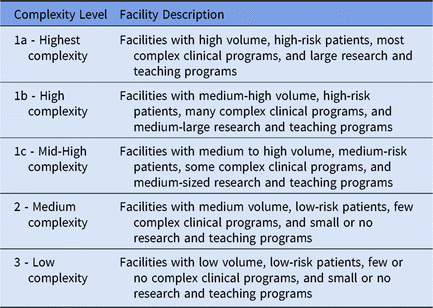
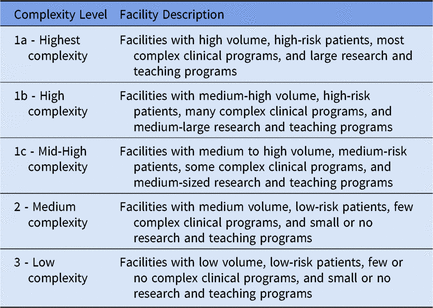
The sample used for analyses consisted of those facilities with valid survey responses, self-reported increase or decrease of CDI rates and actual CDI rates for each facility. Using descriptive statistics, we analyzed and presented frequencies to survey questions. The outcome variable was CDI rate expressed as rate per 10,000 bed days of care (BDOC). One BDOC was defined as an overnight stay of an individual in a VA bed within an assigned treating specialty bed section.12 We calculated CDI rates associated with survey responses in a bivariate analysis. In addition, we stratified facilities according to whether their overall CDI rate per 10,000 BDOC was above or below the national VA mean CDI rate of 0.74 per 10,000 BDOC, and we calculated the risk ratio (RR) associated with having a CDI rate above the national CDI rate for each CDI prevention practice. We wanted to examine whether certain survey responses were more often recorded by facilities with higher CDI rates. Using categorical variables in 2 × 2 tables with facilities’ survey responses against their CDI rates above or below the mean of national CDI rates was the most useful method of quantifying the strength of the association and of providing results that were directly interpretable as probabilities and risk ratios (RR). We conducted multiple logistic regression analysis to assess the odds of having a CDI rate above the national CDI rate for a given CDI prevention practice, adjusting for the complexity of each facility. Facility complexity, ranging from 1 (highest complexity) to 3 (lowest complexity), is a surrogate measure of patient case mix of various hospitals (Table 4). Variables for inclusion in the regression model were identified based on clinical and/or statistical significance in bivariate analysis. Analyses were performed using SAS version 9.3 software (SAS Institute, Cary, NC), and all reported P values were 2-tailed.
Facility Complexity Level
Results
All 126 VA facilities that provided acute inpatient care at the time of the survey responded (100% response rate): 83 (65.9%) level 1 facilities, 24 (19.1%) level 2 facilities, and 19 (15.1%) level 3 facilities. The most frequently reported survey respondents were infection preventionists (IPs, 66 of 126, 52%) and MDRO program coordinators (MPC, 27 of 126, 22%).
There were 229 IPs at 126 facilities: 163 of the IPs (71%) were nurses and 114 (50%) were certified in infection control (CIC). There were 131 MPCs at 126 facilities: 92 of the MPCs (70%) were nurses and 30 (23%) were CIC certified. Subsequent analyses were based on a total of 123 VA facilities because 3 facilities did not have data on CDI rates available.
Among the 123 facilities, 60 (49%) reported a decrease in CDI after implementing the VA-CDI bundle, compared with 22 (18%) that reported an increase in CDI rates; 41 (33%) reported that rates had not changed.
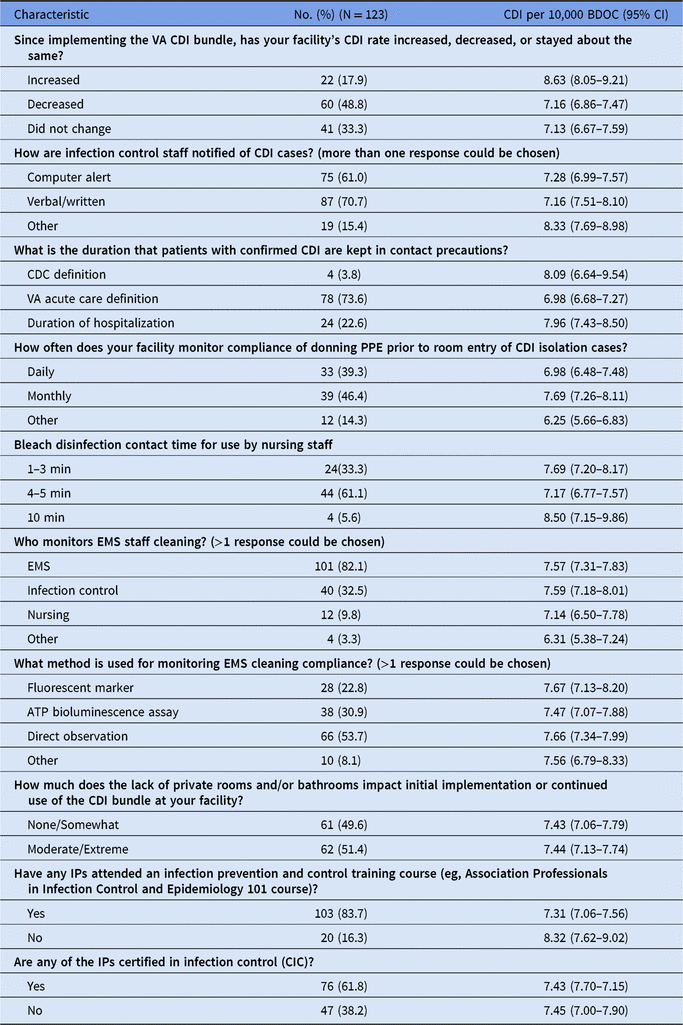
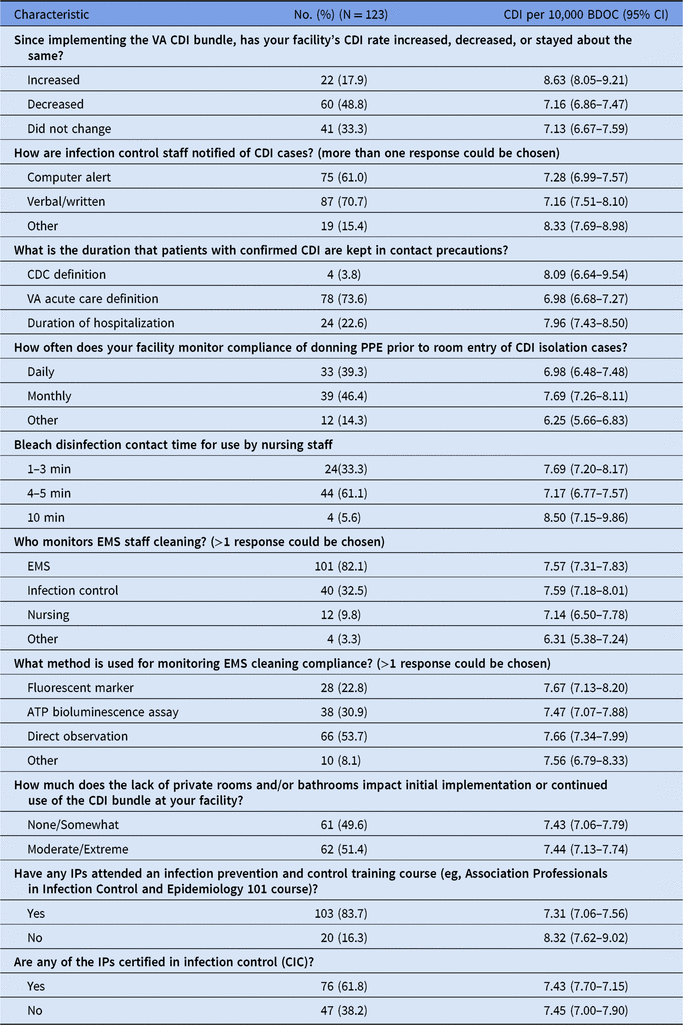
Table 1 summarizes CDI prevention practices in these facilities. Of 106 facilities, 78 (74%) isolated patients with confirmed CDI for the entire duration of illness plus 48 additional hours after diarrhea resolved (ie, the VA acute-care definition). The proportion of respondents using bleach contact time of 4 minutes or higher was 67% (48 of 72). Environmental cleaning was monitored by environmental management service (EMS) in 101 of 123 facilities (82%) and by the infection control department in 40 of 123 facilities (32%). Infection control staff were notified of CDI cases through written or verbal means in 87 of 123 facilities (70%) and through computerized alerts in 77 of 123 facilities (75%). Respondents could answer yes to multiple communication avenues.
Clostridioides difficile Infection (CDI) Prevention Practices Frequencies and CDI Rates, Bivariate Analysis
Note. VA, Veterans’ Affairs; CDC, Centers for Disease Control and Prevention; IP, infection preventionist; EMS, environmental management service; MPC, MDRO program coordinator; CIC, certified in infection control; ATP, adenosine triphosphate; BDOC, bed days of care; CI, confidence interval.
Monthly monitoring of PPE donning prior to room entry of CDI cases in contact precautions occurred in 39 of 84 facilities (46%), and 33 of 84 facilities (39%) did daily monitoring. Monitoring EMS cleaning compliance was done through direct observations in 66 of 123 facilities (54%). Half of the participants (61 of 123) did not perceive the lack of private rooms and/or bathrooms as a barrier to initial implementation or continued use of the CDI bundle at their facilities. All facilities required hand hygiene with soap and water when providing care for patients with confirmed CDI; 120 of 126 facilities (95%) required hand hygiene with soap and water during the care for patients with suspected CDI. We did not explore this variable further given that there was very little variation in response.
Bivariate analysis comparing survey responses and CDI rates of facilities
We calculated CDI rates per 10,000 BDOC. Facilities that reported an increase in CDI rates since implementing bundled CDI prevention practices had a mean rate of 8.63 CDI cases per 10,000 BDOC (95% CI, 8.05–9.21) based on the national VA CDI data. This was significantly greater than that for facilities reporting that their CDI rates had decreased or those reporting that their CDI rate did not change. Facilities that reported keeping patients with a confirmed diagnosis of CDI in contact precautions for the duration of hospitalization had higher CDI rates compared to those that use 48 hours after resolution of diarrhea for isolation duration: 7.96 CDI cases per 10,000 BDOC (95% CI, 7.43–8.50) vs 6.98 CDI cases per 10,000 BDOC (95% CI, 6.68–7.27). CDI rates did not differ between facilities that reported monitoring environmental cleaning by EMS or infection control, but facilities in which nurses monitored EMS cleaning had significantly lower CDI rates than those in which monitoring was reported by EMS or infection control.
The CDI rates did not differ between facilities based on frequency (daily vs monthly) of isolation room PPE compliance monitoring or between facilities reporting different communication methods (computer alerts vs verbal or written alerts) of CDI cases to IPs. CDI rates did not differ based on variations in bleach disinfection contact time, method used to monitor environmental cleaning compliance, or the perception of the lack of private rooms and single bathrooms. CDI rates did not differ between facilities employing IPs with and without CIC certification (Table 1).
Facilities stratified according to whether their overall CDI rate per 10,000 BDOC was above or below the national CDI rate
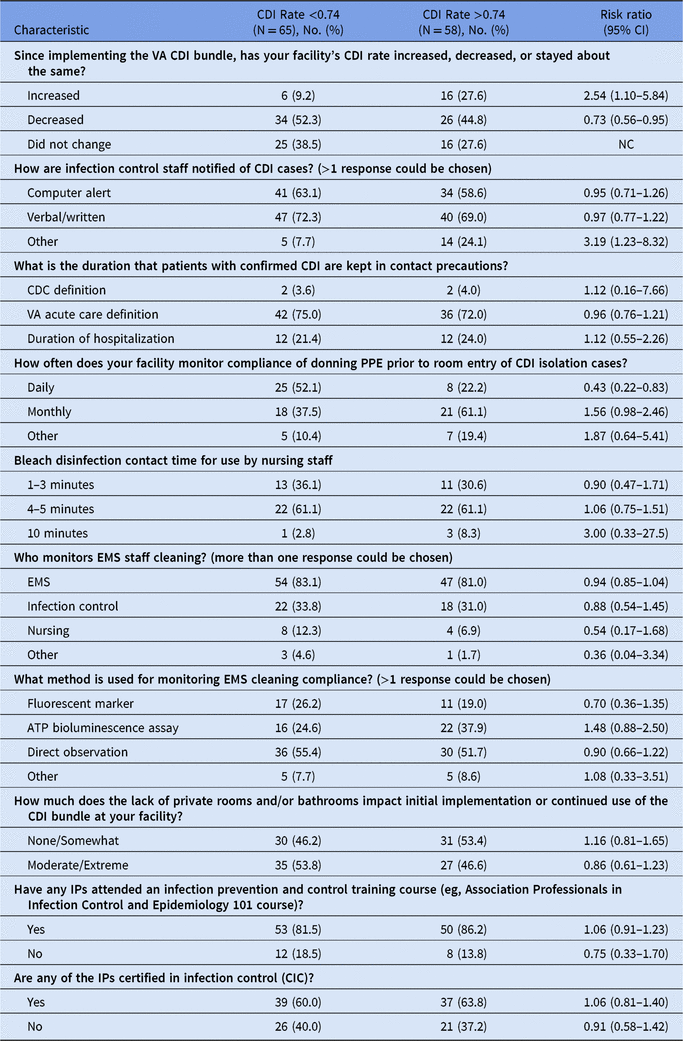
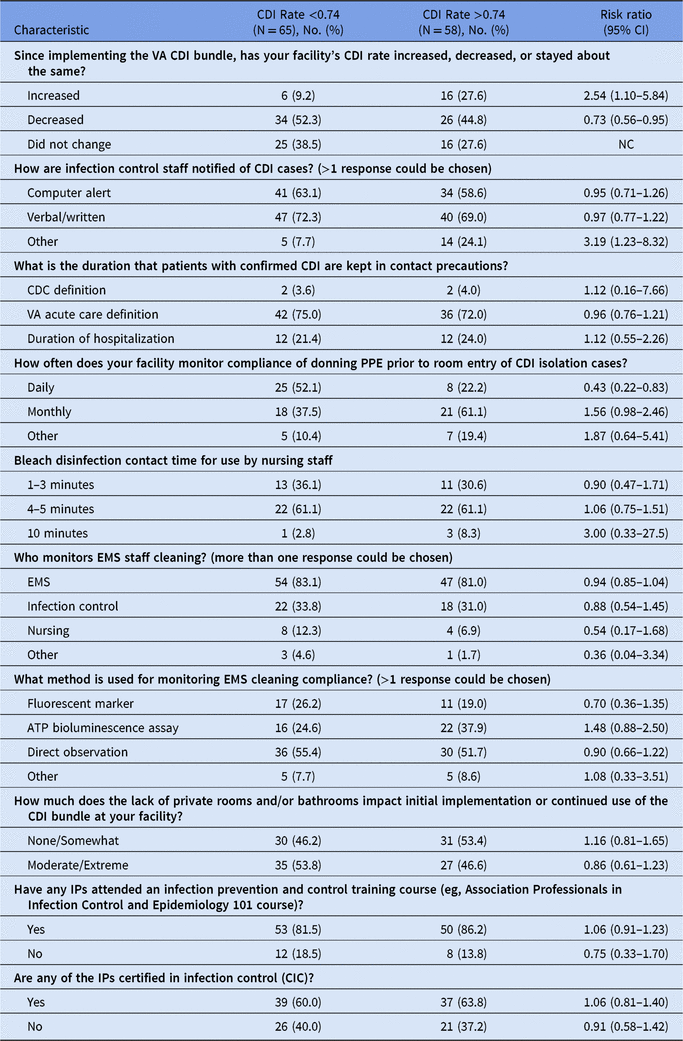
Of 123 facilities, 58 (47%) had CDI rates above the national VA mean CDI rate of 0.74 per 1,000 BDOC, and 65 (53%) had CDI rates below the national VA mean. Facilities that self-reported that their CDI rates had increased after implementing the CDI bundle were 2.54 (95% CI, 1.10–5.84) times more likely to have CDI rates above the national CDI rate compared with facilities that reported a decrease in their CDI rates. In addition, those facilities in which infection control staff were notified of CDI cases by other methods (eg, paper copies of lab reports, log sheets, etc) were 3.2 (1.2 – 8.3) times more likely to have their CDI rates above the national average compared to facilities in which infection control staff were notified through verbal or computer alerts.
The duration that patients were kept in contact precautions did not significantly influence whether a facility’s CDI rates were above or below the national CDI rate. Compared to any isolation duration, facilities whose duration of isolation was 48 hours after resolution of diarrhea (VA acute-care definition) had a CDI RR of 0.96 (95% CI, 0.76–1.21); those whose isolation was for the duration of diarrhea (CDC definition) had a CDI RR of 1.12 (95% CI, 0.16–7.66), and facilities whose isolation was throughout their hospitalization had a CDI RR of 1.12 (95% CI, 0.55–2.26).
Whether a facility’s CDI rates were above or below the national CDI rate was not influenced by the following factors: (1) the department that monitors environmental cleaning, (2) the method used for monitoring environmental cleaning compliance, (3) frequency of monitoring isolation PPE compliance, (4) bleach disinfection contact time, (5) the lack of private rooms/single bathrooms or (6) certification of IPs in infection control (Table 2).
Clostridioides difficile Infection (CDI) Prevention Practices for Facilities with CDI Rates Above and Below National Hospital-Onset Healthcare Facility Associated (HO-HCFA) CDI Rate
Note. IP, infection preventionist; EMS, environmental management service; MPC, MDRO program coordinator; CIC, certified in infection control; ATP, adenosine triphosphate. NC, not calculated.
Multiple logistic regression analysis to assess the odds of having a CDI rate above the national CDI rate for a given CDI prevention practice
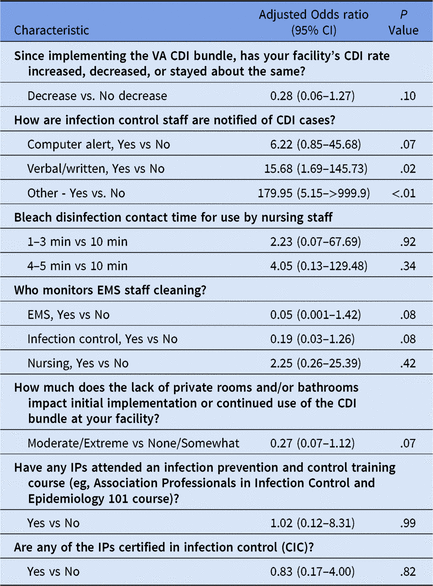
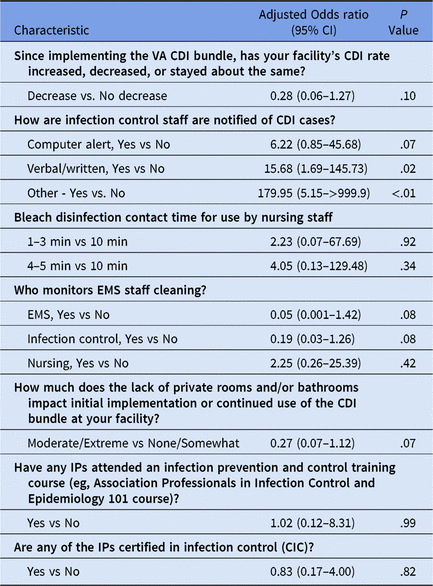
Multiple regression analysis, adjusting for the complexity of each facility, showed that CDI rates were not influenced by any of the following factors: (1) infection control training, (2) infection control certification, (3) self-reported CDI rates as being high or low, (4) method of notification of CDI by lab to infection control staff, (5) bleach disinfection contact time, (6) the department that monitors environmental cleaning, or (7) the lack of private rooms/single bathrooms (Table 3).
Multivariable Logistic Regression Showing Odds of Clostridium difficile Infection (CDI) Rate Being Above the National Average Rate for Different CDI Prevention Practices, Adjusting for Facility Complexity
Note. IP, infection preventionist; EMS, environmental management service; CIC, certified in infection control.
Discussion
Our study found that half (48%) of VA acute-care facilities reported a decrease, and the other half (52%) reported an increase or no change in CDI rates after bundle implementation. We showed that facilities reporting a perceived increase in CDI rates after implementing the CDI bundle were more likely to have rates above the national VA CDI rate. This finding shows consistency between the survey findings and actual facility CDI rates. Verbal or computer notification of CDI to infection control staff was associated with lower CDI rates, and “other” communication methods (ie, MDRO daily census reports, daily laboratory print-outs, or log sheets generated by the laboratory) were associated with higher CDI rates. This finding is reassuring because verbal or computer alerts are commonly used communication methods and may be simpler than the more complex other methods reported, including identifying CDI in daily census reports or daily laboratory printouts.Reference Dubberke, Carling and Carrico13 Verbal or computer alerts allow facilities to compile patient-level C. difficile data in real time, and also increases the likelihood of acting on this data. Moreover, electronic surveillance (eg, through computer alerts) is more accurate and reliable than manual surveillance (eg, through generation of laboratory log sheets).Reference Hota, Lin and Doherty14
The key strengths of our study are linking facility-level survey data with actual CDI rates and a 100% survey response rate from all VA acute-care facilities. This survey was mandated by the VA. Evans et alReference Evans, Kralovic, Simbartl, Jain and Roselle5 reported that between July 2012 and March 2015, the VA CDI prevention initiative led to a 15% decrease in the standardized infection ratios of clinically confirmed CDI cases. In this study, we were not able to identify the specific contribution of each bundle component to CDI prevention in this analysis. The inability to identify individual component effectiveness when implementing multiple bundled evidence-based practices concurrently was also noted in a large study evaluating CDI hospital prevention strategies in preventing patient risk of CDI.Reference Daneman, Guttmann, Wang, Ma, Gibson and Stukel11 Daneman et alReference Daneman, Guttmann, Wang, Ma, Gibson and Stukel11 showed that patient-level risk factors such as older age, specific medical comorbidities like inflammatory bowel disease, liver disease, and being immunocompromised were important predictors of CDI. A limitation of that study was that less than half of participating facilities self-reported compliance with several infection control practices such as empiric patient isolation with onset of diarrhea and antimicrobial stewardship program. However, two systematic reviews reported that bundled interventions showed an improvement in CDI rates.Reference Barker, Ngam, Musuuza, Vaughn and Safdar15 , Reference Louh, Greendyke and Hermann16 Nonetheless, assessing a causal relationship between bundled interventions and CDI rates is currently difficult given the abscence of randomized controlled trials examining this association.
Our finding that any particular self-reported CDI prevention practices were not associated with low CDI rates could be due to multiple factors: self-reported prevention practices, lack of data on the influence of antimicrobial stewardship on CDI rates, and other factors such as patient comorbidities and variation in implementation of prevention practices. These factors were not investigated in this study.
Individual interventions may have had a significant impact on outcomes, but effects in this study were measured by self-reported normative survey responses that may have been influenced by social desirability: participants might have been averse to self-reporting high CDI rates at their facilities. However, we linked the survey with actual CDI rates. The survey did not attempt to capture implementation fidelity of the various prevention practices reported.
The analysis was based on VA data and may not be generalizable to other populations in the United States. We were not able to control for unmeasured confounding factors. CDI prevention is multifactorial; other prevention practices could affect the risk of CDI but were not measured in our survey. These include factors such as antibiotic stewardship, variation in CDI testing methods and importation of community-associated CDI. We measured mode of notification of results rather than time to notification of results. Although time to notification of CDI results might be more meaningful, its measurement with a survey methodology is likely to have been reported with errors due to recall issues. Therefore, we used mode of notification of results as a surrogate for the time to notification of results.
The survey of infection control practices was cross-sectional in nature, whereas the CDI outcome data used for analysis spanned a 2-year period prior to the survey. However, this lack of overlap of survey period and CDI outcome data should not have influenced our findings because the CDI bundle prevention practices were implemented throughout the study period. In addition, mandatory reporting of CDI within the VA occurred simultaneously with the CDI initiative, which allows for audit and feedback of HAI outcomes, an important component of infection prevention programs.Reference Mauger Rothenberg, Marbella, Pines, Chopra, Black and Aronson19
In conclusion, we were not able to delineate which CDI prevention practices or bundled components were associated with low CDI rates. A better understanding of the impact of individual practices that led to CDI reductions will help target interventions that are more economical and practical, but this will require additional research. Future cluster randomized control trials of individual infection prevention and control practices are needed to adequately assess their impact on CDI. In addition, studies are needed to assess real-world variations in implementation of infection practices for CDI prevention.
Acknowledgments
The views expressed in this article are those of the author(s) and do not necessarily represent the views of the Department of Veterans’ Affairs.
Financial support
This work was supported by the Department of Veterans’ Affairs, Veterans’ Health Administration, Health Services Research and Development Service Quality Enhancement Research Initiative (project no. PEC 15-248).
Conflicts of interest
All authors report no conflicts of interest relevant to this article.