INTRODUCTION
Body dysmorphic disorder (BDD) is characterised by a preoccupation with, and repetitive behaviours in response to, a perceived flaw in one’s physical appearance, which causes significant distress and impairment in functioning (American Psychiatric Association, 2000). For BDD patients, poor insight, fears of negative evaluation, and ideas of reference are often associated with appearance-related beliefs, leading to feelings of distress and social withdrawal (Castle et al., Reference Castle, Rossell and Kyrios2006; Labuschagne et al., Reference Labuschagne, Castle, Dunai, Kyrios and Rossell2010; Marazziti et al., Reference Marazziti, Giannotti, Catena, Carlini, Dell’Osso, Presta, Pfanner, Mungai and Dell’Osso2006; Phillips et al., Reference Phillips, Hollander, Rasmussen, Aronowitz, DeCaria and Goodman1993).
The perception of emotion from faces is an essential social cognitive function, and there is growing evidence that facial emotion processing is a core deficit in the social cognitive profile of BDD. While individuals with BDD do not have a deficit in general face recognition when compared to healthy controls, they do show a deficit in the recognition of facial emotional expressions (Buhlmann et al., Reference Buhlmann, McNally, Etcoff, Tuschen-Caffier and Wilhelm2006; Buhlmann et al., Reference Buhlmann, Etcoff and Wilhelm2011; Buhlmann et al., Reference Buhlmann, Gleiss, Rupf, Zschenderlein and Kathmann2004). People with BDD have also been identified as having slower and less accurate performance in face-matching tasks involving emotion, but not when matching neutral faces or shapes (Feusner et al., Reference Feusner, Bystritsky, Hellemann and Bookheimer2010a). Overall, current research in BDD points to a pattern suggestive of specific deficits in the ability to correctly recognise neutral, negative, or threatening facial emotions (Buhlmann et al., Reference Buhlmann, McNally, Etcoff, Tuschen-Caffier and Wilhelm2006; Jefferies et al., Reference Jefferies, Laws and Fineberg2012; Toh et al., Reference Toh, Castle and Rossell2015). For instance, the data outlined in Jefferies et al. (Reference Jefferies, Laws and Fineberg2012) suggested that BDD patients have specific deficits in the identification of ‘threat’ emotions (i.e., fear, anger, disgust), as opposed to non-threatening emotions (i.e., happiness, sadness, surprise). However, in addition to ‘threat’ emotions, other authors have reported additional deficits in response to ‘negative’ emotions such as sadness (Buhlmann et al., Reference Buhlmann, McNally, Etcoff, Tuschen-Caffier and Wilhelm2006; Toh et al., Reference Toh, Castle and Rossell2015). Compared to healthy controls, BDD patients exhibited specific deficits in recognising neutral emotional expressions. Such findings are speculated to result from a negative interpretational bias, whereby neutral expressions are more often misidentified as angry (Buhlmann et al., Reference Buhlmann, Gleiss, Rupf, Zschenderlein and Kathmann2004) or disgusted (Buhlmann et al., Reference Buhlmann, Etcoff and Wilhelm2011). Thus, further research into face emotion perception in BDD is warranted to determine whether there is a general facial emotion identification deficit or more specific deficits for negative or threatening emotions.
To this end, the current study aimed to investigate facial emotion recognition in BDD. We hypothesised that for a facial emotion recognition task displaying faces showing neutral, fear, happy, sad, and angry emotions, BDD patients (compared to demographically matched healthy control participants) would (i) make significantly more labelling errors and exhibit slower reaction times for all faces and (ii) demonstrate significantly worse performance in the identification of negative or threatening emotions (i.e., anger, sadness, and fear). As a second exploratory aim, we sought to investigate the relationships between facial emotion recognition accuracy and response times with BDD symptom severity, depression, and social anxiety.
METHOD
Participants
The clinical sample comprised 19 patients (6 male) diagnosed with DSM-IV BDD (American Psychiatric Association, 2000) who were referred from a local BDD clinic (Melbourne, Australia). Patients were excluded if they had a psychotic disorder or comorbid mental disorder that was considered to be their primary diagnosis, confirmed using the Mini International Neuropsychiatric Interview (MINI v5.0; Sheehan et al., Reference Sheehan, Lecrubier, Sheehan, Amorim, Janavs, Weiller, Hergueta, Baker and Dunbar1998); other comorbid psychiatric disorders were permitted as long as participants had a primary diagnosis of BDD. Assessment with the MINI showed that four BDD participants fulfilled diagnostic criteria for current major depressive disorder or dysthymia, and five had current agoraphobia or social phobia, which are representative of typical psychiatric comorbidity profiles of BDD patients (Gunstad & Phillips, Reference Gunstad and Phillips2003). The most common appearance-related concerns were face, hair, and skin. Six patients were taking an SSRI alone; three were taking an SSRI and anxiolytic medication; one was taking an SSRI and a mood stabiliser; one was taking an SNRI alone; one was taking mood stabilisers alone; and five were medication free.
A control sample of 21 healthy participants (7 male) matched for sex, age, and education were recruited via newspaper advertisements and posters at local universities. Using the MINI screen, no control participants had a current or past diagnosis of psychiatric illness, no known first-degree family history of mental illness, and no history of current alcohol/substance abuse or dependence.
All participants were fluent in English, had no current or previous neurological disorders, and had an estimated pre-morbid IQ of >70, as scored by the Wechsler Test of Adult Reading (WTAR, Wechsler, Reference Wechsler2001). Written informed consent was obtained, study procedures had full ethical approval by the Human Research Ethics Committee at the Alfred Hospital and were in accordance with the latest revision of the Declaration of Helsinki.
Materials
BDD diagnosis was confirmed using the BDD Disorder-Diagnostic Module (BDD-DM; Phillips, Reference Phillips1994). Current BDD symptomatology was assessed using the Yale-Brown Obsessive-Compulsive Scale modified for BDD (BDD-YBOCS; Goodman et al., Reference Goodman, Price, Rasmussen, Mazure, Fleischmann, Hill, Heninger and Charney1989; Phillips et al., Reference Phillips1997), the Zung Self-Rating Depression Scale (SDS; Zung, Reference Zung1965) for depression, and social anxiety symptoms with the Social Interaction Anxiety Scale (SIAS; Mattick & Clarke, Reference Mattick and Clarke1998).
The Facial Emotion Perception Task was designed to assess participants’ ability to identify emotional expressions based on whole face stimuli. Stimuli consisted of greyscale photographs exhibiting five emotional expressions (happy, sad, angry, fear, and neutral) selected from the Ekman and Friesen (Reference Ekman and Friesen1976) stimuli set. In the task, ten identities (five male and five female) were displayed four times, consisting of 200 stimuli in total, presented for 200 or 2000 ms, followed by the presentation of a fixation cross for 1700 ms; thus the maximum times to respond were 1900 or 3700 ms, repectively.Footnote 1 Stimuli were counterbalanced across the ten identities for serial position and number of repetitions of each face and affective state. Participants were instructed to indicate the emotion expressed on each face by pressing one of five stimulus-specific response buttons. The average percentage of correct responses (accuracy) and response time for each emotion were recorded.
Statistical Analysis
Demographic and clinical group differences were assessed via independent samples t-tests or χ2-tests. We assessed our hypotheses by entering accuracy and response time data into two mixed between-within ANOVAs with group (BDD, healthy controls) as the between-subjects factor, and emotion (happy, sad, fear, angry, and neutral), as the within-subjects factor. Follow-up post hoc analyses were performed using pairwise comparisons of simple main effects, with a Bonferroni adjustment applied and an alpha level of <.05 was considered statistically significant. Pearson’s correlations were also conducted to examine the relationship between emotion recognition task performance and BDD symptom severity, social anxiety, and depression scores, as assessed using the BDD-YBOCS, SIAS, and SDS, respectively. For correlational analyses, a Bonferroni corrected alpha level of <.01 was applied to account for multiple comparisons. Analysis scripts and data are available at https://osf.io/uavbq/.
RESULTS
Demographics and Clinical Data
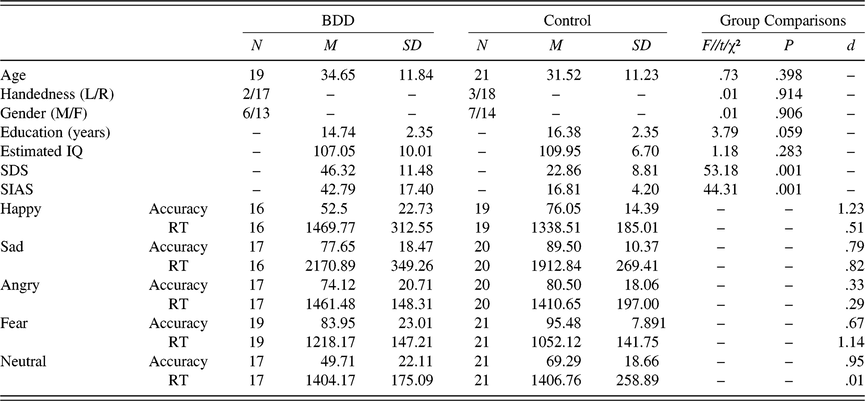
For the BDD group, the mean BDD-YBOCS score was 24.11 (SD = 9.14; range 7–39). When comparing BDD and control groups, no significant differences in age, gender, education, and IQ were observed. The SDS and SIAS scores were significantly different, with the BDD group predictably exhibiting elevated depression and anxiety symptoms relative to healthy controls (see Table 1).
Demographic and clinical characteristics of the sample and accuracy and observed response time means and standard deviations for the face emotion recognition task

Note. Group comparisons for demographics are all independent samples t-tests except gender and education, Please check if the text “Group comparisons for demographics are all independent sample t-tests except gender and education” is OK as written in table note.which were chi-squared. L/R = Left/Right; M/F = Male/Female; IQ estimated by Wechsler Test of Adult Intelligence; SDS = Zung Self-Rating Depression Scale; SIAS = Social Interaction Anxiety Scale; Accuracy = percent correct, RT = response time in milliseconds.
Emotion Labelling Accuracy Analysis
A mixed between-within subjects ANOVA (2 × 5) investigating the effect of emotion labelling accuracy found a significant group by emotion interaction effect [F(4,124) = 55.14, p = .002, partial η 2 = .12]. Planned contrasts demonstrated that BDD participants performed significantly worse in identifying the emotional expressions for angry faces [F(1,31) = 10.08, p = .003, partial η 2 = 0.25], neutral faces [F(1,31) = 5.63, p = .024, partial η 2 = .15], and sad faces [F(1,31) = 7.52, p = .010, partial η 2 = .16], indicating large effect sizes for these emotions. No significant group differences in accuracy for fearful or happy faces were found. Estimated marginal means are presented in Figure 1. We also found a significant main effect for emotion [F(2.87, 89.09) = 55.14, p < .001, partial η 2 = .64, Greenhouse-Geisser corrected], with the most accurately identified emotions being in the following order: happy, neutral, fear, happy, and sad. A significant main effect of the group was also observed [F(1, 31) = 8.21, p = .007, partial η 2 = .99], with the BDD group showing reduced accuracies for all emotions compared to the healthy control group. The observed means and standard deviations for each emotion type are presented in Table 1.
Estimated marginal mean accuracy rates (% correct) and response times (RT) for the face emotion recognition task across the groups. Significant differences are displayed at p < .05 (Bonferroni adjusted for multiple comparisons). Error bars represent 95% confidence intervals.

Response Time Analysis
A mixed between-within subjects ANOVA (2 × 5) investigating the effect of response time found a significant emotion by group interaction [F(4,124) = 4.13, p = .004, partial η 2 =.12], indicating that the BDD group responded slower than healthy controls for angry faces [F(1,31) = 5.14, p = .031, partial η 2 = .14], neutral faces [F(1,31) = 5.48, p = .026, partial η 2 = .15], and happy faces [F(1,31) = 6.75, p = .014, partial η 2 = .18], all with large effect sizes. No significant differences were observed for response time for fearful or sad faces. Estimated marginal means are presented in Figure 1. In addition, there was a significant main effect for emotion [F(3.26,101.04) = 123.05, p < .001, partial η 2 = .79, Greenhouse-Geisser corrected] with the fastest to slowest mean response times for each emotion being: happy, sad, angry, fear, and neutral. No significant main effect was observed for group.
Symptom Correlations
After Bonferroni correction, bivariate correlation analyses found no significant within-group associations for the BDD group between accuracy or response time performance and BDD-YBOCS, SIAS, or SDS scores.
DISCUSSION
This study investigated facial emotion recognition in BDD. In partial support of our hypothesis (i), we identified that BDD patients performed worse than healthy controls in identifying all facial expressions, in line with previous literature (Buhlmann et al., Reference Buhlmann, Gleiss, Rupf, Zschenderlein and Kathmann2004; Feusner et al., Reference Feusner, Bystritsky, Hellemann and Bookheimer2010; Toh et al., Reference Toh, Castle and Rossell2015). In contrast to our hypothesis (i), we did not find that the BDD group were significantly slower at identifying all emotions; however, they were significantly slower when identifying angry, neutral, and happy faces. In partial support of our hypothesis (ii), we also identified specific deficits for recognising negative and neutral emotions; the BDD group were significantly less accurate than the healthy control group in identifying angry, neutral, and sad expressions. However, in contrast to our hypothesis (ii), this deficit did not translate to all ‘threat’ emotions (i.e., fear), as identified by Jefferies et al. (Reference Jefferies, Laws and Fineberg2012). We found no significant associations between recognition performance or reaction time on the task and our clinical measures, including BDD severity.
Together with previous findings, this pattern of findings further affirms that BDD patients have a general deficit in identifying facial emotions, but this deficit is most robust for emotions involving expressions of anger, sadness, and neutral faces. To date, the BDD literature has identified significant recognition deficits for facial expressions of sadness, anger (Toh et al., Reference Toh, Castle and Rossell2015), fear (Jefferies et al., Reference Jefferies, Laws and Fineberg2012; Toh et al., Reference Toh, Castle and Rossell2015), neutral (Buhlmann et al., Reference Buhlmann, Etcoff and Wilhelm2011, Reference Buhlmann, Gleiss, Rupf, Zschenderlein and Kathmann2004), and disgust (Buhlmann et al., Reference Buhlmann, Gleiss, Rupf, Zschenderlein and Kathmann2004). Synthesising these findings, a deficit in the identification of ‘negative’ faces may represent an essential social-cognitive deficit in BDD, hypothesised to contribute to fears of negative self-evaluation that serves as a precipitating and maintaining factor in BDD symptoms (Buhlmann et al., Reference Buhlmann, Etcoff and Wilhelm2011). In support, a deficit in identifying neutral expressions could also be attributed to the increased tendency of BDD patients to interpret neutral faces as exhibiting negative emotions, such as in the case of anger (Buhlmann et al., Reference Buhlmann, McNally, Etcoff, Tuschen-Caffier and Wilhelm2006). It is therefore argued that for BDD patients, dysfunctional negative thoughts and beliefs can lead to and maintain deficits in the perception and interpretation of emotion in others, particularly for negative facial expressions.
Aberrant scanpath strategies identified in previous research could also play a role in explaining these deficits in emotion recognition in people with BDD. For example, there is evidence that BDD patients compared to controls either extensively attend to, or restrictively avoid, pertinent facial features (e.g., eyes and mouth) required to infer emotional expressions accurately (Toh et al., Reference Toh, Castle and Rossell2015). We speculate that our finding of slower reaction times for happy, neutral, and angry faces indicates that BDD patients are likely to display aberrant scanpath strategies, either excessively avoiding or fixating on the eyes and mouth, requisite to identifying these basic emotional expressions (Wells et al., Reference Wells, Gillespie and Rotshtein2016), and thereby contributing to slower reaction times and poorer identification performance. Of clinical relevance, Buhlmann et al. (Reference Buhlmann, Etcoff and Wilhelm2011) found preliminary evidence that such face emotion identification deficits can be improved with training. Thus, these data can inform targeted clinical treatments, for instance, in cognitive retraining programmes that focus specifically on emotional face perception (Buhlmann et al., Reference Buhlmann, Etcoff and Wilhelm2011) or in cognitive-behavioural treatment (CBT) approaches, through addressing negative interpretational biases with patients.
A limitation of the present study was the modest sample size and two participants had subclinical BDD at the time of their study participation (BDD-YBOCS score <16) despite having been diagnosed with DSM-IV BDD by a clinician, which was further confirmed by the BDD-DM. We re-tested all statistical models excluding these participants, which resulted in no significant changes to the outcomes of each model. So, to bolster sample size, we decided to include these participants in the final sample. Moreover, the present study had limitations in that it neglected to collect data on which specific emotions had been selected when errors were made and did not collect eye-tracking data. Previous research has shown that people with BDD tend to misinterpret neutral facial expressions as angry (Buhlmann et al., Reference Buhlmann, McNally, Etcoff, Tuschen-Caffier and Wilhelm2006) and an excessive focus or avoidance of facial features may contribute to an emotion recognition deficit in BDD patients (Toh et al., Reference Toh, Castle and Rossell2015). However, methodological constraints limited our ability to test these hypotheses with our data set and therefore we suggest that future studies collect both misidentification and eye-tracking data when examining face emotion recognition in BDD patients. Finally, several of the BDD patients were taking some form of psychoactive medication at the time of testing; some of these medications, that is SSRIs, have been shown to facilitate the recognition accuracy of emotional faces in healthy subjects and other clinical groups (Tranter et al., Reference Tranter, Bell, Gutting, Harmer, Healy and Anderson2009). We did not control for the effect of medication on emotion identification performance a priori; thus, we cannot exclude that medication use significantly contributed to our study findings.
In summary, this study identified a general face emotion perception deficit in BDD patients, with specific deficits identified for neutral, sad, and angry facial emotions. These data suggest an emotional identification deficit for negative faces in people with BDD, which might contribute to the maintenance of BDD symptoms. Future research should explore targeted intervention approaches such as CBT to retrain face emotion identification deficits in BDD patients.
ACKNOWLEDGEMENTS AND CONFLICTS OF INTEREST
The authors have no conflicts of interest but would like to acknowledge the Australian Government Research Training Program Scholarship for providing financial assistance for the completion of this work.