





Moravian count Heinrich Wilhelm Haugwitz (1770–1842) is known as one of the last great aristocratic patrons of secular vocal music, especially opera and oratorio, in Habsburg Central Europe. Unlike his more famous predecessors from the eighteenth century, such as Moravian count Johann Adam Questenberg (1678–1752), Hungarian prince Nikolaus I Esterházy (1740–90) and Bohemian prince Franz Joseph Maximilian Lobkowitz (1772–1816), Haugwitz did not focus on producing contemporary repertoire or commissioning new works.Footnote 1 Instead, he was driven by a fascination with past composers whom he admired and sought to promote. This focus on historical repertoire developed gradually after he took possession of his castle in Namiest (present-day Náměšť nad Oslavou) in 1794. The following year, he established a prospering cloth factory, whose profits allowed him to invest substantial sums in his musical pursuits. In 1800, he had a theatre built in his castle, accommodating sixty to eighty spectators, and began performing operas and oratorios with a large ensemble comprising an orchestra of up to thirty musicians, a substantial group of soloists and a choir.Footnote 2
Although Haugwitz’s productions in the early 1800s were diverse, including several of Mozart’s operas,Footnote 3 by the 1810s he had shifted his focus to works by three deceased composers – George Frideric Handel, Christoph Willibald Gluck and Johann Gottlieb Naumann – as well as one living composer, Antonio Salieri. This led him to produce German-language adaptations of English, French, Italian and Swedish operas by the composers he admired.Footnote 4 Over the decades and up to his death in 1842, Haugwitz repeatedly returned to some of these works, creating multiple – and at times strikingly different – adaptations.
Previous studies have examined the wealth of documents – manuscript and printed scores, librettos, production materials and financial records – related to Haugwitz’s engagement with Handel, Naumann and Gluck.Footnote 5 However, his work with Salieri’s operas has largely been overlooked.Footnote 6 Yet Antonio Salieri played a crucial role in Haugwitz’s operatic activities. Haugwitz was personally acquainted with the composer, who belonged to his Viennese circle of historical music enthusiasts, alongside Gottfried van Swieten, Ignaz von Mosel and Raphael Georg Kiesewetter.Footnote 7 Salieri not only dedicated compositions to Haugwitz but also visited Namiest several times, conducted the count’s orchestra and commented on his adaptations. Haugwitz was particularly drawn to those of Salieri’s operas that most closely resembled Gluck’s late works, especially the Parisian operas of the 1780s: Les Danaïdes, Les Horaces and Tarare. Footnote 8 Of the three, Salieri adapted only his 1787 Tarare (set to a libretto by Beaumarchais) for Vienna, in 1788. This Viennese adaptation, created in collaboration with Lorenzo da Ponte, transformed the French opera into the Italian Axur, re d’Ormus, substantially altering the plot, the music and – somewhat confusingly – the names of the characters: the Italian Axur corresponds to the French Atar, whereas the Italian Atar derives from the French Tarare (see Appendix D). Both Tarare and Axur were clearly among Haugwitz’s favourites, as he produced at least three distinct adaptations between 1810 and 1832.
This article argues that Haugwitz’s interest in decades-old operas – works no longer common in contemporaneous operatic repertoire – was shaped in part by early nineteenth-century efforts at the Vienna Court Theatre to assemble a patriotic canon of musical ‘masterpieces’ from the past. By foregrounding Salieri’s historical significance, Haugwitz became an early participant in processes of canon formation and contributed to the emerging notion of what Michael Talbot has termed ‘composer-centred’ musical practice: the tendency to categorise music according to composers and their presumed intentions.Footnote 9 Yet Haugwitz’s pursuit of historical fidelity was marked by contradictions and shaped by personal and political concerns. Since Lydia Goehr’s seminal study on the ‘musical museum’, scholars have often characterised the early nineteenth century as a transitional period leading toward a focus on unique musical works – the ‘work-concept’ – and with it, ideas of the musical canon and ‘original intentions’.Footnote 10 Haugwitz’s handling of Tarare/Axur reveals the uneven and often circuitous nature of these developments. His work anticipates modern ideas of historical fidelity even as it remains embedded in the ideological context of the time.
Haugwitz and the patriotic opera museum at the Vienna Court Theatre
Haugwitz’s interest in reviving eighteenth-century operas by Gluck and Salieri should be understood within the context of broader patriotic tendencies that shaped the repertoire of the Vienna Court Theatre in the first decade of the nineteenth century. These tendencies originated in the 1790s, when the reintroduction of a German opera company under the directorship of Peter von Braun provoked intense patriotic debates, in which various court officials criticised Italian opera and celebrated German works as exemplary of their understanding of Austrian cultural identity.Footnote 11 The construction of this new company’s German repertoire initially paralleled developments in German-language theatre throughout the late eighteenth century. As Austin Glatthorn has shown, most late eighteenth-century German opera companies relied on standardised repertoire and a balance of ‘familiarity with novelty’ to maintain audience interest.Footnote 12 After 1806, however, the Vienna Court Theatre partially shifted toward repertoire that was archaic and unfamiliar to contemporary audiences, staging works that were decades old, had never been performed in Vienna – and did not necessarily appeal to theatre-goers.
This move carried a clear political dimension and coincided with the disbandment of the Italian opera ensemble in the spring of 1806. The political significance of this repertoire shift was tied to the profound transformations within the Habsburg monarchy. In the wake of the 1804 proclamation of Emperor Francis II as Austrian Emperor Francis I and the 1806 dissolution of the Holy Roman Empire, Viennese culture increasingly emphasised notions of cultural patriotism.Footnote 13 As Claudio Vellutini has noted, moreover, following Austria’s cession of its Italian territories to France in the Treaty of Pressburg (26 December 1805), Italian opera increasingly came to be regarded as a foreign import, which further intensified the focus on German-language repertoire.Footnote 14 At the Vienna Court Theatre, these political shifts shaped cultural policies under the directorship of the Gesellschaft der Kavaliere, a group of Viennese music patrons who took over management from Braun on 1 January 1807. One of the most explicitly patriotic outcomes of the Gesellschaft’s policies was the revival of Gluck’s operas, which, according to Vellutini, ‘filled the void left by Italian opera seria … in the highbrow realm of tragic opera’.Footnote 15 Gluck operas produced at the Vienna Court Theatre during this period are listed in Table A1 (Appendix A). Andreas Mayer has shown that the cultivation of Gluck’s music in Vienna, which was supported by the activities of the soprano Anna Milder-Hauptmann and her colleague, baritone Johann Michael Vogl, were part of a larger movement to promote Austrian patriotism and German cultural consciousness at the time of the wars with Napoleonic France.Footnote 16 Eric Schneeman has gone as far as to suggest that the Gluck revival at the Vienna court opera may have been intended ‘to reclaim Gluck from the French’.Footnote 17 During the first two decades of the nineteenth century, furthermore, German critics (starting with E.T.A. Hoffmann and Ignaz von Mosel) claimed Gluck’s operas as part of the German (as opposed to French and Italian) cultural heritage and viewed his French operas, and particularly Iphigénie en Tauride, as models for future German grand opera.Footnote 18
Closely related to these efforts to construct a canon of serious historical ‘German’ operas were the Vienna Court Theatre’s productions of Mozart’s Idomeneo in 1806 (originally produced in Munich in 1781 and performed in Vienna only in concert in 1786) and La clemenza di Tito in 1811. Unlike earlier traditions of German opera in Vienna and elsewhere, the Court Theatre largely presented works that – apart from Tito – did not belong to the standard German or Italian repertoire in Habsburg Central Europe.Footnote 19
Contemporary critics in Vienna and beyond initially regarded these operas as archaic and out of step with prevailing tastes.Footnote 20 Such attitudes are evident, for instance, in a review of the first German production of Idomeneo in Kassel in 1802. The reviewer thought the music was perhaps too sophisticated to be appreciated by the audience:
The opinions about the value of the music are very diverse. Connoisseurs and admirers of the composition consider it, together with Don Giovanni, to be the masterpiece of this great artist; the class of musicians who are more receptive to Italian melody than to German harmony find all sorts of things to carp on about. They find no agreement in the style of the arias, recitatives and choruses; the former, they say, is operatic, the latter church style. The dilettantes in the strict sense of the word, however, find the least comfort in it, for in this piece there does not occur a single theme to hum along with, and alongside the sin of its serious style the music has another to atone for, namely that it is very long.Footnote 21
Discussing the same Kassel production, the Allgemeine musikalische Zeitung reviewer likewise emphasised the complexity of Idomeneo’s music but insisted that mainstream German audiences could – and should – be cultivated to appreciate such a work:
Our theatre has ventured something that no German stage has yet undertaken: to bring Mozart’s Idomeneo to the stage … To be sure, this sublime and profound music will, at first, always appeal only to the more discerning portion of the audience; but this makes it all the more commendable when theatre directors occasionally present works of this kind, so as to retain the esteem of the cultivated while gradually leading those who are not yet cultivated – but capable of becoming so – toward something better. This will surely succeed everywhere, provided that theatres know how to maintain their own dignity and persevere.Footnote 22
It is plausible that under Braun’s directorship – and even more so under the Gesellschaft – the Vienna Court Theatre presented Idomeneo and later the Gluck operas with a similar aim: to cultivate both the aesthetic sensibilities and patriotic sentiments of Viennese audiences.
It was during the first decade of the nineteenth century that Haugwitz’s operatic interests began to take shape. Although he was a Moravian count, he was clearly a product of the cultural and political developments in late eighteenth- and early nineteenth-century Habsburg Austria. His family originally came from Silesia, one of the Bohemian crownlands, much of which the Habsburgs had lost to Prussia during the War of the Austrian Succession. Despite the Silesian origins, Haugwitz’s great uncle Friedrich Wilhelm Haugwitz (1702–62) became one of the main proponents of Maria Theresa’s centralising reforms in the 1750s, which led to his appointment as the Supreme Chancellor of the United Court Chancery.Footnote 23 In 1752, Friedrich Wilhelm also purchased the Namiest estate, beginning the family’s association with another Bohemian crownland, Moravia. Although it was formally part of the Bohemian crown, Moravia’s aristocratic elites often pursued policies distinct from those of Bohemia proper and maintained closer ties with the Habsburg Austrian sphere.Footnote 24 Heinrich Wilhelm Haugwitz himself no longer held a prominent governmental post, but he remained closely connected to Austrian elite circles and divided his time between Vienna and Namiest. His cultural activities therefore reflected a multilayered identity: he was both a member of the Habsburg Austrian patriotic elite and a Moravian patriot, with many of his operatic adaptations published in the regional capital, Brünn (Brno). In the early nineteenth century, regional patriotism among local elites in the Habsburg lands was strongly tied to the German language, although significant portions of the Moravian regions controlled by Haugwitz would later identify as Czech, and likely spoke that language during his lifetime.Footnote 25 Haugwitz’s operatic activities, especially his creation of new German adaptations of musical ‘masterpieces’ by composers associated with Habsburg lands, thus aligned with the multilayered German-language-based imperial patriotism of Viennese cultural elites of the early 1800s.
Although Haugwitz’s operatic tastes were heavily shaped by the Viennese patriotic repertoire from around 1810, he gradually became more reclusive, and by the mid-1810s he no longer followed new developments in the theatres of the imperial metropolis. This shift is clearly reflected in his financial records, which provide detailed information about his purchases of musical scores and his participation in Viennese theatrical life. A comparison of two three-month periods a decade apart (1805 and 1815) illustrates the change in his interests (see Appendix B). In the first three months of 1805, the financial logs record more than twenty-five visits to Viennese theatres, sometimes even noting the specific works he attended – for example, Salieri’s Axur, re d’Ormus, Weigl’s Die Uniform, Mozart’s Die Entführung aus dem Serail and Don Giovanni. The operatic scores he purchased during this period closely mirrored the current Viennese theatre repertoire, including Salieri’s Axur, Grétry’s Raoul Barbe-bleue (Theater an der Wien in 1804), Dalayrac’s Léon, ou Le chateau de Montenero (Theater an der Wien, 1804) and Paer’s I fuorusciti (Court Theatre, 1804). By contrast, in the first three months of 1815 Haugwitz attended far fewer performances – only thirteen are recorded – and he no longer acquired scores of operas staged in Viennese theatres. Instead, his purchases focused primarily on masses and cantatas, including works by Naumann and Salieri. Although he was not purchasing contemporary works in his later years, Haugwitz kept reworking and performing some of the operas he acquired in his earlier years, especially the works of Gluck and Salieri. Thus, whereas the operas of these composers became increasingly rare at the Viennese stages, the Namiest theatre represented a time capsule of the Viennese operatic trends from the first decade of the century.
Salieri and Austrian cultural patriotism
Although Salieri’s works were not staged as part of the patriotic German repertoire at the Court Theatre, Viennese commentators, including Haugwitz and his friend Ignaz von Mosel, held the composer’s music in high regard and appropriated it for their ideological agendas. In this respect, the reception of Salieri’s serious operas was analogous to that of Mozart and Gluck, whose works came to be regarded as German masterworks despite being written in Italian and shaped by the conventions of Italian opera, conventions that German-language commentators, including Haugwitz, would later criticise. As Rudolph Angermüller has noted, in the final decades of his life, Salieri moved within a German national circle in Vienna that included Mosel, dramatist Heinrich Joseph von Collin, composer and music archivist Abbé Maximilian Stadler and Moritz von Dietrichstein, one of the directors of the Court Theatre in the 1820s.Footnote 26
Salieri, moreover, was himself deeply involved in the Gluck revivals and cultivated his image as a Gluck follower. After the premiere of the first Viennese patriotic Gluck production, Iphigénie en Tauride in 1807, one reviewer praised ‘the direction of the much-accomplished Salieri’.Footnote 27 Following the Court Theatre’s production of Gluck’s Alceste, Mosel emphasised that Salieri, one of the music directors at the theatre, always conducted Gluck’s operas himself and did so ‘out of commendable respect for his late friend and teacher’.Footnote 28 This respect also translated into regrets that Salieri’s own music had disappeared from Viennese stages, most prominently voiced in Mosel’s 1827 biography of the composer. Discussing both the success of the 1817 Paris revival of Les Danaïdes and the opera’s original 1784 production in Paris, Mosel presents it as a national embarrassment that the work had never been produced on a German stage:
But can a German read the present excerpts without blushing with shame that, while so many worthless compositions from distant lands have been transplanted onto our opera stage, a work that in two different periods aroused such admiration and such enthusiasm has, to this very hour, never yet been heard on a German theatre stage?
This passage is striking in that it contrasts Salieri’s Les Danaïdes – an opera written for Paris and never performed in Vienna – with ‘compositions from distant lands’, thereby suggesting that Salieri’s operas were essentially the works of a local artist, of whom Mosel and his circle could think as belonging to Austrian, Viennese and likely even German culture. Even in the late eighteenth century, Salieri’s place of origin did not necessarily mean that he was regarded as an Italian composer, instead, as Glatthorn points out, after he became a music director in Vienna the German-language journal Theater-Kalender auf das Jahr referred to Salieri as a ‘resident’ composer and did not mention his Italian background.Footnote 29
Thus, although Salieri was of Italian origin, Haugwitz and his associates venerated him as a composer of central importance within Austria’s increasingly patriotic musical tradition. Numerous examples of Salieri’s portrayal as a Viennese, Austrian and even German composer appear in Mosel’s 1827 biography, where he repeatedly refers to him as ‘our master’ (unser Meister), presents him as Gluck’s artistic heir, and even claims that Axur surpasses Mozart’s operas, such as La clemenza di Tito.Footnote 30 Similar ideas emerge even more prominently in Haugwitz’s writings. Most notably, in the preface – likely written in 1828 – to his collected adaptations of Salieri’s operas, Haugwitz presents Salieri as the culmination of a distinctly Germanic lineage:
Anyone fortunate enough to be touched by Apollo’s flame, to behold and delight in Handel’s dramatic beauty, will clearly recognize in him the model for Gluck, and in Gluck, that of Salieri.
These three masters form a lineage in dramatic composition: Handel, of giant stature and strength, as the unsurpassed grandfather; Gluck, the refined and singular son; and Salieri, the charming, youthful grandson.Footnote 31
Haugwitz therefore subscribed to a distinct view of music history, one that is quite different from narratives developed in later years. Already in the 1820s, for example, some critics and historians were beginning to view Salieri as an aberration within the grand narrative of music history, presenting him as the less successful opponent to Mozart.Footnote 32
Haugwitz’s appreciation of Salieri was based on a personal relationship. As Mosel noted in his biography of the composer, Salieri frequently conducted Haugwitz’s orchestra, both in Vienna and in Namiest, ‘where nature and art in beautiful harmony granted our master many summer days full of enjoyment’.Footnote 33 Salieri’s close relationship to Haugwitz is also attested by the fact that the composer entrusted the autograph of his Requiem to Haugwitz. In a letter dated March 1821, Salieri also asked Haugwitz to have the Requiem performed in his private chapel as prayer for his soul.Footnote 34 As Jane Hettrick has suggested, moreover, Haugwitz likely honoured Salieri’s wish after the composer’s death in 1825.Footnote 35 Furthermore, in many of his libretto adaptations of Salieri’s works, Haugwitz explicitly refers to him as ‘our Salieri’, further underscoring the multilayered understanding of the composer and his work as Viennese, Austrian, German and potentially also Moravian.
Haugwitz adaptations and the patriotic work-concept
The emergence of Haugwitz’s interest in creating his own German adaptation of operas by his favourite composers coincides with the rise of the patriotic repertoire at the Vienna Court Theatre. In 1808–9, Haugwitz likely staged several of Gluck works in Namiest, including Iphigénie en Aulide and Alceste. Unlike earlier operatic productions in Namiest, however, these were presented in Haugwitz’s own German adaptations. Proud of these Gluck adaptations, Haugwitz had them published in Brno.Footnote 36 The prefaces to these 1809 publications offer insight into Haugwitz’s aesthetic views. In both, he critiques the original librettos – Italian for Alceste and French for Iphigénie – arguing that Gluck’s musical setting far surpasses them, which resonated with contemporary Viennese views of Gluck as a German genius. Regarding Iphigénie, he laments that the libretto ‘fell far short of the dignity of the subject as a whole, to such an extent that it is astonishing how such a text could give rise to the most consummate and greatest musical masterpiece’.Footnote 37 His assessment of Alceste is even harsher, calling the Italian libretto ‘unworthy’ of Gluck’s genius and suggesting that, at times, it ‘seems to have disturbed the enthusiasm of the great master’.Footnote 38
Haugwitz’s desire to create an authoritative version of Gluck’s operas that would touch on the composer’s presumed original musical conception undermined by the insufficient libretto resonated with the rhetoric and practices surrounding contemporaneous Gluck and Mozart revivals at the Vienna Court Theatre. Viennese critics, including Haugwitz’s friend Mosel, also often emphasised notions of authenticity, originality and fidelity to a composer’s intentions, while sanctioning extensive alterations to the text and music of Gluck’s and Mozart’s operas. In his review of the 1819 production of Idomeneo (a revival of the German version first performed in 1806), for example, Mosel praised Georg Friedrich Treitschke’s German adaptation for removing numbers he considered juvenile, archaic and overly Italianate. These included Arbace’s two arias (No. 10a, ‘Se il tuo duol’, and No. 22, ‘Se colà ne’ fati è scritto’), Idomeneo’s second- and third-act arias (‘Fuor del mar’ and No. 30a, ‘Torna la pace’) and Elettra’s second act aria (No. 13, ‘Idol mio, se ritroso’).Footnote 39 Mosel also welcomed the addition of a male chorus to the celebrated third-act quartet ‘Andrò ramingo e solo’, claiming that ‘even Mozart himself could not have withheld his approval’.
Haugwitz’s and his Viennese contemporaries’ understanding of the purpose of operatic adaptations differs markedly from how such adaptations were typically viewed in German theatres around 1800. As Glatthorn demonstrates, although most operas on late eighteenth-century German stages appeared in substantially altered forms, critics were generally untroubled by these changes. This created a situation in which ‘local adaptations around the [Holy Roman] Empire did not preclude recognition that went beyond minor differences in titles and content to conceive of alerted pieces as essentially the same’.Footnote 40 Haugwitz’s effort to create a version he believed best reflected Gluck’s presumed genius rested on a different premise: that certain adaptations are more ideal – more closely aligned with the composer’s intentions – than others. This approach anticipates, though does not fully embody, later notions of the work-concept and the pursuit of ‘an “original”, authoritative version that designated the piece as “intended” by its creators’.Footnote 41 Similar to many later music critics and editors, Haugwitz regarded his adaptations as superior because he believed they were more faithful to Gluck’s original concepts. His search for the perfect adaptation eventually led him to revise his earlier attempts in his later years.
Haugwitz’s adherence to a Gluck-centred work-concept in his adaptations – later extended to his reworkings of Salieri operas – is partly related to the notions of patriotic Werktreue that emerged in late eighteenth- and early nineteenth-century Prague in connection with Mozart’s operas. According to Magnus Tessing Schneider, the idea that a performance should render a composer’s original idea with exactness and perfection can be found as early as in the 1770 preface to the printed score of Gluck’s Paride ed Elena (an opera that Haugwitz adapted in 1830).Footnote 42 Yet the insistence that certain operatic works be performed in ways that honoured a composer’s presumed intentions became particularly prominent in Prague’s discussions of Mozart’s operas. Various Prague critics – including Mozart’s first biographer Franz Xaver Niemetschek – used appeals to historical authenticity to channel patriotic sentiments about Bohemia’s cultural distinctiveness.Footnote 43 Haugwitz and his Viennese patriotic contemporaries were similarly committed to honouring a composer’s original idea. For them, however, such fidelity did not require strict adherence to the original music and text. Rather, they operated with a more flexible concept of Werktreue, one that allowed for cuts, interpolations and other alterations to the musical and dramaturgical structures of the works they revised.
Niemetschek was also among the first opera critics to stress the need for repeated listening to Mozart’s ‘timeless masterpieces’ because of their ‘classic’ qualities.Footnote 44 This perspective connects to the patriotic historical repertoire cultivated both in the early nineteenth-century Vienna Court Theatre and in Haugwitz’s Namiest theatre. Even the limited surviving information about musical life in Namiest presents the image of a kind of music-historical museum, centred on repeated performances of presumed masterpieces from the past. Only a single document allows us to reconstruct the performance schedule in Namiest: an undated draft programme for Haugwitz’s theatre, which Karel Vetterl has dated to 1837.Footnote 45 The proposed lineup reveals an impressively diverse yet decidedly archaic repertoire:Footnote 46
Sunday 2 April, Handel’s Joseph and his Brethren
Sunday 9 April, Naumann’s Mass in D Minor and Psalm 111
Sunday 16 April, Naumann’s Mass in G Minor and Miserere
Sunday 23 April, Handel’s Funeral Anthem for Queen Caroline and Salieri’s Requiem
Sunday 30 April, Handel’s Anthem and Salieri’s Mass in D Minor
Sunday 7 May, Handel’s Judas Maccabaeus
Monday 15 May, Handel’s Samson
Sunday 21 May, Handel’s Belshazzar
Sunday 28 May, Salieri’s Axur
Sunday 4 June, Gluck’s Alceste
Sunday 11 June, Gluck’s Orfeo ed Euridice
Sunday 18 June, Gluck’s Paride ed Elena
Sunday 25 June, Salieri’s Palmira
Sunday 2 July, Handel’s Acis and Galatea
Sunday 9 July, Handel’s Esther
Sunday 16 July, Handel’s Saul
Sunday 23 July, Sacchini’s Oedipe à Colone and Handel’s Alceste (‘Alcides’)
Sunday 30 July, Naumann’s Unsere Brüder and Mass in G Minor
Sunday 6 August, Handel’s Susanna
Sunday 13 August, Naumann’s I pelegrini al sepolcro and Mass in D Minor
Sunday 20 August, Naumann’s Il ritorno del figlio prodigo and Mass in C Minor
Sunday 27 August, Handel’s Alexander’s Feast
A visitor to Namiest in late May and early June of 1837 would thus have encountered three Gluck operas and two Salieri operas – each in Haugwitz’s German adaptations – none of which formed part of the standard German operatic repertoire at that time. The fact that two of Haugwitz’s final adaptations of these five operas had been completed more than two decades before these performances (his Alceste adaptation dates from 1814, Orfeo from 1816, Paride from 1830, Axur from 1831–2 and Palmira from 1833) suggests that he continued to revive these works intermittently from the 1810s until his death in 1842. This commitment to a historical repertoire was also noted by Mosel in his 1821 preface of a translation of an English treatise on music history, where he writes that Haugwitz ‘has the works of Handel, Gluck, Salieri and Naumann performed with great perfection on his estate in Namiest’.Footnote 47
Haugwitz’s three adaptations of Axur
Unlike the Viennese adapters of Mozart’s works – and unlike in his own adaptations of Gluck’s operas – Haugwitz had the opportunity to discuss his approach to Salieri’s Axur with the composer himself. These conversations, together with Haugwitz’s evolving views on recreating Salieri’s ‘original’ conceptions, produced three distinct adaptations of the work between 1810 and 1832. Haugwitz likely first encountered Axur at the Vienna Court Theatre, where both the Italian opera and its German adaptation were performed frequently before disappearing from the repertoire in 1805. His financial records document his attendance at one of the final Italian performances on 5 January of that year.Footnote 48
In 1810, Haugwitz followed his adaptations of Gluck with the publication of his German renditions of Axur and Les Danaïdes.Footnote 49 His engagement with Axur generated an especially rich body of archival materials – including manuscript librettos and orchestral scores – allowing his activities related to the work to be dated with unusual precision. German-language opera adaptations were a common phenomenon in the early nineteenth century, and Haugwitz’s manuscripts offer a rare perspective on how an individual adapter transformed French and Italian works into German. Haugwitz’s materials are preserved in the Music History Department of the Moravian Museum (Moravské zemské muzeum, MZM) and in the Moravian Archive (Moravský zemský archiv, MZA) and are listed in Appendix C.
Haugwitz’s three adaptations of Axur were clearly based on a Viennese Italian score of the opera (Score 1 in Table C2), which he most likely purchased in 1805, a few months after attending a performance of Axur at the Court Theatre. This score contains annotations that can be linked to his later German adaptations of the opera and thus appears to have served as their starting point. He also acquired the published score of the 1787 French Tarare (Score 2 in Appendix C), a version of the opera that was never performed in Vienna. He completed his first German adaptation of the Italian opera in 1810 (as documented in Libretto 1 and Score 3 in Appendix C). Returning to the work in 1813, he combined this version with a German translation of the prologue to Tarare (as documented in Libretto 2 and Score 4 in Appendix C). He produced a final adaptation 1832, omitting the prologue but incorporating other portions of Tarare into Axur (as documented in Librettos 3 and 4 and Score 5 in Appendix C).
The linguistic and musical looseness of Haugwitz’s 1810 Axur
Although clearly initiated by Haugwitz’s reverence for Salieri, his first adaptation of Axur was shaped by a range of contradictory personal, ideological and practical considerations. Many aspects of Haugwitz’s 1810 Axur resemble other German adaptations of foreign language works from around 1800. For example, he introduced numerous cuts and substantial revisions to his 1810 Axur (see Appendix D). Some of these modifications were dictated by the specific performance conditions in Namiest, where the limited resources of a rural setting necessitated a reduced scope. An 1812 article describes the Namiest orchestra as small but balanced: eight violins, two violas, two cellos, two oboes, two clarinets, two bassoons, two horns, two trumpets and timpani.Footnote 50 The vocal forces included two sopranos, two altos, two tenors and two bass soloists, along with a chorus of five sopranos, five altos, three tenors and three basses. Reflecting these limitations, Haugwitz’s 1810 adaptation omits many of the opera’s more demanding arias and action ensembles. In Act II, for example, he excised several virtuosic numbers: Atar’s lyrical arioso ‘Da qual nuova sciagura’ was retained, while the technically demanding aria ‘V’andrò tutto si tenti’ was omitted – likely to accommodate the limited abilities of the local tenor.
Somewhat more unusual was Haugwitz’s decision to retain Salieri’s recitatives in his adaptation, furnishing them with newly composed string accompaniment (see Appendix D). This choice clearly reflects Viennese practices and debates surrounding German adaptations. Axur, unlike most other Italian operas of the 1780s, features a fluid structure: following Gluck’s reform ideas, it intersperses shorter arias and ensembles with extended stretches of accompanied recitative, rather than relying on a strict division between recitative and set pieces. Earlier German adaptations, such as Heinrich Gottlieb Schmieder’s from the early 1790s, attempted to reshape the work into one with clearly defined musical numbers separated by spoken dialogue.Footnote 51 Haugwitz, however, followed the precedent set by the earlier Viennese German production of Axur at the Court Theatre between 1797 and 1798 and retained the recitatives.Footnote 52 His choice may have been informed by his familiarity with that production, but it also resonated with contemporary debates about the retention of recitatives in the post-1806 Court Theatre historical repertoire. For instance, the Viennese German adaptation of Tito, first performed at the Theater an der Wien in 1801 and later revived at the Court Theatre in 1811, replaced the original secco recitatives with newly composed ones accompanied by a string quartet. One Viennese critic objected to this change, describing the German recitatives as ‘unintelligibly delivered’ and arguing that they made it ‘harder for the listener to grasp the overall coherence of the work’.Footnote 53 By contrast, regarding the 1819 revival of Treitschke’s 1806 Idomeneo adaptation, which replaced recitatives with pentametric spoken dialogue, Mosel insisted that the German Idomeneo – and, more generally, other German adaptations of heroic and tragic operas – should be performed with recitatives, since the alternation between sung numbers and spoken dialogue was ‘disgusting’ (wiederlich) and ‘disturbing’ (störend).Footnote 54 Yet he did not call for the restoration of Mozart’s original Italian recitatives; rather, perhaps influenced by Seyfried’s earlier adaptation of Tito, he proposed that Treitschke’s iambic spoken dialogues be accompanied by strings.
In addition to the new recitative accompaniment, the 1810 adaptation score (Score 3) features substantial changes to the rhythm and melody of the vocal lines. These alterations are far more significant than the adjustments found in other German adaptations of Italian operas from the period. For example, the 1798 Vienna adaptation of Axur largely fitted the German translation into the original Italian vocal lines, as illustrated by comparing an excerpt from the 1788 Vienna Court Theatre Italian score (Example 1) to Haugwitz’s 1805 Italian score (Example 2), which includes both the Italian text of the 1805 Vienna productions and the German text of the 1798 Vienna adaptation. Haugwitz’s 1810 score (Example 3), by contrast, suggests that he did not simply fit the German text to Salieri’s music; rather, he retrofitted the music to his new German text. At one point, Haugwitz even claims authorship of these musical revisions (see below). These modifications were partly the result of Haugwitz’s inexperience with libretto adaptation. His newly created German text adhered neither to Lorenzo da Ponte’s accentuation and syllable count nor to the original meaning of his text. Consequently, the 1810 score alters pitches and rhythms not only in the recitatives but also in more measured sections of the opera.
Opening of Biscroma and Atar’s Duet ‘Tu sul mar la cara sposa’ in Act III scene 4 of the 1788 Vienna Axur (Austrian National Library, KT 50/2, published with permission).

Example 1. Long description
A handwritten musical score on aged paper with two distinct systems of staves.
* The top system consists of five staves. The fourth staff contains the vocal line for Biscroma, indicated by the label Biscr. The lyrics begin with menti Aspasia sola Aspasia, Aspasia Ah senti, e ti consola. Above the final measures of this line, a stage direction reads guarda sospettosamente un poco intorno. The system ends with the start of the duet lyrics Tu sul.
* The bottom system also consists of five staves, beginning with the tempo marking andte con molto moto. The fourth staff features the vocal entry for Atar, labeled Atar above a tenor clef symbol. The lyrics continue mar la cara sposa a cercar andresti in vano giusti.
* The bottom left corner of the page is marked Tutti.
* The bottom right corner of the page is numbered 23.
* The notation includes hand-drawn clefs, key signatures with flats, and various musical ornaments and articulations such as tenuto markings and slurs.
Opening of Biscroma and Atar’s Duet ‘Tu sul mar la cara sposa’ with an inserted German text of the 1798 Viennese Court Theatre adaptation, in Act II scene 4 of the 1805 Haugwitz Axur Score (MZM, A17082b, courtesy of the Moravian Museum, Brno).
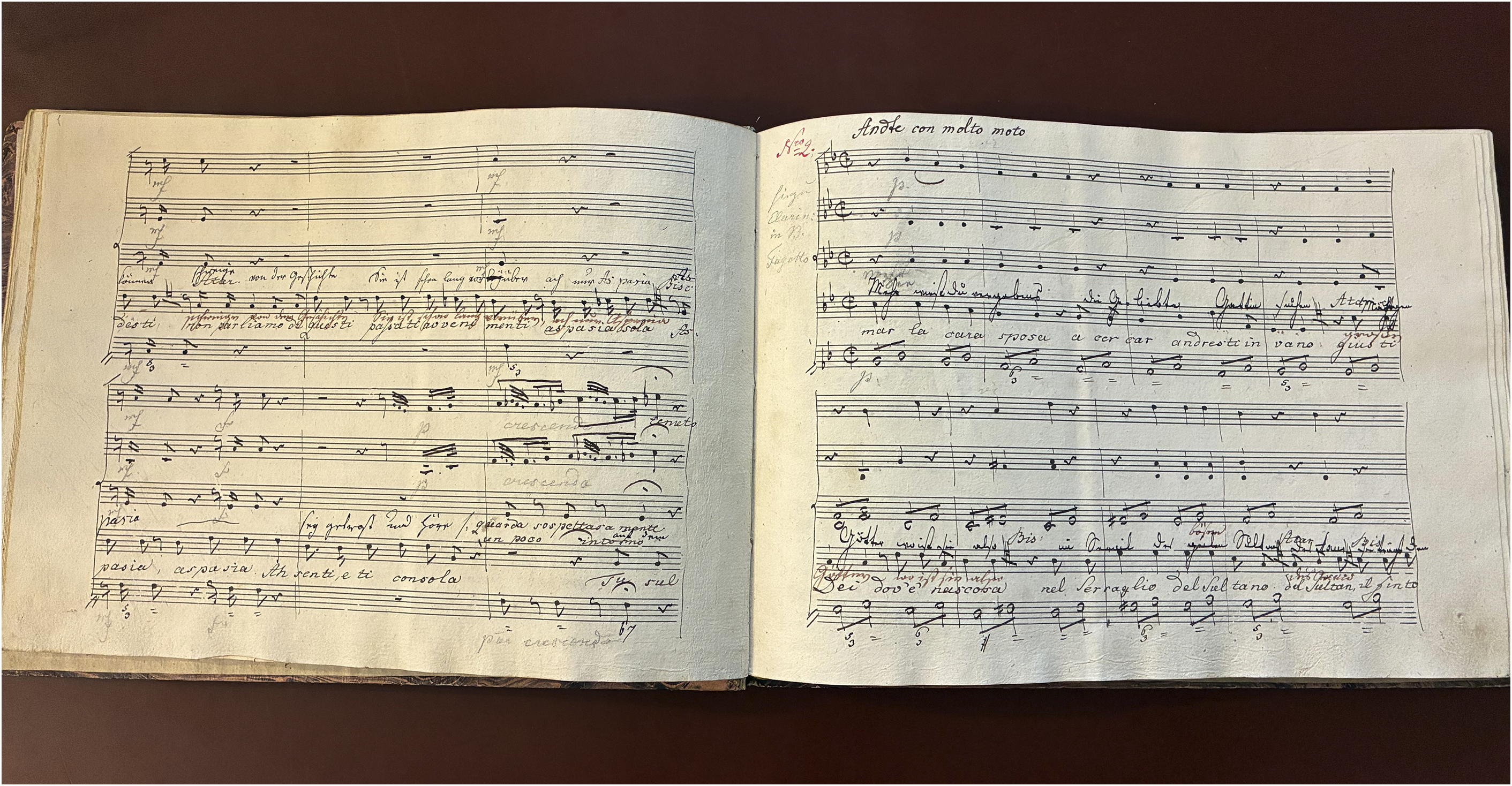
Example 2. Long description
The score is presented across two open pages of a bound manuscript.
On the left page, there are two main systems of musical staves. The top system contains four staves with handwritten notes and dynamics such as m f. Below the notes, the original Italian lyrics are written in a cursive hand, while a secondary layer of German text in Kurrent script is inserted directly above the Italian lines. The bottom system on this page shows more complex notation with crescendo markings and additional textual annotations in the lower margin.
On the right page, the heading at the top right reads Number 2, Andante con molto moto. The left margin lists instrumentation including Clarin: in B and Fagotto. This page continues the vocal duet with five staves. The Italian lyrics Tu sul mar la cara sposa are clearly visible on the middle staff, while the German adaptation is again interlined above it. Some sections of the original text appear to have been crossed out or modified with heavier ink strokes. The bottom of the right page contains further musical notation for the accompaniment, featuring bass clef staves with ledger lines and dynamic markings.
Opening of Lysander (originally Biscroma) and Atar’s Duet ‘Umsonst ist deine Schiffahrt’ in Act II scene 3 of the 1810 Namiest Atar (MZM A17081a, courtesy of the Moravian Museum, Brno).
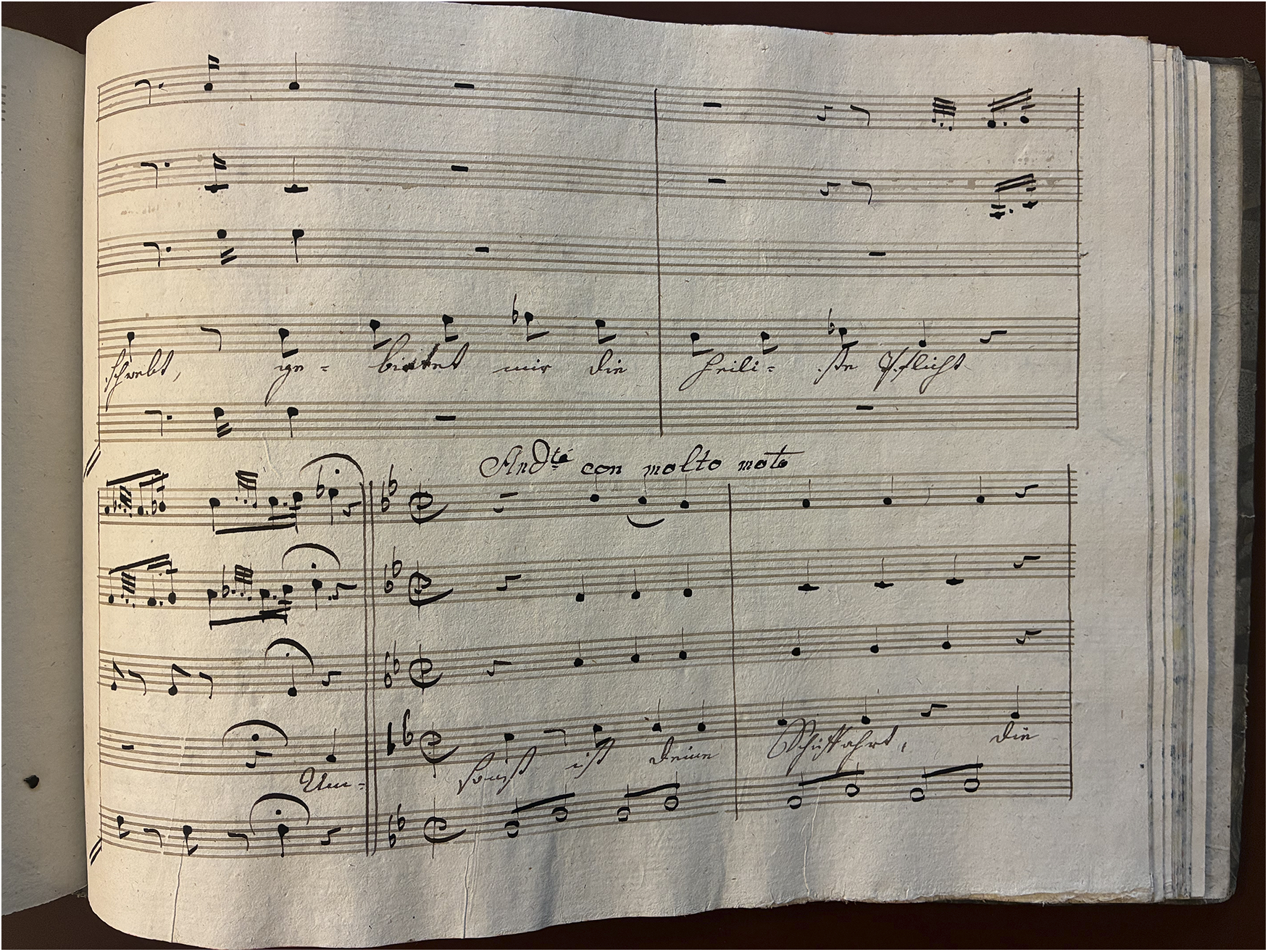
Example 3. Long description
The manuscript is divided into two main sections of musical notation on aged, cream-colored paper.
* Top Section: Consists of five staves. The upper three staves contain instrumental parts with sparse notation. The fourth staff is a vocal line with handwritten German lyrics underneath, including the words ‘bietet mir die heilige Pflicht’. The fifth staff is a bass or accompaniment line.
* Bottom Section: Separated by a double bar line and a tempo marking ‘Andante con molto moto’ written in cursive script. This section contains five staves.
* Left Margin: The start of the second section features complex key signatures with multiple flats and C-clefs.
* Musical Content: The notation includes quarter notes, eighth notes with beams, and various rests. The bottom-most staff features a series of eighth notes grouped in pairs with a continuous beam. Handwritten lyrics are interspersed between the fourth and fifth staves, beginning with the word ‘Umsonst’.
* Physical Condition: The paper shows visible texture, slight creasing, and some ink bleed-through from the reverse side. The right edge of the page shows the binding of the book.
Haugwitz later dismissed his 1810 adaptation, along with his other early works, in the preface to the manuscript collection of his Gluck opera translations, dated 1820.Footnote 55 He also credited Salieri with teaching him more precise translating methods:
Enthralled by the composition of this immortal master [i.e. Gluck] and burning with the desire to enjoy his other works within the limited capabilities of my small Namiest orchestra, I took the liberty in 1808 of translating Gluck’s Iphigénie en Aulide, a counterpart to Iphigénie en Tauride, from the French – at a time when I was still unfamiliar with the basic elements of a functional musical translation and unaware of the great, sometimes insurmountable difficulties faced by a translator working without the collaboration of the original composer.
Although this first attempt was unsuccessful, I could not resist my passionate impulse to translate Gluck’s Alceste and Orfeo ed Euridice from Italian as well. Indeed, I even dared to lay my hands on the sacred Naumann, translating several of his oratorios. No less recklessly, I tampered with Axur, Les Danaïdes, and Les Horaces by the esteemed Salieri. It is to this latter mischief that I owe my conversion and a ray of enlightened artistic understanding, which makes me view my earlier scribblings with shame and my present ones only with humility. My indulgent and honourable friend Salieri, to whom I sent my daring distortions of his works for judgment, did not punish my transgressions as they surely deserved. Instead, he kindly extended his hand to me, instructed me in musical punctuation [i.e. accentuation], metre and rhythm, and encouraged me not to be discouraged by my failed early attempts.
Haugwitz’s reference to sending ‘daring distortions of his works’ likely pertains to the 1810 Axur score (Score 3 in Appendix C), which contains French handwritten notes in Haugwitz’s hand at passages most altered from the Italian original (noted in Appendix D). These annotations were probably addressed to Salieri: they are in French rather than German, which Haugwitz used in correspondence with his German-speaking Viennese friends; Haugwitz refers to his recipient as ‘esteemed friend’ (respectable ami), and he even requests that the recipient rework one newly composed passage.
One such note accompanies Axur’s final monologue, just before the eponymous hero’s suicide. Haugwitz replaced Axur’s eight lines of text – originally set to fifteen bars of accompanied recitative – with fifteen lines spanning thirty-one bars. His note explains: ‘I particularly recommend this recitative to my esteemed friend – it is, for the time being, a sketch based on my feeling and the prosody of our language.’ The ‘feeling’ (sentiment) Haugwitz mentions likely reflects his desire to alter the ideological meaning of the opera’s conclusion: his rendition of Axur is far more reconciliatory, showing him offer good wishes to Atar and his people before his death, in contrast to the harsher, more vindictive tone of the original Italian. Yet the note also indicates that Haugwitz was motivated by the need to produce a passage that would sound properly poetic in German. Furthermore, although he seeks the opinion of an ‘esteemed friend’, he does not suggest any willingness to modify his revisions – his adaptation aims to create an idealised version of Salieri’s work without much concern for the composer’s input.
Haugwitz’s selective approach to fidelity becomes even more evident in his notes on the revision of the scene between Arteneo, the high priest of Ormus, and Elamir, the boy oracle. In Act II scene 5 of the original Italian score (‘D’una scelta importante oggi dobbiamo’), Arteneo attempts to persuade Elamir to appoint his son Altamor as army leader. In 1810, Haugwitz replaced this scene of political and religious manoeuvring with a more straightforward monologue in which Arteneo prays for heavenly mercy, setting the new German text to a freshly composed recitative (‘O laßt in Demuth unsers Herzens’; see Appendix D). In two autograph French notes in the 1810 score – likely addressed to Salieri – Haugwitz expresses satisfaction with this transformation. Regarding the second part of the monologue, he writes: ‘Here the High Priest [Arteneo] speaks to the child [Elamir] and has him kneel – so the recitative must remain.’ If addressed to Salieri, the note demonstrates Haugwitz’s confidence in directing the original composer on what he considered the ideal content of the opera. Another note, on the opening part of the newly composed monologue, requests an alternative setting of the German text: ‘I would like this prayer, which I only allowed myself to sketch out in recitative, to be set to a melody by my esteemed friend.’ These notes indicate that, even in his idealised adaptation, Haugwitz envisioned the possibility of further improvement – ideally with the participation of his ‘esteemed friend’. If that friend was indeed Salieri, the comment illustrates Haugwitz’s desire to arrive at a definitive version of the scene, one that both respected and revised Salieri’s original conception. While the openness to change reflects the eighteenth-century flexibility in operatic adaptations, his insistence on producing an idealised version of the scene signals the emergence of a more fixed ‘work-concept’. Salieri, however, does not appear to have complied, as Haugwitz’s recitative remained unchanged in the 1810 version and in later Namiest manuscripts containing the scene.
The politics of Haugwitz’s 1810 adaptation
Many of Haugwitz’s revisions in his Axur adaptations engage directly with the work’s controversial political elements, suggesting that politics played a central role in his flexible understanding of the work-concept. Haugwitz clearly recognised the proto-revolutionary dimensions of the 1787 French opera, as he states in the preface to the 1831–2 libretto (Libretto 4). There, he praises Salieri’s (and Da Ponte’s) 1788 Viennese Italian version for achieving a ‘highly moral’ tone by removing Beaumarchais’s ‘immoral and Jacobin’ prologue and epilogue:
Axur, an opera, whose plot, while identical in its main outline to the character and action of Tarare, is elevated to an even higher classical and highly moral standing through the addition of essential scenes and the omission of Beaumarchais’s immoral and Jacobin prologue [unmoralischen und jakobinischen Prologs], as well as the similarly objectionable epilogue.
Many of the revisions across Haugwitz’s three Axur adaptations can thus be understood as extending the process of political containment already initiated by Salieri and Da Ponte in Vienna in 1788.
An example of how Haugwitz goes beyond the political circumspections of the 1788 Vienna revision can be found in the scene that opens Act II of the Italian opera in the 1805 Haugwitz score, which introduces substantial changes. In both Beaumarchais’s 1787 libretto and Da Ponte’s 1788 version, King Axur (Atar in 1787) appears in conversation with the high priest Arteneo (Arthénée in 1787), who is portrayed as a pragmatic politician intent on manipulating the masses through religion. In a brief arioso, the French Arthénée openly dismisses religious belief as a mere instrument of political power:Footnote
56
Ah! d’une antique absurdité,
Ah, let us leave to the Hindu
Laissons à l’hindou les chimères.
The chimeras of an ancient absurdity.
Brame et Soudan doivent en frères;
Brahmin and Sultan must, as brothers,
Soutenir leur autorité.
Uphold their authority.
Tant qu’ils s’accordent bien ensemble,
As long as they remain in accord,
Que l’esclave ainsi garotté,
Let the slave, thus bound,
Souffre, obéit, et croit, et tremble,
Suffer, obey, believe and tremble,
Le pouvoir est en sûreté.
Power remains secure.
Although this passage was omitted from the Italian Axur, Da Ponte retained the section in which Arteneo proposes to control the people through sham religious practices and to manipulate the boy oracle (Élamir in 1787, Elamir in 1788 and 1831–2, Knabe in 1810) into endorsing a military leader of his choosing:
I popoli signor, d’un altro mondo
Lord, the people of another world
Questi lochi minacciano; da lungi
Threaten these lands; from afar
Il fulmine già fischia e già si vede
The thunderbolt already whistles, and already is seen
Superstizioso e stolto
Superstitious and foolish,
Ire a’ tempi de’ numi il popol folto.
The crowded populace rushing to the temples of the gods.
…
Più che il valor nemico,
More than the enemy valour,
De’ tuoi popoli, o sire,
It is the cowardice of your people, O sire,
La viltà mi spaventa: a noi conviene
That frightens me: we must
Far credere all’indian, che il Cielo stesso
Make the Indian believe
Regge i nostri disegni; a me la cura
That Heaven itself guides our designs.
Lascia d’insinuar al fanciuletto
Leave to me the task of instilling in the boy
Dagli auguri prescelto
Chosen by the augurs,
Il nome di colui, che delle squadre
The name of the one
Condottiero essere deve.
Who must be the leader of the armies.
Haugwitz may well have understood the high priest’s endorsement of using religion to control the ‘superstitious and foolish’ people of Ormus as a veiled critique of Catholicism – an interpretation that could explain why he substantially reworked this scene in his 1810 adaptation:
Der unversöhnliche Feind, den unlängst erst Atars
The implacable enemy, whom only recently Atar’s
Noch nie besiegter Arm zur Friedensbitte zwang,
As yet undefeated arm forced to sue for peace,
Der wagt sein stolzes Haupt nun wieder zu erheben,
Now dares once more to raise his proud head
Und droht des Reiches Grenze verrät’risch zu befallen.
And treacherously threatens to invade the borders of the realm.
Zum Tempel strömt das Volk des höchsten Herrschers Willen,
The people stream to the temple to humbly receive the will of the supreme ruler,
Der Himmel, Welten, lenkt in Demuth zu vernehmen.
Who guides heaven and worlds alike.
Kraft der ihm heil’gen Pflicht erscheint der Oberpriester
By the power of his sacred duty, the High Priest now stands
Vor seinem König hier, ihn bittend zu beschwören,
Before his king, beseeching him to swear
Dass er im Tempel dort die Andacht seines Volkes
That he will grace the temple with his presence,
Durch seine Gegenwart bestärke, und erhöhe.—
Strengthening and elevating the devotion of his people.
Rather than plotting political deception, Haugwitz’s 1810 Arteneo merely urges the sultan to visit the temple to support his people in a time of danger. As in other passages of the 1810 version, this radical textual change required the composition of an entirely new recitative. The 1810 adaptation also omits Arteneo’s ensuing monologue (Act II scene 2, ‘O divina prudenza’, in the 1805 Italian opera), in which the priest reveals his plan to persuade Elamir to appoint his own son, Altamor, as leader of the army, thereby securing enormous power for himself.
Haugwitz also appears to have been uncomfortable with the arioso ‘Di tua milizia’ at the beginning of Act II in the Italian score, in which Arteneo warns the sultan of a potential rebellion. Although he retained Salieri’s music, he radically altered the text, removing any explicit reference to the threat of revolt:
Arteneo’s 1788 Arioso
Di tua milizia temi lo sdegno;
Fear the wrath of your own soldiers;
Temi di perdere corona, e regno,
Fear losing your crown and kingdom.
Per te medesimo temi, o signor.
Fear for yourself, O lord.
D’ogni trasporto capace fora,
The terrible crowd that adores Atar
La stuol terribile che Atar adora,
Would be capable of any outburst
Se il crede morto per tuo livor.
If it believes him dead by your spite.
Haugwitz’s 1810 Revision
Nicht bergen darf er es dem König,
He [Arteneo] must not conceal from the king,
Dass dort der Gottheit Bild im Tempel,
That the image of the deity in the temple,
Das sonst vom himmlischen Lichte strahlte,
Which once shone with heavenly light,
Wie mit einem Flor nun überzogen
Now seems veiled as if by a shroud,
Von einem Unglück zu warnen scheint.
As if to warn of misfortune.
Das heilige Feuer brennt nur schwach.
The sacred fire burns only weakly.
Possibly influenced by his retrospective awareness of the events set in motion by the French Revolution, Haugwitz avoids portraying Arteneo as warning of a popular uprising against the monarch and shifts the focus to omens of divine displeasure.
The 1813 adaptation of the Prologue to Tarare
Haugwitz’s interest in reviving Salieri’s work came into most direct conflict with the political sensibilities of the early nineteenth century in his 1813 adaptation of Axur (documented in Score 4). This version was essentially the 1810 adaptation, but it now opened with Haugwitz’s newly created adaptation of the Prologue to the 1787 Tarare – the same Prologue that he would later describe as ‘immoral and Jacobin’. The Prologue had never been performed in the Habsburg lands: Salieri and Da Ponte had excised it from the 1788 Vienna Axur, and its score was accessible only to connoisseurs through the published Paris edition of Tarare; one such score survives in the Haugwitz archive (Score 2). Haugwitz’s decision to include the Prologue in the 1813 adaptation was clearly an expression of his admiration for the composer operatic output, comparable to the recent Court Theatre revivals of previously unperformed Gluck operas and the first staging of Mozart’s Idomeneo. One may wonder whether this decision was influenced by conversations with Salieri about the 1810 adaptation. As John Rice has noted, the omission of the Prologue from the 1788 Viennese Axur may have been motivated in part by the need to avoid ‘elements most incompatible with an opera buffa company’, including the requirement of a ballet.Footnote 57 But the omission may also have been tied to the Prologue’s politically incendiary content, which explicitly criticises social inequality and monarchical rule. Haugwitz’s 1813 adaptation of this Prologue therefore offers a fascinating case study in how the sharp social and political critique of pre-revolutionary France could be neutralised in an early nineteenth-century Austrian context.
In his adaptation of Beaumarchais’s French text, Haugwitz softens the Prologue’s political critique and replaces it with a markedly moralistic tone. One of the central – and inherently radical – ideas in Beaumarchais’s libretto is that social rank matters less than personal merit, and that social inequality represents one of humanity’s gravest problems. This theme emerges clearly in scene 3 of the Prologue, when the allegorical figures of Fire and Nature assess human shades to assign them societal roles – specifically, who should become king and who should become a soldier. Just before making this decision, Fire reflects:
Mon oeil, entr’eux cherche un roi préférable;
My eye seeks among them a preferable king;
Mais que je crains mon jugement!
But how I fear my judgement!
Nature, l’erreur d’un moment
Nature, the error of a moment
Peut rendre un siècle misérable.
Can make a century miserable.
The opera then dramatises the consequences of Fire’s error in elevating an unfit ruler – Atar. Uncomfortable with this message, Haugwitz rewrote Fire’s quatrain – renaming the character ‘the Genius of the Earth’ (Genius der Erde) – in a way that removes any suggestion that fate might mistakenly bestow power on an unworthy sovereign:
Sieh da in Ruhe die Schatten noch friedlich,
See, in stillness, the shadows remain peaceful,
Doch in Bewegung bald entzweit.
Yet in motion, soon divided.
Erschaffen! O möchte das Spiel
Created! Oh, may the play
Zum Lebensspiegel euch dienen.
Serve you as a mirror of life.
A few moments later in Beaumarchais’s Prologue, Fire transforms one shade into King Atar and the other into the soldier Tarare:
Le Génie du Feu
Genius of Fire
Sois l’empereur Atar; despote de l’Asie,
Be the emperor Atar, despot of Asia,
Règne à ton gré dans le palais d’Ormus.
Reign as you wish in the palace of Ormus.
E toi, soldat, formé de parents inconnus,
And you, soldier, born of unknown parents,
Gémis longtemps de notre fantaisie.
Lament long under our fantasy.
Haugwitz significantly altered this scene, both textually and musically. He expanded Fire’s declaration to include Tarare’s wife Aspasia, who is abducted and mistreated by the king throughout the opera, and set the added material (in bold) to newly composed music. (In the Viennese Italian and Haugwitz’s German versions of the opera, Tarare is called Atar.)
Genius der Erde
Genius of the Earth
Edelmütiger Atar, den schwarzer Neid verfolgt!
Noble Atar, pursued by black envy!
Herrschen an Thron von Ormus sollst du einst;
You shall one day rule on Ormus’s throne;
Du aber Axur, dessen Krone das Laster befleckt,
But you, Axur, whose crown is stained by vice,
In hoher Schmach hier büße dein Verbrechen.
Atone for your crimes here in utmost disgrace.
Aspasia! Der ehelichen Treue das Bild!
Aspasia! The image of marital fidelity!
Dir blüht der Lohn deiner Tugend.
The reward of your virtue shall flourish for you.
By introducing Aspasia’s fidelity – entirely absent from the original French Prologue – Haugwitz introduces the opera as a moral tableau in which virtue is rewarded and vice punished, thereby displacing Beaumarchais’s critique of social inequality with a more conservative ethical framework.
Haugwitz also radically transformed Nature’s ensuing arioso:
Nature
Nature
Enfants, embrassez-vous: égaux par la Nature,
Children, embrace each other: equal by Nature,
Que vous en serez lois dans la société:
What will you be in society’s laws?
De la grandeur altière à l’humble pauvreté,
From lofty grandeur to humble poverty,
Cet intervalle immense est désormais le vôtre.
This vast gap is now yours.
Instead of Beaumarchais’s emphasis on human equality, Haugwitz presents a plea for unity:
Reicht Brüder euch die Hand, zur Eintracht geboren,
Brothers, extend your hands, born for unity,
O welche Feindes Macht stört den Bund unter euch?
Oh, what enemy power disrupts your bond?
Gleich wie der Bergen Höh’ verachtend Tiefen blickt,
Just as the mountain heights look down upon the depths,
Sprosst unter Neid und Hohn der Zwietracht Apfel auf;
The apple of discord sprouts amid envy and scorn,
Haugwitz fundamentally alters the meaning of the text yet remains attentive to the expressive power of Salieri’s music. For example, he replaces Beaumarchais’s contrast between grandeur and poverty with the imagery of mountains and depths to convey envy and scorn, thus still accommodating the emphatic madrigalisms of Salieri’s score. The three-bar-long high G and the downward octave leap (Prologue, bb. 346–51) suit both Beaumarchais’s ‘altière’ (grandeur) and ‘l’humble pauvreté’ (humble poverty) as well as Haugwitz’s ‘Bergen Höh’’ and ‘Tiefen’.
Beaumarchais’s concluding chorus explicitly celebrates ‘égalité’, later a key slogan of the French Revolution:Footnote
58
Ô bienfaisante déité!
Oh, beneficent deity,
Ne souffrez pas que rien n’altère
Let nothing alter
Notre touchante égalité;
Our touching equality;
Qu’un homme commande à son frère!
Let no man rule over his brother.
By contrast, Haugwitz shifts the focus to social harmony:
Wohltätig strahlend ewiges Licht!
Charitably radiant eternal light!
O nicht gestatt’, dass zwischen uns
Oh, do not allow that between us
Der heil’ge Bruderbund erlöscht,
The sacred brotherhood be extinguished,
Das Haupt je die Zwietracht erhebt.
That discord ever raise its head.
In this way, Haugwitz transforms Tarare’s Prologue from a radical call for social equality into a plea for unity and the preservation of the existing order. Given his position as a member of the Habsburg monarchy’s noble elite, it is understandable that Haugwitz would be uncomfortable with the Prologue’s social radicalism. That he did not reinstate the Prologue in his final adaptation of Axur in the 1830s, nor include it in his collected edition of Salieri’s librettos, underscores this continued unease. The inclusion of the Prologue in the 1813 adaptation therefore represents yet another instance of Haugwitz’s flexible, evolving approach to composer-centred work-concept.
Striving for historical ‘authenticity’ in the 1830s Axur revision
Haugwitz’s final adaptation of Axur, dated to 1831–2, represents yet another stage in the evolution of his understanding of the essence of an operatic work. The archival materials associated with this final adaptation reveal a heightened concern with historical accuracy and textual precision, yet this meticulousness is repeatedly undermined by numerous instances of editorial looseness.
A crucial source for understanding Haugwitz’s method as an adapter in the 1830s is the autograph draft of his libretto translation (Libretto 3). In this manuscript, Haugwitz selects passages of Italian text and writes his German translation beneath them. This approach ensures that the length and accentuation of individual phrases correspond to the original, allowing them to fit the music more precisely – a marked contrast to the freer, more flexible treatment of the Italian text in his 1810 adaptation. As a result, Haugwitz no longer altered Salieri’s vocal lines extensively in his last adaptation of Axur, as demonstrated by the opening of Biscroma and Atar’s duet ‘Die Geliebte aufzufinden’ (originally ‘Tu sul mar la cara sposa’) in the 1830s Namiest score (Example 4).
Opening of Biscroma and Atar’s Duet ‘Die Geliebte aufzufinden’ in Act II scene 1 of the 1830s Namiest Axur (MZM A17082e, courtesy of the Moravian Museum, Brno).
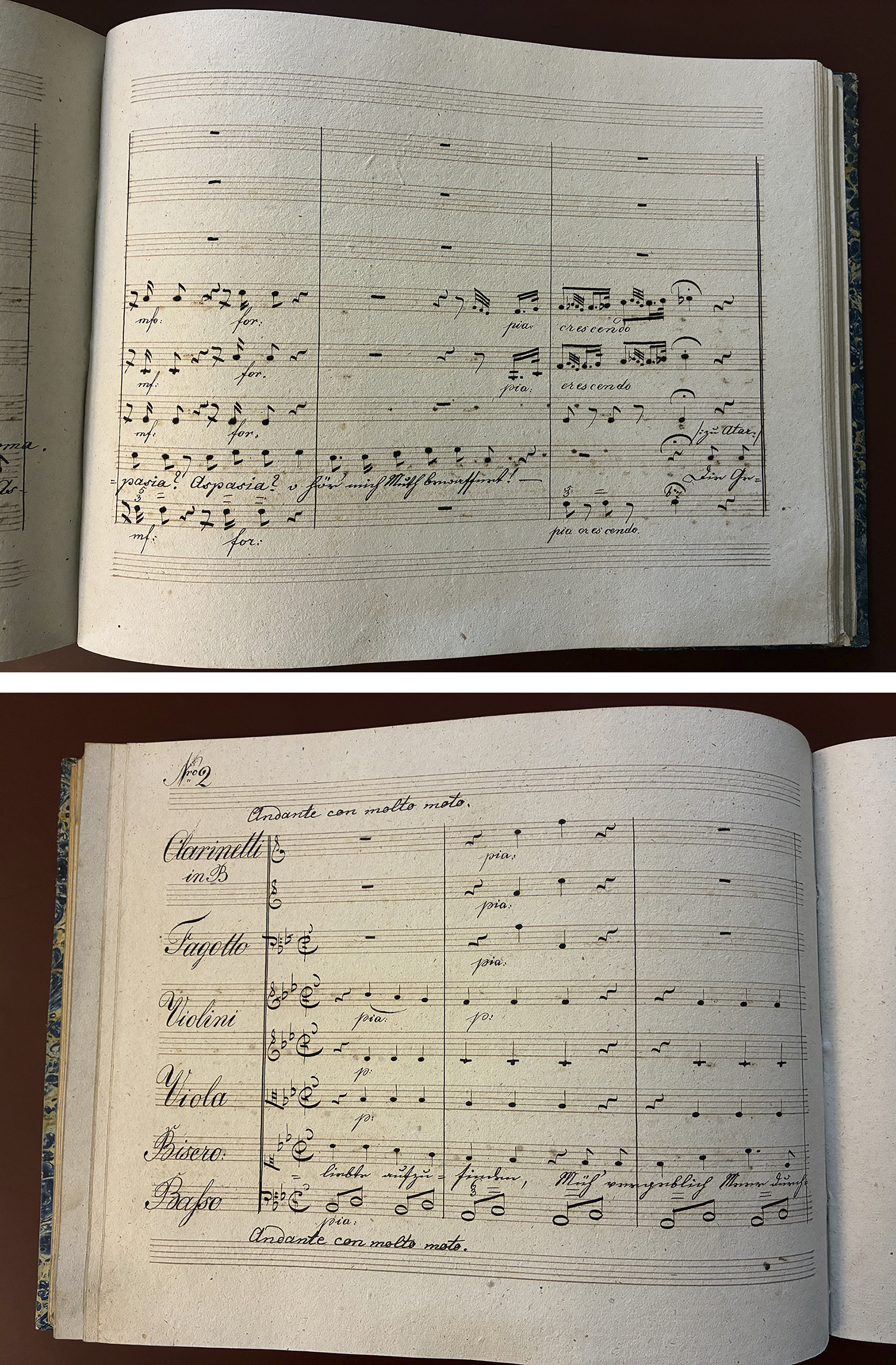
Example 4. Long description
The musical score is organized into a system of eight staves.
* The top four staves are instrumental and contain only whole-measure rests indicated by thick horizontal bars.
* The fifth and sixth staves contain active musical notation with dynamic markings including m f dot, for dot, pia dot, and crescendo. These staves feature sixteenth-note runs and fermatas over the final rests of the fourth measure.
* The seventh staff is the vocal line for Biscroma and Atar. It begins with a series of eighth notes and rests. Handwritten German text is written below this staff, reading pasia? Aspasia? o hör mich Muth bewaffnet! followed by a name label for Atar near a fermata.
* The eighth and bottom-most staff is the basso continuo or accompaniment line, featuring figured bass notation with small numbers 5 and 3 stacked vertically above the notes.
The notation is handwritten in dark ink on aged, off-white paper. Vertical bar lines divide the page into four distinct measures. The right edge of the page shows the binding of the manuscript volume.
Haugwitz further emphasises his close connections to Salieri’s libretto and music in the preface to the representative copy of the 1831–2 Axur adaptation (Libretto 4). This copy is included in volume 7 of Haugwitz’s manuscript of collected libretto translations.Footnote 59 The Axur libretto includes an extensive historical essay about the opera’s origins, containing anecdotes that expand upon the information in Ignaz von Mosel’s 1827 biography of Salieri – some of which Haugwitz likely heard from Salieri himself. Mosel’s biography briefly notes that the revision of Tarare as Axur was commissioned by Emperor Joseph II in the autumn of 1787. Salieri and Da Ponte chose to create a completely new work rather than a simple translation and aimed to complete it as quickly as possible. Mosel also describes how Salieri’s rheumatic pain, which confined him to his home, inadvertently facilitated the opera’s rapid completion:
In the autumn of the same year, Salieri received an order from the Emperor to adapt his Tarare for the Italian company in Vienna. … The work was started anew, with the poet and the composer proceeding hand in hand along the chosen path. Wherever the latter could make use of a musical idea from the French version, he did so; where this was not possible, he composed entirely new music. A rheumatic pain in his knee, which forced Salieri to stay in his room for nearly three weeks, actually facilitated the faster completion of the work, as he was unable to dedicate all his time to it without being disturbed by other obligations. To accelerate the performance even further, he wrote scene by scene as Da Ponte brought them to him, initially setting down only the vocal parts with the bass, and sent them to the copyist so that the singers could begin rehearsing them immediately.Footnote 60
Haugwitz’s account introduces additional details, particularly regarding the Emperor’s impatience and Salieri’s health. In Haugwitz’s telling, Salieri’s illness results from the stress under which he laboured and is framed as an obstacle rather than a catalyst for his work:
After conducting the first performance of Tarare in Paris, Salieri returned to Vienna. However, by order of Emperor Joseph, he was required, in the late autumn of the same year, to swiftly rework the opera’s subject matter into an Italian libretto for the Italian court opera company in Vienna. … Urged on by Emperor Joseph’s impatience, Salieri had to work, so to speak, sheet by sheet, racing alongside the Italian court poet, exchanging new sections through couriers. Without being able to wait for the completion of the libretto, he had to set each newly finished section of the poet’s text to music without delay.
Despite this haste, which was forced upon him, and an illness brought on by his great exertion – one that compelled him to compose the final act from his bed – his new masterwork does not reveal the slightest deficiency in a single bar. It would be difficult to determine whether in it the strictness and precision of his musical structure or the soaring brilliance of his fiery, uniquely personal imagination deserves greater admiration.
Haugwitz clearly portrays Joseph II more critically, depicting him as a petty micromanager who endangered the health of his employees. Regardless of whether Haugwitz’s preface provides a more accurate version of events, it demonstrates his intimate knowledge of Salieri’s biography and enhances the appearance of historical authenticity in his approach to the 1831–2 adaptation.
Another element of historical accuracy in the 1831–2 Axur is Haugwitz’s incorporation of sections from the 1787 French Tarare into the German adaptation of the 1788 Italian Axur – none of these, unlike the 1787 Prologue, is explicitly political. In the preface to his 1831–2 Axur libretto (Libretto 4), Haugwitz acknowledges these borrowings, stating that he took the liberty of inserting ‘a few flowers from the French Tarare in the translation of the Italian Axur’. In the autograph draft libretto translation (Libretto 3), the original text, intended for German translation, occasionally shifts from Italian to French. Each French insertion is prefaced with a reference to the published Tarare score (Score 2), indicating where the corresponding music should be inserted into the 1830s Axur. There are three sets of French insertions:
Act I scene 5 (1805 Italian Axur). Haugwitz cuts the Italian recitative sung by Aspasia upon realising she is in Axur’s harem, replacing it with an extended recitative from Tarare and her arioso ‘Quoi cruel! par cet attentat’ (Act I scene 3, bb. 73–118).
Act II scene 6 (1805 Italian Axur). Haugwitz removes Altamor’s suggestion that Aspasia is a mere slave, along with Atar’s aria defending her dignity, and replaces them with a short, four-line segment of Atar’s French text expressing sorrow over the abduction. In Tarare, this passage is set to a recitative and brief arioso (Act I scene 6, bb. 78–90).
Act III scene 3 (1805 Italian Axur). In a scene that depicts the festival Axur organises to entertain Aspasia, Haugwitz inserts a minuet and chaconne and provides only the French text of Biscroma’s song, omitting the Italian counterpart.
The mixing of these musical portions creates a hybrid adaptation that signals a concern for historical fidelity to Salieri’s entire output while simultaneously extending beyond Salieri’s original conception for either the French or the Italian versions of the opera.
Many other elements of Haugwitz’s 1830s adaptation undermine the semblance of historical fidelity. As in his earlier adaptations, he executed numerous cuts, many of which reflected the needs and capabilities of the Namiest musicians. In the preface to the 1831–2 adaptation, Haugwitz explains:
The translator of Axur, remaining true to his previous principles and taking particular account of the condition of his Namiest orchestra, to which his works are dedicated, found himself compelled to omit the entire fourth act of the opera [i.e. the fourth act of the 1805 Italian version of the opera; see Appendix D for the specifics of this excision]. Its effect is calculated solely for theatrical performance, and its music, without pantomime action would be tedious and thus even disruptive to the artistic enjoyment of the whole.
This passage also indicates that Haugwitz’s productions were not staged in the traditional sense but performed in a concert- or oratorio-like format, a practice also reflected in the musical materials.Footnote 61 Even in the 1830s, Haugwitz continued to transform the opera’s political elements, including Salieri’s and Da Ponte’s depiction of political machinations by a religious authority. Unlike the 1810 revision, which relied on radical textual rewritings, the 1830s adaptation achieves this primarily through extensive cuts: all politically sensitive scenes involving Arteneo at the beginning of the second act are omitted (see Appendix D).
Conclusion
Haugwitz’s adaptations of Salieri’s Tarare/Axur illuminate the complex interplay between emerging ideologies of the operatic canonicity, composer-centredness, the work-concept, patriotism and practical performance realities in semi-private spaces of early nineteenth-century rural Central Europe. They reveal an evolving conception of historical fidelity that negotiates between reverence for the composer’s ‘genius’ and the adapter’s ideological and logistical constraints. Rather than pursuing authenticity in any straightforward sense, these adaptations reflect processes shaped by political sensitivities, regional identity and the limitations of private performance contexts. Haugwitz’s work thus exemplifies a broader characteristic of the operatic canon identified by Cormac Newark and William Weber: even when the canon ‘might appear to be straining toward timelessness’, it operates dynamically within specific historical conditions.Footnote 62 By reconciling historical respect with patriotic imperatives, these adaptations anticipate later conceptions of the musical canon while remaining firmly embedded in the cultural politics of their time.
Moreover, Salieri’s interactions with Haugwitz and his Viennese patriotic circle stand in stark contrast to his later reputation, which reduced him to a marginal figure overshadowed by Mozart. Haugwitz’s efforts to elevate Salieri to music-historical prominence underscore that canon formation is neither inevitable nor impartial. These adaptations preserve a moment in which Salieri was celebrated as a master composer shaping Central European cultural identity.
In this tension between influence and erasure lies the deeper significance of Haugwitz’s work: it offers a lens through which to examine nineteenth-century canon building not as a linear progression toward modern ideals, but as multifaceted and often contradictory process. Haugwitz’s operatic museum ceased to exist after his death in 1842. His son, Karl Joseph Wilhelm Haugwitz (1797–1874), himself a composer, was more interested in salon music, and he discontinued the large-scale operatic productions in Namiest, depositing the performing materials from his father’s adaptations in the family archive.Footnote 63 Nevertheless, despite its relatively short lifespan, Haugwitz’s canon-building activities exemplify broader dynamics of the operatic canon. As James Parakilas has shown, the operatic canon is not simply a collection of timeless masterpieces but rather a set of institutions and practices (‘a system of cultural upbringing’) that strive to create the semblance of timelessness and aesthetic significance.Footnote 64 Haugwitz established and sustained one such system successfully for several decades. Although his operatic museum initially resonated with and contributed to patriotic canon-forming efforts in Vienna, it could not endure without his personal engagement. His activities nonetheless demonstrate that the construction of the operatic canon is not confined to imperial capitals and major public venues; it also significantly shaped musical life in rural and often overlooked communities.
Appendix A
Gluck opera productions at the Vienna Court Theatre between 1807 and 1810
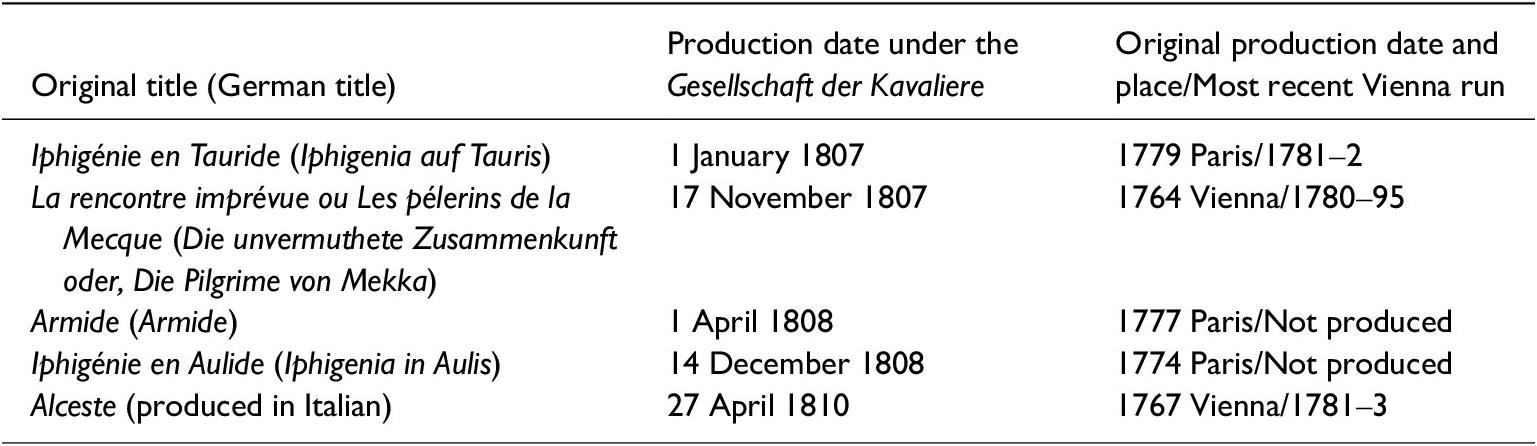
Table A1. Long description
The table consists of three columns: Original title (German title), Production date under the Gesellschaft der Kavaliere, and Original production date and place/Most recent Vienna run.
* Row 1: Iphigénie en Tauride (Iphigenia auf Tauris); 1 January 1807; 1779 Paris / 1781–2.
* Row 2: La rencontre imprévue ou Les pèlerins de la Mecque (Die unvermuthete Zusammenkunft oder, Die Pilgrime von Mekka); 17 November 1807; 1764 Vienna / 1780–95.
* Row 3: Armide (Armide); 1 April 1808; 1777 Paris / Not produced.
* Row 4: Iphigénie en Aulide (Iphigenia in Aulis); 14 December 1808; 1774 Paris / Not produced.
* Row 5: Alceste (produced in Italian); 27 April 1810; 1767 Vienna / 1781–3.
Appendix B
Tables B1–B5 list Haugwitz’s theatre visits and music purchases in early 1805 and 1815.
Haugwitz’s visits to Viennese Theatres in January, February and March 1805 (Rubriquenbuch 74)
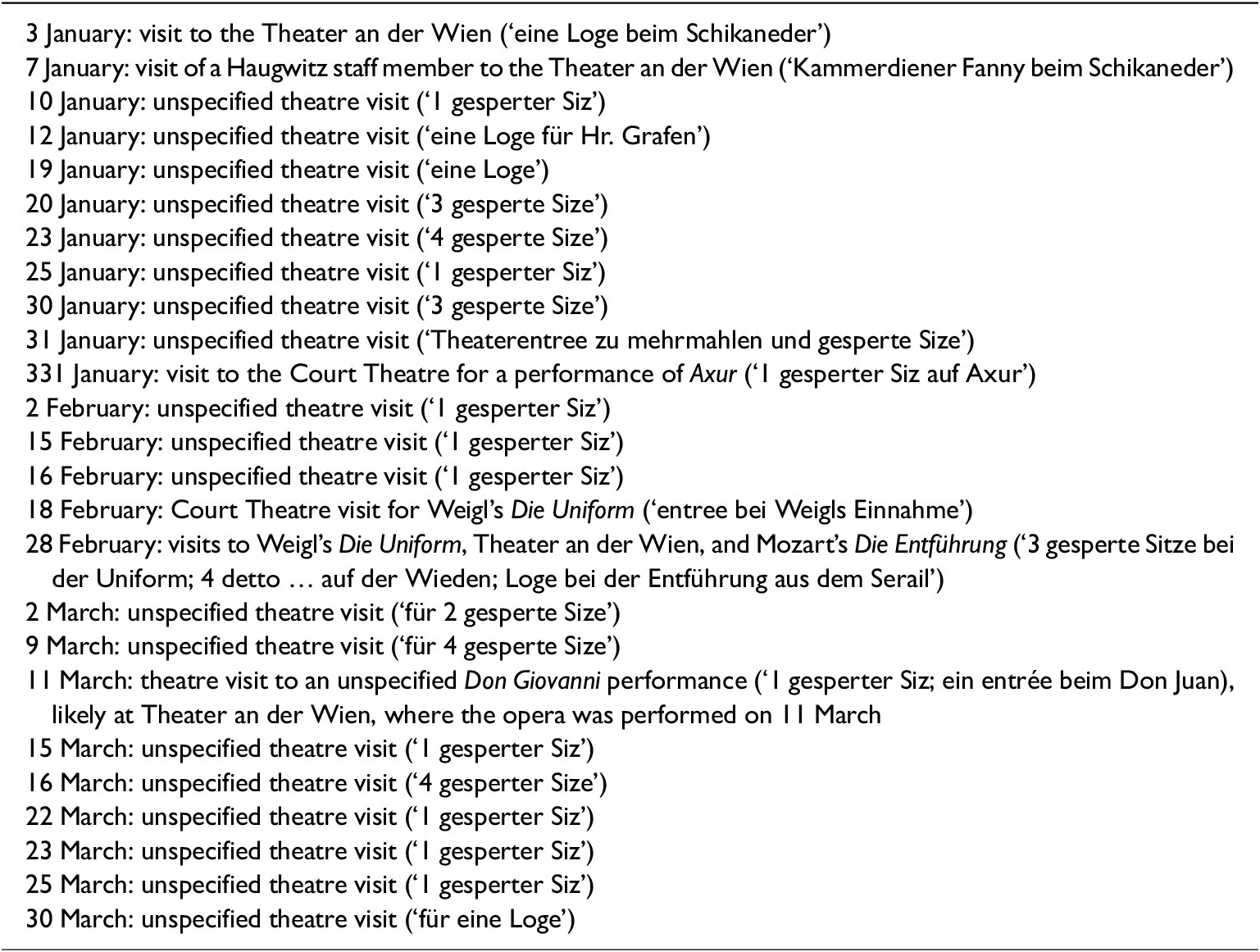
Table B1. Long description
The table contains 24 chronological entries detailing theatre visits and ticket types.
January entries:
- 3 January: Theater an der Wien (eine Loge beim Schikaneder).
- 7 January: Staff member visit to Theater an der Wien (Kammerdiener Fanny beim Schikaneder).
- 10 January: 1 gesperter Siz.
- 12 January: eine Loge für Hr. Grafen.
- 19 January: eine Loge.
- 20 January: 3 gesperte Size.
- 23 January: 4 gesperte Size.
- 25 January: 1 gesperter Siz.
- 30 January: 3 gesperte Size.
- 31 January: Theaterentree zu mehrmahlen und gesperte Size.
- 31 January: Court Theatre for Axur (1 gesperter Siz auf Axur).
February entries:
- 2 February: 1 gesperter Siz.
- 15 February: 1 gesperter Siz.
- 16 February: 1 gesperter Siz.
- 18 February: Court Theatre for Weigl’s Die Uniform (entree bei Weigls Einnahme).
- 28 February: Multiple visits including Die Uniform, Theater an der Wien, and Mozart’s Die Entführung (3 gesperte Sitze bei der Uniform; 4 detto ... auf der Wieden; Loge bei der Entführung aus dem Serail).
March entries:
- 2 March: für 2 gesperte Size.
- 9 March: für 4 gesperte Size.
- 11 March: Don Giovanni performance (1 gesperter Siz; ein entrée beim Don Juan), likely at Theater an der Wien.
- 15 March: 1 gesperter Siz.
- 16 March: 4 gesperter Size.
- 22 March: 1 gesperter Siz.
- 23 March: 1 gesperter Siz.
- 25 March: 1 gesperter Siz.
- 30 March: für eine Loge.
Scores of operas Haugwitz had copied in January, February and March 1805

Table B2. Long description
The table consists of four chronological entries detailing opera scores and their associated costs or actions.
* 11 January: Axur, re d’Ormus. Described as three pieces in keyboard arrangement from the opera Axur.
* 7 February: Raoul Barbe-bleue. Grétry’s opera produced at the Theater an der Wien in 1804. The entry notes the binding of the score for Raul der Blaubart.
* 19 March: Léon, ou Le chateau de Montenero. Dalayrac’s opera produced at the Theater an der Wien in 1804. The entry notes the score and copying for the opera das Schloss v. Montenero.
* 20 March: I fuorusciti. Paër’s opera produced at the Court Theatre in 1804. The entry identifies the work as Opera I fuorusciti by Paer.
Librettos of operas Haugwitz purchased in January, February and March 1805

Table B3. Long description
The table consists of a header and two subsequent rows.
* The header row contains the title Léon, ou Le chateau de Montenero, followed by the purchase note 11 Feb, 6 Büchl von Schloss Montenero.
* The first body row contains the title Die Zauberflöte, followed by the purchase note 11 Feb, 6 Büchl von der Zauberflöte.
* The second body row contains the title Palmira, followed by the purchase note Opernbüchl v. Palmira.
Haugwitz’s visits to Viennese theatres in January, February and March 1815 (Rubriquenbuch 87)
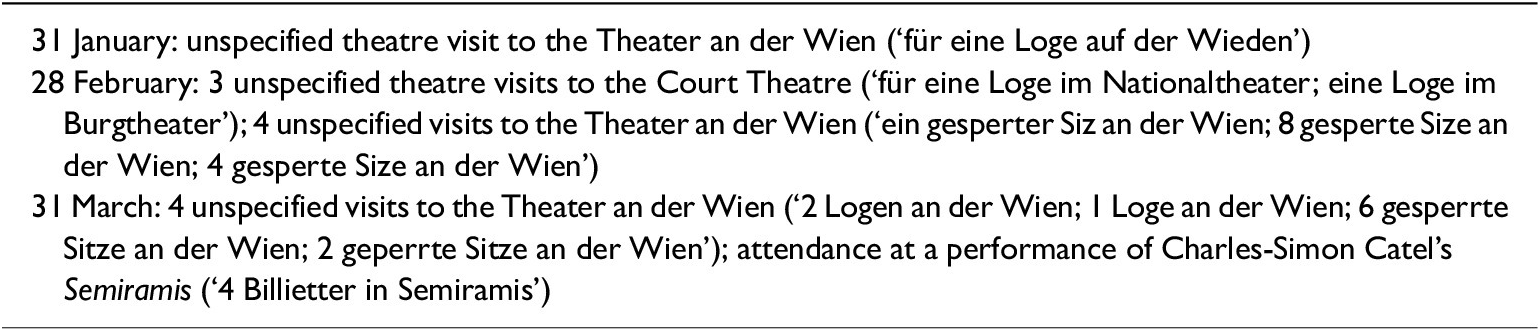
Table B4. Long description
The table consists of three main entries organized by date:
* 31 January: Records an unspecified theatre visit to the Theater an der Wien, noted as ‘für eine Loge auf der Wieden’.
* 28 February: Lists three unspecified visits to the Court Theatre, including ‘für eine Loge im Nationaltheater’ and ‘eine Loge im Burgtheater’. It also lists four unspecified visits to the Theater an der Wien, including ‘ein gesperter Siz an der Wien’, ‘8 gesperte Size an der Wien’, and ‘4 gesperte Size an der Wien’.
* 31 March: Lists four unspecified visits to the Theater an der Wien, including ‘2 Logen an der Wien’, ‘1 Loge an der Wien’, ‘6 gesperrte Sitze an der Wien’, and ‘2 geperrte Sitze an der Wien’. It also records attendance at a performance of Charles-Simon Catel’s Semiramis, noted as ‘4 Billietter in Semiramis’.
Scores of musical works Haugwitz had copied in January, February and March 1815
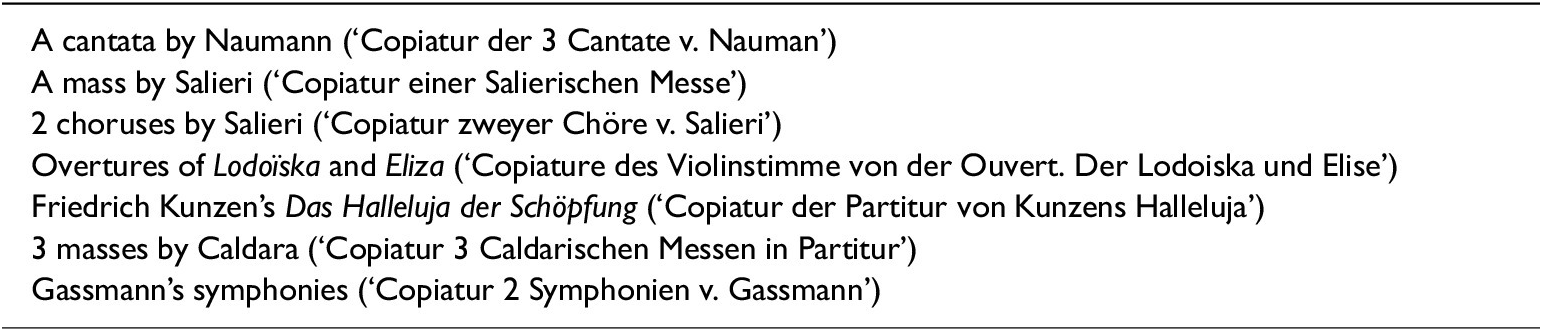
Table B5. Long description
The table contains seven rows of text, each identifying a specific musical work or set of works along with their original German archival notations.
* Row 1 (Header): A cantata by Naumann (‘Copiatur der 3 Cantate v. Nauman’).
* Row 2: A mass by Salieri (‘Copiatur einer Salierischen Messe’).
* Row 3: 2 choruses by Salieri (‘Copiatur zweyer Chöre v. Salieri’).
* Row 4: Overtures of Lodoïska and Eliza (‘Copiature des Violinstimme von der Ouvert. Der Lodoiska und Elise’).
* Row 5: Friedrich Kunzen’s Das Halleluja der Schöpfung (‘Copiatur der Partitur von Kunzens Halleluja’).
* Row 6: 3 masses by Caldara (‘Copiatur 3 Caldarischen Messen in Partitur’).
* Row 7: Gassmann’s symphonies (‘Copiatur 2 Symphonien v. Gassmann’).
Appendix C
Tables C1 and C2 list Axur-related sources in the Haugwitz estate in the Moravské zemské muzeum (Moravian Museum, MZM) and the Moravský zemský archiv (Moravian Archive, MZA).
Librettos
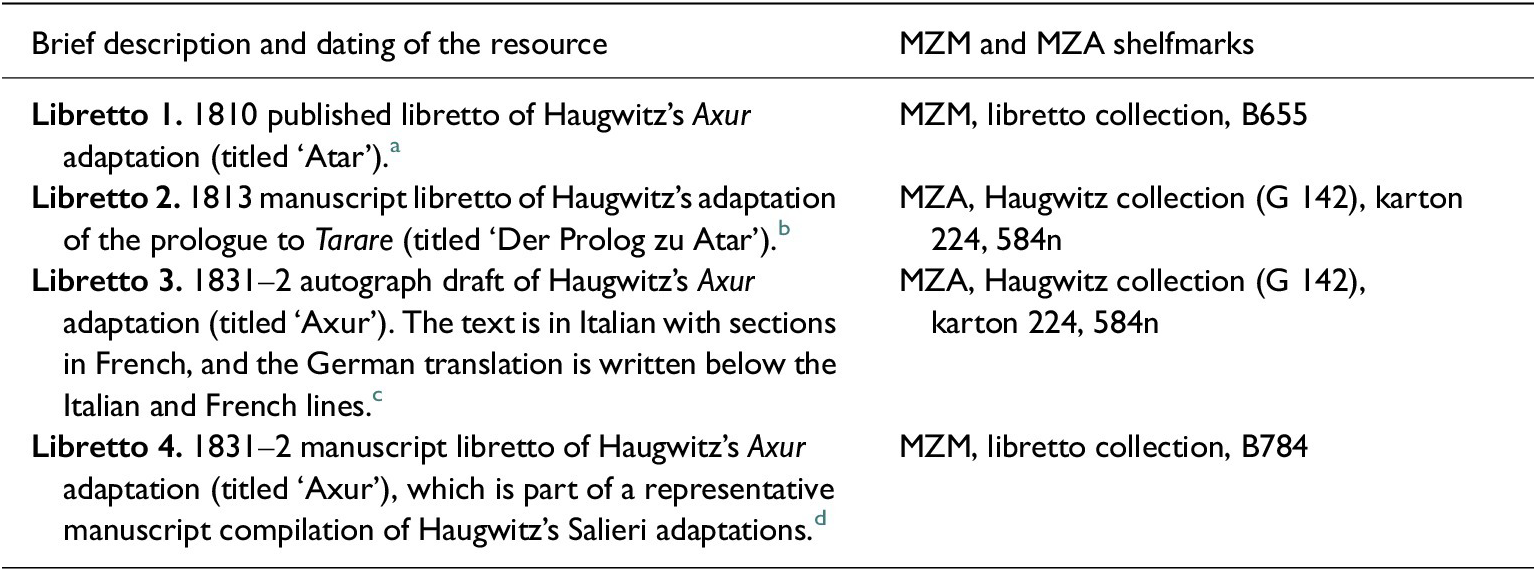
Table C1. Long description
The table consists of two columns and four rows of data.
* Row 1: Libretto 1. 1810 published libretto of Haugwitz’s Axur adaptation titled Atar. Shelfmark: M Z M, libretto collection, B 6 5 5.
* Row 2: Libretto 2. 1813 manuscript libretto of Haugwitz’s adaptation of the prologue to Tarare titled Der Prolog zu Atar. Shelfmark: M Z A, Haugwitz collection G 1 4 2, karton 2 2 4, 5 8 4 n.
* Row 3: Libretto 3. 1831 to 1832 autograph draft of Haugwitz’s Axur adaptation titled Axur. The text is in Italian with sections in French, and the German translation is written below the Italian and French lines. Shelfmark: M Z A, Haugwitz collection G 1 4 2, karton 2 2 4, 5 8 4 n.
* Row 4: Libretto 4. 1831 to 1832 manuscript libretto of Haugwitz’s Axur adaptation titled Axur, part of a representative manuscript compilation of Haugwitz’s Salieri adaptations. Shelfmark: M Z M, libretto collection, B 7 8 4.
Scores
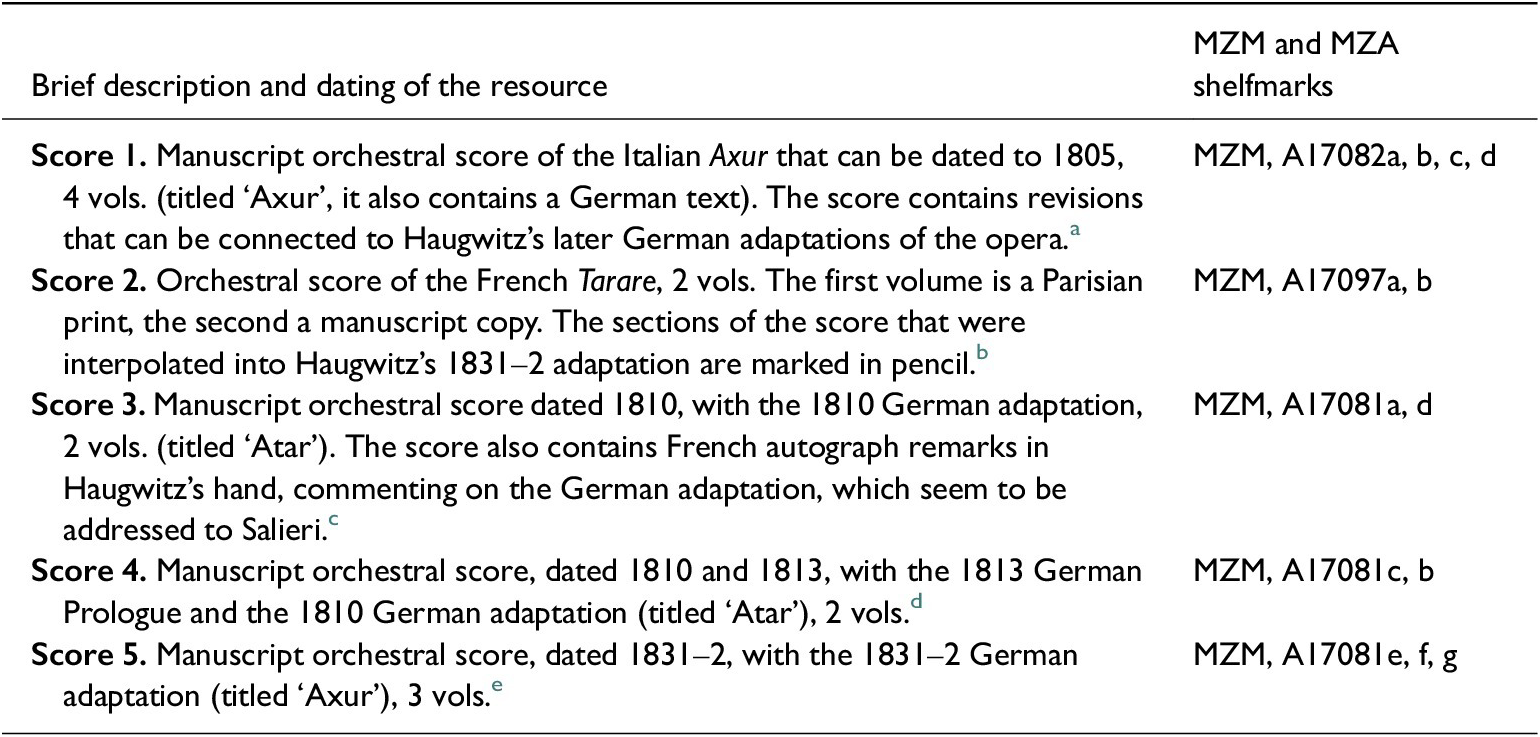
Table C2. Long description
The table consists of two columns: ‘Brief description and dating of the resource’ and ‘M Z M and M Z A shelfmarks’.
* Score 1: Manuscript orchestral score of the Italian Axur dated to 1805, in 4 volumes. It includes German text and revisions related to Haugwitz’s later adaptations. Shelfmarks: M Z M, A 1 7 0 8 2 a, b, c, d.
* Score 2: Orchestral score of the French Tarare in 2 volumes. Volume 1 is a Parisian print and volume 2 is a manuscript copy. Sections for the 1831 to 1832 adaptation are marked in pencil. Shelfmarks: M Z M, A 1 7 0 9 7 a, b.
* Score 3: Manuscript orchestral score dated 1810 for the German adaptation titled Atar, in 2 volumes. Includes French autograph remarks by Haugwitz addressed to Salieri. Shelfmarks: M Z M, A 1 7 0 8 1 a, d.
* Score 4: Manuscript orchestral score dated 1810 and 1813, containing the 1813 German Prologue and the 1810 German adaptation titled Atar, in 2 volumes. Shelfmarks: M Z M, A 1 7 0 8 1 c, b.
* Score 5: Manuscript orchestral score dated 1831 to 1832 for the German adaptation titled Axur, in 3 volumes. Shelfmarks: M Z M, A 1 7 0 8 1 e, f, g.
Appendix D
Tables D1–D4 show the structure of the 1805 Vienna Axur in comparison to the Paris and Namiest versions.
Act I
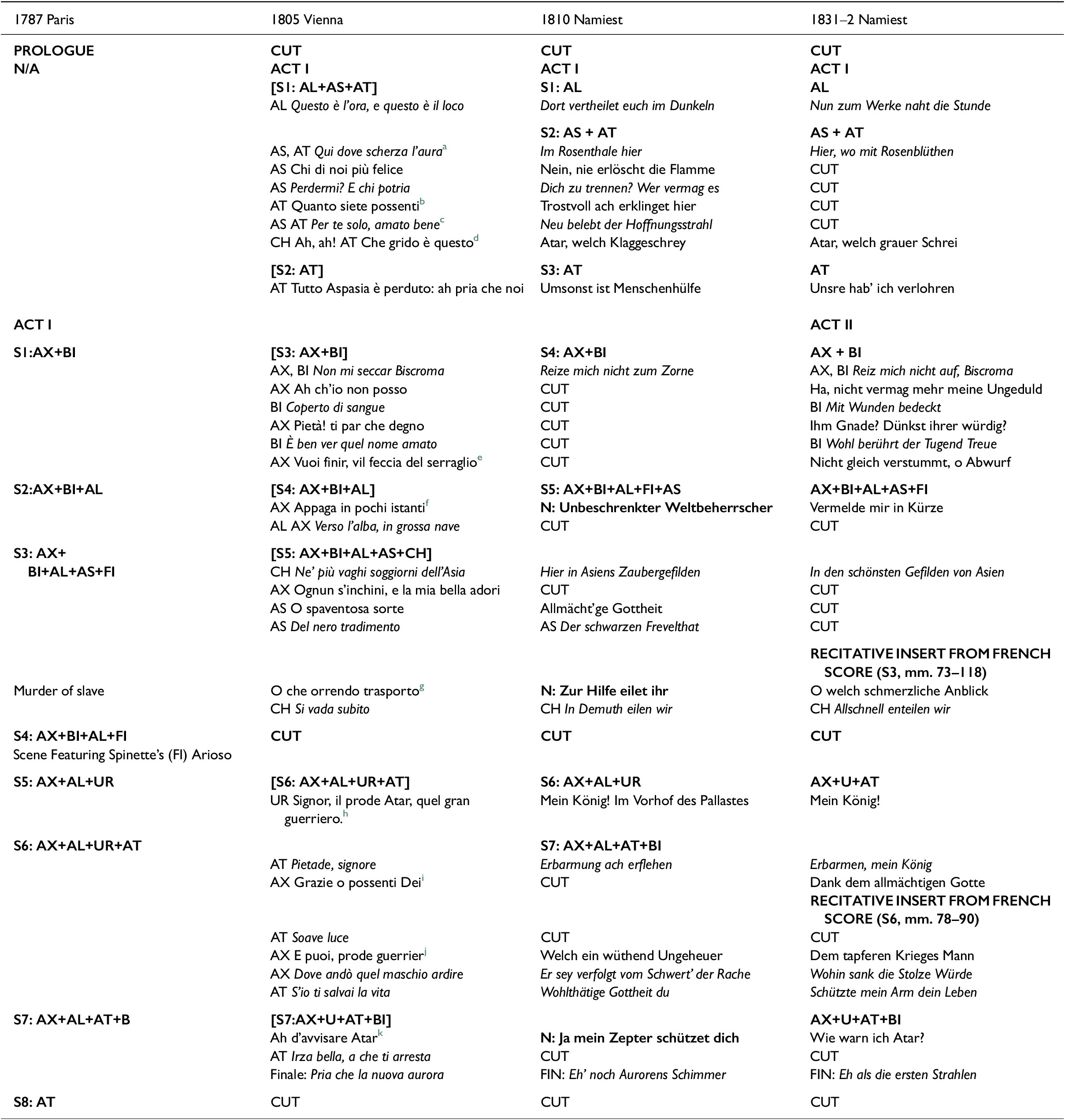
Table D1. Long description
The table compares four versions of Act I: 1787 Paris, 1805 Vienna, 1810 Namiest, and 1831 to 1832 Namiest.
* Row 1: The 1787 Paris version begins with a PROLOGUE, which is marked as CUT in all three subsequent versions.
* Row 2: The 1787 version is marked N/A, while the other three versions officially begin ACT I here.
* Row 3: Scene 1 (S 1) features characters A L, A S, and A T. In 1805, the text is ‘Questo è l’ora’. In 1810, it is ‘Dort vertheilet euch’. In 1831 to 1832, it is ‘Nun zum Werke’.
* Row 4: Continues S 1 or S 2 with A S and A T. The 1805 version includes several lines like ‘Qui dove scherza l’aura’. The 1810 version translates these to German, while the 1831 to 1832 version marks several sections as CUT.
* Row 5: S 2 or S 3 for A T. 1805: ‘Tutto Aspasia è perduto’. 1810: ‘Umsonst ist Menschenhülfe’. 1831 to 1832: ‘Unsre hab’ ich verlohren’.
* Row 6: Structural shift. 1787 Paris begins ACT I here. 1831 to 1832 Namiest begins ACT I I here.
* Row 7: Scene featuring A X and B I. 1805: ‘Non mi seccar Biscroma’. 1810: ‘Reize mich nicht zum Zorne’. 1831 to 1832: ‘Reiz mich nicht auf, Biscroma’.
* Row 8: Scene featuring A X, B I, and A L. 1810 and 1831 to 1832 add characters F I and A S.
* Row 9: Scene featuring A X, B I, A L, A S, and F I. 1805 uses ‘Ne’ più vaghi soggiorni’. 1810: ‘Hier in Asiens Zaubergefilden’.
* Row 10: 1831 to 1832 version includes a RECITATIVE INSERT FROM FRENCH SCORE.
* Row 11: Describes the ‘Murder of slave’ in 1787. 1805: ‘O che orrendo trasporto’. 1810: ‘Zur Hilfe eilet ihr’. 1831 to 1832: ‘O welch schmerzliche Anblick’.
* Row 12: S 4 featuring Spinette’s (F I) Arioso in 1787 is marked CUT in all other versions.
* Row 13 to 16: Scenes involving A X, A L, U R, and A T. 1831 to 1832 includes another RECITATIVE INSERT FROM FRENCH SCORE.
* Row 17: Final scene and Finale. 1805: ‘Pria che la nuova aurora’. 1810: ‘Eh’ noch Aurorens Schimmer’. 1831 to 1832: ‘Eh als die ersten Strahlen’.
* Row 18: S 8 for A T in 1787 is CUT in all other versions.
Act II

Table D2. Long description
The table consists of four columns representing different productions: 1787 Paris, 1805 Vienna, 1810 Namiest, and 1831 to 1832 Namiest.
* Scene 1: Present in 1787 (A X plus U R plus A R), but marked as CUT in all subsequent versions.
* Scene 2: 1787 features A X plus A R. 1805 retains this as S1 with Italian text (Sire, Parla Arteneo). 1810 changes this to S1: A X plus O B with German text (Der unversöhnliche Feind). 1831 to 1832 marks this as CUT.
* Scene 3: 1787 features A R. 1805 retains it as S2. 1810 and 1831 to 1832 mark it as CUT.
* Scene 4: 1787 features A T. 1805 retains it as S3. 1810 lists it as S2 with German text (O Gott der ew’gen Wahrheit). 1831 to 1832 marks it as CUT.
* Scene 5: 1787 features A T plus B I. 1805 retains it as S4. 1810 lists it as S3. 1831 to 1832 includes the German text (Erkenne mich Atar).
* Scene 6: 1787 features A T. 1805 includes the aria (V’andrò tutto si tenti). 1810 and 1831 to 1832 mark it as CUT.
* Scene 7: 1787 features A R plus E L. 1805 retains it as S5. 1810 lists it as S4 with German text (Allmächt’ge Güt’). 1831 to 1832 includes the text (Laßt zum Schutze des Reiches).
* Scene 8: 1787 features a large ensemble (A X plus A L plus A T plus U R plus A R plus E L plus B I plus C H). 1805 retains it as S6. 1810 lists it as S5 with significant cuts and the addition of NEW TEXT for A X (Noch heute falle er). 1831 to 1832 includes German choral sections (Herr des Persischen Meeres and Atar vom Mund des Knaben).
* Finale: The 1805 version includes a full Italian finale (Non partir, la scelta è ingiusta), while the 1810 version is heavily cut, ending with a chorus (Empfang allmächtige Gottheit). The 1831 to 1832 version features a German chorus (O du allmächtiger Walter).
Acts III and IV.
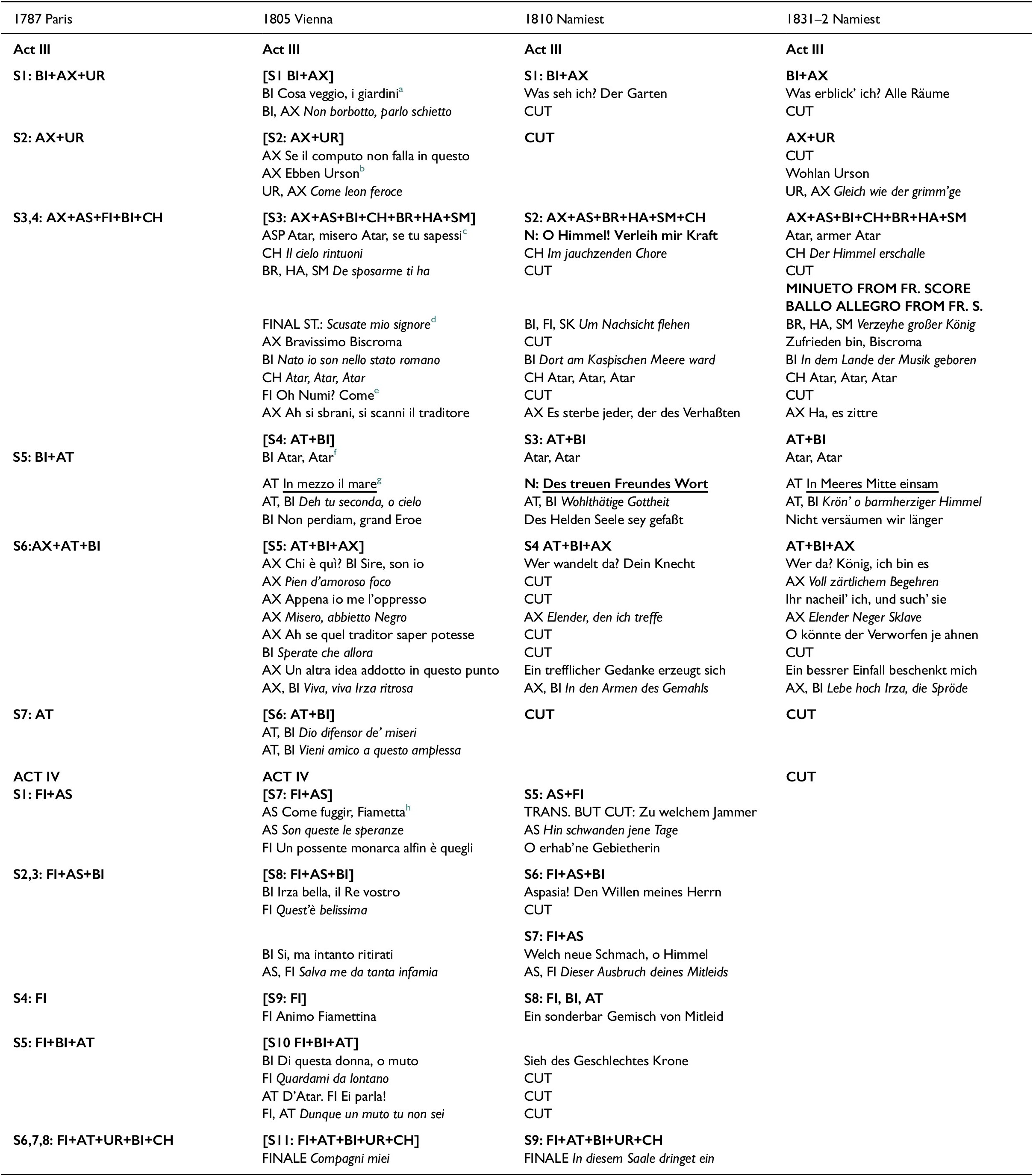
Table D3. Long description
The table is organized into four columns: 1787 Paris, 1805 Vienna, 1810 Namiest, and 1831 to 1832 Namiest.
Act III breakdown:
* Scene 1: Features B I plus A X plus U R in Paris. In Vienna and Namiest, it is B I plus A X. The 1805 Vienna version includes the line ‘Cosa veggio, i giardini’ while the Namiest versions use German translations like ‘Was seh ich? Der Garten’.
* Scene 2: Features A X plus U R in Paris and Vienna. It is marked as C U T in 1810 Namiest but restored in 1831 to 1832.
* Scenes 3 and 4: Involve large ensembles including A X, A S, F I, B I, and C H. Vienna adds B R, H A, and S M. The 1831 to 1832 version includes a Minueto and Ballo Allegro from the French score.
* Scene 5: Features B I plus A T. Includes the aria ‘In mezzo il mare’ in Paris and Vienna, translated to ‘In Meeres Mitte einsam’ in 1831 to 1832.
* Scene 6: Features A X plus A T plus B I. Includes the duet ‘Viva, viva Irza ritrosa’ in Vienna, translated to ‘In den Armen des Gemahls’ in 1810 and ‘Lebe hoch Irza, die Sprode’ in 1831 to 1832.
* Scene 7: Features A T in Paris and A T plus B I in Vienna. It is C U T in both Namiest versions.
Act IV breakdown:
* Scene 1: Features F I plus A S. Present in Paris, Vienna, and 1810 Namiest, but marked C U T in 1831 to 1832.
* Scenes 2 and 3: Features F I plus A S plus B I. Present in Paris, Vienna, and 1810 Namiest.
* Scene 4: Features F I. Present in Paris and Vienna. In 1810 Namiest, it includes F I, B I, and A T.
* Scene 5: Features F I plus B I plus A T. Includes the dialogue ‘Dunque un muto tu non sei’ in Vienna.
* Scenes 6, 7, and 8: Finale featuring F I, A T, U R, B I, and C H. The 1810 Namiest version lists the finale as ‘In diesem Saale dringet ein’.
Act V
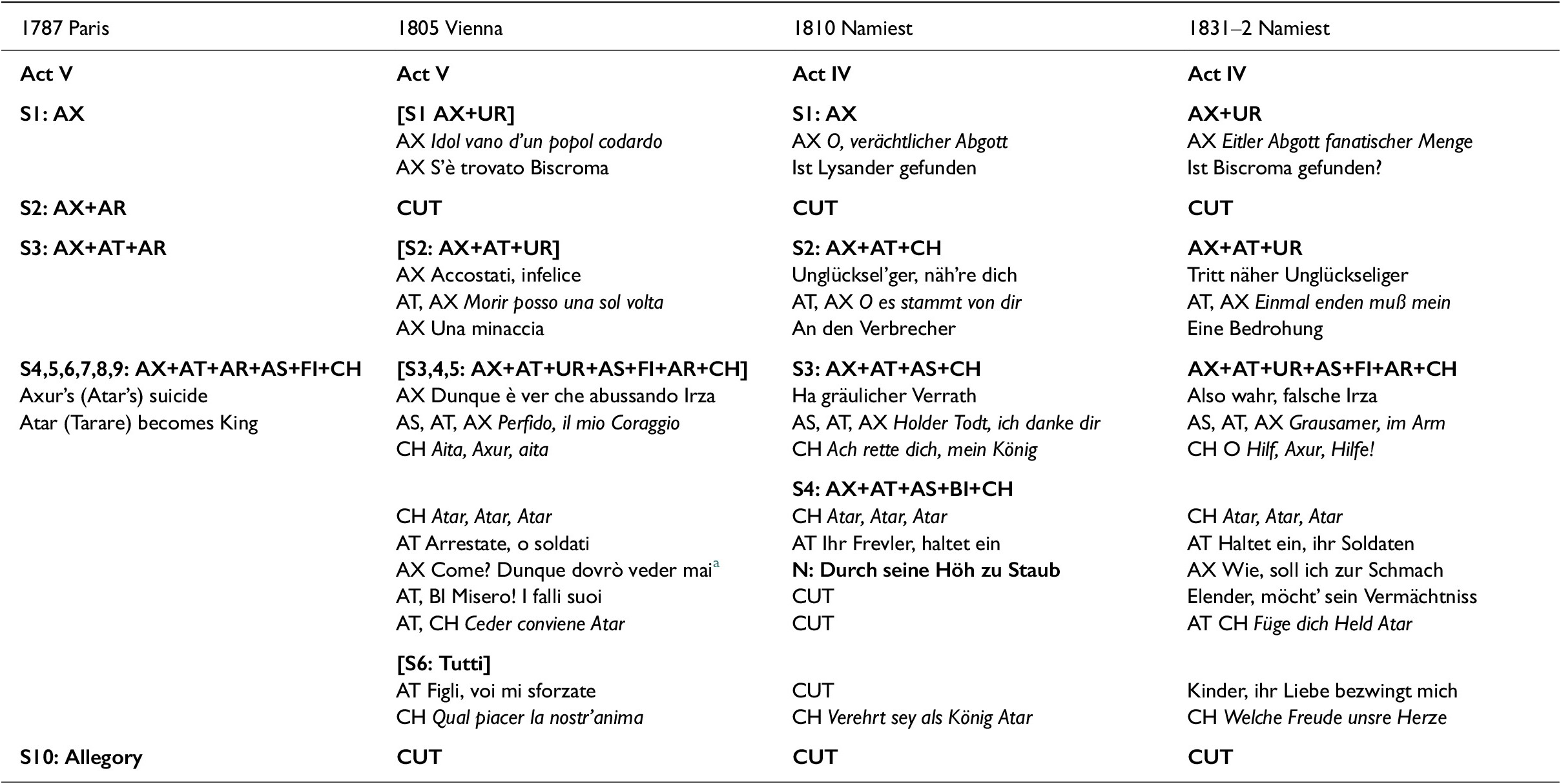
Table D4. Long description
The table consists of four columns representing different productions: 1787 Paris, 1805 Vienna, 1810 Namiest, and 1831 to 1832 Namiest.
* The 1787 Paris column lists Act V with scenes S 1 through S 10. Key elements include S 1 A X, S 2 A X plus A R, S 3 A X plus A T plus A R, and a large block for S 4 through S 9 involving A X plus A T plus A R plus A S plus F I plus C H, concluding with S 10 Allegory.
* The 1805 Vienna column lists Act V. S 1 is bracketed as A X plus U R. S 2 is marked as CUT. S 3 is bracketed as A X plus A T plus U R with the lyric Morir posso una sol volta. The finale includes A X plus A T plus U R plus A S plus F I plus A R plus C H, ending with a Tutti section.
* The 1810 Namiest column lists Act IV. S 1 is A X. S 2 is CUT. S 3 is A X plus A T plus C H with the lyric O es stammt von dir. S 4 includes A X plus A T plus A S plus B I plus C H. It features a specific note N: Durch seine Hoh zu Staub.
* The 1831 to 1832 Namiest column also lists Act IV. It follows a similar structure to the 1810 version but with different German lyrics such as Eitler Abgott fanatischer Menge and Einmal enden muss mein.
Common character initialisms used throughout include A X, A T, U R, A S, F I, A R, B I, and C H. Several sections in the later versions are marked as CUT compared to the original 1787 Paris production.
For the basic dramaturgical structure of the 1787 Paris Tarare, I relied on the critical edition.Footnote 65 Since there is no critical edition of the Viennese Axur, which kept changing under Salieri’s supervision, I relied on Haugwitz’s Italian score (Score 1 in Appendix C) as the basis for my comparison of the other versions – calling it the ‘1805 Vienna’ score. I am providing the scene designations, which are not in the Haugwitz score, based on the Lobkowitz Vienna libretto (dated 1788).Footnote 66 This libretto is closer in structure and content to the Haugwitz Italian score than the original 1788 Vienna libretto.Footnote 67 At the same time, the Lobkowitz libretto divides the acts differently from the Haugwitz score (it treats the first two scenes as a separate act, and treats the Haugwitz score’s Acts III and IV as a single act); as a result, I provide the scene indications in [square brackets] and show them as they would be numbered in the Haugwitz Italian version.
Haugwitz used his Italian score as the basis for all his later adaptations, and it contains remarks and notes that can be associated with text and music of both the 1810 and 1831–2 revisions of the opera. I am basing the information about the 1810 Haugwitz adaptations on the 1810 Brno edition of the libretto and the 1810 score (Libretto 1 and Score 3), and the 1831–2 adaptation on the 1830s autograph libretto sketch and the 1830s score (Libretto 3 and Score 5).
Character abbreviations in alphabetical order, based on the 1805 Vienna Italian names, the 1787 French names and any other name variants provided in parentheses here but not in the table for clarity’s sake: AL = Altamor (Altamort in 1787); AR = Arteneo (Arthénée in 1787, Oberpriester or Adrasteo in 1810, Arteneus in 1831–2); AS = Aspasia (Astasie in 1787); AT = Atar (Tarare in 1787); AX = Axur (Atar in 1787); BI = Biscroma (Calpigi in 1787, Lysander in 1810); EL = Elamir (Élamir in 1787, Knabe in 1810); FI = Fiammetta (Spinette in 1787, Irza in 1810); UR = Urson; CH = Chorus; BR = Brighella; HA = Harlequin; SM = Smeraldina.
Incipits of arias, ariosos, duets and ensembles are provided in italics, incipits of recitatives in regular script, incipits of extended sections of accompanied recitative are underlined, sections that were completely rewritten by Haugwitz (with new text and a new setting) are introduced as N: and are in bold.


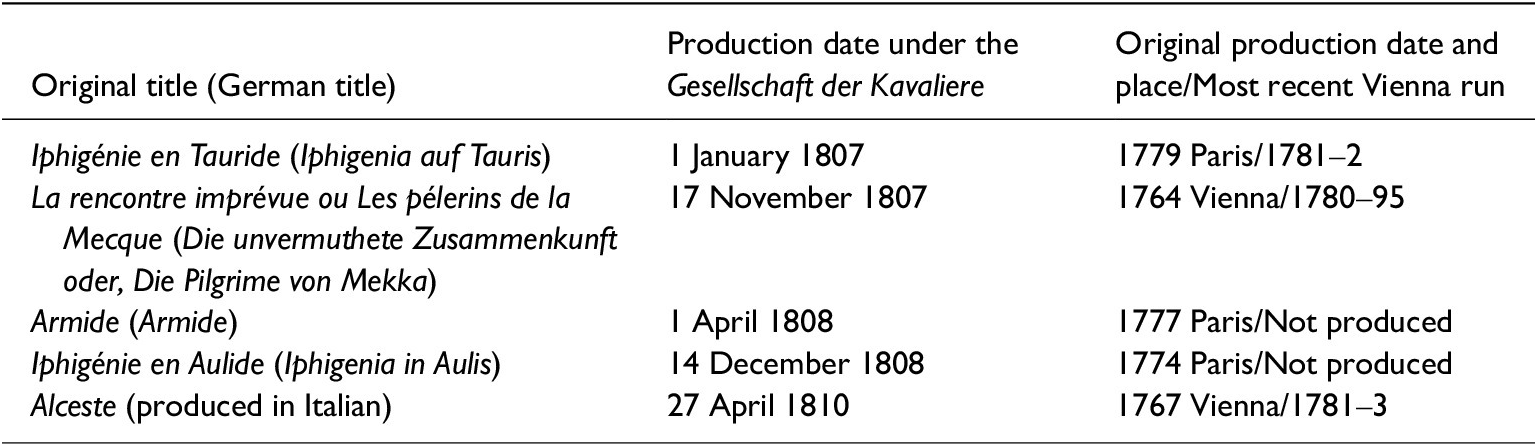
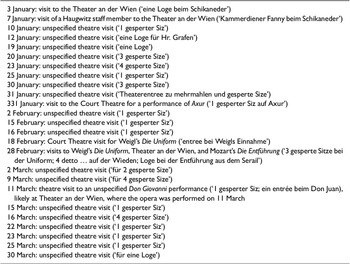


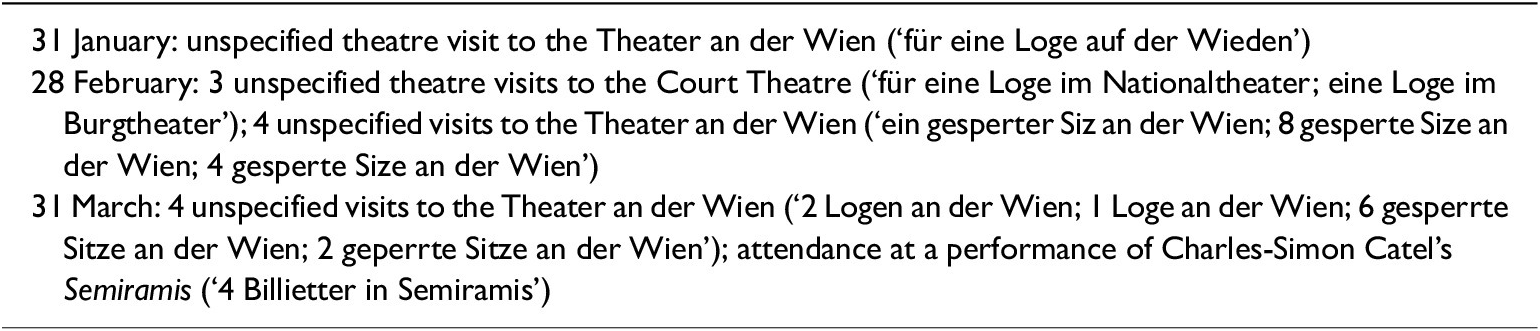
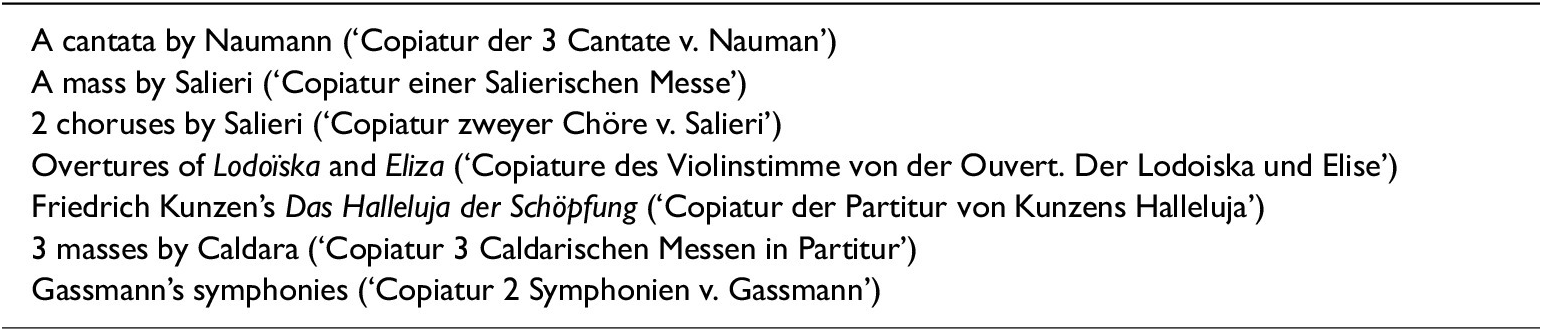


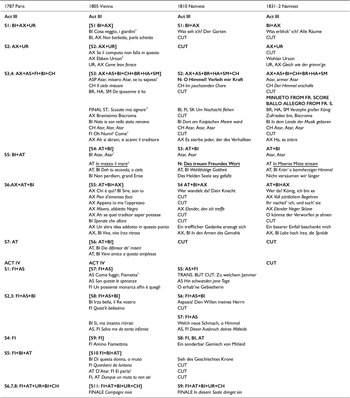


 Open access

