Introduction
On 12 January 2010, Haiti was struck by magnitude 7.0 Mw (about 7.0 on the Richter scale) earthquake. More than 230,000 people were killed, and > 300,000 were injured.Reference Ben-Ezra and Soffer1 The Israeli aid delegation arrived to Haiti on 15 January 2010 begin rescue operations. Most studies on rescue personnel have been conducted in the context of small-scale, multi-casualty incidents and disasters. These studies showed that exposure to mutilated, dead bodies was associated with dissociative and post-traumatic stress symptoms among rescue personnel.Reference Ben-Ezra, Palgi, Essar, Soffer and Haber2–Reference Ursano and McCarroll8 Most rescue personnel who work in disaster areas save only a small fraction of the number of victims, while most of the time is spent extricating dead bodies.
Numerous studies assess the impact of large-scale disasters on rescue personnel; they have focused primarily on the development of post-traumatic stress disorder (PTSD).Reference Battles9–Reference Chang, Lee, Connor, Davidson, Jeffries and Lai12 However, to the best of our knowledge, no study has been conducted on rescue personnel involved in large-scale disaster relief that has examined the association between various psychosocial factors (life satisfaction, social support, perceived coping, meaningfulness, and crisis of meaning) and post-traumatic reactions (dissociative symptoms and PTSD symptoms).
The purpose of this preliminary study was to examine the correlation between various psychosocial variables and post-traumatic reactions using a survey of rescue personnel who were exposed to the disturbing sights in the aftermath of the Haiti earthquake. Based on previous research,Reference Ben-Ezra, Palgi, Essar, Soffer and Haber2–Reference Ursano and McCarroll8 it was hypothesized that rescue personnel would exhibit a correlation between lower levels of psychosocial variables and higher levels of dissociation and PTSD symptoms.
Methods
Participants included 20 Israeli rescue personnel who were working in Haiti (mean age = 39.9 ± 9.5 years; range = 22–55 years; 19 men; 16 married). Participants reported no history of medical or psychiatric disorders prior to the mission. Each participant signed an informed consent form. The rescue personnel returned from Haiti on 28 January 2010, and data were collected during the week of 15–18 February 2010.
The rescue personnel worked under harsh conditions and upon returning to Israel, were administered a short demographic survey (age, sex, marital status, profession) along with a brief questionnaire. The questionnaire was used to assess the following:
1 Perceived social support was assessed using a single item question taken from the SF-36:Reference Ware, Snow, Konsinski and Gandek13 “In general, are you satisfied with the social support you recive?” 1 = not at all, 2 = a little bit, 3 = moderately, 4 = much, and 5 = very much;
2 Life satisfaction was assessed using a single item question: “In general, how satisfied are you with your life?” 1 = very dissatisfied, 2 = dissatisfied, 3 = satisfied, and 4 = very satisfied. This single item measure has been validated and has been associated with objective indicators of “well-being”;Reference Oswald and Wu14
3 Self-rated health was assessed using a single item question: “In general, how do you rate your health?”1 = bad, 2 = fair, 3 = good, and 4 = excellent. This single item measure has been validated and has been associated with objective indicators of “health”;Reference Benyamini, Blumstein, Lusky and Modan15 and
4 Perceived coping was assessed using the question: “How well do you think you are handling the situation given the circumstances?” On a five-point Likert scale of 1-5: 1 = not at all, 2 = a little bit, 3 = moderately, 4 = much, 5 = very much.Reference Bandura16
Negative and positive affect were measured by the Hebrew version of the Scale of Positive and Negative Experience (SPANE),Reference Diener, Wirtz, Tov, Kim-Prieto, Choi, Oishi and Biswas-Diener17 which is a 12-item questionnaire that includes six items assess positive feelings and six items used to assess negative feelings experienced with in the last month. For both the positive and negative items, three of the items are general (e.g., positive, negative) and three per subscale are more specific (e.g., joyful, sad). The items are rated on a 5-point frequency scale (1 = very rarely or never; 5 = very often or always) summing the score on each item. The SPANE consists of two subscales: positive affect (range = 5–30) (Cronbach α = 0.876) and negative affect (range = 5–30) (Cronbach α = 0.833).
Meaningfulness and crisis of meaning were measured by the two subscales of the Hebrew version of the Sources of Meaning and Meaning in Life Questionnaire (SoMe).Reference Schnell18 Each subscale includes five items used to assess the meaning in life and crisis of meaning respectively on a 6-point scale (0 = strongly disagree; 5 = strongly agree). The meaningfulness scale is used to measure the degree of subjectively experienced meaningfulness. It is composed of complementary facets of meaning in life; its items read as follows: (1) “I think that there is meaning in what I do”; (2) “I have a task in life”; (3) “I feel part of a bigger whole”; (4) “I lead a fulfilled life”; and (5) “I think my life has a deeper meaning”. Crisis of meaning is used to measure the degree of meaninglessness and suffering from a lack of meaning: (1) “When I think about the meaning of my life I find only emptiness”; (2) “My life seems meaningless”; (3) “I don't see any sense in life”; (4) “I suffer from the fact that I don't see any point in life”; and (5) “My life seems empty”. The score was the sum of items in each subscale: meaningfulness (range = 0–25) (Cronbach α = 0.650) and crisis of meaning (range = 0–25) (Cronbach α = 0.625).
Peri-traumatic dissociation was assessed by using the 6-item Peritraumatic Dissociative Experiences Questionnaire—Self-Report Version,Reference Marmar, Weiss, Metzler, Wilson and Keane19 which rates peri-trauamtic dissociation symptoms severity on a 5-point severity scale (0 = not at all; 4 = very much). The score of this questionnaire was the sum of the scores across all items (range = 0–24). Internal consistency of the 6-item Peritraumatic Dissociative Experiences Questionnaire was good (Cronbach α = 0.820).
Post-traumatic stress disorder symptoms were assessed using the 22-item Impact of Event Scale-Revised (IES-R),Reference Weiss, Marmar, Wilson and Keane20 which rated severity of intrusion, avoidance, and hyperarousal symptoms during the past week on a 5-point severity scale (0 = not at all; 4 = extremely). The score was the sum of items (range = 0–88) (Cronbach α = 0.933). This instrument is used commonly in Israel among rescue and hospital personnel.Reference Ben-Ezra, Palgi, Essar, Soffer and Haber2,Reference Ben-Ezra, Essar and Saar3,Reference Essar, Palgi, Saar and Ben-Ezra4,Reference Palgi, Ben-Ezra and Essar21–Reference Ben-Ezra, Palgi and Essar24
A set of Pearson correlations was conducted in order to learn the associations between psychological factors (life satisfaction, social support, perceived coping, positive affect, negative affect, meaningfulness, and crisis of meaning) and dissociative symptoms and PTSD symptoms. All analyses were performed using SPSS statistical software (version 16.0, SPSS Inc, Chicago, IL).
Results
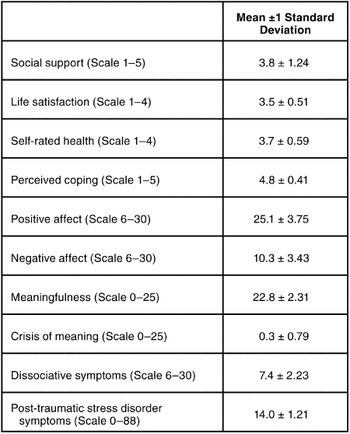
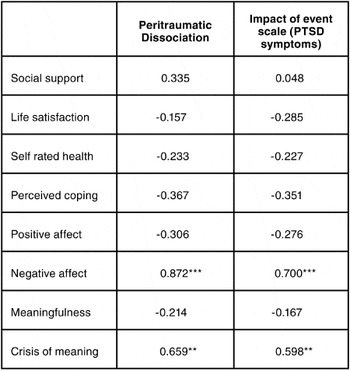
After returning from Haiti, rescue personnel reported a moderate to high level of perceived social support; high level of life satisfaction; high level of self-rated health; high level of perceived coping; high level of positive affect; low level of negative affect; high level of meaningfulness; low level of crisis of meaning; low level of dissociative symptoms; and moderate level of PTSD symptoms (Table 1). The only statistically significant correlation was found between negative affect and dissociative symptoms (r = 0.872; p <0.001) and PTSD symptoms (r = 0.700; p <0.001) and between crisis of meaning and dissociative symptoms (r = 0.659; p <0.01) and PTSD symptoms (r = 0.598; p <0.01) (Table 2).
Mean values of psychological factors and psychological trauma symptoms

Pearson correlations between psychosocial factors and post–traumatic reactions.

* p < 0.05, ** p < 0.01, *** p < 0.001.
Discussion
The results indicate that rescue personnel's negative affect and crisis of meaning were associated with dissociative and PTSD symptoms. This suggests that when involved in disaster relief, some rescue personnel may feel negative emotions and loss of meaning during extrication of bodies, and are prone to develop elevated dissociative and PTSD symptoms. However, on the whole, rescue personnel showed high levels of perceived coping, social support, and life satisfaction. Although rescue personnel are resilient and find merit in their duty, there always is a risk that the disaster environment overwhelms them and leads to psycholoical symptoms. These findings are in line with previous studies demonstrating that despite negative experiences, positive meaning can result from helping others.Reference Folkman and Moskowitz25,Reference Larsen, McGraw and Cacioppo26 This explains why, even when rescue workers show vulnerability, they still are committed to their work and find a meaning in a seemingly meaningless situation. This may imply that rescue personnel, even under an extreme workload, still show high job value, responsibility, and purpose in aiding the trapped, and satisfaction from saving lives although the environmental conditions in Haiti were harsh. A brief intervention can help rescue personnel to process the significant situation they underwent.
The main limitation of this study is the small sample size and the lack of a comparison group. Future studies should involve longitudinal methods with larger samples in order to understand the long-term effects of a large-scale disaster on rescue personnel.
Conclusions
The impact of the Haiti earthquake on rescue personnel led to crisis in meaning and negative affect that were associated with dissociative symptoms and PTSD symptoms. However, the majority of rescue personnel showed high levels of meaning and purpose in aiding the survivors while extricating dead and mutilated bodies.
Acknowledgments
The authors appreciate the cooperation of the rescue personnel who were in Haiti and completed the survey.
Abbreviations:
PTSD = post-traumatic stress disorder
SPANE = Scale of Positive and Negative Experience
SoMe = Sources of Meaning and Meaning in Life Questionnaire