In the fall of 2008, I conducted a survey of political theorists in the United States.Footnote 1 The survey asked a wide range of questions about the place of political theory within political science, the experiences of political theorists as teachers and scholars, and about what and how political theorists teach.Footnote 2 My goal was to investigate theorists' views on the long-running debate over whether political theory belongs in political science,Footnote 3 as well as to get a snapshot view of the practice of political theory as a subfield today. For purposes of the survey, I defined political theory as the study of political philosophy, including both normative and historical approaches, but not including positive political theory or formal modeling.
My research assistantsFootnote 4 and I visited the webpage of every accredited, four-year college and university in the United States to attempt to identify potential participants. We also included everyone in the American Political Science Association's (APSA) Directory of Political Science Faculty and Programs, 2007–2008 (2007) who listed an interest in political theory (not including positive political theory). We included everyone who could not be excluded.
Of the 2,073 schools we identified, 59.1% (1,226) include political theory in their curriculums, while 20.3% (420) include political science but not political theory, and 14.8% (306) do not teach political science at all (in any department). We attempted to verify these findings by examining school catalogs. Through this process, we identified 5,144 potential respondents—roughly half people whom we had reason to believe were political theorists, and roughly half people we could not rule out. After deducting bounced emails, undeliverable letters, and respondents who identified themselves as ineligible, 4,351 potential respondents received an invitation to take the online survey. By the time data collection had closed, 1,086 individuals had completed some or all of the survey, producing a simple response rate (total responses/total invitations received by potential respondents) of 25% (1,086/4,351). The response rate among scholars we now had reason to believe are political theorists and who received the invitationFootnote 5 was 49.3% (1,086/2,203).
One simple, initial question of interest is: who are political theorists? Many of the answers to this question are not surprising, such as that 96.1% (745; N = 775) of respondents hold a Ph.D. or equivalent, or that 81% (628; N = 775) of respondents teach in a political science department. (Since not every respondent answered every question, I will indicate the N for each topic.) However, one finding of note concerns gender. According to the APSA (2001), 23.8% of political scientists are women, whereas 26.6% (205; N = 771) of survey respondents were women, suggesting that political theory has a slightly higher proportion of women than does the profession generally. (As of February 2010, 31.8% of the APSA's members are women, but, as I report below, not all political scientists are members of the APSA, so that figure may not be representative of the broader population.) Similarly, while it should be no surprise, only 25.3% (270) of respondents were at institutions that grant a Ph.D. in political science, while 74.7% (798; N = 1,068) were not.
One final demographic question concerns how the respondents, all of whom reported teaching at least some political theory, relate to political theory itself. I have broken the respondents into three categories: (1) Theorists by Necessity, whose primary research or teaching interests are not in political theory (27.3% [211] of respondents); (2) Theorists at Heart, whose primary teaching or research interests are in political theory and who teach at least 25% of the time in political theory (58.9% [456] of respondents); and (3) Would-Be Theorists, whose primary teaching or researching interests are in political theory but who teach theory less than 25% of the time (13.8% [107; N = 774] of respondents).
THE PLACE OF THEORY IN POLITICAL SCIENCE
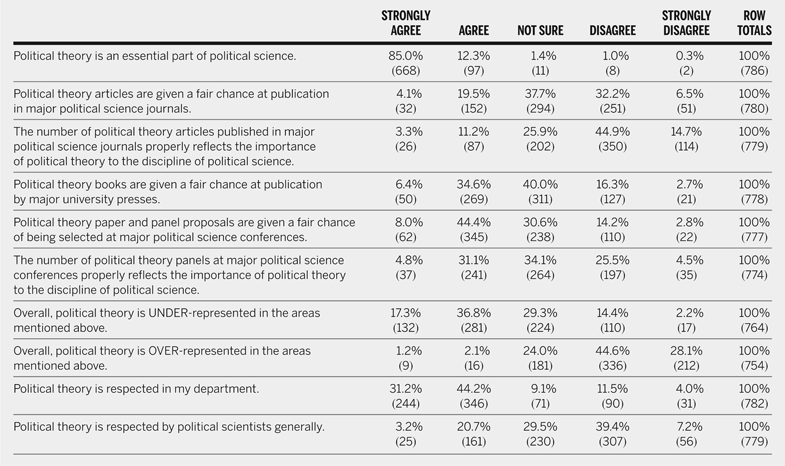
As mentioned above, one main motivation for conducting this survey was the perennial debate over whether theory belongs in political science. Perhaps not surprisingly, of the 781 respondents to a question about whether political science is the right academic “home” for political theory, 92.7% (724) said “yes.” A related series of questions asked about respondents' views regarding the current status of political theory within the discipline. The results, summarized in Table 1, show both that political theorists are concerned about their place within political science, and that, in many cases, they are unsure about theory's current status.
Respondents' Views on the Place of Political Theory within Political Science

Another question asked about the numbers and proportions of theorists in the respondents' departments. The mean percentage of tenured or tenure-track faculty teaching political theory in respondents' departments is 16.9%, while the median is 20%. However, a follow-up survey revealed that the median at Ph.D.-granting institutions is lower (see below for details).
A final question in this set asked how many theory classes the respondent's department offers in the average year (counting different sections of the same course separately). The mean answer was 6.5, the median was 5, and the mode was 4 (N = 744).
WHAT IT'S LIKE TO BE A POLITICAL THEORIST
A second motivation for undertaking the survey was to investigate the professional experiences of political theorists. One question in this series asked how many courses the respondent is required to teach per academic year. The mean answer was 5.5, the median answer was 5, and the modal answer was 4. However, 24.4% (182) of respondents said that they teach 6 classes per year, and 17.7% (132; N = 747) said they teach 8. A related question asked how much of that teaching is in theory. Just over half of those answering this question (53.2%, or 412 respondents) reported that theory makes up only half or less of their teaching load, while only just over a third (35.4%, or 274 respondents; N = 774) reported that theory makes up at least three-quarters of their teaching.
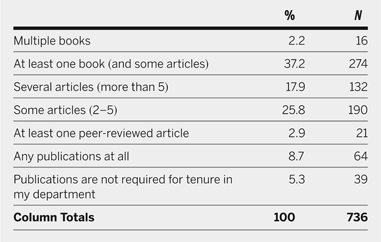
Of respondents who answered a question about whether their school offers tenure, 96.9% (747; N = 771) answered affirmatively. Those whose departments do offer tenure saw a follow-up question about the relative importance of teaching, research, and service in tenure decisions at their schools. Of respondents answering these questions, 54.1% (397; N = 731) identified teaching, 45.5% (334; N = 729) identified research, and only 0.4% (3; N = 732) identified service as being the most important factor in tenure decisions at their institution.Footnote 6 Those who indicated that their school grants tenure were also asked how many and what type of publications, if any, were required for tenure. The results, summarized in Table 2, show that the majority of the respondents—60.6% (446; N = 736) —are in departments that do not require a scholar to publish a book to gain tenure.
Amount of Publication Required for Tenure in Respondents' Departments

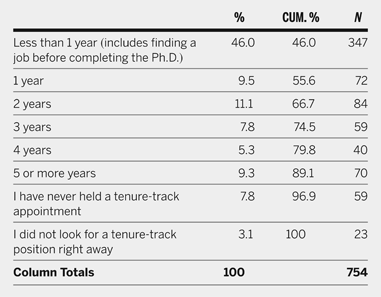
A final question in this set asked how much time the respondent had spent on the job market before finding a tenure-track position. The responses are summarized in Table 3. Two noteworthy findings are that 55.6% (419) of respondents who answered this question found a tenure-track job within a year of receiving their Ph.D., and that nearly 90% (672; N = 754) of those looking for one found a tenure-track position within five years.
Length of Time Respondents Spent on Tenure-Track Job Market after Receiving Ph.D.

A vast majority 90.6% (696; N = 768) of respondents reported that they were political scientists by training, but of those only 66.3% (451; N = 680) indicated that political theory was their primary subfield, while 19.7% (113; N = 574) indicated that it was their secondary field. That suggests that more than 20% of respondents who are teaching political theory are not specialists in the field (adding together those who are not political scientists with those for whom theory is neither their primary nor secondary field).
Of those who reported being political scientists by training 81.5% (555; N = 681) belong to the APSA. Of these, only 44.9% (249; N = 554) belong to the Foundations of Political Thought organized section within the APSA. This suggests that a majority of the people teaching political theory in the U.S. today are members of the APSA, but not of the Foundations section.
RANKINGS
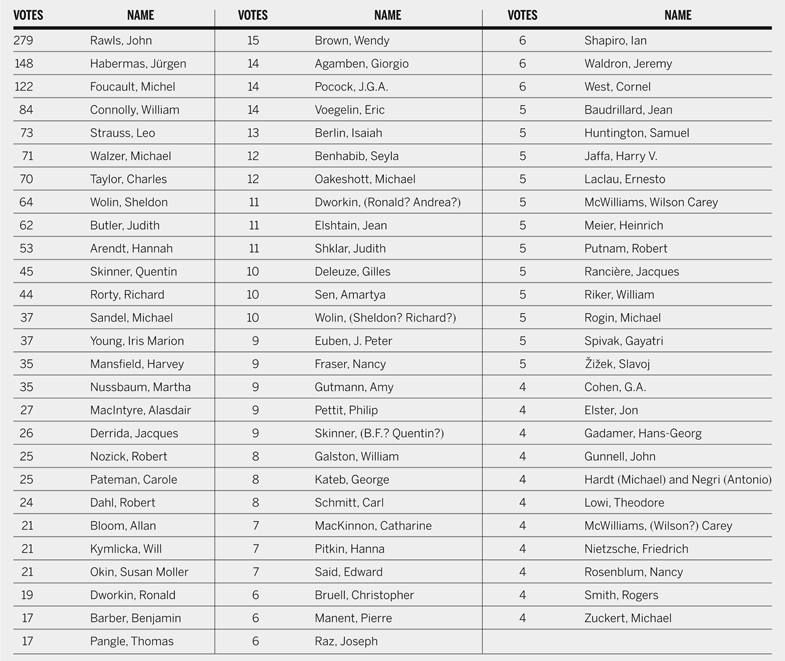
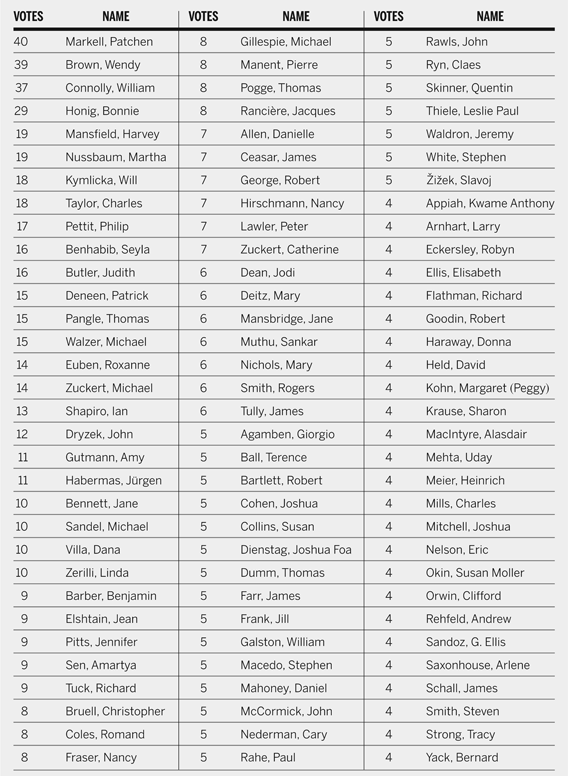
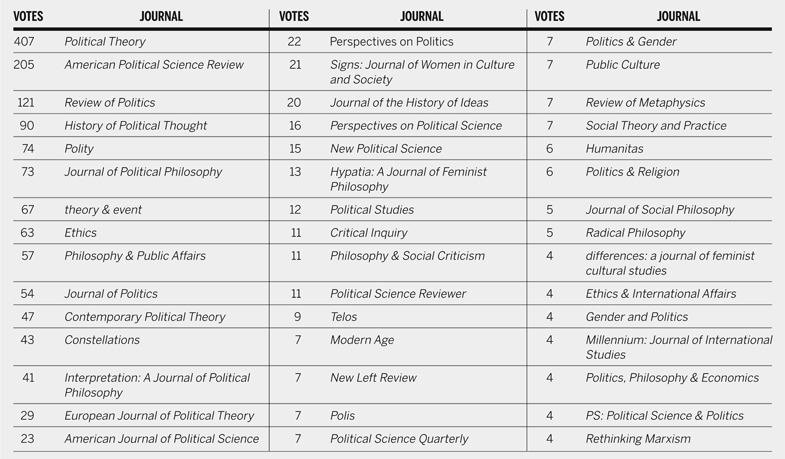
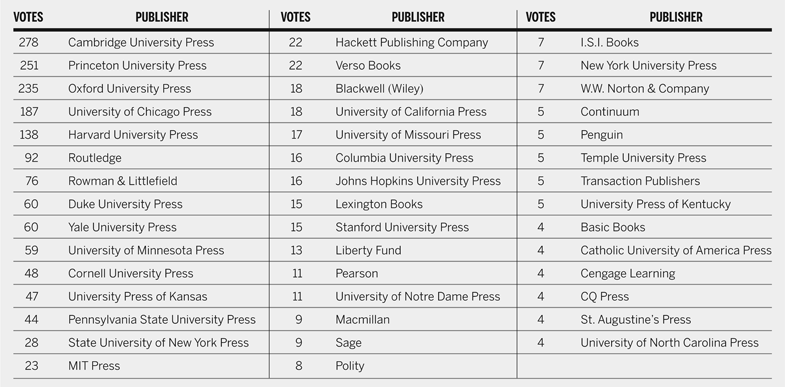
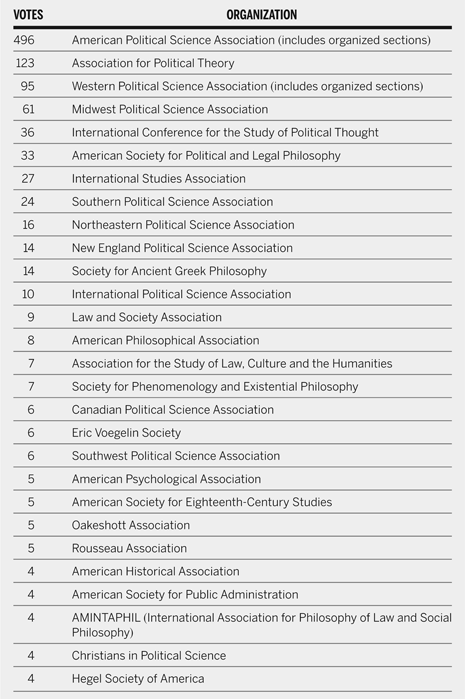
Several questions asked respondents to rank scholars, presses, journals, and professional associations. The results are presented in Tables 4–8. All of the ranking questions had the same basic format, asking respondents to identify up to five entries for each category. The rank orderings were determined by the total number of votes received for each response.
Rank Ordering of Scholars Who Have Had the Greatest Impact on Political Theory in the Past 20 Years

Note: This list includes only those scholars who received at least four votes.
Rank Ordering of Scholars Doing Excellent Work Today Whose Work Will Be Influential during the Next 20 Years

Note: This list includes only those scholars who received at least four votes.
Rank Ordering of Journals Related to Political Theory That Respondents Report Reading

Note: This list includes only those journals that received at least four votes.
Rank Ordering of Publishers Related to Political Theory Whose Books Respondents Report Reading

Note: This list includes only those publishers that received at least four votes. Votes for subsidiaries were added to the vote totals for the named publishers.
Rank Ordering of Professional Organizations Related to Political Theory to Which Respondents Report Belonging

Note: This list includes only those associations that received at least four votes.
GRADUATE TRAINING IN POLITICAL THEORY
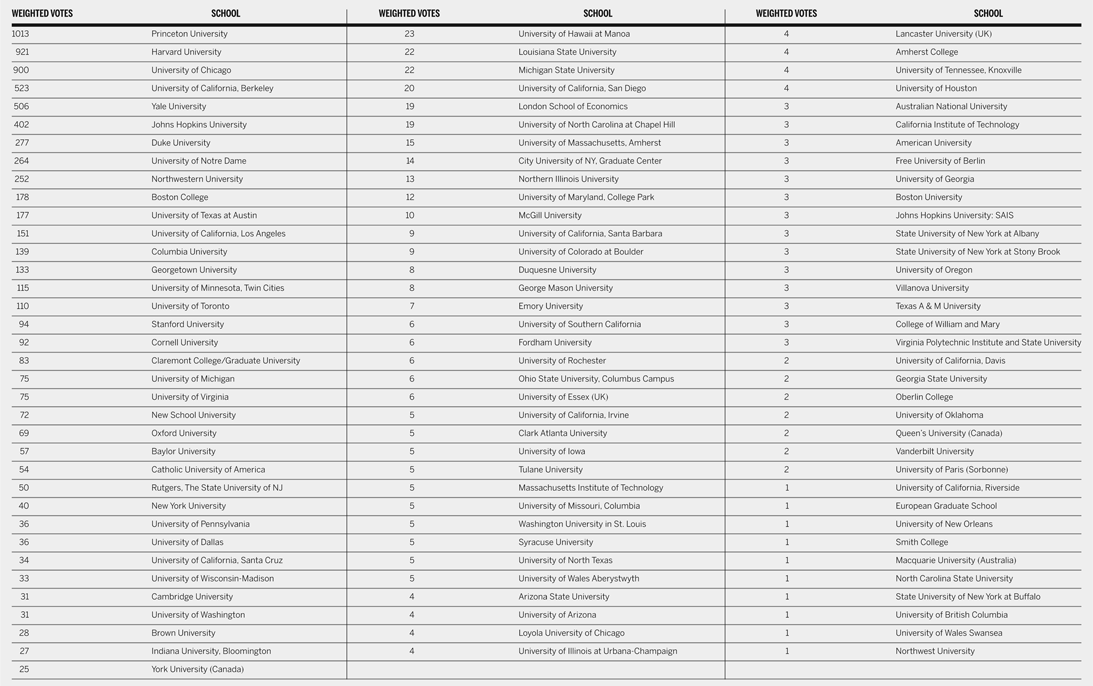
The survey asked three questions about the training of graduate students. Respondents who indicated that their departments grant the M.A. or Ph.D. were asked whether their department offers theory as a primary or major area of concentration for graduate students; 68.2% (206; N = 302) said “yes.” Of those same respondents, only 33.9% (102; N = 301) reported that their department requires graduate students to take at least one political theory class. Further, all respondents were asked to rank political science Ph.D. programs in terms of the quality of their training in political theory; their responses are summarized in Table 9.
Rank Ordering of Political Science Ph.D. Programs by the Quality of Political Theory Training They Offer

Note: The question asked respondents to rank order their responses. Schools ranked number 1 received 5 points, number 2 received 4 points, and so on. This list is ranked by the schools' weighted totals. Every school that received at least one vote is included in this list, including schools that do not currently offer the Ph.D. in political science but were named by respondents.
Because the original survey focused on individuals as the unit of analysis, rather than institutions, it was difficult to tell how representative the findings summarized above were of political science Ph.D. programs. To get a more complete picture of the status of political theory in American graduate programs, I conducted a follow-up survey of the graduate directors of the 129 programs identified by the APSA as granting a Ph.D. in political science. I received answers from 95 of the program directors, and was able to identify 10 other programs that are either currently inactive or offer a Ph.D. only in a coordinate field, such as public administration. For the remaining programs, I visited their websites and gathered as much information as possible.Footnote 7 This follow-up survey found that theory is available as a major/primary field in 69.7% (83) and available as a secondary or minor field in 77.3% (92) of the active programs (N = 119). Only 27.7% (33) of active programs require their Ph.D. students to take at least one theory class. In terms of the percentage of Ph.D.s granted in theory in an average year, the mean response was 12.4% and the median was 10% (N = 91). The mean percentage of theorists on the full-time, tenure-track faculty of the active Ph.D. programs is 16.9% and the median is 11.7% (N = 90). Regarding full-time, non-tenure track faculty, the mean percentage of theorists was 14%, while the median was 0% (N = 90).
CONCLUSION
My hope is that the results of these surveys will be the catalyst for a discussion among political theorists and within the discipline more broadly about the role of theory in political science, as well as about whether we are training graduate students appropriately for the jobs that await them. Knowing the actual state of political theory in the discipline is the first step in deciding whether we are happy with the status quo and, if not, how we might go about changing it.