Following decades of scholarly research on the political effects of natural resource wealth—frequently focused on oil production—the multifaceted effects of “black gold” remain of intense interest. Resembling a broader pattern of characterizing oil wealth as a “curse,” an influential perspective in the enormous international relations literature on causes of civil war contends that oil production frequently encourages rebel groups to initiate civil wars against vulnerable governments.Footnote 1 Existing arguments about oil span a wide spectrum of general mechanisms posited to cause civil conflict. Regarding material incentives to fight, expectations of capturing “unimaginably” high rents from oil revenues have provided one of the strongest “economic motive[s] for civil war in the past half-century” because the state becomes a lucrative prize.Footnote 2 Regarding opportunities to fight, because resource-rich rulers do not have to build strong societal ties to raise revenues,Footnote 3 oil-rich governments tend to have weak bureaucratic institutions relative to their country's per capita income level. This relative state weakness mechanism enables fights for the prizeFootnote 4 —a problem exacerbated when rebels can loot and bunker oil to finance their insurgency.Footnote 5 These prominent arguments that oil wealth motivates and provides opportunities for violent rebellions against vulnerable governments underpin published cross-national regression evidence that usually supports a conflict resource curse.Footnote 6
Comparative politics research on authoritarian regime survival, however, provides a compelling alternative hypothesis.Footnote 7 Although this related literature also characterizes oil as a curse, the mechanisms posited to prevent democratization are incompatible with vulnerability-based conflict resource curse arguments. Oil-rich governments are hypothesized to prevent democratization by strategically investing enormous revenues in military capacity and by building generous welfare states. The hypothesis that oil wealth enhances the coercive apparatus is conventional wisdom among Middle East and North Africa scholars,Footnote 8 and “rentier” spending effects have attracted even wider attention.Footnote 9 These revenue-enhancing effects should decrease prospects for societal challenges.
Juxtaposing divergent theoretical conclusions from these related resource curse literatures raises two key questions for evaluating a widely discussed cause of civil wars. How do revenue-enhancing and government vulnerability effects impact rebels’ overall incentives to attack an oil-rich government? And, if pacifying revenue-enhancing effects are theoretically relevant, then why do existing statistical results consistently uphold a conflict resource curse?
I address these questions by distinguishing between two types of civil war: center-seeking civil wars to control the capital and separatist civil wars to create an autonomous government. The analysis focuses mainly on center-seeking wars because the motivating theoretical puzzle of strengthening versus vulnerability mechanisms directly affects this type of civil war. In contrast, the within-country location of oil reserves should be more important for determining separatist civil wars. Disaggregating types of civil war therefore provides needed theoretical and empirical clarifications for conflict-resource-curse debates. The oil prize will not motivate secession if a potential rebel group's region does not contain any oil reserves—whereas seizing the center would yield the prize regardless of within-country oil location—and the deterrence effect of a strong government military will be less effective against separatist insurgencies fought in the periphery than against attacks on the capital. These theoretical considerations also imply that widely used country-level oil income measures—which do not incorporate oil location—provide valid tests for hypotheses about oil and center-seeking wars only.Footnote 10
To evaluate the conflict-resource-curse hypothesis applied to center-seeking civil wars, I present a game-theoretic model that combines competing oil vulnerability and revenue-enhancing mechanisms into a unified theoretical framework. In each period of an infinite horizon game, a government allocates its per-period revenues—which consist of oil and non-oil revenues—among personal consumption, armament, and a patronage offer to a challenger. The challenger either accepts the offer or fights to control the government. The model incorporates oil's revenue-enhancing effects by assuming the government controls and strategically allocates oil revenues—an empirically grounded contrast to oil-looting theories. Oil generates a state prize effect by increasing the challenger's expected gains from winning a fight. Finally, the model captures the relative state weakness mechanism by assuming, for a fixed amount of revenues, bureaucratic capacity decreases in the percentage of revenues that derive from oil.
The first main theoretical result explains why large oil-generated revenues dominate vulnerability effects and decrease prospects for center-seeking civil war. Although oil enhances the prize of capturing the state, the government strategically spends oil revenues on military capacity. This partially counteracts the prize effect by decreasing the challenger's probability of winning, which lowers the patronage offer needed to induce acceptance. The coercive possibilities afforded by oil decrease overall incentives to attack the government.
Although this finding provides needed insights for resolving competing theoretical claims, it also raises a new puzzle: Why does existing cross-national regression evidence consistently support a conflict resource curse? The second main result of the model addresses this question by distinguishing overall effects of oil from the distinct theoretical finding that oil revenues are less effective at preventing conflict relative to other revenue sources, which follows directly from the relative state weakness assumption. Problematically, existing theories usually conflate these two effects. Related, the widespread empirical practice of including income per capita as a covariate in regressions of civil war onset on oil wealth tests the wrong theory: relative rather than overall effects. Because large-scale oil production tends to raise both income per capita and government revenues by considerable amounts, the posttreatment bias induced by controlling for income should engender upwardly biased regression estimates—meaning oil appears to be more of a curse than it actually is.
Regression evidence demonstrates the empirical relevance of this specification consideration. One set of regressions uses the same statistical models as much existing research and demonstrates that simply omitting the income control removes the strong positive correlation between oil wealth and center-seeking civil war onset. Furthermore, statistical models that introduce additional justified modifications demonstrate a consistent negative association between oil and center-seeking conflict.
Foundational Assumptions Linking Oil and Center-Seeking Civil Wars
The divergent implications of oil-authoritarianism and oil-conflict research demonstrate that many existing arguments about oil are mutually inconsistent.Footnote 11 This observation highlights the need for a unified theoretical framework to examine opposing arguments. Directly comparing positions from different oil literatures provides foundational assumptions that substantively ground the formal model. We need to scrutinize how oil revenues affect the calculus of both governments—as in research on oil and authoritarianism—and challengers, the predominant theme of the oil/civil war literature. This discussion also theoretically distinguishes center-seeking from separatist civil wars.
First Assumption: Governments Control Oil Revenues
Key attributes of oil production heavily privilege a government over rebel groups, an observation that corresponds with assumptions from oil and authoritarianism research. In contrast, oil and civil war research often focuses on how oil funds insurgencies,Footnote 12 or assumes that all participants in a spoils contest face the same budget constraint (economic theories of conflict).
Oil production requires large capital investments, a crucial feature of oil that favors governments over challengers.Footnote 13 Ross shows that the capital-to-labor ratio is considerably higher in the oil and gas industry than in any other major US industry operating overseas.Footnote 14 Menaldo and Alnaswari each describe the intimate relationship between oil production in developing countries and foreign capital and technology.Footnote 15 Compared with natural resources such as alluvial diamonds and drugs that require little capital to extract, oil is a “less lootable resource”Footnote 16 that “is easily controlled by the central government.”Footnote 17
Empirically, rebel groups have almost never accessed oil revenues to fund start-up costs for challenging a government because of impediments to directly accessing oil wealth during peacetime. Among Ross’s review of cases, only Congo-Brazzaville in the 1990s exhibits this phenomenon in an oil-rich country that experienced a civil war.Footnote 18 In this exceptional case, rebel leader and former president Denis Sassou-Nguesso promised to restore French oil company Elf Aquitaine's monopoly over Congo's oil if he regained power, in return for assistance. However, cases in which international actors provide a “booty futures” market are rare—a failed coup attempt in Equatorial Guinea in 2004 and Libya in 2013 provide two other known cases—because international oil companies and their host governments favor incumbents over challengers to prevent costly disruptions to oil production. For example, distinct states arose on the periphery of the Arabian peninsula because British oil companies needed designated rulers with whom to sign concessions.Footnote 19 The British navy militarily supported these new incumbents.Footnote 20
Rebels have greater opportunities to disrupt or to profit from oil production during ongoing civil wars. Bombing pipelines provides one disruptive option. In extreme circumstances a rebel group may halt oil production entirely by deterring international oil companies from remaining in the country, as during the Second Sudanese Civil War. Rebels may also be able to steal government-produced oil, as in Nigeria and Iraq during the 2000s.Footnote 21 The rebel group ISIS in Iraq and Syria provides an extreme example of rebels looting oil. By gaining military control over existing oil fields and refineries, by the summer of 2014 ISIS had achieved resources exceeding that “of any other terrorist group in history.”Footnote 22
However, these examples provide rare exceptions rather than the norm. Even during ongoing conflicts governments control the overwhelming majority of oil production. This undergirds Colgan's argument that rebels rarely militarily defeat oil-rich governments because oil revenues provide the government with funds to win a war.Footnote 23 In almost all circumstances, even rebel groups that control oil-rich territory face great difficulties extracting oil and constructing a national distribution system to reap profitsFootnote 24 —factors related to high capital costs, foreign assistance needs, and the tendency for international actors to support incumbents. ISIS partially overcame these difficulties by using smuggling routes established during the post-2003 Iraq state collapse. However, its oil fields still have produced at far below capacity ratesFootnote 25 —especially after US bombing campaigns began in 2014.Footnote 26
The prevalence of governmental control over oil revenues also questions the empirical relevance of economic theories of conflict. These models conceptualize wars as a contest. Each side invests in arms to increase its probability of winning a fight for the prize. A larger prize induces actors to devote more resources to fighting. However, the conventional assumption that every actor faces the same budget constraint contrasts with the stylized fact that an oil-rich government has a much larger budget than the challenger to spend on the contest. Instead, the standard contest model set-up may be illuminating for natural resources more easily looted than oil, especially when the state has collapsed. For example, Olsson and Fors use this framework to explain how gold, diamonds, and coltan affected civil wars in the Democratic Republic of the Congo in the 1990s.Footnote 27
Second Assumption: Oil Provides a Large Revenue Base and Raises Income
Not only does oil provide government revenues, it frequently provides a large revenue base. Ross lists the “exceptionally large size” of oil revenues as a central characteristic of oil production and provides supporting cross-national evidence.Footnote 28 Oil revenues are also large even compared with rents from other natural resources. In Haber and Menaldo's data set on oil, natural gas, coal, and metals income for a global sample of countries, oil and natural gas made up 90 percent of all global resource income from 1960 to 2006.Footnote 29 Furthermore, in 76 percent of country-years with more than $500 in resource income per capita in this global sample, at least half the income came from oil and gas. “The global trade of oil generates revenues that are somewhere between ten and a hundred times larger than the next largest natural resource.”Footnote 30
Evidence connecting oil wealth to large revenue bases complements the recent rethinking of the economic development resource curse. Alexeev and Conrad demonstrate that oil-abundant countries have considerably higher per capita incomes than oil-poor countries.Footnote 31 Their evidence overturned earlier conventional wisdom (for example, Sachs and Warner) based on studying economic growth rates during an unrepresentative period in world history.Footnote 32 Although it is puzzling that oil-rich states performed so poorly during the 1970s and 1980s, most major oil producers had already become wealthy from commercial oil production prior to this periodFootnote 33 —which research prior to Alexeev and Conrad's had overlooked. Their evidence also rejects a weaker version of the resource curse hypothesis: oil may boost economic growth, but only in countries with strong pre-oil institutions. Alexeev and Conrad's results instead demonstrate that “countries with weaker institutions benefit more from natural resources.”Footnote 34
Large revenues and high per capita income in major oil producers are especially striking in contrast to bleak economic prospects that many oil-rich countries faced prior to discovering large oil reserves. Modern states did not exist in the Arabian peninsula before oil, and the region was one of the poorest in the world. “The pearling industry was vital to the pre-war economies … [and] suffered an almost total collapse after the Wall Street crash of 1929 … It would have been almost impossible to overcome this crisis had the strange hand of fate not intervened: the oil companies arrived in search of concessions.”Footnote 35 Although Qatar is now one of the world's richest countries, in 1942 the king mortgaged his house to pay off “public” debts and in 1949 the country had only six public employees.Footnote 36 Before Libya discovered oil, “the country's major revenue sources were sales of scrap metal left behind by the belligerents during [World War II], sales of esparto grass, and rent from military bases leased by the United States and Great Britain … 80 percent of the country's population still lived at subsistence level in the hinterland.”Footnote 37
Third Assumption: Governments Use Oil Revenues Strategically
A core premise of oil and authoritarianism research is that oil-rich governments strategically use their large revenue streams to decrease incentives for societal challenges. This contrasts with the core idea behind the state prize argument: oil-rich governments provide easy targets for predation. More generally, most work on oil and conflict devotes little attention to strategic government choices.Footnote 38 Consequently, existing theories often imply that oil wealth raises civil war frequency by imposing unsatisfying limitations on the government's assumed range of strategic options.
Providing one example of a crucial strategic consideration, my model assumes the government can bargain with the challenger. This assumption is standard in models of international warfareFootnote 39 and political regime transitions,Footnote 40 but not in economics-of-conflict models. A key result from Besley and Persson exemplifies the importance of bargaining.Footnote 41 They improve upon standard contest-function models by assuming that only the government can access natural resource wealth. But even though natural resource revenues strengthen the government's coercive capacity, the model still predicts that more resource rents raise the probability of violence.Footnote 42 Because their model does not allow the government to make offers, the challenger can access natural resource wealth only by fighting. More generally, economic theories of conflict face an important shortcoming: “There is typically no decision to fight: arming and fighting are one and the same. This prediction of ever-present conflict is unsatisfying since political competition over power and resources is ubiquitous while violent conflict is not.”Footnote 43
As another example of government strategy in the model presented here, the government can invest oil revenues in military capacity—consistent with evidence linking oil wealth to higher military spending.Footnote 44 However, because most oil and conflict research does not closely scrutinize strategic government choices, the idea that governments can invest oil revenues in coercive capacity is largely absent.
Fourth Assumption: Oil Raises the Prize of Winning
Although economics-of-conflict models do not incorporate certain key features of oil wealth, they do highlight how oil increases the value of capturing the state. Actors in these models fight because there is a lucrative prize.Footnote 45 Fearon summarizes the logic: “scholars in the civil war literature routinely ‘explain’ the association between oil production (or other natural resources) and civil war by arguing that these increase the value of winning.”Footnote 46
The prize effect is an important omission from oil and authoritarianism research. Indeed, if the first through third assumptions are valid, it is difficult to comprehend how oil wealth could fail to raise the value of winning for a rebel group. Thus, whereas the oil/civil war literature tends to understate conflict-depressing effects of oil, oil-authoritarianism research does not carefully evaluate the crucial prize channel through which oil may increase conflict propensity.
Fifth Assumption: Oil Exerts Only a Relative State Weakness Effect
Until recently, it was widely believed that oil wealth systematically weakened governance institutions. However, recent findings reject this argument. Earlier analyses concluded that oil weakens institutions only because they controlled for per capita income. Instead, existing evidence supports a relative state weakness hypothesis: compared with other revenue sources, oil revenues are not as effective at boosting institutional quality.
Alexeev and Conrad, Ross, and Kennedy and Tiede incorporate different measures of institutional quality and reach a similar conclusion: there is no evidence that oil wealth systematically weakens governance institutions.Footnote 47 Kennedy and Tiede consider the widest range of institutional measures and instead reach the opposite conclusion that “oil has a net positive effect on governance.”Footnote 48 Menaldo concurs with this evidence and argues that oil wealth tends to improve institutional quality by “endowing a government with a laboratory in which it can ‘learn how to tax’” and by creating positive spillovers for other aspects of state capacity.Footnote 49 In a qualitative study that exemplifies rethinking the state weakness effect, Hertog provides evidence that “problems of bureaucratic fragmentation and low regulatory power were apparent in the modern Saudi state right from its inception.”Footnote 50 He explicitly contrasts his framework with Chaudhry's argument that the 1970s oil boom caused the Saudi state to dismantle a highly coherent bureaucracy.Footnote 51 Jones Luong and Weinthal also reject an oil-institutions curse by examining oil ownership in former Soviet states.Footnote 52
Newer statistical studies instead demonstrate that earlier regression results provided evidence of a relative institutional resource curse. By controlling for per capita income, older contributions compared oil-rich countries to oil-poor countries with similar levels of income per capita.Footnote 53 This distinct hypothesis about relative effects finds considerable substantive support. It is uncontroversial to assert that oil-rich states have weak bureaucratic capacity relative to oil-poor countries with comparable levels of income per capita, a frequently used proxy for state capacity. Considerable research shows that governments face arduous hurdles to extracting direct tax revenues.Footnote 54 Therefore, oil-poor states have to improve bureaucratic capacity to increase revenue intake. In contrast, bureaucratic government did not exist in countries like Oman, Qatar, or the United Arab Emirates prior to the 1973 oil boom. Bureaucracies in these countries were created solely to distribute oil rents to society.Footnote 55 Furthermore, by associating with international oil companies, poor countries that discover oil can extract their resource without having to build industrial capacity of their own and without having to penetrate society. In direct contrast to countries that derive large revenue streams from direct taxes, weak states often produce larger amounts of oil because of pressing fiscal needs.Footnote 56
Sixth Assumption: Oil Location Affects Separatist Civil Wars More than Center-Seeking Conflicts
Recent research argues that oil wealth's effect on civil war propensity depends on where oil reserves are located within the country.Footnote 57 I build upon these arguments by presenting two relevant scenarios in which oil location minimally alters a societal group's incentives to attack the center but crucially affects separatist motives.Footnote 58 These examples highlight why the formal model provides greater insight into center-seeking wars and why country-level data provide a valid test only for hypotheses about center-seeking wars.
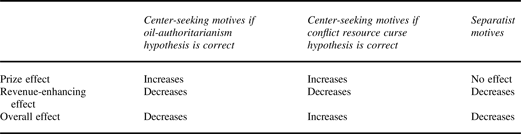
First, suppose the group's homeland does not contain any oil fields. As Table 1 summarizes, if the overall effect of oil strengthens states by enhancing government revenues, then higher country-level oil production should reduce incentives to attack the center. In contrast, if oil tends to make governments vulnerable prizes of predation, then higher country-level oil production should enhance center-seeking motives. Location does not matter, and the debate that motivates this article directly implies how oil wealth affects center-seeking civil wars. However, even if the conflict resource curse arguments are correct, more country-level oil will decrease separatist incentives because the group would not capture the prize by seceding.
Hypothetical example 1: Oil located outside the group's homeland

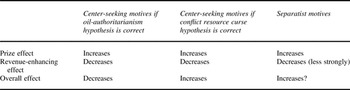
Second, suppose the group's homeland contains oil reserves. As Table 2 summarizes, once again, the revenue-enhancing versus vulnerability debate determines how oil affects overall motives to attack the capital. However, even if oil-authoritarianism arguments are correct about center-seeking civil wars, oil wealth may increase separatist incentives. A stronger state apparatus should weaken incentives to attack the center by a greater amount than incentives to launch a separatist war—and the farther away and the rougher the terrain in the group's area, the more feasible guerrilla warfare against a stronger government becomes. The key idea here, drawing from Buhaug's argument and evidence,Footnote 59 is that the marginal effect of buying a tank on raising the government's probability of winning is larger when the government defends the capital than when it fights in the periphery. This argument also highlights why it is relevant that regime transitions—on which oil-authoritarianism arguments focus—conceptually resemble center-seeking fights more closely than separatist wars.
Hypothetical example 2: Oil located inside the group's homeland
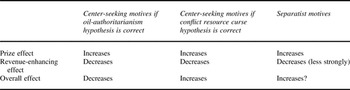
These two examples demonstrate why the conflict resource curse versus oil-authoritarianism debate yields clear predictions for center-seeking incentives—seizing the capital yields the prize regardless of oil location, and military investments defend the center more effectively than the periphery—whereas the within-country location of oil fields strongly conditions the overall effect of oil on separatist civil wars. Because the model focuses on strengthening versus vulnerability effects rather than on location effects, and because standard cross-national oil production measures do not incorporate location, the theoretical implications and empirical testing strategy are more relevant for understanding center-seeking civil wars.
Summarizing the Assumptions
The first through third assumptions highlight how oil can strengthen a government, but the fourth assumption highlights an important countervailing effect. And properly interpreting evidence about oil and governance institutions does not tip the balance one way or the other. Oil revenues may not be as effective as other revenue sources, as the fifth assumption states, but that does not imply that oil weakens states. The sixth assumption suggests that mechanisms debated by the oil-authoritarianism and oil/civil war literatures may be less important than within-country location of oil to explain separatist wars but, like existing research, does not provide a clear hypothesis for the overall effect of oil on center-seeking civil war onset.
A Unified Theory of Oil and Center-Seeking Civil War Onset
The formal model incorporates these assumptions to provide a unified framework for evaluating how the competing effects of oil wealth affect overall incentives to initiate a center-seeking civil war.
Set-up
Two long-lived actors, a government G and challenger C, bargain over state revenues in each period of an infinite horizon game. Future consumption is discounted exponentially by
 $\delta \in (0,1)$
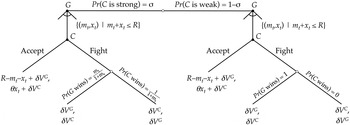
. Because the challenger can gain control of the state in the future, G and C refer to an actor's position in a particular period. Figure 1 presents the stage game played in each period.
Tree of Stage Game

In each period Nature stochastically chooses whether C is “strong” (probability σ) or “weak” (probability 1 − σ), terms that will be formally defined soon. G moves next. In every period G accrues oil revenues O and non-oil revenues N that sum to total revenues R, of which
 $\omega \equiv \displaystyle{O \over {O + N}}$
percent derives from oil. Capturing Assumption 3 about strategic governments, in each period G allocates its revenues among three factors. G devotes an amount m
t
≥ 0 to arm its military. G also offers C a share of spoils x
t
≥ 0 that captures a more general decision over patronage, welfare policies, public-sector job provision, and other ways for the government to distribute benefits. G retains the residual not spent on armaments and patronage as personal consumption in period t. The per-period budget constraint requires m
t
+ x
t
≤ R.
C moves next, deciding whether to accept the patronage offer or to initiate a center-seeking civil war. If C accepts an offer x
t
, it consumes only
 $\theta \in (0,1]$
percent of the intended patronage offer. Bureaucratic corruption and other sources of inefficiency destroy the remaining
 $(1 - \theta )\! \cdot x_t$
. The smooth function
 $\theta ( \cdot )$
can be conceived as a reduced form production function that translates patronage spending into output. To incorporate Assumption 5 about relative state weakness, for fixed total revenues R, institutional capacity for distributing patronage is assumed to decrease in the percentage of revenue that derives from oil. This assumption captures that Qatar's nascent bureaucracy in the 1970s was less effective at turning oil revenues into coveted goods than a bureaucracy in an oil-poor country that had achieved similarly large revenue streams.Footnote
60
Formally,
 $\displaystyle{{d\theta} \over {d\omega}} \lt 0$
. However, consistent with Assumption 5, assuming that oil is less effective than other revenue sources does not imply oil systematically diminishes institutional capacity, that is, the sign of
 $\displaystyle{{d\theta} \over {dO}}$
is assumed to be ambiguous.
Therefore, if C accepts, then in period t the challenger consumes θ · x t and G consumes the remaining revenues R − m t − x t . The game then moves to the next period with the same players as government and challenger. Each player has a linear utility function, and Figure 1 denotes the future continuation values V G and V C .
If instead C fights, then its probability of winning a center-seeking civil war depends on its contemporaneous strength. If C is weak, then it wins with probability 0 regardless of G’s military spending. If C is strong, then it wins with probability
 $\displaystyle{1 \over {1 + m_t}}$
. Therefore, in strong periods, C has an exogenous arms endowment normalized to 1 and each side wins a war with probability directly proportional to its share of arms. C becomes the government in period t + 1 if it wins the war and remains as challenger otherwise. The incumbent government remains in control of the state in period t + 1 with complementary probability
 $\displaystyle{{m_t} \over {1 + m_t}}$
and becomes the challenger otherwise. Neither player consumes in the period of a fight, but a war does not alter future revenues.
Two assumptions about C’s fighting option require further elaboration. First, oil revenues do not affect C’s armaments. As established with Assumption 1, this captures an overwhelming empirical trend rather than artificially assumes away a generally relevant conflict-inducing effect of oil. To motivate this argument, suppose instead G and C each choose armament spending from separate endowments. As long as G’s revenues are sufficiently larger, C will optimally spend all of its revenues to participate in the contest. This corner solution produces identical implications as the simplifying assumption here that C inherits an exogenous armament endowment. Certainly, if C controlled a large enough percentage of the oil revenues, the findings would change because more oil could unambiguously raise the probability of fighting. However, the discussion accompanying Assumption 1 implies the set-up of the present model has stronger empirical foundations than this alternative.
Second, many prominent formal theories of civil wars also model exogenous shifts in the distribution of power.Footnote 61 One plausible microfoundation for this assumption is that societal groups are only occasionally able to solve collective action problems and to effectively challenge the government.Footnote 62 This is natural if we conceptualize the challenger not necessarily as an established rebel group, but instead as a societal actor that occasionally faces opportunities to coerce the government. As examples from oil-rich countries, Iraq's defeat in the 1991 Gulf War provided a temporary coordination device for discontented Shi'a in the south to organize insurgencies known collectively as the Intifida. Similarly, the electoral defeat of incumbent president Denis Nguesso-Sassou in the Republic of Congo in 1992 dramatically boosted a challenger's ability to confront the new government—for as long as Nguesso-Sassou could effectively organize his supporters.
A final notable assumption highlights an important scope condition. The model assumes the government cannot commit to future promises. As I will show, G will deliver patronage payments commensurate to the challenger's contemporaneous expected utility from fighting. Supporting this focus, Blattman and Miguel contend: “The most intriguing theories of civil war focus on the cases where credible commitments to peace or redistribution cannot be made even with complete information.”Footnote 63 Walter also discusses the prominence of commitment problem explanations for civil wars.Footnote 64 The no-commitment assumption highlights the model's relevance for studying weakly institutionalized environments. That is, it provides an appropriate setting for studying the effects of oil in a country like Saudi Arabia, but not Norway—which was already a rich, consolidated democracy prior to discovering oil.
Equilibrium Analysis
The analysis applies the single-deviation principle to solve for equilibrium actions in a peaceful Markov Perfect EquilibriumFootnote 65 (henceforth, equilibrium) —which is shown to be unique when one exists—and the conditions under which a peaceful equilibrium exists, in three steps. First, assuming it is possible for G to buy off C and that G chooses to do so, I solve for G’s state-dependent optimal patronage offers and military spending amounts. Second, I demonstrate that G will indeed choose to buy off C if possible. Third, I describe the conditions under which G is able to buy off C. Online Appendix A.2 proves all the formal statements.
Optimal Patronage and Armament in a Peaceful Equilibrium
Assuming it is possible for G to buy off C and that G chooses to do so, G allocates patronage and military spending in each period to maximize its utility subject to inducing acceptance. C’s lifetime expected utility to accepting an offer x t is θx t + δV C , because C consumes θx t in the current period plus the future continuation value of the challenger, V C .
Two straightforward preliminary results narrow the set of possible equilibrium offers. First, C will accept an offer x
t
in a weak period if
 $\theta x_t + \delta V^C \ge {\rm E}[U_C({\rm fight}\vert{\rm weak})]$
and will accept x
t
in a strong period if
 $\theta x_t + \delta V^C \ge {\rm E}[U_C({\rm fight}\vert{\rm strong,}m_t)]$
. C optimally accepts such offers because fighting in the current period—the single deviation from accepting—is not profitable. Second, any peaceful equilibrium strategy profile features
 $(x_w^{\ast}, x_s^{\ast}, m_w^{\ast}, m_s^{\ast} )$
such that the previous two inequalities hold with equality:
 $\theta x_w^{\ast} + \delta V^C = {\rm E}[U_C({\rm fight}\vert{\rm weak})]$
and
 $\theta x_s^{\ast} + \delta V^C = {\rm E}[U_C({\rm fight}\vert{\rm strong,}m_s^{\ast} )]$
. It cannot be optimal for G to make an offer that C strictly prefers to accept because then G could profitably deviate to a lower offer that would still be accepted.
In a weak period, G consumes the entire budget. Because the government prevails regardless of its arms investment over a weak challenger,
 ${\rm E}[U_C({\rm fight}\vert{\rm weak})] = \delta V^C$
for any m
t
. Therefore,
 $m_w^{\ast} = 0$
. Additionally,
 $x_w^{\ast} = 0$
uniquely solves
 $\theta x_w^{\ast} + \delta V^C = {\rm E}[U_C({\rm fight}\vert{\rm weak})]$
. Although this offer entails no consumption for C in a weak period, C accepts because the single deviation of fighting is not strictly profitable.
In a strong period, G makes a positive patronage offer to C because C prefers to fight rather than to forgo consumption in the current period. The single deviation in which C fights in a strong period t in response to G’s allocation
 $(m_t,x_t)$
generates expected lifetime utility of
 ${\rm E}[U_C({\rm fight}\vert{\rm strong,}m_t)] = \delta \left[ \displaystyle{1 \over {1 + m_t}}V^G + \displaystyle{{m_t} \over {1 + m_t}}V^C \right]$
because no consumption occurs in the fighting period, and C would receive the government's future continuation value if it wins whereas losing would yield the challenger's future continuation value. Solving for the equilibrium values of V
C
and V
G
, C will consume
 $\theta x_s^{\ast} $
in the σ percentage of future periods it is strong and 0 when weak. This implies that
 $V^C = \displaystyle{{\sigma \theta x_s^{\ast}} \over {1 - \delta}} $
. Furthermore, because G consumes R in periods that C is weak and
 $R - m_s^{\ast} - x_s^{\ast} $
in periods that C is strong,
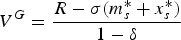 $V^G = \displaystyle{{R - \sigma (m_s^{\ast} + x_s^{\ast} )} \over {1 - \delta}} $
. Because in equilibrium
 $x_s^{\ast} $
solves
 $\theta x_s^{\ast} + \delta V^C = {\rm E}[U_C({\rm fight}\vert{\rm strong,}m_t)]$
, substituting in the continuation values and rearranging yields the optimal strong-period patronage offer as a function of m
t
:
 $$x_s^{\ast} (m_t) = \displaystyle{{\delta (R - \sigma m_s^{\ast} )} \over {(1 - \delta )(1 + m_s^{\ast} )\theta + \delta \sigma (1 + \theta )}} \cdot \displaystyle{{1 + m_s^{\ast}} \over {1 + m_t}}$$
Anticipating C’s calculus, G chooses military spending and patronage in a strong period t to maximize its lifetime expected utility, holding future-period choices constant:Footnote 66
 $$(m_s^{\ast}, x_s^{\ast} ) \equiv \arg \mathop {\max} \limits_{m_t,x_t} \;R - (m_t + x_t) + \delta V^G$$
 $$\eqalign{{\rm s.t.}\;\left( {\rm C1} \right)\,x_t & \ge \displaystyle{\delta (R - \sigma m_s^{\ast} ) \over (1 - \delta)(1 + m_s^{\ast}) \theta + \delta \sigma (1 + \theta)} \cdot \displaystyle{1 + m_s^{\ast} \over 1 + m_t}\comma \ \left({\rm C2} \right)\ x_t \ge 0,\cr \left({\rm C3} \right) m_t & \ge 0,\ \left({\rm C4} \right)\ m_t + x_t \le R.}$$
Equation 2 shows how the oil-authoritarianism and oil/civil war mechanisms affect G’s decision. The revenue-generating effects of oil (Assumption 2) loosen G’s per-period budget constraint C4, x
t
+ m
t
≤ R—but, following Assumption 1, does not affect the challenger's budget—by enabling higher levels of military capacity investments and patronage offers (Assumption 3). Constraint C1 shows that oil exhibits a prize effect (Assumption 4) by raising R, that is, requiring G to make a larger patronage offer for a given level of m
t
to buy off C. Oil also affects the optimal patronage offer because of relative state weakness,
 $\displaystyle{{d\theta} \over {d\omega}} \lt 0$
(Assumption 5). Finally, within-country oil location does not alter these considerations (Assumption 6).
If a peaceful equilibrium exists—implying that C4 does not bind—then Lemma 1 characterizes G’s optimal incentive-compatible allocation that induces acceptance.
Lemma 1
Assuming it is possible for G to buy off C (that is, if C4 in Equation 2 does not bind), then there exists a unique optimal armament and patronage choice (
 $m_s^{\ast} $
,
 $x_s^{\ast} $
) that induces C to accept.
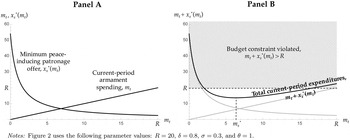
Figure 2 explains G’s equilibrium strong-period allocation. Panel A demonstrates that, on the one hand, armament expenditures m
t
are costly for G because they raise total expenditures. On the other hand, higher m
t
decreases C’s probability of winning a fight and therefore reduces the patronage offer needed to buy off the challenger,
 $x_s^{\ast} (m_t)$
.Footnote
67
Panel B superimposes a total expenditures curve and demonstrates that G optimally satisfies C’s no-fighting constraint by spending on the military until additional arms spending is less effective at reducing total current-period expenditures than transferring funds to C as patronage. This yields optimal armaments,
 $m_s^{\ast} $
.Footnote
68
The government devotes to patronage the remaining revenues needed to buy off the challenger.
Optimal Strong-Period Armament and Patronage Choices

Why the Government Always Induces Acceptance if Possible
If it is possible for G to buy off C, then G cannot profitably deviate from its Lemma 1 allocation by instead lowballing C. A single deviation that triggers fighting would destroy all consumption in the current period. This produces strictly lower utility compared with inducing C to accept and consuming
 $R - m_s^{\ast} - x_s^{\ast} $
, which is greater than 0 if C4 does not bind. Furthermore, the best possible outcome from the single deviation is that G wins the center-seeking civil war—therefore probabilistically yielding the same future continuation value, V
G
, that G would have received for sure had it bought off C. Therefore, G also receives strictly lower utility in future periods.Footnote
69
G’s overall strict preference to buy off C when possible is consistent with a large literature that studies the “inefficiency puzzle” in international warfare.Footnote
70
Lemma 2 formalizes this argument.
Lemma 2
G will not deviate from its Lemma 1 allocation to an armament and offer pair that prompts C to fight.
Conditions Under Which a Peaceful Equilibrium Exists
Finally, we need to assess the conditions under which C can profitably deviate from accepting G’s most competitive equilibrium offer in a strong period, that is, determine the conditions under which C4 from Equation 2 binds. Fighting occurs in every strong period if σ—the percentage of future periods in which C expects to be strong—is sufficiently low. C does not consume in weak periods. Therefore, the more frequently C expects to be weak in the future, the smaller is C’s expected future stream of benefits to remaining as challenger. Consequently, in a strong period, C needs to be compensated with more in the present to be induced not to fight—which makes it harder to buy off C. When σ is low enough, to induce acceptance in a rare period that C is strong, G would be required to spend more on arms and patronage than it has in current-period revenues. Because G cannot credibly promise to pay C more than 0 in any weak period and because G cannot borrow across periods, if σ is low enough, then C will fight in response to any offer in a strong period. Lemma 3 characterizes a threshold
 $\overline \sigma $
such that
 $m_s^{\ast} (\overline \sigma ) + x_s^{\ast} (\overline \sigma ) = R$
. Fighting occurs in equilibrium if
 $\sigma \lt \overline \sigma $
because C’s benefits from possibly gaining control of the state in the future outweigh the lost consumption from fighting, considering its low expected future consumption from remaining as challenger.
Lemma 3
A threshold value of σ determines whether or not G can induce C to accept in a strong period. Formally, there exists a unique
 $\overline \sigma $
such that C4 in Equation 2 binds if
 $\sigma \lt \overline \sigma $
and does not bind if
 $\sigma \gt \overline \sigma $
.
Equilibrium Strategy Profile
Combining Lemmas 1 through 3 characterizes strategies in a peaceful equilibrium and the conditions under which a peaceful equilibrium exists.
Proposition 1
If
 $\sigma \gt \overline \sigma $
, for
 $\overline \sigma $
defined in Lemma 3, then the following strategies compose the unique equilibrium strategy profile.
-
• Strong period:
-
– Lemma 1 defines
 $(m_s^{\ast}, x_s^{\ast} )$
.
-
– C accepts G’s offer if
$\theta x_t + \delta V^C \ge \delta \left[ \displaystyle{1 \over {1 + m_t}}V^G + \displaystyle{{m_t} \over {1 + m_t}}V^C \right]$
, and fights otherwise.
-
-
• Weak period:
-
–
$(m_w^{\ast}, x_w^{\ast} ) = (0,0)$
. -
– C accepts any offer.
-



If
 $\sigma \lt \overline \sigma $
, then a peaceful equilibrium does not exist and a center-seeking civil war will occur in every strong period along the equilibrium path.
First Result: How Oil Prevents Center-Seeking Civil Wars
Flipping the logic of conventional conflict resource curse arguments, large oil-generated revenues strengthen the government and decrease incentives for center-seeking civil war. Although oil enhances the prize of capturing the state, G strategically spends oil-generated revenues on military capacity—which lowers C’s probability of winning a fight—and on patronage, which increases C’s utility to accepting an offer.
Allowing G to arm endogenously drives the finding that large oil revenues dampen incentives to fight. This is demonstrated by considering a baseline scenario in which G does not arm, which results in the state prize and revenue-enhancing mechanisms canceling out. Restricting m
t
= 0 means G does not build a military and will for sure lose a fight if attacked by a strong C, although the following logic is identical if G was instead granted a costless military endowment that enables it to possibly win a fight even without investing any revenues into additional military capacity. If
 $m_t = m_s^{\ast} = 0$
in Equation 1, then G’s total expenditures consist only of the patronage offer:
 $$x_s^{\ast} (0) = \displaystyle{{\delta R}\over {(1 - \delta )\theta + \delta \sigma (1 + \theta )}}$$
Examining Equation 3 explains why the revenue-enhancing and prize effects offset each other. More revenues imply that G must offer more to compensate C for not fighting to gain a larger prize, as shown in the numerator of Equation 3. However, the revenue-generating effect of oil also enables G to spend more on patronage without hitting the budget constraint R, which perfectly offsets the prize effect.
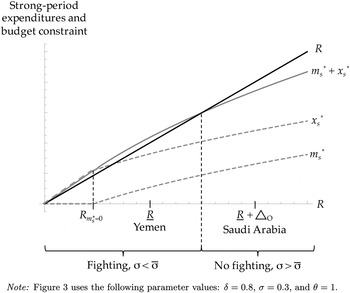
By contrast, Figure 3 depicts how large oil revenues privilege the government when G can choose armament spending. Although larger revenues increase the prize of fighting and therefore necessitate a higher strong-period patronage offer for a fixed m t ,Footnote 71 a larger prize also increases the benefit—decreasing C’s probability of winning—that G receives from raising military spendingFootnote 72 and enables G to spend more on the military without hitting its budget constraint. By partially counteracting the prize effect, larger military spending ensures that the equilibrium patronage offer does not rise in proportion to increases in oil. Most important, G’s optimal incentive-compatible mixture of patronage and military spending implies that an increase in oil does not cause total strong-period expenditures to rise as rapidly as the size of the prize for substantively relevant parameter values.Footnote 73 Therefore, when G can arm endogenously, the coercive possibilities afforded by larger oil streams strengthen G’s bargaining leverage, as Proposition 2 demonstrates.Footnote 74
Proposition 2
Part a. For an initial amount of revenues R, there exists a large enough increase in oil revenues Δ
O
that the range of σ values low enough that equilibrium fighting occurs is smaller after the oil increase. Formally, if
 $\Delta _O \gt \underline \Delta _O$
, then
 $\overline \sigma (R) \gt \overline \sigma (R + \Delta _O)$
.
Part b. If the initial amount of revenues R is sufficiently large and if the marginal effect of oil on institutional quality is not negative and large in magnitude, then the range of σ values low enough that equilibrium fighting occurs is smaller after an infinitesimal oil increase. Formally, if
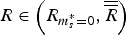
 $R \gt \max \left\{ R_{m_s^{\ast} = 0},\overline {\overline R} \right\} $
and
 $\displaystyle{{d\theta} \over {dO}} \gt \underline {d\theta} $
, for
dθ
< 0, then
 $\displaystyle{{d\overline \sigma } \over {dO}} \lt 0$
.
Large Oil Increases Diminish Center-Seeking Civil War Incentives

Figure 3 also illustrates an empirically relevant counterfactual comparison. Assuming Saudi Arabia and Yemen have the same baseline level of revenues
 $\underline R $
, Proposition 2 implies that
 $\overline \sigma $
is lower for Saudi Arabia because of its large oil endowment Δ
O
.Footnote
75
Therefore, for the parameter values in Figure 3, major oil production has prevented center-seeking fighting that otherwise would have occurred in Saudi Arabia—that is, in the counterfactual scenario in which Saudi Arabia did not become a major oil producer and instead had government revenues commensurate to Yemen's.
Although more oil always diminishes center-seeking civil war prospects if the increase in oil revenues is large enough, there are three ways that a small increase in oil revenues can fail to have this effect. First, if R is sufficiently low,Footnote
76
then G chooses a corner solution
 $m_s^{\ast} = 0$
and the game is strategically equivalent to the baseline game considered earlier. Second, even if military spending has an interior solution, for some parameter values there exists a range of small R values for which an infinitesimal increase in revenues raises center-seeking civil war propensity.Footnote
77
Third, even if small increases in oil would diminish center-seeking civil war prospects if oil did not affect institutional quality, oil can increase conflict propensity if it exerts a large negative effect on θ.
Substantive considerations suggest that these conditionalities do not alter the main argument. Holding fixed institutional quality, oil strictly decreases center-seeking conflict propensity if the initial revenue stream is sufficiently large. This is the substantively relevant parameter range for extant oil-rich countries. This result also holds for a large enough revenue increase. Because commercial oil fields tend to produce immense revenue windfalls (Assumption 2), previously revenue-starved countries that have recently discovered their first major oil fields achieve substantial revenue streams.Footnote 78 Regarding bureaucratic institutions, as discussed with Assumption 5, existing research shows that oil does not systematically diminish institutional quality and some even argue that oil positively affects institutions.Footnote 79 In Libya, for example, whose distributive state institutions were “created and relied upon purely for economic largesse and distributive purposes,” oil perpetuated a historical legacy of weak institutions rather than engendered institutional weakness. And Muammar Gaddafi used vast oil revenues in his early years to buy legitimacy by distributing patronage widely and to greatly enhance his coercive apparatusFootnote 80 —despite these weak institutions.
In sum, this logic counters conventional resource curse arguments by showing how large oil revenues strengthen governments and decrease center-seeking conflict propensity, rather than weaken governments or otherwise empower rebels.
Second Result: Distinguishing the Relative Conflict Resource Curse Hypothesis
If theoretical reasoning suggests that oil exerts an overall effect that depresses propensity for an empirically prevalent type of civil war, then why does existing regression evidence consistently support a conflict resource curse? An important reason is that most empirical work tests a relative conflict resource curse hypothesis—by including per capita income as a covariate—but does not assess the overall effects of oil on conflict.
A statement identical to Proposition 2 also applies to non-oil revenues. The key difference between oil and other revenue sources, however, is that non-oil revenues are more effective at preventing conflict. This relative conflict resource curse finding follows directly from the relative state weakness assumption,
 $\displaystyle{{d\theta} \over {d\omega}} \lt 0$
. If we compare two countries with the same amount of revenues, the relative state weakness assumption implies that the country receiving a higher percentage of revenues from oil (that is, higher ω) will have lower bureaucratic capacity θ for distributing patronage. The lower θ is, the less able G is to make attractive patronage offers to C. This implies a larger range of σ values that are low enough for fighting to occur in equilibrium. Therefore, incentives for center-seeking civil war increase when hypothetically fixing the total amount of government revenues and raising the percentage that derives from oil. Proposition 3 summarizes this relative conflict resource curse result.
Proposition 3
The range of σ values low enough that equilibrium fighting occurs is smaller following an increase in non-oil revenues Δ
N
than the same-sized increase in oil revenues Δ
O
. Formally, for any R,
 $\overline \sigma (R + \Delta _N) \lt \overline \sigma (R + \Delta _O)$
.
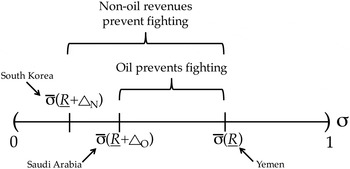
Figure 4 provides an example. Even though South Korea and Saudi Arabia have comparable levels of income per capita—which is closely associated with government revenues—non-oil revenues Δ N fund South Korea's government whereas oil revenues Δ O primarily fund Saudi Arabia's. Proposition 3 implies that a country with South Korea's parameter values is less likely to experience center-seeking civil wars than a country with Saudi Arabia's parameter values.
Relative Conflict Resource Curse

Comparing Propositions 2 and 3 highlights a subtle but crucial distinction that provides the second key implication from the model. Oil exerts a negative overall effect on incentives for center-seeking civil war because oil raises revenues. However, when holding revenues fixed and evaluating the effect of oil relative to other revenue sources, more oil raises conflict propensity.
Distinguishing overall from relative effects is vital because it highlights an important problem with conventional empirical practice in the conflict resource curse literature. Much existing work considers regressions with civil war onset as the dependent variable, oil as a main explanatory variable, and income per capita as a control variable. As I showed when presenting Assumption 2, oil production tends to raise income per capita and government revenues by large amounts. Therefore, regressions that control for income test the relative effect rather than the overall effect. It is not surprising that existing evidence consistently appears to support a conflict resource curse. Controlling for income holds fixed the crucial revenue-enhancing channel through which oil should decrease overall incentives to challenge the center.
To illustrate this point, it is useful to ask: What is the best counterfactual comparison for Saudi Arabia? It is not South Korea. Although Saudi Arabia and South Korea have similar levels of income per capita, Saudi Arabia was unlikely to achieve high wealth and large government revenue streams had it not become a major oil producer. However, statistical models that control for income heavily weight medium-to-high-income countries as comparisons for oil-rich countries. Therefore, when including income per capita as a covariate, scholars implicitly compare Saudi Arabia to countries like South Korea—even though Saudi Arabia differs from South Korea on many important pre-oil covariates.
Instead, a more plausible comparison for Saudi Arabia is Yemen, Saudi Arabia's relatively oil-poor neighbor that is also poor in overall income and has experienced a history of violent conflict. This counterfactual comparison is premised on the more tenable assumption that Saudi Arabia would have remained poor had it not become a major oil producer. Evaluating the hypothetical intervention of interest supports this consideration. To assess the overall effects of oil, the relevant intervention is whether or not Saudi Arabia discovers oil—which manipulates everything that comes along with oil wealth, including income per capita—rather than hypothetically manipulating only the mediating variable so that Saudi Arabia has high oil wealth but does not experience increases in income per capita.
Because countries like South Korea are less likely to experience center-seeking conflicts than are countries like Yemen, the incorrect counterfactual comparisons generated by controlling for income per capita should yield upwardly biased estimates of the oil-conflict relationship—that is, to make oil seem like more of a curse than it actually is when the goal is to assess the overall effects of oil. More technically, controlling for income has likely induced large and positive posttreatment bias in existing regression estimates.
Although some scholars may indeed be interested in the effect of oil relative to other revenue sources, the key problem in existing research is that most theoretical discussions conflate the overall and relative resource curse hypotheses. Widespread misinterpretation of Fearon and Laitin's influential so-called “state weakness” hypothesis exemplifies this concern.Footnote 81 Fearon and Laitin study oil within a general model on causes of civil wars. They hypothesize that given the amount of revenue, a government is better off receiving these revenues from income taxes than from oil because income taxes correspond with higher levels of bureaucratic capacity. This relative state weakness argument does not imply that oil-rich states would have developed large income tax bases had they not become oil-rich. However, this widely cited argument is almost universally misinterpreted as: oil exerts an overall effect that weakens governance institutions and raises the probability of civil war.Footnote 82 Comparing Propositions 2 and 3 from the model demonstrates the important problem with what otherwise may appear to be a minor discrepancy.
Empirical Evidence
In addition to informing influential theoretical debates, the two main results from the formal model also carry empirical implications. There should be a negative rather than positive relationship between oil wealth and center-seeking civil war onset, and oil coefficient estimates in models that control for income per capita should be higher than in models without an income per capita covariate. The following results support these implications and, overall, are more consistent with oil and authoritarian stability mechanisms than with oil and civil war theories.
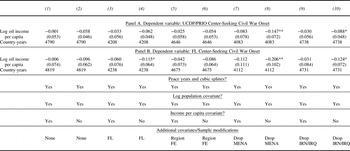
The first set of regressions alter conventional pooled time-series cross-sectional regression models estimated with cross-national data—which have provided the foundational evidence linking oil to conflict—by omitting an income per capita covariate. This single alteration of dropping a theoretically problematic posttreatment variable overturns the strong positive correlation between oil wealth and center-seeking civil war onset found in conventional specifications. The second set of regressions address key conceptual and scope condition issues to better assess the relationship between oil and civil war onset in weakly institutionalized countries, and demonstrate a consistent negative association between oil and center-seeking conflict. Finally, this section discusses model specification issues regarding the income per capita covariate and summarizes a series of robustness checks presented in the appendix, which include controlling for counterfactual non-oil income.
Despite voluminous scholarship on oil and conflict, less research has empirically examined the effects of oil on center-seeking civil wars specifically. Three contributions that do, however, reach similar conclusions as the broader oil/civil war literature. Buhaug; Wimmer, Cederman, and Min; and Ross each report a strong positive relationship between oil and center-seeking civil war onset (measured using UCDP/PRIO data)Footnote 83 in specifications that control for income per capita.Footnote 84 Buhaug also includes robustness checks using Fearon and Laitin's (FL) civil war measure and finds a positive but insignificant effect of oil wealth.Footnote 85 These results provide the most direct comparisons for the findings presented here.
Set-up
The statistical models summarized in Table 3 replicate models from Ross,Footnote 86 which closely resemble those from the broader conflict resource curse literature. Annual log oil income per capita (lagged one year) is used to measure oil wealth. I use two civil war data sets, UCDP/PRIO and FL, to code two center-seeking civil war onset variables. Years with ongoing center-seeking civil wars and without a new center-seeking civil war onset are coded as 0 for the onset variable. Ross’s data set also provides additional covariates including annual log total per capita income (lagged one year), a set of region dummies, and control variables from Fearon and Laitin: log population, ethnic fractionalization, religious fractionalization, log of percent mountainous terrain, a dummy for noncontiguous states, a dummy for new states, Polity, Polity squared, and political instability.Footnote 87 The data range from 1960 to 2006 with broad global coverage of oil producers and non-oil producers. The logistic regression models include standard temporal dependence controls and cluster standard errors by country.
Oil wealth and center-seeking civil war onset, conventional specifications

Notes: Table 3 summarizes a series of logistic regressions by presenting the coefficient estimate for log oil income per capita (lagged one year) and the country-clustered standard error estimates in parentheses. Other coefficient estimates are suppressed for expositional clarity. The various specifications contain at least one country-year observation from between 150 and 169 countries, among a broad global sample of oil and non-oil producers. * p < .1; ** p < .05; *** p < .01.
The statistical models summarized in Table 4 address two key conceptual and scope condition issues to better assess the relationship between oil and civil war onset among weakly institutionalized countries, in addition to other justified modifications. First, Table 4 uses a dependent variable that more closely coincides with the concept of civil war onset—the focus of the formal model—than most existing research. Specifically, the UCDP/PRIO data set does not code distinct civil wars.Footnote 88 Most empirical work uses a two-year-lapse rule to code civil war onsets from UCDP/PRIO's civil war incidence data. If a particular government-rebel dyad crosses the UCDP/PRIO's death threshold, but is followed by at least two years in which the annual battle death toll remains under twenty-five, then any future year with at least twenty-five battle deaths is coded as a new civil war. This coding rule, however, does not closely match the concept of “onset” when applied to long-running conflicts that only periodically exceed the twenty-five death threshold. For example, the rebel group MEK engaged in assassinations and bombings against the Iranian government between 1979 and 2001. Although this is naturally conceived as a single war with a single onset year in 1979, conventional procedures code this as five different center-seeking conflicts because MEK successfully hit targets in some years but not others.Footnote 89 Regarding a distinct conceptual concern, whereas the present model—and conflict resource curse theories broadly—assume governments have perfect control over their militaries and instead examine interactions with non-state actors, empirical tests usually code military coup attempts with large death tolls as center-seeking civil wars.
Oil wealth and center-seeking civil war onset, modified specifications

Notes: Table 4 summarizes a series of logistic regressions by presenting the coefficient estimate for log oil income per capita (lagged one year) and the country-clustered standard error estimates in parentheses. Other coefficient estimates are suppressed for expositional clarity. The various specifications contain at least one country-year observation from between 126 and 145 countries, among a broad global sample of oil and non-oil producers that excludes OECD countries and occupied countries. The specifications incorporate the coding decisions discussed in Appendix B. * p < .1; ** p < .05; *** p < .01.
These conceptual concerns are highly relevant for evaluating the conflict resource curse hypothesis. More than half of UCDP/PRIO center-seeking civil war onsets (coded by conventional procedures) in oil-rich countries either follow temporary lapses in fighting rather than represent a distinct civil war, or are initiated by the military. Existing scholarship has not noticed this crucial trend in the data, which suggests the importance of scrutinizing existing onset coding rules and assessing whether statistical models that appear to support the conflict resource curse are in part driven by overcounting onsets in oil-rich countries. Table 4 uses a revised UCDP/PRIO center-seeking onset variable that addresses these conceptual concerns, which Online Appendix B.1 describes.
Second, the revised sample in Table 4 excludes Organisation for Economic Cooperation and Development (OECD) countries and nonsovereign countries (whether colonized or otherwise forcibly controlled), which Online Appendix B.2 discusses. Non-OECD countries better reflect the scope conditions of the formal model, which assumes a weakly institutionalized environment—as most theories in the conflict resource curse literature implicitly do. Excluding OECD members therefore removes countries that exhibit causally heterogeneous treatment effects from the sample of theoretical interest. That is, oil-rich countries such as Canada, Norway, and the United States faced essentially no risk of center-seeking civil war regardless of their amount of oil. Separately, governments in nonsovereign countries do not directly accrue oil revenues—in contrast to a key presumption in the model—and conflicts in these countries differ from civil wars because they usually revolve around overthrowing the occupying country.
Finally, Online Appendix B.3 discusses additional changes in Table 4 such as dropping country-years with ongoing civil wars,Footnote 90 imputing income data to avoid dropping large numbers of observations, excluding or modifying other posttreatment covariates, and coding region fixed effects.
Results
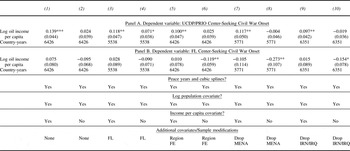
Motivated by the concern that controlling for income per capita induces posttreatment bias, the following regression tables compare specifications that include a per capita income control with those that omit this covariate. I then discuss alternative modeling choices for income per capita. In Tables 3 and 4, panel A uses UCDP/PRIO to measure center-seeking civil war onset and panel B uses FL. Odd-numbered columns control for per capita income whereas even-numbered columns do not. To make the paired specifications directly comparable, even-numbered columns exclude observations missing per capita income data. The five sets of paired specifications in each table draw from the full-sample robustness checks in Ross.Footnote 91 Columns (1) and (2) estimate a core model that additionally controls for population. Columns (3) and (4) add the Fearon and Laitin controls to the core model.Footnote 92 Columns (5) and (6) add region dummies to the core model. Columns (7) and (8) estimate the core model but exclude countries from the Middle East and North Africa. Columns (9) and (10) estimate the core model but exclude Iraq and Iran, whose “colonial histories … arguably make them special cases and unusually prone to conflict.”Footnote 93
Table 3 strongly supports the second implication from the formal model. Comparing each paired specification, there is a positive difference between the oil coefficient estimate in the odd- and even-numbered specification. Odd-numbered specifications in panel A closely resemble existing results by estimating a strong positive correlation between oil wealth and center-seeking civil war onset. After dropping the income control, however, only one specification remains statistically significant at even the 10 percent level, and the coefficient estimate flips signs in two of the five specifications. Panel B provides weak support for a relative resource curse for center-seeking wars, but again demonstrates the empirical relevance of dropping the income control. Every even-numbered specification estimates a negative correlation, and three of the five achieve statistical significance. After making a single change to conventional models to alleviate alleged posttreatment bias—motivated by the theoretical concern of distinguishing between overall and relative effects— we see that oil wealth does not positively correlate with center-seeking civil war propensity.
The Table 4 specifications incorporate the additional modifications described earlier. The oil coefficient estimate is negative in every specification without the income control. Furthermore, several of the correlations in even-numbered UCDP/PRIO specifications now achieve statistical significance. The models also estimate a sizable conflict-depressing effect for oil. Increasing annual oil income per capita from $0 to $1,000 predicts a decrease in the probability of a new center-seeking civil war of between 32 percent and 63 percent in the even-numbered UCDP/PRIO specifications, and between 45 percent to 76 percent for FL data.
Trade-offs Involved with Statistically Modeling Income Per Capita
Income per capita poses a model specification dilemma. On the one hand, the formal model implies regression models that include income per capita should bias toward finding a conflict-inducing effect of oil by testing the wrong theory, and the present regression evidence demonstrates how dramatically the oil coefficient estimate changes when omitting this conventional but posttreatment covariate. On the other hand, income per capita is perhaps the strongest correlate of civil war onset in the literature, and dropping it likely introduces some degree of omitted variable bias into the oil estimate.
Posttreatment concerns about controlling for income appear considerably more compelling than omitted variable concerns about excluding income, in this particular substantive setting. No existing arguments suggest that omitting an income-per-capita control should negatively bias oil-conflict regressions, as would be needed to argue that the evidence here incorrectly rules against a center-seeking conflict resource curse. In contrast, many existing arguments imply that the bias from omitting income should be positive. In other words, the Table 4 coefficient estimates may underestimate the magnitude of the conflict-suppressing effect of oil on center-seeking civil wars. Recall from the discussion accompanying Assumption 2 that many oil-rich countries were impoverished prior to discovering oil, and from Assumption 5 that Haber and Menaldo argue fiscally starved rulers in historically weak states have frequently selected into higher levels of oil production.Footnote 94 Both these considerations suggest that oil-rich countries should on average have been more likely to experience conflict than oil-poor countries had they not become major oil producers.
Additionally, excluding OECD countries in Table 4 mitigates possible omitted variable bias from dropping income. Although domestic oil has raised income in countries such as Canada, Norway, and the United States, they were and very likely would be wealthy even without oil. Therefore, the scope-condition-based exclusion of OECD countries from the Table 4 sample eliminates a major source of unmodeled heterogeneity that could arise from dropping the income-per-capita covariate.
Another important consideration is that more complicated strategies of controlling for counterfactual non-oil income likely induce considerable measurement error and do not necessarily produce less biased results than the present regressions that simply omit income per capita. In principle, if we could perfectly estimate the counterfactual income levels that oil-rich countries would have obtained had they not become major oil producers, then controlling for this variable could solve the trade-off between posttreatment and omitted variable bias. However, in addition to generic problems with estimating counterfactual variables, missing historical income data greatly limits the usefulness of including such a variable in oil/civil war regressions. Herb and Alexeev and Conrad have each attempted different procedures, and Herb cautions that “any possible calculation of counterfactual GDP requires major, perhaps heroic, assumptions.”Footnote 95 Especially given the lack of reasons to believe that omitting an income control induces large negative bias into the regression estimates, it is not necessarily true that controlling for a poorly measured counterfactual income variable will reduce bias.
However, further supporting the contention that the negative-signed oil coefficient estimates in the even-numbered columns in Tables 3 and 4 are not an artifact of unjustifiably omitting income per capita, Online Appendix C presents a series of robustness checks. Although each of the following statistical procedures face important limitations, they coincide with the results by consistently estimating a negative correlation between oil wealth and center-seeking civil war onset. Online Appendix C.1 presents results using various counterfactual non-oil income estimates based upon either historical income data, factual non-oil income, or comparisons with oil-poor countries. Online Appendix C.2 controls for country fixed effects—hence eliminating concerns about unmodeled heterogeneity in temporally invariant factors such as underlying propensity to achieve high income—and Online Appendix C.3 modifies the sample in additional ways suggested by Ross.Footnote 96 Finally, Online Appendix D summarizes case evidence and shows that oil can explain—at most—very few major center-seeking civil war onsets.
Conclusion
This article presented a game-theoretic model explaining why oil wealth should decrease center-seeking civil war propensity. The theoretical framework jointly evaluated oil's revenue-enhancing and vulnerability effects to explain why mechanisms proposed by oil-authoritarianism research should dominate mechanisms from the oil/civil war literature. The model analysis also distinguished between the overall and relative effects of oil, which suggested that the widespread empirical practice of controlling for per capita income should yield upwardly biased oil-conflict estimates. Using implications from the formal model to revise conventional statistical models in the conflict resource curse literature provided evidence more consistent with authoritarian stability arguments than with a center-seeking conflict resource curse.
The formal model presented here extends conflict bargaining models by incorporating distinctive aspects of oil production. This theoretical approach carries broad implications for separatist conflicts and for regime changes, in addition to center-seeking civil wars. Other conflict resource curse theories argue that oil production in ethnic minority regions causes deep grievances and raises separatist civil war propensity because the government redistributes wealth away from the ethnic group's territoryFootnote 97 —consistent with the distinction that oil location should strongly affect prospects for separatist but not center-seeking wars. However, revisiting Table 2, although the revenue-enhancing effects of oil may work less effectively when the government fights away from the capital, additional research is needed to demonstrate why oil wealth creates strong grievances and impedes bargaining between governments and oil-rich territories. These considerations motivate Paine's modification of the bargaining framework presented here to study oil and separatist civil wars.Footnote 98
An additional implication from distinguishing heterogeneous effects of oil location on different types of civil wars is that country-level oil income measures are relevant for testing theories about center-seeking wars only, whereas oil-separatism theories should instead be tested with subnational data. Because location conditions whether oil should increase or decrease separatist civil war propensity, there should not be any clear trends in country-level data. Online Appendix C.4 shows that this implication is indeed validated when replicating Tables 3 and 4 for either separatist wars only or all civil wars. These additional empirical results also demonstrate why the formal model's implication about posttreatment bias from the income per capita control is broadly important for evaluating the conflict resource curse.
This article has also shown how seemingly disparate resource curse debates—about conflict, authoritarianism, and even economic development (see Assumption 2)—can inform each other. The implications from the formal model might therefore also help to reconcile competing empirical findings about oil and democracy. Alternative theories presented in critiques of earlier conclusions that oil hinders democracy do not focus on how governments can strategically combine coercion and patronage to reduce incentives for violent rebellions or prodemocracy movements.Footnote 99 However, the scope conditions from the model appear relevant for explaining why highly uncompetitive and oil-rich authoritarian regimes rarely democratize—because oil revenues can be used to deter and to buy off popular protests.Footnote 100 Therefore, the same reasons that oil revenues prevent center-seeking civil wars may also explain why oil revenues curse prospects for democratization in some circumstances.
Considering these additional applications to separatist civil wars and to democratization, extending the theoretical approach pursued here in future work should help to narrow the differences between broad arguments for and against an oil curse.
Supplementary Material
Supplementary material for this article is available at http://dx.doi.org/10.1017/S0020818316000205.