
I. INTRODUCTION
Zirconium (Zr) and Zr alloys have been the focus of increasing attention because of their small neutron absorption area and excellent corrosion resistance. Reference Griffiths1–Reference Zander and Köster3 However, there are some drawbacks for Zr alloys in the practical application, and for an example, ZrTiAlV quaternary alloys show poor plastic deformation ability. Similarly, due to the difficulty in machining Zr-based alloys, they can only be used to manufacture simple-shaped components. Reference Sabirov, Perez-Prado, Molina-Aldareguia, Semenova, Salimgareeva and Valiev4,Reference Ho, Chen, Wu and Hsu5 In addition, the industrial application of Zr-based amorphous alloys is significantly limited by their high strength.
Shi et al. Reference Shi, Li, Guo, Zhang, Zhang, Li and Zhang6 showed the results of thermo–mechanical processing treatments, which consisted of severe cold rolling at room temperature (RT) to over 90% reduction, recrystallisation annealing and aging treatments under vacuum. Li et al. Reference Li, Guo, Zhang, Ma, Shi, Zhang, Li and Zhang7 assessed the effects of the recrystallization and aging processes on the structure and properties of alloys manufactured by serve plastic deformation and observed the relationship between the deformation heat treatment parameters and the microstructure and mechanical properties of such alloys. Tan et al. Reference Tan, Duan, Yang, Liu, Zhang and Liu8 studied the show results of hot compression tests of the zirconium alloy that performed on the Gleeble 3500 thermomechanical simulator (Dynamic Systems Inc., New York, New York) and investigated the influence of process parameters on the forming performance.
It is argued that when electrical current passes through a metal subjected to plastic deformation, the drift electrons are in favor of the dislocation motion, improving the plastic property and ductility of the deformed metal. Reference Tiwari, Basu, Biswas and Biswas9–Reference Pavia, Durand, Ajustron, Bley, Chevallier, Peigney and Estournès11 Electric-field-assisted extrusion forming process is a new technique that utilizes this principle to reduce the material deformation temperature and deformation resistance and increase the material deformation rate, which can improve the microstructure and mechanical properties of the material. In this work, the electric field-assisted extrusion forming process is adopted in Zr–45Ti–5Al–3V alloys by composite extrusion at the front-and-back to form ZrTiAlV alloy cyclic products. The deformation behavior, microstructure evolution, and mechanical properties of the material subjected to the electric field-assisted extrusion are examined.
II. EXPERIMENT PROCEDURE
A. Preparation of blanks
Sponge Zr (Zr + Hf ≥ 99.5 wt%), sponge Ti (99.7 wt%), industrially pure Al (99.5 wt%), and V (99.9 wt%) were used as materials for preparing the Zr–45Ti–5Al–3V (wt%) alloy. The alloy was melted thrice using a vacuum consumable electro-arc furnace to ensure a uniform chemical composition. The ingot underwent multiple breakdowns after being held at 1050 °C above the transit temperature for 1.5 h to completely break the coarse grain. The ingot was then held at 930 °C for 1.5 h before hot forging and machined into bar stock with a diameter of 41 mm.
B. Electric field-assisted front-and-back composite extrusion forming process
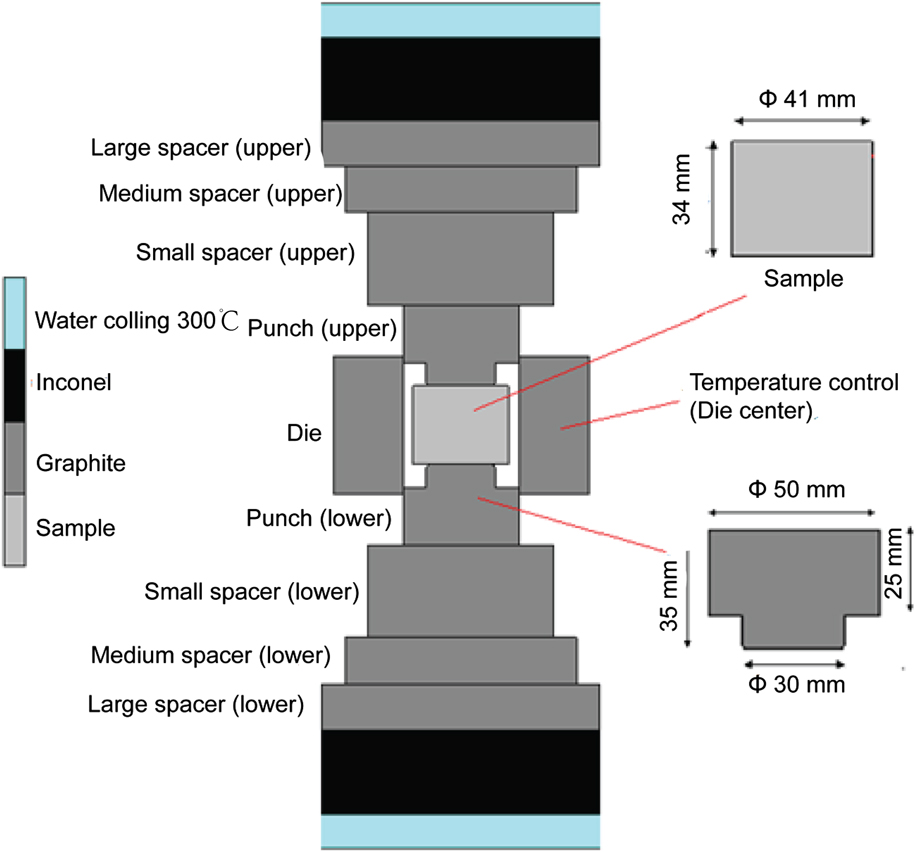
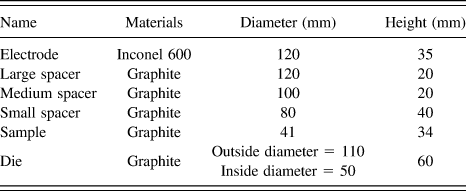
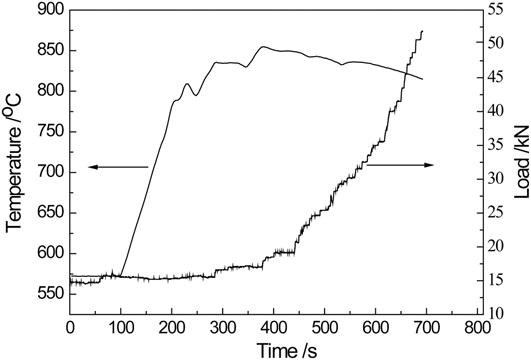
The front-and-back composite extrusion forming process was conducted in SPS-3.20 MK-IV spark plasma sintering machine (SPS SYNTEX Inc., Tokyo, Japan). Figure 1 and Table I show the extrusion forming mold diagram and the mold dimensions, respectively. Calculated in accordance with the mold related dimensions, the maximum strain value is more than 1. The materials of the mold for electric field-assisted extrusion are high strength graphite. The maximum load current is 3000 A. The vacuum degree during extrusion deformation was 10−3 Pa. The curves of temperature and load changed with time during the forming test, as indicated in Fig. 2. As shown in Fig. 2, the temperature range for extrusion forming was 800–850 °C, which was 100–130 °C lower than the temperature for blank forging, Reference Liang, Ma, Jing, Tan and Liu12 and the maximum extrusion deformation force was lower than 55 kN. According to the calculations, the deformation flow stress was lower than 28 MPa.
Extrusion forming mold diagram.
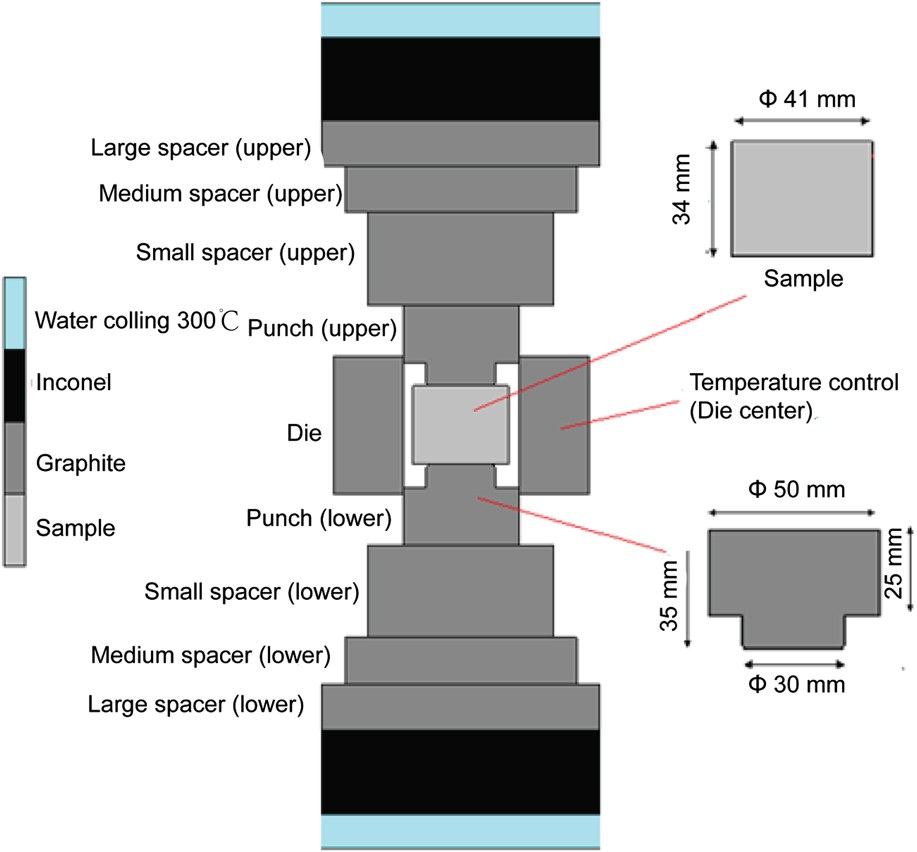
The dimensions of various parts of sintering system.

Curves of extrusion deformation temperature and load changed with time.

C. Analysis methods
The phase structure of the alloy sample was analyzed with the Rigaku D/max-2500/PC x-ray diffraction (XRD) instrument (Rigaku Corporation, Tokyo, Japan). During the analysis, the sample was polished using a water proof abrasive paper and cleaned with ethyl alcohol and ultrasonic cleaner. The wave length during the test was Cu Kα radiation of 1.540598 Å, the scan range was 10–100°, the step length was 0.02°, the operating current was 100 mA, and the operating voltage was 40 kV.
Firstly, the microstructure was observed using a Zeiss optical microscope (Carl Zeiss AG, Jena, Germany). The etchant was a mixed solution of HF (5 mL), HNO3 (15 mL), and H2O (85 mL). The samples of different treatment states were submerged in the etchant for 10–60 s.
Microstructural observation and analysis were conducted on the JEOL 2010 transmission electron microscope (JEOL Ltd., Tokyo, Japan), and EBSD analysis of the materials was conducted on the EDAX-TSL with Hitachi S3400N scanning electron microscope (Hitachi Corporation, Tokyo, Japan). The process of sample preparation was as follows: a 0.5 mm thin piece was cut off by wire cutting and ground to a size of 50–80 µm. Chemical double-injection thinning method was used. The double solution was a mixed solution of 10 vol% perchloric acid and 90 vol% methyl alcohol, the voltage was 13 V, and the temperature was controlled below −35 °C.
Tension tests were conducted on the Inspekt Table Blue mechanical property system (Instron, Boston, Massachusetts) at a strain rate of 1.7 × 10⁻³/s. Each sample was tested thrice. The gauge length of the tension samples was 10 × 2 mm, and its thickness was 1 mm.
III. RESULTS AND DISCUSSION
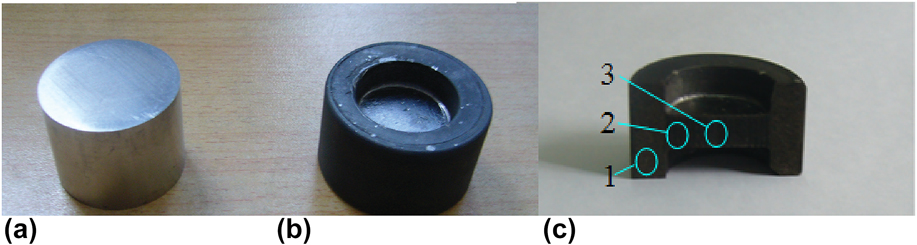
Figure 3 shows the pictures of the product before and after the extrusion forming process. As shown in the figure, the front-and-back of the extruded product did not create any flash and had good surface morphology, which realized the near-net forming of the product.
Morphology of the extruded product: (a) original blank, (b) extruded product, and (c) extruded product cut open.
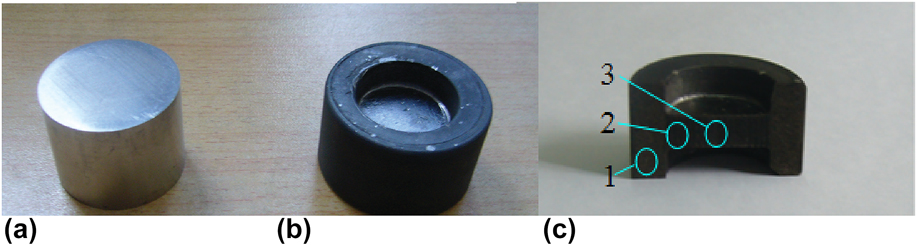
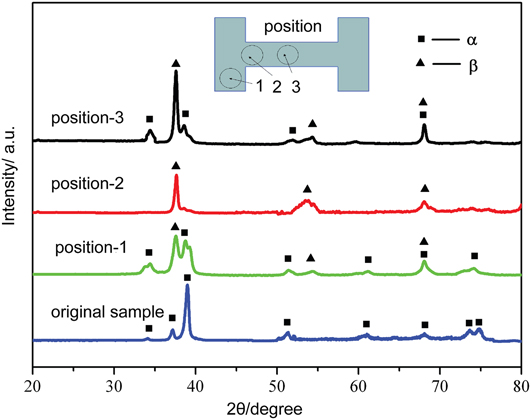
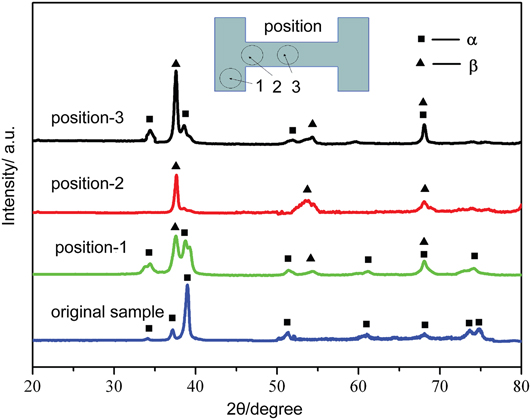
The product was cut along the plane of axial symmetry. Subsequently, the phase structure, metallographic microstructure, and EBSD near position 1 (edge area), position 2 (major shear deformation zone), and position 3 (center) on the measurement profile were analyzed, the selected positions are shown in Fig. 3(c). The analytical results are presented in Figs. 4–6.
XRD results of all areas of the extruded product.
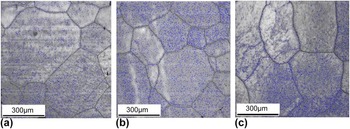
Microstructures of various areas of the extruded product: (a) blank, (b) position 1, (c) position 2 and (d) position 3.

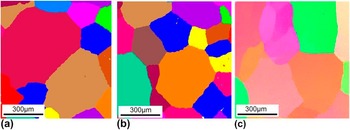
EBSD grain boundary map obtained from the ZrTiAlV alloy after extrusion: (a) position 1, (b) position 2, and (c) position 3.

Figure 4 shows that the initial blank only contained phase α, but a change from phase α to phase β occurred at all positions after extrusion. The area between positions 1 and 3 was the two-phase structure. The area near position 2 was mainly composed of phase β because the area near position 2 was the shear deformation zone and the large shear deformation in this area caused the complete change from phase α to phase β.
Figure 5(a) shows the microstructure of the original blank. The figure and the XRD results indicate that the microstructure almost entirely maintained the phase β original crystal boundary. The phase β crystal boundary, which is approximately 400–500 µm in size, is full of lath-shaped phase α structures. After the electric field-assisted extrusion forming process, its size becomes 350–400 µm, and the lath-shaped phase α structures in the phase β crystal grains were significantly reduced. Figure 5(c) presents the microstructure of position 2, whose phase β crystal boundary is clear. Several crystal grains were elongated, and the lath-shaped phase α structures were in significant. These results are consistent with the XRD results.
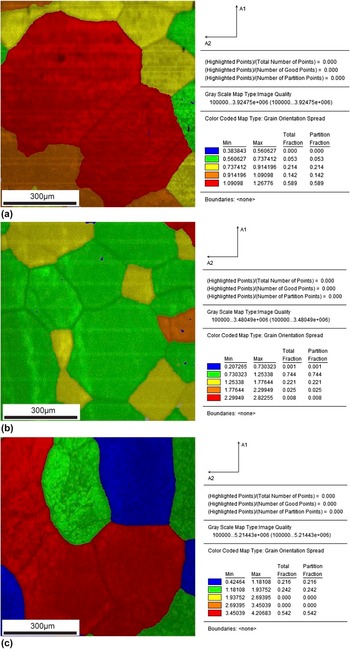
A grain boundary character distribution was examined using a misorientation angle in the 2–15° range for low angle grain boundaries (LAGBs) and above 15° for high angle grain boundaries (HAGBs). An assessment of lattice strain evolution from EBSD data was carried out by a local misorientation approach. Reference Shen, Yu, Jing, Yao, Gu, Wang, Duan, Yu and Liu13 Principles of this method are based on a plastic strain results with an increase in the internal grain orientation spread (GOS). Consequently, grains that undergo deformation (and thus are extensively defected) exhibit high GOS value, and reversely—these which are undeformed (defects-free) have very low GOS values, close to zero. Reference Humphreys14,15 Figures 6–8 show the EBSD grain boundary diagram, crystal grain size diagram, and EBSD GOS map obtained by EBSD analysis of the ZrTiAlV alloy after extrusion, respectively.
EBSD grain size map obtained from the ZrTiAlV alloy after extrusion: (a) position 1, (b) position 2 and (c) position 3.

EBSD GOS map obtained from the ZrTiAlV alloy after extrusion: (a) position 1, (b) position 2, and (c) position 3.

As shown in Figs. 6–8, most of the GOS values at position 1 were lower than 1, and the recrystallization of the grains at this position was complete. The effect of dynamic recrystallization was strong, but the effect of grain refinement was average as LAGB was nearly nonexistent because of the minimal deformation at position 1 in the deformation process. The effect of dynamic recrystallization at position 2 was significant, and a certain percentage of LAGBs existed. The GOS values at this position were higher than those at position 1, and the effect of grain refinement was satisfactory mainly because of the large shear deformation in the deformation process. Position 3 is near the central area, and the GOS values at this position were significantly increased and higher than 3, indicating that the effect of dynamic recrystallization at this position was poor. The effect of grain refinement was also poor and had a high number of LAGBs because this position is near the central symmetrical area. Position 3 was subjected to large axial compressive stress from the pressure head during deformation. Thus, a change from LAGB to HAGB is improbable. Such conditions are not conducive to the occurrence of recrystallization.
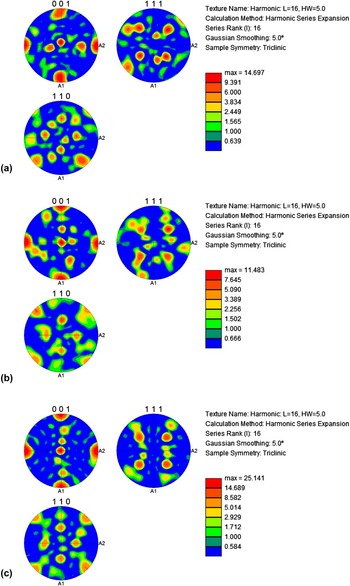
Figure 9 shows the EBSD recrystallization pole diagram obtained from the ZrTiAlV alloy of different positions. Cubic structures in the {100}〈001〉 direction were generated at positions 1 and 2, but their polarity is weak because of complete recrystallization. Position 3 was subjected to high axial compressive stress from the pressure head during deformation. Thus, a change from LAGB to HAGB is improbable and structural polarity becomes evident. These results are consistent with the analytical results shown in Figs. 6–8.
EBSD recrystallization pole diagram obtained from the ZrTiAlV alloy: (a) position 1, (b) position 2, and (c) position 3.

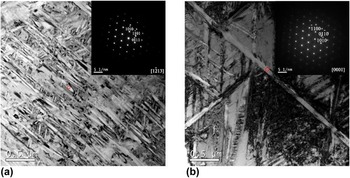
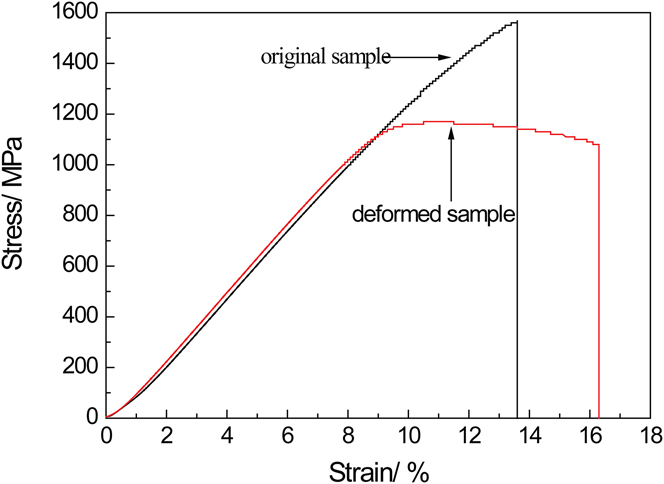
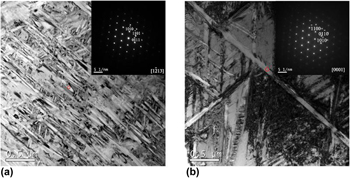
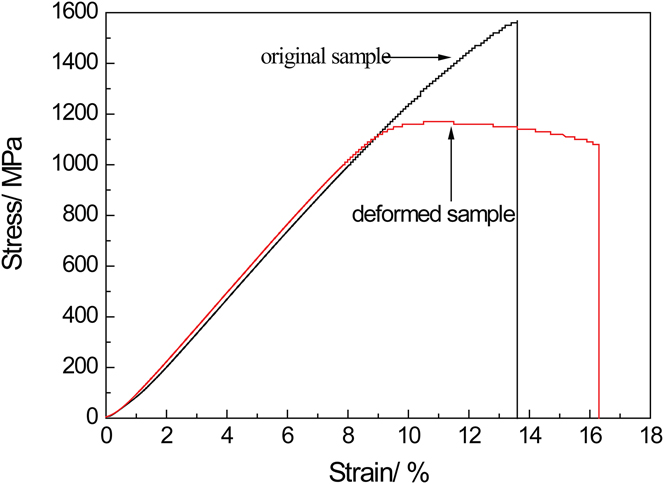
Since the final product is ring-shaped, it sets a higher demand on the mechanical property and microstructure at position 1. Figure 10 shows the TEM microstructure of the original product and the extruded product at position 1. The figure shows that the phase α content of the original material was high, but the size of the lath-shaped structure was small with the length of only 0.5–4 µm. The phase β basal body contains few large-sized residual lath-shaped phase α structures after the completion of the extrusion process. These results are the same as the XRD results. The alpha phase is a compact six party structure with high strength, poor plasticity, and toughness, while the phase β is a body centered cubic structure with good plasticity and toughness, and the strength is reduced. Figure 11 presents the results of the mechanical property test of the original blank of the extruded product and the extruded product at position 1. These results show that, after the extrusion formation of the product, the strength was reduced from 1580 MPa to 1185 MPa, the initial material did not have any significant yield, and the tensile elongation after extrusion reached 7.3%.
TEM microstructure of the raw material and the extruded product at position 1: (a) the original material and (b) the extruded product.

Comparison of the tensile mechanical property of the raw material and extruded product.
IV. CONCLUSIONS
-
(1) This study adopts the electric field-assisted extrusion technology to achieve the formation of the near-net-shaped extrusion of Zr–45Ti–5Al–3V alloys at a low temperature of 800–850 °C and under the conditions of deformation flow stress lower than 28 MPa. After the electric field-assisted extrusion forming process, the continuous dynamic crystallization effect at the edges and the major shear deformation zones is significant, and the equiaxed phase β grain structures are refined to a size of 250–300 µm.
-
(2) During the extrusion of the product, the change from phase α to phase β occurs at various areas and the major shear deformation zones, and the change from phase α to phase β caused by the large shear deformation is nearly complete.
-
(3) The edges and the major shear deformation zones generate cubic structures in the {100}〈001〉 direction with weak polarity; such structures are caused by complete crystallization. Given that position 3 is subjected to more axial compressive stress from the pressure head during deformation, the change from LAGB to HAGB is improbable and the polarity of the structure is strong. The strength at the edges is reduced from 1580 MPa to 1185 MPa, and the tensile elongation is significantly increased.