Transmission of multidrug-resistant organisms (MDROs) has been increasingly reported in nursing homes.Reference D’Agata, Habtemariam and Mitchell 1 , Reference Mody, Gibson and Horcher 2 In Hong Kong, the prevalence of MRSA in nursing homes increased from 2.8% to 21.6% between 2005 and 2011.Reference Ho, Wang and Ching 3 , Reference Cheng, Tai and Wong 4 While infection control measures are generally more stringent in acute hospitals than in nursing homes, the latter have become epidemic centers for MDROs. With the emergence of carbapenem-resistant gram negative organisms in our hospitals,Reference Ho, Cheung and Wang 5 , Reference Cheng, Chen and Poon 6 it is important to determine the prevalence of and risk factors for carbapenem-resistant Acinetobacter baumannii (CRAB), carbapenemase-producing Enterobacteriaceae (CPE), and other MDROs in our nursing homes including methicillin-resistant Staphylococcus aureus (MRSA) and vancomycin-resistant Enterococci (VRE). These findings are useful in the formulation of infection control policy.
METHODS
This study was conducted from July 1, 2015, to August 31, 2015, to determine the prevalence of MDROs among 28 nursing homes in the Hong Kong West District with a population of 0.53 million. The role of nursing homes was described previously.Reference Cheng, Tai and Wong 4 Trained research nurses collected nasal swabs, axillary swabs, and rectal swabs from consented subjects all on the same day according to a standard protocol. The specimens were tested by the microbiology laboratory for the presence of CRAB, CPE, MRSA, and VRE as previously described.Reference Cheng, Tai and Wong 4 – Reference Cheng, Chen and Poon 6 The bacterial species were confirmed by matrix-assisted laser desorption/ionization time-of-flight mass spectrometry (MALDI-TOF MS; Bruker Daltonics, Bremen, Germany). Susceptibility of the isolates was determined using the Kirby–Bauer disc diffusion method or E test, and the results were interpreted according to the guidelines of the Clinical and Laboratory Standards Institute (CLSI). For molecular typing of CRAB and MRSA, multilocus sequencing typing (MLST) and spa typing were performed on isolates of CRAB and MRSA respectively.Reference Cheng, Chen and Poon 6 , Reference Gruteke, Ho, Haenen, Lo, Lin and de Neeling 7 Patient demographic data were retrieved and analyzed. The χ2 test and Student t test were used as appropriate with SPSS version 20 (IBM, Armonk, NY). Factors with P<.05 in univariate analysis were chosen for multivariate analysis. A final model was selected using a forward selection procedure. This study was approved by our institutional review board.
RESULTS
During the study period, 1,408 (60.6%) of 2,322 subjects from 28 nursing homes consented to undergo screening. The mean age was 83.8±10.3 years and 854 (60.7%) were female. Of 691 (49.1%) residents who were functionally dependent, 474 of 691 (68.6%) were chair bound and 217 of 691 (31.4%) were bed bound. Of 1,408 residents, 909 (64.6%) were incontinent requiring the use of adult diapers; 62 (4.4%) had sacral sores; 71 (5.0%) had nasogastric tubes; 4 (0.3%) had percutaneous gastrostomy tubes; 4 (0.3%) had Tenckhoff catheters; and 75 (5.3%) had long-term urinary catheters.
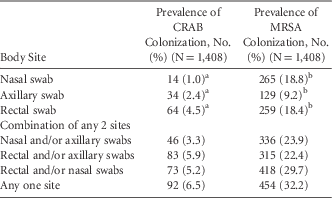
Overall, colonization of MDROs was found in 494 of 1,408 residents (35.1%). MRSA colonization in any 1 of the 3 swabs was found in 454 residents (32.2%), while CRAB colonization was found in 92 residents (6.5%). A single resident had CPE with NDM-1–producing E. coli. VRE was not detected in any screened specimens. Of the 1,408 residents, 399 (28.3%) were colonized with MRSA only; 37 (2.6%) were colonized with CRAB only; and 55 (3.9%) were co-colonized with MRSA and CRAB. The subsequent analyses on residents focused on CRAB and/or MRSA colonization because the number of residents with CPE was small. The prevalence of CRAB and MRSA colonization among residents through different body sites is summarized in Table 1.
Prevalence of Carbapenem-Resistant Acinetobacter baumannii (CRAB) and Methicillin-Resistant Staphylococcus aureus (MRSA) Colonization Among Residents in Nursing Homes by Sampling of Different Body Sites

a The prevalence of CRAB colonization was statistically significant by sampling of different body sites (P < .001).
b The prevalence of MRSA colonization was statistically significant by sampling of different body sites (P < .001).
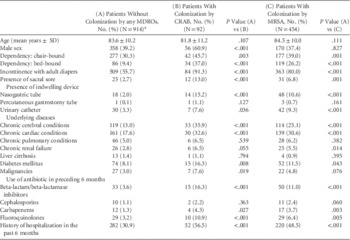
The univariate and multivariate analyses of the epidemiological risk factors for CRAB and MRSA colonization among residents in nursing homes are shown in Tables 2 and 3, respectively. Bed-bound status, incontinence with the use of adult diapers, and presence of a nasogastric tube were the common risk factors for both CRAB and MRSA colonization by multivariate analysis.
Epidemiological Characteristics of Residents With or Without Colonization by Methicillin-Resistant Staphylococcus aureus (MRSA) and Carbapenem-Resistant Acinetobacter baumannii (CRAB)

a MDROs include methicillin-resistant Staphylococcus aureus, carbapenem-resistant Acinetobacter baumannii and carbapenemase-producing Enterobacteriaceae.
Risk Factors in Residents With Colonization by Carbapenem-Resistant Acinetobacter baumannii (CRAB) and Methicillin-Resistant Staphylococcus aureus (MRSA) Using Multiple Logistic RegressionFootnote a

NOTE. CI, confident interval.
a All epidemiological characteristics listed were used as independent variables. Final model was selected using a forward selection procedure. For the analysis of CRAB colonization, the Hosmer-Lemeshow goodness-of-fit statistic was 4.17, and P=.841. For the analysis of MRSA colonization, the Hosmer-Lemeshow goodness-of-fit statistic was 3.23, and P=.780.
Molecular characterization of CRAB and MRSA was performed in 25 and 30 non-duplicated patient isolates from 6 nursing homes and showed a high prevalence of CRAB or MRSA respectively. A predominant spa type of MRSA t1081 was identified in 19 of 30 MRSA isolates (63.3%), in keeping with the predominant MRSA clone of ST45/spa t1081 in our locality.Reference Gruteke, Ho, Haenen, Lo, Lin and de Neeling 7 The MLST patterns of CRAB were diverse, including 8 of 25 clones of ST575 (32.0%), and 7 newly reported MLST patterns in 7 patients with gastrointestinal colonization of CRAB.
DISCUSSION
In this study, we have demonstrated the emergence of CRAB colonization and a high prevalence of MRSA among nursing homes residents in Hong Kong. The prevalence of CRAB colonization was 6.5%, almost 3 times higher than in hospitalized patients identified through active surveillance culture in a previous study.Reference Cheng, Chen and So 8 The rate of CRAB was highest among rectal swab cultures, which coincides with our previous finding that residents in nursing homes have the most significant risk factor for gastrointestinal colonization of CRAB among hospitalized patients.Reference Cheng, Chen and So 8 In our study, the burden of antimicrobial-resistant A. baumannii was comparatively less than that in the United States, where 15% of high-risk nursing home residents have been reported to be colonized with multidrug-resistant A. baumannii (MRAB) using active surveillance culture.Reference Mody, Gibson and Horcher 2 Functional disability was an important risk factor for MRAB colonization,Reference Mody, Gibson and Horcher 2 and we further demonstrated that physical dependency such as bed-bound status, incontinence requiring adult diapers, and nasogastric tube feeding were significant risk factors for CRAB colonization in our multivariate analysis. Unlike MRSA, for which a predominant spa type prevailed, CRAB isolated from nursing home residents had diverse MLST patterns. This finding contrasts with the observation of clonal dissemination of A. baumannii in hospitals,Reference Cheng, Chen and Poon 6 suggesting that a successful clone of A. baumannii has not yet been established in these nursing homes.
In this study, the prevalence of MRSA colonization among elderly residents in nursing homes was 32%, which was 10 times higher than the prevalence reported in Hong Kong 10 years ago.Reference Ho, Wang and Ching 3 The predominant spa type of MRSA was t1081, which was also the most commonly identified spa type among the hospital isolates.Reference Gruteke, Ho, Haenen, Lo, Lin and de Neeling 7 Notably, the rate of gastrointestinal colonization of MRSA was as high as nasal colonization among our residents. Widespread environmental contamination had been shown previously in patients with MRSA colonization of the gastrointestinal tract.Reference Boyce, Havill, Otter and Adams 9 This factor may explain why MRSA in nursing homes could not be brought under control.
With the emergence of CRAB and increasing prevalence of MRSA colonization in our nursing homes, it is important to enhance infection control interventions. Active surveillance culture may facilitate early recognition of residents colonized with MDROs. In our analysis, collection of nasal swabs and rectal swabs, even without axillary swabs, detected 80% and 92% of CRAB and MRSA, respectively. Hand hygiene by healthcare workers (HCWs) in nursing homes should be enforced. In particular, supervisors of nursing homes should directly observe and ensure the implementation of hand hygiene practices by HCWs during and after adult diaper changes and feeding via nasogastric tubes because these were significant risk factors for CRAB and MRSA colonization in our study. Additionally, directly observed hand hygiene before meals and oral medication administration by conscious residents should be promoted to prevent ingestion of MDROs into the gastrointestinal tract.Reference Cheng, Chen and Poon 6 , Reference Cheng, Tai and Wong 10
We are aware of several limitations in this study. First, we did not screen patients who were demented or mentally incapacitated and had not undergone interval screening. Both of these factors may have led to the underestimation of MDRO prevalence. Second, we did not assess the degree of environmental contamination, and gastrointestinal colonization of MRSA was associated with significant environmental contamination.Reference Boyce, Havill, Otter and Adams 9 Third, we selected CRAB and MRSA strains from nursing homes with high incidence, which may have led to the overrepresentation of “epidemic clones.” However, our findings highlight the rapid emergence of CRAB in nursing homes, which deserves the attention of infection control professionals.
ACKNOWLEDGMENTS
Financial support: This study was partially supported by the Health and Medical Research Fund (HMRF), Food and Health Bureau, Hong Kong SAR Government (grant no. HKM-15-M12).
Potential conflicts of interest: All authors report no conflicts of interest relevant to this article.