Introduction
Hematopoietic stem cell transplant (HSCT) is a common treatment for various hematological malignancies, including leukemia, lymphoma, and myeloma. Although there is a notable increase in survival rates as a result of this treatment, HSCT can lead to multiple side effects (Copelan, Reference Copelan2006) that can make recovery challenging in many areas of a person's life beyond physical well-being (Cooke et al. Reference Cooke, Chung and Grant2011; Mosher et al., Reference Mosher, Redd and Rini2009; Syrjala et al., Reference Syrjala, Dikmen and Langer2004). One side effect affecting HSCT patients’ daily lives concerns cognitive changes after transplant (Booth-Jones et al., Reference Booth-Jones, Jacobsen and Ransom2005; Harder et al., Reference Harder, Cornelissen and Van Gool2002; Kelly et al., Reference Kelly, Buchbinder and Duarte2018; Syrjala et al., Reference Syrjala, Dikmen and Langer2004, Reference Syrjala, Artherholt and Kurland2011) that may be related to high-dose chemotherapy and radiation during the conditioning phase of transplant. Such changes have been found to be associated with poor quality of life up to seven years posttransplant (Harder et al., Reference Harder, Cornelissen and Van Gool2002; Wu et al., Reference Wu, Austin and Hamilton2012).
There is a growing body of research focused on cognitive impairments in HSCT patients such as problems with attention and concentration, processing speed, memory, and executive functioning. Typically, cognitive functioning is measured by neuropsychological tests (Friedman et al., Reference Friedman, Fernandez and Wefel2009; Harder et al., Reference Harder, Cornelissen and Van Gool2002; Scherwath et al., Reference Scherwath, Schirmer and Kruse2013; Syrjala et al., Reference Syrjala, Dikmen and Langer2004, Reference Syrjala, Artherholt and Kurland2011); however, such tests generally do not capture what patients themselves see as problematic. Objective cognitive functioning as measured by neuropsychological tests does not always correlate with cognitive functioning measured with self-report instruments (Hutchinson et al., Reference Hutchinson, Hosking and Kichenadasse2012). For example, a patient may be tested as having intact executive functioning, but nevertheless, reports increased problems with organizing work tasks. Self-reported cognitive functioning is usually more closely associated with psychological distress, such as depressed mood and anxiety (Booth-Jones et al., Reference Booth-Jones, Jacobsen and Ransom2005; Scherwath et al., Reference Scherwath, Schirmer and Kruse2013), but this does not mean that self-reported cognition is not “real.” Quantitative self-report measures of cognitive problems may have limited researchers’ ability to provide a detailed description of the nature of perceived cognitive problems and how such problems affect patients’ ability to return to work and perform daily life activities. Obtaining information about perceived cognitive symptoms (1) can provide important complementary information about the lived experience of cognitive impairments, (2) may be an important harbinger of cognitive decline that may not yet be detectable with neuropsychological tests (Reisberg et al., Reference Reisberg, Shulman and Torossian2010), and importantly, (3) are associated with reduced quality of life (Booth-Jones et al., Reference Booth-Jones, Jacobsen and Ransom2005; Wu et al., Reference Wu, Austin and Hamilton2012). Furthermore, studies are increasingly demonstrating associations between self-reported cognition and underlying neurological dysfunction in cancer patients in studies that have measured brain structural networks, brain metabolism, and inflammatory immune function (Ganz et al., Reference Ganz, Bower and Kwan2013; Zeng et al., Reference Zeng, Cheng and Song2017). Studies that collect qualitative data using open-ended interviews can offer researchers a method to generate narrative descriptions beyond what is obtainable from questionnaires, making it possible to gather information about the effect of cognitive problems on a person's life (Patton, Reference Patton2002). Few qualitative studies have examined perceived cognitive problems following HSCT. One study gathered qualitative data from support group meetings and found that a number of survivors reported memory and concentration issues following transplant but the authors reported no specific frequencies nor detail about the nature of cognitive problems (Sherman et al., Reference Sherman, Cooke and Grant2005). A second pilot study gathered qualitative interview data about subjective cognitive complaints experienced in daily life activities (in addition to quantitative data) from HSCT survivors and found that six of 12 participants reported problems in memory and concentration at six months posttransplant, and three of nine reported memory problems at 12 months posttransplant. However, the authors did not describe their interview/coding procedures, nor did they describe any specific effects on daily life functioning (Harder et al., Reference Harder, Duivenvoorden and van Gool2006). Given that cognitive impairment is a common concern for cancer patients (Mitchell et al., Reference Mitchell, Delfont and Bracey2018), understanding the perceived nature of impairments is important for providing effective support and care for survivors. Hence, the objective of the present qualitative study was to specifically examine HSCT survivors’ perceived experiences of cognitive impairment and how such impairment may or may not have impacted their daily life functioning. A secondary objective was to explore the associations between perceived cognitive impairment and known correlates of cognitive impairment: age (Murman, Reference Murman2015), depressed mood, anxiety, and health-related quality of life (Booth-Jones et al., Reference Booth-Jones, Jacobsen and Ransom2005; Wu et al., Reference Wu, Austin and Hamilton2012).
Methods
Participants and procedures
Survivors were English-speaking adults (age 18 years or older) who had an autologous or allogeneic HSCT nine months to three years prior. They were identified through databases at Mount Sinai Hospital and Hackensack University Medical Center or through community recruitment (i.e., announcements in newsletters and internet sites for relevant patient populations and through patient advocacy groups). All participants were part of a larger parent study in HSCT survivors that examined the effectiveness of an expressive helping intervention involving a combination of expressive writing and peer helping using structured writing sessions (Rini et al., Reference Rini, Austin and Wu2014). All study procedures were approved by Mount Sinai's Program for the Protection of Human Subjects (GCO#06-0391) and Hackensack University Medical Center's Institutional Review Board (#00000682). Informed consent was obtained from all participants. To qualify for the parent trial, participants had to have at least mild physical or psychosocial distress and survivorship problems based on published cutoffs or findings in relevant populations (87% of those screened). Detailed procedures and inclusion criteria for the parent study are described in detail elsewhere (Rini et al., Reference Rini, Austin and Wu2014). Eligible participants then completed a baseline assessment consisting of a battery of questionnaires capturing information about survivorship problems after HSCT including general distress, self-reported physical symptoms, and quality of life. One-half of the questionnaires were administered by phone; the second half completed by patients on their own. Participants were randomized to one of four writing groups for four weeks. Three months after the end of the writing intervention, they completed a follow-up assessment of more questionnaires. Relevant to the present study, a brief structured interview consisting of one of a number of modules focusing on different survivorship issues was also administered 3 months after the end of the intervention. Different modules were administered throughout the study's life, one of which pertains to and was designed for the present study. Hence, 69 consecutive participants of the 315 participants completed the module that focused on participants’ experiences of cognitive impairment since transplant; the remaining participants completed one of the other modules.
Measures
Depressed mood and anxiety were measured using subscales of the Brief Symptom Inventory (BSI) (Derogatis, Reference Derogatis1993). The BSI is a 53-item measure of psychological distress and symptoms that is appropriate for use with medical patients and has frequently been used in HSCT patients (Çuhadar et al., Reference Çuhadar, Tanriverdi and Pehlivan2016; Johnson Vickberg et al., Reference Johnson Vickberg, Duhamel and Smith2001). It is a brief version of the 90-item Symptom Checklist-90-Revised (Derogatis, Reference Derogatis1993). The six-item depression and six-item anxiety subscales assess symptomatology (e.g., “feeling no interest in things,” and “suddenly scared for no reason”) over the prior seven days on a scale ranging from 1 = not at all to 4 = extremely. The baseline (preintervention) administration of this measure was used for the current study.
Health-related quality of life was measured using the Functional Assessment of Cancer Therapy Bone Marrow Transplant version 4 scale (FACT-BMT) (Cella et al., Reference Cella, Tulsky and Gray1993; McQuellon et al., Reference McQuellon, Russell and Cella1997). This is a commonly used and well-validated measure of the health-related quality of life of cancer patients who have undergone HSCT. It measures four primary quality of life domains using the 27 items of the general FACT scale (Cella et al., Reference Cella, Tulsky and Gray1993) and HSCT-related concerns using the FACT-BMT, which consists of 10 items (e.g., “The effects of treatment are worse than I had imagined”) (McQuellon et al., Reference McQuellon, Russell and Cella1997). A total health-related quality of life score was used in the present study by summing all subscale and FACT-BMT scores after reverse coding negatively valenced items. The baseline (preintervention) administration of this measure was used for the current study.
Self-reported cognitive functioning was measured using a brief version of the FACT–Cognitive Scale (FACT-Cog) (Jacobs et al., Reference Jacobs, Jacobsen and Booth-Jones2007), a self-report measure of cognitive functioning in cancer patients. We used 28 items from the 50-item scale, choosing items that had been endorsed most frequently in our earlier research with HSCT survivors or that corresponded with complaints we have observed in this population. Participants rate on a 5-point Likert scale (0 = never to 4 = several times a day) the frequency with which each cognitive symptom occurred in the past seven days. This 28-item scale demonstrated excellent internal consistency in our sample (Cronbach α = 0.98). The baseline (preintervention) administration of this measure was used for the current study.
Medical information was gathered from medical chart review at baseline and self-report and included the number of days since transplant, the number of days since diagnosis, and the type of transplant. Sociodemographic information was self-reported and included age, gender, race, marital status, and education level.
Structured interviews
Participants were interviewed by telephone and asked to reflect on their treatment experience to report whether they noticed changes to memory, thinking and concentration following HSCT. Participants verbally responded to the following questions.
• I want you to think back to life before your transplant compared with now. Did you notice changes to your concentration, thinking and memory?
• Did friends and family notice changes to your concentration, thinking, and memory?
• If yes: What did they notice?
• Did you work before your transplant?
• If yes:
○ Did you go back to work after the transplant?
○ What has that been like?
○ Have you noticed that certain tasks are more challenging than they were before? (Ask them to elaborate if necessary)
• If no: What has prevented you from going back to work?
If participants answered, “yes” to any of these questions, they were prompted to explain further what was noticed, for instance, the nature of any changes, how the changes affected their functioning, and specific examples where possible. Responses were written down verbatim by the interviewer. Sixty percent of the interviews were audio recorded as part of the parent study and were cross-checked with the written responses for accuracy.
Qualitative content analysis
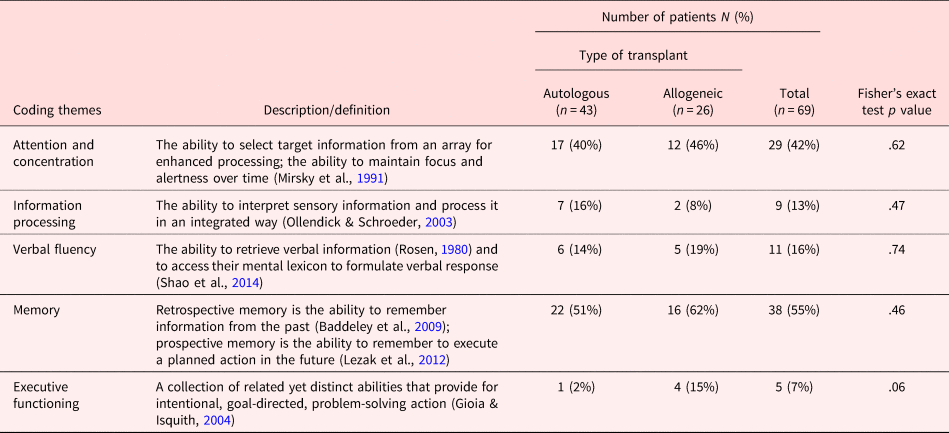
Two trained research assistants (NK and KH) coded all of the transcribed responses of the 69 participants using QSR International's NVivo 7 software. Coders were trained by the lead author to code each participant's entire interview text for sentences that captured instances of impairment in predetermined cognitive domains covering basic cognitive functions through to higher level functions, and that are commonly included in studies of this nature (Poppelreuter et al., Reference Poppelreuter, Weis and Mumm2008; Reisberg et al., Reference Reisberg, Shulman and Torossian2010) (i.e., “attention and concentration,” “information processing,” “verbal fluency,” “memory,” “executive functioning,” and a general cognitive impairment category to capture nonspecific cognitive problems. Definitions of the cognitive domain coding categories are provided in Table 1. Training included studying and discussing the content of each coding category before coding the interviews. Inter-rater agreement between coders occurred 70% of the time (i.e., when the same code was captured by both raters for the participant in question). If there was disagreement between coders, they discussed the coding with the lead author until a consensus was reached. Based on these discussions, the coding categories of “information processing” and “general cognitive impairment” were collapsed into one category called “information processing” because the responses comprising these two categories overlapped between raters. Specifically, both categories included reports of impairment to the speed, accuracy, and efficiency of processing information. Additional coding was not required for the questions regarding whether family and friends had noticed the changes and questions that pertained to work functioning.
Coding themes and number of patients endorsing problems by themes

Quantitative data analysis
The frequency and percentage of participants who reported in the interviews of having a given cognitive problem were calculated. Chi-square tests were used to examine differences by previous exposure to active versus neutral (control) writing conditions in the parent intervention trial. Fisher's exact tests were used to explore differences by transplant type. To examine associations between individuals who endorsed cognitive problems and depressed mood, anxiety, and health-related quality of life, point-biserial correlations were calculated using baseline measurements of the psychosocial outcomes to minimize the potentially confounding effect of the parent study's intervention trial. Point-biserial correlations were also used to explore associations with participants’ responses on the FACT-Cog. All quantitative data analyses were undertaken using IBM SPSS Statistics, version 24, software.
Results
Sample characteristics
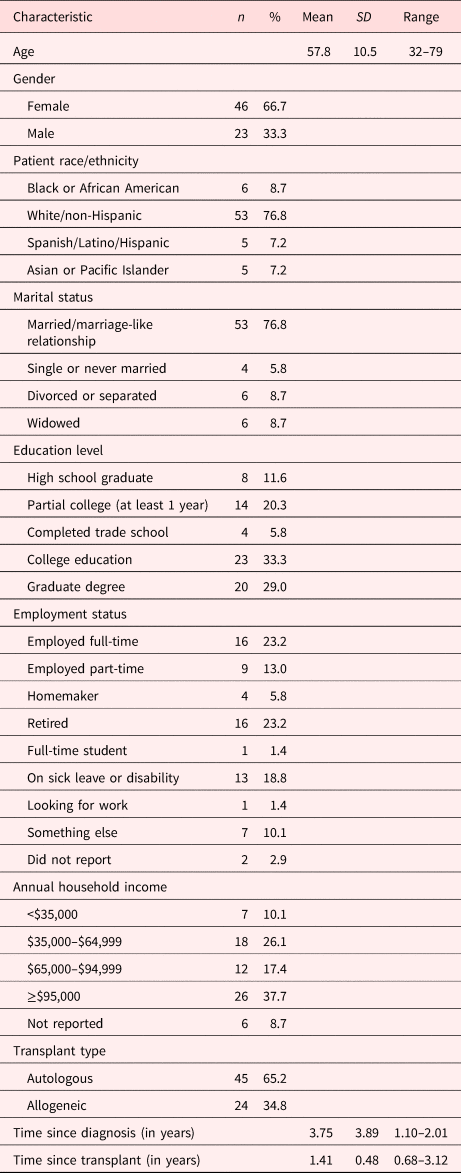
The participant sample consisted of 69 HSCT survivors. Table 2 summarizes the demographic and clinical characteristics of the participants. The majority of HSCTs were performed for malignancies such as leukemia, lymphoma, or myeloma (95.7%).
Participant characteristics (n = 69)

Interview transcriptions
Responses to the questions tended to be brief. Only one of the 41 interviews with audio recordings available to them had a portion of the participant's response that was not noted; this required a correction culminating in one additional code endorsement. The notes were otherwise accurate with respect to the reporting of cognitive impairments and the effect of cognitive impairments on their lives. Any differences in participants’ narratives were superficial/grammatical in nature, rather than substantive.
Among participants who reported cognitive impairment, the average length of interviews was 3.43 minutes with a range of 1.45–12.23 minutes (SD = 2.23). Among those who did not report cognitive impairment, the length of interviews was on average 1.50 minutes (SD = 0.73; range 0.62–2.9).
Perceived cognitive impairment
A chi-square test indicated that there was no association between previous exposure to neutral versus active writing conditions in the parent trial and whether or not participants reported perceived cognitive impairment chi-square (1) = .78, p = 0.39.
Overall, 49 of the 69 participants (71%) reported noticeable impairments in cognitive functioning after their transplant (28 autologous and 21 allogeneic participants) with no difference by type of transplant (p = 0.19) even within specific cognitive domains. Table 1 includes the frequency of participants who endorsed impairments by cognitive domain. A majority (55%; n = 38) of participants reported problems in memory that, in some cases, affected interpersonal interactions and activities of daily living:
Patient 591: “(I) can't remember things, like forgetting why I came into a room. I lose things all the time, e.g., keys…I put things in safe places, then can't remember where I put them….I'll repeat stories I've told them before. I can't remember the things they told me.”
Patient 681: “Yes, I have difficulty recalling things like names and words.”
Patient 597: “If I'm introduced to someone, I often forget their name. Short-term memory is a problem.”
Memory problems were also prospective in nature, affecting memory for future planned actions (Lezak et al., Reference Lezak, Howieson and Bigler2012):
Patient 591: “I forget appointments and need to write them down 10 times.”
Patient 571: “I need to keep lists.”
Patient 431: “(I have to) write notes to myself.”
Attention and concentration problems were endorsed by 30 participants (42%). Examples of attention and concentration problems were:
Patient 588: “When I go to ask a question, it leaves my mind and I have to come back to it at a later time.”
Patient 597: “Sometimes when reading a novel I have to concentrate more.”
Patient 606: “I used to read all the time and now I can't focus.”
Eleven participants (16%) reported problems with verbal fluency. Examples included:
Patient 573: “When I'm talking, I know the words but can't think of it even though it was on the tip of my tongue. I know the English (which is my second language) but it doesn't come to me like it used to. Happens in both languages (Bengali too).”
Patient 592: “Sometimes I can't think of the word I'm thinking of and have to circumvent the word to explain it. They could be simple words.”
Patient 634: “I go blank in the middle of a sentence.”
The same proportion of participants reported problems in information processing:
Patient 588: “It's hard at first trying to get directions in my mind when I need to get to a certain point.”
Patient 661: “(My thinking) is a little slower and foggier…”
Five (7%) reported problems with executive functioning:
Patient 633: “It's very difficult for me to multitask.”
Patient 678: “(I have) difficulty keeping track of life's little details, like coordinating mine and my children's schedules.”
Effect of cognitive impairments on return to work
Of the 50 participants (72%) who were working before the transplant, 19 (38%) did not return to work following transplant. Twelve of those participants (24%) had to stop working because of cognitive and health problems. Work issues included taking longer to complete tasks than before HSCT and struggling to maintain concentration, memory, and executive functioning. For example, patient 618 reported that he could not “remember things including names or procedures at work” and patient 573 stated that “writing out lesson plans was harder because (even if) I knew that I had done something before, I couldn't remember from the past what I needed to do (now).” Patient 657 had to stop working because of memory problems: “I couldn't remember things so I couldn't go back to work.”
Cognitive changes noticed by family and friends
In addition, 31 participants (46%) reported that friends and family members had also noticed cognitive changes after the transplant. For example, patient 563 reported, “It is a joke. They don't ask me time or place of where we are going because it is always wrong” and patient 595 said, “(My husband) noticed that I couldn't remember what we'd spoken about.”
Associations with age, depressed mood, anxiety, and quality of life
Upon examination of the point biserial correlations between reporting noticeable cognitive changes and age, there was a significant negative association (r = –0.28, p = 0.02) such that younger participants were more likely to report declines in cognition following transplant. With respect to psychosocial outcomes, there were significant correlations between reporting noticeable cognitive changes and depressed mood (r = 0.29, p = 0.02), anxiety (r = 0.37, p = 0.002), and health-related quality of life (r = –0.32, p = 0.008).
Associations with subjective cognitive functioning
Point biserial correlations were undertaken to measure associations between the total score of the abbreviated version of the FACT-Cog (in which a higher score means better functioning) and the qualitative reports of noticeable cognitive changes overall and reports of specific problems in different cognitive domains. Analyses indicated significant correlations with reports of noticeable cognitive changes (r = –0.40, p = 0.001) and with reports of memory changes (r = –0.46, p < 0.001). There were no other significant correlations between the FACT-Cog total score and any other cognitive domain reported in the interviews.
Discussion
The aim of this study was to characterize perceived cognitive impairments experienced by survivors in their post-HSCT life that may not be captured by formal, objective neuropsychological tests or by self-report questionnaires. Our findings illustrate that the cognitive impairments reported by participants in this study are largely consistent with the cognitive domains found to be impaired in previous HSCT research using neuropsychological tests (Friedman et al., Reference Friedman, Fernandez and Wefel2009; Harder et al., Reference Harder, Cornelissen and Van Gool2002; Scherwath et al., Reference Scherwath, Schirmer and Kruse2013; Syrjala et al., Reference Syrjala, Dikmen and Langer2004, Reference Syrjala, Artherholt and Kurland2011). The current study also elaborates on those findings by providing information about how those impairments manifest and affect HSCT survivors’ daily lives. Previous studies have been limited due to their focus on questionnaire responses and qualitative self-report data that have not provided details regarding the nature of perceived cognitive problems, nor how such problems affect patients’ ability to return to work and perform daily life activities (Booth-Jones et al., Reference Booth-Jones, Jacobsen and Ransom2005; Harder et al., Reference Harder, Duivenvoorden and van Gool2006; Scherwath et al., Reference Scherwath, Schirmer and Kruse2013; Sherman et al., Reference Sherman, Cooke and Grant2005). Open-ended reports of perceived cognitive functioning, as in the present study, can capture these abilities and describe them in the context of work and other daily life activities. Indeed, our results indicate that HSCT survivors reported impairments in all of the cognitive domains assessed, but most notably in memory, and attention and concentration, similar to previous research (Sherman et al., Reference Sherman, Cooke and Grant2005). Importantly, even when responses on a self-reported cognition questionnaire were compared with the responses in the qualitative interview, the questionnaire was not adequate in capturing the full gamut or impact of perceived problems on specific aspects of the person's daily life functioning (e.g., in relationships, at work). In the interviews, more than one-half of the sample described problems with memory, both retrospective and prospective, that seemed to affect their activities of daily living as well as social interactions (e.g. forgetting appointments, forgetting names, repeating stories). A large group of participants also reported being affected by attention and concentration difficulties that affected work productivity (e.g., writing out lesson plans is harder) and nonwork time (e.g., not being able remember conversations). Participants reported difficulties in executive functioning and information processing less often. The few cases of reported verbal fluency problems were mostly related to word retrieval.
There were strong indicators that the quality of life of these people had been affected as evidenced by both the interviews and a significant association with health-related quality of life. Given growing interest in return to work as an important patient and public health outcome (Duijts et al., Reference Duijts, van der Beek and Boelhouwer2016), it is notable that over a third of employed participants were not able to return to work after the transplant, at least by the time this study had been conducted, up to 3 years after transplant. Almost two thirds of them cited health and cognitive issues as the reason. It is difficult to determine the extent to which impairments to work performance were caused by cognitive issues; however, these findings highlight the need for more targeted research on the effects of cognitive problems on survivors’ ability, or inability, to return to work, and, for those who have been able to return to work for at least some time, to complete work-related tasks. The inability to return to work is likely to have implications on survivors’ lives, such as contributing to financial difficulties, emotional distress, and a less positive self-image (Jim et al., Reference Jim HS, Syrjala and Rizzo2012; Khera et al., Reference Khera, Chang and Hashmi2014; Mosher et al., Reference Mosher, Redd and Rini2009; Syrjala et al., Reference Syrjala, Langer and Abrams2004). Indeed, we found that the reporting of noticeable cognitive changes after transplant was associated with depressed mood, anxiety, and health-related quality of life. Although matters of self-image and financial difficulties were outside the scope of this study, some sense of embarrassment when respondents spoke about their family reactions filtered through as well, as did frustration and distress caused by the cognitive changes. It is also possible that impaired cognition affects emotion regulation itself, thus contributing to distress symptoms (Richards & Gross, Reference Richards and Gross2000). These findings suggest that cognitive changes following HSCT have negative effects on interpersonal and daily life functioning. Consistent with earlier research in cancer survivors (Amidi et al., Reference Amidi, Christensen and Mehlsen2015), younger participants were more likely to report cognitive problems following transplant suggesting that this group may be most at risk for experiencing these problems.
Study limitations
A number of limitations ought to be considered when interpreting these findings. First, most of the sample consisted of survivors who were mostly well-educated, white, and had high income limiting its generalization to other groups. However, these numbers unfortunately reflect the lack of diversity among patients who undergo transplantation across the United States and among participants in HSCT studies in general (Bush et al., Reference Bush, Donaldson and Haberman2000). Second, the sample consisted of HSCT patients who reported at least mild psychological distress or other survivorship difficulty and so the findings are limited to that population; however, a majority of participants who screened for the study (87%) met these criteria. Third, the briefness of the interviews is a weakness in that we were unable to collect more elaborate narratives of the patients’ self-reported experiences and perhaps did not gain rich insights that a more extensive interview or even focus group could have provided. Last, it is unclear the extent to which reported cognitive difficulties were attributable to aging and other medical and psychological conditions of the respondents.
Clinical implications
Despite these limitations, our findings provide us with important insights into the lived experience of cognitive changes in HSCT survivors in a relatively large sample for a qualitative study. It also highlights the importance of asking HSCT survivors about their experiences of cognitive impairment during recovery and that such self-report data are necessary complements to formal neuropsychological testing. For particular cognitive skills that are rarely assessed using neuropsychological tests, such as prospective memory (i.e., the ability to remember to execute a planned action in the future), this questioning becomes all the more important. In addition, the brevity of the interviews illustrate that this line of questioning is likely to be feasible in clinical settings where time is limited. Further research continues to be needed to improve not only the identification and assessment of cognitive impairment in cancer survivors, but to also better understand the impact of cognitive impairments on daily life functioning. Perhaps most important, experiences of cognitive impairment, whether or not they are corroborated by neuropsychological tests, still warrant intervention efforts because of their significant impact on quality of life.
Acknowledgments
We thank Katie Basmajian, Jennifer Chee-Chait, and AnnaMarie Vu for assistance with data collection and data management; we also thank all the survivors who participated in the study. This work was supported by the American Cancer Society (grant #RSGPB-07-285-01-CPPB; principal investigator: CR). LMW's effort on this publication was supported by the National Cancer Institute of the National Institutes of Health under Award Number 5K07CA184145-03. The content is solely the responsibility of the authors and does not necessarily represent the official view of the American Cancer Society or the National Institutes of Health.
Disclosures
The authors have no conflicts of interest to declare.