This issue of TDR includes Katia Arfara’s “Reclaiming the Past: On Lola Arias’s Theatre of Postmemory” and Ali-Reza Mirsajadi’s “And of Clay We Are Created: Zahra Sabri’s Count to One and the Material Ephemerality of War.” These articles are the first of a series of essays focusing on the director’s work regarding inventions of forms, contemporary thought, and reception.
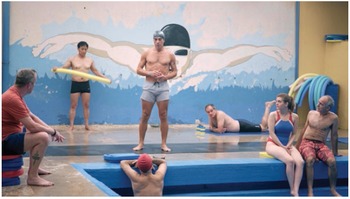
Arfara describes and analyzes Arias’s methods of staging the generational consequences of the Argentinian and Chilean military juntas. The Argentinian author and director, writes Arfara, is deeply engaged with the politics of memory and a search for theatricality both inside and outside the theatre. With letters, photos, maps, and objects projected onto large screens or laid out on tables, Arias assembles facts, memories, and imagination that act as proof that the story is real even as they expose the imaginative processes of making theatre. Hovering in the gray zone between fiction and reality, Arias’s more recent directing and dramaturgy is indebted to Argentina’s postdictatorship reality: the imperative to both recover what was lost and understand what happened. That the project is impossible is a given. Arias and her performers encounter the fluidity of memory, the silence of objects, and the fictional framing of theatre. She dismantles the surety of historical narratives by staging a transparent accumulation of layered images of the performers’ researched experiential realities. Arias’s directing process includes casting the ensemble, determining the props, and assembling a story that sometimes includes simulating what happened during rehearsals.
Marcelo Vallejo in Theatre of War by Lola Arias, first presented at Berlinale, Berlin’s International Film Festival, 2018. (Film still by Manuel Abramovich; courtesy of Lola Arias Company)

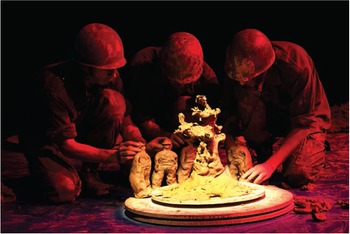
Like Arias, the Iranian director Zahra Sabri focuses on the fluidity of experience but without a specific political critique. Mirsajadi focuses on Sabri’s staging of the precarity, ephemerality, and materiality of the human body. Three soldiers who never speak a word create, animate, and destroy wet clay puppets in a recurring cycle of an unnamed war. Sabri’s soldiers refuse an order to bomb a foreign city. Instead, they make and destroy stage worlds. Using pottery wheels built into the stage floor, the silent actors are also puppet makers, puppeteers, and even, at times, puppets. Sabri uses the soldiers’ repeated creation and destruction of the clay puppets both to stage a visual critique of war and to make a statement about the ephemerality of life and art.
Clay versions of the army puppeteers finding solace under a tree. Count to One by Zahra Sabri. Tehran, 2012. (Photo by Siamak Zomorodi; courtesy of Zahra Sabri)

Arias and Sabri both have developed the practices of the auteur director in response to the extraordinary circumstances of the 21st century. They put forward their own intellectual inquiry, aesthetic imagination, relationship with history, and narratives in the context of today’s cultural and political zeitgeist.
Directing methods have been radically expanding since at least the 1950s. Auteur directors, ensemble theatres, and devised theatre practices have contributed to shifts in the role of directors and to radically revising the rehearsal process. Directors play a much bigger role in the theatre not only in the construction of narrative but also in the selection and use of stage properties, scenography, costumes, and dramaturgy. Directors have been puncturing the membrane between actor and character and professional and nonprofessional performers, as they create immersive, site-specific, and proscenium theatre that disrupts divisions between fiction and nonfiction, and abandons the suspension of disbelief.
I hope that this ongoing series on directing will capture the boldest techniques of some of the most important international directors.