Election pledges are a vital part of modern representative democracy. They serve as a credible commitment device that allows parties to trade votes today for policies in the future. Pledges can help voters choose between parties before elections and hold parties accountable after elections. Pledges are, thus, the core mechanism linking voters and their elected representatives. Yet, in this day and age, where politicians confront the public with numerous statements on a daily basis, we often do not know when voters consider statements to be pledges. For example, when Donald Trump promises to ‘build a great wall at the southern border’ or when Boris Johnson vows to ‘get Brexit done’, voters might perceive such statements as election pledges for which they can be held accountable, or they might not do so and effectively relieve politicians from the burden of fulfilling these proposals. Without knowing when voters consider statements to be election pledges, we might miss an important explanation for why some political statements have electoral repercussions, while others do not. As such, the question of how voters define election pledges has far-reaching implications for research on election campaigns (for example, Aytaç, Rau, and Stokes Reference Aytaç, Rau and Stokes2020; Banducci, Giebler, and Kritzinger Reference Banducci, Giebler and Kritzinger2017) and the electoral link between citizens and parties more broadly (for example, Adams, Ezrow, and Somer-Topcu Reference Adams, Ezrow and Somer-Topcu2014; Gillion, Ladd, and Meredith Reference Gillion, Ladd and Meredith2020; Han Reference Han2020; Spoon and Klüver Reference Spoon and Klüver2019).
By building on classic research on election pledges (for example, Mansergh and Thomson Reference Mansergh and Thomson2007; Royed Reference Royed1996; Thomson Reference Thomson2001), recent literature demonstrates that while voters generally understand pledges quite broadly (Naurin Reference Naurin2011), they tend to focus on the degree of commitment (Dupont et al. Reference Dupont2019) and the use of persuasive, value-laden words (Lindgren Reference Lindgren2017; Lindgren Reference Lindgren2018; Lindgren and Naurin Reference Lindgren and Naurin2017). Another strand of literature convincingly demonstrates that parties do, in fact, keep most of their promises (see also Müller Reference Müller2020; Thomson et al. Reference Thomson2017) and that voters are quite apt to punish and reward parties based on such performances (Matthieß Reference Matthieß2020; Naurin, Soroka, and Markwat Reference Naurin, Soroka and Markwat2019; see also Thomson Reference Thomson2011). However, apart from these significant contributions, we have a limited understanding of what statement characteristics make voters systematically categorize some as pledges and others as not, and we know relatively little about whether the very same characteristics are used by voters to hold parties and politicians accountable for their pledges.
We address this lacuna by undertaking an extensive cross-country conjoint experiment on representative samples totalling around 6,000 citizens and more than 18,000 observations in the United States, Britain and Denmark. Without nationally representative samples with sufficient power, we will always struggle to know how voters – understood as the real-world electorate – define pledges. Moreover, a major lesson from Thomson et al. (Reference Thomson2017) and Naurin, Royed and Thomson (Reference Naurin, Royed and Thomson2019) is that governments' pledge-keeping track records vary across countries, which might also affect how voters define pledges. If we have any ambition of drawing cross-country conclusions about the politics of pledges, having firm knowledge about such cross-country variation is vital. With our design, we are able to account for these issues.
From this, we present several noteworthy conclusions. First of all, voters consistently differentiate between statements in a highly focused manner: first, by considering statements on concrete outputs to be pledges because politicians have direct control over these outputs; and, second, by considering statements with committing formulations to be pledges because such statements indicate that the pledge giver sincerely prioritizes the issue. In contrast, voters pay no attention to either the partisan identity of the pledge giver or whether the statement is quantified with numeric goals or time horizons. Taking stock of such differences is important in the study of election pledges. Whereas it might seem unsurprising that committing statements are seen as election pledges, it tells us a great deal about voters' capabilities that they, on the one hand, have their eyes fixed on politicians' ability to fulfil their pledges and, on the other hand, disregard partisan considerations and the specificity of statements when deciding whether or not to consider them election pledges. A promise is a promise if it is realistic and sincere – no matter who made it and whether it can be checked.
However, while we find that voters generally believe politicians should be held accountable for pledges and base their perceptions on the same dimensions as outlined earlier, pledge perceptions and accountability perceptions seem to differ in one important respect: although voters are consistent in ignoring senders' party identification when perceiving statements as pledges or non-pledges, they rely heavily on partisan considerations when attributing accountability for fulfilling these proposals. Following the logic of rationalized attribution of responsibility (see, for example, Tilley and Hobolt Reference Tilley and Hobolt2011), voters are markedly less willing to hold their party accountable for a given statement – even if they consider it an election pledge.
Combined, these findings represent the perceptual logic of election pledges among voters in Western democracies: they are consistent and focused when perceiving political statements as election pledges, but inconsistent and biased when drawing conclusions about accountability.
The Perceptual Logic of Election Pledges
Election pledges are generally defined as ‘a statement committing a party to one specific action or outcome that can be clearly determined to have occurred or not’ (Thomson et al. Reference Thomson2017, 532). From this vantage point, we can deduce four assumed dimensions of election pledges, which we present briefly here and discuss in more detail in the Online Appendix (see Appendices A1 and B1).
First is the degree of commitment. Committing formulations are vital because they signal to voters the extent to which a pledge giver sincerely prioritizes the issue at stake. A pledge that does not contain an explicit commitment, such as ‘we promise’, ‘we vow’ or ‘we swear’, suggests to the voter that it is not a high priority for the sender and is thus less likely to be labelled a pledge at all. Much the same can be said when a pledge giver attaches conditions to the pledge. By saying that a pledge will only be fulfilled under certain conditions, such as ‘if the economy allows it’ or ‘if the opportunity arises’, the pledge giver is essentially creating back doors to escape credible commitment to the pledge.
The second dimension of pledges is the pledge giver. Voters often harbour a partisan bias by interpreting information in ways that align their partisan biases with incoming information so as to avoid so-called ‘cognitive dissonance’ (Lodge and Taber Reference Lodge and Taber2013). Following this, voters may consider statements from their own party to be pledges simply because they trust that the politician will act according to their statement.
The third dimension is the policy content of the pledge. Parties can make promises about virtually anything, but a crucial dividing line exists between output and outcome. Output is the direct consequence of a legislative decision and can be controlled by the government; outcome is the desired end result of this decision and cannot be manipulated directly. Appreciating such differences, we can reasonably expect that voters distinguish between outputs and outcomes, and that they do so by perceiving statements on outputs as pledges to a greater extent than statements on outcomes because the sender has direct control of the former but not the latter.
The fourth and final dimension is quantification, that is, whether the statement includes a numeric goal (for example, promising not only more spending, but 25 per cent more spending) or time horizon (for example, within the first year of the election) that makes it possible to unambiguously observe after the election whether a pledge has been kept. According to the literature, such testability is a key feature of pledges (see, for example, Naurin, Royed, and Thomson Reference Naurin, Royed and Thomson2019). By proposing an exact yardstick for pledge keeping before the election, parties in principle renounce the right to define their own pledge-keeping record. Instead, objective and specific metrics increase voters' own ability to assess a pledge, that is, the voters' own sense of internal efficacy increases. By this logic, voters perceive a quantified statement to be an election pledge because it allows them to assess the pledge-keeping record.
Theoretically, pledges are significant because voters imbue them with an expectation of fulfilment. In other words, when a statement is considered a pledge, the actor making the statement should also be considered accountable for seeing it implemented. Following the logics stipulated earlier, we should thus expect the same dimensions to be relevant regarding perceptions of accountability.
Research Design
In assessing the attributes of a political statement that induce citizens to consider it an election pledge, we used a conjoint experimental design (Hainmueller, Hopkins, and Yamamoto Reference Hainmueller, Hopkins and Yamamoto2014) on a representative sample of around 2,000 respondents each in the United States, Britain and Denmark (for a detailed discussion of the data collection, questionnaire and case selection, see Online Appendices C1–C3).
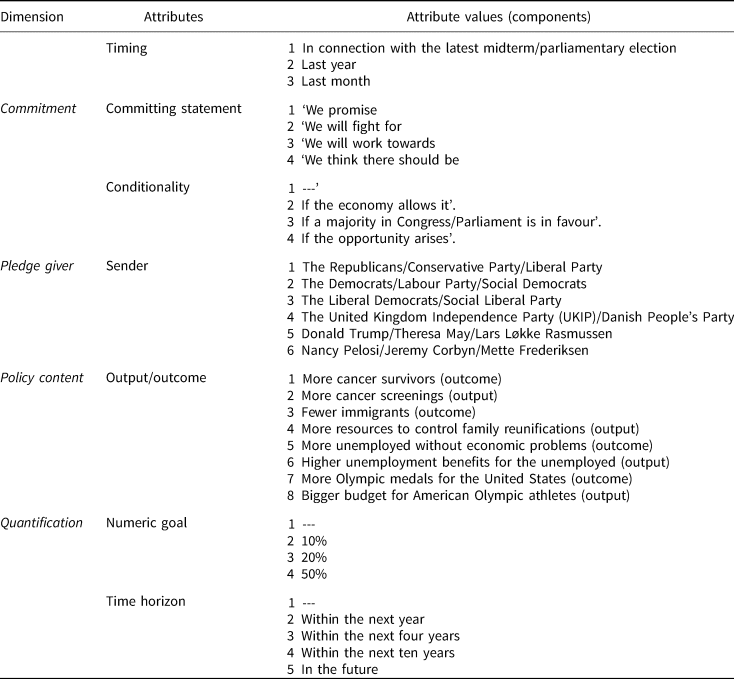
In the conjoint experiments, we presented our respondents with a series of political statements that randomly varied on the key attributes discussed earlier. Based on this, the respondents declared whether they perceived the statement to be an election pledge or not. Table 2 presents all conceptual attributes of the statement that we varied in the experiment: the degree of commitment was measured by varying the committing statement and conditionality; the pledge giver was measured by specifying a sender of the statement; the policy content was measured by proposing either outputs or outcomes; and quantification was measured by including both a numeric goal and a time horizon (for a detailed description, see Online Appendix C4). We also varied the timing of the statement in order to improve the realism of the vignettes, though we only present the results of this dimension in the Online Appendix.
All respondents read a vignette with a political statement combining the attributes shown in Table 2. Hereafter, they were asked whether they would classify it as an election pledge. Each respondent went through this process four times, that is, they read and evaluated four different, randomly generated political statements in total. This amounted to 18,924 observations.
The main estimation strategy follows the approach of Hainmueller, Hopkins and Yamamoto (Reference Hainmueller, Hopkins and Yamamoto2014). It consists of a series of ordinary least squares (OLS) models – one for each attribute – and takes the following forms for each country:

for i = 1, …, n respondents, j = 1, …, n profiles and k = 1, …, n rounds.
E i,j,k represents a binary outcome variable that contains each respondent's answer to whether a given political statement constitutes an election pledge (1) or not (0). Each of the main attributes – vote for sender (S 2i,j,k), committing statement (C 2i,j,k, C 3i,j,k, C 4i,j,k), numeric goal (Q 2i,j,k, Q 3i,j,k, Q 4i,j,k), output/outcome (O 2i,j,k),Footnote 1 time horizon (T 2i,j,k, T 3i,j,k, T 4i,j,k, T 5i,j,k) and conditionality (I 2i,j,k, I 3i,j,k, I 4i,j,k) – is examined by including dummy variables for each possible value (except the base category) in separate regressions. The coefficients of these denote the average marginal component effect (AMCE). We cluster standard errors on respondents.
Determinants of Election Pledge Perceptions
Dimension 1: Commitment
Fig. 1 demonstrates that the linguistic formulation matters. Statements containing ‘we think there should be’ are substantially less likely to be perceived as election pledges than commitments containing ‘we will fight for’ and ‘we will work towards’, which, in turn, are less likely to be perceived as election pledges than phrases containing ‘we promise’. This is no surprise, and it serves to show that voters share the intuition that statements need an explicit commitment in order to be labelled a pledge. Likewise, creating back doors to escape binding commitments has clear implications for perceptions of political statements, as attaching conditions significantly decreases the likelihood of being perceived as pledges.
When are statements perceived as pledges?
Notes: Average marginal component effects (AMCE) on the likelihood of considering a statement an election pledge and 95 per cent confidence intervals. Points without horizontal lines denote the reference category. Black = United States; dark grey = Britain; light grey = Denmark.

Dimension 2: Pledge Giver
The relationship to the sender of the statement – in the form of vote intention – does not play a significant role in voters' definition of pledges. In addition, there is no direct effect of the pledge giver in itself. Whether the sender is, for example, the Democrats, the Republicans, Donald Trump or Nancy Pelosi makes no difference (see Online Appendix D7). These findings are somewhat surprising, and they set pledges apart from many other forms of political communication. Voters generally tend to interpret political information in ways that align with their partisan predispositions, but election pledges seem unique in the sense that voters asses the incoming information without relying on their partisan biases.
Dimension 3: Policy Content
Statements on outputs are significantly more likely to be considered election pledges than statements on outcomes. This suggests that voters generally perceive statements on areas that the government can directly control to be pledges to a greater extent than statements on areas that the government can only control indirectly. Promising ‘more cancer screenings’ is a pledge; promising ‘more cancer survivors’ is less so. This finding is noteworthy because appreciating such differences requires a reasonable understanding of how the social world works.
Dimension 4: Quantification
The quantification of a statement is unimportant for voters' perceptions of election pledges. Although adding exact yardsticks increases voters' ability to assess parties' pledge-keeping track record, it does not seem to matter for election pledge perceptions. Attaching numerical goals (for example, ‘10 per cent’ or ‘25 per cent’) or time horizons (for example, ‘within the next year’ or ‘within the next four years’) has no significant effect. It seems that voters care little about their own ability to assess the record of pledge keeping.
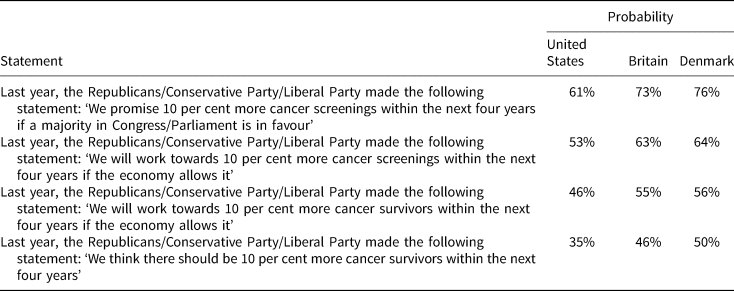
To get an impression of the size of the effects, Table 3 presents a set of predicted probabilities across specific statements that vary on the degree of commitment and output/outcome dimension, that is, the two dimensions that appear to matter most to voters. In the Online Appendix, we present an array of alternative model specifications, different estimation methods and various split-sample estimations – all generally corroborating the robustness of the results (see Online Appendices D–F).
Mechanisms and the Perceptual Logic
In order to examine the mechanisms that link statement characteristics and pledge categorization, we utilize the fact that we inquired about respondents' perceptions of sender priority, sender trustworthiness, sender control and respondent efficacy after each statement. Specifically, we use the causal mediation analysis approach stipulated by Imai and Yamamoto (Reference Imai and Yamamoto2013) and examine the mediation effect of the two substantially most interesting of the statistically significant attributes from the preceding analysis: conditionality and output/outcome (for a more detailed discussion of model specifications and alternative specifications, see Online Appendix E).
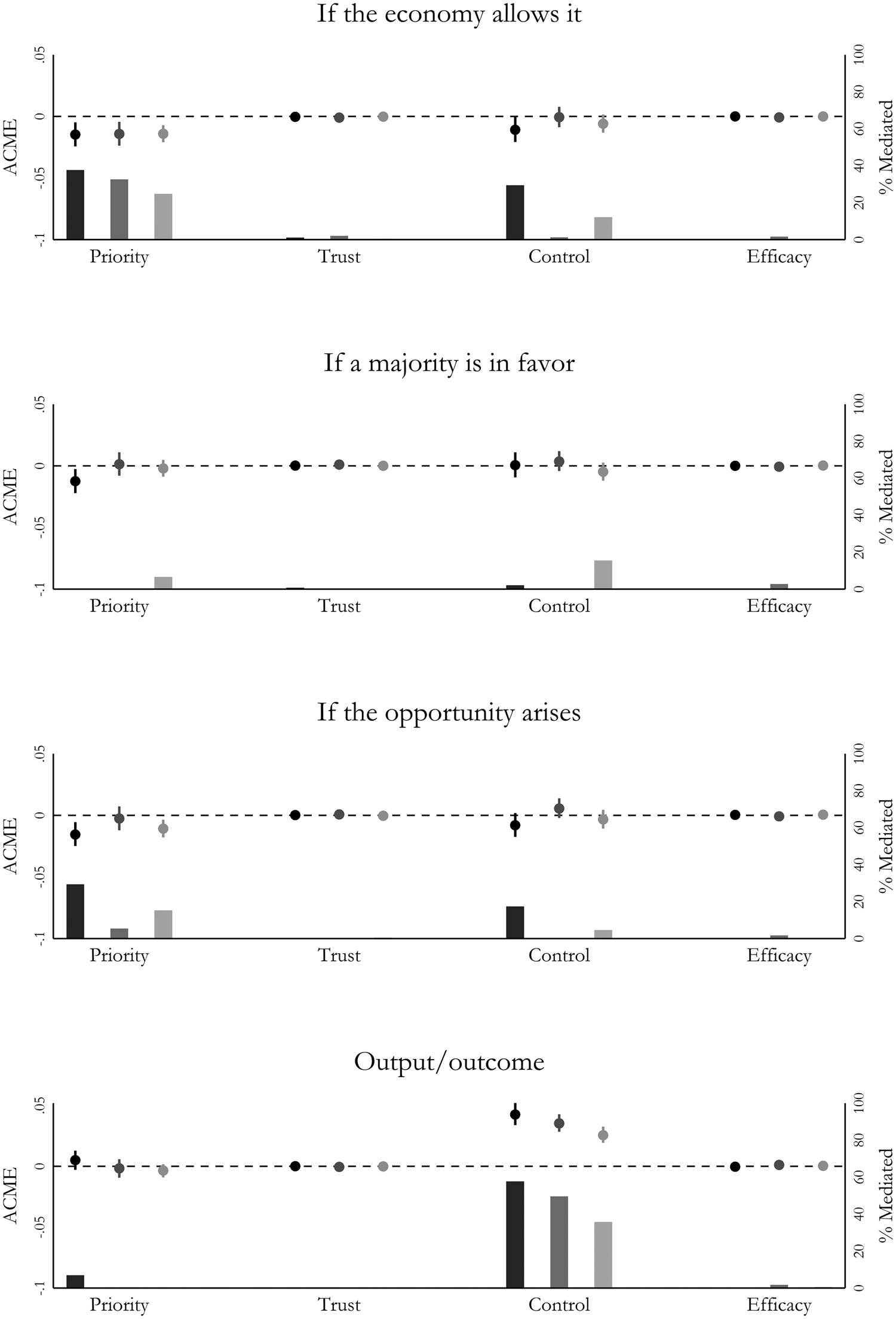
Although reporting correlational evidence, Fig. 2 generally supports the stipulated perceptual logic from Table 1. Statements with the two significant conditions attached – ‘if the economy allows it’ and ‘if the opportunity arises’ – are less likely to be regarded as pledges because they signal that the pledge giver does not sincerely prioritize the issue at stake (see dots and confidence intervals in Fig. 2). Up to around 38 per cent of the total effect is mediated through this mechanism (see bars in Fig. 2), which is a substantial mediation effect. Moreover, results show that voters regard outputs as being within the government's control to a greater extent than outcomes, which, in turn, explains why voters are more likely to perceive statements on outputs to be election pledges. Of the total effect, this mediation effect is suggested to be between 35 per cent and 57 per cent, which, again, is a substantial mediation effect.
Examining the perceptual logic of pledges.
Notes: Dots denote the average causal mediation effect (ACME) for treatment = 1 on the probability of perceiving a statement to be an election pledge, with 95 per cent confidence intervals. Bars denote the estimated proportion of the total effect mediated (given in percentages on the second axis). Black = United States; dark grey = Britain; light grey = Denmark.

The perceptual logic of pledges

Conjoint design

Predicted probabilities of specific statements

Note: Predicted probabilities of a given statement being classified as an election pledge.
These correlations are reassuring. They not only underscore that the degree of commitment and policy content are the most important dimensions, but also corroborate that they are so because they impact voters' perceptions of how much politicians prioritize a given issue and how much control they have over it.
Election Pledges and Accountability
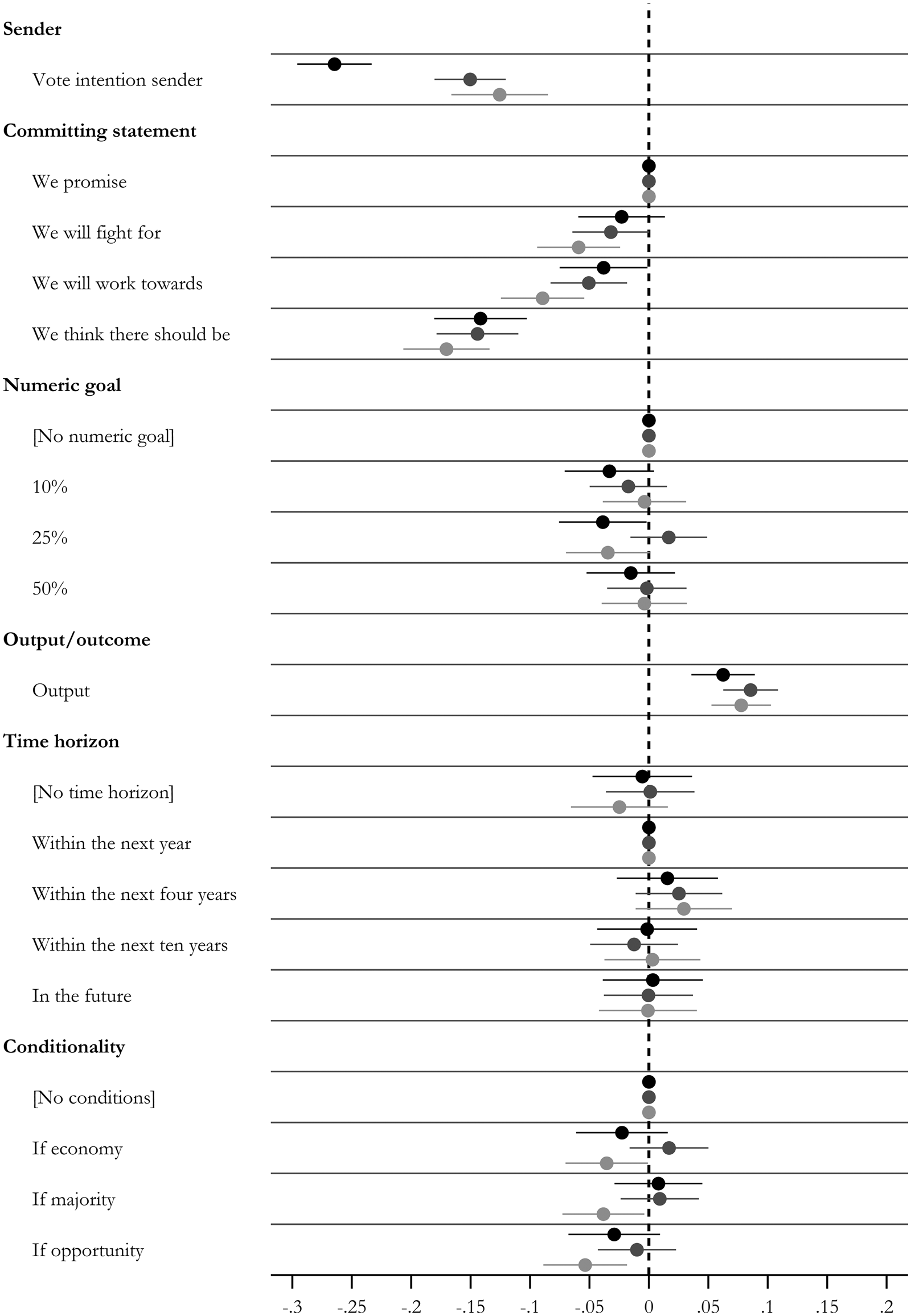
Generally, voters seem to perceive pledges as a distinct form of political communication – both in terms of their rhetorical quality and their associated accountability. If a statement is categorized as a pledge, voters strongly believe the pledge giver is accountable for implementing it; if a statement is not seen as a pledge, most do not hold the pledge giver accountable (see Online Appendix F1). Fig. 3 examines this even further by examining when citizens believe a given politician or party should be held accountable for a given political statement (substituting E i,j,k with a binary accountability variable).
Political statements and accountability.
Notes: AMCE on the likelihood of considering the sender accountable for a statement and 95 per cent confidence intervals. Points without horizontal lines denote the reference category. Black = United States; dark grey = Britain; light grey = Denmark.

As is evident, the pattern is generally quite similar to the one regarding election pledge perceptions. Parties and politicians are held accountable to a greater extent when they formulate strong committing statements without conditions attached (though these effects seem less consistent here) and when the statements regard outputs rather than outcomes.
However, one noteworthy difference deserves attention: the party identification of the sender matters a great deal in terms of accountability. Voters clearly consider the identity of the sender when deciding whether to hold the given party or politician accountable for the statement. If a voter supports a given sender, the voter is less likely to hold the very same sender accountable for the statement; on the contrary, if the voter does not support the sender, the voter will hold the sender accountable to a greater extent. These findings suggest that while perceiving a given political statement to be an election pledge is done without relying on partisan biases, the subsequent attribution of accountability is politically much more precarious. Partisans' focus and consistency in perceiving statements as election pledges is seemingly no guarantee that they will employ similar yardsticks regarding accountability, particularly when it comes to holding their own party accountable for pledges.
Conclusion
In the scholarly literature, pledges are conceptualized as statements that commit parties to observable actions or outcomes. Our findings suggest that voters only partly share this definition. Most notably, the extent to which a party includes an exact, observable yardstick – a numeric quantity or a specific time horizon – does not matter to voters. All else equal, this suggests that voters consider more statements to be pledges than those normally counted as such in the literature (see, for example, Mansergh and Thomson Reference Mansergh and Thomson2007; Royed Reference Royed1996; Thomson et al. Reference Thomson2017). This might help explain the so-called ‘pledge puzzle’ often highlighted in the literature: that voters in surveys consistently report that governments do not keep their pledges, when, in fact, governments largely do (Müller Reference Müller2020; Naurin Reference Naurin2011; Naurin, Soroka, and Markwat Reference Naurin, Soroka and Markwat2019). If voters consider a larger proportion of party statements to be pledges, governments may – from the point of view of the voters – actually not keep all that many of their promises. In addition, we showed that voters generally associate pledges with accountability, but that they do so selectively. Specifically, voters hold parties that they have not voted for accountable for their pledges to a much higher degree. This implies that governments are held accountable by the voters for a larger proportion of their statements than we would otherwise assume, and maybe for a larger proportion than the parties themselves realize – especially among voters who have not voted for them.
Overall, our results are very stable across the three countries we studied. Yet, future research could still explore the role of the national context for voters' understanding and use of election pledges. Voters want parties to be held accountable for their promises, but both the beliefs that statements are pledges to begin with and especially the role they should play for accountability could vary in ways we currently have little insight into. Another context we have yet to explore is the mode and type of presentation of pledges. We may assume that pledges presented in an election manifesto are more likely understood to be a pledge than, for example, an interview statement long before the next election. This, too, will be an important task for future research. A final context is the wider parliamentary setting in which parties make political statements. Parties in government, we assume, should be held accountable to a greater extent than parties in opposition. Yet, are there other systematic tendencies for some parties to be perceived as making more frequent pledges than other parties, or to be held accountable to a higher degree than their competitors? We hope future research will build on the results of this study and further scrutinize such questions on the perceptual logic of election pledges in Western democracies.
Supplementary Material
Online appendices are available at: https://doi.org/10.1017/S0007123421000284
Data Availability Statement
Data replication sets are available in Harvard Dataverse at: https://doi.org/10.7910/DVN/X73XUM.
Acknowledgements
We thank Martin Bisgaard, Troels Bøggild, Ann-Kristin Kölln, Mathias Osmundsen, Rune Slothuus and participants at the European Political Science Association 2019 panel Election Pledges and Voters for valuable comments on earlier versions of this article. We are also grateful to the editors of BJPS and the three anonymous reviewers for very thorough and constructive comments.
Funding
This work has been supported by the Independent Research Fund Denmark (grant number 8019-00025B).