Same-sex friendships are the primary source of intimacy and support during adolescence and young adulthood (see Chow, Roelse, Buhrmester, & Underwood, Reference Chow and Buhrmester2011). Research has consistently found that stable and supportive friendships are important for adolescents’ and young adults’ psychological adjustment (e.g., Bagwell et al., Reference Bagwell, Bender, Andreassi, Kinoshita, Montarello and Muller2005; Oswald & Clark, Reference Oswald and Clark2003; Wilkinson, Reference Wilkinson2010). Furthermore, research also found that commitment in friendships provides a foundation for the emergence of commitment in subsequent romantic relationships (De Goede, Branje, & VanderValk, Reference De Goede, Branje, van Duin, VanderValk and Meeus2012). Given the importance of friendships, examining factors that are related to friendship stability and commitment should shed light on individuals’ psychological and interpersonal functioning. Therefore, the current study drew on two theoretical perspectives, the investment model (Rusbult, Martz, & Agnew, Reference Rusbult, Martz and Agnew1998) and attachment theory (Bowlby, Reference Bowlby1982; Furman & Wehner, Reference Furman, Wehner, Montemayor, Adams and Gullotta1994), to examine the dyadic dynamics of commitment between same-sex friends with the Actor-Partner Interdependence Mediation Model (APIMeM; Ledermann, Macho, & Kenny, Reference Ledermann, Macho and Kenny2011). We examined: (1) whether the link between friendship attachment and commitment in a dyadic friendship would be mediated by the relationship features of satisfaction level, quality of alternatives, and investment size; and (2) whether these mediation processes would function at the intrapersonal (actor) and interpersonal (partner) levels.
The Investment Model of Friendships
According to the investment model (Rusbult et al., Reference Rusbult, Martz and Agnew1998), commitment in a relationship is determined by three major components: rewards and costs associated with a relationship (satisfaction level), perceptions and evaluations of alternative relationships (quality of alternatives), and magnitude and importance of resources that are attached to a relationship (investment size). Although the investment model has been widely applied to romantic relationships (e.g., Rusbult et al., Reference Rusbult, Martz and Agnew1998), it has been shown to be equally valid in describing friendships (Branje, Frijns, Finkenauer, Engels, & Meeus, Reference Branje, Frijns, Finkenauer, Engels and Meeus2007; Rusbult, Reference Rusbult1980). Consistent with the investment model, research on friendships showed that higher satisfaction and investment size were related to greater commitment, whereas higher quality of alternatives was related to lower commitment (Branje et al., Reference Branje, Frijns, Finkenauer, Engels and Meeus2007; Rusbult, Reference Rusbult1980; Lin & Rusbult, Reference Lin and Rusbult1995). It is important to note, however, that because friendships are less exclusive than romantic relationships, the link between quality of alternatives and commitment was found to be weaker for friendships than romantic relationships (Branje et al., Reference Branje, Frijns, Finkenauer, Engels and Meeus2007). While satisfaction, quality of alternatives, and investment size are important predictors of commitment in a dyadic friendship, the current study argued that the construct of friendship attachment may also play a crucial role in this process.
Attachment Theory
Social cognitive theories have long argued for the importance of internalised mental representations of close relationships on relationship functioning (Bowlby, Reference Bowlby1982; Furman & Wehner, Reference Furman, Wehner, Montemayor, Adams and Gullotta1994). For instance, attachment theory proposed that individuals form mental representations of their significant others through their history of interactions (Bowlby, Reference Bowlby1982). In turn, security of these attachment representations may systematically influence various aspects of relationship functioning, including levels of commitment to a close relationship (Simpson, Reference Simpson1990; Pistole, Clark, & Tubbs, Reference Pistole, Clark and Tubbs1995).
Adult attachment researchers conceptualise individual differences in attachment security in terms of two relatively orthogonal dimensions: attachment avoidance and attachment anxiety (e.g., Brennan, Clark, & Shaver, Reference Brennan, Clark, Shaver, Simpson and Rholes1998; Fraley & Shaver, Reference Fraley and Shaver2000). The avoidance and anxiety dimensions reflect two fundamental components that underlie attachment-related regulatory systems. First, the attachment anxiety component reflects an appraisal-monitoring system that determines the extent to which individuals monitor their partners and relationships (Fraley & Shaver, Reference Fraley and Shaver2000). This component involves regulating individuals’ tendencies to monitor and appraise events that may be relevant to a relationship, such as the attachment figure's availability, as well as possible cues of rejection. For instance, highly anxious individuals, whose appraisal-monitoring systems have lower thresholds, are theorised to be hypervigilant and hypersensitive to interpersonal cues, prompting them to notice and place emphasis on their partner's availability and potential signs of rejection.
Second, the avoidance component is responsible for regulating attachment-related behaviours that determine the extent to which individuals choose to draw nearer to or withdraw from their attachment partner (Fraley & Shaver, Reference Fraley and Shaver2000). This component involves regulating individuals’ behavioural tendencies to seek intimacy and closeness from their partners, especially in times of stress. For instance, individuals who are high in avoidance tend to suppress their behavioural attempts to seek support or intimacy from their attachment figure, and place greater emphasis on independence and interpersonal distance.
Friendship Attachment
Elaborating on attachment theory, contemporary friendship researchers have argued that although friendships during adolescence may not meet the criteria for full-blown attachment relationships, the intimate nature of friendships should give rise to mental representations that resemble those observed in parent–child relationships (Furman et al., Reference Furman, Simon, Shaffer and Bouchey2002). Indeed, recent research has offered evidence that argues for the importance of investigating friendship attachment (Doherty & Feeney, Reference Doherty and Feeney2004; Fraley, Heffernan, Vicary, & Brumbaugh, Reference Fraley, Heffernan, Vicary and Brumbaugh2011; Markiewicz, Lawford, Doyle, & Haggart, Reference Markiewicz, Lawford, Doyle and Haggart2006; Wilkinson, Reference Wilkinson2010). For instance, one line of research found within-individual variations in the way that young adults perceive different attachment relationships (Fraley et al., Reference Fraley, Heffernan, Vicary and Brumbaugh2011; Overall, Fletcher, & Friesen, Reference Overall, Fletcher and Friesen2003; Sibley & Overall, Reference Sibley and Overall2008). With confirmatory factor analyses (CFA), the researchers were able to demonstrate that individuals hold distinctive attachment representations for different relationships (e.g., parents, romantic partners, friends), which are nested within a more general and higher-order mental representation of attachment relationships. Taken together, these studies provide evidence for the domain differentiation of multiple attachment representations, offering an important basis for investigating friendship attachment independently from parent–child and romantic attachment.
Another line of empirical studies also argues for the importance of investigating friendship attachment. Specifically, studies have found that friendship attachment security uniquely predicts various social and emotional outcomes, even above and beyond that for which parent–child or romantic attachment relationships can account (e.g., Bartholomew & Horowitz, Reference Bartholomew and Horowitz1991; Chow & Buhrmester, Reference Chow and Buhrmester2008; Burge, Hammen, Davila, & Daley, Reference Burge, Hammen, Davila and Daley1997; Trinke & Bartholomew, Reference Trinke and Bartholomew1997). For instance, one study found that attachment security with friendships is a significant unique predictor of adolescents’ loneliness, depression, and self-esteem, controlling for attachment security with parents (Chow & Buhrmester, Reference Chow and Buhrmester2008). Similarly, attachment with a best friend was found to be significantly related to psychological adjustment above and beyond general peer relationships quality (Wilkinson, Reference Wilkinson2010). Given that close friendships occupy unique and vital developmental functions during adolescence, we, along with other attachment researchers (Markiewicz et al., Reference Markiewicz, Lawford, Doyle and Haggart2006; Wilkinson, Reference Wilkinson2010), proposed that adolescents’ attachment security with friends deserves more research attention than has previously been received.
Friendship researchers (e.g., Furman & Wehner, Reference Furman, Wehner, Montemayor, Adams and Gullotta1994; Jones & Furman, Reference Jones and Furman2011) suggest that the structure of friendship attachment should be similar to models of attachment relationships, which can be conceptualised based on a two-dimensional approach: avoidance and anxiety (Brennan et al., Reference Brennan, Clark, Shaver, Simpson and Rholes1998). Specifically, individuals high in attachment avoidance are less likely to seek support or intimacy from their friends and place greater emphasis on independence and interpersonal distance. In contrast, individuals high in attachment anxiety tend to worry about being abandoned or rejected by their friends and are hypersensitive to their friends’ potential signs of rejection. According to this perspective (Furman & Wehner, Reference Furman, Wehner, Montemayor, Adams and Gullotta1994), the functions of friendship attachment are similar to representations that govern romantic relationships. Based on this argument, as well as the research on attachment and commitment in romantic relationships (Pistole et al., Reference Pistole, Clark and Tubbs1995), we proposed that the conceptualisation of friendship attachment would be important in describing young adults’ commitment in a dyadic friendship.
Friendship Attachment and Commitment
Attachment avoidance and commitment
Past research on romantic relationships showed that individuals high in attachment avoidance may have less desire to form a committed relationship or are less committed to their current partner (Simpson, Reference Simpson1990; Pistole et al., Reference Pistole, Clark and Tubbs1995). When applying these findings to friendships, individuals high in attachment avoidance would be less likely to develop a stable and committed friendship. But what are the mechanisms that underline the link between attachment avoidance and commitment? The investment model has provided important insights into this question. Specifically, we argued that the association between attachment avoidance and commitment in a friendship may be mediated by satisfaction level and investment size. Individuals high in attachment avoidance tend to have intense desires to be independent and self-reliant (Furman & Wehner, Reference Furman, Wehner, Montemayor, Adams and Gullotta1994). Therefore, intimacy in friendships may be viewed as less rewarding, leading them to experience lower levels of satisfaction and invest less in their relationships. According to the investment model (Lin & Rusbult, Reference Lin and Rusbult1995), these characteristics may in turn lead to lower levels of commitment. Based on this line of reasoning, we hypothesised that higher attachment avoidance would be indirectly related to lower commitment through lower satisfaction and investment size. Although romantic relationship theorists have argued that individuals high in avoidance may be more likely to direct their attention toward alternatives (Pistole et al., Reference Pistole, Clark and Tubbs1995), no strong empirical evidence has been found to support such a proposition. Furthermore, previous studies have not established a strong association between quality of alternatives and commitment in a friendship (Branje et al., Reference Branje, Frijns, Finkenauer, Engels and Meeus2007). Therefore, the indirect link from attachment avoidance and commitment through quality of alternatives was not explicitly predicted.
Attachment anxiety and commitment
In the literature on romantic relationships, the association between anxious attachment and commitment is less consistent. Whereas some researchers found that individuals who are higher in anxiety have lower commitment (e.g., Mikulincer & Erev, Reference Mikulincer and Erev1991), others found that they have higher commitment (e.g., Jin & Peña, Reference Jin and Peña2010). One possible explanation for these inconsistent findings is that individuals who are high in anxiety hold conflicting views or ‘relational ambivalence’ toward their partner (Mikulincer, Shaver, Bar-On, & Ein-Dor, Reference Mikulincer, Shaver, Bar-On and Ein-Dor2010; Joel, MacDonald, & Shimotomai, Reference Joel, MacDonald and Shimotomai2011). When applying the idea of relational ambivalence to friendships, it is possible that individuals who are higher in attachment anxiety may sometimes perceive that their friend has failed to fulfill their intense desires for intimacy; in turn, they feel less satisfied and less committed to their friendship. Interestingly, because of the intense fear of being abandoned, individuals high in attachment anxiety may also invest more in a friendship, pressuring them to exhibit more commitment to their friend. Based on this reasoning, we hypothesised that attachment anxiety would be related to lower commitment in a dyadic friendship through lower satisfaction. In contrast, we also hypothesised that attachment anxiety would be related to higher commitment in a dyadic friendship through higher investment. Again, we made no explicit hypothesis regarding the associations among attachment anxiety, quality of alternatives, and commitment.
Actor-Partner Interdependence Model
According to an interdependence perspective (Hatfield, Cacioppo, & Rapson, Reference Hatfield, Cacioppo and Rapson1993; Kelley & Thibaut, Reference Kelley and Thibaut1978), relationship quality is subject to reciprocal influences in a dyadic relationship. Indeed, friendships are inherently interdependent in that two friends constitute a dyadic system and they mutually influence each other behaviourally and psychologically (Chow & Buhrmester, Reference Chow and Buhrmester2011; Oswald & Clark, Reference Oswald and Clark2006). Thus, we argued that a dyadic approach that treats the friend dyads as the unit of analysis, rather than the individuals, would be a vital step towards better understanding the dynamics in a dyadic friendship, including commitment.
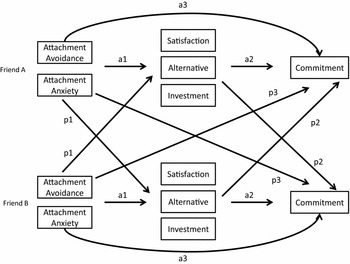
The actor-partner interdependence model (APIM; Kenny, Kashy, & Cook, Reference Kenny, Kashy and Cook2006) has provided ideal theoretical foundations for understanding issues of interdependence in close friendships. This model argues that an outcome in a relationship is a function of the target person's personal characteristic (actor effect) as well as the partner's characteristic (partner effect). For instance, as depicted in Figure 1, Friend A's commitment is a function of his/her own friendship attachment (e.g., path a3) and Friend B's friendship attachment (path p3). Whereas a typical APIM would involve one predictor and one outcome variable from each partner, we proposed a mediation model by including relationship satisfaction, quality of alternatives, and investment size as the mediators between friendship attachment and commitment. Figure 1 depicts the generic Actor-Partner Interdependence Mediation Model that guided the current study (APIMeM; Ledermann et al., Reference Ledermann, Macho and Kenny2011).
Proposed APIMeM of friends’ attachment representations and commitment mediated through satisfaction level, quality of alternatives, and investment size. To simplify the presentation, not all coefficient paths are shown. Also, covariances between friends’ error terms are estimated but not shown. Paths denoted as ‘a’ are actor effects and paths denoted as ‘p’ are partner effects. Estimates for Friend A and Friend B would be identical due to the interchangeable nature of same-sex friends.

Based on the APIMeM, two types of mediation effects could be examined: mediated actor effects and mediated partner effects (see Figure 1). In mediated actor effects, the effects of an actor's own ratings of friendship attachment on commitment would be mediated by the actor's satisfaction, quality of alternatives, and investment (i.e., indirect paths a1*a2) or friend's satisfaction, quality of alternatives, and investment (i.e., indirect paths p1*p2). In mediated partner effects, the effects of an actor's friendship attachment on a friend's commitment would be mediated by the actor's satisfaction, quality of alternatives, and investment (i.e., indirect paths a1*p2) or friend's satisfaction, quality of alternatives, and investment (i.e., indirect paths p1*a2). This model follows the guidelines outlined by recent advancement in the research on dyadic relationships (e.g., Avivi, Laurenceau, & Carver, Reference Avivi, Laurenceau and Carver2009).
The dyadic design is important for two reasons. First, the examination of both actor and partner effects would demonstrate that there are mutual influences of dyadic friends’ personal characteristics. Results from the current study would show whether commitment in a friendship is dependent on individuals’ own friendship attachment and investment model predictors as well as their friends’ characteristics. Second, partner effects would advance previous research by ruling out ‘potential shared-method variance’ that is common in individual perspective data. Altogether, we believed that a dyadic design would provide a fuller picture of the association between friendship attachment and commitment in a dyadic friendship.
Summary of Hypotheses
In conclusion, the current study examined: (1) whether the link between friendship attachment and commitment in a dyadic friendship would be mediated by relational features of satisfaction level, quality of alternatives, and investment size; and (2) whether these mediation processes would function at the intrapersonal (actor) and interpersonal (partner) levels. We hypothesised that at both actor and partner levels:
(A) Attachment avoidance would be related to lower commitment through lower satisfaction.
(B) Attachment avoidance would be related to lower commitment through lower investment size.
(C) Attachment anxiety would be related to lower commitment through lower satisfaction.
(D) Attachment anxiety would be related to higher commitment through higher investment.
Method
Participants and Procedure
Participants were recruited from a medium-sized university located in Texas in the United States. Participants completed the study as a partial requirement for psychology classes. In order to participate in the study, participants were asked to bring a close, same-sex friend to the laboratory. Participants were also reminded not to bring their siblings or family members as their friend. The final sample consisted of 120 pairs of same-sex friends (78 pairs of women and 35 pairs of men) with average age of 23.7 (SD = 7.01), ranging from 17 to 56 years old. Both friends completed computer-administered questionnaires in separate rooms in a laboratory. The duration of friendships varied: 15% had been friends less than a year, 27% one to three years, 17% three to five years, 14% five to seven years, and 27% more than seven years. When participants were asked to rank the importance of their friend, participants reported their friend as best friend (57.1%), good friend (40.3%), social friend (1.7%), and acquaintance (.8%). Of 120 original dyads, 7 were excluded from data analysis due to incomplete questionnaires. The current sample was diverse, including Caucasians (55.8%), African Americans (8%), Asian Americans (15.5%), Hispanics (15.5%), and others (5.3%).
Measures
Commitment
Participants completed the Investment Model Scale to assess their commitment level, satisfaction level, quality of alternatives, and investment size, specific to their friend who also participated in the study (Rusbult et al., Reference Rusbult, Martz and Agnew1998). The commitment subscale contains 9 items (e.g., ‘I want our friendship to last for a very long time’), which capture the participants’ level of commitment to their friend using a 6-point scale ranging from 1 (do not agree at all) to 6 (agree completely). A composite score for friendship commitment level was computed by averaging across the respective items. In the current sample, Cronbach's alpha for this subscale was .80.
The Investment Model Scale also captures three theoretical determinants of commitment level: satisfaction level (five items), quality of alternatives (five items), and investment size (six items). Satisfaction assessed the extent to which participants felt satisfied with their relationship (e.g., ‘I feel satisfied with our friendship’). Quality of alternatives assessed the extent to which participants perceived rewards and attractiveness of alternative relationships (e.g., ‘My needs for intimacy, companionship, etc., could easily be fulfilled in an alternative relationship’). Investment size assessed the amount of emotional and resource investment participants felt that they have put into the friendship (e.g., ‘I have put a great deal into our friendship that I would lose if the relationship were to end’). Each determinant was captured by 5 items using a scale that ranged from 1 (do not agree at all) to 5 (agree completely). Composite scores for each construct were created by averaging the items. In the current sample, Cronbach's alphas for the satisfaction level, quality of alternatives, and investment size subscales were .92, .86, and .91, respectively.
Friendship Attachment
Participants’ attachment with regard to the general friendships was assessed using Brennan et al.'s (Reference Brennan, Clark, Shaver, Simpson and Rholes1998) 36-item Experiences in Close Relationships (ECR) questionnaire. Two major dimensions were assessed (18-items each): avoidance (e.g., ‘I prefer not to show my friends how I feel deep down’) and anxiety (e.g., ‘I worry about being abandoned’). Respondents were instructed to think about their experiences with a few close friends and answered the questions based on a scale that ranged from 1 (not agree at all) to 7 (agree very much). Composite scores for each construct were created by averaging the items. In the current sample, Cronbach's alphas for the avoidance and anxiety scales were .91 and .93, respectively.
Results
Data Structuring
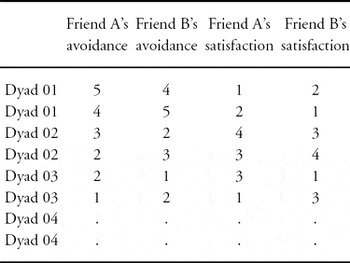
Unlike distinguishable dyads in which there are clear roles that differentiate two members in a relationship (e.g., parent and child, husband and wife), same-sex friends are interchangeable dyads (Kenny et al., Reference Kenny, Kashy and Cook2006). In other words, there is no clear criterion, such as gender, that exists to distinguish same-sex friend dyad members. As a result, the designation of participants as ‘Friend A’ versus ‘Friend B’ in the data set would be arbitrary. In order to take into account the interchangeable nature of the data, we restructured the data before any analyses were conducted. Rather than assigning roles arbitrarily, we followed Kenny et al.'s (Reference Kenny, Kashy and Cook2006) suggestion and adopted the ‘double-entry method’ to restructure our dyadic data set. Each member's score was entered twice, once in the column for Friend A and again in the column for Friend B (see Appendix for a hypothetical data set). With the restructured data, both Friend A and Friend B would have identical means and variances, addressing the issue of indistinguishability. Preliminary analyses were conducted with SPSS 20.0 whereas the APIMeM was estimated with path analysis in Mplus 6.11 (Muthén & Muthén, Reference Muthén and Muthén2010), based on the restructured data.
Preliminary Analyses
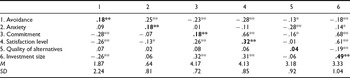
Based on the restructured data, the means and standard deviations of the study variables are shown in Table 1. Furthermore, Table 1 also presents the (a) within-person (above diagonal), (b) cross-partner (below diagonal), and (c) intraclass (diagonal) correlations among the study variables, controlling for sex and friendship duration. Within-person correlations revealed the associations among variables that came from the same reporter (e.g., Friend A's avoidance and Friend A's satisfaction). Cross-partner revealed the associations among variables that came from two informants (e.g., Friend A's avoidance and Friend B's satisfaction). In sum, all within-person and cross-partner correlations were generally as expected. Finally, intraclass correlations revealed the degree to which friends were similar in their investment size and satisfaction. Intraclass correlations for attachment avoidance, anxiety, and commitment were small, although they were statistically significant.
Means, Standard Deviations, and Correlations Among Study Variables

Note: Table shows within-person (above diagonal), cross-partner (below diagonal), and intraclass (diagonal) correlations. Coefficients were computed based double-entry data. *p < .05, **p < .01.
Actor-Partner-Interdependence Mediation Model (APIMeM)
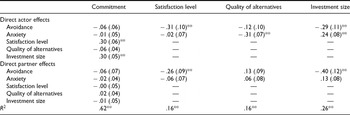
The APIMeM suggested by Figure 1 was specified based on the double-entry data set. Table 2 contains the unstandardised actor and partner coefficients, along with respective standard errors. In this model, participants’ sex and friendship duration were included as control variables. The model was a saturated model and therefore, no fit indices were reported.
Direct Effects from the APIMeM With Satisfaction, Quality of Alternatives, and Investment Size as Mediators Between Friendship Attachment and Commitment

Note: Unstandardised coefficients and standard errors (in parentheses) are presented. *p < .05; **p < .01.
Actor direct effects
As expected, results showed that higher satisfaction level and investment size were independently related to higher commitment (see Table 2). Quality of alternatives, however, was not related to commitment. Furthermore, individuals who reported greater attachment avoidance also reported lower satisfaction level and investment size in their current friendship. Individuals who reported greater attachment anxiety reported having lower quality of alternatives but higher investment size in their current friendship.
Partner direct effects
Surprisingly, none of the investment model predictors (satisfaction level, quality of alternatives, and investment size) were related to commitment at the partner level (see Table 2). Significant partner effects, however, showed that individuals reported lower satisfaction and less investment in their current friendship when their friend was higher in attachment avoidance.
Mediation effects
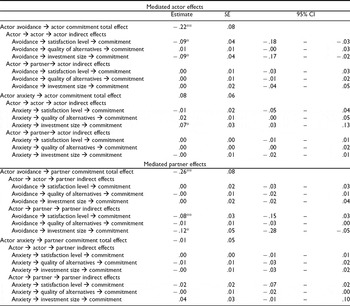
The mediation effects of satisfaction level, quality of alternatives, and investment size between friendship attachment and commitment were examined. The significance tests of these mediation effects were based on the estimation of indirect effects with corresponding standard errors and bias-corrected confidence intervals computed by the bootstrapping procedures implemented by Mplus 6.11 (Muthén & Muthén, Reference Muthén and Muthén2010). Out of all possible actor and partner mediation effects, five of them emerged to be significant (see Table 3).
Indirect (Mediation) Effects From the APIMeM with Satisfaction, Quality of Alternatives, and Investment Size as Mediators Between Friendship Attachment and Commitment

Note: Standard errors (SE) and bias corrected confidence intervals were estimated based on bootstrap resampling of 5000. *p < .05; **p < .01.
Mediated actor effects showed that the association between attachment avoidance and lower commitment was mediated by satisfaction level (Bindirect = −.09, p = .01) and investment size (Bindirect = −.09, p = .02). Specifically, these findings showed that individuals with greater attachment avoidance experienced lower satisfaction and invested less in their current friendship, which in turn led to lower commitment. The association between attachment anxiety and commitment was also mediated by investment size (Bindirect = .07, p = .01) at the actor-effect level. These findings showed that individuals who were more anxious also invested more in their current friendship, which in turn led to higher levels of commitment. It is important to note that although attachment anxiety and commitment was not significantly related at the correlational level, the significant direct effect was still plausible, which has been termed as the ‘inconsistent mediation effect’ (MacKinnon, Krull, & Lockwood, Reference MacKinnon, Krull and Lockwood2000).
Interestingly, two mediated partner effects also emerged. Specifically, the link between individuals’ attachment avoidance and their friend's commitment level was mediated by their friend's satisfaction (Bindirect = −.08, p = .01) and investment size (Bindirect = −.12, p = .01). Specifically, these results revealed that individuals who scored higher on attachment avoidance also had a friend who was less committed; this link was partially explained by their friend's lower satisfaction levels and smaller investment size.
Discussion
The major aims of the current study were to examine: (1) whether the link between friendship attachment and commitment in a dyadic friendship would be mediated by relationship features of satisfaction level, quality of alternatives, and investment size; and (2) whether these mediation processes would function at the intrapersonal (actor) and interpersonal (partner) levels. The current study has two major contributions. First, it demonstrated that the association between friendship attachment and commitment in a friendship was not simply intrapersonal but also interpersonal. The current dyadic design shed important light on how two friends function as a dyadic system and reciprocally influence each other. Second, the current study illuminated the underlying mechanisms that mediated the association between friendship attachment and commitment. Integration of the investment model and attachment theory has proven to be fruitful in furthering our understanding of friendship dynamics.
Attachment Avoidance and Commitment
As expected, bivariate correlations showed that individuals high in attachment avoidance were less likely to exhibit commitment to a dyadic friendship. This finding was also consistent with previous research on romantic relationships (Pistole et al., Reference Pistole, Clark and Tubbs1995). The direct association between attachment avoidance and commitment has sparked our interests in examining if satisfaction and quality of alternatives would serve as mediators that underlined such link. It was hypothesised that attachment avoidance would be related to lower commitment through lower satisfaction at the actor level (Hypothesis A). Confirming this, a mediated actor effect showed that individuals high in attachment avoidance were less satisfied with their current friendship, which in turn led them to show less commitment. According to attachment theory, individuals high in attachment avoidance value friendship intimacy less and even have aversive feelings towards closeness (Furman, Simon, Shaffer, & Bouchey, Reference Furman, Simon, Shaffer and Bouchey2002). Thus, intimacy may be regarded as less rewarding and satisfying, leading individuals to show less commitment in a dyadic friendship.
Individuals high in avoidance may also be less likely to invest in a relationship that they perceive as less rewarding (Pistole et al., Reference Pistole, Clark and Tubbs1995). Thus, it was hypothesised that attachment avoidance would be related to lower commitment through lower investment size at the actor level (Hypothesis B). Confirming this notion, mediated actor effects also showed that individuals high in attachment avoidance invested less in their current friendship, which in turn predicted lower commitment. Consistent with previous studies on friendships within the investment model framework (e.g., Lin & Rusbult, Reference Lin and Rusbult1995), we did not find the indirect link from attachment avoidance to commitment through quality of alternatives. The lack of association between quality of alternatives and commitment in friendships may be attributable to the fact that friendships are less exclusive compared to romantic relationships. Consequently, the effect of good quality alternatives on commitment was less pronounced in friendships (Branje et al., Reference Branje, Frijns, Finkenauer, Engels and Meeus2007).
The most interesting results reside in the partner effects. Specifically, bivariate correlations showed that individuals high in attachment avoidance also had a friend who was less committed to their current friendship. Again, we were interested in further examining whether satisfaction level and quality of alternatives would serve as mediators underlining such a cross-partner link.
It was hypothesised that attachment avoidance would be related to lower commitment through lower satisfaction at the partner level (Hypothesis A). Supporting our hypothesis, mediated partner effects showed that individuals high in attachment avoidance also had a friend who felt less satisfied with and less committed to their current friendship. Friendships are characterised by intimacy and closeness (Chow et al., Reference Chow, Roelse, Buhrmester, Underwood, Laursen and Collins2011). Therefore, individuals high in avoidance who exhibit less intimate behaviours (e.g., disclosure, support) may have violated their friend's expectations for intimacy. Subsequently, their friend may experience lower levels of satisfaction and thus shows less commitment in their current friendship.
It was further hypothesised that attachment avoidance would be related to lower commitment through lower investment at the partner level (Hypothesis B). Confirming this, a mediated partner effect also showed that individuals high in attachment avoidance had a friend who invested less and exhibited a lower level of commitment. According to the investment model, close relationships are interdependent and reciprocal in nature (Rusbult et al., Reference Rusbult, Martz and Agnew1998). Because individuals who are high in attachment avoidance invest less in their current friendship, to reciprocate, their friend may show lower levels of investment in return. These tendencies from both friends generate a cycle of distance that may eventually lead to lower commitment from both sides, and even dissolution of a friendship (Branje et al., Reference Branje, Frijns, Finkenauer, Engels and Meeus2007).
Attachment Anxiety and Commitment
Previous studies on romantic relationships have found that anxious attachment was inconsistently related to commitment (see Joel et al., Reference Joel, MacDonald and Shimotomai2011). Consistent with previous research, bivariate correlations from the current study showed that attachment anxiety and commitment were not significantly related at both the intrapersonal and interpersonal levels. Furthermore, attachment anxiety was not significantly related to satisfaction at the actor level. Thus, the hypothesis that attachment anxiety would be related to lower commitment through lower satisfaction was not supported at both the actor and partner levels (Hypothesis C). Contrarily, supporting our hypothesis, the association between attachment anxiety and commitment was mediated by investment size at the actor level but not the partner level (Hypothesis D). These findings indicated that individuals who were more anxious also invested more in their current friendship; this in turn led to a higher level of commitment. It is noteworthy that although attachment anxiety and commitment was not significantly related at the correlational level, the significant indirect effect might be explained by a phenomenon termed as the ‘inconsistent mediation effect’ (MacKinnon et al., Reference MacKinnon, Krull and Lockwood2000). The lack of association between attachment anxiety and commitment at the correlational level might be attributable to the conflicting associations between attachment anxiety and satisfaction (negative) versus investment size (positive) that cancelled out each other's effect on commitment. Thus, when satisfaction level was taken into consideration simultaneously, investment size had emerged to be a significant predictor of commitment. Indeed, such a suppression effect was interpreted as the results of the interesting ‘relational ambivalence’ phenomenon observed among individuals high in attachment anxiety (Joel et al., Reference Joel, MacDonald and Shimotomai2011).
Limitations and Future Directions
The current study was not without limitations. First, although we proposed the directional influences of friendship attachment and the investment model predictors on commitment, the current study's correlational nature has precluded us from making strong causal inferences about the constructs. For example, it is certainly possible that having a less satisfying friendship precedes the emergence of anxious or avoidant friendship attachment. Nevertheless, the current research's directional predictions were based on the investment model and attachment theory; we believe that such a theoretical-based approach would at least provide an important model for future research that elucidates a directional influence between friendship attachment and commitment, especially with a longitudinal design. Second, all variables in the study were based on individuals’ self-reports. However, it is important to note that the partner effects found in the current study were independent of any within-individual reports. In other words, the results were not completely attributable to shared-method variance. Nevertheless, it is important for future research to consider actual relationship maintenance behaviours that occur between friends. Third, the current study was based solely on a sample of young adults. The results may not be generalised to populations representing different age groups. For instance, early adolescents’ friendships are less exclusive and intimate compared to those in late adolescence and early adulthood (Carbery & Buhrmester, Reference Carbery and Buhrmester1998). Therefore, it would be interesting for future research to apply the current model to different age groups and examine if similar processes could be observed. Nevertheless, the large effect size (R 2 = .62) demonstrated that combing attachment and investment model variables was important towards explaining individual differences in friendship commitment.
Conclusions
In summary, the current study demonstrated that a dyadic design is useful in illuminating the dynamics of commitment processes between friends. Furthermore, integration of the investment model and attachment theory has been shown fruitful in advancing the understanding of friendships dynamics. Specifically, we found that the associations between friendship attachment and commitment in a dyadic friendship were mediated through satisfaction and investment size at both the actor and partner levels. We believe that the current model would not be limited to friendship literature; a similar approach may be adopted for future research on romantic relationships or other voluntarily relationships.
Hypothetical Dyadic ‘Double-Entry’ Data