


Introduction
Shame is a painful, self-conscious emotion that is related to a number of negative mental health outcomes (e.g. Pinto-Gouveia et al., Reference Pinto-Gouveia, Matos, Castilho and Xavier2014). Shame occurs in response to the perceived social threat of having negative aspects of the self exposed to others and the resulting risk of being criticised, rejected, excluded, persecuted or even harmed. It is a multifaceted experience, involving the perception of being negatively evaluated by others (also known as external shame), negative self-evaluation (i.e. self as inferior and/or worthless, also known as internal shame), and defensive behaviours (e.g. submission, withdrawal and avoidance; Gilbert, Reference Gilbert, Tracy, Robins and Tangney2007; Tangney and Dearing, Reference Tangney and Dearing2002). It has been suggested that shame experiences typically involve interactions between both internal and external shame (Gilbert, Reference Gilbert, Tracy, Robins and Tangney2007). As opposed to guilt, in which the focus of the experience is on a particular act or transgression, shame is focused on the self (e.g. ‘I am bad’ versus ‘doing that thing was bad’; Tangey, Reference Tangey1996). Momentary experiences of shame can occur in response to an array of interpersonal experiences, but persistent experiences of shame are particularly common in the context of interpersonal trauma (including physical, sexual and emotional abuse; Matos, Reference Matos2012; Matos et al., Reference Matos, Steindl, Gilbert, Pinto-Gouveia, Gilbert and Kirby2020) and can contribute, for instance, to the development of post-traumatic stress disorder (PTSD) (Harman and Lee, Reference Harman and Lee2010). Specifically, shame can be a direct emotional response to traumatic circumstances that represent an acute social threat by stripping individuals of their dignity, sense of agency and personal control (Budden, Reference Budden2009). Moreover, post-traumatic shame characterised by appraisals of the social self (e.g. self-criticism) as having diminished value following the trauma might lead to the development and persistence of PTSD (Budden, Reference Budden2009; Harman and Lee, Reference Harman and Lee2010). Shame is suggested to result in intense pre-occupation with social threats (hyper-vigilance) associated with feelings of being vulnerable, as well as repeated attempts to suppress and avoid thinking or talking about shameful and traumatic memories (avoidance), which can prevent the emotional processing of the traumatic experience, leading to high levels of intrusive recollections and memories (Budden, Reference Budden2009).
The experience of hearing a voice in the absence of corresponding external stimuli (auditory verbal hallucinations) is common across a number of psychiatric diagnostic categories (Johns et al., Reference Johns, Kompus, Connell, Humpston, Lincoln, Longden and Larøi2014; Larøi et al., Reference Larøi, Sommer, Blom, Fernyhough, Ffytche, Hugdahl, Johns, McCarthy-Jones, Preti and Raballo2012; Waters and Fernyhough, Reference Waters and Fernyhough2017) and is also thought to occur on a continuum within the general population (Beavan et al., Reference Beavan, Read and Cartwright2011; Johns and van Os, Reference Johns and Van Os2001; Linscott and van Os, Reference Linscott and van Os2010; van Os et al., Reference van Os, Linscott, Myin-Germeys, Delespaul and Krabbendam2009). Although there are many similarities in the phenomenology of voice hearing across non-clinical and clinical groups, there are some key variables that appear to differentiate these groups. Clinical voice hearers report more frequent voices, higher voice-related distress, more negative voice content, more problematic beliefs about voices, and less perceived control (Baumeister et al., Reference Baumeister, Sedgwick, Howes and Peters2017), raising the possibility that different psychological processes may be involved. There is a large body of research linking interpersonal trauma with voice hearing experiences (Varese et al., Reference Varese, Smeets, Drukker, Lieverse, Lataster, Viechtbauer, Read, Os and Bentall2012). Interestingly, rates of exposure to traumatic events do not appear to differ between clinical and non-clinical voice hearing groups (with both groups showing a higher prevalence rate than non-voice hearers), suggesting that traumatic experiences themselves may be a general risk factor for hearing voices (Baumeister et al., Reference Baumeister, Sedgwick, Howes and Peters2017). Therefore, psychological and emotional problems that might result from the traumatic experiences (e.g. ways of appraising and coping with the trauma) may be key factors in differentiating the groups. This is in line with cognitive models of voice hearing that suggest that the way individuals appraise and cope with the voice hearing experiences are better predictors of distress and need for care (Chadwick and Birchwood, Reference Chadwick and Birchwood1994; Mawson et al., Reference Mawson, Cohen and Berry2010; Peters et al., Reference Peters, Ward, Jackson, Morgan, Charalambides, McGuire, Woodruff, Jacobsen, Chadwick and Garety2016).
Recent theories have argued that shame may be a particularly relevant emotion in the occurrence of positive symptoms in psychosis (Carden et al., Reference Carden, Saini, Seddon, Watkins and Taylor2018; Wood and Irons, Reference Wood and Irons2016). Wood and Irons (Reference Wood and Irons2016) showed that both high levels of external shame (i.e. the perception of being negatively evaluated by others) and low social rank (i.e. oneself evaluation and comparison with others, which includes self-criticism aspects) were associated with increased positive symptoms in the psychosis spectrum. In addition, shame has been found to be associated with depressive symptoms and self-stigma (Keen et al., Reference Keen, George, Scragg and Peters2017; Wood and Irons, Reference Wood and Irons2016; Wood et al., Reference Wood, Byrne, Burke, Enache and Morrison2017). It has also been theorised that shame may be particularly implicated in the development of hearing voices (McCarthy-Jones, Reference McCarthy-Jones2017; Woods, Reference Woods2017). Following this, several studies have shown a link between shame and voice hearing. Bortolon and Raffard (Reference Bortolon and Raffard2019) found that shame was a significant mediator in the association between childhood trauma and voice hearing proneness in the general population. A recent systematic review also found that negative cognitions about the self, the world and others (as seen in internal and external shame experiences) were a well evidenced mediator between childhood trauma and voice hearing (Williams et al., Reference Williams, Bucci, Berry and Varese2018). Also in line with the notion of a link between shame and voice hearing, the content of voices often reflects themes of shame (Corstens and Longden, Reference Corstens and Longden2013) and appears to be shaped by past interpersonal trauma (Hardy et al., Reference Hardy, Fowler, Freeman, Smith, Steel, Evans, Garety, Kuipers, Bebbington and Dunn2005).
Voice hearing has been conceptualised to occur as a result of an over-sensitive social threat detection system, sensitised through experiences of physical or emotional harm from dominant others (as seen in chronic experiences of shame). This is hypothesised to occur through the mechanism of dissociated threatening self-other representations that intrude into consciousness (Heriot-Maitland et al., Reference Heriot-Maitland, McCarthy-Jones, Longden and Gilbert2019) or hypervigilance to social threat that leads to false positives in detecting socially threatening words in environmental noise (Dodgson and Gordon, Reference Dodgson and Gordon2009; Laloyaux et al., Reference Laloyaux, De Keyser, Pinchard, Della Libera and Larøi2019). Similar to the ideas of Heriot-Maitland et al., earlier work has indeed identified intrusions of episodic and semantic memories from traumatic events as potentially playing a key role in voice hearing (Hardy, Reference Hardy2017; Morrison, Reference Morrison2001; Steel, Reference Steel2015). Based on this body of work, shameful experiences can be conceptualised to result in the activation of the social threat detection system, higher levels of hypervigilance, and intrusions of semantic and episodic memories, potentially leading to voice hearing experiences. We are not aware of any studies to date that have examined differences in levels of shame across the voice hearing spectrum, thus it is unclear whether the proposed relationship between shame and voices constitutes a general vulnerability to voice hearing, or whether there is specific relationship with distressing (clinical) voices.
In addition to the emotional and cognitive aspects of shame, an important body of literature has emerged in recent years, highlighting the importance of the nature of autobiographical memories of shame experiences. Memories of shaming experiences have been shown to possess traumatic-like characteristics, leading to memory intrusions, avoidance and hyperarousal in a similar way to memories of events that would meet diagnostic criteria for PTSD (Matos and Pinto-Gouveia, Reference Matos and Pinto-Gouveia2010). Similarly, shame memories can become central to one’s life story and personal identity, forming the foundation for schematic self-beliefs (Pinto-Gouveia and Matos, Reference Pinto-Gouveia and Matos2011). The extent to which shame memories are central and possess traumatic characteristics has been associated with various negative mental health outcomes, including paranoia, social anxiety, depression and anxiety (Matos et al., Reference Matos, Pinto-Gouveia and Duarte2012; Matos et al., Reference Matos, Pinto-Gouveia and Gilbert2013). There is reason to believe that the nature of shame memories may also play a role in voice hearing. Indeed, trauma-informed models of voice hearing take into account the nature of autobiographical memories of childhood trauma (using a broad definition encompassing childhood physical, sexual and emotional abuse and neglect). It is proposed that deficits in contextual encoding following traumatic experiences, together with other dysfunctional cognitive processes, increase the probability of intrusive thoughts and memories which are then appraised as voices (Hardy, Reference Hardy2017; Steel et al., Reference Steel, Fowler and Holmes2005). In support of this, there is evidence that intrusive trauma memories are associated with voice hearing experiences and proneness to voices (Brand et al., Reference Brand, Bendall, Hardy, Rossell, Meyer and Thomas2020a; Bortolon and Raffard, Reference Bortolon and Raffard2019; Gracie et al., Reference Gracie, Freeman, Green, Garety, Kuipers, Hardy, Ray, Dunn, Bebbington and Fowler2007; Peach et al., Reference Peach, Alvarez-Jimenez, Cropper, Sun and Bendall2019). Given the prominent themes of shame in voice hearing content (Corstens and Longden, Reference Corstens and Longden2013), and evidence of the involvement of shame-related emotions and cognitions, we propose that the characteristics of shame memories may also be a relevant mechanism in voice hearing.
To the authors’ knowledge, only one study has examined the role of shame and shame memory characteristics in voice-hearing proneness in a general population sample (Bortolon et al., Reference Bortolon, Brand, Altman and Matos2021). This study found that the centrality of shame memories (i.e. how much they have become central to one’s life story and personal identity) was associated with voice-hearing proneness and that this relationship was mediated by traumatic characteristics of shame memories (i.e. intrusions, hyperarousal and avoidance), external shame and self-criticism (Bortolon et al., Reference Bortolon, Brand, Altman and Matos2021). In this study participants were asked to self-identify a prominent memory of shame from their childhood and report on the psychological sequelae of that memory. The focus of the study was on the psychological sequelae of shame memories and did not explore the characteristics of the identified shame events themselves. The study also examined proneness to hearing voices as a continuous outcome and did not examine whether the characteristics of shame memories differed between those with distressing and non-distressing voices.
As no studies to date have examined the role of shame and shame memory characteristics across the voice hearing spectrum, the differential role of shame and shame memory characteristics in relation to clinical and non-clinical voice hearing have not yet been fully disentangled. The consistent finding that traumatic events are common in the histories of both clinical and non-clinical voice hearing may also hold true when examining shame-related life events, suggesting that shaming life events may also be a general vulnerability for voice hearing. However, given that shame as an emotional and cognitive response is potentially implicated in negative voice content and negative appraisals of voices (Carden et al., Reference Carden, Saini, Seddon, Watkins and Taylor2018; Larøi et al., Reference Larøi, Thomas, Aleman, Fernyhough, Wilkinson, Deamer and McCarthy-Jones2018), and that intrusive memories and hypervigilance could be hypothesised to cause more frequent and negative voices, we anticipate that the psychological sequalae of shame events (i.e. emotional and cognitive aspects of shame and the nature of shame memories) will be particularly linked to distressing clinical voices.
Aims
In the present study, we aimed to extend previous literature by comparing distressed voice hearers, non-distressed voice hearers, and a non-voice hearer control group on various dimensions of shame and shame memory characteristics. We aimed to examine whether particular types of reported shame experiences were related to voice hearing, as well as examining the potential role of the psychological sequelae of these shame experiences (i.e. intrusions, hyperarousal, avoidance, the centrality of shame memories, external shame, and self-criticism).
Considering that rates of exposure to traumatic (and potentially shameful) events do not appear to differ between clinical and non-clinical voice-hearing groups (Baumeister et al., Reference Baumeister, Sedgwick, Howes and Peters2017), we hypothesised that both distressed and non-distressed voice hearers would recall more severe shame events than a non-voice hearer control group; particularly, that they would report more protracted shame experiences (versus one-off events) that occurred at an earlier age and involved an attachment figure as the shamer (versus a stranger or peer). We also hypothesised that they would be more likely to report shame experiences that involved physical or sexual abuse (i.e. shame related to traumatic events likely to meet criteria for PTSD).
Anticipating that the psychological sequelae of shame events (rather than the presence of the events themselves) may play a particular role in voice-hearing distress (potentially fuelling more frequent and negative voices), we hypothesised that distressed voice hearers would report higher levels of post-traumatic stress symptoms in relation to their shame experiences (i.e. intrusive thoughts, avoidance and hyperarousal symptoms) and have memories that were experienced as more self-defining than both non-distressed voice hearers and non-voice hearers. We also hypothesised that problematic emotional psychological sequelae of shame experiences (i.e. external shame and self-criticism) would be more severe in the distressed group versus the non-distressed and control groups.
Method
Design
The study was a cross-sectional study using an online questionnaire. The study was a secondary analysis based on data obtained for other purposes (Bortolon et al., Reference Bortolon, Brand, Altman and Matos2021; M. Raffoul and R.M. Brand, 2020, unpublished honours thesis).Footnote 1
Participants
Participants included in this study were a subset drawn from two large general population samples, one recruited from the French population (n=436, and previously reported by Bortolon et al., Reference Bortolon, Brand, Altman and Matos2021), and the other recruited in Australia (n=79; M. Raffoul and R.M. Brand, unpublished honours thesis). Both of these general population samples were recruited online through social media (e.g. Facebook), university websites and via acquaintances of the authors using snowballing. Inclusion criteria consisted of being 18 years old or more and being fluent in French (French sample) or English (Australian sample). Participants from this large sample were classified according to their voice hearing status. Distressed voice hearers were defined as those reporting frequent voices and associated distress. Participants had to rate 3 or above on frequency (0=‘No’; 1=‘Happens hardly at all’; to 5=‘Happens all the time’) and distress (1=‘Not at all distressing’ to 5=‘Very distressing’) for at least one of five relevant items from the Cardiff Anomalous Perceptions Scale (CAPS; Bell et al., Reference Bell, Halligan and Ellis2006). Non-distressed voice hearers were those rating above 3 on at least one item of the CAPS for frequency only. Those who answered no to all items of the CAPS were classified as non-voice hearers. All participants classified as distressed and non-distressed voice hearers were included. In order to balance the groups, a subsample of those reporting no voices was randomly selected and matched to the voice hearing groups in terms of age and sex (using the random select cases function in SPSS and selecting the solution with most similarities to the voice hearer groups in term of age and sex). The final sample consisted of 120 participants (distressed voice hearers n=39; non-distressed voice hearers n=31; non-voice hearers n=50).
Measures
Demographic and clinical data
Data were collected regarding the age, level of education, and current psychiatric medication of participants. Participants were given a list of types of psychiatric medication and were asked to choose the option that best described their current treatment.
Voice hearing status was assessed using three items of the CAPS (Bell et al., Reference Bell, Halligan and Ellis2006). The CAPS assesses a range of hallucination-like experiences. It consists of 32 items, with yes/no answers as well as ratings of distress, disruption and frequency. We used the following items to assess for the presence of frank hallucinatory experiences: Do you ever hear voices commenting on what you are saying or doing? Do you ever hear voices saying words or sentences when there is no-one around that might account for it? Have you ever heard two or more unexplained voices talking with each other? This scale has good psychometric properties, with a Cronbach’s alpha coefficient of .87 and good test–retest reliability (Pearson’s correlation=.77, p<.0005; Bell et al., Reference Bell, Halligan and Ellis2006). In the current study, Cronbach’s alpha was .92.
Shame event characteristics
A shame memory priming task was used to prompt participants to recall a shame experience from their past. Participants were presented with a brief written description of the concept of shame, with two fictitious examples of a shame experience during childhood or adolescence. Participants were then instructed to try to remember one or several significant situations from their adolescence or childhood in which they experienced shame. This shame memory priming task has been used in previous studies with both clinical and non-clinical samples and has been found to be effective at eliciting recall of shame memories in order that their characteristics and related psychological sequelae can be assessed (e.g. Matos et al., Reference Matos, Pinto-Gouveia and Duarte2012; Matos et al., Reference Matos, Pinto-Gouveia and Gilbert2013; Matos and Pinto-Gouveia, Reference Matos and Pinto-Gouveia2010; Pinto-Gouveia et al., Reference Pinto-Gouveia, Castilho, Matos and Xavier2013). Following the shame memory priming task, participants were asked to provide details about the nature of the shame experience(s) they had selected. Specifically, participants were asked to provide the type of experience they had recalled (criticism or rejection by an attachment figure, criticism or rejection by a significant other, negative comments about weight, body, or physical appearance, exposure of devaluing behaviour/negative personal attributes, shame about family status, shame about personal habits, physical abuse, sexual abuse, other), their age at the time of the situation, the person that made them feel shame (parents, sibling, other family members, teacher, peer, stranger, other) and the duration of the event (once, merging, or extended). These questions were based upon the shame experiences interview developed by Matos (Reference Matos2012).
Psychological sequelae of the shame memory
Participants completed four measures relating to psychological sequelae of their recalled shame experience. The Centrality of Event Scale (CES; Berntsen and Rubin, Reference Berntsen and Rubin2006) was used to assess how self-defining the shame memory was. The CES assesses how a memory is perceived as being central to one’s identity and life story, using 20 items relating to: reference points for everyday inferences, turning points in life story and personal identity. In this study participants were asked to complete the CES in relation to their recalled shame memory. CES has previously been used to assess the centrality of shame memories in this way and has been found to be reliable (α=0.96; Pinto-Gouveia and Matos, Reference Pinto-Gouveia and Matos2011). In the current study, Cronbach’s alpha was .95.
The Impact of Event Scale-Revised (IES-R; Horowitz et al., Reference Horowitz, Wilner and Alvarez1979) was used to assess post-traumatic stress symptoms of intrusions, avoidance and hyperarousal (22 items). In this study participants were asked to complete the IES-R in relation to the shame memory they had recalled in the shame memory priming task. The IES-R has been used to measure traumatic reactions to shame memories in this way in previous studies in both clinical and non-clinical samples (Matos et al., Reference Matos, Pinto-Gouveia and Duarte2012; Matos et al., Reference Matos, Pinto-Gouveia and Gilbert2013; Matos et al., Reference Matos, Duarte and Pinto-Gouveia2017; Matos and Pinto-Gouveia, Reference Matos and Pinto-Gouveia2010; Pinto-Gouveia et al., Reference Pinto-Gouveia, Matos, Castilho and Xavier2014), and has good psychometric properties, with Cronbach’s alpha coefficient of .96 (Matos et al., Reference Matos, Pinto-Gouveia and Martins2011). In the current study, Cronbach’s alpha was .93.
The Other As Shamer-2 scale (OAS-2; Matos et al., Reference Matos, Pinto-Gouveia, Gilbert, Duarte and Figueiredo2015) was used to assess external shame. The OAS-2 is a short version of the OAS (Goss et al., Reference Goss, Gilbert and Allan1994) and consists of 8 items relating to external shame, with higher scores indicative of high external shame. The OAS-2 has good psychometric properties with a unidimensional structure, good internal consistency (α=.82) and good concurrent and divergent validities (Matos et al., Reference Matos, Pinto-Gouveia, Gilbert, Duarte and Figueiredo2015). In the current study, Cronbach’s alpha was .87.
The Forms of Self-Criticising/attacking & Self-Reassuring Scale (FSCRS; Gilbert et al., Reference Gilbert, Clark, Hempel, Miles and Irons2004) assesses self-criticism, self-attacking thoughts and self-reassurance using three subscales: Reassured Self, Inadequate Self and Hated self. Good to excellent reliability in clinical and non-clinical samples has been found for all subscales (α=.82 to .88, .82 to .89 and .89 to .91, respectively; Baião et al., Reference Baião, Gilbert, McEwan and Carvalho2015). A total self-criticism score was computed as the sum of the Inadequate Self and Hated self subscales. In the current study, Cronbach’s alpha was .92.
Statistical analysis
Data were analysed using Statistical Packages for the Social Sciences (SPSS; version 27). Univariate tests were used to examine whether any variables differed significantly across the three groups. Differences between the groups for continuous variables were analysed using one-way ANOVAs. All continuous variables met assumptions of normality (with Z-scores for skewness within each group all being below 2.58), had no univariate outliers (assessed using visual inspection of boxplots) and showed homogeneity of variances using Levene’s test. Tukey’s honest significant difference test was used as a post hoc analysis of difference for variables that were significant in the omnibus ANOVA. Categorical variables were analysed using chi square tests of difference. Where expected cell frequencies were below five in more than 20% of cells, maximum likelihood chi square values were used.
Results
Descriptives
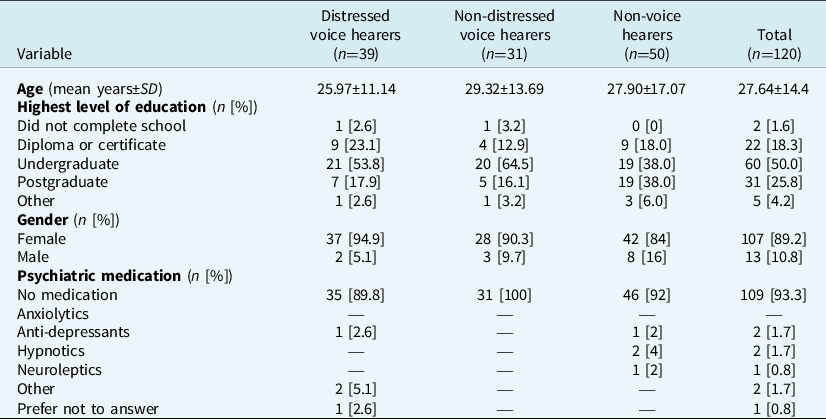
Table 1 shows descriptive data for the sample. The mean age of our sample was 27.64. Most of our participants were female (89.2%) and declared ‘undergraduate’ as being their highest level of education (50.00%). Most participants were not currently taking any psychiatric medication (93.30%).
Descriptive data

SD, standard deviation.
Univariate analyses
Chi-square tests found no significant difference between the groups for the type of shame experience recalled (physical/sexual abuse vs other; χ2 (2, N=120)=0.102, p=0.95). The contingency table for this analysis is shown in Table 2. There was also no significant difference in the reported shamer (χ2 (14,120)=18.11, p=0.202), or the duration of the recalled shame experience (χ2 (4,120)=0.66, p=0.957).
Contingency table for type of shame experience recalled

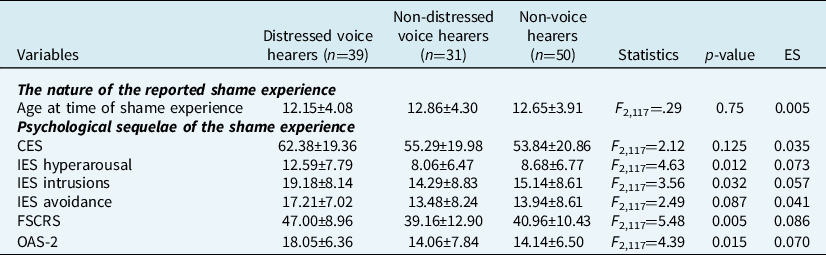
Results from univariate analyses of continuous and ordinal variables are shown in Table 3. There were significant differences between the groups in hyperarousal (IES), intrusions (IES), self-criticism (FSCRS) and external shame (OAS-2). Partial eta squared effect sizes indicated that these differences were of a small to medium magnitude. Analysis of pairwise differences using Tukey’s post hoc tests showed that the distressed voice hearer group scored significantly higher than both the non-distressed voice hearer group and the non-voice hearer group on hyperarousal (p=0.023; p=0.028), self-criticism (p=0.008; p=0.025), and external shame (p=0.044; p=0.023). There was no significant difference between the non-distressed voice hearer and non-voice hearer groups for these variables (hyperarousal p=0.923; self-criticism p=0.743; external shame p=0.999). Intrusions were significantly higher in the distressed voice hearer group than the non-distressed voice hearer group (p=0.049), but this difference was not significant between the distressed voice hearers and the non-voice hearer group (p=0.072) or the non-voice hearer group and the non-distressed voice hearer group (p=0.9).
Results of the univariate tests

ES, effect size (partial eta squared); CES, Centrality of Event Scale; IES, Impact of Event Scale; FSCRS, Forms of Self-criticizing/Attacking and Self-reassuring Scale; OAS-2, Other As Shamer scale 2; F, ANOVA.
Discussion
This study is the first study to examine differences in the characteristics and psychological sequalae of shame memories across distressed versus non-distressed voice hearers, and people who do not hear voices.
Contrary to our hypothesis, we did not find any significant differences in the type of shame memories recalled by the different groups in response to the shame memory priming task. In contrast to previous literature that has indicated higher levels of physical and sexual abuse in both clinical and non-clinical voice hearers when compared with non-voice hearer groups (Daalman et al., Reference Daalman, Boks, Diederen, Weijer, Blom, Kahn and Sommer2011), there was no difference in the proportion of people reporting physical or sexual abuse memories versus other shaming events across the groups. Rather, the findings here indicate that when specifically probing for shame experiences, both voice hearers and non-voice hearers recall similar types of experiences. Interestingly, only eight (6.7%) of the total sample recalled physical and sexual abuse as their shame experience and this was spread evenly across the three groups. The majority of recalled shame experiences were events that would not traditionally be described as traumatic (in terms of diagnostic criteria for PTSD), but reflected adverse interpersonal experiences such as criticism, or the perceived exposure of personal flaws. The recalled shame experiences also did not differ significantly in terms of the age at which they occurred, the person involved in the shaming, or the length or repetition of the event. This leads to the possibility that when considering the impact of shame experiences on voice hearing it is not the presence of these experiences that is important but rather it is the psychological sequelae of these experiences that are key.
In line with this possibility, we found that people with distressing voices reported significantly higher levels of shame memory related intrusions, hyperarousal, external shame, and self-criticism. There were no significant differences between the non-voice hearer and non-distressed voice hearer groups on these variables. These findings are partially in line with previous research documenting higher levels of shame memory related traumatic symptoms, centrality to self-identity, and external shame and internal shame in a mixed clinical sample in comparison with a general population sample (Matos, Reference Matos2012). Moreover, these findings also corroborate Peters et al. (Reference Peters, Ward, Jackson, Morgan, Charalambides, McGuire, Woodruff, Jacobsen, Chadwick and Garety2016) who found that clinical and non-clinical voice hearers do not differ in terms of the frequency of previous traumatic experiences, but, instead, differ in terms of their psychological characteristics (e.g. self-esteem, schemas about the self, and emotional problems). We did not find avoidance of shame memories and the centrality of shame memories to be different across the groups, suggesting these psychological sequalae of shame experiences may be less relevant to voice hearing.
Our results are in support of trauma-informed models of voice hearing which propose that post-traumatic stress symptomatology plays a role in the onset and maintenance of voice hearing experiences (Hardy, Reference Hardy2017; Steel, Reference Steel2015). The fact that the sample here were reporting on post-traumatic stress symptoms in relation to shame experiences such as criticism and experiences of being devalued, rather than to events traditionally considered to be ‘traumatic’, indicates that post-traumatic reactions to these more innocuous interpersonal adversities may also be important to consider in trauma-informed models of voice hearing. Our findings also suggest that intrusive memories, hyperarousal, external shame and self-criticism may specifically contribute to distress in relation to voice hearing experiences, rather than to the presence of voice hearing experiences in general. Negative voice content has recently been highlighted to be a key driver of distress in relation to voices (Larøi et al., Reference Larøi, Thomas, Aleman, Fernyhough, Wilkinson, Deamer and McCarthy-Jones2018) and an important differentiator between clinical and non-clinical voice hearers (with non-clinical voice hearers generally experiencing less negative content; Daalman et al., Reference Daalman, Boks, Diederen, Weijer, Blom, Kahn and Sommer2011). It is plausible that shame memory related intrusions, hyperarousal, external shame and self-criticism are specifically related to clinical (or distressing) voice hearing (as opposed to non-clinical voice hearing) because they contribute to negative voice content (through intrusions of negative material, priming for threat and shame related content) which in turn leads to distress and impairment. Similarly, it is also plausible that shame memory related intrusions, hyperarousal, external shame and self-criticism contribute to negative beliefs about voices, which then leads to increased distress in relation to the experience (Carden et al., Reference Carden, Saini, Seddon, Watkins and Taylor2018). Another possibility is that due to its negative content, distressing voice hearing might trigger more intrusions related to past shame experiences, increasing feelings of shame and self-criticism. Moreover, the negative content of distressing voice hearing may itself lead to external shame and self-criticism, particularly in the context of subordinating relationships with the voices (Hayward et al., Reference Hayward, Berry and Ashton2011), that might trigger the over-sensitive social threat detection system (Gilbert, Reference Gilbert2001). These hypotheses would need to be further explored in future research including experimental studies.
The findings of this study should also be viewed with consideration of some important limitations in our methods. Firstly, we selected our distressed and non-distressed voice hearer groups from a general population sample based on their ratings on several items of the CAPS. This means that we had no way of verifying whether our distressed voice hearer sample was in receipt of clinical care for their voice hearing. Inspection of the medication data shows that none of this group was taking neuroleptic medication, which would be unusual for a clinical voice hearing sample. It may therefore be that our ‘distressed voice hearer’ group do not map on to typical definitions of clinical voice hearers used in previous research in the field. Indeed, the criteria we developed to identify group membership using the CAPS has not been used in other studies and thus does not have consensus regarding its validity. We also did not assess depression or negative affect, which could play an important role in shame and voice hearing experiences, as previous literature has shown (Bishop et al., Reference Bishop, Younan, Low and Pilkington2022; Keen et al., Reference Keen, George, Scragg and Peters2017; Wood and Irons, Reference Wood and Irons2016; Upthegrove et al., Reference Upthegrove, Ross, Brunet, McCollum and Jones2014). Future research should include such assessment. Secondly, our sample was mostly recruited online and data were collected online, which could induce some bias as we had no control over the environmental conditions of the procedure. The cross-sectional design of the study and the reliance on retrospective recall also limits inferences regarding the direction of the relationship between shame experiences, their psychological sequalae and voice hearing. Third, our study is the result of secondary data analyses from Bortolon et al. (Reference Bortolon, Brand, Altman and Matos2021) and our hypotheses were not pre-registered. Finally, it should be noted that the majority of our sample were female and were predominantly undergraduate or postgraduate level educated, which may not be representative and therefore may limit the generalisability of our results.
The findings here do indicate that further research is warranted to understand the links between the psychological sequelae of shame experiences and voice hearing. Particularly, it will be important to explore this in a sample of people who are receiving clinical care for their voices and for whom diagnostic status is verified. In addition, it may be fruitful to examine the role of shame related intrusions, hyperarousal, external shame and self-criticism in negative voice content and negative beliefs about voices, as these may be important mediators in the relationship with distress. Moreover, future studies should explore shame related to traumatic experiences and to what extent they might contribute to the onset and maintenance of voice hearing experiences longitudinally as has been demonstrated in the field of PTSD (Budden, Reference Budden2009; Feiring and Taska, Reference Feiring and Taska2005). More data in this area will help to identify clinical interventions for voice hearing that can address the psychological sequelae of shame memories, for example compassion-focused therapy (Heriot-Maitland et al., Reference Heriot-Maitland, McCarthy-Jones, Longden and Gilbert2019), or trauma-focused therapies (Brand et al., Reference Brand, Rossell, Bendall and Thomas2017; Brand et al., Reference Brand, Bendall, Hardy, Rossell and Thomas2020b).
Our study has important clinical implications for trauma-focused cognitive behavioural therapy and compassion-focused therapy applied to voice hearing. Mostly important, clinicians should systematically explore both shame in relation to traumatic experiences, but also other shameful experience whose consequences (e.g. intrusions) might be prevalent in those reporting distressing voice hearing. Subordinating and intrusive relationships with the voices might be shameful and result in more external shame and self-criticism, and this imbalanced relationship should also be the target of interventions for distressing voice hearing experiences (Gilbert, Reference Gilbert2001; Hayward et al., Reference Hayward, Berry and Ashton2011; Hayward et al., Reference Hayward, Bogen-Johnston and Deamer2018). Overall, clinicians should ask about shame in relation to voices and address it during therapy regardless of the presence of traumatic experiences.
Data availability statement
The data that support the findings of this study are available from the corresponding author upon reasonable request.
Acknowledgements
None.
Author contributions
All authors contributed to the study conception and design. Data collection and analysis were performed by R. Altman, M. Raffoul and C. Nardelli. Supervision and project oversight were provided by C. Bortolon and R. Brand. The first draft of the manuscript was written by R. Brand and C. Bortolon, and all authors commented on subsequent versions of the manuscript. All authors read and approved the final manuscript.
Rachel Brand: Conceptualization (equal), Data curation (supporting), Formal analysis (supporting), Methodology (equal), Supervision (equal), Writing – original draft (lead), Writing – review & editing (lead); Rosalie Altman: Data curation (supporting), Methodology (supporting), Writing – original draft (supporting), Writing – review & editing (supporting); Carla Nardelli: Data curation (equal), Formal analysis (equal), Investigation (equal), Methodology (supporting), Project administration (equal), Writing – review & editing (supporting); Maxine Raffoul: Data curation (equal), Formal analysis (equal), Investigation (equal), Methodology (supporting), Project administration (equal), Writing – review & editing (supporting); Marcela Matos: Conceptualization (supporting), Methodology (supporting), Writing – review & editing (supporting); Catherine Bortolon: Conceptualization (equal), Data curation (supporting), Formal analysis (supporting), Investigation (equal), Methodology (equal), Supervision (equal), Writing – original draft (supporting), Writing – review & editing (supporting).
Financial support
No funding was received to assist with the preparation of this manuscript.
Conflicts of interest
The authors have no conflicts of interest to declare.
Ethical standards
This study had ethical approval from the University Grenoble Alpes (CER Grenoble Alpes-Avis-2019-06-11-1) and the Cairnmillar Institute, Melbourne (2019/01913-17-11390). Australian approval included approval for secondary data analysis (not a requirement in France). Authors have abided by the Ethical Principles of Psychologists and Code of Conduct as set out by the BABCP and BPS. All participants provided informed consent prior to their participation in the study.




Comments
No Comments have been published for this article.