Implications
Implementing high digestibility forage of low fiber content in feed rations for dairy cows has gained interest as it may reduce costs for concentrate feeds. Forage fiber is essential for stimulation of chewing activity and a well-functioning rumen. Earlier harvest of pasture forage reduces the content of fiber, and contribution of such forage to stimulation of chewing is uncertain. Information on the extent to which early harvest and type of conservation of forage affects chewing activity and excretion of undigested particles in feces is of relevance to improve feed evaluation systems and feed ration formulation in the dairy farming advisory.
Introduction
One of the challenges in formulating feed rations for dairy cows is to provide adequate forage fiber to stimulate chewing activity and prevent rumen disorders without compromising energy intake to support milk production. This challenge has formed the basis for terms like roughage value index (Sudweeks et al., Reference Sudweeks, Ely, Mertens and Sisk1981), physical effective NDF (Mertens, Reference Mertens1997) and physical structure value (Nørgaard, Reference Nørgaard1986; De Boever et al., Reference De Boever, Andries, De Brabander, Cottyn and Buysse1990) expressing the NDF contribution to stimulation of chewing activity. The Nordic feed evaluation system (NorFor) predicts the physical structure value of a diet based on an additive chewing index calculated from feed NDF content, feed particle size and potentially indigestible NDF (iNDF) to NDF ratio (Nørgaard et al., Reference Nørgaard, Nadeau, Randby and Volden2011). Chewing is required for feed particles to reduce sufficiently in size to leave the rumen, and hence fecal particle size is related to the physical structure value of feeds (Ulyatt et al., Reference Ulyatt, Dellow, John, Reid and Waghorn1986). Decreasing NDF content in forage leads to higher dry matter intake (DMI), increased passage rate and less chewing per kg NDF intake (NDFI; Mertens, Reference Mertens1993). A meta-analysis by Nørgaard et al. (Reference Nørgaard, Nadeau and Randby2010) showed that rumination time per kg NDFI decreased with increasing NDFI per kg BW. Moreover, different modes of forage conservation may alter the content and potential digestibility of NDF (Morrison, Reference Morrison1979) and possibly the chewing activity per kg NDFI.
A growing interest in incorporating high digestibility forage in feed rations for dairy cows, calls for more insight into how decreasing NDF concentration and low iNDF/NDF ratio in forage of early maturity at harvest affect chewing activity and rumen function. Further, hay has traditionally been considered to be higher in structure value than silage, although very few studies have made direct comparisons. The hypothesis was that chewing time was decreased by early maturity at forage harvest and altered by conservation method due to changes in NDFI, NDF content and potential NDF digestibility. More than 90% of non-permanent pastures in Denmark for grazing and silage are mixtures of grasses and clover (Grønbæk O., personal communication). Therefore, the main objective of this study was to investigate eating and rumination activity and fecal particle size distribution from heifers fed spring season grass/clover forage of high potential digestibility as affected by (1) harvest time and conservation method and (2) NDFI per kg BW and iNDF/NDF ratio.
Material and methods
Diets, animals and experimental design
All experimental procedures concerning the heifers were approved by the Research Animal Ethics Committee (The Animal Protection Law, The Danish Ministry of Justice).
Grass/clover from a mixed sward of ryegrass (Lolium perenne), red clover (Trifolium pratense) and white clover (Trifolium repens) was harvested at Aarhus University, Foulum, Denmark (56°29'N, 9°35'E) at two vegetative growth stages in 2009; these included an early harvest on May 9 and late harvest on May 25. Half the forage was pre-wilted to ∼40% DM, chopped to 19.2 mm (John Deere 6750; Holbaek, Denmark), baled in round bales (diameter 125 cm, height 125 cm; Orkel MP 2000 Compactor, Orkel, Fannrem, Norway), and ensiled by wrapping with 11 layers of 25 µm plastic without use of ensiling additives. The other half was pre-wilted in the field to ∼70% DM, loaded on a forage wagon without knifes and then dried in the barn as hay. To facilitate later transport, the hay was baled in 175 kg round bales (diameter 125 cm, height 125 cm) inside the barn. Morphological analysis was conducted by manually separating newly harvested plants into leaves and stems (including flowers). The experimental diets consisted solely of one of the four forages referred to as early harvest silage, late harvest silage, early harvest hay and late harvest hay.
The diets were offered to four non-pregnant rumen-fistulated Jersey heifers with an average initial live weight of 435±30 kg. Diets were fed in a balanced 4×4 Latin square design with a 2×2 factorial arrangement of treatments. The experimental periods lasted 21 days and included a period for the heifers to adapt to the diet (days 1 to 14) and a data collection period (days 15 to 21). Heifers were kept in individual tie stalls equipped with rubber mats, and they had access to individual automatic water bowls and cribs for forage. Mineralized salt (NaCl) blocks (Brogaarden, Lynge, Denmark) containing biotin (12 mg/kg), manganese (190 mg/kg), iron (210 mg/kg), copper (80 mg/kg), cobalt (12 mg/kg), zinc (300 mg/kg), iodine (50 mg/kg) and selenium (20 mg/kg) were available during the adaption periods.
Experimental procedures
Heifers were fed for ad libitum intake from days 1 to 11, and the amounts of feed offered, as well as orts, were recorded. From day 12, a restricted feeding level of 90% of individual ad libitum intake was offered to avoid selection of feed. Throughout the experiment, the feed rations were offered twice daily in equal portions at 0800 and at 1530 h. Live weights of the heifers were recorded before each experimental period and at the end of the experiment. For feedstuff analyses, random grab sampling of forage was carried out throughout each bale, and samples were mixed and pooled into representative samples of 1 kg silage and 0.5 kg hay per bale.
Chewing activity was recorded for 96 h continuously from day 15 at 0800 h before morning feeding. Jaw movements (JM) were automatically recorded using a jaw recorder (Nørgaard and Hilden, Reference Nørgaard and Hilden2004) and modified GigaLog F logger (Controlord, La Farlede, France) logging digitized JM oscillations at 20 Hz. The individual JM were identified from JM oscillation amplitudes and analyzed as described by Nørgaard and Hilden (Reference Nørgaard and Hilden2004). Individual JM were clustered into crude chewing cycles and further clustered into crude periods of eating and rumination. Periods of idling or licking were filtered out based on manual observations and plots of JM oscillations, using the principles described by Schleisner et al. (Reference Schleisner, Nørgaard and Hansen1999). The basic chewing rate within each cycle was calculated as the reciprocal of the most frequent time interval between successive JM and given in JM/s. The duration of an effective chewing cycle was defined as the time from the first JM to the final JM, added the reciprocal basic chewing rate value in a crude chewing cycle, and subtracted pauses in mastication. The daily eating and rumination times were calculated as accumulated effective cycles and periods of eating behavior and rumination, respectively. Total chewing time equaled eating plus rumination time. Characteristics of rumination were evaluated from the duration of rumination cycles, rumination periods, number of JM per rumination cycle and number of rumination cycles per kg NDFI.
Observed eating behavior was further estimated from feed-intake challenges performed on day 15 during four test meals, each of 20 min duration. For this, meals consisting of 20% of the daily ration were offered in the morning at 0800 and 0825 h, and in the afternoon at 1530 and 1555 h. Feed orts were weighed after each test meal and offered to the heifers with the remaining feed ration after the second and fourth test meals, respectively. Eating time relative to feed intake was calculated (mean of the four meals), and total eating time per day was estimated by multiplying eating time per kg feed intake by consumed feed.
A sample of 150 g feces was collected by rectal sampling from each heifer in the morning, at noon and in the afternoon, on days 15 to 17, respectively. These nine samples were mixed into one representative sample per heifer and period, and frozen at −20°C for later analysis.
Analytical procedures
DM was determined in feeds and feces by drying each sample in a forced air oven at 60°C to constant weight. As preparation for chemical analysis, feeds and feces were freeze-dried and ground to 1.5 mm. Ash was determined by combustion at 525°C for 6 h. The ash free contents of NDF, ADF and ADL were analyzed sequentially using filter bags in an ANKOM apparatus (ANKOM200, 65 r.p.m. agitation, ANKOM Technology, Fairport, NY, USA) according to Van Soest et al. (Reference Van Soest, Robertson and Lewis1991). The analysis was modified by adding a thermo-stable α-amylase (Novozymes, Bagsværd, Denmark) during neutral detergent boiling. Total sugar was analyzed by the Luff-Schoorl method (European Community, 1971). Total N content was analyzed by the Kjeldahl procedure (Association of Official Analytical Chemists (AOAC), 2012), and CP was calculated as N×6.25. Determination of crude fat was performed by HCl hydrolysis followed by petroleum ether extraction (AOAC, 2012) in a Soxtec system (Foss, Hillerød, Denmark). In vitro organic matter digestibility was performed by anaerobic incubation in rumen fluid for 48 h, followed by incubation of undissolved material with pepsin HCl solution for 48 h (Tilley and Terry, Reference Tilley and Terry1963).
The iNDF content and rate of ruminal potentially digestible NDF degradation of the four forages were assessed by analysis of disappearance in situ, as described by Åkerlind et al. (Reference Åkerlind, Weisbjerg, Eriksson, Tøgersen, Udén, Ólafsson, Harstad and Volden2011). Dry ground (1.5 mm) forage samples were incubated in Dacron bags for 0, 2, 4, 8, 16, 24, 48, 96, 168 (38-μm pore size bags), and 288 h (iNDF, 12-μm pore size bags) in the rumen of three cows fed at a maintenance metabolizable energy level. Their feed ration consisted of 4 kg/day grass/clover hay, 2 kg/day barley straw and 2.8 kg/day pelleted concentrate mixture. Concentrate consisted of 40 kg barley grain, 40 kg oat grain, 10 kg soybean meal, 3 kg rapeseed meal, 3 kg sugar beet molasses and 4 kg of a commercial mineral mixture (6 g/100 g Ca, 10 g/100 g P, 12 g/100 g Mg, 5 g/100 g Na; Type 3, Vitfoss, Gråsten, Denmark) per 100 kg fresh mixture. The chemical composition of the diet was (g/kg DM) crude protein 139, NDF 241, starch 137, crude fat 32. The feed ration was divided into two meals of equal size. Bags were pre-soaked for 20 min in 39°C water immediately before incubation. After incubation, bags were rinsed twice for 12 min in 25°C water in a washing machine. Residues for NDF determination were transferred directly to filter crucibles for analysis of ash-free NDF, using the FibertecTM 2010 (Foss) according to Mertens (Reference Mertens2002). Rate of NDF degradation was calculated by non-linear curve fitting of degradation profile up to 168 h incubation time according to Ørskov and McDonald (Reference Ørskov and McDonald1979). However, rate of degradation was corrected according to the potentially degradable NDF, according to Åkerlind et al. (Reference Åkerlind, Weisbjerg, Eriksson, Tøgersen, Udén, Ólafsson, Harstad and Volden2011). The degradation profiles were fitted and reported without lag time adjustment, as estimations including lag time revealed that estimated lag times were <0.6 h.
Silage extracts were used to analyze silage pH and fermentation products. Water (500 ml) was added to thawed samples (50 g) and blended in a Bosch Chopper (Type CNCM13ST1; Ballerup, Denmark). A 40 ml homogenized sample was centrifuged, and the pH was measured in the supernatant before stabilizing with 5% meta-phosphoric acid. Concentrations of acetic acid, propionic acid and butyric acid were analyzed by gas chromatography as described by Kristensen et al. (Reference Kristensen, Danfær, Tetens and Agergaard1996). Content of ammonia was determined using a Cobas Mira auto-analyzer (Triolab A/S, Broendby, Denmark) and a kit based on glutamate dehydrogenase (AM 1015; Randox Laboratories Ltd, Crumlin, UK). Content of glucose (d-glucose oxidase) and l-lactate (l-lactate oxidase) was determined using a YSI analyzer (YSI 7100; YSI Inc., Yellow Springs, OH, USA).
For determination of fecal particle size distribution, triplicate samples of 10 g feces were transferred into nylon bags of 10 µm pore size with 4.0 ml of liquid soap (Biotex Color, Biotex, Copenhagen, Denmark). Batches of 16 nylon bags were washed for 2 h at 40°C in a washing machine to remove protein and soluble carbohydrate. Washed particulate DM was removed from the bags by gentle flushing, and then freeze-dried. The dry particles were dry-sieved into six sieving fractions (2.360, 1.000, 0.500, 0.212, 0.106 mm, and a bottom bowl) with a vertical sieve shaker (Retsch AS 200; Retsch GmbH, Haan, Germany). Entangled particles were separated manually by steady brushing. The threshold for large particles was determined as >1.0 mm in line with the definition of >1.18 mm for large particles being the maximum size of particles that can easily escape from the rumen of cows and sheep (Poppi et al., Reference Poppi, Minson and Ternouth1981). The mass proportions of fecal particle dry matter (PDM) of each sieve and particles >1.0 mm were determined. The geometric mean particle size (GPS) was calculated based on a lognormal distribution of particle mass proportions according to the method described by Waldo et al. (Reference Waldo, Smith, Cox, Weinland and Lucas1971) using the equation:
 $$\eqalign{{\rm GPS}= \exp \left( \left[ {A\,{\times}\!\ln \left( {0.05} \right)} \right]{\plus}\left[ {B\,{\times}\!\ln \sqrt {\left( {0.106{\times}0.212} \right)} } \right] \right \cr {\plus}\left[ {C\,{\times}\ln \sqrt {\left( {0.212{\times}0.5} \right)} } \right] \cr & {\plus}\left[ {D\,{\times}\ln \sqrt {\left( {0.5{\times}1.0} \right)} } \right]{\plus}\left[ {E\,{\times}\ln \sqrt {\left( {1.0{\times}2.36} \right)} } \right] \cr {\plus}\left[ {F\,{\times}\ln \sqrt {\left( {2.36{\times}4.75} \right)} } \right]\Big) \cr} \right)$$
where A is the mass proportion of particles<0.106 mm, B the mass proportion retained on the 0.106-mm aperture sieve, C the mass proportion retained on the 0.212-mm aperture sieve, D the mass proportion retained on the 0.5-mm aperture sieve, E the mass proportion retained on the 1.0-mm aperture sieve and F the mass proportion retained on the 2.36-mm aperture sieve.
Statistical analysis
Feed intake, chewing activity, eating rate, fecal particle size distribution and difference between logged and observed eating time were analyzed with the MIXED procedure in SAS 9.2 (SAS Institute Inc., Cary, NC, USA). The analysis of variance (n=16) consisted of
 $$Y_{i} =\mu {\plus}A{\rm (animal}_{i} ){\plus}a{\rm (}P_{i} ){\plus}b{\rm (}H_{i} ){\plus}c{\rm (}C_{i} ){\plus}d{\rm (}H_{i} ,C_{i} ){\plus}e_{i} $$
where Y i is the dependent variable, µ the overall mean, A the random effect of animal (animal=1 to 4), and e i the experimental error term. Letters a, b, c and d denote the fixed effects of period (P=1 to 4), time of harvest (H=early, late), type of conservation (C=hay, silage), and the two-way interaction between harvest time and type of conservation, respectively. A test for homogeneity of treatment slopes and intercepts between observed and predicted values was made by the GLM procedure in SAS, using a Type 3 test on the interaction between observed and predicted values. Correlations between observed and predicted data were tested using the CORR procedure.
To further evaluate the impact of NDFI and iNDF/NDF on physical structure of the forages, rumination and fecal particle size responses were analyzed by multiple linear regressions using the MIXED procedure in SAS. The regression (n=16) consisted of
 $$Y_{i} =\mu {\plus}A{\rm (animal}_{i} ){\plus}\alpha \cdot{\rm intake}_{i} {\plus}\beta \cdot{\rm ratio}_{i} {\plus}e_{i} $$
where A is the random effect of animal, α the slope effect of NDFI per kg BW (intake) and β the slope effect of the iNDF/NDF ratio. Effects were considered significant at P<0.05 for all analyses.
Results
Forages and feed intake
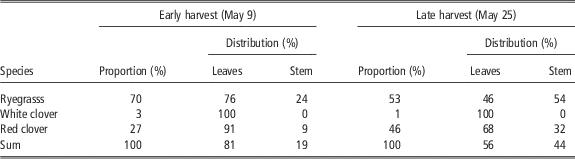
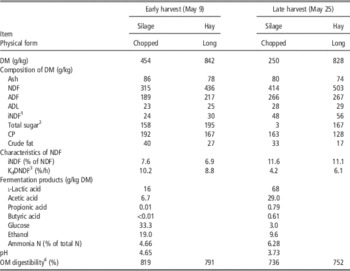
Time of harvest influenced the botanical composition of the forages. Within the later harvest, red clover became more dominant and the total stem fraction constituted a larger proportion of the botanical mass (Table 1). The late harvest of grass/clover had less CP and more NDF and iNDF and lower rate of NDF degradation within type of conservation (Table 2). The late harvested silage was characterized by relatively low DM and high lactic and acetic acid concentrations and a lower pH, indicating a more extensive fermentation with the majority of glucose and total sugar depleted. Within harvest, the nutrient composition varied by conservation method for CP, and especially for NDF. The early harvested silage had a high concentration of both total sugar and free extracted glucose, and a low concentration of lactic acid, indicating that limited fermentation occurred. Hays had greater NDF and iNDF contents than silages, and the early harvest hay had also greater ADF content than the early harvest silage. The sugar contents were greater and CP contents smaller in hays compared with silages.
Morphological composition of early and late harvest fresh forage before conservation to hay or silageFootnote 1

DM=dry matter.
1 Weight proportion of DM of plant parts in harvested fresh forage, determined by manual separation of plant species.
Characteristics and chemical composition of experimental grass/clover forage treatments

DM=dry matter; CP=crude protein; OM=organic matter.
1 Indigestible NDF estimated by incubation 288 h in situ.
2 Glucose, fructose, sucrose and fructan.
3 Rate of degradation of potentially digestible NDF.
4 OM digestibility determined in vitro (Tilley and Terry, Reference Tilley and Terry1963).
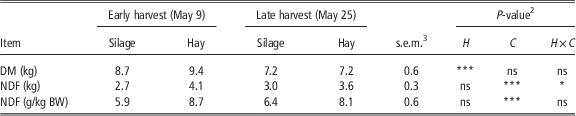
Heifers consumed more DM from early than from late harvested forage (P<0.001), but similar amounts of NDF (Table 3; P>0.05). The NDFI from hay was significantly greater than that from silage (P<0.001), whereas the type of conservation had no effect on DMI (P>0.05).
Daily feed intakeFootnote 1 as affected by time of harvest and type of conservation of grass/clover forage fed to heifers

DM=dry matter.
1 Ninety percent of ad libitum intake.
2 Probability of effects of harvest time (H), type of conservation (C) and the interaction of H and C. ***P<0.001, *P<0.05, ns=non-significant P>0.05.
3 n=4 per treatment.
Eating activity
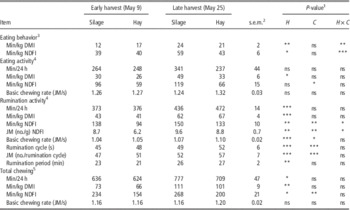
Time spent eating was evaluated by observed eating behavior and by continuously logged JM. From observed eating behavior, more eating time per kg NDFI and DMI was measured from late harvest forages compared with early harvest, but the effect depended on type of conservation, as shown by the significant interaction between harvest time and type of conservation for NDFI (P<0.001) and DMI (P<0.01). Hence, the increase in eating time per NDFI and DMI with later harvest was greater for silages compared with hays.
Analysis of logged JM showed that eating time per kg DMI was longer from late harvest forage (Table 4; P<0.05) and unaffected by type of conservation (P>0.05), and that also basic chewing rate was unaffected by harvest time (P>0.05) or type of conservation (P>0.05). Eating time per kg NDFI was longer for silage than for hay (P<0.05) and similar for early and late harvest (P>0.05).
Observed eating behavior and chewing activity estimated from logged jaw movements over 92 h as affected by time of harvest and type of conservation of grass/clover forage fed to heifers

JM=jaw movements; DMI=dry matter intake; NDFI=NDF intake.
1 Probability of effects of harvest time (H), type of conservation (C) and the interaction of H and C. ***P<0.001, **P<0.01, *P<0.05, ns=non-significant P>0.05.
2 n=4 per treatment.
3 Observed eating behavior during feed intake challenges.
4 Automatically recorded using a jaw recorder.
5 Total chewing=eating activity+rumination activity automatically recorded using a jaw recorder.
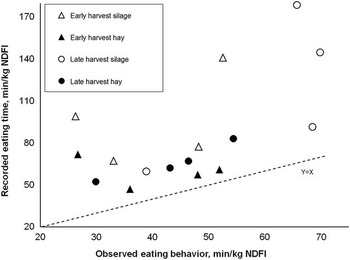
Figure 1 shows the relationship between eating time estimated from recorded JM and from observed eating behavior. The mean difference between eating time from recorded JM and observed eating behavior was 39 min/kg NDF, with recorded eating time showing the greater values. Hay caused less difference than silage (P<0.05), while no effect of harvest time was found (P>0.05).
Relationship between eating time estimated from logged data and observed eating behavior. Logged data are based on jaw movements recorded by Hall-sensors mounted on chewing halters. All observations of eating behavior were means of four test meals. The dashed line indicates the 1 : 1 relationship between observed and recorded eating time.

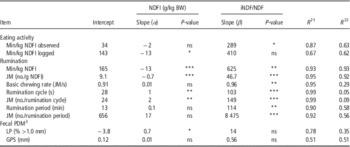
Multiple linear regressions were performed on both logged and observed eating time per kg NDFI (Table 5). The two analyses disagree on the correlations with NDFI per kg BW and iNDF/NDF ratio. The slopes were in the same direction, however, NDFI per kg BW was negatively correlated with logged eating time (P<0.05) while no significant correlation was found between NDFI per kg BW with observed eating time (P>0.05). In contrast, iNDF/NDF ratio was positively correlated with observed eating time (P<0.05) while no significant correlation was found between NDFI per kg BW with logged eating time (P>0.05).
Multiple linear regression equations for effects of NDF intake (NDFI) per kg BW and indigestible NDF (iNDF) to NDF ratio on eating activity, rumination parameters, and fecal particle size in heifers (n=16)

JM=jaw movements; LP=large particles; GPS=geometric mean particle size; PDM=particulate dry matter.
1 R 2 for the multiple linear regressions with random effect of animal.
2 R 2 for the multiple linear regressions without random effect of animal.
3 PDM, DM residue after washing feces in neutral detergent.
***P<0.001, **P<0.01, *P<0.05, ns=non-significant P>0.05.
Rumination activity
Rumination time per day and per kg DMI increased with later harvest (Table 4; P<0.001; P<0.001) and was similar (P>0.05) for hays and silages. Rumination time per kg NDFI also increased with later harvest, depending on type of conservation (P<0.05) as the increase was greater within hays compared with silages. The same was evident with number of JM per kg NDFI, which increased with later harvest, most distinctly for hay compared with silages (P<0.05). The rumination of early harvest forages compared with late harvest were of less intensive character shown by slower basic chewing rate (P<0.001), shorter rumination cycles (P<0.001), fewer JM per rumination cycle (P<0.001) and shorter rumination periods (P<0.01). Compared with hay, silage stimulated slower basic chewing rate (P<0.05), shorter rumination cycles (P<0.001) and fewer JM per rumination cycle (P<0.001) while rumination periods were similar (P>0.01).
The multiple linear regression analysis showed that iNDF/NDF ratio was positively related to rumination time in min per kg NDFI (P<0.01) and to JM per kg NDFI (P<0.001), basic chewing rate during rumination (P<0.01), duration of rumination cycles (P<0.001), JM per rumination cycle (P<0.001) and JM per rumination period (P<0.001). Rumination time per kg NDFI was negatively related to NDFI per kg BW (P<0.001), and suggests that rumination time will decrease by 13 min/kg NDF when NDFI increased by 0.1% of BW within this data set. Measures of chewing efficiency such as duration of rumination cycles (P<0.01) and number of JM per rumination cycle (P<0.01) increased with greater NDFI per kg BW.
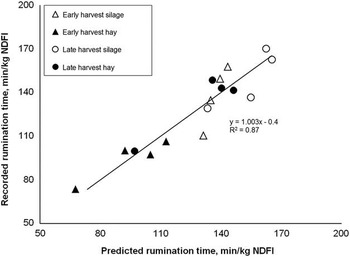
The multiple linear regressions explained 93% of the variation in rumination time per kg NDFI and 95% of the variation in number of JM per kg NDFI, within animal (Table 5). In comparison, the main effects of harvest time and type of conservation explained 97% of the within-animal variation. A plot of recorded v. predicted rumination time per kg NDFI from the multiple linear regression is shown in Figure 2. The slope for the trend line for all data points is 1.003, with the four treatments of different NDF and iNDF/NDF contents distributed both over and under the trend line. The four data points for early harvest silage in Figure 2 suggested a steeper slope compared with the overall trend line slope, indicating that the multiple linear regression model did not predict rumination time per kg NDFI well for this treatment. However, a slope homogeneity test showed no significant difference between forages (P>0.05).
Recorded rumination time v. predicted mean rumination time per kg NDF intake (NDFI) corrected for NDFI per kg BW and iNDF/NDF ratio by use of multiple linear regressions. Rumination time data are based on jaw movements recorded by Hall-sensors mounted on chewing halters.

Fecal particle size
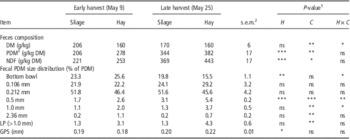
Feeding silage compared with hay resulted in drier feces depending on harvest time (Table 6; P<0.05) as the difference in DM content was most distinct from early harvest forage. Feeding silage compared with hay further resulted in fecal DM containing less NDF (P<0.05) and PDM (P<0.01), and feeding early compared with late harvest forage resulted in fecal DM containing less NDF (P<0.001) and PDM (P<0.001). No effect of harvest time was found on proportion of large particles (P>0.05) while more large particles were found in feces from heifers fed hay compared with silage (P<0.01). The GPS of feces particles was smaller from early compared with late harvest forages (P<0.05) while no effect of type of conservation was found (P>0.05).
Feces composition and PDM distribution as affected by time of harvest and type of conservation of grass/clover forage fed to heifers

PDM=particulate dry matter; DM=dry matter; LP=large particles; GPS=Geometric mean particle size.
1 Probability of effects of harvest time (H), type of conservation (C) and the interaction of H and C. ***P<0.001, **P<0.01, *P<0.05, ns=non-significant P>0.05.
2 n=4 per treatment.
3 PDM is DM residue after washing feces in neutral detergent.
The multiple linear regression analysis (Table 5) illustrated that increasing NDFI per kg BW led to a higher proportion of large particles in feces (P<0.05), whereas iNDF/NDF ratio had no effect on the same particle fraction (P>0.05). The GPS was not affected by NDFI per kg BW and iNDF/NDF ratio (P>0.05).
Discussion
The aim of this study was to evaluate the effects of high quality grass/clover forages with contrasting properties due to different plant maturity at harvests and conservation methods on animal responses related to physical structure value. Two harvests from a grass/clover sward were made in spring season; the first at an extremely early growth stage (early vegetative) and the second at a normal growth stage (vegetative), according to North European standards in intensive farming systems. This is reflected in particularly low NDF concentrations in the early harvest forages. A part of the forage was ensiled to represent a feedstuff conserved according to dairy farming common practice. Another part was dried for hay to represent an alternative feedstuff more commonly fed to calves than to heifers or lactating cows.
Forage characteristics related to physical structure
Within harvests, hays had greater NDF content than silages as well as slightly higher iNDF/NDF ratios. The NDF differences were assumed to be related mainly to mechanical loss of DM during the wilting and moving processes, a well-known problem in the production of hay (Rees, Reference Rees1982). However, the difference in NDF content was unusually large if caused only by loss of DM in the field, especially between early harvested silage and hay. As herbage dries, it becomes more brittle and susceptible to mechanical losses (McGechan, Reference McGechan1989), and may account for some of the difference in NDF contents as hays were dried to less moisture content and exposed to more handling steps. In grasses, the NDF content is mainly concentrated in vascular tissues of leaves and of stems in particular and with progressing maturity the NDF is increasingly lignified. In legumes, the NDF is likewise concentrated in vascular tissue, which, however, is mainly present in the stem and only to small degree in the leaves. The difference in morphology and NDF allocation of clover compared with grass means a high risk of leaf shatter from clover (Rees, Reference Rees1982). A high leaf proportion and low NDF content increases the fragility of the harvested crop, and the risk of losing the leafy part of both grass and clover in the field is therefore assumed greater with earlier maturity at harvest. In summary, high leaf proportions, little lignification of the NDF and high fragility caused by drying combined with repeated moving of the crops during wilting for hay, is suggested to have caused an unintended high occurrence of leaf shatter resulting in greater NDF contents in hays compared with silages.
The hemicellulose fraction of the forages, estimated as NDF minus ADF, comprised 40% of the NDF in silage and 50% of the NDF in hay of early harvest, and 36% of the NDF in silage and 47% of the NDF in hay of late harvest. Only small changes in the cellulose fraction, estimated as ADF minus ADL, were found between hays and silages. The late harvested silage in this experiment was more extensively fermented compared with the studies by Morrison (Reference Morrison1979 and Reference Morrison1988) and had a mean pH of 3.73, which may have caused some degree of acid hydrolysis of the hemicellulose and contributed to some of the difference in NDF content between late harvest silage and hay.
None of the models describing data in this experiment considered any effects of the forage particle size on physical structure, unlike the model of Nørgaard et al. (Reference Nørgaard, Nadeau, Randby and Volden2011) for prediction of eating and rumination activity. Studies have shown that rumination time is unaffected by particle size with forages of theoretical chop length >20 mm (De Boever et al., Reference De Boever, De Smet, De Brabander and Boucque1993; Garmo et al., Reference Garmo, Randby, Eknass, Prestløkken and Nørgaard2008) and that feeding grass silage chopped at 19 mm and unchopped grass silage produced similar bolus particle size and fecal particle size (Nørgaard and Sehic, Reference Nørgaard and Sehic2003). We therefore assumed that differences in rumination time and fecal particle size distributions found in this experiment were not affected by the physical form of the forages.
Factors affecting rumination
The increased rumination time with later harvest relative to DMI found in this study was consistent with previous studies of grass forages for heifers (Beauchemin and Iwaasa, Reference Beauchemin and Iwaasa1993) and dairy cows (De Boever et al., Reference De Boever, De Smet, De Brabander and Boucque1993; Rinne et al., Reference Rinne, Huhtanen and Jaakkola2002). In this study, rumination time per kg NDFI increased with later maturity in disagreement with previous studies that found no effect of progressing maturity of pure grass, clover or alfalfa silage on rumination per kg NDFI (Bosch et al., Reference Bosch, Lammers-Wienhoven, Bangma, Boer and van Adrichem1992; Beauchemin and Iwaasa, Reference Beauchemin and Iwaasa1993; Rinne et al., Reference Rinne, Huhtanen and Jaakkola2002; Kornfelt et al., Reference Kornfelt, Nørgaard and Weisbjerg2013). The less intensive rumination behavior found in this study from early harvest forages is in agreement with the results of Kornfelt et al. (Reference Kornfelt, Nørgaard and Weisbjerg2013) feeding heifers red and white clover silage of early maturity, and indicates less need for rumination with early plant maturity in these forages. Silages compared with hay caused similar rumination time per kg DMI, and more rumination time per kg NDFI, in line with the results of Van Bruchem et al. (Reference Van Bruchem, Bosch, Lammers Wienhoven and Bangma1991).
The multiple linear regressions (Table 6) of the rumination parameters incorporates variations in forage NDF potential digestibility as well as different intake of NDF among heifers and describes their interaction, including effect of animal as random intercept. An increase in forage iNDF/NDF ratio is the natural development expected as plants mature (Buxton and Redfearn, Reference Buxton and Redfearn1997), and hence the positive correlation between iNDF/NDF ratio and rumination parameters from the multiple linear regressions underlines the result that late harvest silage and hay stimulate rumination more than early harvest silage and hay, respectively.
The decreasing rumination time per kg NDFI with increasing NDFI found in this experiment is in line with the findings of Nørgaard et al. (Reference Nørgaard, Nadeau and Randby2010), even though NDF concentrations of forages in the present study were less than those of the forages in the meta-analysis. The decrease in rumination with increasing intake of NDF seems to be slightly compensated by heifers ruminating more effectively expressed by faster basic chewing rate, longer rumination cycles and more JM per rumination cycle with greater NDFI per kg BW, in agreement with previous studies (Bae et al., Reference Bae, Welch and Smith1981; Luginbuhl et al., Reference Luginbuhl, Pond, Burns and Russ1989; Kornfelt et al., Reference Kornfelt, Nørgaard and Weisbjerg2013).
Table 6 gives R 2 values for the multiple linear regressions with and without the random statement. Although the random statement was essential for the model to predict data well for most of the dependent variables, hardly any animal variation was found for rumination time in min/kg NDFI and JM/kg NDFI. This indicates that iNDF/NDF ratio and NDFI/kg BW might be good variables for prediction of rumination time by heifers in general, fed grass/clover forages harvested early in the growing season. Conversely, the low R 2 values of the remaining variables related to rumination pattern and efficiency, from the model without random effects, were indicative of large variation among heifers.
Fecal particle size distribution
The fecal particle size distribution is assumed to represent the distribution of particles leaving the rumen, due to the very limited reduction taking place in the hindgut (Ahvenjärvi et al., Reference Ahvenjärvi, Skiba and Huhtanen2001). Forage particles require a certain amount of mastication from eating and rumination to reach a small enough size and leave the rumen. The fecal weight distribution between most sieving fractions, GPS and proportion of large particles were essentially unaffected by harvest time, despite more rumination time per kg NDFI with increasing harvest time. This is in agreement with the results of Bayat et al. (Reference Bayat, Rinne, Kuoppala, Ahvenjärvi and Huhtanen2011 and Reference Bayat, Rinne, Ahvenjärvi, Vanhatalo and Huhtanen2010) who fed red clover and grass silages to cows. Conversely, Rinne et al. (Reference Rinne, Huhtanen and Jaakkola2002) reported decreasing proportion of large particles in feces with delayed harvest of grass silage, though ingestive and ruminative mastication per kg NDFI was similar within treatments. The greater proportion of large particles in feces from hay in this study was probably associated with less time spent eating and rumination per kg NDFI in hay compared with silage. Van Bruchem et al. (Reference Van Bruchem, Bosch, Lammers Wienhoven and Bangma1991) and Teller et al. (Reference Teller, Vanbelle, Kamatali and Wavreille1989) found similar results with hay v. silage and wilted v. direct cut silage, respectively. However, as previously discussed, the effect of type of conservation is most likely explained by the variation in NDF between hay and silage.
The positive correlation between proportion of large particles and NDFI per kg BW (Table 6) fitted well with the finding that increasing NDFI per kg BW was related to less rumination per kg NDF. Poppi et al. (Reference Poppi, Minson and Ternouth1981) described the critical size at which feed particles can leave the rumen to be 1.18 mm. In our study, only 1.3% to 3.7% of the PDM was >1.0 mm, whereas 9% to 11% of PDM was >1.25 mm in the studies of Bayat et al. (Reference Bayat, Rinne, Kuoppala, Ahvenjärvi and Huhtanen2011 and Reference Bayat, Rinne, Ahvenjärvi, Vanhatalo and Huhtanen2010), with NDF of grass silages ranging from 50% to 59% of DM.
Conclusion
This study showed that feeding spring season grass/clover to heifers resulted in less chewing activity with earlier maturity stage at harvest, especially regarding rumination time. Within harvests, differences in NDF contents and NDF composition caused by different forage conservation processes confounded the aim of assessing effects of conservation method. Rumination time per kg NDFI decreased with greater NDFI per kg BW and with lower iNDF/NDF ratio. Fecal particle size distribution was unaffected by maturity stage at harvest, whereas larger feces particles were found with increasing NDFI per kg BW. From the findings in this study, it would be relevant to implement intake of NDF in systems for prediction of physical structure in diets.
Acknowledgments
This work was financially supported by the Knowledge Centre for Agriculture – Cattle, the Faculty of Health and Medical Sciences at the University of Copenhagen, and the Research School in Animal Nutrition and Physiology (RAN) at the Faculty of Health and Medical Sciences, University of Copenhagen. The authors would like to thank Engineer Frank Oxvang Mortensen at the Department of Plant and Environmental Sciences, University of Copenhagen, Denmark, for technical assistance during the experiment.