Introduction
Ageism exists across various social structures and contexts, in diverse forms, and in many areas of life (Palmore et al., Reference Palmore, Branch and Harris2005). On an individual level, different forms of ageism include avoidance of contact with older people, age denial, ageist humor, patronizing and negative attitudes and stereotypes about older adults (e.g. Palmore et al., Reference Palmore, Branch and Harris2005). On an institutional level, ageism can involve discrimination in housing, employment, mandatory retirement, public policy, and inappropriate care in institutional settings (International Longevity Center, 2006).
Several cross-national studies (for an overview, see Giles et al., Reference Giles, McCann, Ota, Noels, Kaplan, Henkin and Kusano2002) indicate that while ageism is a world-wide phenomenon, certain cultural differences can be found. For example, the existence of ageist attitudes in many Eastern and Southern Asian populations (e.g. China and South Korea) is more pronounced than in developed economies (e.g. USA and Australia). In this regard, examining ageism in Israel, a society influenced by traditional and modern factors alike, may provide important insights which could extend beyond its own specific population and culture.
Although ageism shares similar characteristics with other forms of intergroup prejudice such as racism, it has its unique features. Unlike many negative “isms”, aging is an inevitable process (Butler, Reference Butler and Maddox1995). Since aging exposes people to ageist attitudes, the current study aims to examine the connection between such attitudes and two basic demographic variables which define individuals throughout life: their gender, which remains stable, and their own age, which is subject to changes.
When examining gender differences in ageism, it seems that over the life cycle, men display more ageist attitudes than women. For example, Kogan and Shelton (Reference Kogan and Shelton1962) administered a “sentence completion form” referring to “old people” to an American sample, ranging in age from 49 to 92 years, and found significant age differences between men and women in response to specific items (see also Rupp et al., Reference Rupp, Vodanovich and Crede2005). Similar gender differences in ageism were found among a sample of Canadians (Fraboni et al., Reference Fraboni, Saltstone and Hughes1990). However, in a study involving undergraduate students aged 20–50, these gender differences were not found (Bodner and Lazar, Reference Bodner and Lazar2008), but they were reconstructed in another study on community-dwelling older adults in the age range of 64–85 (Bodner and Cohen-Fridel, Reference Bodner and Cohen-Fridel2010).
While ageist attitudes seem to be more pronounced among men, the picture regarding age differences is more obscure. In general, findings indicate distinctive patterns of ageism among younger adults, while data are less conclusive for middle-aged and older adults (see meta-analysis by Kite et al., Reference Kite, Stockdale, Whitley and Johnson2005). Accordingly, we review current evidence in relation to the three common age-groups (see Erikson, Reference Erikson1950): young adults (aged 18–39), middle-aged adults (40–65), and older adults (66+).
Studies show that young adults hold negative attitudes regarding older people (e.g. Rupp et al., Reference Rupp, Vodanovich and Crede2005; Bodner and Lazar, Reference Bodner and Lazar2008), even when positive age-stereotyped or incongruent information is provided (Kite et al., Reference Kite, Stockdale, Whitley and Johnson2005). It was suggested that the process of aging (mainly the physical aspect), and not just old age, is viewed negatively, and this remains consistent for both younger and older respondents (Boduroglu et al., Reference Boduroglu, Yoon, Luo and Park2006). Regarding middle-aged individuals, a meta-analysis of relevant data found that only 11 out of 232 studies on attitudes toward younger and older adults employed a sample of this age group (e.g. Laditka et al., Reference Laditka, Fischer, Laditka and Segal2004; Kite et al., Reference Kite, Stockdale, Whitley and Johnson2005). In these studies, middle-aged respondents tended to demonstrate the largest preference for young age.
Findings are less consistent when older people's views about people of their own age-group are concerned. Some studies have shown that older individuals are not prejudiced against older adults (Rupp et al., Reference Rupp, Vodanovich and Crede2005); rather, they hold more positive attitudes toward older target groups (e.g. Chasteen et al., Reference Chasteen, Schwarz and Park2002) and have more complex views of older people as a group than do younger respondents (e.g. Laditka et al., Reference Laditka, Fischer, Laditka and Segal2004). Conversely, other studies report what can be interpreted as intragenerational ageism of older adults (e.g. Barker et al., Reference Barker, Giles, Harwood, Nussbaum and Coupland2004), and even a negative bias when group identity is defined around old age (Kite and Wagner, Reference Kite, Wagner and Nelson2002). Social reasons for intragenerational ageism of older adults may stem from the association between aging and increased losses. Alternatively, elderly people's tendency to spend much of their leisure time watching television (e.g. Donlon et al., Reference Donlon, Ashman and Levy2005), which very often displays ageism (e.g. Bell, Reference Bell1992), may also contribute to their internalization of ageist beliefs. Consequently, the expression of ageist sentiments may allow older adults to differentiate themselves in a positive manner from those they believe to be “really older people.”
One of the possible reasons for the lack of agreement between the above-mentioned studies may stem from the relatively narrow sampling of age-ranges within older participants. In line with this contention, there is evidence that less positive stereotypes were associated with photographs of very old people (80 years and above), than with photographs of people in their sixties and seventies (Hummert et al., Reference Hummert, Teri and Shaner1997). These findings imply that attitudes toward older adults differ according to the age group to which they belong. However, studies on ageist attitudes have not yet examined intragenerational ageism according to age subcategories.
In accordance with these lacunas, the present study used a large sample, ranging in age from 18 to 98, in order to examine cross-generational ageism. In light of the evidence reviewed above, three hypotheses were formulated:
Hypothesis 1: Since young age was found to be correlated with higher levels of ageism, we expected that the young adult group would display higher levels of ageism in comparison to middle-aged and older adults.
Hypothesis 2: As the vast majority of findings indicate that women display less ageist attitudes than men, we predicted that across all three age-groups, men would exhibit more ageist attitudes than women.
Hypothesis 3: In line with the literature confirming the heterogeneity of the older population in regard to social attitudes, we hypothesized that disparities in ageist attitudes would be found not only between different subgroups of the older cohort, but also within each subgroup as well. However, we had no premonition regarding the direction of the expected differences.
Method
Participants
The three study groups comprised 955 Israeli participants: 420 (43.9%) men, and 535 (56.1%) women, aged 18 to 98 years (M = 52.47, SD = 23.37). There were no significant age differences between men and women for the general cohort. The majority of the cohort (65.5%) was born in Israel, and the rest comprised immigrants, mostly from Europe (24.9%) and the USA (6%). All participants had a minimum of a high-school education, and all, including the older adults, were living in the community. Of the participants, 630 (65.9%) reported an average income, 238 (24.9%) reported a high income, and the rest (9.2%) reported a low income.
According to the hypotheses, and with regard to existing literature described earlier, the general cohort was divided into three groups: Group 1, comprising the 387 younger participants, 160 men and 227 women (ages 18–39, M = 27.05, SD = 4.94); Group 2, comprising 200 middle-aged participants, 86 men and 114 women (ages 40–67; M = 56.14, SD = 9.68); and Group 3, comprising 368 people, 174 men and 194 women (ages 68–98, M = 77.27, SD = 5.92). Most participants in the older group (66.03%) were retired educators of the Israeli school system, and the age range of the middle-aged groups was slightly expanded from 65 to 67, to include participants up to the age of retirement in Israel. χ2 tests for goodness-of-fit revealed no significant gender differences across the three groups (p > 0.05), and t-tests revealed no significant age differences between genders for each group (p > 0.05).
For the purpose of examining Hypothesis 3, we further divided Group 3 into three subgroups, based on age percentiles: Group 3a, comprised 58 men and 65 women (ages 68–73; M = 70.88, SD = 1.31); Group 3b, comprised 56 men and 78 women (ages 74–80; M = 77.10, SD = 2.06); and Group 3c, comprised 60 men and 51 women (ages 81–98; M = 84.54, SD = 3.29). Here too, χ2 tests for goodness-of-fit revealed no significant gender differences between the three groups (p > 0.05).
Measures
Participants’ levels of ageism were assessed by the Fraboni Scale of Ageism (FSA; Fraboni et al., Reference Fraboni, Saltstone and Hughes1990). Participants rate statements which measure levels of agreement with ageist statements on a Likert-type scale ranging from 1 (strongly disagree) to 6 (strongly agree). Three factors were found in previous investigations (Rupp et al., Reference Rupp, Vodanovich and Crede2005, and the Hebrew version by Bodner and Lazar, Reference Bodner and Lazar2008). Since this is the first study to employ the FSA in such a large age range, we conducted a confirmatory factor analysis with varimax rotation in order to verify its factorial structure. Eighteen items displayed factor loadings above 0.40 for a specific factor and less than 0.35 on the other two (accounting for 47.05% of the variance). Six items were found for the first factor (Eigenvalue = 3.79, 21.03% of explained variance), and were associated with perceived level of older people's contribution to society (e.g. “Old people can be very creative”); five items were found for the second factor (Eigenvalue = 3.04; 16.87% of explained variance), and were associated with behaviors designed to avoid contact with older adults (e.g. “I sometimes avoid eye contact with old people when I see them”); seven items were found for the third factor (Eigenvalue = 1.65; 9.15% of explained variance), and were connected with stereotypical cognitions and perceptions regarding older adults (e.g. “Many old people just live in the past”). Cronbach's α ranged between 0.66 and 0.83. Accordingly, three separate means were calculated for participants’ ageism in each factor.
Procedure
Research assistants approached participants at several venues. The young adult group consisted mostly of students, who were recruited from campuses in large universities in Israel. The middle-age group was recruited on campus, at participants’ places of work, or in the general community. Most of the older cohort were contacted through the Organization of Retired Employees of the Ministry of Education, and approached by mail or during general assemblies. Others were recruited in various situations, such as while visiting day centers. All participants provided the data at home or at their workplace, gave their informed consent, and received no compensation for their time.
Data analysis
We used the Statistical Package for the Social Sciences software (SPSS-18). Differences between the groups (Hypotheses 1 and 2) were examined by multivariate analysis of variance (MANOVA); the three factors of ageism (contribution/avoidance/stereotypes) were the dependent variables, and age group (Group 1/Group 2/Group 3) and gender (male/female) were the independent variables. Post-hoc effects were examined using Scheffé's test. Between-group effects for Hypothesis 3 were also examined by MANOVA with the same dependent variables, but with gender and subgroup (Group 3a/Group 3b/Group 3c) as independent variables. Additionally, in order to further understand within-group effects for each subgroup of the older cohort, linear hierarchical regressions were performed for the three subgroups, with the three ageism factors as predicted variables. Age and gender were simultaneous predictors, and age × gender interaction was inserted in the second step.
Results
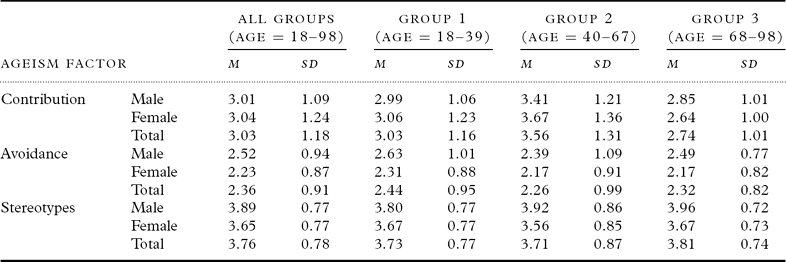
Hypothesis 1: The analysis yielded significant age-group effects for contribution, F(2,952) = 30.29, p < 0.001, η 2 = 0.06, and avoidance, F(2,952) = 3.48, p < 0.05, η 2 = 0.01. Post-hoc tests for contribution revealed that all three groups differed significantly from each other, with Group 2 demonstrating the highest levels of ageism, followed by Group 1 and Group 3. Regarding avoidance, we found a near-significant difference between Group 1 and Group 2 (p = 0.08), as the younger group tended to display higher levels of avoidance (see Table 1 for group means and standard deviations). No age × gender interactions were found.
Means and standard deviations for the three factors of ageism in the three age-groups

Hypothesis 2: Gender differences were found for avoidance, F(1,953) = 21.35, p < 0.001, η 2 = 0.02, and stereotypes, F(1,953) = 23.65, p < 0.001, η 2 = 0.03. Simple main effect tests revealed that for both factors, men's scores were significantly higher than those of women. Here too, no age × gender interactions were found.
Hypothesis 3: Between-group effects: The analysis revealed significant age-group differences for avoidance, F(2,365) = 3.41, p < 0.05, η 2 = 0.02, and stereotypes, F(2,365) = 4.46, p < 0.05, η 2 = 0.03. Post-hoc tests revealed that Group 3c demonstrated higher avoidance scores (M = 2.50, SD = 0.87) than Group 3a (M = 2.19, SD = 0.81), and displayed more stereotypical attitudes (M = 3.96, SD = 0.69) than Group 3a (M = 3.65, SD = 0.69). Gender differences were also found for all ageism factors: contribution, F(1,366) = 3.88, p < 0.05, η 2 = 0.01, avoidance, F(1,366) = 13.83, p < 0.001, η 2 = 0.04, and stereotypes, F(1,366) = 14.78, p < 0.001, η 2 = 0.04. Simple main effect tests demonstrated that men reported significantly higher scores in ageist views of contribution (M = 2.85, SD = 1.01 versus M = 2.64, SD = 1.00), avoidance (M = 2.49, SD = 0.78 versus M = 2.17, SD = 0.83), and stereotypes (M = 3.96, SD = 0.72 versus M = 3.67, SD = 0.73). No age × gender interactions were significant.
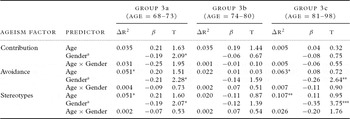
Within-group effects: As Table 2 demonstrates, gender, but not age, was a significant predictor in Group 3a for all three ageism factors. No significant findings were shown for Group 3b. As for Group 3c, gender, but not age, was found to be a significant predictor for avoidance and stereotype factors. For all three groups, no significant interactions were discovered.
Regression coefficients of the three factors of ageism for the three subgroups of the elderly cohort

Gendera: 0 = Male, 1 = Female; * = p < 0.05, ** = p < 0.01, *** = p < 0.001.
Discussion
Our findings show significant differences across the life span when age groups are examined for ageist attitudes. In line with the first hypothesis, younger participants tended to report more avoidant attitudes toward older adults. However, while younger participants viewed older adults as contributing less to society in comparison with the older cohort, middle-aged participants were significantly more ageist in this regard than both younger and older groups. The finding regarding greater ageism in middle-aged participants with regard to perceived contribution to society is seemingly inconsistent with previous findings indicating that younger people tend to report more ageist attitudes (e.g. Kogan and Shelton, Reference Kogan and Shelton1962; Fraboni et al., Reference Fraboni, Saltstone and Hughes1990; Rupp et al., Reference Rupp, Vodanovich and Crede2005). In fact, we formulated Hypothesis 1 in light of the vast amount of data with regard to younger participants, while taking into account the fact that knowledge regarding ageism among people in their forties and fifties is somewhat scarce (Kite et al., Reference Kite, Stockdale, Whitley and Johnson2005). However, previous studies have demonstrated a tendency of middle-aged individuals to distance themselves from aging by judging the onset of old age to occur significantly later than younger individuals (e.g. Musaiger and D'Souza, Reference Musaiger and D'Souza2009). It was also argued that this age-group views old age as “right around the corner,” but is not quite ready to accept its coming and, therefore, may have a greater need than to maintain positive self-image by devaluing older adults (Kite et al., Reference Kite, Stockdale, Whitley and Johnson2005). Moreover, as middle-aged persons mature, they may have to deal with caring for older relatives, while simultaneously experiencing physical signs of aging, and perhaps even be the target of ageism themselves. Hence, they may be more motivated to positively differentiate themselves from older adults, by adopting ageist attitudes. Thus, the current study is an important addition to the limited number of studies examining middle-aged ageism.
The second hypothesis was generally confirmed, as across all age groups, men exhibited more avoidance and stereotypical attitudes toward older adults than women, a finding consistent with previous literature (e.g. Kogan and Shelton Reference Kogan and Shelton1962; Rupp et al., Reference Rupp, Vodanovich and Crede2005). A possible account of these steady gender differences could stem from the fact that women are largely in charge of caring for the infant in the initial stages of its life, and serve as attachment figures to their children and to their older parents (e.g. Cicirelli, Reference Cicirelli2010). Therefore, it may be that thoughts about older adults activate the caregiving behavioral system (see review by George and Solomon, Reference George, Solomon, Cassidy and Shaver2008), resulting in lower levels of ageism among women, regardless of their age.
Hypothesis 3, that differences in ageist attitudes will be found between different subgroups of the older cohort, and within these subgroups as well, was mainly verified. In line with previous findings indicating that older age is a multifaceted period in one's life (e.g. Werntoft et al., Reference Werntoft, Halberg, Elmsahl and Edberg2006), older subjects in the current study (Group 3c) viewed their “own” peer-group in a more stereotypical manner and sought to avoid their company in comparison with their younger peers (Group 3a). This finding is perhaps surprising, as one could expect that, as opposed to the younger old-age-groups (3a and 3b), people in their eighties have already experienced the aging process, and the need to defend themselves from the “out-group” of the older adults has decreased. However, it is important to note that all older participants were fully functioning adults, both mentally and physically. Therefore, it may very well be that competent older adults actively distance themselves from the inevitable declines of aging even when they are over 80, by distinguishing themselves from what they perceive as “old people.” This explanation is in line with previous evidence for such tendencies among healthy older adults (e.g. Hurd, Reference Hurd1999).
While for all three ageism factors, men demonstrated higher ageism than women, Group 3c (ages 81–98) reported higher avoidant attitudes and stereotypical perceptions in comparison with Group 3a (ages 68–73). Moreover, the regression analysis for examining within-group effects revealed that whereas age within each group was not a significant predictor, gender played an intriguing role. Gender was a significant predictor of all three ageism factors in Group 3a and lost its significance in Group 3b (ages 74–80), only to regain it in Group 3c for avoidance and stereotypes. Men's proneness to harbor ageist attitudes in their late sixties and early seventies may be explained by their difficulty to adjust to the change in their employment status upon retirement from work (Théariault, Reference Théariault1994). As time passes, this may slowly soften the impact of retirement for men, and they may be more willing to accept this change. Hence, gender differences may vanish. However, in the age range of 81–98, men are usually the first to die and, therefore, accepting their own age may be perceived as more threatening to men. By holding negative attitudes toward older adults, men in their eighties and nineties may be trying to distance themselves from the association between growing older and getting closer to one's personal death (see Martens et al., Reference Martens, Goldenberg and Greenberg2005).
Several limitations arise from this work. First, while the FSA is considered to be a reliable and valid instrument for examining attitudes regarding ageism, it is still a single measure for ageism. Additionally, self-report scales are susceptible to various interferences, such as social desirability. Accordingly, future studies, which target a wide age-range, should employ additional measures including implicit procedures and qualitative methods (e.g. see Théariault, Reference Théariault1994). An additional issue concerns the participants of Groups 3a–3c. As previously noted, this group was comprised only of able-bodied and independent individuals. Future studies may wish to examine differences between older individuals with various degrees of dependence and physical health problems.
It is also important to note that the research was conducted in Israel, and as such, may be subjected to certain cultural and social biases. Israel is a modern country, influenced by traditional cultural beliefs and standards. This seemingly unique position of Israel as both traditional and modern may hinder the generalization of the results. In this regard, it is also helpful to remember that Israel was established by young people who are now, in fact, in the age range of Group 3c. Therefore, it may be that our older adult group is unique to the cultural and political climate of Israel, thus posing a further difficulty in generalizing the findings to other societies.
However, a report from the European Research Group on Attitudes to Age (EURAGE) demonstrated that 24% of Israelis see people aged 70 and above as a burden on society, in comparison to 28% in France, 31% in Germany, and 18%–19% in Belgium and Germany (Age UK, 2011). Another EURAGE study reports that 32% of Israelis have experienced unfair treatment due to their age, in comparison to 31% in Spain, 30% in the UK, and 47% in Finland and the Netherlands (Abrams et al., Reference Abrams, Russel, Vauclair and Swift2011). Therefore, we can conclude that despite its distinctive social and political characteristics, general patterns of ageism in Israel do not deviate from other European countries. Nevertheless, we stress the need to examine ageism in older cohorts among additional cultures in order to gain more information regarding attitudes toward older adults within these age-groups.
Growing old is inevitable, and concerns regarding the detrimental physical and mental deterioration which may be connected with old age are very real. However, different age-groups demonstrate distinct attitudes toward older adults, and one needs to take into account the various stages in life which affect the way we perceive older adults. Furthermore, just as we cannot regard older adults as homogeneous when it comes to issues such as well-being, physical and mental health, or quality of life (e.g. Werntoft et al., Reference Werntoft, Halberg, Elmsahl and Edberg2006), it is impossible to see them as a single unit in their attitudes toward their peers. By doing that, we demonstrate ageist attitudes ourselves.
Conflict of interest
None.
Description of authors' roles
E. Bodner initiated, planned the study, decided on the relevant questionnaires, and provided the introduction and the rationale. Y. S. Bergman contributed the results and discussion. S. Cohen-Fridel collected and analyzed the data. The three authors cooperated through all stages of the study (i.e. collected the data, consulted each other while writing, edited and commented on all sections of the paper).