Introduction
Infants born prematurely experience elevated risks for mortality and a spectrum of neurodevelopmental and behavioural impairments that emerge early in life (Bhutta et al. Reference Bhutta, Cleves, Casey, Cradock and Anand2002; Anderson & Doyle, Reference Anderson and Doyle2008; Msall & Park, Reference Msall and Park2008; Saigal & Doyle, Reference Saigal and Doyle2008; Aarnoudse-Moens et al. Reference Aarnoudse-Moens, Weisglas-Kuperus, van Goudoever and Oosterlaan2009; Schlotz & Phillips, Reference Schlotz and Phillips2009). Follow-up studies into childhood and adolescence of infants born at very low birth weight (VLBW, <1500 g) and extremely low birth weight (ELBW, <1000 g) or extremely preterm (<26 weeks) have reported them to be at elevated risk for mental health problems, particularly inattention, hyperactivity and anxiety and to have poorer social and peer relationships compared with normal birth weight (NBW) controls (for VLBW comparisons, see Levy-Shiff et al. Reference Levy-Shiff, Einat, Har-Even, Mogilner, Mogilner, Lerman and Krikler1994; Botting et al. Reference Botting, Powls, Cooke and Marlow1997; Sykes et al. Reference Sykes, Hoy, Bill, McClure, Halliday and Reid1997; Horwood et al. Reference Horwood, Mogridge and Darlow1998; Stevenson et al. Reference Stevenson, Blackburn and Pharoah1999; Stjernqvist & Svenningsen, Reference Stjernqvist and Svenningsen1999; Rickards et al. Reference Rickards, Kelly, Doyle and Callanan2001; Johnson et al. Reference Johnson, Bowler, Yudkin, Hockley, Wariyar, Gardner and Mutch2003; Gardner et al. Reference Gardner, Johnson, Yudkin, Bowler, Hockley, Mutch and Wariyar2004; Indredavik et al. Reference Indredavik, Vik, Heyerdahl, Kulseng, Fayers and Brubakk2004, Reference Indredavik, Vik, Heyerdahl, Kulseng and Brubakk2005; Dahl et al. Reference Dahl, Kaaresen, Tunby, Handegård, Kvernmo and Rønning2006; Delobel-Ayoub et al. Reference Delobel-Ayoub, Kaminski, Marret, Burguet, Marchand, N'Guyen, Matis, Thiriez, Fresson, Arnaud, Poher and Larroque2006; Reijneveld et al. Reference Reijneveld, de Kleine, van Baar, Kollée, Verhaak, Verhulst and Verloove-Vanhorick2006; Johnson et al. Reference Johnson, Hollis, Kochhar, Hennessy, Wolke and Marlow2010; for ELBW comparisons, see Szatmari et al. Reference Szatmari, Saigal, Rosenbaum, Campbell and King1990, Reference Szatmari, Saigal, Rosenbaum and Campbell1993; Taylor et al. Reference Taylor, Hack and Klein1998, Reference Taylor, Klein and Hack2000, Reference Taylor, Klein, Drotar, Schluchter and Hack2006; Hille et al. Reference Hille, den Ouden, Saigal, Wolke, Lambert, Whitaker, Pinto-Martin, Hoult, Meyer, Felman, Verloove-Vanhorick and Paneth2001; Anderson & Doyle, Reference Anderson and Doyle2003; Saigal et al. Reference Saigal, Pinelli, Hoult, Kim and Boyle2003; Grunau et al. Reference Grunau, Whitfield and Fay2004; Farooqi et al. Reference Farooqi, Hägglöf, Sedin, Gothefors and Serenius2007; Samara et al. Reference Samara, Marlow and Wolke2008; Hack, Reference Hack2009; Hack et al. Reference Hack, Taylor, Schluchter, Andreias, Drotar and Klein2009).
As the early survivors of modern neonatal intensive care move into adulthood, questions arise about their psychological functioning. Large-scale epidemiological studies linking birth records to psychiatric registries in Norway and Sweden have reported increases in the risk for severe psychopathology such as schizophrenia (Moster et al. Reference Moster, Lie and Markestad2008) and for psychiatric hospitalization (Lindström et al. Reference Lindström, Lindblad and Hjern2009). However, these conditions are relatively rare, even in the highest-risk group (Moster et al. Reference Moster, Lie and Markestad2008), and leave unanswered questions about more common forms of psychopathology. These studies can neither adjust for common psychosocial risk factors associated with psychopathology (Copeland et al. Reference Copeland, Shanahan, Costello and Angold2009) nor consider the extent to which elevated risk for these adverse outcomes might be accounted for by the personal health-related characteristics of survivors. Follow-up studies beyond 18 years of age for VLBW versus NBW controls are few in number, variable in methodological quality and discordant in their findings (Cooke, Reference Cooke2004; Hack et al. Reference Hack, Youngstrom, Cartar, Schluchter, Taylor, Flannery, Klein and Borawski2004; Hille et al. Reference Hille, Dorrepaal, Perenboom, Gravenhorst, Brand and Verloove-Vanhorick2008; Räikkönen et al. Reference Räikkönen, Pesonen, Heinonen, Kajantie, Hovi, Järvenpää, Eriksson and Andersson2008; Strang-Karlsson et al. Reference Strang-Karlsson, Räikkönen, Pesonen, Kajantie, Paavonen, Lahti, Hovi, Heinonen, Järvenpää, Eriksson and Andersson2008; Walshe et al. Reference Walshe, Rifkin, Rooney, Healy, Nosarti, Wyatt, Stahl, Murray and Allin2008).
The relevance of mental health findings in children and adolescents born at VLBW to later adult functioning is unclear. Most of these studies report parent and teacher ratings which are only modestly associated with adolescent self-reports of symptoms (Achenbach et al. Reference Achenbach, McConaughy and Howell1987; De Los Reyes & Kazdin, Reference De Los Reyes and Kazdin2005). Among six studies conducted in adolescence using problem checklists completed by parents and youth, parent ratings of internalizing and externalizing problem behaviour are elevated in all six (Rickards et al. Reference Rickards, Kelly, Doyle and Callanan2001; Saigal et al. Reference Saigal, Pinelli, Hoult, Kim and Boyle2003; Gardner et al. Reference Gardner, Johnson, Yudkin, Bowler, Hockley, Mutch and Wariyar2004; Grunau et al. Reference Grunau, Whitfield and Fay2004; Indredavik et al. Reference Indredavik, Vik, Heyerdahl, Kulseng and Brubakk2005; Dahl et al. Reference Dahl, Kaaresen, Tunby, Handegård, Kvernmo and Rønning2006), but adolescent self-ratings are elevated for internalizing problems in only one study (Gardner et al. Reference Gardner, Johnson, Yudkin, Bowler, Hockley, Mutch and Wariyar2004).
A second important issue bears on the differential risk of psychopathology among VLBW boys versus girls. In the few studies to test for statistical interactions (Botting et al. Reference Botting, Powls, Cooke and Marlow1997; Horwood et al. Reference Horwood, Mogridge and Darlow1998; Grunau et al. Reference Grunau, Whitfield and Fay2004; Hack et al. Reference Hack, Youngstrom, Cartar, Schluchter, Taylor, Flannery, Klein and Borawski2005; Lindström et al. Reference Lindström, Lindblad and Hjern2009; Conrad et al. Reference Conrad, Richman, Lindgren and Nopoulos2010), one found an elevated risk for parent-reported delinquency among males at age 17 years (Grunau et al. Reference Grunau, Whitfield and Fay2004) and another reported an interaction placing 20-year-old white females with distressed mothers at elevated levels of parent-reported internalizing problems (Hack et al. Reference Hack, Youngstrom, Cartar, Schluchter, Taylor, Flannery, Klein and Borawski2005). Other studies presenting strata-specific estimates for males and females versus NBW controls or national norms have documented muted differences between ELBW males and females versus controls (Hack et al. Reference Hack, Youngstrom, Cartar, Schluchter, Taylor, Flannery, Klein and Borawski2004; Dahl et al. Reference Dahl, Kaaresen, Tunby, Handegård, Kvernmo and Rønning2006; Hille et al. Reference Hille, Dorrepaal, Perenboom, Gravenhorst, Brand and Verloove-Vanhorick2008).
Finally, recent evidence suggests that being born small for gestational age (SGA) versus appropriate weight for gestational age (AGA) may elevate risk for psychopathology among those born at VLBW. The Helsinki Study of Very Low-Birth-Weight Adults reported that among adults aged 18–27 years <1500 g, only those born SGA were at elevated risk for executive dysfunction, emotional instability and depression compared with those <1500 g and AGA. In a number of comparisons, NBW controls exhibited worse mental health than those born AGA and VLBW (Räikkönen et al. Reference Räikkönen, Pesonen, Heinonen, Kajantie, Hovi, Järvenpää, Eriksson and Andersson2008; Strang-Karlsson et al. Reference Strang-Karlsson, Räikkönen, Pesonen, Kajantie, Paavonen, Lahti, Hovi, Heinonen, Järvenpää, Eriksson and Andersson2008). In the two other studies to examine birth weight for gestational age in <1500 g survivors, one reported no difference between those born SGA and AGA (Hack et al. Reference Hack, Youngstrom, Cartar, Schluchter, Taylor, Flannery, Klein and Borawski2004), and the other noted elevated Child Behavior Checklist scores among those born SGA versus AGA (Dahl et al. Reference Dahl, Kaaresen, Tunby, Handegård, Kvernmo and Rønning2006).
There are no published studies on adult psychological outcomes of those born at ELBW (<1000 g). Reports from our group indicate that compared with NBW controls, ELBW infants experience higher levels of attention deficit-hyperactivity disorder (ADHD) based on parent and teacher assessments at 5 and 8 years (Szatmari et al. Reference Szatmari, Saigal, Rosenbaum, Campbell and King1990; Szatmari et al. Reference Szatmari, Saigal, Rosenbaum and Campbell1993) as well as higher symptom levels associated with ADHD and depression based on parent assessments at 14 years (Saigal et al. Reference Saigal, Lambert, Russ and Hoult2002, Reference Saigal, Pinelli, Hoult, Kim and Boyle2003). However, at 14 years, there were no differences in self-reported levels of self-esteem or psychopathology between ELBW individuals and NBW controls.
The current study extends the follow-up of our ELBW cohort and NBW controls into young adulthood and addresses the following questions: (1) do adults born ELBW exhibit higher levels of psychopathology than NBW controls; (2) are differences in levels of psychopathology between ELBW and controls accounted for by: (a) family background characteristics, including indicators of socio-economic status (SES), family functioning and maternal anxiety, and (b) the personal health-related characteristics of survivors, including prior levels of psychopathology and intellectual functioning assessed during adolescence; (3) does the sex of respondents modify the association between exposure to ELBW and psychopathology after controlling for family background and personal health; and (4) are risks for psychopathology among the ELBW respondents elevated among those born <1000 g and SGA versus those born AGA?
Method
Participants
The ELBW cohort (501–1000 g) comprised 397 predominantly Caucasian infants, born between 1977 and 1982 to residents of a geographically defined region in central-west Ontario, Canada. Infants were weighed at birth, and gestational age was estimated from maternal report of the last menstrual period. Infants with birth weights <10th percentile for gestational age were classified as SGA (n=35) and the remainder as AGA (n=107) (Kramer et al. Reference Kramer, Platt, Wen, Joseph, Allen, Abrahamowicz, Blondel and Breat2001). Followed longitudinally from birth, 179/397 infants (45%) survived to hospital discharge; 166/179 survived to age 23 years (current follow-up). Assessment data were collected on 142/166 (86%): nine were lost and eight refused (six of these 17 had neurosensory impairments); and seven with neurosensory impairments could not complete assessments. ELBW follow-ups were done at ages 5, 8, 14 and 23 years.
The NBW control group was identified and enlisted when the ELBW cohort was 8 years old; it comprised a stratified random sample of 145 children born at term according to maternal report, between 1977 and 1981, selected from class lists provided by local school boards and group-matched with the ELBW cohort on child age, sex and family SES (Saigal et al. Reference Saigal, Szatmari, Rosenbaum, Campbell and King1991). Assessment data were collected on 133/145: five were lost and seven refused (none had neurosensory impairment). NBW follow-ups were done at ages 8, 14 and 23 years.
Trained lay interviewers, naive to group status, collected study information using a mix of structured interviews and self-administered questionnaires completed by respondents. Information on family background variables was obtained directly from mothers using a structured interview. Most interviews were conducted in a private room at McMaster Children's Hospital. The study was approved by the Hamilton Health Sciences Ethics Review Board, and all respondents provided written informed consent.
Family covariates at time of assessment (age 22–26 years)
The socio-economic variables included: (1) lone-parent family (1, yes; 0, no); (2) both parents born outside of Canada (immigrant family: 1, yes; 0, no); (3) family income in $1000s; (4) maternal education in years.
Family functioning was measured by the 12-item self-administered general functioning scale derived from the McMaster Family Assessment Device (Epstein et al. Reference Epstein, Baldwin and Bishop1983) (α=0.89): it measures family functioning on six dimensions (e.g. problem solving, communication, etc) assessed on a four-point scale, going from 1, strongly agree to 4, strongly disagree. The scale correlates predictably with alternative measures of family functioning (construct validity) (Byles et al. Reference Byles, Byrne, Boyle and Offord1988) and is a useful measure of whole family functioning (Georgiades et al. Reference Georgiades, Boyle, Jenkins, Sanford and Lipman2008).
Maternal anxiety was measured by the trait component of the self-administered Spielberger State-Trait Anxiety Inventory (STAI Trait: α=0.92) (Spielberger et al. Reference Spielberger, Gorsuch, Lushene, Vagg and Jacobs1983). The STAI Trait targets how respondents ‘generally feel’ and includes a 20-item set (e.g. ‘I am a steady person’; ‘I lack self-confidence’) assessed on a four-point scale, going from 1, almost never to 4, almost always. The STAI has a long history of use in psychological research (Barnes et al. Reference Barnes, Harp and Jung2002).
Young adult covariates in adolescence (age 14 years)
Emotional–behavioural problems
Emotional–behavioural problems were measured by the Ontario Child Health Study-Revised (OCHS-R) scales (Boyle et al. Reference Boyle, Offord, Racine, Fleming, Szatmari and Sanford1993); these problem checklists were completed by parents and youth. The OCHS-R Scales are comprised of emotional–behavioural problems occurring in the previous 6 months and rated as: 0, never or not true; 1, somewhat or sometimes true; and 2, very or often true. The items were matched to psychiatric symptoms used to classify externalizing problems (conduct disorder, oppositional defiant disorder, ADHD), or internalizing problems (overanxious disorder, separation anxiety, and depression), based on DSM-III-R criteria (APA, 1987). Item scores are summed to produce scale scores. The present study uses scale scores for externalizing (parent/youth α=0.94/0.90) and internalizing (parent/youth α=0.87/0.86) problems.
Estimated intelligence quotient (IQ)
An abridged version of the Wechsler Intelligence Scale for Children-Revised (WISC-R; Weschler, Reference Wechsler1974) was administered to all children. The following subscales were included: (1) verbal tests: Similarities, Mental Arithmetic and Vocabulary; and (2) performance tests: Picture Arrangement and Block Design. These items provide an estimated IQ score (mean: 100±15). The correlation of the estimated score with the full-scale WISC-R IQ is 0.96 (Schuerger & Witt, Reference Schuerger and Witt1989). Children with blindness (n=7) were tested only on the verbal items of the WISC-R.
Young adult characteristics and covariates at time of assessment (age 22–26 years)
Information on the socio-economic characteristics of young adults was obtained from them in a structured interview and used descriptively. These variables included: (1) living at home (1, yes; 0, no); (2) married or living with a partner (1, yes; 0, no); (3) has one or more children (1, yes; 0, no); (4) employed full time (1, yes; 0, no); (5) education in years completed; and (6) income in $1000s. The personal health-related covariates included the following.
Neurosensory impairment
Neurosensory impairments included one or more of cerebral palsy, blindness, deafness, mental retardation and microcephaly diagnosed by a neonatologist and a developmental paediatrician and coded 1, yes; 0, no.
Functional limitations
Functional limitations were measured by the 36-item short-form health survey (SF-36) 10-item physical functioning scale (α=0.86) (Ware & Sherbourne, Reference Ware and Sherbourne1992). Item responses are coded, 0, no, not limited at all; 1, yes, limited a little; and 2, yes, limited a lot; and summed in response to the question, ‘Does your health now limit you in these activities (If so, how much?)’ applied to 10 activity descriptions (e.g. running, lifting heavy objects).
Chronic health problems
Chronic health problems were measured as a count of chronic illnesses/conditions of at least 6 months' duration drawn from a list of 24 separate categories that included problems of vision, hearing and chronic diseases such as asthma, epilepsy, etc (Cadman et al. Reference Cadman, Boyle, Offord, Szatmari, Rae-Grant, Crawford and Byles1986, Reference Cadman, Boyle, Szatmari and Offord1987).
Young adult outcome measures
Psychopathology
Psychopathology was measured by the Young Adult Self-Report (YASR), a self-administered problem checklist (Achenbach, Reference Achenbach1997). The YASR contains 130 problem items rated as: 0, not true; 1, somewhat or sometimes true; and 2, very true or often true. Based on experts' ratings of the items' consistency with classifications in DSM-IV (APA, 1994), the items were grouped into five DSM-oriented scales (Achenbach et al. Reference Achenbach, Bernstein and Dumenci2005): depressive problems (α=0.88), anxiety problems (α=0.77), avoidant personality problems (α=0.76), ADHD problems (α=0.72) and antisocial personality problems (α=0.80); and two higher-order scales: internalizing problems (α=0.93) and externalizing problems (α=0.85).
Self-esteem
Self-esteem was measured by the Rosenberg Self-Esteem Scale (RSES), a self-administered questionnaire comprised of 10 items rated on a four-point scale from 1, strongly agree to 4, strongly disagree (α=0.91) (Rosenberg, Reference Rosenberg1965). The RSES has a long history of use in epidemiological studies.
ADHD
ADHD was measured by the ADHD Rating Scale, a self-administered questionnaire comprised of 18 items rated on a four-point scale from 0, never or rarely to 3, very often (α=0.85) (Barkley & Murphy, Reference Barkley and Murphy1998). The ADHD Rating Scale has been used in epidemiological and clinical research in adults in the USA and in The Netherlands (Kooij et al. Reference Kooij, Boonstra, Swinkels, Bekker, de Noord and Buitelaar2008).
Anxiety
Anxiety was measured by the trait component of the STAI (α=0.94).
Statistical analysis
Statistical comparisons of group differences (ELBW versus NBW) used χ2 tests for categorical variables and independent Student's t tests for quantitative variables. Standard multivariable linear regression was used to estimate the strength of association between group status and internalizing versus externalizing problems in young adulthood. Two models were examined: model 1 adjusted for family background; model 2 adjusted for personal health-related characteristics. To help interpret differences, the internalizing and externalizing scale scores of participants were divided at the 90th percentile to identify individuals at elevated risk for clinical disorder (Achenbach, Reference Achenbach1997). These binary outcomes were modelled in logistic regression analyses of ELBW individuals subdivided by SGA and AGA versus NBW controls. To determine if the sex of respondents modifies the association between being born at ELBW and psychopathology, a group (ELBW versus NBW)×sex interaction was tested for statistical significance. PASW Statistics v. 18.0 (SPSS Inc., USA) was used for all analyses.
Results
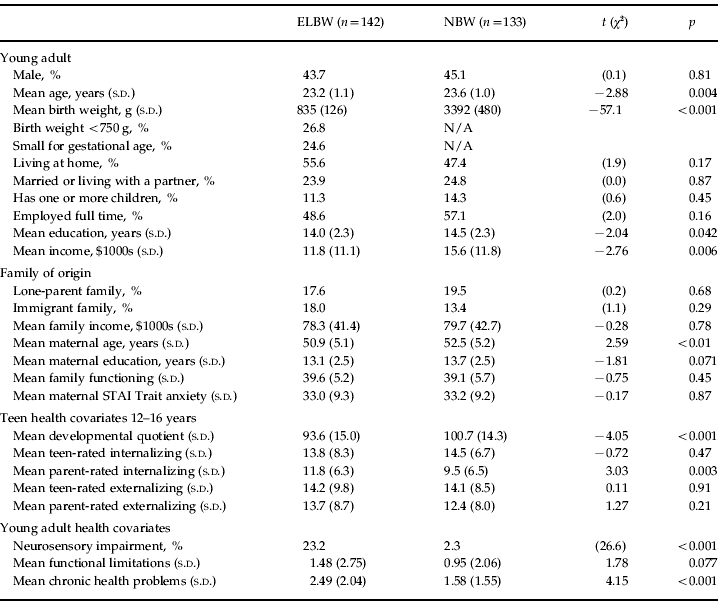
Table 1 compares the current health, living circumstances and family background characteristics of young adults born ELBW versus NBW. As young adults, those born at ELBW are at elevated risk for health deficits, including neurosensory impairment, functional limitations and chronic health problems. As teens, individuals born at ELBW exhibited a lower developmental quotient (93.6 v. 100.7) and received higher scores from parents on internalizing problems.
Characteristics of young adult respondents and their families of origin

ELBW, Extremely low birth weight; NBW, normal birth weight; s.d., standard deviation; STAI, Spielberger State-Trait Anxiety Inventory.
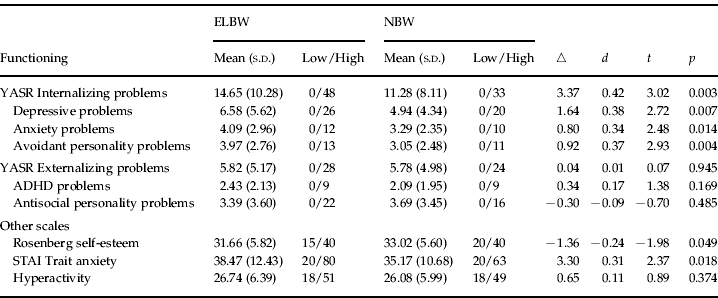
Table 2 compares mean raw scores of self-reported psychopathology for ELBW individuals versus NBW controls. There are statistically significant elevated scores for internalizing problems, and all subtypes (depression, anxiety, avoidant personality problems) among ELBW compared with NBW controls and negligible differences between the groups on externalizing problems. The pattern of differences associated with the YASR is repeated in the other specialized scales, providing evidence of consistency in the findings. Statistically significant effects are between small and moderate in magnitude (i.e. 0.20–0.50) based on Cohen's d (Cohen, Reference Cohen1992).
ELBW versus NBW on mean levels of psychological functioning

ELBW, Extremely low birth weight; NBW, normal birth weight; s.d., standard deviation; ▵, difference in mean scores (ELBWmean – NBWmean); d, standardized difference in mean scores: (ELBWmean – NBWmean)/NBWs.d.; YASR, Young Adult Self-Report; ADHD, attention deficit-hyperactivity disorder; STAI, Spielberger State-Trait Anxiety Inventory.
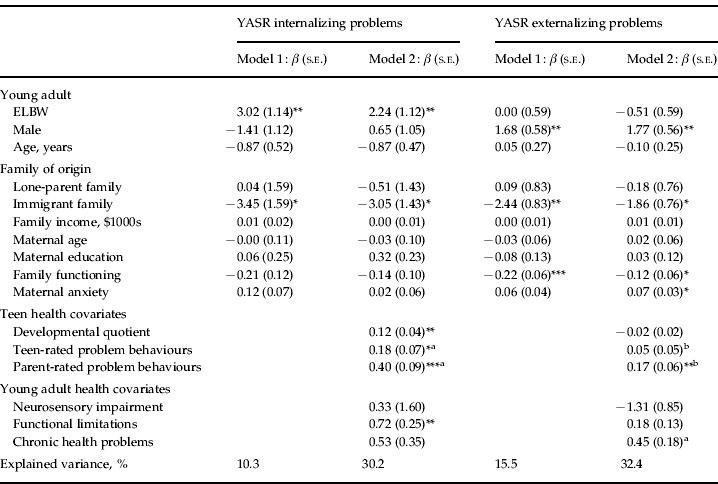
Table 3 presents the multivariable linear regressions of internalizing and externalizing behaviour problems on birth-weight status. Model 1 controls for family background variables that could confound ELBW versus NBW comparisons. The mean scores for ELBW versus NBW controls are 3.02 scale points higher on internalizing problems (d=0.37) and no different on externalizing problems. Immigrant-family background exhibits a particularly strong negative association with internalizing and externalizing problems. Model 2 adjusts for personal health-related characteristics of participants that could account for ELBW versus NBW differences. Mean score differences on internalizing problems are attenuated but still 2.24 scale points higher among ELBW versus NBW controls (d=0.28) and 0.51 points lower on externalizing problems (d=−0.10). The teen health covariates exhibit stronger associations with internalizing than externalizing problems. Family background combined with the health-related characteristics of participants account for about 35.5% of the difference in internalizing problems between the groups [(3.37–2.24)/3.37].
Multiple linear regressions of internalizing and externalizing problems on ELBW versus NBW controls, adjusting for selected covariates

ELBW, Extremely low birth weight; NBW, normal birth weight; YASR, Young Adult Self-Report; β, unstandardized beta coefficient; s.e., standard error.
a Internalizing problems.
b Externalizing problems.
* p <0.05, ** p <0.01, *** p <0.001.
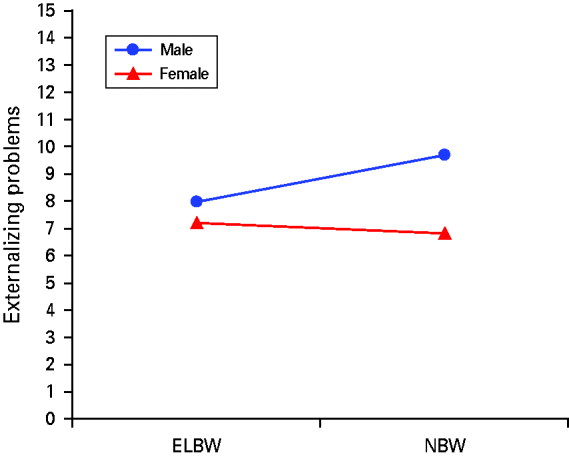
We extended model 2 to test for a statistical interaction between respondent sex, ELBW status and levels of internalizing and externalizing problems. In both problem areas, male–female differences were muted among ELBW participants – the effect is non-significant for internalizing problems (β=−1.71, SE2=0.03, t=−0.84, p=0.40) but significant for externalizing problems (β=−2.11, SE1=0.07, t=−1.98, p=0.049) (Fig. 1).
Interaction between sex and extremely low birth weight (ELBW) status. NBW, Normal birth weight.

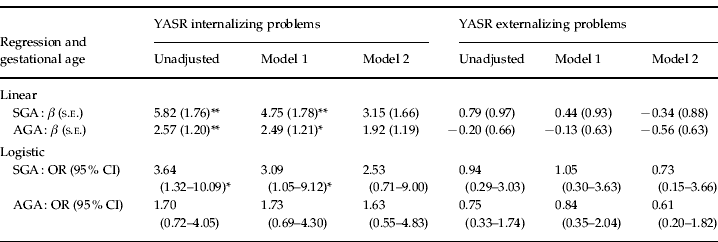
Table 4 shows multivariable linear (continuous measures) and logistic (binary measures) regressions of internalizing and externalizing problems on ELBW individuals (SGA and AGA) versus NBW controls. The covariates appearing in Table 3 (models 1 and 2) are included in Table 4 but their coefficients are not shown. In comparison with NBW controls, the unadjusted mean differences for SGA and AGA, ELBW participants are 5.82 (d=0.72) and 2.57 (d=0.31) for internalizing problems and 0.79 (d=0.16) and −0.20 (d=−0.04) for externalizing problems. The gradient effect observed for unadjusted differences in internalizing problems persists in models 1 and 2. However, the addition of personal health-related characteristics in model 2 renders the coefficients for SGA and AGA non-significant. The associations between birth-weight group and externalizing problems are small and non-significant.
Multiple linear and logistic regressions of internalizing and externalizing problems on ELBW participants subdivided by SGA and AGA versus NBW controls, adjusting for selected covariates (not shown)

ELBW, Extremely low birth weight; SGA, small for gestational age; AGE, appropriate weight for gestational age; NBW, normal birth weight; YASR, Young Adult Self-Report; β, unstandardized beta coefficient; s.e., standard error; OR, odds ratio; CI, confidence interval.
* p<0.05, ** p<0.01.
The percentage of respondents scoring above the 90th percentile on internalizing problems was SGA, 22.9; AGA, 12.1; and NBW, 7.5 (not shown). The corresponding odds ratios (ORs) versus NBW are 3.64 [95% confidence (CI) 1.32–10.09] for SGA and 1.70 (95% CI 0.72–4.05) for AGA (Table 4). The gradient effect for SGA and AGA persists in models 1 and 2 but is only statistically significant for SGA in model 1.
Discussion
This study finds that adults born at ELBW manifest higher levels of depressed mood, anxiety, social withdrawal and poor self-esteem (internalizing problems) compared with NBW controls but not higher levels of externalizing problems. Family background variables explained only a small proportion of this difference – an expected finding based on the method used to select the controls. Statistically significant differences persisted after adjusting for personal health-related characteristics. This suggests that differences between ELBW and NBW controls in self-reported internalizing problems mostly emerge or become recognized by those born at ELBW in adulthood. Although ELBW and NBW controls exhibited similar levels of externalizing problems, there was a group×sex interaction, indicating that differences between males and females were muted in the ELBW group. Finally, in comparison with NBW controls, there was a gradient of risk for internalizing problems in the ELBW group from SGA to AGA to NBW.
Expressed as a standardized difference d, ELBW individuals have a small to moderate risk overall for elevated levels of internalizing problems after adjusting for family background variables (d=0.37). However, this risk is distributed differently between those born SGA (d=0.59) versus AGA (d=0.31). Using the 90th percentile to identify individuals at elevated risk for clinical disorder, and the OR to calibrate the magnitude of this risk, those born SGA versus AGA are 4.75 and 2.49 times more likely to be above threshold. Although ELBW survivors are at increased risk for clinically important internalizing problems, the majority (about 85%) fall within normal levels of mental health.
Informant perspective is an important consideration when assessing mental health. Based on self-report in our cohort, there is no evidence of group differences at ages 14 or 23 years in externalizing problems, including ADHD symptoms (Saigal et al. Reference Saigal, Pinelli, Hoult, Kim and Boyle2003). The emergence of internalizing problems in young adulthood refers to group differences in self-reported symptoms that only become apparent at age 23 years. This pattern of self-assessed difficulties – no evidence of differences in levels of ADHD symptoms and risk for internalizing problems emerging in early adulthood – contrasts with parent reports which date elevated risk for these problems back to childhood (Hack et al. Reference Hack, Taylor, Schluchter, Andreias, Drotar and Klein2009; Johnson et al. Reference Johnson, Hollis, Kochhar, Hennessy, Wolke and Marlow2010). Among individuals born at ELBW, the apparent attenuation of risk for ADHD symptoms, as well as the endorsement of internalizing problems among young adults, may reflect informant-specific influences, developmentally timed responses to biological or social risks (i.e. latent effects that only become apparent in the early twenties), or a combination of the two. For example, ADHD symptoms reported by parents and teachers may: (1) represent children's behavioural expressions of neurological deficits in perception, intelligence and executive functioning (Hack, Reference Hack2009) which themselves exert adverse effects on emotional regulation and may also contribute to the development of internalizing problems in early adulthood; (2) be early manifestations of later developing depressive and anxiety problems; or (3) mark the emergence of detrimental social processes that also increase risk for depression and anxiety. The absence of statistically significant differences in self-reported levels of ADHD symptoms in our study could reflect maturation, treatment effects, inaccurate self-assessments and/or the move away from school contexts where such behaviour is more noticeable and likely.
Separate testing of right-handed participants in our study free of neurosensory impairment (ELBW, n=71; NBW, n=83) has revealed personality differences that place ELBW survivors at risk for emotional problems, including significantly higher levels of shyness, behavioural inhibition and lower sociability and emotional well-being compared with NBW controls (Schmidt et al. Reference Schmidt, Miskovic, Boyle and Saigal2008). Further study of these groups has revealed subtle neurological differences between ELBW and NBW adults indicative of aberrant electroencephalogram (EEG) profiles in ELBW adults (Miskovic et al. Reference Miskovic, Schmidt, Boyle and Saigal2009). Moreover, ELBW adults exhibit greater relative right frontal EEG activity at rest and emotional problems than their NBW peers (Schmidt et al. Reference Schmidt, Miskovic, Boyle and Saigal2010). These frontal brain processes are presumed to underlie the dysregulation of emotion, particularly fear and have strong links to mood and anxiety disorders (Davidson, Reference Davidson2000). Such abnormalities may underpin the increased levels of internalizing problems observed in the present study.
Evidence is sparse on differential risk for psychopathology between males versus females linked with birth-weight status. Our study indicates that male–female differences in risk for externalizing problems are smaller among ELBW participants than NBW controls. Outcome data from other follow-up studies of VLBW survivors suggest that VLBW females may be differentially vulnerable to internalizing problems (Hack et al. Reference Hack, Youngstrom, Cartar, Schluchter, Taylor, Flannery, Klein and Borawski2004; Dahl et al. Reference Dahl, Kaaresen, Tunby, Handegård, Kvernmo and Rønning2006; Hille et al. Reference Hille, Dorrepaal, Perenboom, Gravenhorst, Brand and Verloove-Vanhorick2008), and there are examples from longitudinal studies done in the general population of low birth weight females being at elevated risk for depression in young adulthood (Alati et al. Reference Alati, Lawlor, Mamun, Williams, Najman, O'Callaghan and Bor2007; Costello et al. Reference Costello, Worthman, Erkanli and Angold2007). The bases for such an effect – differences in male–female survivorship, biological vulnerability and/or exposure to social processes – are subject to speculation. This finding needs to be replicated in other studies.
Among ELBW survivors in our study, the risk for internalizing problems was elevated among those born SGA – consistent with findings from the Helsinki Study (Räikkönen et al. Reference Räikkönen, Pesonen, Heinonen, Kajantie, Hovi, Järvenpää, Eriksson and Andersson2008; Strang-Karlsson et al. Reference Strang-Karlsson, Räikkönen, Pesonen, Kajantie, Paavonen, Lahti, Hovi, Heinonen, Järvenpää, Eriksson and Andersson2008). In examining psychopathology, the few birth cohort studies of VLBW infants to differentiate small size at birth as a function of growth restriction versus prematurity have produced mixed findings (Hack et al. Reference Hack, Youngstrom, Cartar, Schluchter, Taylor, Flannery, Klein and Borawski2004; Dahl et al. Reference Dahl, Kaaresen, Tunby, Handegård, Kvernmo and Rønning2006). There is, however, epidemiological evidence that low birth weight in relation to gestational age is associated with hospitalization for mental disorder (Monfils Gustafsson et al. Reference Monfils Gustafsson, Josefsson, Ekholm Selling and Sydsjö2009) as well as a number of serious medical problems (coronary heart disease, stroke, hypertension and type 2 diabetes) (Barker, Reference Barker2006). Thus, it would not be surprising that chronic mental health problems such as depression and anxiety would also be adversely affected by intra-uterine growth restriction among VLBW infants.
More contentious is the finding from the Helsinki Study that VLBW survivors born AGA might be at lower risk for internalizing problems than NBW adults (Räikkönen et al. Reference Räikkönen, Pesonen, Heinonen, Kajantie, Hovi, Järvenpää, Eriksson and Andersson2008; Strang-Karlsson et al. Reference Strang-Karlsson, Räikkönen, Pesonen, Kajantie, Paavonen, Lahti, Hovi, Heinonen, Järvenpää, Eriksson and Andersson2008). To our knowledge, this is the only finding of its kind in this literature. In our study, both subgroups of ELBW survivors exhibit elevated risk in comparison with NBW controls but not each other. While the pattern of outcomes by birth weight and gestational age in our study has precedent in an earlier report (Korkman et al. Reference Korkman, Liikanen and Fellman1996), very few studies have attempted to disaggregate the risk of adverse outcomes attributable to extreme prematurity versus growth restriction among VLBW infants. Apparent differences in risk could be due to differences in neonatal and pregnancy complications (Gutbrod et al. Reference Gutbrod, Wolke, Soehne, Ohrt and Reigel2000).
Birth weight and gestational age are surrogate markers of the fetal environment and are influenced by a variety of factors – maternal genes, health behaviour during pregnancy and adverse maternal exposures that can, in turn, negatively influence the development of neurological and hormonal systems relevant to psychopathology (Schlotz & Phillips, Reference Schlotz and Phillips2009). Although theoretical reasons exist for expecting VLBW and ELBW survivors born SGA versus AGA to have experienced more adverse fetal environments leading to comparatively worse mental outcomes, there is no convincing reason to believe that those born AGA would have experienced either more optimal fetal environments and/or ones that would result in better outcomes than NBW infants from similar families. While it is difficult to know with any certainty, the Helsinki finding could reflect sample selection mechanisms: taking into account tracing, attrition, residency requirements and missing data in 2004, the study contained 162/335 (48.4%) VLBW infants discharged alive from hospital.
Our study is resistant to some of the methodological problems that characterize the follow-up research on VLBW survivors. Sample attrition is low: 14% among ELBW survivors and 8% among NBW controls. The ELBW cohort was assembled from a well-defined geographic area, reducing the problem of selection bias associated with centre-based studies (Horwood et al. Reference Horwood, Boyle, Torrance and Sinclair1982), and the availability of assessment data collected in earlier waves allowed us to control statistically for a number of variables linked with postnatal influences on development that may differ between VLBW survivors and NBW controls. However, the study also has limitations. The sample size is small and has relatively little power to test for statistical interactions. The absence of maternal pregnancy data rules out our ability to examine associations between mental health risk and factors such as pre-eclampsia, smoking and alcohol. Resources were unavailable for collecting parent assessments or implementing a structured diagnostic interview with young adults. These survivors have ready access to universal health care which may improve their outcomes relative to systems where care is less readily available. Finally, the study focuses on mental health risk associated with birth weight and gestational age and does not test for mechanisms that might explain these associations.
This study has shown that risk for mental health problems based on self-reported symptom levels of depression, anxiety and social withdrawal is elevated in young adults born at ELBW versus NBW. This effect is small to modest overall but elevated among adults born at ELBW and SGA. Given the challenges associated with measuring gestational age reliably (Lynch & Zhang, Reference Lynch and Zhang2007), the effects observed in our study could be underestimates. This finding highlights the potential importance to health outcomes of impaired growth versus prematurity among infants born at low birth weight, the clinical importance of monitoring growth among high-risk pregnancies, and the urgent need for further research that attempts to disaggregate the contribution of impaired growth versus prematurity to health outcomes among low birth weight survivors.
Acknowledgements
This research was supported by grants from the Canadian Institutes of Health Research (CIHR: grant no. MOP42536) and National Institute of Child Health and Development (NICHD: grant no. RO1HD40219) awarded to S.S. and colleagues. M.H.B. was supported by a CIHR Canada Research Chair in the Social Determinants of Child Health. We thank the ELBW and NBW young adults and their parents for their generosity in participating in our ongoing studies for the last 25 years.
Declaration of Interest
None.