Since the mid-1990s, China has instituted a series of policies aimed at reversing its “brain drain” and overcoming the shortage of human capital needed for its ever-growing economy. Early policies focused on high-end talent, including scientists, academics and entrepreneurs.Footnote 1 Known as “sea turtles,” or hai gui 海龟 (a homonym for the Chinese word for “returning from overseas,” 海归), their skills and ability to transfer technology and information from abroad were highly valued and well compensated by the state and by the Chinese market.
However, beginning in the mid-2000s, owing to the jump in household incomes among the emerging Chinese middle class and the liberalization of overseas student recruitment in OECD countries,Footnote 2 the number of Chinese students going abroad for bachelor's and master's degrees dramatically increased – as did the number of returnees, which increased from 12,243 in 2001 to almost 35,000 in 2005. Among this group of returnees, 73.4 per cent were master's students, 11.6 per cent were undergraduate students and only 9.8 per cent were PhD students.Footnote 3 According to Vanessa Fong, however, many of the young people she observed in Dalian went overseas because they were mediocre students who could not gain admission to good universities in China.Footnote 4
As China's employment market grew increasingly competitive, many returnees, especially those without PhDs or degrees from a top-ranked university, found it difficult to find a job, and they often had to settle for salaries below their expectations once they did. Consequently, there was much debate as to whether investing so much of a family's savings in developing the “transnational” human capital of its children was a wise decision.Footnote 5 Did those who paid high overseas educational fees actually learn skills that could not be learned at home at a much lower cost? Were these younger, overseas-educated returnees appreciated by the Chinese marketplace and rewarded with an “income premium” for going abroad? With so many returnees “waiting for a job” (dai ye 待业), were the once valuable “sea turtles” becoming “sea weed” (hai dai 海带), a homonym for “overseas returnees waiting for work” (hai dai 海待)?Footnote 6 In response to these questions, David Zweig and Donglin Han have shown empirically that, at that time, it did not take returnees so long to find a job and that their salaries were significantly higher than domestic graduates.Footnote 7
The more recent dramatic increase in the number of students going abroad and returning has revived this debate.Footnote 8 Between 2015 and 2018, the number of returnees increased from 409,100 to 519,400, or by 26.9 per cent.Footnote 9 And, according to a 2018 report, about 78 per cent of Chinese students abroad planned to work in China either straight after graduation or following a period working overseas, compared with 58 per cent in 2016.Footnote 10 Given that the number of China's graduate students reached a new high of 8.34 million in 2019, landing a good job and the salaries offered could be highly problematic for returning students.Footnote 11
So, does overseas study still pay off? In 2016, the Center for China and Globalization (CCG) found that 27.3 per cent of returnees who were looking for work thought that the “benefits” (shouyi 收益) of overseas study were less than the costs, 18.3 per cent were uncertain, while 18.1 per cent felt they were the same, meaning that two-thirds saw no big benefit from studying abroad.Footnote 12 When the same survey was conducted again in 2018, CCG found that about 80 per cent were not satisfied with their salaries. Of this group, 49 per cent felt that their salary was “below expectations” while 31 per cent saw it as “far below expectations.”Footnote 13 Therefore, the question remains, does study abroad reward returnees with a wage premium?
Establishing a causal relationship between studying abroad and labour market outcomes later in life is a challenging task because students who decide to study abroad are in many ways different from students who complete all of their education in their home country.Footnote 14 Unobserved personal qualities, such as an individual's ability and willingness to take risks, may also affect their income later in life. Also, studying returnees without comparing them to a control group of locally trained students who share similar characteristics as the returnees will yield less convincing or less definitive results and will make it difficult to measure the impact of studying abroad on incomes.
To achieve more accurate results, we compare our returnees to a matching cohort of locally educated graduates who are as similar as possible to the returnees in terms of important characteristics such as age, level of education, geographical location, gender, etc. We then empirically analyse these matching sets of recent graduates.Footnote 15
Our empirical analysis of the matched data shows that, compared with domestic students who have completed a graduate degree (largely master's degrees), returnees with an overseas graduate degree earn about 20 per cent more annually. However, we find no significant difference in income between returnees and domestically educated students with bachelor's degrees.
We also explore whether returnees’ higher income is owing to their enhanced “human capital” or reflects a “signalling” effect. A human capital effect refers to the notion that people become more productive as a result of the knowledge and skills they acquire as part of their education and that employers pay a higher wage because these people turn out to be more productive.Footnote 16 A signalling effect indicates that people who gain an overseas degree send a signal to potential employers about their innate abilities. These employers decide to hire them at a higher salary because of the overseas degree, not because of any verified increase in their talent or human capital.Footnote 17
To investigate whether these effects explain the income gap between returnees and locals, we add interaction terms with Tenure – that is, the length of time spent in a current job.Footnote 18 Our results show that when Tenure equals 0 – i.e. newly hired – there is no significant income difference between returnee and local graduate degree holders. Therefore, we can reject any signalling effect. Moreover, as time in the job increases, so does the income gap between these two groups, showing that respondents are awarded a higher salary because of their capabilities, or greater human capital, which they will have demonstrated on the job.
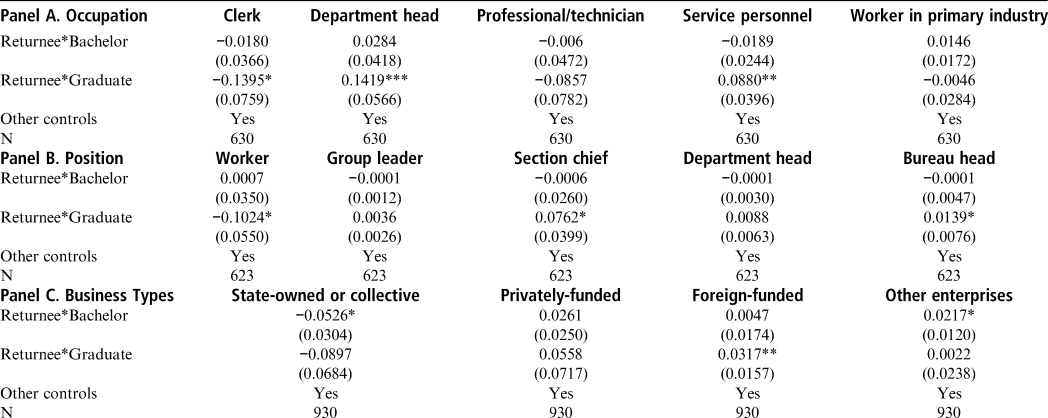
Our study also sheds some light on the difference between returned graduate students and local graduate degree holders in terms of occupation, positions and the type of firms in which they work. Compared with domestic graduate degree holders, returnees are more likely to be “department” heads, engage in service sector jobs, work in foreign-funded ventures and, overall, are more likely than locals to have higher positions. However, returnee bachelor's degree holders have no significant advantage in terms of choices of occupation, enterprise type and positions.
Our paper contributes to the literature in two ways. First, by using the matching method proposed by Daniel E. Ho and colleagues, we reduce any potential bias that may arise because of the overseas sojourners’ unobservable characteristics, particularly the possibility that people who go abroad are more capable in the first place.Footnote 19
Second, a human capital effect, rather than a signalling effect, explains the income premium of a foreign graduate degree. Human capital acquired abroad increases a foreign graduate degree holder's income, work situation and long-term work prospects, something that simply acquiring the degree cannot affect.
No doubt our conclusions could be stronger if we had directly comparable data for the returnees and locals. Ideally, besides our current data, we would like to have data similar to that used by Prashant Loyalka and colleagues, who have directly comparable data on the capability variables of domestic and overseas students, such as their abilities in mathematics, physics and critical thinking.Footnote 20 Such data from both before and after our subjects graduated would allow us to study the effects of studying abroad on each student's human capital.Footnote 21
The paper proceeds as follows. The next section reviews the literature and presents the hypotheses to be tested. The third section describes the data. The paper then presents the main results about the income gap between returnees and domestic graduates, and then continues by reporting the differences between returnees and local graduates in terms of occupation choice and positions, both of which are important determinants of income. The final section presents our overall conclusions.
Literature Review and Hypotheses
Literature review
The research on how overseas education affects income is limited.Footnote 22 A few scholars have focused on returnees’ short-term labour market outcomes, such as early unemployment rates, over-education rates and wages. Some studies find that in Norway, returnees have a higher risk of unemployment and tend to be overqualified for the available jobs in the market, but earn 3 per cent more than domestic graduates when they do find a job.Footnote 23 Jannecke Wiers-Jenssen provides descriptive evidence that returnees have higher unemployment rates in Finland and the Faroe Islands, have lower unemployment rates in Iceland, and are overqualified in Finland.Footnote 24 A comparison of Malaysian graduates educated abroad with those educated domestically finds no difference in the starting salaries of these two groups.Footnote 25 Theodore Lianos, Dimitrios Asteriou and George Agiomirgianakis together document that returnees to Greece who graduated in an EU country earn more than those who graduated in other countries, including the UK, Canada, the US and Australia.Footnote 26 These studies largely focus on short-term labour market careers and not on the differences among degrees and industries. Moreover, few consider the problem that those who study abroad may simply be more talented to begin with.
Some papers analyse the link between overseas experience and academic outcome. For example, Jung Cheol Shin and colleagues use a sample of full-time university scholars with PhDs to analyse whether foreign PhDs are more productive in research than domestic PhDs in three higher education systems – Korea, Hong Kong and Malaysia.Footnote 27 They find that holders of foreign PhDs are not more productive, in terms of research, than their colleagues with domestic degrees, and are even slightly less productive than domestic PhD holders in some disciplines. Using data from the GlobSci survey, Chiara Franzoni, Giuseppe Scellato and Paula Stephan study the differences in academic performance, including the academic impact factors and number of citations, between returnees and local graduates in 16 countries.Footnote 28 They find that people with an overseas post-doctorate perform better, but other overseas experiences are uncorrelated with the performance of returnees in these countries. One exception is the US, where returnees to the US from abroad perform at the same level as Americans who did not go abroad.
Many studies of Chinese returnees focus on the effect of returnees on the Chinese economy. Returnees are more likely to import cutting edge technology and capital,Footnote 29 to have an international network,Footnote 30 to accelerate domestic knowledge spillover,Footnote 31 and to promote technical innovation and a high-tech zone's development.Footnote 32 In addition, Ou Dai and Xiaohui Liu, as well as Haiyang Li and colleagues, both provide evidence that enterprises led by returnees perform better.Footnote 33 Academically, scholars with foreign degrees publish more papers in international journals,Footnote 34 and there is a positive correlation between foreign experience in a particular host country and the number of international co-publications with researchers from that region.Footnote 35 However, the link between studying abroad and employment outcomes has rarely been studied. The paper which is most closely related is the study by Zweig and Han, which argues that, as of 2007, the employment problems of returnees were overstated, as most returnees could find a job within three months and received higher salaries relative to domestic graduates with the same degree.Footnote 36
Hypotheses
There are two possible explanations as to why returnee and domestic graduates earn different rewards. The first points to the human capital effect, as illustrated separately by Jacob Mincer and Gary Becker.Footnote 37 Their theory suggests that the education and competence acquired abroad may be different from those which are acquired at home institutions because a foreign and a domestic education are not the same, and it is the different educational experiences and accumulated knowledge that, in turn, lead to different performances. As some studies show that an overseas education is superior to a domestic Chinese education, returnees should have better professional knowledge and skills than local graduates.Footnote 38 Moreover, returnees may possess skills developed outside the classroom, such as language fluency, cultural competence and global networks, which Chinese employers are likely to acknowledge through higher salaries. On the other hand, the local education system may understand the requirements of the Chinese labour market better and provide better access to internship opportunities, which give local graduates advantages in the domestic market.Footnote 39 Thus, while studying abroad may impart new skills, the absence of internship opportunities and lack of domestic institutional and social understanding are regarded as a cost of studying abroad.Footnote 40
Alternatively, “signalling” effects could explain income differences between returnee and local graduates. According to the signalling effect, individuals who are admitted to better schools must have innate abilities; an external party determines whether to hire an individual based on the person's degree, without seeing the impact of those innate abilities.Footnote 41 In our study, a school's reputation or location (domestic versus overseas) sends a signal about an applicant's abilities, which an external party may use as an indicator of capability when making decisions about hiring the applicant and about whether or not to offer a higher wage.Footnote 42
Therefore, we test the following two hypotheses:
Hypothesis 1: Returnee and local graduates earn different incomes, even after considering the impacts of some confounding factors.
Hypothesis 2: The income differences between returnees and locals can be explained by the human capital effect and/or signalling effect.
Data and Descriptive Statistics
Our data are taken from the China Household Finance Survey 2015, which was conducted by Southwestern University of Finance and Economics of China. The original data contain a stratified sample of 37,340 households across 363 counties in China. The survey not only includes households’ asset allocation, consumption and investment information but also detailed demographic and labour market information for each member in the household.
The main indicator for labour market outcome is an employee's annual income in the previous year (2014), which is the sum of wages, bonuses and fringe benefits. The key independent variable, Returnee, is an indicator for obtaining the highest degree abroad.Footnote 43
As there are few returnees with degrees below a bachelor's degree, we restrict our sample to respondents with bachelor's degrees and above. As a result, the sample size declines to 7,727, including 647 returnees and 7,080 locals. Furthermore, given that the number of farmers and self-employed individuals only account for 6.8 per cent of all working people in our sample, we exclude them from the study.
Other control variables include educational attainment, gender, age, length of tenure at current job, marital status and a dummy variable for living in urban areas. After deleting observations where these variables are missing, we finally end up with a sample of 6,051 respondents, among whom 487 are returnees and 5,564 are locals.
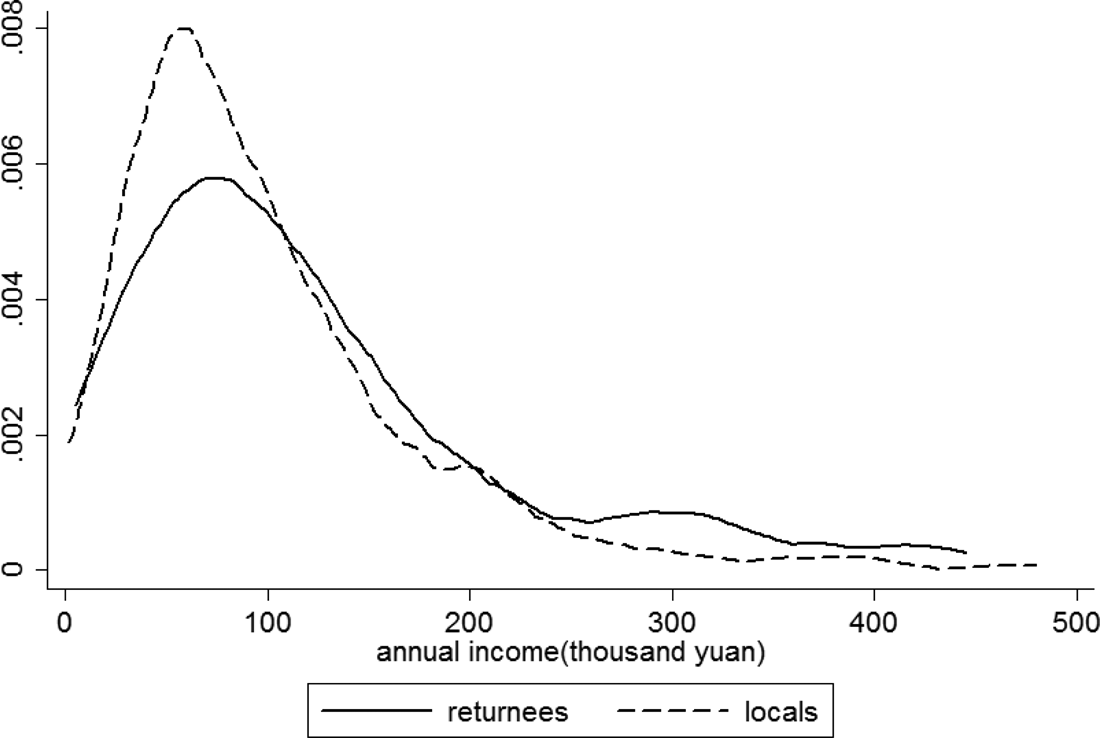
Figures 1 and 2 plot the estimated income density functions for bachelor's and graduate degree recipients, respectively.Footnote 44 Owing to an insufficient number of returnee PhD holders, we combine those with master's degrees and PhDs as graduate degree recipients.Footnote 45 In Figure 1, we see little difference between the income distributions of local and returnee bachelor's degree holders. However, the local bachelor's degree holders’ income distribution is skewed more to the right. Actually, there are 43 local bachelor's degree holders with income over 400,000 yuan, whereas the number for those with an overseas bachelor's degree is only five. The postgraduate returnees’ income distribution is clearly to the right of the local postgraduates, as shown in Figure 2.
The Estimated Income Distributions for Local and Returnee Bachelor's Degree Holders with Annual Incomes Less than 500,000 Yuan, 2014
Note:
This figure presents the estimated densities for the incomes of overseas and local bachelor's degree holders using the raw data. The sample comprises 385 overseas graduates and 4,960 local graduates.

The Estimated Income Distributions for Graduate Degree Holders with Annual Incomes Less than 500,000 Yuan, 2014
Note:
This figure presents the estimated densities for the incomes of overseas and local postgraduates using the raw data. The sample comprises 91 returnee and 560 local postgraduates.

Table 1 reports the descriptive statistics of all relevant variables. The average income of returnees is 91,539 yuan, much higher than that of locals, which is 75,105 yuan. Also, the average income of returnees has a much bigger standard deviation than that for locals. The share of master's degrees and PhDs among returnees is higher than among the locals.
Descriptive Statistics of Selected Variables

Source:
Notes:
The sample is limited to employed individuals with a bachelor's degree and above. Returnees are those who obtained their highest degree abroad, while Locals are those who gained their highest degree within China. Department head includes administrators in government offices, the Chinese Communist Party and mass organizations, enterprises and public institutions, such as universities or hospitals.
We divided the sample into five occupation types: department head, professional/technician, clerk, service personnel,Footnote 46 and worker in primary industry. As shown in Table 1, 39.2 per cent of returnees are professionals/technicians; 31.0 per cent are department heads. Those proportions are higher than the corresponding numbers for locals. As for the proportions in different types of businesses, returnees are more likely than locals to enter privately funded or foreign-funded enterprises, while locally educated people are more likely to work in state-owned enterprises (SOEs).
To get more accurate results, we match each returnee with a local so that the domestic group is as similar as possible to the returnees’ group. To be specific, we perform a one-to-one, “nearest neighbour,” propensity score matching (without replacementFootnote 47) for returnees based on their education level, gender, age, working experience, marital status and location.Footnote 48 As shown below, having a foreign diploma affects an individual's choice of occupation and type of business, so we do not match locals and returnees on those characteristics. Our large sample of locals allows us to conduct an exact match on gender and educational level (bachelor's, master's and PhD degrees) for each returnee. After deleting cases with no common characteristics, we end up with a matched sample of 482 locals and 482 returnees.
We then carry out our empirical analyses of the matched data. Analysing the data through matching pairs solves our problems very well. First, the number of domestic graduates (5,564) is much bigger than the number of returnees (487), so we can find a match for each returnee. Second, returnees have very different characteristics to some locals in the sample, so rather than using all the locals, we use only people who are similar, which allows us to attribute the differences between returnees and the matched locals to the experience of studying abroad.
Some balance test results show that matching substantially reduces the differences in the controlled characteristics between returnees and locals. Moreover, it turns out that even the uncontrolled proxy variables for ability and family background become comparable between the two groups after matching.Footnote 49
Empirical Results for Income
In this section, we analyse the income gap between returnees and locals. We find that returnees with a graduate degree have a higher income than do locally educated graduate degree holders, and the income premiums are owing to a human capital effect rather than a signalling effect. However, our analysis shows no significant differences between returnees and locals who have only a bachelor's degree.
Results on annual income
We first investigate the effect of an overseas diploma on annual income. As returnees with various degrees behave differently in many ways, we add interaction terms of Returnee and degrees in Mincer's income equation:Footnote 50
 $$\eqalign{& y_{\,pni} = \beta _1Returnee_{\,pni} \, \ast \, Bachelor_{\,pni} + \beta _2Returnee_{\,pni} \, \ast \, Graduate_{\,pni} \cr & \qquad \,\, + \beta _3Bachelor_{\,pni} + \beta _4Graduate_{\,pni} + \beta _5{\bf X}_{\,pni} + \mu _p + \vartheta _n + \epsilon _{\,pni}} $$
where y is the log annual income of individual i in province p and industry n; Returnee is a dummy variable that equals one for returnee and zero otherwise; Bachelor and Graduate are dummy variables for those with a bachelor's degree and those with a graduate degree, respectively; X is a vector of other control variables, including gender, marital status, age, tenure of current job and location; μ p and  $\vartheta _n$ are the province and industry fixed effects, respectively.Footnote 51
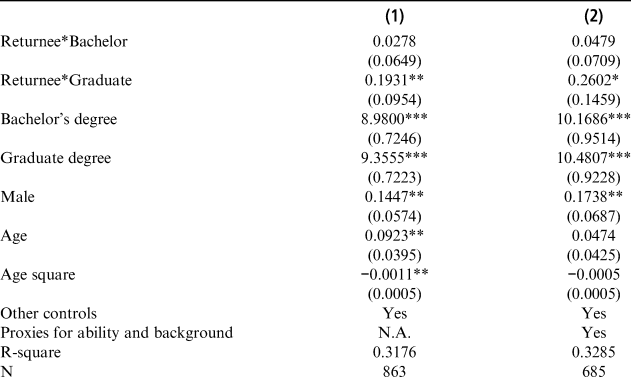
Column 1 of Table 2 reports the ordinary least squares (OLS) estimates of our primary model (1). The findings for Returnees*Graduate are significant at the 5 per cent level with an estimate of 0.1931, which means that returnees with a graduate degree earn 19.31 per cent more than locals with the same degree. The results for bachelor's degree students are not statistically significant, which suggests that there is no real income differential between returnees and locals with a bachelor's degree. Other important variables include gender, where males earn 14.47 per cent more than females, which is in line with findings that incomes vary across gender in China. We also find an inverted U-shaped relationship between an individual's age and income with younger and older people earning less than those in their middle ages. Column 2 reports the results when we control for the proxy variables of ability and family background and, when we do so, our findings on income differences between locals and returnees with graduate degrees are significant at the .10 per cent level (Row 2).Footnote 52
Estimates of Returnees’ Log Income Premium

Source:
CHFS 2015.
Notes:
Columns 1 and 2 both use the log annual income of individuals as the dependent variable. The numbers in parentheses are standard errors clustered at the city level. “Other controls” include tenure at current job and tenure squared, a marital status dummy, a dummy for living in urban versus rural areas, province and industry fixed effects. Proxy variables for ability and family background include the ability to understand the questionnaire, parents’ educational level and positions. ***, **, and * indicate significance at the 1%, 5%, and 10% level, respectively.
A human capital effect or a signalling effect?
To see whether a human capital effect and/or a signalling effect explains the income gap between returnees and locals, we add interaction terms with Tenure – the length of time in current jobFootnote 53 – to the model:
 $$\eqalign{y_{\,pni} = & \,\,\beta _1Returnee_{\,pni} \, \ast \, Bachelor_{\,pni} + \beta _{11}Returnee_{\,pni} \, \ast \, Bachelor_{\,pni}\ast Tenure_{\,pni} \cr & + \beta _2Returnee_{\,pni} \, \ast \, Graduate_{\,pni} + \beta _{21}Returnee_{\,pni} \, \ast \, Graduate_{\,pni} \, \ast \, Tenure_{\,pni} \cr & + \beta _3Bachelor_{\,pni} + \beta _4Graduate_{\,pni} + \beta _5{\bf X}_{\,pni} + \mu _p + \vartheta _n + \epsilon _{\,pni}} $$
In this way, we can compare the initial income difference between returnees and locals. In our view, a positive and significant result for β 2 (Tenure = 0) would suggest a signalling effect, as the employers would be paying returnees more without any confirmation as to whether their overseas study enhanced their productivity, while a statistically significant result for β 21 suggests that the higher salary follows after they have worked some time on the job.Footnote 54
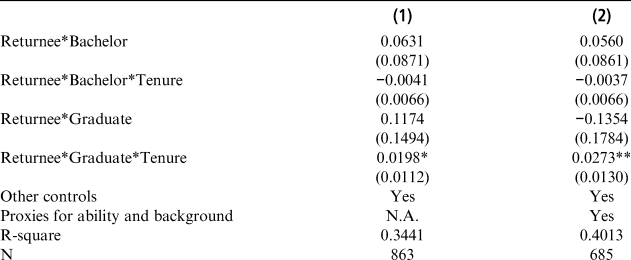
Table 3 reports the results of Model (2). Again, we find no difference in the salaries of local and returnee bachelor's degree recipients, even after they have spent time on the job. Nor do we find any significant difference between the salaries of graduate students when Tenure equals 0. Therefore, we can reject any signalling effect.
Human Capital versus Signalling Effect

Source:
CHFS 2015.
Notes:
Columns 1 and 2 both use the log annual income of individuals as the dependent variable. The numbers in parentheses are standard errors clustered at the city level. “Other controls” include a dummy for bachelor's degrees, a dummy for graduate degrees, a gender dummy, age and age squared, tenure at their current job and tenure squared, a marital status dummy, a dummy for living in urban versus rural areas, province and industry fixed effects. Proxy variables for ability and family background include the ability to understand the questionnaire, parents’ educational level and positions. ***, **, and * indicate significance at the 1%, 5%, and 10% level, respectively.
On the other hand, while Model (2) shows that we can reject a signalling effect for students with a graduate degree, when Tenure equals 0 the interaction term Returnee*Graduate*Tenure is statistically significant at the .10 level (Column 1), and significant at the .05 level when we include proxies for ability and family background. These results imply that the income gap will increase as employers gain more and more positive information about the true productivity of their employees through on-the-job observation, which is consistent with a human capital effect explanation. Therefore, we are confident that the higher salaries for returnees with foreign graduate degrees are owing principally to the superior productivity gained from their overseas education rather than the irrational behaviour of employers. According to Bai Chunli 白春礼, former deputy director of the China Association of Alumnae from Europe and America, and president of the Chinese Academy of Sciences as of 2016, “As China's education catches up with the West, sea turtle replacements have been growing at a rapid rate. Domestic employers are taking a more rational attitude towards sea turtles. They're not blindly chasing foreign diplomas anymore. They want real, solid experience.”Footnote 55
Cost and benefit analysis
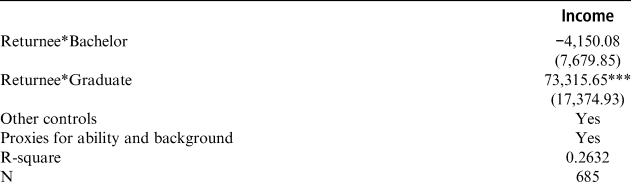
To study the benefit of studying abroad, we change the dependent variable from log-income to income in the main estimation equation (1) and get the results shown in Table 4.
Estimates of Returnees’ Income Premium

Source:
CHFS 2015.
Notes:
The numbers in parentheses are standard errors clustered at the city level. The dependent variable is the annual income of individuals. “Other controls” include a dummy for bachelor's degrees, a dummy for graduate degrees, a gender dummy, age and age squared, tenure at their current job and tenure squared, a marital status dummy, a dummy for living in urban versus rural areas, province and industry fixed effects. Proxy variables for ability and family background include the ability to understand the questionnaire, parents’ educational level and positions. ***, **, and * indicate significance at the 1%, 5%, and 10% level, respectively.
We can see that graduate returnees earn about 73,316 yuan more than locally trained graduates annually, while there is no significant income difference between returnees and locals with bachelor's degrees.
The average annual cost of studying abroad for a master's degree is about 299,000 yuan, and for a bachelor's degree it is 344,000 yuan.Footnote 56 According to the CHFS 2015, the cost of studying a master's in China is 14,790 yuan, and 17,219 yuan for a bachelor's degree. Therefore, annually, it costs about 284,000 yuan more to study for a master's degree abroad, and 327,000 yuan more for a bachelor's degree.
Based on the above analysis, even without considering overseas scholarships and part-time jobs, a returnee from a two-year master's degree programme can expect to get back the costs of studying abroad after working 7–8 years in China.Footnote 57
Occupations and Positions
In this section, we investigate the effects of a foreign diploma on the jobs that returnees choose and the positions they attain. We find that compared with domestic postgraduates, returned postgraduates are more likely to be department heads and work in the service sector, attain a higher position, and work in foreign-funded ventures. However, returnee bachelor's degree holders have no significant advantage in terms of choices of occupation, enterprise type and positions.
Occupation choice
First, we examine the effect of a foreign diploma on a graduate's choice of occupation. We divided occupations into five categories: clerk, department head, professional/technician, employee in the service (and business) sector, and worker in primary industry. Then we apply a multinomial logit model to investigate the effect of a foreign diploma on occupation choices.
Panel A of Table 5 reports the estimated marginal effects. It shows that having a foreign graduate degree significantly increases an individual's likelihood of being a department head by 14.19 per cent, or working in the service or business sector by 8.8 per cent; it somewhat decreases the probability of being a clerk by 13.95 per cent. Again, we find no significant difference between local and returnee bachelor's degree holders in terms of occupation choices.
Job Choices and Positions of Returnees versus Locals, 2014

Source:
CHFS 2015.
Notes:
The reported numbers are the marginal effects of Multinomial Logit models for Panels A and C, and an Ordered Probit model for Panel B. The numbers in parentheses are standard errors clustered at the city level. “Other controls” include a dummy for bachelor's degrees, a dummy for graduate degrees, a gender dummy, age and age squared, tenure at current job and tenure squared, a marital status dummy and a dummy for living in urban areas. For Panel B, “Other controls” also include provincial fixed effects and industry fixed effects. For Panel C, “Other controls” also include provincial fixed effects. “Other enterprises” in Panel C cover all types of businesses not included in the above three categories, such as NGOs and the military. ***, **, and * indicate significance at the 1%, 5%, and 10% level, respectively.
When we include these different occupations in the original Model (1), we find that salaries earned by department heads and service sector or business employees are significantly higher than clerical salaries (30.62 per cent and 28.61 per cent higher, respectively). Meanwhile, the income differential among individuals with graduate degrees drops from 26.02 to 18.15 per cent, while the income gap between local and returnee bachelor's degree holders is still not statistically significant. These results suggest that the higher income of returnees with a graduate degree is partly explained by their higher probability of being a department head or an employee in the service or business sector.
Positions
Higher positions generally bring higher salaries. And since some returnees have wider social networks,Footnote 58 as well as attributes which can positively influence promotions in official careers,Footnote 59 such as better personal abilities and educational backgrounds, we believe that returnees tend to get higher positions.
To compare the positions held by returnees and domestic graduates, we rank the positions according to the questionnaire, with position 1 being a worker; position 2, a group leader; position 3, a section chief; position 4, a department head; and position 5, a bureau head. We then use an Ordered Probit model to study the effect of a foreign diploma on positions.
Panel B of Table 5 reports the estimated marginal effects. While the findings are significant only at the .10 level, the trends are in the right direction, so we report them here. First, and not surprisingly, returnees with a graduate degree are less likely than domestic graduate degree holders to be workers. Second, returnees with graduate degrees seem more likely than locals with the same to become section chiefs and bureau heads, suggesting that an overseas education does help the returnees to secure higher-ranking posts. Finally, we find again that there is no significant difference between having an overseas or domestic bachelor's degree in terms of position reached.
Also, although we do not show the results in table form here, when we include “Position” in our regression model explaining salary differences between returnee and local graduate students, the coefficient for Returnee*Graduate drops to 0.1912, suggesting that part of the income difference between returnee and local postgraduates can be explained by position. The finding for those with undergraduate degrees remains statistically insignificant.
Choice of business types
Different types of enterprises have different pay scales,Footnote 60 with foreign-invested firms (FIES) generally paying higher wages than SOEs or private domestic firms. So, if returnees are more likely to work in FIEs, then the choices that locals and returnees make about where to work may contribute to wage or income differentials.
We categorize firms into four groups: state-owned or collective enterprises, privately funded enterprises, foreign-funded enterprises and “other” enterprises. We then employ a multinomial logit model to see if having a foreign degree affects the type of enterprise one joins. We also control for the impact of the province in which the respondents work because salaries can vary significantly by region in China.
Panel C of Table 5 shows that compared to domestic graduate degree holders, returnee graduate degree holders have a 3.17 per cent higher probability of entering a foreign-funded venture, which is consistent with previous findings that people educated abroad are more frequently employed in internationally oriented jobs.Footnote 61 Panel C of Table 5 also shows that compared with local bachelor's degree holders, overseas bachelor's degree holders are 2.17 per cent more likely to enter “other” enterprises, such as NGOs, and are 5.26 per cent less likely to enter an SOE or collective enterprise.
Although we do not present our findings in tabular form here, when we include firm types in the model that analyses salaries, we find that foreign-funded enterprises pay 55.2 per cent more than SOEs or collective enterprises, while the salaries offered in private and “other” enterprises are not significantly different from those offered in SOEs or collective enterprises. These results are consistent with previous findings that graduates employed in foreign firms, such as fully foreign-owned enterprises or Sino-foreign joint ventures, receive a higher wage.Footnote 62 Moreover, an overseas graduate degree increases a salary by 18.77 per cent, while the comparison between those holding an undergraduate degree is still not statistically significant. These results demonstrate that the higher income awarded to those with an overseas graduate degree can be partly explained by the fact that these returnees are more likely to enter an FIE, and not just because of the skills learned abroad.
Conclusion
Massive numbers of Chinese students have gone overseas to study since China opened up in 1978, and the desire to study abroad continues. But the added value of a foreign diploma begs the question: is the investment in overseas study worth it?
Using national survey data, we empirically study the impact that studying abroad has on later labour market performance in China. Because people who go overseas are inherently likely to be different from people who do not study abroad in significant ways, we match the people in our returnee dataset with locals who share many similar attributes, and then carry out our empirical analyses on the matched pairs.
Our results indicate that over time, those returning from overseas with a graduate degree achieve salaries that are 20 per cent higher than those awarded to local postgraduates. Second, when we compare human capital effects versus signalling effects, we find that unless a returnee can demonstrate significantly improved skills or “efficiency,” he or she will not be rewarded for simply going abroad. Instead, students must enhance their human capital while they are abroad, and as this fact becomes more obvious over time, returnee postgraduates will earn higher salaries than locally trained graduate students.
In addition, compared with locally trained graduate degree holders, returnees with a graduate degree are more likely to work in higher-income professions and in FIEs, and also to attain higher positions. These factors all contribute to enhance the incomes of postgraduate returnees.
The decision to return home after graduating from a foreign university is partly based on the domestic economic opportunity, which “pulls” people home.Footnote 63 Moreover, our finding of higher earnings for returnees with graduate degrees should further encourage overseas graduates to return home, in line with China's goal of attracting students who have earned a graduate degree abroad. Since 2015, there have been serious incentives offered by the state to encourage those with overseas graduate degrees to return home, including the opportunity to live in Beijing, Shanghai or Shenzhen. Since the income premium is offered in exchange for their improved skills, returnee postgraduates’ enhanced human capital can contribute to China's economic modernization, making the study abroad programme a positive policy for China's development.
However, those holding overseas bachelor's degrees have no significant advantage over locals with a bachelor's degree in terms of income, choices of occupation, enterprise type and positions. So, once a Chinese student goes abroad to study, getting a master's degree should be part of his or her strategy.
Finally, our conclusions could be stronger if we had directly comparable data across returnees and locals. With the capability variables of domestic and overseas students before and after they graduate, we could directly study the effects of studying abroad on students’ human capital. Moreover, we could control such ability variables when running the regressions. As yet, no survey collects that type of data and so, until that time, the findings we present here are important.
Supplementary material
To view supplementary material for this article, please visit https://doi.org/10.1017/S0305741021000023
Acknowledgements
The authors thank two anonymous referees for helpful comments. Yuting Sun's research is funded by Liaoning Province Social Science Planning Fund Project (Grant No. L19CJY009). Guochang Zhao's research is funded by the National Natural Science Foundation of China (Grant No. 71603215) and the 111 Project of China (Grant No. B16040).
Conflicts of interest
None.
Biographical notes
Zaichao DU is professor of economics at Fudan University, China. His current research focuses on econometrics, financial risk management and the Chinese economy.
Yuting SUN is lecturer of economics at Dongbei University of Finance and Economics, China. Her current research focuses on labour economics and education economics.
Guochang ZHAO is associate professor of economics at Southwestern University of Finance and Economics, China. His current research focuses on labour economics and education economics.
David ZWEIG is professor emeritus, The Hong Kong University of Science and Technology, director of Transnational China Consulting Limited, HK, and vice-president of the Center for China and Globalization (Beijing).