Introduction
Among all the agricultural sectors in Africa, production and marketing of fruits and vegetables offer one of the most important opportunities for income generation, employment creation and improvement in food security. Kenyan fruit and vegetable exports alone were estimated to be worth USD 1 billion in 2008 (Horticultural Crops Development Authority of Kenya; HCDA, 2010). Fruits such as mango (Mangifera indica L.; Anacardiaceae) have seen a steady increase in production over the last decade with yields increasing to 10 tons per ha, but potential yields of 25 tons per ha or more can be achieved from improved varieties (Griesbach, Reference Griesbach2003).
In 2012, Kenya's average mango production rose to 2.8 million tons worth USD 153 million from 593,499 tons worth USD 122 million in 2010 (HCDA, 2013). Similarly, the area under mango cultivation has increased from 47,051 ha in 2010 to 57,021 ha in 2013 (HCDA, 2014). Of the total mango output, approximately 98% is consumed locally while 2% is exported (Government of Kenya; GOK, 2010). The main export market is the Middle East, and smaller volumes are exported to other markets such as Holland, UK, Belgium, Germany and France (FAO, 2009). There is, therefore, little doubt that mango production has the potential of improving farmers’ livelihoods.
Notwithstanding its positive prospects, the mango industry in Kenya is adversely affected by various factors including pests and diseases, lack of quality planting material, poor post-harvest handling technologies, poor road infrastructure, limited knowledge about improved production technologies and high freight costs (Irungu, Reference Irungu2011; Ekesi et al., Reference Ekesi, Chabi-Olaye, Subramanian and Borgemeister2011a). Among these challenges, the problem of insect pests and diseases ranks high, as these are regarded as the most important for production and marketing, directly lowering the quality and quantity of the fruits.
As with other African countries, fruit flies are generally regarded to be the most important constraints of fruit production. The invasive tephritid fruit fly, Bactrocera dorsalis (Hendel), and other native species such as Ceratitis cosyra (Walker), Ceratitis fasciventris Bezzi, Ceratitis rosa Karsch, Ceratitis anonae Graham and Ceratitis capitata (Wiedemann) cause direct damage to mango, leading to 40–80% losses depending on the locality, variety and season (Ekesi et al., Reference Ekesi, Nderitu and Rwomushana2006; Ekesi and Billah, Reference Ekesi and Billah2007; Rwomushana et al., Reference Rwomushana, Ekesi, Gordon and Ogol2008). Quarantine restrictions on fruit fly-infested mango limit access to lucrative export markets abroad, where these insects are quarantine pests. For example, exports of host crops of B. dorsalis (such as mango) from many African countries are already banned in Seychelles, Mauritius, South Africa and several European countries (Ravry, Reference Ravry2008). Trade of several horticultural produce between Africa and the USA has been severely hampered by a Federal Order issued by the United States Department of Agriculture-The Animal and Plant Health Inspection Service (USDA-APHIS, 2009) banning importation of several cultivated fruits and vegetables from African countries where B. dorsalis has been reported. Industry losses across the entire African continent as a result of export trade bans associated with fruit flies are estimated at approximately USD 2 billion annually (S. Ekesi et al., unpublished data).
In Kenya, management of fruit flies is largely dependent on the use of chemical pesticides. Over time, and with the rapid growth in the agricultural sub-sectors (mainly cash crops and horticulture), pesticide use in the country has increased (Ohayo-Mitoko, Reference Ohayo-Mitoko1997). Accordingly, pesticide imports in Kenya increased by about 38% between 2003 and 2008, a trend that FAO said is expected to persist (FAO, 2013). Majority of these pesticides find their use in the horticultural sub-sector (Nyakundi et al., Reference Nyakundi, Magoma, Ochora and Nyende2010). In fact, it is reported that pesticide use in the production of fruits and vegetables is seven times higher than in other crops (Fernandez-Cornejo et al., 1994). This high usage is accelerated by consumers’ demand for aesthetic value of the fresh produce (Okello and Swinton, Reference Okello and Swinton2010).
Although pesticides have been used as the primary pest control strategy, they have been shown to be ineffective against some insect pests such as fruit flies whose larvae (the destructive stage) develop inside the fruit tissue and so cannot be reached by pesticides applied on the fruit surface. Consequently, farmers are misusing pesticide by increasing the dosage and frequency of spraying, and mixing various brands. All these measures are targeted at improving effectiveness (Gitonga et al., Reference Gitonga, Okello, Mithoefer, Olaye and Ritho2009; Mugure, Reference Mugure2012). Such pesticide misuse practices have adverse health, cost, trade and environmental implications (Nyakundi et al., Reference Nyakundi, Magoma, Ochora and Nyende2010). Rola and Pingali (Reference Rola and Pingali1993) also observed that use of pesticides in developing countries seriously compromises farmers’ health due to unsafe application procedures caused by high illiteracy levels.
To respond to these negative concerns associated with the use of pesticides, agricultural sector stakeholders continue to consider alternative pest management strategies that seek to minimize pesticide use such as integrated pest management (IPM). Indeed, in managing pests such as fruit flies, an IPM approach offers the best method to improve the economies of the production system by reducing yield losses and enabling growers to comply with stringent quality standard of the export market (Aluja, 1996; Allwood and Drew, Reference Allwood and Drew1997; Ekesi et al., Reference Ekesi, Maniania and Mohamed2011b).
icipe has developed and is currently disseminating an IPM package for the management of fruit flies across various African countries, including Kenya (Ekesi and Billah, Reference Ekesi and Billah2007; Ekesi et al., Reference Ekesi, Mohamed and Hanna2010, Reference Ekesi, Chabi-Olaye, Subramanian and Borgemeister2011aReference Ekesi, Maniania and Mohamedb, Reference Ekesi, Mohamed and Tanga2014). The package consists of five components: (1) use of male annihilation technique (MAT) incorporating methyl eugenol; (2) use of food-based bait (Mazoferm) mixed with Spinosad insecticide and applied as spot spray; (3) use of Metarhizium anisopliae-based fungal biopesticides; (4) releases and conservation of exotic parasitoids (Fopius arisanus (Sonan) and Diachasmimorpha longicaudata (Ashmead)); (5) orchard sanitation using an augmentorium (trap) or burying of fallen fruits. Mango farmers participating in the application of the fruit fly IPM package have recorded lower fruit damage (less than 14%) compared with 24–60% damage reported in mango growers’ farms that were either unmanaged or relying on conventional pesticide application (Ekesi et al., Reference Ekesi, Mohamed and Hanna2010, Reference Ekesi, Maniania and Mohamed2011b, Reference Ekesi, Mohamed and Tanga2014; Kibira, Reference Kibira2014). In Kenya, it has been demonstrated that the use of any 2–3 management components listed above within the context of IPM increases net income of smallholder growers by 22.4% relative to control, and insecticide use and mango rejection were reduced by 46.4 and 54.5%, respectively (Kibira, Reference Kibira2014).
Previous studies have revealed that adoption of IPM is beneficial to farmers in terms of reduction in pesticide expenditures and pest damage, and improving farm enterprise profitability (Fernandez-Cornejo, Reference Fernandez-Cornejo1996; Dasgupta et al., Reference Dasgupta, Meisner and Huq2005; Baral et al., Reference Baral, Roy, Rahim, Chatterjee, Mondal, Mondal, Ghosh and Talekar2006; Jankowski, et al., Reference Jankowski, Mithöfer, Löhr and Waibel2007). Despite the success of the fruit fly IPM package and its potential demand, evidenced by farmer's willingness to pay for the technology (Mugure, Reference Mugure2012), its intensity of adoption in Kenya has not been studied. Here, farm-level adoption of the fruit fly IPM components by growers in Embu East Sub-County of Kenya is assessed.
Methodology
Study area and sampling technique
The study was conducted in Runyenjes and Kyeni divisions of Embu East Sub-County, Kenya. Three locations (with 10 sub-locations) – Kyeni South, Kyeni East and Kagaari South, which are among the major mango-growing areas – were included in the study. The 10 sub-locations are Karurumo, Kasafari and Kathanguri in Kyeni South, Kigumo and Mukuria in Kyeni East and Nthagaiya, Gichera, Kiringa, Kanduri and Kigaa in Kagaari South. The agroecology of the study area is typically homogeneous and is greatly influenced by Mount Kenya, similarly endowed with fertile and well-drained soils.
Multistage sampling procedure was used to obtain the sample of mango farmers to be interviewed. In the first stage, three mango-producing locations (Kyeni South, Kyeni East and Kagaari South) in Embu East Sub-County were purposively selected. In the second stage, 10 sub-locations in the different locations were also purposively selected based on their level of mango production. A sampling frame of 1000 farmers was compiled with the assistance of icipe staff, divisional agricultural officers based in Kyeni and Runyenjes divisions and village elders. This sampling frame consisted of 600 farmers who had attended icipe fruit fly IPM training, awareness campaigns and demonstration activities, and 400 who had not participated in the activities.
We defined ‘participants’ as mango growers who were involved in icipe fruit fly IPM training, awareness campaigns and demonstration activities and actively participated in testing the effectiveness of the various IPM components against mango-infesting fruit flies in the study area. The farmers participated in the IPM activities by attending fruit fly management training sessions in selected mango orchards within their respective sub-locations. Participants were trained on use of the various components of the IPM package and thereafter issued with a starter-pack of the components to use in their orchards on trial basis. When the demonstration activity was concluded in the 2011/2012 mango-growing season, farmers willingly purchased the components of the package from local agroshops during subsequent mango seasons and applied them based on the previous knowledge acquired from the various fruit fly IPM training sessions. ‘Non-participants’ were growers who did not participate in the icipe fruit fly IPM training, awareness campaigns and demonstration activities.
In the third stage, a sample of 447 and 358 respondents, respectively, from the participant and non-participant sampling frames, was randomly drawn. Since the number of mango farmers in the three locations varied, the probability proportional to size sampling technique was used to ensure representativeness of the target population. Three hundred farmers were sampled from Kagaari South, 354 from Kyeni South and 151 from Kyeni East locations. Data were collected using a household-level interview survey conducted between 10th November 2012 and 15th December 2012, to obtain primary data on farmers’ demographics, socio-economic characteristics, mango production and marketing constraints, mango output and sales, and mango pest and disease control (including fruit fly IPM components adopted) as well as source of information on pest and disease control.
Methods and data analysis
Descriptive statistics were used together with the Poisson and negative binomial regression models to analyse the data in STATA version 12 (StataCorp LP, TX, USA). To assess the relative difference between fruit fly IPM participants and non-participants, the main descriptive analyses used were the two-group mean comparison t-test and the two-sample test of proportion. The Poisson and negative binomial regression models were used to assess the intensity of adoption of components of the IPM package. The Poisson model was chosen because the number of fruit fly IPM components adopted (dependent variable) was a discrete variable taking positive integers only. The Poisson regression model predicts the number of fruit fly IPM components used by the ith farmer, which indicates the intensity of adoption of the fruit fly IPM package.
Following Greene (Reference Greene2007), the Poisson model assumes that the number of occurrences of the event of interest (dependent variable), given a vector of independent variables, X has a Poisson distribution with probability density given as (equation 1):
 $$ Pr \left ( Y = y _{ i }/ X _{ i }\right ) = \frac { e ^{ - \lambda } \lambda ^{ y }}{ y ^{!}}, y _{ i } = 0,1,2,.., n , $$
where y i is a random variable representing the number of occurrences of the event of interest (number of fruit fly IPM components adopted), X i is a vector of explanatory variables influencing the number of fruit fly IPM components adopted by the ith farmer and λ are the parameters of interest (expected number of IPM practices used by the ith farmer) to be estimated. Finally, n denotes the total number of fruit fly IPM components constituting the package.
The most common formulation for the parameter of interest (λi) is the log-linear model (Greene, Reference Greene2007) given as:
 $$ln \lambda _{ i } = x _{ i } \beta . $$
Equation (2) implies that the parameter  $$\lambda _{ i } $$ is linearly related to the explanatory variables,
 $$x _{ i } $$
The Poisson model also has the convenient feature that
 $$ E \left ( y _{ i }/ x _{ i }\right ) = var\left ( y _{ i }\right ) = \lambda _{ i }. $$
Equation (3) denotes the equidispersion assumption of the Poisson model, which implies that the number of fruit fly IPM components adopted by the ith farmer is equal to its variance.
Following Greene (Reference Greene2008), the model to be estimated is specified as:
 $${\begin{array}{ccc}Prob\left ( Y = y _{ i }/ x _{ i }\right ) = \frac {\,exp\,( - \lambda _{ i }) \lambda _{ i }^{ y _{ i }}}{\Gamma (1 + y _{ i })}, \\ \partial _{ i } = \,exp\,( \alpha + X _{ i }^{\lsquo } \beta ),\ \ y _{ i } = 0,1\ldots , i = 1,\ldots , N \\ \end{array} } $$
where  $$y _{ i } $$ is a random variable representing the number of IPM components adopted by the ith farmer,
 $$x _{ i } $$ are the explanatory variables that influence the number of fruit fly IPM components adopted by the ith farmer, β is a vector of unknown parameters to be estimated and n is the number of IPM components constituting the IPM package.
After estimating the regression model mentioned above, a test for overdispersion and underdispersion was carried out. This test is important because there is a possibility that the restrictive assumption, imposed by the Poisson model, of equality of the variance and the mean of the number of fruit fly IPM components adopted may not hold. Following Trentacoste (Reference Trentacoste2000), we tested for the presence of over- or underdispersion using the Pearson χ2 ratio (Pearson's χ2 divided by degrees of freedom), where Pearson's χ2 between 0.8 and 1.2 indicates that the model is appropriate for modelling the data. The calculated Pearson's χ2 ratio for this study was 0.73, indicating the presence of underdispersion.
In the presence of underdispersion, the estimates of the Poisson regression model are inefficient and biased, which invalidate the inferences based on the estimated standard errors (Winkelmann and Zimmermann, Reference Winkelmann and Zimmermann1995; Cameron and Trivedi, 1999). In such situations, Greene (Reference Greene2007) suggested the functional form for the negative binomial regression model that relaxes the equidispersion assumption of the Poisson model. The negative binomial model was then specified as follows:
 $$ E \left ( y _{ i }/ x _{ i }, \varepsilon _{ i }\right ) = exp\left ( \alpha + X _{ i }^{\lsquo } \beta + \varepsilon _{ i }\right ) = h _{ i } \lambda _{ i }, $$
where  $$h _{ i } = exp\left ( \varepsilon _{ i }\right ) $$ is assumed to have one parameter gamma distribution,
 $$\varepsilon \left ( \theta , \theta \right ) $$ with mean 1 and variance
 $$1/ \theta = k ; $$
 $$\begin{eqnarray} f ( h _{ i }) = \frac { \theta ^{ \theta }\,exp\,( - \theta h _{ i }) h _{ i }^{ \theta - 1}}{\Gamma ( \theta )},\ h _{ i }\geq 0,\ \theta > 0. \end{eqnarray}$$
with variance given as:
 $$\left ( y _{ i }/ x _{ i ,} \varepsilon \right ) = \lambda _{ i } - u\lambda _{ i }, $$
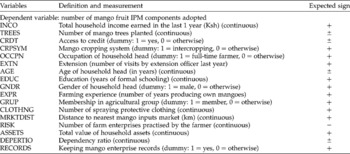
where the disturbance term ɛ reflects either specification error, or the heterogeneity characterizing microeconomic data. The independent variables used in this study were chosen based on the results of previous studies and economic theory. These variables are presented in Table 1.
Factors hypothesized to influence the intensity of adoption of the fruit fly IPM components in Embu East Sub-County, Kenya

Results and Discussion
Descriptive statistics of participants and non-participants in the fruit fly IPM demonstration activities
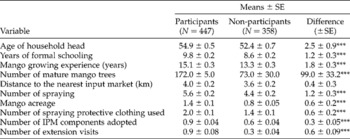
Descriptive statistics results for participants and non-participants of the IPM package are presented in Table 2. These results indicate that the age of fruit fly IPM participants was statistically significantly higher (with an average age of 54.9 ± 0.5 years) than that of non-participants whose average age was 52.4 ± 0.7 years. Similarly, participants had significantly more mango growing experience of 15.1 ± 0.3 years compared with non-participants who had an experience of 13.3 ± 0.3 years. Fruit fly IPM participants had an average of 9.8 ± 0.2 years of formal schooling compared with non-participants who had an average of 8.6 ± 0.2 years of formal schooling, and the difference was statistically significant. Participants in the IPM allocated statistically significant large proportion of land to mango production (on average 1.4 ± 0.1 acres or 1 ha) had significantly more mango trees (172.0 ± 5.0 trees) than non-participants who allocated an average of 0.85 ± 0.05 acres (less than 1 ha) of land to mangoes with an average of 73.0 ± 30.0 trees.
Descriptive statistics of selected variables for IPM project participants and non-participants in Embu East Sub-County, Kenya (Source: survey data, 2013)

*** Significant at 99% confidence level.
Participants on average sprayed their mangoes more frequently (5.6 ± 0.2 times) compared with non-participants who sprayed 4.4 ± 0.2 times per season, and the difference was statistically significant at the 1% level. The high spraying frequency among IPM participants could be attributed to the use of the Mazoferm–Spinosad food bait, a component of the fruit fly IPM package that requires farmers to spray weekly (approximately 50 ml spot-spray of the solution) to 1 m2 of the mango canopy to enhance the effectiveness of the bait spray. On average, IPM participants used statistically more protective clothing for spraying (2.0 ± 0.1) compared with non-participants who used an average of 1.4 ± 0.1 protective clothing. This protective clothing includes spraying mask, spraying goggles, overalls, gumboots and gloves.
Descriptive analysis of adoption of the fruit fly IPM package by sampled farmers in Embu East Sub-County, Kenya
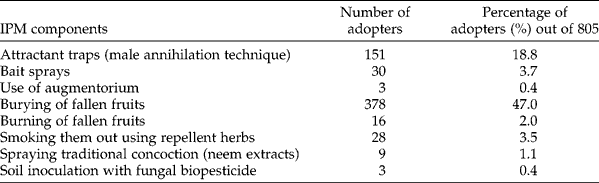
A mango grower who practised one or a combination of the components presented in Table 3 in addition to conserving the exotic parasitoids that were released by not embarking on broad spectrum cover spray of chemical pesticide was considered to be an IPM adopter. For both participants and non-participants, adopters were defined as those who purchased components or borrowed from other mango farmers and continued to use them in subsequent mango seasons. Participants who were issued with components but did not purchase nor borrow components in the 2012/2013 season after completion of the project were treated as non-adopters, since comparing them with non-participants who were not issued with any component would introduce bias.
Adoption of fruit fly IPM components by sampled farmers in Embu East Sub-County, Kenya (Source: survey data, 2013)
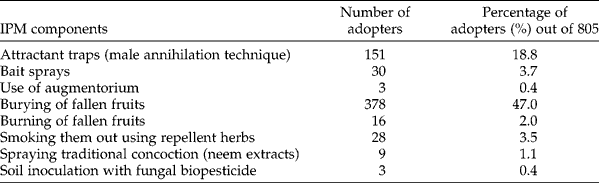
Results indicate that 58.5% (471/805) of the sampled mango farmers adopted at least one of the fruit fly IPM components developed and being promoted by icipe. Results further revealed that the most popular IPM component among the sampled mango farmers was burying fallen fruits, which was adopted by 47% of the respondents followed by the use of MAT, which was adopted by 18.8% of the respondents. Burying of fallen fruits, although labour-intensive, relies on family labour at no extra cost, and so is cheaper and highly adopted. Bait sprays was adopted by 3.7% of the respondents. The least adopted fruit fly IPM component was the use of augmentorium, which was adopted by 0.4% of the respondents. Biological control was left out of this analysis since the wasps were released in the fields at no extra cost to the farmers and also the technology is self-spreading (Mugure, Reference Mugure2012).
Adoption of the fruit fly IPM package by participants and non-participants
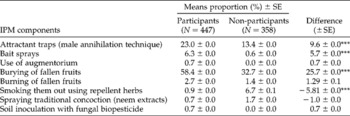
Results presented in Table 4 indicate that a higher percentage of farmers who participated in the trials (23.0%) adopted the use of MAT using methyl eugenol compared with 13.4% among non-participants with statistically significant difference at 1% level between both groups. This could be attributed to the fact that growers are mostly convinced when they see the fruit flies trapped and killed in the Lynfield traps used to contain the insects compared with the other management components where dead insects are often not seen. Among the participants, 6.3% adopted the bait sprays as an IPM component compared with 0.6% among the non-participants, with significant difference between the two groups (P< 0.01). This finding can be explained by the fact that Mazoferm food bait was withdrawn from the market by the producers (Corn Product International, Kenya) shortly after the introduction of this management component due to some unknown reasons and growers could no longer purchase the food bait after they had already utilized the starter pack provided by icipe. The augmentorium and biopesticide components were the least adopted between the two groups. In fact, none of the non-participants adopted any of these components. Discussion with key informants and lead farmers revealed that the low adoption level of the augmentorium component was due to the difficulty in constructing and assembling of the tent while the fungal biopesticide component was not readily available in the market. Overall, majority of the IPM package components are also knowledge intensive; hence, more mango growers who participated in the demonstration activities have a higher likelihood of adopting it compared with non-participants.
Two-sample test of proportion (%) for different IPM components adopted by participants and non-participants (Source: survey data, 2013)

*** Significant at 99% confidence level.
The percentage of participants in the IPM group adopting the burying of fallen fruit component (58.4%) was significantly higher (P< 0.01) compared with non-participants (32.7%). It was established that majority of the mango growers initially did not appreciate the importance of proper disposal of rotten fruits to minimize fruit fly population. Therefore, those who had participated in the IPM training, awareness and demonstration activities and were trained on orchard sanitation had a higher likelihood of burying their fallen fruits compared with non-participants.
Determinants of intensity of adoption of the fruit fly IPM package in Embu East Sub-County
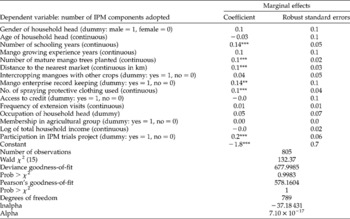
The negative binomial model was estimated to assess the intensity of adoption of the fruit fly IPM components. χ2 value from the model was significant at 1% level.
According to the negative binomial model (Table 5), six variables had a significant impact on the intensity of adoption of the fruit fly IPM components: education of the household head, number of mature mango trees planted, distance to the nearest mango input market, keeping records of mango enterprise and use of protective clothing for spraying. Results indicate that educated mango growers were more likely to adopt additional IPM components than less educated growers. As expected, education had a positive correlation with the intensity of IPM components adoption since IPM is a knowledge-intensive technology. Growers that participated in the fruit fly IPM demonstration activities have higher likelihood of adopting more IPM components. This result supports previous findings that have shown a strong correlation between participation in field days/demonstrations/IPM training and intensity of IPM adoption (Ramirez and Shultz, Reference Ramirez and Schultz2000; Maumbe and Swinton, Reference Maumbe and Swinton2000; Singh et al., Reference Singh, Vasisht, Kumara and Das2008). Participation in demonstration activities (as a proxy to access to IPM information) improves the trust and confidence of the farmers in the IPM package, hence increasing the chances of adopting more of its components.
Negative binomial regression results for factors influencing the intensity of adoption of the fruit fly IPM components in Embu East Sub-County, Kenya (Source: survey data, 2013)

Level of significance for dy/dx: *** = (1%) and ** = 5%.
As expected, the distance to the nearest mango market is positively associated with the probability of IPM adoption. Specifically, an increase in distance to the nearest input for mango production is associated with a higher likelihood of adopting more IPM components. This result can be explained by the fact that growers whose orchards are situated further away from inputs market have less access to purchase management inputs, hence are more likely to readily adopt other IPM components (as substitutes) such as orchard sanitation through burying of fallen fruits to minimize fruit fly infestation in their orchards. Keeping of mango enterprise records is predicted to increase the probability of adopting more fruit fly IPM components. Proper implementation of IPM package requires close timing and monitoring of components by the orchard operator. Growers who keep proper records are thus more likely to adopt more components since records will enable them to implement different components and monitor their results in a timely manner.
Results indicate significant positive scale effect on the intensity of adoption of the fruit fly IPM components. Precisely, mango growers who have higher number of mango trees are more likely to adopt more IPM components. This result contradicts the findings of Singh et al. (2008), who found negative scale effect of paddy IPM adoption in India. However, it supports the results of Maumbe and Swinton (Reference Maumbe and Swinton2000), who identified farm size as an important variable positively influencing cotton IPM adoption in Zimbabwe. Large mango growers view mango as a priority crop and are thus more interested in adopting improved methods for controlling fruit fly infestation. Furthermore, growers with more mango trees are presumed to be commercially oriented and thus seek for more cost-effective measures to minimize pest management methods (such as the use of IPM).
In addition, the increased use of protective gear for spraying (largely due to awareness of the harmful health effects of pesticides) significantly strengthens the likelihood of adopting fruit fly IPM components. Mango growers who are more aware of pesticide-related health hazards are more likely to adopt fruit fly IPM components with a view to minimizing exposure to these hazards. However, this finding contradicts that of Maumbe and Swinton (Reference Maumbe and Swinton2000) which concluded that awareness of pesticide-related health hazards has no influence on IPM adoption.
Conclusions
Different socio-demographic characteristics of growers participating in fruit fly IPM demonstration activities and non-participants were assessed. It is apparent that factors such as number of mature mango trees planted, participation in fruit fly IPM training and demonstration activities, education of household head, use of protective clothing for spraying, distance to the nearest mango input market and record keeping have a positive influence on the intensity of adoption of the fruit fly IPM package. Our results showed that use of the fruit fly IPM package has positive scale effect (due to the effect of the number of mango trees) on the intensity of adoption, and IPM promotional campaigns should also be tailored to suit the needs of large mango orchard operators.
Acknowledgements
We are extremely indebted to the African Fruit Fly Programme (AFFP) of the International Centre of Insect Physiology and Ecology (icipe) for financially supporting this research. We thank the staff of the Kenyan Ministry of Agriculture who were involved in the focus group discussions and survey. We sincerely thank all the farmers who willingly volunteered information and enumerators for their efforts. We also thank Beatrice W. Muriithi for her comments that helped to improve the quality of the paper.