Introduction
Antarctic Cenozoic fossil deposits give us important information about a period of environmental change in the Southern Hemisphere. This includes the final break-up of Gondwana, the onset of the Antarctic Circumpolar Current and the first major expansion of Antarctic ice (Zachos et al. Reference Zachos, Breza and Wise1992). Establishment of present-day oceanographic and atmospheric circulation patterns also took place in the Cenozoic (Ivany et al. Reference Ivany, Lohmann, Hasiuk, Blake, Glass, Aronson and Moody2008).
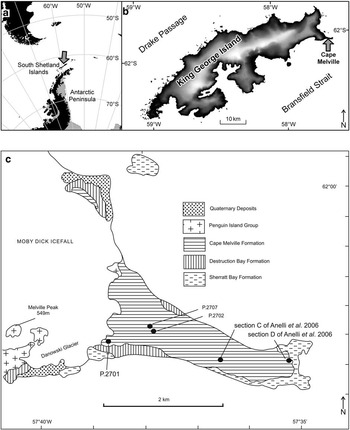
The Cape Melville Formation preserves one of the most important glacial faunal assemblages from Antarctica during the Cenozoic. Study of the British Antarctic Survey (BAS) Cape Melville Formation collection has increased our knowledge of the bivalve assemblage, which contributes to the overall community structure of the formation and of Antarctica in the Early Miocene. The exposures of the Cape Melville Formation on King George Island, located to the north-west of the Antarctic Peninsula (Fig. 1), preserve a Miocene marine invertebrate fauna. Few fossiliferous outcrops are found from this age in Antarctica (Beu Reference Beu2009), therefore this assemblage is extremely important in understanding Cenozoic biodiversity in Antarctica. Along with the underlying Late Oligocene Destruction Bay Formation (Quaglio et al. Reference Quaglio, Whittle, Gaździcki and Simões2010), the Cape Melville Formation provides a unique fossil record in the Antarctic Peninsula region during a latest Oligocene to earliest Miocene interglacial to glacial transition (Birkenmajer et al. Reference Birkenmajer, Gaździcki and Wrona1983, Dingle & Lavelle Reference Dingle and Lavelle1998, Troedson & Riding Reference Troedson and Riding2002).
a. Location of the South Shetland Islands, b. location of Cape Melville on King George Island, and c. Cape Melville geology and site localities (P. 2701, P. 2702 and P. 2707) for nuculid specimens from BAS and the Instituto de Geociências, Universidade de São Paulo (adapted after Feldmann & Crame Reference Feldmann and Crame1998).

Geology and stratigraphy of the Cape Melville Formation
The Cape Melville Formation (Moby Dick Group, King George Island Supergroup) comprises a c. 150 m thick exposure on the narrow Melville Peninsula, which lies at the eastern extremity of King George Island, West Antarctica (Troedson & Riding Reference Troedson and Riding2002) (Fig. 1). The unit consists of horizontal to sub-horizontally bedded mudstones and silty mudstones, which are characterized by a diverse assemblage of glacially rafted lithological material (Birkenmajer et al. Reference Birkenmajer, Gaździcki and Wrona1983). It has been dated as 22.6 ± 0.4 Ma (Early Miocene) based on Sr isotope data from bivalves (Dingle & Lavelle Reference Dingle and Lavelle1998).
Overall, the assemblage has a deepwater, outer-shelf aspect (Förster et al. Reference Förster, Gaździcki and Wrona1987, Feldmann & Crame Reference Feldmann and Crame1998). The fauna includes gastropods (Karczewski Reference Karczewski1987), solitary corals (Roniewicz & Morycowa Reference Roniewicz and Morycowa1985), a nephropid lobster (Feldmann & Crame Reference Feldmann and Crame1998), crabs (Förster et al. Reference Förster, Gaździcki and Wrona1987), brachiopods (Bitner & Crame Reference Bitner and Crame2002), bryozoans (Hara & Crame Reference Hara and Crame2004), echinoids (Jesionek-Szymańska Reference Jesionek-Szymańska1987), scaphopods, polychaetes (Szaniawski & Wrona Reference Szaniawski and Wrona1987) and bivalves (Jonkers Reference Jonkers2003, Anelli et al. Reference Anelli, Rocha-Campos, Dos Santos, Perinotto and Quaglio2006, Whittle et al. Reference Whittle, Linse and Griffiths2011).
The Family Nuculidae
The Family Nuculidae Gray, 1824 belongs to the Protobranchia, a bivalve subclass that is an understudied but important component of extreme environments at the present-day. They are common in polar regions and the deep sea (Allen Reference Allen1978). The family Nuculidae is also known from the shelf and slope, as well as abyssal depths (Allen Reference Allen1978), and they are active infaunal deposit feeders (Rhind & Allen Reference Rhind and Allen1992). Nuculidae are characterized by small- to medium-sized, ovate to ovate-trigonal shells and taxodont dentition. The beaks are opisthogyrate, the ligament is internal and a resilifer is present. Ornamentation typically consists of fine radial striae, usually with a smooth, shiny periostracum in living forms (Keen Reference Keen1969). Nuculidae range in age from the Ordovician to the present (Keen Reference Keen1969). There are many taxonomic issues within this family based on the low numbers of polymorphic shell characters (McAlester Reference McAlester1964, Rhind & Allen Reference Rhind and Allen1992, Beu Reference Beu2006). To date there have been no molecular phylogenetic or barcoding analyses (Beu Reference Beu2006), so morphological aspects are currently used to identify modern genera and species. A problem with studying the morphology of the Nuculidae is that they retained primitive characters as they are well adapted to their environment (McAlester Reference McAlester1964) and this conservatism in evolution, at the species and the genus level, means that they are difficult to characterize for taxonomic and phylogenetic analysis (McAlester Reference McAlester1964, Rhind & Allen Reference Rhind and Allen1992, Beu Reference Beu2006). Nuculids from King George Island have been described from the Cape Melville Formation by Anelli et al. (Reference Anelli, Rocha-Campos, Dos Santos, Perinotto and Quaglio2006). The material was placed into two species of the genus Ennucula Iredale, 1931, but was subsequently re-assigned by Beu (Reference Beu2009) to the genus Leionucula.
In this paper the composition of an assemblage of Cape Melville fossil bivalves from the BAS collections is identified and a new species is described.
Methods
Cape Melville Formation bivalve specimens were collected by J. Alistair Crame in the 1994–95 field season. Bivalve specimens are housed in the BAS collections, Cambridge, under the prefixes P. 2701 (22 specimens), P. 2702 (751 specimens) and P. 2707 (123 specimens), the locations for which are shown in Fig. 1.
Bivalves in the BAS assemblage were studied using an optical microscope, measured using Vernier callipers, drawn with the aid of a camera lucida and photographed using a digital camera. The BAS bivalve specimens were also compared to those held at IGc-USP (Instituto de Geociências, Universidade de São Paulo), especially with the type material. These are housed in the Coleção Científica (Scientific Collection) of the Departamento de Geologia Sedimentar e Ambiental, Instituto de Geociências, Universidade de São Paulo, under the prefix GP/1T and GP/1E (Anelli et al. Reference Anelli, Rocha-Campos, Dos Santos, Perinotto and Quaglio2006).
Length of the shell was measured by taking the greatest distance along the antero-posterior axis. Height was the greatest measurement at right angles to the length and inflation was measured by taking the maximum measurement of two valves together in complete specimens. A total of 542 nuculid specimens from three locations in the Cape Melville Formation were studied. All available specimens per locality were measured, unless they had undergone significant distortion or flattening. SCAR-MarBIN (www.scarmarbin.be, accessed February 2011) was used to access data on the distribution of recent nuculids in Antarctica and the southern high latitudes (Bouchet Reference Bouchet2012). SOMBASE-GSCM (the Cenozoic Marine Fauna Database, developed by H. Griffiths, BAS) and the Paleobiology Database (http://paleodb.org/cgi-bin/bridge.pl, accessed February 2011) were used to access data on the distribution of fossil nuculids. These occurrences were checked against the original published literature (Ihering Reference Ihering1897, Ihering 1907, Wilckens Reference Wilckens1910, Doumani et al. Reference Doumani, Boardman, Rowell, Boucot, Johnson, McAlester, Saul, Fisher and Miles1965, Dell & Fleming Reference Dell and Fleming1975, Gaździcki & Pugaczewska Reference Gaździcki and Pugaczewska1984, Zinsmeister Reference Zinsmeister1984, Stilwell & Zinsmeister Reference Stilwell and Zinsmeister1987, Reference Stilwell and Zinsmeister1992, Pickard et al. Reference Pickard, Adamson, Harwood, Miller, Quilty and Dell1988, Zinsmeister & Macellari Reference Zinsmeister and Macellari1988, Beu & Maxwell Reference Beu and Maxwell1990, Del Río & Camacho Reference Del Río and Camacho1996, Del Río & Chiappara Reference Del Río and Chiappara1998, Taviani et al. Reference Taviani, Beu and Jonkers2000, Stilwell Reference Stilwell2000, Reference Stilwell2003, Taviani & Beu Reference Taviani and Beu2001, Stilwell et al. Reference Stilwell, Zinsmeister and Oleinik2004, Anelli et al. Reference Anelli, Rocha-Campos, Dos Santos, Perinotto and Quaglio2006, Beu Reference Beu2009).
Southern high latitude Nuculidae
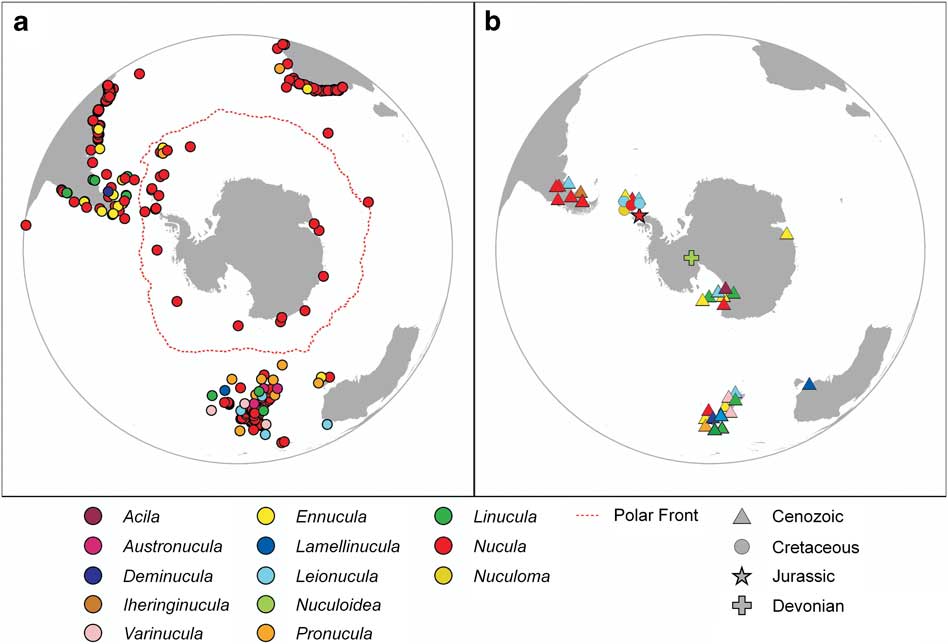
The four genera belonging to the Family Nuculidae that are currently found in southern high latitude waters (Fig. 2a) are Austronucula Powell, 1939, Ennucula, Nucula Lamarck, 1799 and Pronucula Hedley, 1902. The nuculids have a high species-richness north of the Antarctic Polar Front and a lower species-richness south of the Polar Front (dominantly of the genus Nucula, but occurrences of Pronucula and Ennucula have also been found near the South Shetland Islands) (Fig. 2a) (Linse et al. Reference Linse, Griffiths, Barnes and Clarke2006, Bouchet Reference Bouchet2012). Specimens are mostly identified from the Antarctic Peninsula region and occur in water depths of 6–4209 m (Dell Reference Dell1990). At present Nuculidae are species rich in waters around New Zealand and South America (Bouchet Reference Bouchet2012).
Distribution of Nuculidae in the southern high latitudes. a. Nuculid records at the present-day. b. Nuculid records through time. Colours represent genera, shapes represent time periods.

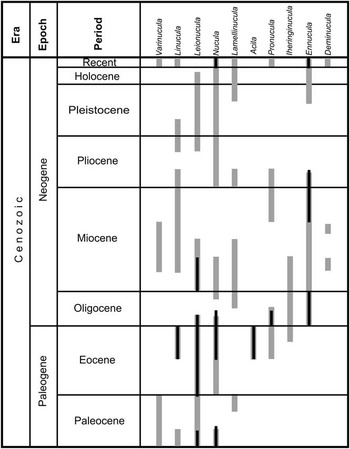
The oldest recorded occurrence of a fossil nuculid in the southern high latitudes is of Nuculoidea Williams & Breger, 1916, which is Lower Devonian in age; it was collected from the Ohio Range in Antarctica (Doumani et al. Reference Doumani, Boardman, Rowell, Boucot, Johnson, McAlester, Saul, Fisher and Miles1965) (Fig. 2b). Apart from a Jurassic record of Nucula from the Antarctic Peninsula, the rest of the fossil Antarctic nuculids are from the Cretaceous period and younger, and most are Cenozoic (Figs 2b & 3). Ten genera of fossil nuculids have been found in the southern high latitudes in the Cenozoic, with six of these genera occurring in rocks from Antarctica (Figs 2b & 3). However, New Zealand fossil nuculid diversity is significantly greater than the published diversity (A. Beu, personal communication 2012). Generic diversity has decreased in the southern high latitudes through time as only three genera occur south of the Polar Front at the present-day (Fig. 2a).
Antarctic fossil species (Figs 2b & 3) have been found from the drill cores DSDP 270 (Dell & Fleming Reference Dell and Fleming1975) and CRP-2/2A (Taviani et al. Reference Taviani, Beu and Jonkers2000), plus in the vicinity of Mount Discovery (Stilwell Reference Stilwell2000), which are all in the McMurdo Sound region and also from the Antarctic Peninsula region (Wilckens Reference Wilckens1910, Stilwell & Zinsmeister Reference Stilwell and Zinsmeister1987, Zinsmeister & Macellari Reference Zinsmeister and Macellari1988, Stilwell & Zinsmeister Reference Stilwell and Zinsmeister1992, Stilwell et al. Reference Stilwell, Zinsmeister and Oleinik2004, Anelli et al. Reference Anelli, Rocha-Campos, Dos Santos, Perinotto and Quaglio2006), Marine Plain (Pickard et al. Reference Pickard, Adamson, Harwood, Miller, Quilty and Dell1988) and the Ohio Range (Doumani et al. Reference Doumani, Boardman, Rowell, Boucot, Johnson, McAlester, Saul, Fisher and Miles1965).
Nuculids occurred sporadically through the Cenozoic in the southern high latitudes (Fig. 3) in units deposited in a variety of water depths. No genus has a continuous fossil record through the Cenozoic to the present. The fossil record in Antarctica is very patchy, with most occurrences in the Eocene–Miocene periods (Fig. 3). There are no Antarctic fossil occurrences in the Pleistocene or Holocene, probably related to glaciation in Antarctica. Generic diversity of the family Nuculidae decreased in the Antarctic region through the Cenozoic to the Recent (Fig. 2). The cause of this decrease in diversity is unknown but it may have been related to environmental reasons such as changes in oceanic circulation or extension of ice sheets onto continental shelves, which led to a change in species composition.
Time ranges of southern high latitude nuculid genera (grey), with Antarctic genera (black), through the Cenozoic.

The BAS Cape Melville Formation bivalve assemblage
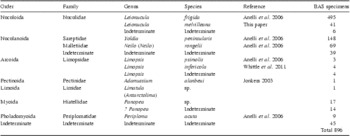
The BAS Cape Melville Formation bivalve assemblage consists of 896 specimens. Of these 770 specimens have been identified to species level, 783 to genus, 851 to family and 45 fossil specimens were too badly preserved to be assigned (Table I). In total eight bivalve families have now been identified from the Cape Melville Formation: Nuculidae, Sareptidae, Malletiidae, Limopsidae, Pectinidae, Limidae, Hiatellidae and Periplomatidae. Generally families in the Cape Melville Formation bivalve assemblage are monospecific, except for the Limopsidae and Nuculidae, which are both represented by two species (Table I).
The BAS Cape Melville Formation bivalve fossils.

Overall, ten species of bivalve have been identified from the BAS Cape Melville collection (Table I). Of these, one species was originally identified by Jonkers (Reference Jonkers2003) and seven species by Anelli et al. (Reference Anelli, Rocha-Campos, Dos Santos, Perinotto and Quaglio2006). Five of the species originally identified by Anelli et al. (Reference Anelli, Rocha-Campos, Dos Santos, Perinotto and Quaglio2006) are also in BAS collection, and two species of nuculid are re-assigned and synonymized into the species Leionucula frigida (Anelli, Rocha-Campos, Santos, Perinotto & Quaglio, Reference Anelli, Rocha-Campos, Dos Santos, Perinotto and Quaglio2006) (see Systematics below), based on new data from the BAS nuculid collection. A second taxon of nuculids can be identified from the BAS Cape Melville Formation assemblage, specimens are described as Leionucula melvilleana n. sp. (see Systematics below).
Following study of the BAS collection a further two species are recorded from the unit, Limopsis infericola Whittle, Linse & Griffiths, Reference Whittle, Linse and Griffiths2011, and Limatula (Antarctolima) sp. Leionucula frigida is the most abundant species, with 495 specimens, Yoldia peninsularis is the second most abundant with 148 specimens. The Limidae and Pectinidae are represented by only one specimen each (Table I). Overall protobranch bivalves dominate the Cape Melville Formation bivalve assemblage as they comprise 89% of the BAS collection. As a family, the Nuculidae constitute 60% of the collection.
Systematics
Class Bivalvia Linnaeus, 1785
Order Nuculida Dall, 1889
Family Nuculidae Gray, 1824
Subfamily Nuculominae Maxwell, 1988
Genus Leionucula Quenstedt, 1930
Anelli et al. (Reference Anelli, Rocha-Campos, Dos Santos, Perinotto and Quaglio2006) described two species of nuculid under the names Ennucula frigida and E. musculosa, based on 84 well preserved specimens. However, several authors have suggested Ennucula and Leionucula are synonymous (e.g. Keen Reference Keen1969, Stilwell Reference Stilwell2000, Beu Reference Beu2009). Based on this, Beu (Reference Beu2009) stated that the Cape Melville species of Nuculidae, E. musculosa and E. frigida, should be re-assigned to the genus Leionucula.
Type species: (by original designation) Nucula albensis d'Orbigny
Leionucula frigida (Anelli, Rocha-Campos, Santos, Perinotto & Quaglio, Reference Anelli, Rocha-Campos, Dos Santos, Perinotto and Quaglio2006)
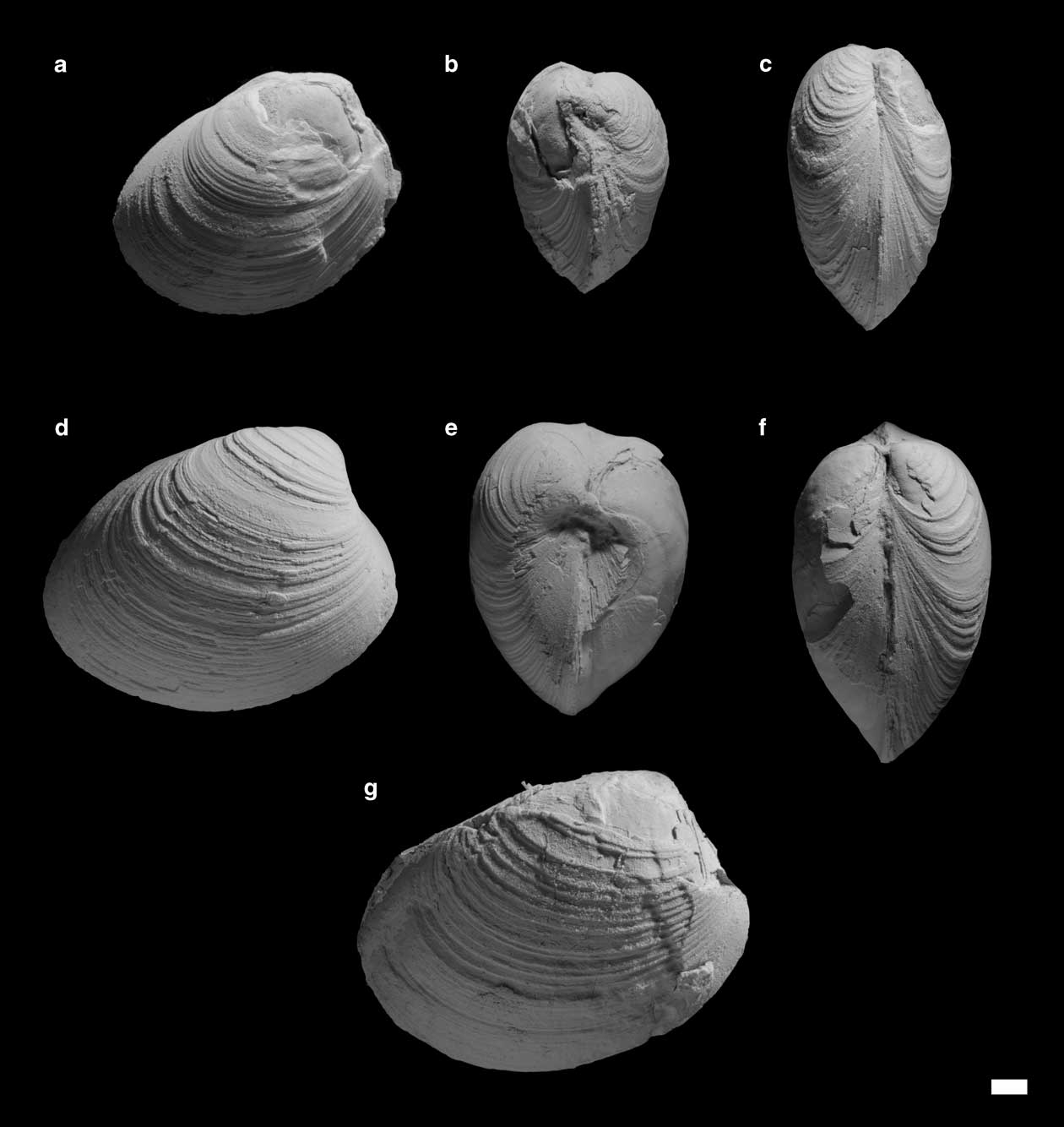
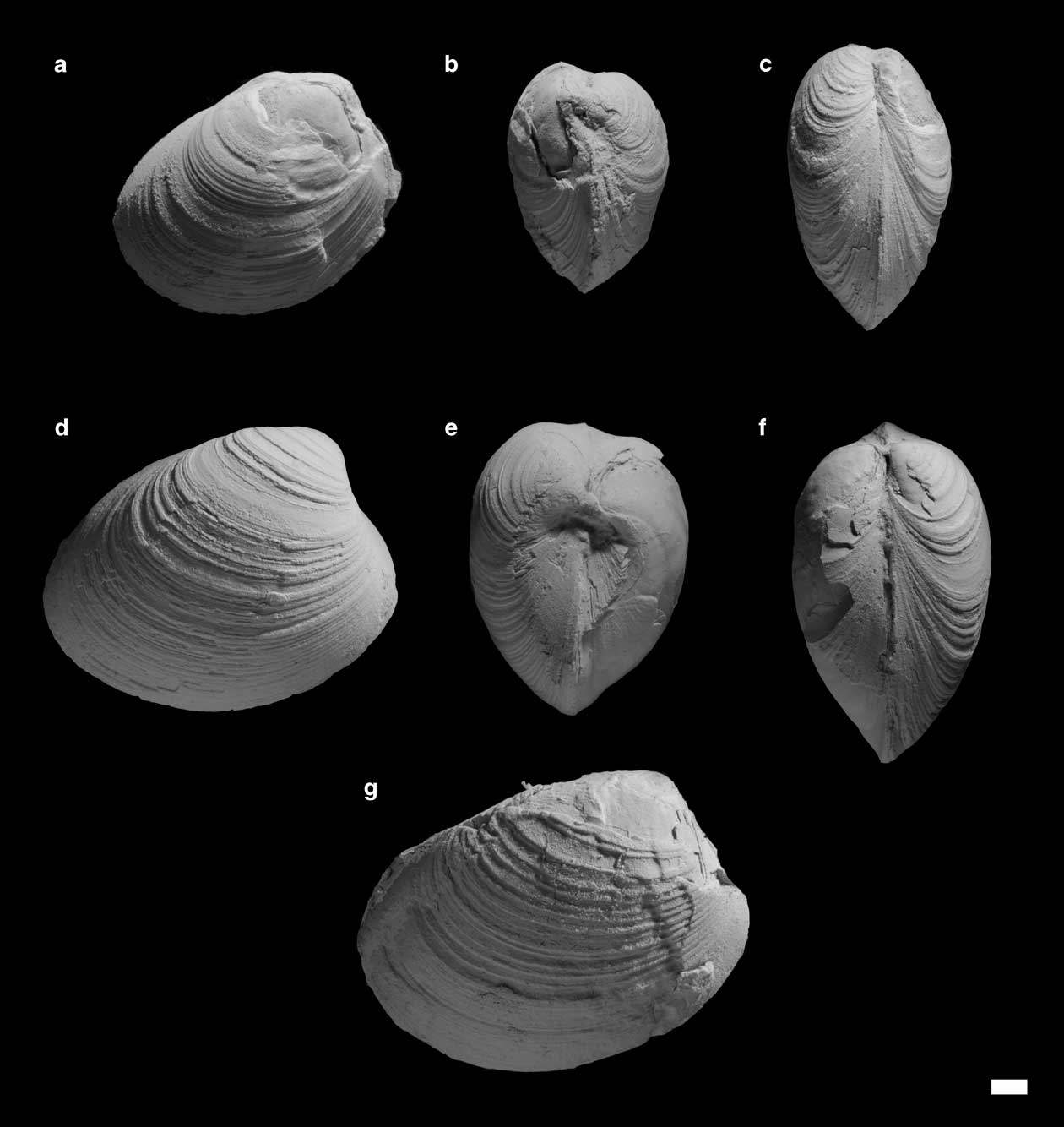
(Fig. 4)
Shells of Leionucula frigida from the BAS collection. a.–c. P. 2702.340, a. left valve, b. posterior, c. anterior. d.–f. P. 2702.341, d. left valve, e. posterior, f. anterior. g. P. 2702.339 left valve. Scale bar = 2 mm.
2006 Ennucula frigida Anelli, Rocha-Campos, Santos, Perinotto & Quaglio, pp. 117–119; Fig. 5.
Shell morphometrics of Cape Melville Formation Nuculidae.

2006 Ennucula musculosa Anelli, Rocha-Campos, Santos, Perinotto & Quaglio, pp. 119–120; Fig. 6.
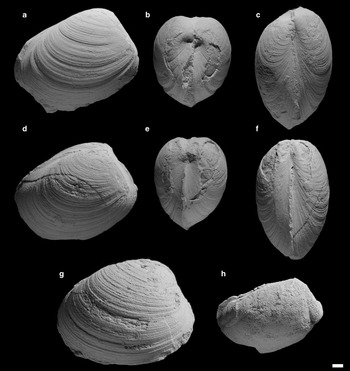
Leionucula melvilleana n. sp. a.–c. Holotype, P. 2702.1321, a. left valve, b. posterior, c. anterior. d.–f. Paratype P. 2702.1322, d. left valve, e. posterior, f. anterior. g. P. 2702.1323 left valve. h. Internal mould P. 2702.1328. Scale bar = 2 mm.

Diagnosis of species: Umbones slightly elevated above hinge line with opisthogyrate beaks, external ornament of fine growth lines overlain by well-marked irregularly spaced commarginal growth corrugations; with a maximum of 20 teeth in the anterior and ten on the posterior regions of the shell; chondrophore short and oblique.
Material examined: 495 specimens from the BAS Cape Melville Formation collection and 15 specimens originally described as E. frigida and E. musculosa in Anelli et al. Reference Anelli, Rocha-Campos, Dos Santos, Perinotto and Quaglio2006 from the Instituto de Geociências, Universidade de São Paulo.
Localities: BAS localities P. 2701, P. 2702 and P. 2707, plus section C and D of Anelli et al. Reference Anelli, Rocha-Campos, Dos Santos, Perinotto and Quaglio2006 (Fig. 1).
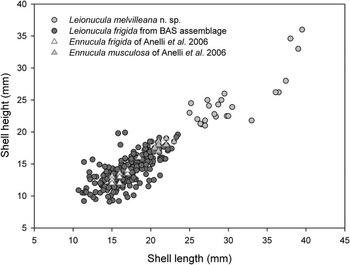
Discussion: The BAS collection includes 495 specimens with morphological similarity to the previously described species E. musculosa and E. frigida (Figs 4 & 5). One of the criteria for the separation of these two species was specimen size, as the IGc-USP specimens fit into two discrete size categories (see E. frigida and E. musculosa datasets on Fig. 5) (Anelli et al. Reference Anelli, Rocha-Campos, Dos Santos, Perinotto and Quaglio2006). However, further evidence from the large BAS collection of nuculids has increased our knowledge of the shell morphology and size ranges for Cape Melville nuculids. The BAS specimens of L. frigida show a much wider range in shell size than specimens originally described as E. frigida and E. musculosa (Anelli et al. Reference Anelli, Rocha-Campos, Dos Santos, Perinotto and Quaglio2006) and there is no distinct division in the BAS data (Fig. 5). Other criteria used to separate the two species were slight differences in margin shape and angles (Anelli et al. Reference Anelli, Rocha-Campos, Dos Santos, Perinotto and Quaglio2006). However, as with shell size, BAS specimens also show a range in margin morphology that incorporates the E. frigida and E. musculosa end members of Anelli et al. (Reference Anelli, Rocha-Campos, Dos Santos, Perinotto and Quaglio2006). Therefore, it is not possible to separate the BAS specimens into two species using the descriptions in Anelli et al. Reference Anelli, Rocha-Campos, Dos Santos, Perinotto and Quaglio2006. Simple morphometric comparisons demonstrate that E. musculosa intergrades with E. frigida, and we regard the species names musculosa and frigida as synonymous. As first revisers, we choose the name Leionucula frigida for this species.
Leionucula melvilleana n. sp.
Whittle & Quaglio, 2012
(Fig. 6)
Derivation of name: Named for the Melville Peninsula, where the specimens were discovered.
Diagnosis: Large inflated nuculid, with a straight posterior margin.
Holotype: P. 2702.1321 complete articulated shell.
Paratypes: P. 2702.1322, P. 2702.1323, P. 2702.1324, internal mould P. 2702.1328, and partial specimen P. 2702.1329, which was cut in two to see the taxodont dentition. Type specimens are housed in the BAS Type and Figured collection.
Other material : P. 2702.1325–1327; P. 2702.1330–1334 and P. 2702.1097–1113, P. 2702.1115–1117, P. 2702.1119–1122; P. 2702.1148, P. 2702.1149, which are housed at BAS, and specimen GP/1E 5252, from the Instituto de Geociências, Universidade de São Paulo.
Locality: King George Island, South Shetland Islands, Antarctica. Cape Melville Formation, Moby Dick Group 62°02′S, 57°38′W, locality P. 2702 and section C of Anelli et al. Reference Anelli, Rocha-Campos, Dos Santos, Perinotto and Quaglio2006 (Fig. 1).
Age: 22.6 ± 0.4 Ma (Early Miocene) based on Sr isotope data from bivalves (Dingle & Lavelle Reference Dingle and Lavelle1998).
Description: Shell longer than high, antero-posteriorly elongate. Length 25–39.5 mm (mean 30.5 mm, SD = 4.7; holotype length 37.4 mm), height 21–36 mm (mean 25.0 mm, SD = 4.1; holotype height 28 mm), inflation 13.5–23.1 mm (mean 17.4 mm, SD = 2.8; holotype inflation 23.1 mm) (Fig. 5). Umbones somewhat elevated above the hinge line, with slightly curved opisthogyrate beak. Posterior margin almost straight, anterior margin curved, ventral margin broadly rounded. Posterior adductor rounded; anterior adductor sub-quadrate, larger than posterior, with a very clear margin (Fig. 6h). Non-sinuate pallial line. External sculpture of irregularly spaced coarse commarginal growth lines, inner ventral margin smooth. Taxodont dentition visible on some specimens, posterior part of hinge short, with at least seven teeth (GP/1E 5252), anterior part hinge, with at least 15 (P. 2702.1325) to 19 teeth (GP/1E 5252).
Remarks: Specimens are similar to a single Leionucula specimen from Eocene erratics of McMurdo Sound identified by Stilwell (Reference Stilwell2000), who suggested that it may belong to a new species but did not formally describe it. The McMurdo specimen falls within the length, height and inflation range of the Cape Melville specimens. However, L. melvilleana n. sp. differs in having a straighter posterior margin. Nucula (Leionucula) grandis Malumian, Camacho & Gorroño, Reference Malumian, Camacho and Gorroño1978 is also similar in size to L. melvilleana n. sp., but differs in having a subrectangular as opposed to subtriangular outline and more pointed umbones (Malumian et al. Reference Malumian, Camacho and Gorroño1978).
The new species differs from specimens belonging to the nuculid genera Nucula Lamarck, 1799, Lamellinucula Schenck, 1944, Linucula Marwick, 1931, Deminucula Iredale, 1931, Pronucula Hedley, 1902, Pectinucula Quenstedt, 1930, Gibbonucula Eames, 1951 and Rumptunucula Bergmans, 1978 as it has a smooth as opposed to crenulate inner ventral margin (Rhind & Allen Reference Rhind and Allen1992). Acila (Adams & Adams, 1858) differs from the new species as it has divaricate sculpture (Rhind & Allen Reference Rhind and Allen1992).
Leionucula melvilleana n. sp. differs from the L. frigida previously described from the Cape Melville Formation by its greater height and length (Fig. 5). Leionucula melvilleana specimens are generally more inflated than L. frigida, but there is some overlap. Measurements of L. melvilleana and L. frigida were analysed using unpaired t-tests. The two species show highly significant differences for height, length and inflation (length P = 9.04 x 10⁻¹⁴, height P = 8.80 x 10⁻¹³, inflation P = 1.18 x 10-47). The L. melvilleana specimens have less pronounced commarginal ridges than L. frigida. They also have a straighter beak, antero-dorsal margin, and posterior margin. Also, the muscle scars are a different shape and the anterior adductor is much less rounded on L. melvilleana n. sp.
Conclusions
The Cape Melville Formation, one of the earliest Cenozoic glacial faunas from Antarctica, preserves a bivalve assemblage that was dominated by protobranchs. The Family Nuculidae, represented by two species, is the most numerous in the unit, with most specimens belonging to L. frigida. The fauna of the Cape Melville Formation has been extended by the addition of L. melvilleana n. sp. These results increase our knowledge of the Cape Melville Formation fossil assemblage, as well as contributing to knowledge of the overall Antarctic fossil community. Analysis of the Cenozoic fossil record indicates that the generic diversity of the Family Nuculidae has decreased in the Antarctic region through the Cenozoic to the Recent.
Acknowledgements
This study is part of the British Antarctic Survey Polar Science for Planet Earth Programme. It was funded by The Natural Environment Research Council. We acknowledge the help of S. M. Redshaw with BAS fossil collection. FQ is funded by CNPq (Conselho Nacional de Desenvolvimento Científico e Tecnológico). We thank the reviewers, Alan Beu and Liz Harper, whose comments and suggestions greatly improved the manuscript and Alan Vaughan for his editorial comments. We acknowledge the help of Hilary Blagbrough and Lucy Wilson with access to BAS collections and databases, and Mike Tabecki for help with fossil preparation. We thank Chris Gilbert and Pete Bucktrout for specimen photography. We are grateful to L.E. Anelli and the Instituto de Geociências, Universidade de São Paulo for their hospitality and the chance to view their material. We thank Huw Griffiths for the creation of maps and helpful discussion.