Hong Kong's institutions of higher education are, for the most part, publicly funded and, accordingly, publicly accountable through the government, legislature, audit and the media. Yet, during Hong Kong's 100-plus years of experience of directly providing higher education via public institutions, the autonomy of these institutions has varied considerably in line with the state's vision of the purpose of higher education, the power and authority of the state, and Hong Kong's changing economic and social environment. Using path dependency, I argue that critical incidents have shaped the relationship between the state and institutions of higher education in Hong Kong. The UK initially established a university in Hong Kong as part of Britain's global imperial ambition. In 1951, however, cut off from the mainland, colonial authorities shifted their focus to providing higher education for Hong Kong. Then, in 1991, in a new political and economic environment, authorities agreed that Hong Kong's institutions of higher learning should become globally competitive. In 1997, when sovereignty over Hong Kong returned to China, central and local authorities began to more fully integrate Hong Kong into the national development project.
This paper is based on archival material such as government, Education Commission and University Grants Committee (UGC) reports, Legislative Council reports and papers, university reports and minutes of meetings and newspaper accounts as well as material archived in the Public Records Office in Hong Kong and the UK National Archive. In addition, from April to September 2017, I conducted in-depth interviews, using an open-ended questionnaire, with five individuals who together have experience at very senior management levels in four of Hong Kong's eight publicly funded UGC universities.Footnote 1
I understand institutional autonomy to vary, from organizations that political executives tightly control such as a government department, to those that are virtually independent of the political executive constrained by law and community norms, such as a private business.Footnote 2 The autonomy of universities globally also varies along this continuum, with some established as government departments, employing mainly civil servants (Thailand), to universities that are run as private businesses (for example, the former Bond University in Australia, or the University of Southern California in the USA). The public universities in Hong Kong come from a mixed lineage ranging from formally “independent”Footnote 3 or “self-governing,”Footnote 4 such as the University of Hong Kong (HKU) and the Hong Kong University of Science and Technology (HKUST), to those which have evolved from government-managed schools that employed teachers on civil service terms, such as the Hong Kong Polytechnic University, the City University of Hong Kong and the Education University of Hong Kong, to those that have developed from educational institutions initially established by non-government organizations, such as the Chinese University of Hong Kong (CUHK), the Baptist University and Lingnan University.Footnote 5 As publicly funded universities today, the eight universities are neither government departments nor are their employees civil servants.Footnote 6
The European University Association (EUA) has identified over 30 separate indicators of autonomy in four different domains.Footnote 7 These criteria focus on organizational matters such as the selection process and criteria for choosing and dismissing a university president, terms of office, and the selection of members of university governing bodies and their capacities; financial matters such as the length and type of public funding, whether surpluses may be kept, the ability to borrow and to own buildings and charge tuition; staffing matters such as the ability of the institution to independently hire, promote and dismiss senior academics and administrators and set their salaries; and academic matters such as the ability to decide on student numbers and to select students, to introduce and terminate degree programmes, decide on the language of instruction, to decide on quality assurance mechanisms and providers, and to decide on the content of degree programmes.Footnote 8 I will reference these criteria in the sections that follow.
Hong Kong's official understanding of institutional autonomy for institutions of higher education was set out by the UGC in 1996. The UGC, describing itself as an intermediary between the government and the publicly funded institutions of higher education, saw autonomy as “freedom of action in managing their [university's] affairs within the restraints of the laws of Hong Kong,”Footnote 9 which arguably is in line with the EUA's criteria outlined above. In this 1996 statement, the UGC specifically identified the selection of staff and students, the determination of curricula and the setting of standards as key areas in which Hong Kong's institutions exercised “freedom of action.” The UGC concluded that the institutions enjoyed “considerable” institutional autonomy, “subject to the constraints of financial dependence.”Footnote 10 More recently, the UGC acknowledged that it: “safeguards the academic freedom and institutional autonomy of the universities, while it ensures value for money for taxpayers.”Footnote 11 In the following paragraphs, I evaluate the first part of this claim.
Overview
In 2018, Hong Kong was locked in a political structure that was both somewhat liberal (for example, with a Western-inspired Bill of Rights, mostly enforced, and various rights/freedoms including “academic freedom” and dutiesFootnote 12) and somewhat authoritarian (including a central government-appointed political executive and a legislature half composed of formal representatives of special interests (“functional constituencies”), such as business chambers of commerce, designed to frustrate democracy).Footnote 13 The political structure empowers big business and the professions, which have a close relationship with government but also with the universities. Hong Kong's political executive and business community have not particularly valued research, however, together spending only about 0.79 per cent of GDP on research and development (compared to 2.07 per cent in mainland China, and 2.19 per cent, 3.28 per cent, and 4.23 per cent in Singapore, Japan and South Korea, respectively).Footnote 14 Accordingly, Hong Kong does not provide a particularly nurturing environment for globally competitive research-based universities.
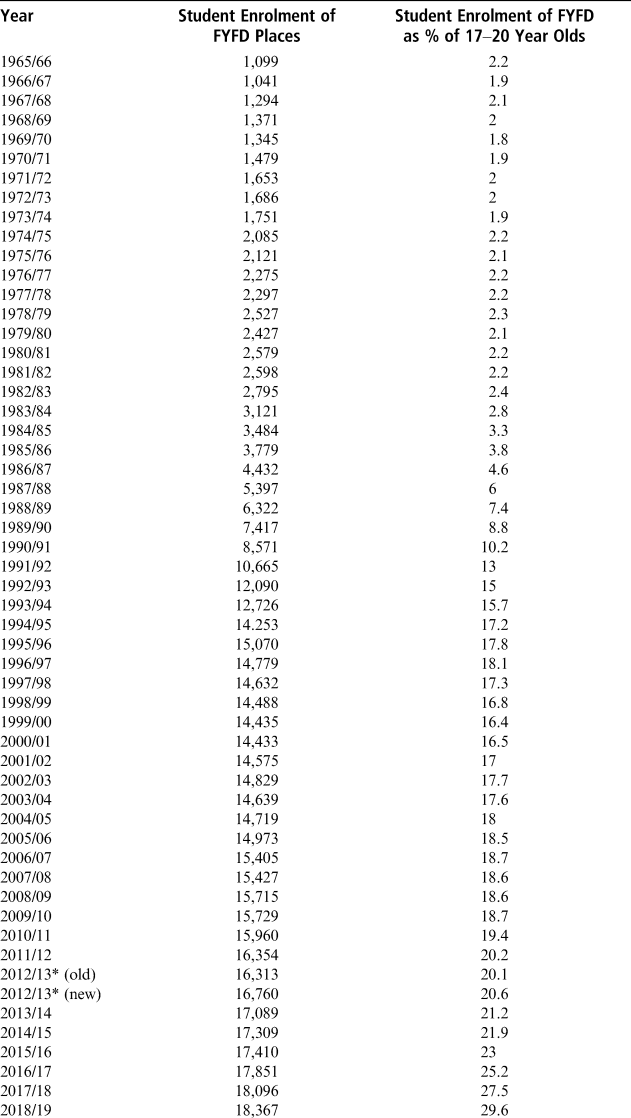
Hong Kong has 21 degree-awarding institutions of higher education, of which eight are publicly funded through the UGC, set up in 1965 and copied from the UK.Footnote 15 Hong Kong's university sector consists of many small institutions, measured in terms of full-time student equivalents (see Table 1).Footnote 16 Although private operators also offer degrees, the private sector plays a relatively minor role in the delivery of higher education in Hong Kong. The government funds 15,000 places each year for Hong Kong's four-year undergraduate programmes, and caps enrolment at 20 per cent of 18- to 19-year-olds for Hong Kong's publicly funded universities.Footnote 17 Universities select their own students but 80 per cent of undergraduates must be local according to government policy. Funding for the eight publicly funded universities relies heavily on the government.Footnote 18 Tuition fees for an undergraduate programme were set at HK$42,100/year in 1997/98 and have remained unchanged for the past 20 years.Footnote 19 Tuition in all eight universities is formally in the English language. Each institution selects its own university teaching and administrative staff, who are employed on contract and/or tenure terms, and may be dismissed under certain circumstances, for example “good cause,” although dismissals are rare.Footnote 20
Student Enrolment of First-year First Degree (FYFD) Places of UGC-funded Programmes, 1965–2019

Source:
UGC at https://cdcf.ugc.edu.hk/cdcf/searchStatSiteReport.action. Accessed 31 May 2020.
Notes:
*Separate enrolments for last of 3-year and first of 4-year undergraduate degrees.
Hong Kong's chief executive serves as the chancellor of each of the eight publicly funded universities and the government appoints the members of each university's Council, a body similar to a board of trustees.Footnote 21 Under the current arrangements, the power in practice of the University Councils varies by institution, a point I will return to below.
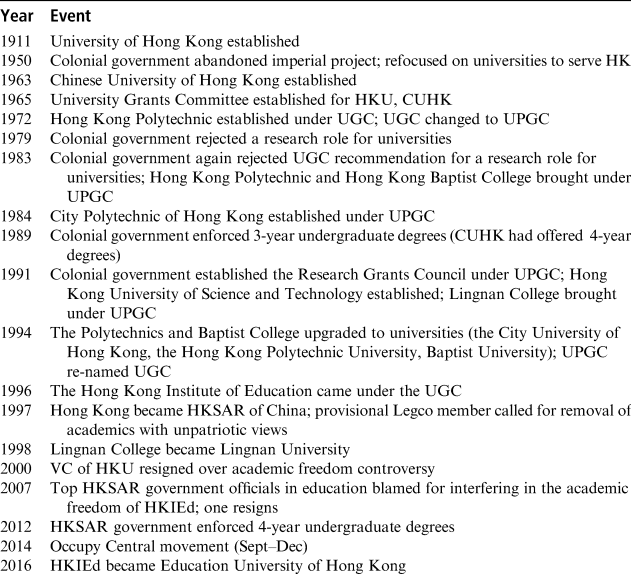
The development of the autonomy of Hong Kong's institutions of higher education may usefully be seen chronologically. In the first phase, 1911–1951, colonial authorities envisioned the university in Hong Kong as part of a grand plan to extend Britain's imperial influence in China and the Far East. During this phase, colonial authorities exercised relatively tight control. In the second phase, from 1951 to 1990, the government established universities in Hong Kong to serve Hong Kong but hobbled them so that they focused on mostly teaching three-year undergraduate programmes, a development which produced a landscape of “proto-universities.” In the third phase, from 1991, the government established the Research Grants Council and HKUST, and formally encouraged Hong Kong's universities to compete globally. Since 1997, when Hong Kong became a special administrative region of China, both the local but especially the central state have contested the universities’ autonomy, seeking to draw them more directly to the aid of the country's national development programme without challenging state stability. In this paper, I discuss each phase in turn, focusing on state goals, governance arrangements and interactions with business and civil society, referring to the key measures of autonomy.
An Imperial Project, 1911–1950
Colonial universities have a certain character and this is true of the universities in Hong Kong. According to Martin Carnoy, “‘Modern’ educational institutions introduced under colonialism … carried out the ideological function of making the process of domination and exploitation appear normal, inevitable or even scientific. The small elite educated at the secondary and higher level under these circumstances would prove natural allies to the economic and political interests of the imperialist nations.”Footnote 22 This was certainly the hope of the colonial authorities in Hong Kong when they set up the University of Hong Kong in 1911.
By the turn of the 20th century, missionary and other groups were building universities on the mainland supported by German, French and US interests all seeking to gain an influence in China. The British, with a vast empire, had yet to venture into this area.Footnote 23 Hong Kong governor Frederick Lugard, who pushed for the establishment of a Hong Kong university, made the imperial objective of such a project clear, despite official scepticism in London.Footnote 24 He observed that a duty of the colony was to “uphold” the British “name and fame in the Far East,” and that support for maintaining British prestige in the Far East was widespread in the UK and among the British community in Hong Kong. Lugard noted that gone were the days of focusing only on the material and that the UK “had placed in the forefront, as the watchword of our Empire, our obligations to the races who come under our Government or who may be benefited by our institutions.”Footnote 25 Establishing a university in Hong Kong to cater for the mainland Chinese market would have many advantages: location, cultural proximity (a familiar environment) as well as providing an English-language education, which would promote British interests and influence and provide mainland youths with access to a great literature and “the passport to a great trade.” The English language, Lugard observed, had gained a “high position” in the Far East, and because he understood that there was no common language on the mainland and Chinese vocabulary “has not yet adapted itself to express the terms and conceptions of modern science,” the Chinese would need to adopt an alien tongue for a time. English, he observed, was already assisting communication between Chinese merchants in North and South China and had been adopted as a medium of instruction, for example, in some mainland-based customs and engineering institutions. In 1911, Lugard reported to the Legislative Council that in addition to members of the British business community in Asia, the Qing government, via the viceroy of Canton, and representatives of Chinese communities in Saigon, Penang and Australia had contributed financially to the project.Footnote 26
Although colonial authorities and British businessmen subsequently expressed disappointment that the imperial objectives were not achieved,Footnote 27 they continued to reiterate them from time to time. In 1937, the authors of the government-appointed committee on the future of HKU pointed out that in their opinion, “the true vocation of the University is, its founders realized, the training of students from China. Unless this aim is kept steadfastly in view, we are satisfied that nothing of lasting value can be achieved.”Footnote 28 Throughout this period, the university recruited students from China, South-East Asia (for example, Malaya and Singapore) and Hong Kong.
Ali Mazrui observes that colonial universities stood “at the pinnacle of the structure of cultural dependency, a cultural corporation with political and economic consequences.”Footnote 29 One of the most significant consequences was the position of English in Hong Kong's education system, a characteristic that continues to this day. Moreover, Hong Kong's universities continue to live with colonial-era internal governance arrangements (established by ordinance) and a colonial-era intermediary body that links them to the government (the University Grants Committee).Footnote 30 It is difficult to overstate the impact of the colonial legacy.
Governance
In its relationship with the University of Hong Kong, the local government and the Colonial Office were most concerned about containing costs. The initial endowment soon proved insufficient and, by the early 1920s, HKU was virtually bankrupt.Footnote 31 In 1923, the government took more direct control, a step reflected in the new composition of the HKU Council. Chaired by Hong Kong's governor (the chancellor), the reformed Council (total membership of 15) included six government officials (the colonial secretary, colonial treasurer, secretary for Chinese affairs, director of education and the principal civil medical officer), plus two members of the Legislative Council, then a completely appointed body. From HKU came the vice-chancellor (VC) and the three faculty deans. The HSBC and the General Chamber of Commerce also each had a seat. The university treasurer, from outside HKU, was also a member.Footnote 32 The local colonial government, therefore, played a direct role in the management of HKU. To address the difficulties of attracting talented British academics to relocate to Hong Kong (the university selected mostly British expatriate academics and offered discriminatory terms of service to the very few non-whites employed, for example, in medicine),Footnote 33 the British government became more involved in university staffing decisions. As Peter Cunich shows, although the university could veto appointments, “the Secretary of State for the Colonies had the power to shape the future of the University through his selection of key staff members” and, from 1923, the Colonial Office “took full control” of the selection process with the governor handling every recruitment exercise “as intermediary.”Footnote 34 By the 1930s, the Colonial Office's role was replaced by the UK Board of Education and the Universities Bureau of the British Empire.Footnote 35
Throughout the period, HKU faced continuing financial insecurity,Footnote 36 prompting the governor to appoint a committee to look into its financial position.Footnote 37 The committee's report, which reflected views beyond government, started from the imperial nature of the project, which was not questioned, and suggested that it had yet to be realized. The committee recommended various economies by cutting professorships, reducing salaries and abolishing or “rigorously pruning” departments (commerce and social science), measures mostly resisted by the universityFootnote 38 and duly reported by the governor back to the secretary of state in London.Footnote 39
The Hong Kong government controlled university curricula indirectly through its control over university hiring (as above) and primary and secondary education, which was mostly privately provided, for example, by churches. The Education Ordinance (1913) required every school in Hong Kong to be registered with the director of education, with a few exceptions (Part I, para. 5), and made it illegal to “use any book the use of which appears undesirable” (Part IV, para. 10(c)), a provision aimed at curbing Chinese nationalism in schools and thus preventing them from becoming centres of anti-colonialism.Footnote 40 The Ordinance set up a system of school inspectors under the director of education to ensure that the rules were carried out. The government exercised tighter control from 1948 as it sought to reduce the influence especially of the Chinese Communist Party (CCP) in the colony, an organization which the governor claimed was “deforming and twisting … youthful minds.”Footnote 41
During this period, the university prohibited its members from taking part in political activity.Footnote 42 Still, students engaged in various forms of political action, sometimes on the mainland, to support popular or nationalist causes, such as the 1925–1926 Strike and Boycott, an action which was aimed at British interests but went unpunished.Footnote 43
Universities for Hong Kong, 1951–1991
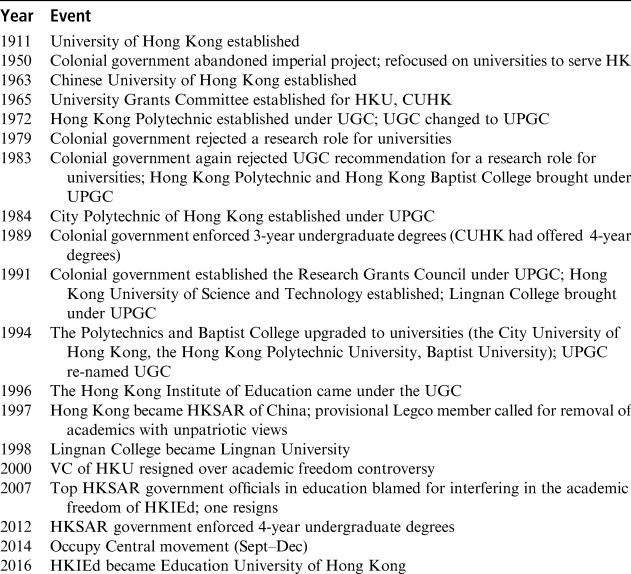
The Second World War had a seismic impact on Hong Kong, not least because the war's end signalled to the world that although Britain was allowed by first the Nationalist Party (KMT) and then the CCP to re-occupy and then govern Hong Kong, the territory's continued separation from the mainland was temporary.Footnote 44 The weakened legitimacy of British rule, the CCP victory on the mainland, which cut off student recruitment to the university, and waves of decolonialization globally encouraged the colonial government to embark on various reforms that considered the interests of the local population. In a watershed decision, in 1950 the Hong Kong government recognized for the first time that Hong Kong itself needed a university.Footnote 45 A year later, the Keswick Report proposed that higher education in Hong Kong “should be provided primarily for the needs of Hong Kong itself.”Footnote 46 In response to the policy change in 1963, the government established the Chinese University of Hong Kong (see Table 2). This was the beginning of an expansion in the number of institutions in Hong Kong offering undergraduate degrees.
Timeline of Selected Key Higher Education Events in Hong Kong, 1911–2016
Sources:
“Brief history,” University Grants Committee, https://www.ugc.edu.hk/eng/ugc/about/overview/history.html. Accessed 28 August 2018; Law, Wing-Wah Reference Law, Postiglione and Jung2017; Postiglione Reference Postiglione2017.
Throughout the period, the colonial state's vision of a university focused mostly on training professionals to meet local manpower needs and not on research.Footnote 47 In the words of the UGC, “Hong Kong was, in fact, remarkably reluctant to become involved in research. The issue was debated in the 1970s, when Taiwan, South Korea and Singapore were planning to upgrade their industrial technologies, but the Advisory Committee on Diversification (set up in 1977 and reporting in 1979) did not favor government expenditure on research and development.”Footnote 48 The Advisory Committee's report, narrowly written, endorsed only “industrially-oriented” research.Footnote 49 Surprisingly, in its review of the education system in 1981, the government stated that both HKU and CUHK already had “strong” research programmes.Footnote 50 Failing to recognize the need for research in Hong Kong's universities characterized the entire period until 1991.
Governance
The period started out much as before, with the government funding HKU directly. After setting up the CUHK in 1963, however, the government recognized the need for even-handedness between the two institutions.Footnote 51 In the 1964 budget debate, Legco members specifically recommended that a body like the University Grants Committee in the UK be established to “advise the government on the facilities, development and financial needs of the universities”Footnote 52 and to ensure that their facilities adequately measured up to Commonwealth standards and met appropriate local educational demands.Footnote 53 The UGC, set up in 1965, gradually took over this role for other tertiary institutions as well (for example, polytechnics, etc.), becoming the University and Polytechnic Grants Committee (UPGC). Legco envisaged that once a grant was made, the university itself should decide on the grant's disposal. Failure to carry out the policy on which the grant was made would be taken into account by the UGC in future funding cycles.Footnote 54 The UGC was already assuming its role as a “buffer” and as a communication channel between the government and the universities. As it developed, the UGC also sometimes lobbied the government on behalf of the universities on issues such as the provision of research funding. Universities as teaching institutions were relatively generously funded and, in 1971, the government agreed to link university staff remuneration to that of the Hong Kong civil service, a practice that lasted until 2003.Footnote 55 Previously, university salaries were linked to British university salaries.
On major policy matters, the government communicated directly with the universities. In the mid-1980s, for example, after the government decided to standardize general undergraduate degrees at three years’ duration largely for financial reasons (CUHK degrees had been set up as four years, and the government was contemplating the establishment of HKUST), the secretary for education or his representative consulted the universities directly. Both universities opposed the move, without success, and the government then imposed three-year degrees using the artifice of an Education Commission that advocated a common entry process and standard (Joint University Programmes Admission System, JUPAS).Footnote 56 That is, the government did not threaten directly to withhold funding from the universities for not complying, although for planning purposes the UGC was undoubtedly instructed to assume three-year general undergraduate programmes.
On the issue of funding for research, the UGC observed in 1996 that the committee (then the UPGC) was:
increasingly worried about the difficulty of attracting good staff to the expanding tertiary system unless research facilities could be provided. It set up its own enquiry … which reported in 1983 and proposed the establishment of a Research Grants Committee which would distribute government support for research on a competitive basis … The Hong Kong Government rejected this proposal (or at any rate put it into cold storage), it is believed because officials regarded university research as potentially very costly and also felt that private industry would unaided make the right decisions about R&D in market terms. With hindsight this may have been an expensive mis-judgement … In spite of this rebuff, the UGC continued to press upon government the importance of research and finally in 1991 the Research Grants Council was established.Footnote 57
In the post-Second World War period, the government modernized the governance arrangements first for HKU and then the other universities, drastically reducing the number of senior government officials appointed to the Council and replacing them with business and community leaders appointed by the governor, who remained chancellor. Thus, in 1950, the HKU Council was chaired by the VC and consisted of the university treasurer, the colonial secretary, the dean of each faculty, and nine persons appointed by the governor (acting as chancellor), one of whom was a full-time member of university staff.Footnote 58 Although these arrangements have evolved, the government introduced this more indirect method of holding the universities to account. From 1967, the government replaced VCs as chairs of the Councils with its own appointee and gradually expanded the size of the Councils so that by the mid-1980s members numbered about 36, only seven of whom were appointed by the governor.Footnote 59
Government control of education continued through legislation, an education inspectorate and through the content of examinations (such as the Hong Kong A-Level Exam for HKU and the Hong Kong Higher Level Exam for CUHK), which from 1972 led to university admission.Footnote 60 Government control of primary and middle school curricula ensured that they were depoliticized and that most students in Hong Kong had no formal education in post-1840 Chinese history.Footnote 61 Although the establishment of CUHK in 1963 redressed the balance somewhat for the tiny percentage of the population admitted to university, the interested public had to acquire this knowledge on its own.
University students, especially the relatively autonomous student unions, which were funded directly by mandatory student contributions, participated in actions such as the 1966 Star Ferry riots, the “Chinese language” movement, and the Precious Blood Golden Jubilee School affair (1977–1978), which had focused on financial mismanagement in the school.Footnote 62 The violent 1967 anti-colonial riots, which were instigated by Cultural Revolution leftists on the mainland, however, were mostly condemned by the university students, who sided with the government.Footnote 63 From the 1970s onwards, Hong Kong university student unions and student organizations visited the mainland and actively supported demonstrators in Beijing prior to the 4 June 1989 crackdown.
Hong Kong's universities began recruiting postgraduate students from the mainland, particularly in fields such as engineering, in the mid-1980s, a move which diversified the student body. Mainland students in Hong Kong, especially those at HKU, participated in the condemnation of the central authorities following the 4 June incident. In retaliation, the victors in the CCP power struggle cut the number of mainland postgraduates applying to HKU in 1990 to zero.Footnote 64
Modernization of Hong Kong's Universities, 1991–1997
With the colonial government's days numbered, another watershed occurred in 1991 when the government set up the Research Grants Council, urging the universities to become globally competitive teaching and research institutions. The government expanded the number of universities by upgrading polytechnics and colleges and sought to improve academic excellence through defining roles for the universities (mostly research or mostly teaching)Footnote 65 and through competition. As one senior university manager pointed out, University Councils supported the modernization of Hong Kong universities’ human resource management policies, spurred by the establishment of HKUST in 1991. Unlike both HKU and CUHK, which the colonial government had only reluctantly supported, the government enthusiastically supported the establishment of the new university, which was modelled on MIT and CalTech. HKUST served as a powerful demonstration of what could be done in Hong Kong and of what the two earlier universities had failed to do.Footnote 66
In the run up to the transfer of sovereignty over Hong Kong, no effort was made to decolonialize school education and English continued to be the language of elite schools and the universities. By 1996, officials in both China and the UK sought a stable transition, a “through train.”Footnote 67 That is, colonial institutions (structures, norms and processes) and people characterized the post-1997 setup.
Governance
The government, through the UGC, laid down policies for Hong Kong's publicly funded universities on student numbers, student origin (local or overseas) and tuition, and encouraged the universities to meet local manpower needs (for example, training medical doctors and nurses, dentists, social workers and teachers). From 1993, the UGC began to link funding to performance. Law Wing-Wah describes the UGC during this time as an “increasingly strong external force capable of shaping” the universities’ academic structures, institutional development, research, teaching and governance.Footnote 68 The UGC's “insistence on quality, performance, accountability and fiscal transparency [which date from this period] define the limits of institutional autonomy and provide strong justification for supervision and regulation of institutional development and governance” in a system that became “negotiated freedom” or “regulatory autonomy.”Footnote 69 I will return to these issues below.
Autonomous student unions in the universities mobilized students to support the Hong Kong Alliance in Support of Patriotic Democratic Movements of China (Xianggang shimin zhiyuan aiguo minzhu yundong lianhehui 香港市民支援爱国民主运动联合会), which was set up by activists in Hong Kong in the wake of the 4 June incident to push for change on the mainland, by organizing memorial events and hosting symbols of the movement, such as statues, on campus.Footnote 70 Student union leaders published magazines and books that sometimes critically evaluated the political system on the mainland.Footnote 71
Contested Autonomy, 1997–2018
Although the Basic Law stipulates that Hong Kong's universities “may retain their autonomy and enjoy academic freedom,”Footnote 72 autonomy continued to be contested. In 1997, for example, a politician in Hong Kong called for the dismissal of unpatriotic academics.Footnote 73 The central government, which according to the Basic Law would not have responsibility for education policy in Hong Kong, appeared to envision a role for Hong Kong's universities that focused on their contribution to national development,Footnote 74 their stabilizing role in Hong Kong and the mainland, and as institutions to transfer patriotic education to Hong Kong's elite. Because Hong Kong had not decolonialized, conflict between the central government's vision and the reality in Hong Kong soon emerged.
The HKSAR government did take some steps to align Hong Kong more closely with the mainland, however. From 1998 to 1999, authorities sought to replace teaching in English in many schools with mother-tongue teaching, and at that time 75 per cent of schools began teaching in Cantonese, up from 20 per cent of secondary schools in 1994.Footnote 75 Fearing for the job prospects of their children, parents resisted the policy and it was eventually abandoned. In 2008, the government decided that undergraduate degrees in Hong Kong should be four years in length, rather than three, which helped to align Hong Kong with the mainland.Footnote 76 In 2012, the government sought to introduce “national and moral education” in schools in an effort to produce more patriotic Chinese citizens in Hong Kong.Footnote 77 Parents and students organized and pushed back, forcing the government to abandon this policy.Footnote 78
With China's rapid economic development and the increased economic and social integration of Hong Kong with the mainland, universities in Hong Kong began looking towards the mainland. They established degree programmes, branch campuses, research facilities and clinical outposts on the mainland.Footnote 79 They also hosted mainland-based State Key Laboratories and competed for research funding from the central state. In 1998, universities in Hong Kong began recruiting students directly from the mainland.Footnote 80 Mainland-origin staff with postgraduate degrees earned overseas were increasingly hired, especially in science, technology, engineering and mathematics (STEM), business and economics, and medicine, a move which diversified university teaching staff in Hong Kong. By 2017, for example, 34 per cent of HKU's academic staff were of mainland origin, as were 39 per cent of HKUST's engineering staff.Footnote 81 The increased diversity also meant better understanding of central state policies on university campuses. The Liaison Office encouraged Party members among university postgraduates and academic staff to update it on activities on campus,Footnote 82 and the Party's presence in Hong Kong has undoubtedly contributed to a more complete picture of local politics and society.
Governance
This period demonstrated the relative weakness of the post-1997 local state in Hong Kong vis-à-vis the universities. First, in 2004 and again in 2006, the-then secretary for education and manpower, Arthur Li Kwok-cheung 李国章, was unable to implement his preferred policy to merge the CUHK and HKIEd. When staff at the HKIEd protested vigorously,Footnote 83 his deputy, the permanent secretary for education and manpower, Fanny Law Fan Chiu-fun 罗范椒芬, requested that the president of HKIEd “try to curb … the criticisms” towards government policy of two academic staff at HKIED, a move that “improperly interfered with” their academic freedom. She promptly resigned.Footnote 84 Second, in 2000, the VC of HKU, Cheng Yiu Chung 郑耀宗, responded to complaints from the HKSAR Chief Executive's Office about negative opinion polls conducted by HKU's Robert Chung Ting Yiu 钟庭耀, in a way to “inhibit his [Chung's] right to academic freedom.”Footnote 85 The VC was forced to resign. In each of these cases, universities fought off perceived challenges to their institutional autonomy and academic freedom.
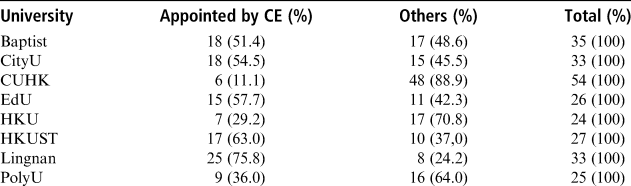
More serious challenges to university autonomy came during the tenure of HKSAR chief executive Leung Chun-ying 梁振英 (2012–2017), and the 79-day long closure of a key transportation artery in 2014 by demonstrators in the “Occupy Central” movement who were pressing for political reform.Footnote 86 From 2014 to 2017, the divisive politics of the community was brought into University Councils via government-appointed Council members, who since 2012 had reflected Leung's “united front” orientation (see Table 3).Footnote 87 Although university teachers (Benny Tai Yiu-ting 戴耀廷 (Law, HKU) and Chan Kin-man 陈健民 (Sociology, CUHK)), led the “Occupy” movement in its early days, the government focused its ire mostly on HKU, which was then led by UK national Peter Mathieson. As one senior university manager observed, “the government pointed the finger at HKU; [discussion of] Hong Kong's independence came from HKU students; Occupy Central came from HKU … Most Occupy leaders came from HKU… and HKU was a colonial university.”Footnote 88 Staff of HKU received donations to support the protests, and prominent academics, such as Johannes Chan Man-mun 陈文敏, then dean of the HKU Law Faculty, defended their actions. In 2015–2016, when Mathieson attempted to appoint Johannes Chan to a senior administrative position, the “united front” within the CouncilFootnote 89 blocked the appointment.Footnote 90 Moreover, they demanded that the university dismiss Benny Tai for “polluting” students’ minds. In 2014 and 2015, the “united front” press in Hong Kong launched repeated attacks on the HKU Law Faculty, Johannes Chan and Benny Tai.Footnote 91 The Hong Kong government repeatedly denied, however, that it had led a campaign against Chan, or that it had interfered in the autonomy of the institution.Footnote 92 Still, according to one senior university administrator, the government perceived that “HKU was in a mess, unable to handle its students [who were demonstrating in Occupy Central and discussing independence for Hong Kong], the hiring of a VP [Chan], making a fool out of Hong Kong.”Footnote 93 In the course of acrimonious discussions during a Council meeting about the role of HKU in the “Occupy” movement, a government-appointed Council member accused Mathieson of “endangering national security under the guise of academic freedom.” Individual Legislative councillors and members of the community demanded that HKU fire Tai for his role in the movement. On 9 April 2019, a court convicted both Tai and Chan Kin-man (and many others) of inciting others to break the law, a decision they are appealing.Footnote 94 HKU fired Tai in July 2020. Chan retired from CUHK in 2019.
University Council Membership, 2018
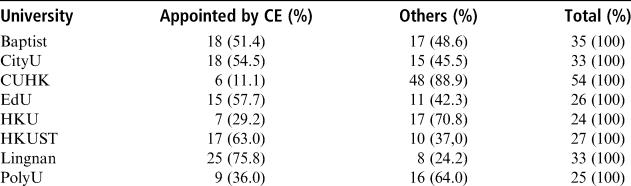
Sources:
University governance webpages and university ordinances.
Some students and alumni demanded that the governance arrangements for Hong Kong's universities be reformed, in particular that the chief executive be removed as chancellor of Hong Kong's universities and that the public be given more say in government Council appointments, a move clearly aimed at bolstering the autonomy of the universities. Councils of various universities resisted this move.Footnote 95 Carrie Lam Cheng Yuet-ngor's 林郑月娥 replacement of Leung as chief executive temporarily defused the situation, but she has continued to serve as chancellor of Hong Kong's universities.
During Leung's tenure (2012–2017), the government sought to bring Hong Kong's universities under tighter control using traditional tools such as the government's power to appoint Council members and Council chairs, a review of their governance arrangementsFootnote 96 and audit.Footnote 97 The government also made it easier for Hong Kong people to study and work on the mainland, facilitating Hong Kong university expansion on the mainland and providing substantially more money for research.Footnote 98 During this time, university VC/presidents were linked directly to the secretary for education in a WhatsApp chat group that did not include the UGC. Since 2014, the secretary has called them to informal meetings without the UGC three to four times a year to discuss issues including political matters such as student participation in the “Occupy” movement, independence activities on campus, and the extent to which the universities educated students in the Basic Law. The implication is that they were not doing enough.Footnote 99 I am unaware that this arrangement changed the behaviour of Hong Kong's universities, however.
The leadership of university students’ unions, especially of HKU and CUHK, participated in the civil disobedience campaign that shut down the area around the government headquarters. On campus, some student publications discussed political reform for Hong Kong and even independence.Footnote 100
Conclusion
The story of the autonomy of Hong Kong's universities is one in which they passed from one state to another, each with its own view of the appropriate relationship between the state and society. Pre-1997 Hong Kong witnessed considerable growth in institutional autonomy, especially during the 1990s, when the UK's exit strategy for Hong Kong became clear. Post-1997 Hong Kong continued to be colonial. By agreement among the principals, Hong Kong's colonial power structure and institutions slid effortlessly across the change of sovereignty (“the through train”), fundamentally unchanged until today.
The CCP rules Hong Kong through proxies and, in the absence of a revolution, seeks to achieve its vision in Hong Kong of the people enthusiastically embracing Leninism (with Chinese characteristics) in a unified, strong China. The CCP is very critical of Hong Kong's colonial education system, which has tolerated some mostly young people advocating independence for Hong Kong.
The Party's tools to achieve its vision have evolved over the decades since the 1980s, when united front work of necessity was the dominant mode. A wealthy China now offers Hong Kong's universities land, accommodation, staff and students, employment, honours, access to projects, labs, research subjects and materials, and, of course, massive research funding. A confident China uses its media to praise and criticize behaviour in Hong Kong universities that the Party wishes to encourage or suppress in a tug of war for legitimacy. The mainland state's coercive apparatus actively rewards and punishes the employees of Hong Kong's universities, granting and denying access to mainland resources and threatening, intimidating and re-educating mainland-origin Hong Kong university employees to better serve China's national development goals. These tools are designed to bring Hong Kong's universities into the embrace of the dominant narrative of institutional autonomy on the mainland that focuses on “self-mastery.”Footnote 101 The colonial education system, rooted in Western notions of autonomy, has resisted this outcome and hence its contestation. But, the universities in Hong Kong, like all our institutions, are embedded in society and as society changes, so may they adapt. This is not to suggest that a Western notion of autonomy is intrinsically inappropriate simply because of its colonial origins in Hong Kong. More autonomous universities in Hong Kong may indeed lead in some areas as they adapt to contextualized social change on the mainland and globally.
Postscript
In 2019–2020, Hong Kong witnessed months of massive and increasingly violent anti-government protests, sparked by an unpopular extradition bill that would have allowed Hong Kongers to be extradited to the mainland, and the COVID-19 pandemic. Authorities closed schools and universities in November and December 2019 because of the street violence, and from 1 February until June 2020 because of the pandemic. Trust in the Hong Kong government plummeted,Footnote 102 and authorities relied mostly on the police to govern. The police arrested thousands of protesters, including many local opposition politicians. Mainland authorities reacted to the protests by replacing their representatives in Hong Kong and introducing a new national security law for Hong Kong, an unprecedented move. The law punishes acts of succession, subversion, treason, terrorism and foreign interference in Hong Kong. The central government also established its own national security apparatus in the region. The CCP launched a stinging attack on Hong Kong's still “colonial” education system, which, the Party declared, was unfit for purpose.Footnote 103 This system, the Party said, failed to build a sense of national identity in Hong Kong. The central and local governments’ response to the protests has clearly exposed Hong Kong's authoritarian regime. The future of Hong Kong's universities is intimately tied to the mainland, where the state tightly controls universities, repressing dissent and demanding conformity. At the time of writing, the autonomy of Hong Kong's institutions of higher education continues to be contested.
Acknowledgements
The author gratefully acknowledges the advice of Michael Palmer, Terry Bodenhorn, Peter Cunich and Gerard Postiglione in the production of this paper.
Conflicts of interest
None.
Biographical note
John P. BURNS is emeritus professor and honorary professor of politics and public administration at the University of Hong Kong. His research focuses on the politics and public administration of China, including Hong Kong.