Hibbing and his colleagues provide an enlightening overview of current research on the psychological foundations of ideology, with a specific focus on how ideology may be rooted in individual differences in negativity bias. Here, we focus on two points underplayed in the target article. First, we highlight the conditional nature of the relationship between negativity bias and ideology. Second, we contend that the mechanism by which negativity bias structures preferences is more complex. Although we agree that negativity bias has important consequences for political attitudes, we also suggest that its impact should vary as a function of (1) issue domain and (2) political engagement, or the degree to which citizens are interested in and informed about politics.
In the domain of social issues (e.g., gay marriage), variables associated with negativity bias should translate into conservatism among both the engaged and unengaged (though the relationship may be stronger among the engaged; Zaller Reference Zaller1992). Such “easy” issues elicit symbolic associations relevant to negativity bias (e.g., threats to traditional values) regardless of political knowledge. However, economic policy is “hard” – technical and unlikely to automatically elicit emotionally laden symbolic associations (Carmines & Stimson Reference Carmines and Stimson1980). We argue that in the domain of economic issues, engagement should play a key moderating role. Among the engaged, economic preferences should serve a symbolic function, expressing partisan and cultural affiliation. Two mechanisms are responsible. First, cues from political-party leaders assign symbolic meaning to party membership and party-endorsed issue positions. For example, in an effort to reshape electoral competition long dominated by the Democratic Party, Republicans embraced a number of affect-laden concerns related to race and ethnicity, crime, and religion, all issues directly related to negativity bias (Hetherington & Weiler Reference Hetherington and Weiler2009). Second, elites strategically frame economic issues in symbolic terms (“Obamacare is socialism”). These frames convey the abstract meaning of issues in ways relevant to negativity bias (e.g., rapid institutional change). However, since symbol-laden elite signals like cues and frames are more likely to be picked up by the highly engaged (Zaller Reference Zaller1992), it is only among these individuals that negativity bias should influence partisan sorting (Federico & Goren Reference Federico, Goren, Jost, Kay and Thorisdottir2009; Federico et al. Reference Federico, Fisher and Deason2011) and lead to the assimilation of party-approved issue frames.
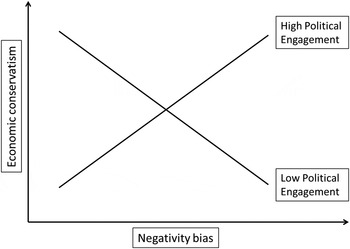
By contrast, if less attentive citizens are unlikely to notice (and therefore be influenced by) elite cues and frames, their economic preferences are more likely to serve an instrumental function. That is, the economic preferences of inattentive citizens should reflect a more personal view of the stakes – that is, the extent to which one desires government protection from the risks associated with free markets. Given this largely instrumental outlook, negativity bias should function as dispositional risk-aversion, and thus promote liberal economic preferences (e.g., Iversen Reference Iversen2005). A schematic representing our predictions is shown in Figure 1.
Figure 1.
Schematic representation of predictions regarding the impact of negativity bias as a function of issue domain and political engagement.
Consistent with this account, our recent work – based on multiple national surveys – indicates that the impact of variables related to negativity bias is strongly heterogeneous with respect to economic issues, with negativity bias leading to economic conservatism among those high in engagement and economic liberalism among those low in engagement (Johnston Reference Johnston2011; Johnston et al. Reference Johnston, Lavine and Federico2014). In turn, our model and results allow us to speak to several issues left open by Hibbing and colleagues. In particular, they allow us to address two complications in the literature on the relationship between individual differences and ideology that Hibbing and colleagues highlight. First, the model outlined above speaks to the claim that “deeper psychological and biological characteristics are less relevant to economic issues” (sect. 6.2, para. 3), which Hibbing and colleagues discuss as a current ambiguity in the literature. Our model provides concrete predictions about when and how variables related to negativity bias will predict economic attitudes: Negativity bias will be associated with economic conservatism among those high in engagement and economic liberalism among those low in engagement, because of the different functions served by these preferences for each group. This asymmetry can explain researchers' failure to find consistent relationships between negativity bias and economic judgments. If negativity bias has opposite effects on economic preferences as a function of engagement, the two effects will cancel in analyses that collapse across engagement levels.
Second, our model speaks to the question of when the relationship between negativity bias and conservatism may not arise (sect. 6.2 para. 6). In this context, Hibbing and colleagues note that conservatives appear less concerned than liberals about a number of negative outcomes, such as “leveled rainforest,” despite greater negativity bias. In passing, Hibbing and colleagues note that conservatives may be attuned primarily to threats involving an “identifiable, malevolent, volitional force” rather than ones involving diffuse social problems (sect. 6.2, para. 6). However, it seems unlikely that a general negativity bias would operate in such a narrow fashion. We argue that some conservatives – highly engaged ones – may not react against these threats because preferences on these issues serve a symbolic function rather than the instrumental function of avoiding a direct source of danger. So, for example, given the negative symbolic meaning attached by conservatives to government interventions aimed at reducing poverty, rejection of these policies may simply reflect the assimilation of elite issue positions among engaged conservatives – even if they would seem to leave one open to economic risks. Thus, any consideration of why individuals differing in ideology react to some threats but not others requires an analysis of which citizens invest issues with additional symbolic meaning that draws out the relationship of negativity bias with conservatism (and vice versa). In this sense, a complete understanding of the role of negativity biases in political preference formation requires greater attention to politics itself, and a push to unify psychological models with standard models in political behavior.





Hibbing and his colleagues provide an enlightening overview of current research on the psychological foundations of ideology, with a specific focus on how ideology may be rooted in individual differences in negativity bias. Here, we focus on two points underplayed in the target article. First, we highlight the conditional nature of the relationship between negativity bias and ideology. Second, we contend that the mechanism by which negativity bias structures preferences is more complex. Although we agree that negativity bias has important consequences for political attitudes, we also suggest that its impact should vary as a function of (1) issue domain and (2) political engagement, or the degree to which citizens are interested in and informed about politics.
In the domain of social issues (e.g., gay marriage), variables associated with negativity bias should translate into conservatism among both the engaged and unengaged (though the relationship may be stronger among the engaged; Zaller Reference Zaller1992). Such “easy” issues elicit symbolic associations relevant to negativity bias (e.g., threats to traditional values) regardless of political knowledge. However, economic policy is “hard” – technical and unlikely to automatically elicit emotionally laden symbolic associations (Carmines & Stimson Reference Carmines and Stimson1980). We argue that in the domain of economic issues, engagement should play a key moderating role. Among the engaged, economic preferences should serve a symbolic function, expressing partisan and cultural affiliation. Two mechanisms are responsible. First, cues from political-party leaders assign symbolic meaning to party membership and party-endorsed issue positions. For example, in an effort to reshape electoral competition long dominated by the Democratic Party, Republicans embraced a number of affect-laden concerns related to race and ethnicity, crime, and religion, all issues directly related to negativity bias (Hetherington & Weiler Reference Hetherington and Weiler2009). Second, elites strategically frame economic issues in symbolic terms (“Obamacare is socialism”). These frames convey the abstract meaning of issues in ways relevant to negativity bias (e.g., rapid institutional change). However, since symbol-laden elite signals like cues and frames are more likely to be picked up by the highly engaged (Zaller Reference Zaller1992), it is only among these individuals that negativity bias should influence partisan sorting (Federico & Goren Reference Federico, Goren, Jost, Kay and Thorisdottir2009; Federico et al. Reference Federico, Fisher and Deason2011) and lead to the assimilation of party-approved issue frames.
By contrast, if less attentive citizens are unlikely to notice (and therefore be influenced by) elite cues and frames, their economic preferences are more likely to serve an instrumental function. That is, the economic preferences of inattentive citizens should reflect a more personal view of the stakes – that is, the extent to which one desires government protection from the risks associated with free markets. Given this largely instrumental outlook, negativity bias should function as dispositional risk-aversion, and thus promote liberal economic preferences (e.g., Iversen Reference Iversen2005). A schematic representing our predictions is shown in Figure 1.
Schematic representation of predictions regarding the impact of negativity bias as a function of issue domain and political engagement.
Consistent with this account, our recent work – based on multiple national surveys – indicates that the impact of variables related to negativity bias is strongly heterogeneous with respect to economic issues, with negativity bias leading to economic conservatism among those high in engagement and economic liberalism among those low in engagement (Johnston Reference Johnston2011; Johnston et al. Reference Johnston, Lavine and Federico2014). In turn, our model and results allow us to speak to several issues left open by Hibbing and colleagues. In particular, they allow us to address two complications in the literature on the relationship between individual differences and ideology that Hibbing and colleagues highlight. First, the model outlined above speaks to the claim that “deeper psychological and biological characteristics are less relevant to economic issues” (sect. 6.2, para. 3), which Hibbing and colleagues discuss as a current ambiguity in the literature. Our model provides concrete predictions about when and how variables related to negativity bias will predict economic attitudes: Negativity bias will be associated with economic conservatism among those high in engagement and economic liberalism among those low in engagement, because of the different functions served by these preferences for each group. This asymmetry can explain researchers' failure to find consistent relationships between negativity bias and economic judgments. If negativity bias has opposite effects on economic preferences as a function of engagement, the two effects will cancel in analyses that collapse across engagement levels.
Second, our model speaks to the question of when the relationship between negativity bias and conservatism may not arise (sect. 6.2 para. 6). In this context, Hibbing and colleagues note that conservatives appear less concerned than liberals about a number of negative outcomes, such as “leveled rainforest,” despite greater negativity bias. In passing, Hibbing and colleagues note that conservatives may be attuned primarily to threats involving an “identifiable, malevolent, volitional force” rather than ones involving diffuse social problems (sect. 6.2, para. 6). However, it seems unlikely that a general negativity bias would operate in such a narrow fashion. We argue that some conservatives – highly engaged ones – may not react against these threats because preferences on these issues serve a symbolic function rather than the instrumental function of avoiding a direct source of danger. So, for example, given the negative symbolic meaning attached by conservatives to government interventions aimed at reducing poverty, rejection of these policies may simply reflect the assimilation of elite issue positions among engaged conservatives – even if they would seem to leave one open to economic risks. Thus, any consideration of why individuals differing in ideology react to some threats but not others requires an analysis of which citizens invest issues with additional symbolic meaning that draws out the relationship of negativity bias with conservatism (and vice versa). In this sense, a complete understanding of the role of negativity biases in political preference formation requires greater attention to politics itself, and a push to unify psychological models with standard models in political behavior.