INTRODUCTION
Many large carnivore species are endangered worldwide due, in part, to human-wildlife conflict from the real and/or perceived threat that they place upon livestock, game and human life (Woodroffe & Ginsberg Reference Woodroffe and Ginsberg1998; Gusset et al. Reference Gusset, Swarner, Mponwane, Keletile and McNutt2009). In response to this threat, humans kill carnivores to reduce depredation, which has caused dramatic population reductions and range contractions in many carnivore species globally (Nowell & Jackson Reference Nowell and Jackson1996; Balme Reference Balme2009). Depredation of ranched game and livestock negatively influences the economic viability of rural livelihoods (Asheim & Mysterud Reference Asheim and Mysterud2004; Ikeda Reference Ikeda2004; Yirga & Bauer Reference Yirga and Bauer2010), particularly affecting poor communities. Such people, who rely heavily on livestock for food and income, are unable to afford expensive husbandry methods to protect their stock (Stephens et al. Reference Stephens, Candy, Sillero-Zubiri and Leader-Williams2001; Dickman Reference Dickman2005).
Namibia has been commended for its efforts to conserve large tracts of land, and the wildlife within them, through the formation of conservancies (Weaver & Skyer Reference Weaver and Skyer2003). Conservancies are legally defined protected areas, comanaged by neighbouring land occupiers, which aim to collaboratively use natural resources in a sustainable manner (CANAM [Conservancy Association of Namibia] Reference Shaw and Marker2010). There are two types of conservancies: communal and commercial; the former are created by pastoral land occupiers where the land title is retained by the government with certain restrictions and governance is devolved upon traditional authorities, whereas the latter are created by land owners who intensively and extensively farm livestock and game on a commercial level. Resettlement farms are part of the National Resettlement Policy, where productive commercial farmland is being redistributed to previously disadvantaged Namibians.
Commercial farmers tend to be wealthier and more able to withstand economic perturbations caused by livestock depredation when compared with communal farmers; human-wildlife conflict can thus be more frequent and devastating in communal areas (Frank Reference Frank1998; Butler Reference Butler2000; Schiess-Meier et al. Reference Schiess-Meier, Ramsauer, Gabanapelo and König2007). Support for carnivore conservation in communal areas also appears to be lower than that on commercial land (Selebatso et al. Reference Selebatso, Moe and Swenson2008), which may lead to increased elimination of carnivores in communal landscapes. It is therefore essential to understand the factors influencing human-carnivore conflict to ensure both the conservation of carnivores and the sustainable development of poor rural communities.
Since the inception of Namibian communal conservancies in 1996, there has been a paucity of published research to determine the amount of human-wildlife conflict, notwithstanding the fact that these areas cover over 16% of the country (NASCO [Namibian Association of Community Based Natural Resource Management Support Organisations] 2010) and are extremely important potential refuges for wildlife species outside of nationally protected areas. Policies for equitable land redistribution are in place in many southern African countries and yet there are no known published papers to date on the perceived human-wildlife conflict experienced in these resettled communities. This may question the future success of both communal conservancies and resettlement projects if it is found that human-wildlife conflict is hindering economic development.
Our goal was to understand the interaction between carnivores and rural residents in communal conservancies and resettled areas of Namibia using selected case studies. In particular, we wanted to determine: (1) whether there were differences in perceived human-carnivore conflict between communal conservancy members and resettled farmers; (2) the costs borne from depredation of livestock compared with the benefits from trophy hunting of predators; (3) factors affecting frequency of perceived depredation; and (4) how depredation affects perceptions of and behaviour towards predators. Our findings aim to provide information on levels of human-carnivore conflict in unstudied areas of Namibia, which may assist in planning effective mitigation strategies to decrease conflict to an acceptable level on unprotected lands occupied by poor rural communities.
METHODS
Study area
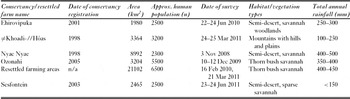
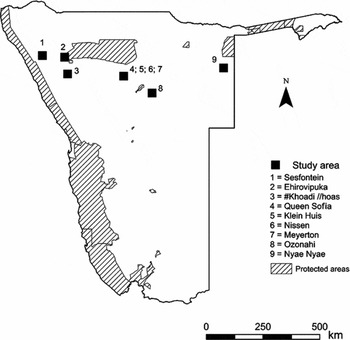
We followed a qualitative research approach to understand in-depth challenges faced by the inhabitants of conservancies and resettled farms. Questionnaires were completed at five communal conservancies and four resettled farms within Namibia (Fig. 1). The locations were chosen to determine the variance in perceived human-carnivore conflict on a large geographical scale (Table 1). Each area had many wildlife species, including an increase in predator populations leading to growing conflict with carnivores (NASCO 2010). We worked with conservancy stewards, who had extensive knowledge of their landscapes.
Study area characteristics (Source: NASCO 2010). n/a = not applicable.

Study area locations (black squares) in Namibia (protected areas are shaded).

Wildlife laws in Namibia grant land occupiers permission to use their natural resources in consumptive and non-consumptive ways (Van Schalkwyk et al. Reference Van Schalkwyk, McMillin, Witthuhn and Hoffman2010). The study sites are predominantly unfenced areas, which allow the free movement of wildlife (FAO [Food and Agriculture Organization of the United Nations] 2009). Inhabitants of these areas rely primarily on livestock for their income, with tourism (wildlife viewing and trophy hunting) also being increasingly financially important (Bandyopadhyay et al. Reference Bandyopadhyay, Shyamsundar, Wang and Humavindu2004). Currently, there are no benefits from wildlife presence for resettled farmers, as the law does not allow them to form conservancies, nor are they allowed use rights of their wildlife. For this reason, most of the land is denuded of wildlife, creating large areas, or patchwork areas in the middle of commercial lands, and act as a vacuum for predators.
Study design
Structured questionnaires were administered in English by interviewers in a face-to-face manner with one adult respondent and a translator who could speak the local language (Afrikaans, Ojiherero, Oshiwambo or Nama-Damara). A pilot survey was conducted on a subset of the population in advance of administering the finalized survey to ensure validity of the questions. Interviews took place between November 2008 and June 2011 (Table 1). Potential respondents gave verbal prior free informed consent before the interview started. We chose the study areas in an opportunistic manner using information provided to us by local informants and conservancy stewards on areas with high human-carnivore conflict. All households within the study area were then sampled. Respondents were asked if they farmed livestock and, if so, the survey commenced. Questions were predominantly fixed closed-ended, with a small number of open-ended questions to illicit further information. Questions related to: (1) demographic and socioeconomic characteristics of the respondent (name, age, sex, length of stay at the farm, main vegetation types of the farm, level of education, distance to nearest protected area and livestock numbers), (2) non-lethal predator control techniques (presence and usage of a herder or livestock guardian dog), (3) degree of depredation experienced (perceived number of livestock lost each year, to which predators, in what location the majority of depredations took place, in which season and what time of day), (4) rating of problem animals (see explanation below), (5) estimated predator and prey sightings on the farms, and (6) the number of predators removed annually.
We calculated the percentage of total annual livestock replacement (number of births from the total livestock herd minus the number of deaths due to depredation from the total livestock) for each livestock species. It is possible that livestock depredation numbers were inflated by respondents (Rasmussen Reference Rasmussen1999) but time did not allow us to verify these claims. However, it is the perceived rather than the real loss that affects attitudes and behaviours towards predators, and we therefore believe that perceived figures may be a more useful variable to measure than actual costs incurred (Marker et al. Reference Marker, Mills and Macdonald2003). Rating of 10 predator species (African wild cat [Felis silvestris lybica], black-backed jackal [Canis mesomelas], brown hyena [Hyaena hyaena], caracal [Caracal caracal], Chacma baboon [Papio cynocephalus ursinus], cheetah [Acinonyx jubatus], leopard [Panthera pardus], lion [Panthera leo], spotted hyena [Crocuta crocuta] and African wild dog [Lycaon pictus]) as being a perceived problem was determined on a 10-point Likert scale, with 1 being no problem and 10 being the most problematic. Again, this figure referred to the perceived problem rather than the actual, but perceptions of risk are more likely to influence tolerance towards carnivores than actual risk (Wywialowski Reference Wywialowski1994). Total predator problems were then calculated by summing scores for all predator species for each respondent. Estimated predator sighting frequency was assessed by asking respondents to rate the perceived abundance of the same 10 predators as above on a five-point Likert scale, with 1 being absent and 5 being very common. Total predator sighting frequency was then calculated by summing the respondents’ scores for each species.
Estimated game sighting frequency was calculated in a similar manner for 12 wild prey species (common eland [Tragelaphus oryx], Angolan giraffe [Giraffa camelopardalis angolensis], common impala [Aepyceros melampus melampus], greater kudu [Tragelaphus strepsiceros], gemsbok [Oryx gazella], southern ostrich [Struthio camelus australis], red hartebeest [Alcelaphus caama], springbok [Antidorcas marsupialis], steenbok [Raphicerus campestris], southern warthog [Phacochoerus africanus sundevallii], blue wildebeest [Connochaetes taurinus taurinus] and zebra [plains, Equus quagga and mountain, Equus zebra]).
Analyses
We used Microsoft Excel 2007 to calculate the basic descriptive statistics. All further statistical analyses were undertaken using Minitab v. 16 (Minitab Inc., Pennsylvania, USA). We tested data for normality and homogeneous variances, and non-parametric tests were used where these assumptions were not met after square root, natural logarithm and log10 transformations of the data.
A Spearman's rank correlation coefficient test was used to determine whether there was a statistically significant correlation between: total estimated predator sightings and total perceived problem scoring of all predator species; rank score of a predator as a problem and estimated frequency of sighting that predator; and total perceived annual livestock depredation in relation to the age of respondent, length of stay on farm, prey sighting frequency, predator sighting frequency, total predators removed, distance to nearest protected area and total predator problem score. Mann-Whitney U tests with Bonferroni corrections were used to compare medians between perceived depredation and: whether respondent was from a conservancy or resettled farm; gender of respondent; time of day and year of depredation; type of annual water source and vegetation structure at farm; owning a livestock guardian dog in the past or present; livestock guard dog breed; livestock guardian dog staying with the herd during the day and/or at night; and asking for help with managing depredation from the Ministry of Environment (MET) or the conservancy board. Mann-Whitney U tests were also used to determine if there was a difference in the median perceived problem scoring between conservancies and resettled farms, and predators removed from conservancies and resettled farms. A chi-squared test of independence was used to determine if there was a difference between low (0–19% of herd depredated) or high (20+% of herd depredated) annual reported stock loss across large (cattle, donkeys, horses) and small (goats, sheep, chickens) stock. We set p = 0.05 for all tests.
The cost of carnivore depredation was calculated by using the total annual number of reported depredations on each farm multiplied by the US$ market value of the animal (US$1 = N$8.53, 4 June 2012). Although the value of livestock depredation depends upon the age and breeding status of the individual, no data were collected on these variables for our survey; therefore, the average market price of livestock was obtained from the Otjiwarongo area on 24 May 2012 (J. Britz, personal communication May 2012). The costs also did not take into account the loss in production due to the fear that predators induce upon their prey, nor did it consider the injury that predators may inflict upon livestock (Howery & Deliberto Reference Howery and Deliberto2004). The cost of livestock guardian dogs did not include veterinary bills, as many communal farmers in Namibia do not use veterinary services for guardian dogs (A. Bradley, personal communication June 2012). The cost of using small livestock guardian dogs did not include the cost to buy the dog because many small dogs were mongrels that were bred in the community and given free of charge (A. Bradley, personal communication June 2012). A large livestock guardian dog breed price was based upon the cost of procuring an Anatolian shepherd from Cheetah Conservation Fund (CCF) at US$80 per dog. The cost of food for the dogs is based upon data provided by CCF (R. Glazier, personal communication June 2012) on daily costs of large guardian dogs; small dogs were assumed to eat 40% of the amount of large dogs. However, smaller dogs are often not fed shop-bought dog food; instead they are generally given scraps and inexpensive maize meal.
A total of 147 people were questioned. During the four-year timespan of the survey period, the questions evolved to elicit more information; for example, initially respondents were asked if they had any herder present at all, whereas later surveys also asked specifically what type of herder (for example cattle, sheep or goat). Questions not answered by respondents were deemed non-responses and were therefore eliminated from the analysis.
RESULTS
Are there differences between the livestock husbandry practices on resettled and conservancy farms?
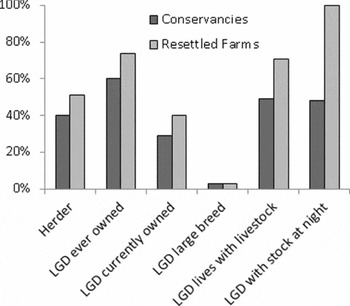
Respondents from resettled farms were more likely to use preventative measures to protect their livestock from depredation than those from conservancies (Fig. 2). Although overall, two-thirds of respondents had used livestock guardian dogs with their herds, only a very small percentage used large breeds capable of defending stock from large predators. Of those who owned dogs, most respondents from resettled farms kept these with livestock during the day and night, whereas this was observed with only half of respondents from conservancies.
Percentage of respondents who use herders and livestock guardian dogs (LGD) in conservancies and resettled farms.

What are the levels of livestock depredation on resettled and conservancy farms?
Of the 103 respondents who provided information on total annual depredation, 96% had suffered depredation within the past year of the survey. The total annual livestock replacement was greatest for cattle (x = 39% annual herd increase) and smallest for goats (x = 16%). Out of 44 respondents owning cattle that provided figures on annual births and reported depredations, 14% (n = 6) had either zero or negative annual replacement. This was 28% (n = 60) for goat farmers and 34% (n = 34) for sheep farmers.
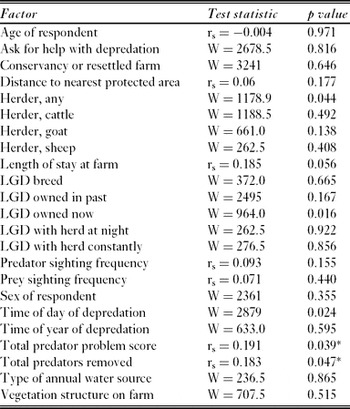
There was no significant difference in total annual perceived depredations between conservancies and resettled farms (Table 2). Perceived depredations were most often reported in the bush (58% of cases), or at multiple locations (28%). Both total reported mean annual livestock depredation and percentage of stock depredation compared to the total number of livestock in the herd were greatest for goats (mean depredation = 17, 31% stock killed) and sheep (x = 10, 27%), and smallest for horses (x = 0.3, 11%) and donkeys (x = 2, 12%); small stock were significantly more likely to be predated upon compared with large stock (χ2 = 30.291, df = 1, p < 0.001).
Statistical results of factors related to total perceived annual livestock depredation. *Significant p-value. LGD = livestock guardian dog.

Greater perceived annual livestock depredation was positively related to greater total predator problem scores and more predators removed from the farm (Table 2).
What is the cost of living with carnivores?
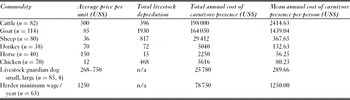
The total cost of carnivore presence in the study areas due to depredation amounted to US$ 508 898, a mean of US$ 3461 per person. Although cattle were relatively infrequently perceived to be depredated, the cost of this perceived depredation was greater than other livestock species due to the higher market price of cattle (Table 3).
Annual cost of livestock depredation due to carnivores in study area. n/a = not applicable.

What are the perceived problem predators?
Hyenas were thought to prey mostly on cattle (33% of reported kills presumed to be due to hyenas) and donkeys (40%), jackals were implicated most often for goat (69%) and sheep (68%) kills, leopards for horses (50%) and African wild cats for chickens (39%). Out of a maximum score of 100, the total mean predator problem score per respondent was 32 (±11.4 SD) for conservancies and 30 (±9.6SD) for resettled farms. Caracals were rated as more of a problem (W = 6331.5, p < 0.001) and cheetahs less of a problem (W = 1873.0, p = 0.011) in resettled farms when compared with communal conservancies. There was no significant difference in median problem animal scoring of the other predator species between conservancies and resettled farms.
There were strong correlations between total predator sighting frequency and total problem scoring of all predators (rs = 0.574, p < 0.001), and between frequency of sighting cheetahs (rs = 0.433, p < 0.001), leopards (rs = 0.381, p = 0.001) and lions (rs = 0.401, p = 0.010) correlated against their problem score; this was not significant for the other predator species. Jackals were the most sighted predators in communal conservancies, followed by cheetahs and caracals. In resettled farms, the most sighted predator was also the jackal, followed by caracals and leopards.
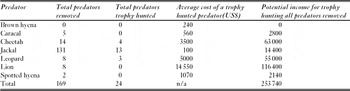
There was no significant difference between the median number of predators removed annually from conservancies when compared with resettled farms (W = 2529.5, p = 0.271). By far the most frequent predator removed was the jackal, followed by the cheetah (Table 4). The jackal was also the most commonly removed predator by trophy hunting, followed by the cheetah. The average cost of trophy hunted predators (Table 4) indicates the total income foregone by removing predators rather than trophy hunting them was US$223 440.
Total annual number of predators removed and trophy hunted in study area and potential income of trophy hunted predators. n/a = not applicable.

DISCUSSION
Reported depredation in this study was considerably higher for both conservancies and resettled farms when compared with other studies (Ogada et al. Reference Ogada, Woodroffe, Oguge and Frank2003; Kissui Reference Kissui2008). Small stock species, particularly goats, were the most susceptible to depredation, as has been shown elsewhere (Jackson et al. Reference Jackson, Ahlborn, Gurung, Ale, Timm and Crabb1996; Kolowski & Holekamp Reference Kolowski and Holekamp2005). Approximately one-third of goat and sheep farmers either made no profit or lost more stock to predators annually than were replaced with births. The average percentage of livestock that are also lost from disease, starvation, accidents and theft amounts to approximately 12–30% of stock losses (Kissui Reference Kissui2008; Schiess-Meier et al. Reference Schiess-Meier, Ramsauer, Gabanapelo and König2007); any depredation suffered by the poverty stricken farmers in this area represents a significant loss of income and questions the economic sustainability of long-term farming in these areas.
Although resettled farmers in this study used more predator prevention measures compared with conservancy farmers, both areas had similar reported depredation, total predator problems and removed a similar number of predators. Despite high reported depredation, herders and livestock guardian dogs were not frequently used; this could partly explain the high perceived depredation. When livestock guardian dogs were used, almost all of these were small- or medium-sized, which may not be an adequate size for deterring medium and large predators (Ogada et al. Reference Ogada, Woodroffe, Oguge and Frank2003; Kolowski & Holekamp Reference Kolowski and Holekamp2005; Dar et al. Reference Dar, Minhas, Zaman and Linkie2009). However, the annual cost of feeding a larger breed is prohibitive for most communal farmers (Table 3), whose average annual income amounts to approximately US$3260 (Angula Reference Angula2006). The lack of reduction in depredation due to livestock guardian dog use could also be due to the lack of training and care for the dogs (Schumann Reference Schumann2003) or because the dogs were generally mongrels that lacked genetic tendency to guard livestock effectively. As the main suspected predators of smaller livestock were jackals, of which small livestock guardian dogs should be able to offer some form of protection from depredation, it appears plausible that the main causes for high perceived depredation in the presence of dogs were due to the lack of guard training that the dogs have undergone and the limited use of dogs bred specifically for guarding behaviour. It is recommended that education is implemented in these areas to inform farmers on how best to protect their livestock from predators. It may also be beneficial for the purpose and care of large livestock guardian dogs to be subsidized for poor farmers, which could not only reduce stock loss, but also reduce the need to use lethal means to control predators.
The majority of reported depredations took place during the day and in the bush, which is similar to other findings (Ikanda & Packer Reference Ikanda and Packer2008). This signifies the importance of kraaling at-risk animals, such as newborns, and employing herders and livestock guardian dogs when animals are let out into the bush.
Jackals and cheetahs, animals active during dawn and dusk (Woodroffe et al. Reference Woodroffe, Frank, Lindsey, le Ranah and Romañach2006), were some of the most common predators seen and some of the most frequently reported culprits for killing livestock. Higher densities of carnivores can lead to increased depredation (Sagor et al. Reference Sagor, Swenson and Roskaft1997; Stoddart et al. Reference Stoddart, Griffiths and Knowlton2001); the high estimated sighting frequency of these species in this study may infer that there are high densities of these predators in the areas. Conversely, this could show that diurnal and crepuscular animals, more frequently seen due to human activity at this time, may be blamed more for depredation, even if they are not the real culprit (Marker Reference Marker2002). However, given the fact that an unpublished study also demonstrated cheetahs and jackals killed the most livestock in one of the conservancies of this study (C. J. Brown, unpublished data 2011), it may be more likely that these predators do indeed pose significant threat to livestock in rural areas of Namibia.
High rates of perceived depredation were correlated with both greater problem scores of predators and greater rates of predator removal. This may show a link between experience of living with predators and behaviour and tolerance towards predators. It is therefore essential to reduce livestock depredation to improve both tolerance and behaviour towards threatened carnivores. Respondents were more likely to rate predators as more of a problem if they saw them regularly on the farm. This may show a bias towards assuming predators are problems because they are sighted more frequently (Marker Reference Marker2002). Yet cheetahs and jackals were reported to be significant problem animals in one of the study sites (C. J. Brown, unpublished data 2011), indicating that farmers in this study may have been reflecting this observation.
The correlation between frequency of perceived depredation, sighting frequency of predators and number of predators removed may be due to respondents killing predators in response to depredation from abundant predators (Marker et al. Reference Marker, Mills and Macdonald2003; Ogada et al. Reference Ogada, Woodroffe, Oguge and Frank2003; Kissui Reference Kissui2008). More abundant predators have more chance to meet and kill livestock (Sagor et al. Reference Sagor, Swenson and Roskaft1997), which may cause the farmer to regard the species as a problem. An alternative theory is that removing predators may actually increase future depredations, possibly by removing stable individuals from their territories, creating vacuums where other predators can immigrate, and increasing birthing rates of predators (Balme et al. Reference Balme, Slotow and Hunter2009).
Smaller stock species were predated upon most frequently; the most commonly sighted predator species in the study areas (jackals, caracals and cheetahs) tend to prey on small- to medium-sized animals (Kok Reference Kok1996; Kaunda & Skinner Reference Kaunda and Skinner2003; Hayward et al. Reference Hayward, Hofmeyr, Brien and Kerley2006). It may be beneficial for farmers to convert to larger stock farming in areas with high densities of jackals and cheetahs and low densities of lions and spotted hyenas (Sagor et al. Reference Sagor, Swenson and Roskaft1997), whilst ensuring good husbandry practices of kraaling young livestock and using herders and birthing seasons (Robel et al. Reference Robel, Dayton, Henderson, Meduna and Spaeth1981; Ogada et al. Reference Ogada, Woodroffe, Oguge and Frank2003). However, owning livestock is not exclusively for financial profit, but is also a cultural tradition (Coertze Reference Coertze1986); this shift may thus prove problematic. An alternative is to create a land-use plan of each conservancy or farm that includes buffer zones in the areas with greatest conflict, which will protect core livestock raising areas from increased levels of predation (Linnell et al. Reference Linnell, Nilsen, Lande, Herfindal, Odden, Skogen, Andersen, Breitenmoser, Woodroffe, Thirgood and Rabinowitz2005).
Contrary to previous findings (Kolowski & Holekamp Reference Kolowski and Holekamp2005; Woodroffe et al. Reference Woodroffe, Lindsey, Romañach, Stein and ole Ranah2005), there was no correlation between the total wild prey sighting frequency and frequency of reported depredations. This may be due to inaccurate estimation of prey abundance by respondents. Further research is necessary to determine whether this is the case. If low wild prey abundance is found to be associated with increased depredation, action must be taken to determine the cause of decline of wild prey species and intervene where necessary.
Where lions and spotted hyenas are absent or in low numbers, competitively inferior predators thrive (Durant Reference Durant1998). Large predators were rarely seen in this study and their populations may therefore be small in these areas. Without top predators controlling the population numbers of mesopredators, this may have caused a mesopredator release (Johnson et al. Reference Johnson, Isaac and Fisher2007), where smaller predators filled the empty niche previously occupied by apex predators. This problem is currently faced in South Africa, with jackal and caracal populations increasing after extirpation of large carnivores across many commercial farming areas, causing significant damage to sheep and goat farming (Thorn et al. Reference Thorn, Green, Dalerum, Bateman and Scott2012). A limited number of apex predators in an ecosystem may be able to regulate the populations of smaller predators from a trophic cascade, which may also reduce the chance of causing greater stock loss from mesopredators (Prugh et al. Reference Prugh, Stoner, Epps, Bean, Ripple, Laliberte and Brashares2009).
Trophy hunting only accounted for 12% of predators removed from farms. Considering the substantial financial loss of income from reported depredation, it may be possible to recuperate some of this loss via increasing the issue of trophy permits of common predator species, whilst ensuring that quotas are in line with predator replacement values (Stein et al. Reference Stein, Fuller, Damery, Sievert and Marker2010). The lack of trophy hunting may be due to the historical ban of legal wildlife ownership in 1994 (Henghali Reference Henghali2006). By using the conservancy's network of members, once a problem animal is identified, an announcement could be made on the local radio system to locate a professional hunter within the conservancy and a trophy hunt could be organized quickly and efficiently to deal with that problem animal (Stein et al. Reference Stein, Fuller, Damery, Sievert and Marker2010). Additionally, baited stations for live-viewing of leopards by approximately 120 tourist visits could generate the amount required to offset the costs of depredation in these areas (Stein et al. Reference Stein, Fuller, Damery, Sievert and Marker2010). Strict regulations and financial management should be created to ensure that profits are dispersed to the local communities who are negatively affected by predators, rather than captured by local elites and government agencies.
CONCLUSION
This research has shown that reported human-carnivore conflict is severe in the sampled communal conservancies and resettled farming areas of Namibia, which may negatively affect the economic sustainability of livelihoods. Improving livestock husbandry is essential to decrease conflict (Gusset et al. Reference Gusset, Swarner, Mponwane, Keletile and McNutt2009), but this requires both initial and sustained financial input (Naughton-Treves Reference Naughton-Treves1997). Previous publications have indicated that improved husbandry decreases conflict (Ogada et al. Reference Ogada, Woodroffe, Oguge and Frank2003; Marker et al. Reference Marker, Dickman and Schumann2005), but for farmers to uptake these practices, training schemes and awareness campaigns are essential for successful implementation (Madden Reference Madden2004), which must highlight the long-term advantages of employing such methods. If a depleted wild prey base is causing increased livestock depredation, factors associated with the decline must be addressed. Land zonation to create buffer zones in hotspots of high conflict is recommended. Additionally, providing tangible benefits of carnivore presence, such as income from trophy hunting and photo tourism that outweigh the costs of depredation, may increase tolerance and improve behaviour towards carnivores (Gadd Reference Gadd2005; Lindsey et al. Reference Lindsey, Du Toit and Mills2005; Romañach et al. Reference Romañach, Lindsey and Woodroffe2007). This could then lead to a decrease in the use of lethal control upon threatened species whilst improving the economic development of rural communities (Dickman et al. Reference Dickman, Macdonald and Macdonald2011).
ACKNOWLEDGEMENTS
We thank the Howard G. Buffett Foundation for funding surveys, conducted by the International Courses in Integrated Livestock and Predator Management and Cheetah Conservation Biology, with gracious participation of the residents. Matti Nghikembua greatly assisted in data collection and coordination of surveys. We are also grateful for comments from the three anonymous reviewers and the editor.