Vocabulary is an important component of reading ability and academic success (Biemiller, Reference Biemiller, Dickinson and Neuman2006; Scarborough, Reference Scarborough, Catts and Kamhi2005; Stoel-Gammon, Reference Stoel-Gammon2011; Storch & Whitehurst, Reference Storch and Whitehurst2002; Verhoeven, Reitsma, & Siegel, Reference Verhoeven, Reitsma and Siegel2011), but children's vocabulary knowledge varies significantly at the beginning of elementary school (Hart & Risley, Reference Hart and Risley1995), and this variance grows (Biemiller & Slonim, Reference Biemiller and Slonim2001). This research has mainly focused on vocabulary breadth: the number of words children know. Less work has been done on vocabulary depth: how well children know what words mean. In this study, we tracked phonological and lexical development of Dutch children in kindergarten and first grade. We asked whether skill in learning phonologically similar words is predictive not only of vocabulary breadth but also of knowledge about the meaning of words, that is, vocabulary depth.
Word learning should not be seen as “an all-or-none proposition” (Beck, McKeown, & Kucan, Reference Beck, McKeown and Kucan2002); rather, word learning exists on an incremental continuum ranging from no knowledge, via recognition and rough or partial knowledge, to in-depth knowledge about a lexical item (Beck et al., Reference Beck, McKeown and Kucan2002; Nagy & Scott, Reference Nagy, Scott, Kamil, Mosenbach, Pearson and Barr2000; Schwanenflugel, Stahl, & McFalls, Reference Schwanenflugel, Stahl and McFalls1997; Vermeer, Reference Vermeer2001). Vocabulary breadth and depth thus have different developmental trajectories and relations to other early literacy skills (Anderson & Freebody, Reference Anderson, Freebody and Guthrie1981; Ouellette, Reference Ouellette2006; Read, Reference Read, Bogaards and Laufer2004; Schmitt, Reference Schmitt2014; Vermeer, Reference Vermeer2001). For example, Ouellette (Reference Ouellette2006) found that, in fourth-grade students, receptive vocabulary breadth predicted word decoding, expressive vocabulary breadth predicted visual word recognition, and vocabulary depth predicted reading comprehension. Vocabulary breadth was measured by asking participants which of multiple presented pictures corresponds to an auditorily presented word, whereas vocabulary depth was assessed by asking participants to describe or define a given word. Breadth and depth, while related aspects of vocabulary, are nonetheless different constructs, not only because they have different developmental trajectories and are measured in different ways but also because of a fundamental distinction: knowing how many words are in a child's lexicon cannot determine how much they know about the meanings of particular words, nor vice versa.
The richness and specificity of phonological representations plays a crucial role in several accounts of the development of vocabulary breadth and depth. Note that these accounts are not directly tested here, but they are relevant to the rationale of this study. The lexical restructuring model (Metsala & Walley, Reference Metsala, Walley, Metsala and Ehri1998) suggests that representations gradually develop from more global to more specified, and that this lexical restructuring is related to vocabulary breadth: increasing vocabulary size leads to increasingly segmented representations. More recently, however, the relationship between representations and vocabulary size has been suggested to be bi-directional or mutually dependent (Beckman, Munson, & Edwards, Reference Beckman, Munson and Edwards2007; Munson, Edwards, & Beckman, Reference Munson, Edwards, Beckman, Cohn, Fougeron and Huffman2011). Underspecified representations are also the key feature of the phonological representations hypothesis (Hulme & Snowling, Reference Hulme and Snowling2009; Swan & Goswami, Reference Swan and Goswami1997), which proposes that children with poorer early literacy skills (i.e., reading and phonological awareness) have a basic deficit in how they represent the sound structures of words. According to the lexical quality hypothesis (Perfetti & Hart, Reference Perfetti, Hart, Verhoeven, Elbro and Reitsma2002), words can only be accessed and used adequately if their form (phonology and orthography) and meaning are represented with sufficient precision, flexibility, and quality. Thus, the development of vocabulary breadth depends on the development of and access to phonological representations in the mental lexicon.
The question that follows, then, is what aspects of phonological development are related to the development of vocabulary depth. Phonological factors that likely influence vocabulary development are perceptual discrimination skill, phonological awareness, and the ability to learn phonologically similar new words. Perceptual abilities are predictive of vocabulary. For example, 12-month-olds who were better at segmenting speech had a larger vocabulary at 24 months and scored higher on vocabulary and other language measures in preschool (Newman, Ratner, Jusczyk, Jusczyk, & Dow, Reference Newman, Ratner, Jusczyk, Jusczyk and Dow2006). A study with Dutch children showed that speech perception abilities at 7 months of age were associated with vocabulary and language production at age three (Kooijman, Junge, Johnson, Hagoort, & Cutler, Reference Kooijman, Junge, Johnson, Hagoort and Cutler2013). However, in a very similar study, Junge and Cutler (Reference Junge and Cutler2014) did not find a relationship between infant speech perception skill and vocabulary at age five. Nevertheless, relationships between phoneme discrimination ability and literacy have been found in elementary school children (Serniclaes, Van Heghe, Mousty, Carré, & Sprenger-Charolles, Reference Serniclaes, Van Heghe, Mousty, Carré and Sprenger-Charolles2004). Therefore, it is important to control for the ability to discriminate phonemes in older children, for example through perception tasks in which they are asked to indicate whether two words sound the same.
Phonological awareness is also closely related to vocabulary (Bowey & Patel, Reference Bowey and Patel1988; Chaney, Reference Chaney1992; Lonigan, Burgess, & Anthony, Reference Lonigan, Burgess and Anthony2000; Metsala & Walley, Reference Metsala, Walley, Metsala and Ehri1998). This metalinguistic skill involves being able to consciously reflect upon and manipulate speech sounds. Since phonological awareness constitutes several subskills, different phonological awareness tasks exist, including rhyming, blending, and deletion tasks. Most research has focused on vocabulary as a predictor of phonological awareness (Metsala, Reference Metsala1999; Wagner, Torgesen, & Rashotte, Reference Wagner, Torgesen and Rashotte1994); for example, Lonigan et al. (Reference Lonigan, Burgess and Anthony2000) found that preschoolers’ vocabulary skills predict their phonological awareness sixteen months later. However, this relationship is probably bi-directional (Ehri, Reference Ehri2005), in that awareness of speech sounds aids discriminating between words and hence fosters word learning.
Finally, the ability to learn phonologically similar new words is also related to phonological awareness and vocabulary size (Elbro, Borstrøm, & Petersen, Reference Elbro, Borstrøm and Petersen1998; Janssen, Segers, McQueen, & Verhoeven, Reference Janssen, Segers, McQueen and Verhoeven2015; van Goch, McQueen, & Verhoeven, Reference van Goch, McQueen and Verhoeven2014; van Goch, Verhoeven, & McQueen, Reference van Goch, Verhoeven and McQueen2017). Kindergartners who are good at learning similar-sounding words through a word-learning game know more words. In the word-learning game used to assess this skill, children are taught real, but previously unknown, words that sound similar (van Goch et al., Reference van Goch, McQueen and Verhoeven2014). Success depends on the ability to discriminate similar-sounding words and on pairing the acoustic representations to specific pictures. Being good in learning new words logically leads to a larger vocabulary, because more new representations can be learned and stored. These three phonological skills all tap into different aspects of phonological representations (i.e., perception, metalinguistic awareness, learning) but are related to each other. Therefore, it is necessary to incorporate measures of all of them when studying the relationship between phonological and lexical development.
In the current study, we asked how Dutch children's vocabulary in the second year of kindergarten and in first grade is influenced by phonological skills. At this age children learn words auditorily, in contrast to when they are older and can learn words via print (Biemiller, Reference Biemiller, Dickinson and Neuman2006; Graves, Reference Graves, McKeown and Curtis1987). We investigated how phonological factors predict vocabulary breadth and depth, including analyses controlling, in turn, for vocabulary depth and breadth, given our assumption that these are separate constructs. Most studies investigating the relationship between phonological and lexical development have been merely correlational, or have focused on the role of lexical development in phonological development. Here, multiple hierarchical regression analyses assessed how phoneme discrimination skill, phonological awareness, and the ability to learn phonologically similar words predicted vocabulary. We hypothesized that phoneme discrimination plays a role in vocabulary development because, to be able to learn words, children need to be able to categorize acoustic information and discriminate between phonemes. Phonological awareness was hypothesized to play a role because metalinguistic awareness of speech sounds aids word learning. Success in learning words that sound similar was predicted to play a crucial role because it fosters the number of words children know and likely also how well they know them, due to mappings between phonological and semantic information of representations in the mental lexicon.
Method
Participants
Sixty-six randomly selected monolingual speakers of Dutch (38 boys) – none of them diagnosed with developmental or language-related problems, according to their parents and/or teachers – were assessed in the second year of kindergarten (K2; mean age 5;7; range ± 4 months) and in first grade (G1; mean age 6:8). In the Netherlands, children typically attend two years of kindergarten, during which they do not yet receive explicit reading instruction. Formal reading education commences in first grade. Children's age did not correlate significantly with their scores on any of the measures.
Materials
Phonological factors
Word Learning
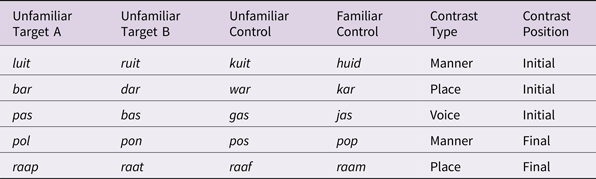
The ability to learn phonologically similar new words was measured using the word-learning game developed by van Goch et al. (Reference van Goch, McQueen and Verhoeven2014; Cronbach's alpha = .77). Children learned pairs of new lexical representations that phonologically differed minimally from each other, by means of pictures and auditory stimuli. Words were selected to be unknown to children in kindergarten (e.g., they did not appear in a list of basic vocabulary in kindergarten; Mulder, Timman, & Verhallen, Reference Mulder, Timman and Verhallen2009). The stimuli were grouped into 24 quadruplets of real monosyllabic Dutch words (see Table 1). Each quadruplet consisted of two unfamiliar target words that differed on one acoustic-phonetic feature (e.g., raap ‘turnip’ and raat ‘honeycomb’ differ in place of articulation), an unfamiliar control word (e.g., raaf ‘raven’), and a familiar control word (e.g., raam ‘window’). Both control words differed on two acoustic-phonetic features with both target words. Contrast Type (manner of articulation, place of articulation, voicing) and Contrast Position (initial versus final phoneme) were manipulated. On every trial, four pictures were shown (two experimental stimuli and two highly familiar filler pictures), and the target question was presented auditorily, containing only one of two target words of a stimulus quadruplet (e.g., “What do you think is a raap?”). Children had to discriminate between the new, similar-sounding words and link the acoustic information to the corresponding pictures. Task difficulty increased gradually during the task: in the first part of the task the familiar control words were paired with the target words and there was a two-feature difference between the target and control words, whereas in the second part the unfamiliar control words were used and there was a one-feature difference. Positive feedback was provided after correct trials; no negative feedback was ever given. The task consisted of 134 trials, was never terminated prematurely, and took 15 minutes on average. The score was the percentage of correct trials overall.
Examples of Stimulus Quadruplets Used in the Word Learning Task

Phoneme Discrimination
In the standardized Phoneme Discrimination subtask of the Diagnostic Test for Language and Literacy Problems (Cronbach's alpha = .82; Verhoeven, Reference Verhoeven2005) children were asked if two auditorily presented words were the same. All stimuli were monosyllabic, high-frequency words. The words in each pair of stimuli were either the same, or they differed on manner of articulation, place of articulation, or voicing. The score was the percentage of correct trials.
Phonological Awareness
In all three subtasks of the standardized Diagnostic Instrument for Emergent Literacy (Cronbach's alpha = > .90; Vloedgraven, Keuning, & Verhoeven, Reference Vloedgraven, Keuning and Verhoeven2009), children were presented with three response alternatives (visually on a computer screen and auditorily over headphones) and the experimental question (auditorily). In the Rhyme Awareness task, children selected the response alternative that rhymed with the target stimulus (“Hoed, bal, peer; wat rijmt op beer?” ‘Hat, ball, pear; what rhymes with bear?’). In the Phoneme Synthesis task, children combined the separate phonemes of the auditory target into a word and selected the response alternative that depicted that word (“Hoed, bal, peer; /b/ – /a/ – /l/” ‘Hat, ball, pear; /b/ – /a/ – /l/’). In the Phoneme Identification task, children selected the response alternative whose name started with the same phoneme as the auditory target stimulus (“Hoed, bal, peer; de b van beer” ‘Hat, ball, pear; the b of bear’). Since the scores for the individual subtasks correlated significantly (Pearson's r ranged between .29 and .57) and it is common to collapse the scores for these Phonological Awareness subtasks, the score for Phonological Awareness was the average percentage of correct trials across the three subtasks.
Vocabulary measures
Breadth
Using the Receptive Vocabulary task of the standardized Dutch Language Test for Children (Cronbach's alpha > 0.95; Verhoeven & Vermeer, Reference Verhoeven and Vermeer2006), four response alternatives were visually presented to the children. Given an auditory target stimulus, the children were asked to select the picture of the word that was named. The task consisted of 96 trials and was discontinued if five consecutive errors were made. The score on this task was the number of correct trials.
Depth
Using the Word Description task of the same standardized Dutch Language Test (Cronbach's alpha > .91), children were asked to define a given spoken word (e.g., ‘battery’). None of the words in this task appear in the Receptive Vocabulary task. Per trial, children could score two, one, or zero points, depending on the extensiveness of their answer. Zero points were given in case of incorrect or null answers. One point was administered if the child partly defined the target word (e.g., ‘a battery goes in a remote control’). Two points were given if the child completely defined the target word (e.g., ‘a battery provides energy to a remote control’). The task consisted of 45 trials; the maximum score was 90. The task was discontinued if zero points were given in four consecutive items. The score was the sum of points for all trials.
Procedure
All children were tested individually in a quiet room in their school. The tests were administered in a fixed order. Vocabulary Breadth and Depth were administered in K2 and G1; the other tasks were administered only in K2.
Data analysis
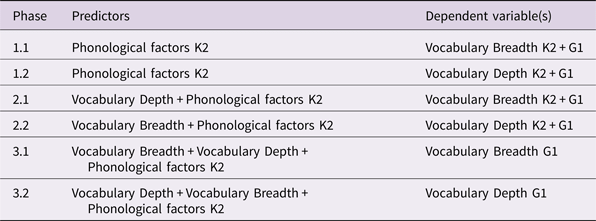
We first evaluated the descriptive statistics and correlations. Then multiple hierarchical regression analyses were carried out, in three phases (see Table 2). The first phase assessed the predictive value of the three phonological factors. The next phase controlled in turn for one of the Vocabulary measures, and in the last, most conservative phase, we controlled for performance on both Vocabulary measures.
Different Phases of Data Analysis

Results
Descriptive statistics and correlations
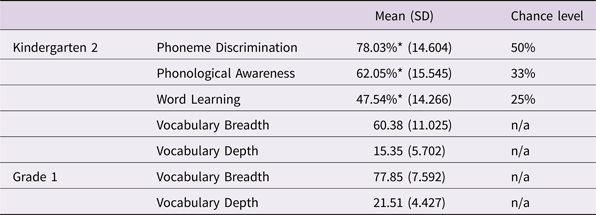
Group performance was above chance level on all measures for which this was possible to assess (Table 3). Four children (6%) scored below chance on Word Learning, four children scored below chance on Phoneme Discrimination, and zero children scored below chance on Phonological Awareness. To account for natural classroom variation, these children were not dropped from the analyses.
Descriptive Statistics (n = 66)

Note. * Performance significantly above chance level (if possible to assess).
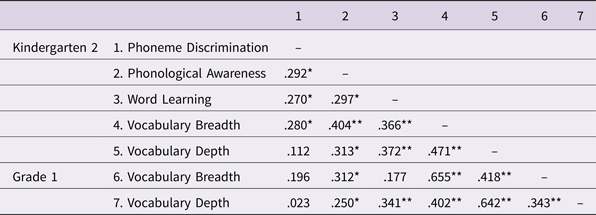
The correlations amongst the phonological factors were significant, but weak (Table 4), indicating that multicollinearity was unlikely to be a problem for the regression analyses. All correlations between the two measures of vocabulary were moderate to strong on both occasions (K2 versus G1). Word Learning correlated moderately with both vocabulary measures at both times, except for G1 Vocabulary Breadth. Phonological Awareness correlated weakly to moderately with both vocabulary measures at both times; Phoneme Discrimination only correlated with K2 Vocabulary Breadth.
Correlations between Variables of Children's Performance (n = 66)

Note. * p < .05; ** p < .01.
Hierarchical regression analyses
Phase 1
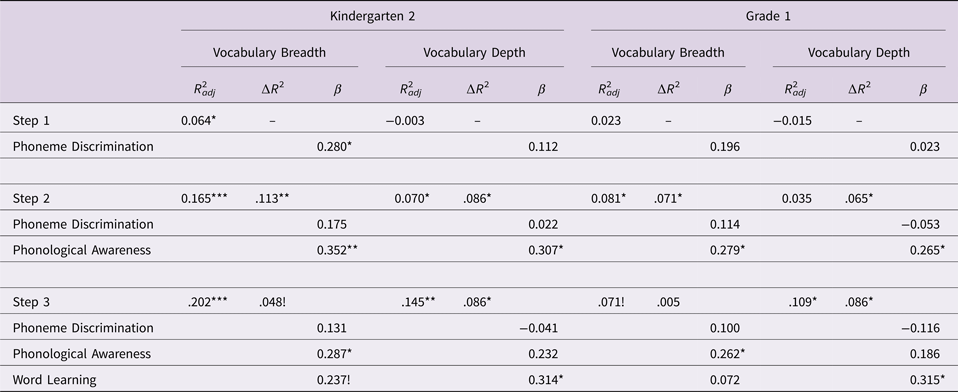
The first hierarchical regression analyses were carried out to assess how performance on the phonological factors in the second year of kindergarten predicts performance on Vocabulary Breadth and Depth in the second year of kindergarten and first grade (Table 5). In the first step, K2 Phoneme Discrimination was entered. This model was only a significant predictor for K2 Vocabulary Breadth, for which it explained 6.4% of the variance. In the second step, K2 Phonological Awareness was added. Now, the model was a significant predictor for all outcome variables, except for G1 Vocabulary Depth. It explained 16.5% of the variance in K2 Vocabulary Breadth, 7.0% of variance in K2 Vocabulary Depth, and 8.1% of variance in G1 Vocabulary Breadth. In the third step of the regression analysis, K2 Word Learning was added. This final model was significant for K2 and G1 Vocabulary Depth, but not for K2 and G1 Vocabulary Breadth. The total variance explained by the model as a whole was 14.5% for K2 Vocabulary Depth and 10.9% for G1 Vocabulary Depth. The introduction of K2 Word Learning explained additional 8.6% variance in Vocabulary Depth in both K2 and G1.
Effects of Phoneme Discrimination, Phonological Awareness and Word Learning in the Second Year of Kindergarten on Vocabulary Breadth and Vocabulary Depth in the Second Year of Kindergarten and in First Grade (n = 66)

Notes. ! < .06; * p ⩽ .05; ** p ⩽ .01; *** p ⩽ .001.
Phase 2
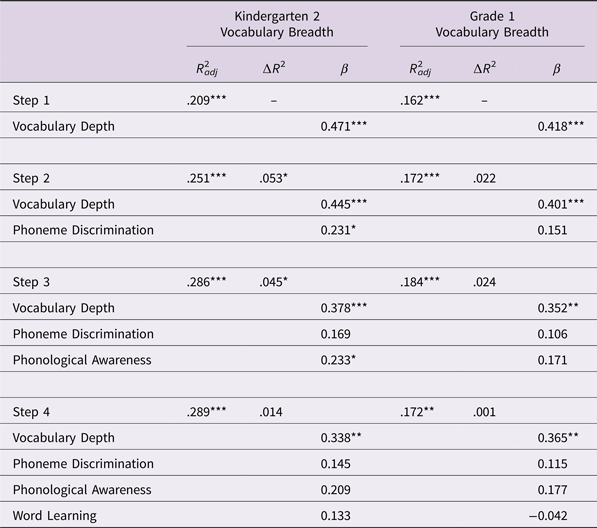
The next analyses assessed how performance on the Vocabulary Depth task and on the phonological tasks in the second year of kindergarten predicted performance on Vocabulary Breadth in the second year of kindergarten and first grade (Table 6). The first predictor was K2 Vocabulary Depth, which was significant. It explained 20.9% of the variance in Vocabulary Breadth in K2 and 16.2% in G1. The next added predictor, Phoneme Discrimination, was a significant predictor for Vocabulary Breadth in K2, but not in G1. For K2 Vocabulary Breadth, the model was significantly better than the model with just Vocabulary Depth; it now explained 25.1% of the variance. Next, Phonological Awareness was added. This did not significantly improve the model for G1 Vocabulary Breadth, but it did for K2 Vocabulary Breadth. The new model now explained 28.6% variance. Adding Word Learning, in the end, did not significantly improve the models for K2 or G1 Vocabulary Breadth.
Effects of Vocabulary Depth, Phoneme Discrimination, Phonological Awareness and Word Learning in the Second Year of Kindergarten on Vocabulary Breadth in the Second Year of Kindergarten and in First Grade (n = 66)

Notes. * p ⩽ .05; ** p ⩽ .01; *** p ⩽ .001.
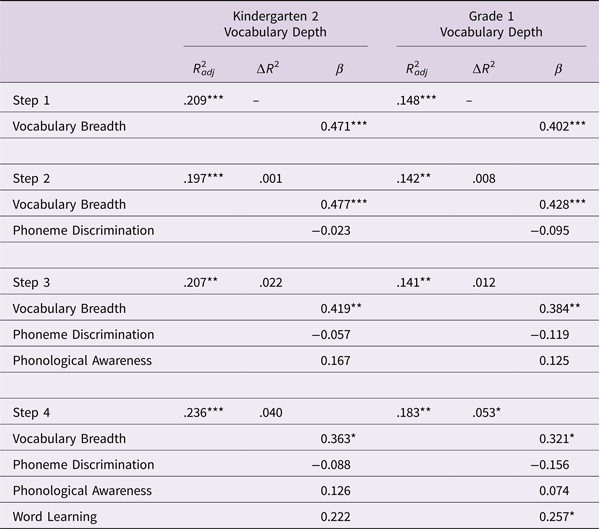
Hierarchical regression analyses were then carried out to assess how performance on the Vocabulary Breadth task and on the phonological tasks in the second year of kindergarten predicted performance on Vocabulary Depth in the second year of kindergarten and first grade (Table 7). K2 Vocabulary Breadth was first added as a predictor and proved to be significant, explaining 20.9% of the variance in K2 and 14.8% of the variance in G1 Vocabulary Depth. When Phoneme Discrimination was added as a predictor, the model was significant, explaining 19.7% of variance in K2 Vocabulary Depth and 14.2% of variance in G1, but adding Phoneme Discrimination did not explain significantly more variance. When Phonological Awareness was added, it did not explain significantly more variance, but the model remained a significant predictor of K2 (20.7%) and G1 Vocabulary Depth (14.1%). In the fourth step, Word Learning was added. Although the percentage of explained variance increased, this did not lead to significantly more explained variance in K2 Vocabulary Depth (23.6%). Adding Word Learning did improve the model significantly for G1 Vocabulary Depth, explaining 18.3% of the variance. In the final model, K2 Vocabulary Breadth and Word Learning were significant predictor variables of G1 Vocabulary Depth.
Effects of Vocabulary Breadth, Phoneme Discrimination, Phonological Awareness and Word Learning in the Second Year of Kindergarten on Vocabulary Depth in the Second Year of Kindergarten and in First Grade (n = 66)

Notes. * p ⩽ .05; ** p ⩽ .01; *** p ⩽ .001.
Phase 3
The next analysis assessed whether K2 Vocabulary Depth and the phonological factors explained variance in performance on G1 Vocabulary Breadth, beyond K2 Vocabulary Breadth. This was not the case: K2 Vocabulary Breadth explained 42% of the variance in G1 Vocabulary Breadth and no further predictor contributed significantly. Last, we analysed whether K2 Vocabulary Breadth and phonological factors explained variance in G1 Vocabulary Depth beyond K2 Vocabulary Depth. This proved also not to be the case: K2 Vocabulary Depth explained 40.7% of the variance in G1 Vocabulary Depth and no other predictor added significantly more variance.
Discussion
This study investigated how performance on three phonological factors – phoneme discrimination skill, phonological awareness, and the ability to learn phonologically similar new words – predicted vocabulary breadth and depth. The most important finding was that first-grade vocabulary depth was predicted by the ability to learn phonologically similar new words in kindergarten, even when controlling for how many words children knew in kindergarten. In addition, kindergarten vocabulary breadth was predicted by kindergarten phonological awareness, even when controlling for kindergarten vocabulary depth.
The word-learning task that we used to assess the ability to learn phonologically similar new words was designed to teach children new words that phonologically differ minimally from each other. It consists of a phonological and a semantic word-learning component, which interact with each other. The semantic component involves the link between sound and meaning: children must link the particular speech sound sequence (the spoken word) to a particular meaning (the picture). The phonological component involves the ability to discriminate between speech sounds that differ minimally from each other and to use those discriminations at the lexical level. Performance on the word-learning task was related to both phonological and semantic performance. Individual differences on the task correlated with phonological awareness (as also in Janssen et al., Reference Janssen, Segers, McQueen and Verhoeven2015; van Goch et al., Reference van Goch, McQueen and Verhoeven2014; van Goch et al., Reference van Goch, Verhoeven and McQueen2017), but did not predict vocabulary breadth more than phonological awareness. Thus, it did not add significantly more variance to the prediction of vocabulary breadth beyond phonological awareness. On the other hand, the word-learning task did add significantly more variance to the prediction of vocabulary depth. It can thus be assumed that when word-form learning becomes easier, children have more resources and/or memory left to focus on and learn the meaning of the new words. Another possibility is that having phonological labels which are clearer and more distinct makes it easier to tie meaning to form. Thus, good word learners either can free up resources to learn more words and/or can learn more about those words. These explanations are not mutually exclusive. Our results are in line with previous research showing that the specificity of phonological representations is related to phonological awareness and vocabulary (Elbro et al., Reference Elbro, Borstrøm and Petersen1998; Elbro, Nielsen, & Petersen, Reference Elbro, Nielsen and Petersen1994; Janssen et al., Reference Janssen, Segers, McQueen and Verhoeven2015; van Goch et al., Reference van Goch, McQueen and Verhoeven2014; van Goch et al., Reference van Goch, Verhoeven and McQueen2017) and with theories that highlight the importance of detailed phonological representations in early literacy (Hulme & Snowling, Reference Hulme and Snowling2009; Metsala & Walley, Reference Metsala, Walley, Metsala and Ehri1998; Perfetti & Hart, Reference Perfetti, Hart, Verhoeven, Elbro and Reitsma2002), suggesting at least a reciprocal relation between phonological representations and vocabulary (Beckman et al., Reference Beckman, Munson and Edwards2007; Munson et al., Reference Munson, Edwards, Beckman, Cohn, Fougeron and Huffman2011).
The finding that the ability to learn phonologically similar new words did not explain unique variance in vocabulary breadth over phoneme discrimination and phonological awareness was unexpected, based on previous research (van Goch et al., Reference van Goch, Verhoeven and McQueen2017). However, the children in the former study were in the first year of kindergarten, whereas the current sample was assessed in the second year of kindergarten and in first grade. It is highly likely that the inter-relations between phonological factors and their predictive strength differ at different time-points. It thus appears that the ability to learn similar-sounding words is related to vocabulary breadth in the short term and to vocabulary depth in the longer term.
Phonological awareness predicted vocabulary breadth in kindergarten and in first grade. Most research on the relation between vocabulary and phonological awareness at this point in development suggests that vocabulary predicts phonological awareness (Metsala, Reference Metsala1999; Wagner et al., Reference Wagner, Torgesen and Rashotte1994). This study shows that phonological awareness also explains unique variance in lexical development, both in the numbers of words children know and in how well they know the meaning of words. Explicit awareness of and access to phonemes, and the ability to consciously manipulate them, thus fosters vocabulary development.
Phoneme discrimination turned out not to be an important predictor for vocabulary breadth or depth. Categorical perception of phonemes thus did play a role in lexical development, but was not as important as phonological awareness. Phoneme discrimination might be more important earlier in lexical development (Junge & Cutler, Reference Junge and Cutler2014; Kooijman et al., Reference Kooijman, Junge, Johnson, Hagoort and Cutler2013; Newman et al., Reference Newman, Ratner, Jusczyk, Jusczyk and Dow2006).
The differential results for vocabulary breadth and vocabulary depth underline the need to view these factors as distinct: they have different developmental trajectories. The influence of phonological factors changes over time for each vocabulary measure. The extra analyses controlling for vocabulary highlighted this. The development of vocabulary breadth seems to be mostly driven by perceptual and metalinguistic phonological factors, whereas the development of vocabulary depth seems to be mostly driven by the lexicon and the quality of lexical representations. In language education, attention should be paid to both aspects of vocabulary.
Previous correlational and longitudinal studies have shown that vocabulary is fairly stable during elementary school (e.g., Verhoeven, Van Leeuwe, & Vermeer, Reference Verhoeven, Van Leeuwe and Vermeer2011). The current study showed that phonological awareness and the ability to learn phonologically similar new words drive vocabulary development before the start of elementary school. In kindergarten, the current results could inform assessment and intervention of deficits: teaching new similar-sounding words might not only benefit how many words children know, but also how well they know them. Although we only included one measure of each construct at each time-point, these results can inform classroom teaching. Future studies should include multiple measurements of all relevant constructs and should include a larger sample, to improve power. Since we focused on the role of knowledge about spoken language on vocabulary development, future research could include assessments of other precursors to vocabulary, e.g., home literacy and story-telling), in order to offer a complete assessment of lexical development.
The current study showed that the ability to learn phonologically similar new words is predictive of word knowledge above and beyond vocabulary size. Phonological skills in word learning thus appear to help with learning about the meanings of words.