The Italian multinational beverage company Martini & Rossi, part of the Bacardi group since 1993, is the maker of Asti, Italy’s number one sparkling wine by volume, and its signature vermouths are mainstays of bars worldwide.Footnote 1 The company’s production facility in Pessione, established outside of Turin in the northwestern Alpine region of Italy in 1864, churned out 1 million bottles a day at the time of its 150th anniversary in 2014 and exported to more than 100 countries, making it the largest in the entire Bacardi network.Footnote 2 From its rustic origins in the hills of Piedmont, historically the heartland of the Duchy of Savoy (which became part of the Kingdom of Sardinia in 1720 and the Kingdom of Italy in 1861), Martini & Rossi rose to become a worldwide phenomenon on the back of its distinctive vermouth wine already in the second half of the nineteenth century, resolutely international yet deeply rooted in its local terroir, or “somewhereness.”Footnote 3 In 1914, just as the world economy was about to dramatically contract, a company ad presented Martini & Rossi as “the great global brand.”Footnote 4 But what, exactly, is vermouth? How did it conquer the world’s palates? And how did the company build such an iconic brand across some of the most tumultuous periods of global economic history?
The European Union characterizes “Vermut o Vermouth di Torino,” the world’s only vermouth with a Protected Geographical Indication (PGI), as an “aromatized wine found in Piedmont born from one or more Italian grape varietals, to which is added alcohol, primarily flavored with Artemisia [wormwood] added to other herbs and spices.”Footnote 5 Through managerial skill and entrepreneurial vision, Martini & Rossi’s founders capitalized on revolutions in technology, transportation, and communications that had characterized the second half of the nineteenth century to export their eminently local product—based on literally millennial Mediterranean traditions—to a veritable global market.Footnote 6 Their vermouths won international acclaim and helped revolutionize cocktail culture and the ritual of the aperitivo worldwide.Footnote 7 The company was already present in 74 countries by 1900, and became the official supplier of vermouth to the Emperor of Japan in 1922. After World War II, Martini & Rossi then went on to become emblematic of La Dolce Vita, the stylishly indulgent “sweet life” captured in Federico Fellini’s celebrated 1960 film of that title, and a “symbol” of Made in Italy, famous also for sports sponsorships like Martini Racing and an active patronage of cinema and the arts.Footnote 8 Today, Martini has been called “the leading brand of vermouth in the world” and, to many, “synonymous” with it.Footnote 9
Both Martini & Rossi and its parent company Bacardi have long cherished the motto of “honouring the past, looking to the future,” holding respect for, and valorization of, the heritage of brands as a “strategic asset” in its own right.Footnote 10 As a consequence, Martini & Rossi hosts not only a premier Museum of Enology but also a massive and carefully curated company archive in Pessione. In revealing the remarkable story of one of the world’s most iconic companies, these unique archives allow us to reconstruct Martini & Rossi’s strategies for success as a capitalist world economy first was woven together in the nineteenth century and, importantly, how the company reinvented itself to navigate the tumultuous subsequent fragmentation of this system in the face of wars and beggar-thy-neighbor policies in the 1910s–1940s. Martini & Rossi’s early globalization reorients the historiographical chronology of multinational alcoholic beverages companies as described in other studies. The business historian Teresa da Silva Lopes, for instance, noted how “until the 1960s, production and consumption were essentially country and culture specific. Each country consumed predominantly one type of alcoholic beverage, usually domestically produced.”Footnote 11 Like pilsner beer and Champagne, Martini & Rossi shows vermouth to be an outlier to that history.Footnote 12 In addition, due to this longevity, the history of vermouth sheds important light also on the broader question of how individual entrepreneurs and firms successfully have prospered through what Harold James so aptly has called the “Globalization Cycle.”Footnote 13 As we today face a new era of geopolitical turmoil and a renewed retrenchment of globalization itself, the history of Martini & Rossi offers valuable food—or rather drink—for thought.Footnote 14
In short, this article uses the longue durée history of Martini & Rossi to examine globalization as a cyclical and historically contingent process rather than a linear trajectory of integration. It shows how the firm repeatedly reconfigured its production, distribution, and organizational structures in response to changing regimes of trade openness, regulation, and geopolitical disruption. In doing so, it highlights the role of incremental innovation, branding, and consumption practices in the creation and diffusion of value in global markets. Drawing on extensive archival sources, the article foregrounds the micro-level strategies through which firms navigated successive phases of globalization and deglobalization from the nineteenth century onward.
Historical Approaches to Globalization
Beyond its intrinsic interest, Martini & Rossi’s extraordinary history offers a unique lens to examine the enormous transformations that have occurred in the architecture of the global economy since the modern world economy first took shape in the middle of the nineteenth century, particularly its cycles of waxing and waning. It uniquely elucidates the granularity of business expansion during the first era of global capitalism, highlighting the ways Martini & Rossi emerged as a pioneering multinational and created one of the earliest global alcohol brands.
The Uppsala model of internationalization—variations of which remain the go-to framework for making sense of firm expansions in foreign markets—suggests that companies expand globally through processes of experiential learning and gradual increases of market commitment. Their process is fundamentally incremental, moving through stages beginning with export activities, then relying on representative agents, followed by sales subsidiaries and finally the establishment of international production plants. No less significantly, the model posits that companies tend to first move into markets that are deemed culturally, geographically, and linguistically closer to home—all measures of “psychic distance.”Footnote 15
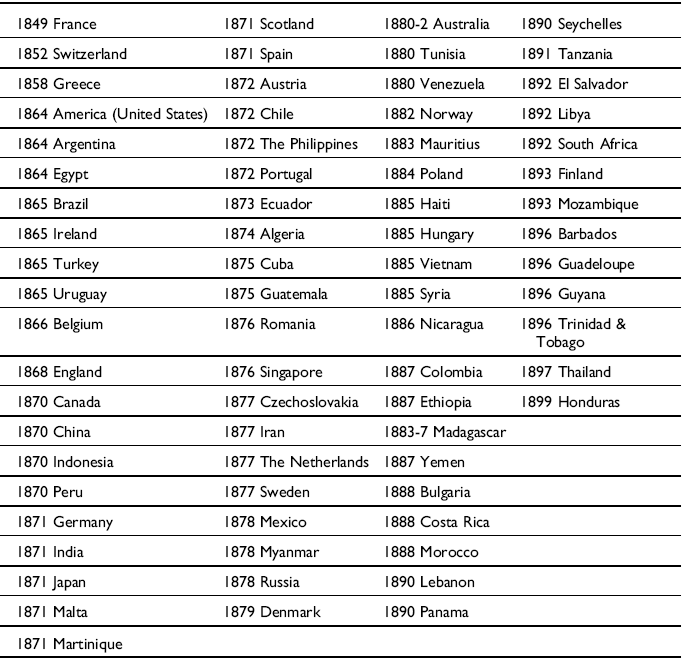
From this perspective, it is hardly surprising that Martini & Rossi exported first to France, a neighboring country with an autochthonous tradition of vermouth, and that it established its first overseas branch in Argentina, one of the principal poles of the Italian diaspora—not unlike German immigrants who brought pilsner-style beer to the United States beginning in the 1840s.Footnote 16 The Uppsala model of internationalization is less useful for making sense of how and why the company entered Egypt the same year as it did Argentina, and Brazil, Ireland, and Turkey the same year as it did Uruguay, another mainstay of Italian emigration. Within a decade of exporting to Argentina, Martini & Rossi’s products were exported to Canada, China, Indonesia, Peru, India, Japan, Martinique, the Philippines, and Algeria (Table 1). These were all countries of great “psychic distance,” and the expansion happened within so contracted a timeframe that, given the technological limitations of the age, experiential learning and gradual market commitments had only limited time to play out. Though perhaps not “born global,” it remains that Martini & Rossi depended on international ingredients for its value-added process and was founded with an expansionary spark that, due to the unique nature and quality of its product, its visionary branding, and entrepreneurial ambitions on many levels—from the aspirations of the founders to the fearlessness of its agents—internationalized far more rapidly and more broadly than reigning models would predict.Footnote 17 As such, it cannot be ignored that some of the cosmopolitan characteristics of the earlier paradigm of traveling merchants, on the more adventurous model of a Marco Polo, survived and indeed flourished also in later eras. But not only were the company’s economic activities precociously international in nature, but its iconic branding also contributed important and brightly colored threads to the cultural warp and weft of the global economy in the late nineteenth and early twentieth centuries.
Date of Introduction of Martini & Rossi to Different Current Countries Before 1900

Table 1 Long description
A table listing the dates of vermouth introduction in various countries during the nineteenth century. The table has four columns and 36 rows. Column headers are years 1849, 1871, 1880, and 1890. Row labels are countries. Row 1: France, Switzerland, Greece, America (United States), Argentina, Egypt, Brazil, Ireland, Turkey, Uruguay. Row 2: Scotland, Spain, Austria, Chile, The Philippines, Portugal, Ecuador, Algeria, Cuba, Guatemala. Row 3: Australia, Tunisia, Venezuela, Norway, Mauritius, Poland, Haiti, Hungary, Vietnam, Syria. Row 4: Seychelles, Tanzania, El Salvador, Libya, South Africa, Finland, Mozambique, Barbados, Guadeloupe, Guyana. Row 5: Trinidad & Tobago, Thailand, Honduras, Lebanon, Panama, Canada, China, Indonesia, Peru, India. Row 6: Japan, Martinique, Germany, Mexico, Myanmar, Russia, Bulgaria, Costa Rica, Morocco, Denmark. The table shows the global spread of vermouth introduction across different countries and continents within a relatively short period.
Source: Compiled from company records.
At the same time, the history of Martini & Rossi also showcases the strategies that firms could adopt in the face of increasing protectionism following the onset of the Great War in 1914, adding important nuance to our understanding of how macroeconomic processes of globalization and deglobalization are experienced and handled by an individual company. From this perspective, globalization is not a Manichean question of black and white, either-or, but rather a dynamic process of regulatory changes in the architecture of international trade, which firms can manage to greater and lesser degrees. Very few companies in the world have existed long enough—and hold archives detailed enough—to reconstruct the strategies they have employed in different moments of regulatory loosening and tightening of the flows of trade. For Martini & Rossi, the 1910s–1940s were rather characterized by reglobalization than deglobalization, with international exports from the historical company headquarters in Pessione giving way to a network of local branches and factories supplying international markets directly as a consequence of changing tariffs and prohibitions. Inversely, as global markets integrated again and transportation costs fell in the second half of the twentieth century, production in turn returned to Pessione at a greater scale.
More conceptually, from the very beginning, their goal was to capitalize on what management theorist Edith Penrose would have called their “productive opportunities” by producing a superior vermouth able to penetrate the new markets that they saw opening around them.Footnote 18 Their strategy fit their changing context like a glove.Footnote 19 More generally, the way in which Martini & Rossi repeatedly shifted and adapted its strategies and even its company structure to face changing circumstances suggests the pertinence of expanding some traditional frameworks of analysis in business history. In his homonymous 1962 classic, Alfred D. Chandler, Jr., famously proposed the dyad of “strategy and structure” to make sense of the successes of reorganized businesses in the earlier twentieth century, and though he suggested the importance of “context” in passing, Richard H. K. Vietor then formalized the triad “strategy—structure—context” to analyze the competitive successes of entire countries.Footnote 20 The story of Martini & Rossi over what in business or company terms counts as a longue durée, through a number of “eras” or “forms” of capitalism, from the mercantile through the industrial to the post-industrial and beyond, highlights the relevance of such an expanded framework for understanding the historical success of individual companies as well.Footnote 21 Again and again, one can see how their company structure followed their strategy as it adapted to changing contexts.Footnote 22
Finally, the history of Martini & Rossi offers a striking and precocious example of the importance of adding value through the development and marketing of brands. The company was never simply in the business of selling liquid calories, and from its very origins also offered a complex of ceremonies, emotions, attitudes, and experiences surrounding vermouth. Its vermouths appealed to European emigrants and expats as a taste of home, and to non-Europeans as an aspirational tang of metropolitan status, culture, and ritual, and ultimately of nostalgia for a lost world of Italian chic. Geoffrey Jones has argued that “the very nature of a brand, whose identity is built over time and which can rest so fundamentally on its heritage, makes an historical approach particularly appropriate,” and it is evident from its company archives that Martini & Rossi’s history itself remains a strategic asset.Footnote 23 Given the iconic role played by Martini & Rossi in the history of advertising, however, it is worth stressing that the company began expanding without advertising and indeed long resisted it, because its founders preferred to emphasize the creation of a superior product before they expanded internationally. International prizes (themselves important elements of the contemporary process of globalization) in turn helped to give the company a particular kind of high-end marketing by proxy.
Though the company and its founders were able to capitalize on demand from the Italian diaspora and Italian institutional support abroad early on, they were also remarkably efficient at staking out new markets around the globe through a direct form of rather adventurous salesmanship. The company’s founders may largely have been “sedentary,” in the archetypal articulation of N. S. B. Gras, managing international trade from their desks in Italy, but its agents very much embodied the “traveling merchants” of yore, and it was only the interplay of these two forms of capitalist agency—particularly in the penetration of frontier markets at the time—that allowed for the company’s unprecedented globalization in the nineteenth century.Footnote 24 In light of recent work on the historical process of marketization, this may not be surprising, as what Tarun Khanna and Krishna G. Palepu refer to as “institutional voids” in emerging markets, from insufficient infrastructure to a lack of reliable data sources, require a hands-on presence and ability to improvise that, given the technological limitations of the time, were difficult if not impossible to execute at a distance.Footnote 25 Yet it is worth noting that, just as Martini & Rossi went out into the world, so the world influenced the products the company offered, most famously in the development of the now core product “Martini Dry.” Globalization remains ever a two-way street.
Vermouth
The earliest examples of conscious wine-making have been traced back to the agricultural revolution in the southern Caucasus, most specifically in Georgia, where remnants of wine have been discovered in earthenware jars decorated with grape clusters and people dancing that date to around 6,000 BCE.Footnote 26 Beyond recreation, however, the history of wine is deeply interwoven also with those of religious rituals and of medicinal practices, for which herbal essences frequently have been mixed into wine in the hopes of achieving a variety of beneficial effects.Footnote 27 In particular, infusions with wormwood, “perhaps the bitterest herb known to mankind” and one of the most symbolically potent of the ancient Mediterranean, predate the written record.Footnote 28
Among the most influential learned vectors for the transmission of this tradition was probably the work of Greek pharmacologist and Roman army physician Pedanius Dioscorides (c. 40–90 CE), whose medical encyclopedia On Medical Substances would remain in circulation for more than 1,500 years and inspire all modern pharmacopeias.Footnote 29 He praised wormwood for being “warming, astringent and digestive” and suggested “wine with wormwood” as good for digestion, not to mention an antidote against “hemlock” and “the bites of the shrewmouse, and the bites of the sea dragon.” And “especially around Propontis and Thrace,” he noted, “a wine is made from it which is called absinthe.”Footnote 30 This and other sources came together in the tenth-century Byzantine agricultural compendium Geoponica, which reflected the practice of infusing wine with wormwood for its medicinal qualities: “use absinth for pain in the liver and hypochondria, for indigestion and pain in the stomach; it also eliminates intestinal worms.”Footnote 31 Similarly, the oldest Arab husbandry manual Nabataean Agriculture, supposedly composed by the agriculturalist Ibn Waḥshīyah (d. 931) from Mesopotamian and Mediterranean sources, described the virtues of drinking “absinthe at meals with wine added,” noting that this elixir could be “drunk before, during, or after the meal.”Footnote 32
A recipe for “Vino Absinthite” finally appeared in the Italian vernacular with Pietro Lauro’s partial translation of the Geoponica, published in Venice in 1542. “This wine,” Lauro wrote, “is used against pains around the heart & the liver & raw stomach & its pains; it also chases away the animals, which nourish themselves in the bowels.”Footnote 33 Leonardo Fioravanti wrote similarly about “wine with wormwood” and other herbs in 1582, claiming that with “good wine” it “helps digestion, purifies the blood, induces sleep, and conserves those who drink it at a good temperature, to the extent that one can call it miraculous, and divine. . . the bitterness. . . comforts the liver, solves the spleen, and cheers the heart; all very important things for our health, from which wonderful experiences and admirable effects result.”Footnote 34 Such Wermutwein, or wormwood-wine, became widespread also in Hungary and in German-speaking lands in the sixteenth century, but was largely reserved for medicinal rather than recreational uses.Footnote 35 Though the etymology of the words remains up for debate, much suggests that the variations of wormwood and vermouth—which historically were mispronunciations of each other—derive from the Proto-Indo-European term for “bitterness.”Footnote 36 From its very beginning, then, vermouth has been a polyglot compound drawing on a variety of gastronomic, medicinal, and religious traditions.
The art of distillation progressed by the eighteenth century, however, and further ingredients were added to wormwood-infused wines in order to expand and balance their flavor profiles. Fittingly, the first recipe for a recognizably vermouth-like “Vino Absinthite” appeared in the 1736 Pharmacopoea Taurinensis, or Turinese Pharmacopeia: white wine, flower of wormwood, and cut root of sweet flag (Acorus calamus). This last ingredient, an aromatic and fragrant marsh herb characterized by sweetness and a bitter aftertaste, would become a cardinal ingredient of alcoholic beverages like absinthe—which gradually came to be defined by additions of anise and sweet fennel in the eighteenth century—as well as vermouth, and had been used across Eurasia as an aphrodisiac and cure for stomach-related ailments for millennia.Footnote 37 Turin was then the capital of the Kingdom of the House of Savoy—which by marriage was bound to the Habsburg-Lorraine dynasty—and developed one of the most sophisticated court cultures of the age.Footnote 38 Demand from the court, its patrons, and its functionaries helped inspire still extant traditions of fine patisserie, chocolates (including the famous hazelnut gianduiotti, of which Ferrero’s Nutella is the more democratic descendant), wines, and distillations in the city, in turn refined further by guilds such as that of “Confectioners and Liquorists” and by the Royal Academy of Agriculture.Footnote 39 The first known reference to a “Vermouth di Torino” appears in the 1778 records of the cellars of the Castle of Agliè, one of the principal residences of the House of Savoy.Footnote 40 Similarly, some of the first experiments with producing a vermouth able to travel longer distances were undertaken by the King’s enologist Paolo Francesco Staglieno in the 1830s for the explicit purpose of promoting exports.Footnote 41
Beyond improving on the technical aspects of production, the Piedmontese innovation was to add sugar, alcohol, and a variety of herbs and spices to produce a durable, bittersweet fortified wine, the exact flavor of which depended upon the whims and tastes of often secretive blenders. Among the more popular additives were sweet and bitter orange, angelica, germander, cinnamon, cardamom, cinchona, coriander, gentian, juniper, hyssop, Quassia wood, marjoram, mint, nutmeg, oregano, rosemary, elderberry, sassafras, thyme, vanilla, and saffron. The varietals of choice originally tended to be the autochthonous white Moscato or Erbaluce grapes, and the fortification process gave the final product an alcohol content of 15–17%.Footnote 42 The traditionally dark golden hue of vermouth derives from the wine but also from the caramel color of its added sugars. And as the world became smaller in the nineteenth century, so the number of supplemental fragrances grew.Footnote 43 Indeed, the sourcing of Martini & Rossi’s main herbal ingredients aligns neatly with a map of mid-nineteenth-century globalization.
Ingredients in the Original Martini & Rossi Vermouth. Map by Isabelle Lewis. (Source: Company Documents.)

Dramatic economic transformations concomitantly gave rise to new forms of consumption and commercial sociability at the time, making goods and habits that once had been restricted to the aristocracy available to ever broader circles of society.Footnote 44 One of the new quotidian rituals introduced at this time was the “vermouth hour”—what eventually would become the aperitivo—a moment during the afternoon during which people came together for drinks and snacks to digest the day.Footnote 45 Though scores of independent vermouth manufacturers emerged in Piedmont during the long nineteenth century, none would equal the global fame and success of Martini & Rossi.
Martini & Rossi
The formal roots of the Martini & Rossi company date to the first half of the nineteenth century. On July 1, 1847, the “National Distillery of Wine and Spirits on the model of France” was born alongside a “Depot of rum, absinthe, kirsch, cognac, curaçao,” which also engaged in the resale of Bordeaux wines. The founders were four merchants—Clemente Michel, Carlo Re, Carlo Agnelli, and Eligio Baudino—and their association had offices in Turin and a factory in San Salvatore Monferrato, where Michel and Re resided. The enterprise evidently emerged from the ashes of earlier companies engaged in the manufacture and sale of wines and spirits. The four founders all had previous experience in the trade before 1847, bringing suppliers and clients from former ventures and of other products. The Distillery’s earliest warehouse inventories listed a variety of products from hats to oil, from exotic fruits to candles. Before long, a warehouse in Genoa Sampierdarena, where Agnelli moved with his whole family, and a brewery in the Piedmontese city of Alessandria were added to the Distillery’s business, along with so-called “representative houses” in the southern French cities of Narbonne and Béziers.Footnote 46
Soon enough, the names of Alessandro Martini (1834–1905) and Teofilo Sola (1831–1879)—respectively salesman and accountant—began to appear in company documents. Martini drafted business letters for the managers as early as June 1850, at the age of 16, though he had begun to get involved with the Distillery already upon his arrival in Turin 2 years earlier. During his apprenticeship in the Turin office, Martini worked closely with Eligio Baudino.Footnote 47 The young man’s initiative allowed him to acquire a share in the company’s profits as early as 1851. Sola appeared in the ledgers as a salaried employee from 1856, but his collaboration certainly began a few years earlier. The role of the Agnelli family—later famous for their involvement in the founding of the automobile manufacturer FIAT in 1899—in the Distillery was also evident early on: having a substantial fortune, they often stepped in to cover expenses and found many ways of helping the company, born, as it was, from previous business relationships woven by “father Agnelli.”Footnote 48 The three partners Baudino, Agnelli, and Re were also closely linked by bonds of marriage and kinship. Only Michel was an outsider to this dense family complex, but he in turn could capitalize on a familial network of shopkeepers in similar trades in Italy (Aosta) and France (Béziers), as well as control and management of the Alessandria brewery. Though Martini and Sola at the outset were outsiders to these older structures, they were quickly able to assert their value to the Distillery. Finally, the botanist Domenico Ulrich joined the Distillery in 1856, first as a traveling agent, then as a producer of essences for vermouth.Footnote 49
A New Beginning
In the spring of 1860 Carlo Re died, inaugurating a period of considerable change in the company. Martini left the Turin office to become an agent, and almost all the former representatives were replaced. The political and economic backdrop, too, was dramatically transformed. Piedmont had long spearheaded the movement for the unification of Italy known as the Risorgimento, and its achievement in 1861 resulted in the abolishment of duties, customs, and other internal barriers to trade on the Italian peninsula.Footnote 50 The company ledgers of the time bore witness to a dense network of small customers chiefly in the territories of the old Sardinian Kingdom, and select contacts with the rest of Europe, especially for the purchase of barley and hops (Germany), rum (England), and sugar beets (Flanders). These were difficult years for the Distillery, with costs frequently outrunning revenues—debts repeatedly covered by the Agnelli family—and products whose quality did not always live up to expectations. Indeed, though the company produced beer, wines, spirits, and vermouths at the time, the failure to achieve a stable product in terms of taste, clarity, and conservation meant that it was not yet ready to export internationally. Martini, in particular, harbored greater ambitions, and wrote of “the way I intend to carry out the clearance [of products] and the way I would do it if I were the master” already in 1861.Footnote 51 The company nonetheless continued operations for another three years following Re’s death before its shareholders threw in the proverbial towel.
Agnelli remained in Genoa in open conflict with his former partners, Michel assumed control of the brewery in Alessandria, and Baudino embarked on a new venture as a collaborator of the newly incorporated “Martini, Sola, and Co.,” founded in 1863. Martini and Sola had added a third partner, Luigi Rossi (spelled Rosso at the time), who, far from a newcomer to the trade, was a skilled liquorist and an old collaborator of the original Distillery, for which, on commission, he long had produced vermouth, China bitters, and fernet in his Turinese workshop. By 2024, seven more generations of master blenders had followed in his footsteps at Martini & Rossi. Sola, who was more active in the Turin area than the others and was a more sophisticated connoisseur of customer tastes, had particularly fought for Rossi’s inclusion in the new company. In fact, recognizing his innate skills as a liquorist, Sola frequently pushed Rossi to further experiment to improve his techniques and to refine the various aspects of production. The efforts paid off, and, after an intense period of trial and error, Alessandro Martini could finally affirm after a tasting that “this vermouth is second to none.”Footnote 52
So, on July 1, 1863, Martini, Sola, and Rossi embarked on a new and far more ambitious adventure. State structures such as customs offices gradually formalized in the nineteenth century, simplifying international trade across Europe and its empires.Footnote 53 Under the auspices of King Carlo Alberto and later the leadership of the redoubtable statesman Camillo Benso, Count of Cavour, the Kingdom of Sardinia had embarked on a similar reform project in the 1830s and 1840s, favoring lower tariffs and a more liberal attitude to trade that suited its key region of Piedmont.Footnote 54 Cavour, in particular, sought to emulate the international success of French wines by producing Piedmontese equivalents able to be “transported to any region of the world.”Footnote 55 The commercial bourgeoisie in Turin immediately saw the advantages of their strategic position between France and the Austrian Empire, on the one hand, and their proximity to Genoa, the most important port on the Italian peninsula, on the other.Footnote 56 The crucial new railway connecting Turin to Genoa by way of the wine-district cities of Alessandria and Asti was built at enormous state expense between 1845 and 1854, and finally gave Piedmont a direct gateway to global markets.Footnote 57 Though increasing international competition as well as state deficits eventually would drive economic nationalism and a new era of protectionism from the 1880s onwards, the central decades of the century experienced a dramatic opening of world trade.Footnote 58
If Rossi had given the company a vermouth capable of competing in international markets, and Sola took care of the company’s management and accounts, it was Martini’s entrepreneurial flair that connected the two. In a little more than a decade the young man, unschooled and speaking no language but Italian, had gone from apprentice to partner, and his ambition was now to export Turin’s characteristic vermouth to the four corners of the earth. The newborn “Martini, Sola, & Co.” rebuilt its clientele, its credibility, and its commercial network following the dissolution of the Distillery, but quickly proved willing and able to transcend the old company’s “national” horizon. With its new factory and warehouse in Pessione, on the recently constructed railway from Turin to Genoa, the company purposefully placed itself at the intersection between its terroir and the markets to which it aspired. Even in the very first months of the new company’s operation, a “mal d’America” or “an almost painful longing for America” was evident in Martini’s correspondence, as he left no stone unturned in an effort to find a foothold in the New World. In January of 1864, Sola, then stationed in Genoa, began to conclude deals to export with the captains of ships in the port. As he explained in a letter, “I am tired of having to spend all my day here at Customs. . . You cannot sell vermouth to sea captains the way you would to liquor merchants. You have to wait for the captain departing for America who wants to trade vermouth then he has to taste it and if he thinks it’s a deal he will buy it.”Footnote 59
Around this time, the company also began to plan direct exports to Argentina, a favorite destination of the massive Italian diaspora at the time, where vermouth would see tremendous success in the nineteenth century.Footnote 60 Other vermouth producers had pioneered this route, but Martini and Sola’s new efforts soon gave rise to a veritable export system. The first shipments were, as they called them, “tests” based on their “knowledge of acquaintances,” but with time they were able to build demand for their supply.Footnote 61 They often worked with other firms—like the Anfossi Brothers of Asti, the Genoese porcelain dealer Vercellone, and the coffee importers Mina or Calcagno—who did not trade in liquors but had existing networks established overseas. The company eventually found a stable partnership with the Genoese forwarding agents Peirano and Valle in 1867, who also became confidants for the company’s managers as they developed expansion strategies toward other continents.Footnote 62 All these efforts were dramatically helped by the fact that the company was awarded the gold medal at the International Exhibition in Dublin in 1865, greatly accrediting them as producers of vermouth and spirits. The company’s success in Dublin would soon be repeated at numerous other international expositions, including Paris in 1867 and Vienna in 1873.Footnote 63
Such awards were a key way of strengthening brand identity and recognition, expanding distribution, and promoting sales at the time.Footnote 64 Production increased significantly in the following years, and agreements were made for direct shipments to several new countries, including Ireland, Brazil, Turkey, and Uruguay. This expansion only continued in the 1870s, with their vermouths making inroads in China, Japan, the Philippines, and India, against an ever more dynamic international backdrop: cholera in South America and a subsequent financial crisis with stagnation of prices and goods, the Franco-Prussian War in Europe, the Meiji Restoration in Japan, the opening of the Suez Canal, and the second industrial revolution with subsequent innovations in land and sea transport further facilitating the movement of goods and people, ideas and illnesses.Footnote 65 Still, trade remained an adventure. As one agent noted with an order of three boxes of fernet bound for Tehran, in Iran, “since the goods will travel on camelback for about two months, the boxes must be sturdy, each bottle will have to be packed in a small box with hay, and then packed with hay again in a large box.”Footnote 66
And, in important ways, this was not a one-way trade. In the last decades of the nineteenth century, for example, agents in America, Sweden, Cuba, and Mauritius, in particular, began to request drier vermouths.Footnote 67 The sweetness of traditional vermouths did not always match the tastes of local consumers, particularly in warmer climates, and, as markets developed, they became more demanding. By this time, major product categories had undergone dramatic changes in order to adapt to international tastes, perhaps most emblematically in the British-led transformation of Champagne from a sweet, sometimes red, and frequently still wine in 1800 to a golden, dry, and sparkling one in 1900.Footnote 68 Alessandro Martini long resisted any such market-driven adaptations, maintaining that a superior product was the best form of advertising, and that Martini, Sola, and Co. vermouth was one and unchangeable. By the end of the nineteenth century, however, Luigi Rossi’s sons had become stable presences in the company, inaugurating new paths, opening up to advertising and better communication, diversifying their product portfolio, and opening new branches—all “supplied with the secret botanical mix from Italy.”Footnote 69 In response to demand from overseas consumers, the first “Martini Dry” was officially launched between 1898 and 1900 to inaugurate the new century.Footnote 70 “Vermouth Secco Martini & Rossi” was first trademarked on February 9, 1900.Footnote 71
The three partners Martini, Rossi, and Sola had divided their roles within the company equally. Martini emerged dominant in regards to relations with foreign markets, representatives, customers and, broadly, company strategy. Rossi was stationary in Pessione as director of production, but allowed himself business trips to Rome—to supervise the establishment of the first single-brand Martini-Sola “Biberia” restaurant in Piazza Colonna in 1871—and Genoa, the nerve center for the company’s exports.Footnote 72 He also managed an increasing number of workers who were brought in for production, bottling, and shipping. Sola continued to be responsible for the company accounts, correspondence with foreign customers, and negotiating between the ambitious Martini and the more grounded Rossi. After Sola died unexpectedly before the age of 50 in April 1879, however, the company name definitively became “Martini & Rossi.”Footnote 73
According to the customs of the time, the two partners included their family members in the company, especially their male heirs, and strategically married off their daughters to company contacts and collaborators.Footnote 74 From 1881, Rossi withdrew ever more to a secluded life in his country villa in the Val della Torre, also due to worsening health, and gradually introduced his four sons Teofilo, Cesare, Enrico, and Ernesto into the company. All were highly educated, well-integrated into the Turinese elite but with a more naturally cosmopolitan outlook than the previous generation, and ready to help the company take off. Alessandro Martini had hoped for a similar future for his beloved son Cesare, but the latter’s sudden and tragic death in June of 1889 left him without direct heirs in the company. In 1892, Luigi Rossi too, now far from the business, died, leaving Alessandro Martini alone as the grand old man of the company. Although anchored to a nineteenth-century entrepreneurial model, his ambitions never wavered, and he held the reins with an iron fist until his death in 1905.Footnote 75
With the advent of the new century and with the death of Martini, Rossi’s sons fully took over the management of the company. Their strategy now focused on strengthening market shares globally, particularly through the establishment of additional administrative branches for international production and distribution. Though always keeping an eye out for the family business, Teofilo and Cesare Rossi both embarked on careers in national politics, the former even serving as mayor of Turin between 1909 and 1917. Enrico and Ernesto, on the other hand, coordinated the activities at Pessione, a new distillery established in Montechiaro d’Asti in 1899, and the branches already active in Buenos Aires, Geneva, and Barcelona. In recognition of his contributions to the homeland, Teofilo Rossi and his descendants were awarded the noble title of Counts of Montelera by King Vittorio Emanuele III during the 1911 International Exposition in Turin.Footnote 76
Technology and Operations Management
All throughout the company’s rise, Martini & Rossi kept careful records of customers and suppliers, debtors and creditors, raw materials purchased and products sold, warehouse inventories and real estate investments, financial statements for branches and subsidiaries, and the salaries of managers and employees. And while some of these records were snapshots of specific moments, others demonstrated the long lines of the companies that eventually would crystallize as Martini & Rossi. One inventory, for example, begun in 1848 and only completed 20 years later, documented the transition between the “old” and “new” companies and their changing inventories, all the way from a room-by-room description of the plant in Pessione to the assets and liabilities of the Béziers branch.Footnote 77 Similar inventories continued without interruption until 1953, providing the firm with an important framework for managing its business activities, particularly during periods of crisis such as wars, epidemics, devaluations, and financial turmoil.
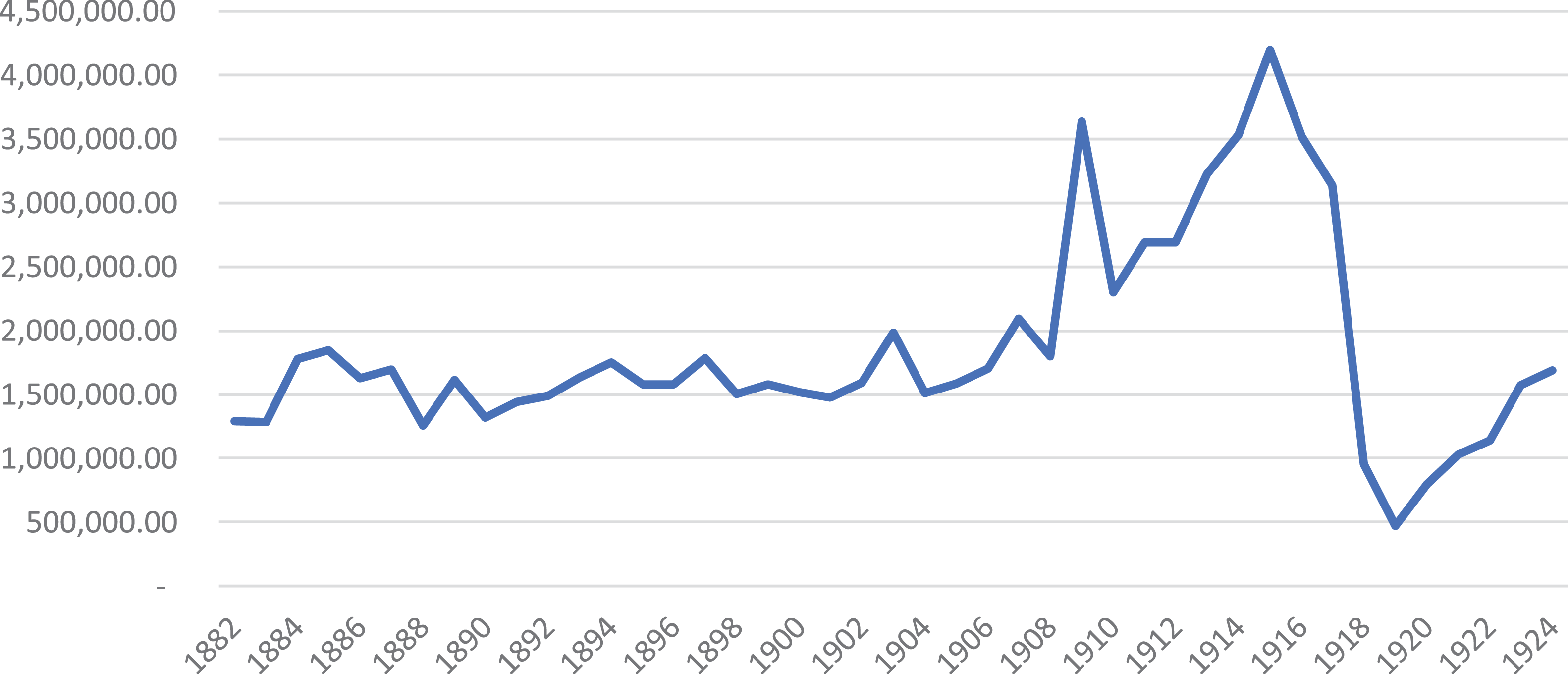
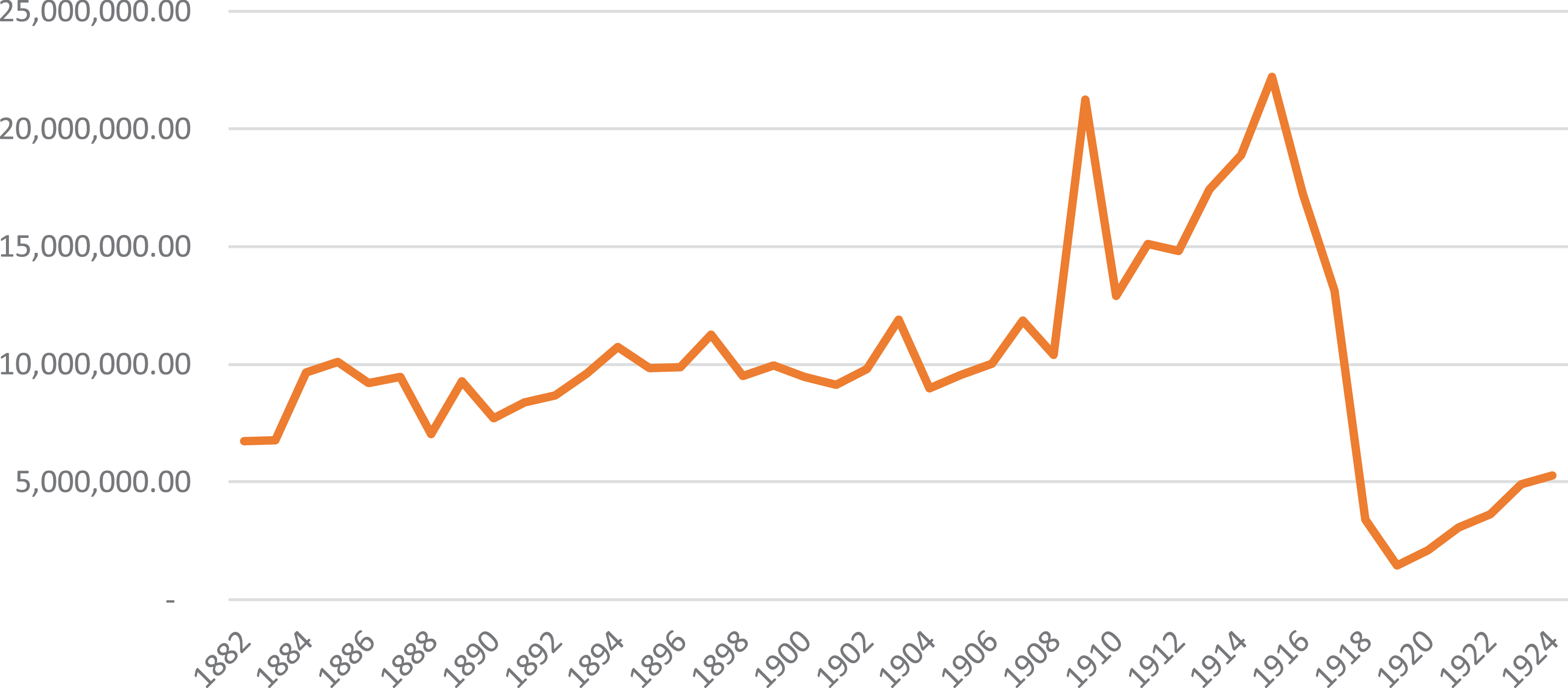
These registers also highlight the rapid growth of Martini & Rossi. The company’s sales from Pessione between 1882 and 1924 are shown in Figures 1 and 2. In 1867, the Pessione plant had just under 39 workers and sold about 350,000 liters of vermouth a year for the domestic market and for export.Footnote 78 In 1885, Martini & Rossi could communicate to the promoters of the Universal Exhibition in Antwerp that they used only the best white wines of the Asti area for their production, and that the secret of their manufacture lay in the unique combination of herbs and spices flavoring their vermouth—“the result of long studies and expensive experiments” which uniquely allowed them to “fight and win against foreign competition.” In 1907, the Pessione plant was proudly described in advertisements as “the largest vermouth factory in the world.”Footnote 79 The following year, Teofilo Rossi wrote to his London agent, Edouard Robinson, that the increase in business had been so great as to force the use of mechanical means for packaging the bottles, and manufacture by hand had been entirely replaced by “automation.”Footnote 80
Martini & Rossi Sales from Pessione, 1882–1924, in constant 1882 lire. (Source: Compiled from company records.)

Martini & Rossi Sales from Pessione, 1882–1924, in 2022 USD. (Source: Compiled from company records. Value conversion by Tomas Pacheco.)

Merchant Adventurers
Another crucial figure at the time, particularly for exports beyond the classic trade routes of the age, was that of the traveling salesman.Footnote 81 Dario Querzani, for example, himself the son of a former Martini & Rossi agent, was not merely a liquor salesman but a veritable commercial adventurer whose life was worthy of a novel. After his father’s death, Querzani swore allegiance to Martini & Rossi and was immediately employed on important missions to South America before turning to what he nonchalantly called “the rest of the world.”Footnote 82 A tireless traveler across all continents, between 1905 and the outbreak of World War I he reported punctually on every market visited, on every customer, supplier, bar or hotel frequented. He documented each trip in great detail across more than 300 letters reporting on the economic and political situations of the countries visited, their gastronomy and restaurant scenes, their habits, competing products, power brokers, diplomatic situations, local statistics, and suggestions for market entry and expansion. “We leave you the greatest freedom,” Martini & Rossi wrote him, and with this blessing Querzani crossed the length and breadth of South America, where he lived for years between Chile, Argentina, and Peru; traveled through China, Japan, Korea, India, Saigon, Haiphong & Hong Kong, Java, Singapore, Kuala Lumpur & Federated Malay States, Indochina, Cochinchina & Tonkin, the Philippines, Australia & New Zealand, and Hobart, Tasmania, before he traveled the length of the African continent from south to north via every available means of transport, describing long crossings by ship, boat, and camel. He even continued his reports as a soldier during World War I, though without communicating his position. Querzani finally returned home to convalesce in 1917, after which his traces were lost in the company archives.Footnote 83
Querzani’s career highlights the microfoundations of Martini & Rossi’s early globalization. Operating in environments characterized by thin institutions, limited information, and high uncertainty, he functioned as a mobile extension of the firm, combining sales, market intelligence, political assessment, and logistical improvisation in a single role. His trajectory underscores how early multinational expansion relied less on formal organizational structures than on trusted individuals capable of navigating institutional voids across distant markets. As global trade regimes later became denser and more regulated, such personalized forms of coordination gradually gave way to centralized management and standardized procedures, mirroring the firm’s broader organizational evolution across successive cycles of globalization.
Vermouth exports could also be promoted by traveling salespeople engaged in other trades. With the onset of the Meiji Restoration in 1868, for example, a conscious project to emulate the techniques and practices of Western industrial capitalism, Japan fully entered the modern world economy.Footnote 84 And, just as Japan looked to German industry and French fashions for inspiration, so it took Western habits of consumption to heart, including vermouth. But this was not the only way in which Japan and Italy became linked at the time. Italy had fallen behind the major European powers economically during the nineteenth century, and the decades between 1860 and 1880 were particularly fraught with turmoil. A pebrine epidemic had brought the Italian silk industry to its knees, and a new type of merchant adventurer emerged—the semaio, or seed merchant—who was willing to risk life and capital in search of silkworm “seed” (as the eggs were known) in remote corners of the world where the disease had not spread. And, for several decades, vermouth traveled with them to the so-called “Far East.” Meiji Japan, in particular, emerged as a principal source of silkworm seed and an increasingly discerning market for vermouth. Already by 1878, Martini & Rossi’s importers Wagen & Frères could state that “the habit of drinking vermouth is spreading in all cities, both on the coast and inland.”Footnote 85
Sole Agents
The 1870s also saw the emergence of a new figure supporting the company’s overseas expansion: the sole agent with an exclusive contract. As Paul Duguid has shown in the context of the port wine trade, agents were the keys to turning the “commodity chain” into a “coherent continuum,” an insight deepened in Robert Graham Harding’s work on Champagne.Footnote 86 Such agents dealt with everything, including the storage of goods, customer selection, research, establishing the right market price, and outmaneuvering competitors. By the late nineteenth century, agents of Martini & Rossi were present all over the world, from Sweden through Brazil to Indonesia. China and Japan were originally served by the same agents, and only separated in the early decades of the twentieth century. One agent similarly ran operations in Singapore, Manila, Shanghai, and Hankou in the 1880s, while a roaming Italian merchant settled to set up shop in Vladivostok. The Japanese market was eventually managed by local importers also thanks to the support of the Imperial Consulate. Because of the vastness of its territory and its diverse markets, the United States continued to be served by numerous and diversified shipments in the first decades of the company’s exports there: Martini & Rossi would have preferred a single trading house capable of distributing 18,000 cases per year but, unable to find one able to guarantee this, decided to forego having an exclusive American agent for years in order to avoid creating harmful rivalries.Footnote 87 “It is our system not to have simple commission agents in foreign markets, but a wholesaler house, which buys our products and makes the trade itself from within.” In line with this, Martini & Rossi also undertook to forward all orders it received from respective markets to their exclusive agents.Footnote 88
From 1889 and for many decades to come, the company settled on Culbert & Taylor of New York to be its sole agent in the United States. This created some friction, for many contended for the brand, and the deal broke with what long had been customary in Italo-American trade. As one agent had put it earlier, “the trade of Italians, and of Italian products in the United States is exclusively in the hands of Italians, the American cannot poke his nose into it.” But by then Martini & Rossi had become a solidly rooted brand, and not only in the Italian diaspora. It had by then “entered the taste of the Americans.”Footnote 89 By 1893, Martini & Rossi already exported nearly 70,000 cases of vermouth to the United States, even though it continued to put off investing in advertising, believing agents wrote “we must have Martini & Rossi for everybody asks for it” because the product proverbially sold itself.Footnote 90
Branches
As markets expanded worldwide, they became increasingly segmented, with consumer demand accommodating more diverse quaffables, even in countries in which vermouth never had been a staple.Footnote 91 In particularly important markets, Martini & Rossi took a step beyond salesmen and agents to establish entirely new branches of the company. In 1883, for example, Luigi Rossi’s nephew Andrea Barberis reached Buenos Aires to open a branch to increase the competitive pressure on incumbent vermouth brands there. He would punctually report back on sundry topics, from the choice of location to establish a production plant to the procurement of raw materials and the quality of local water, the role of competition, and the cost of bottles, labels, and barrels. Such branches could—and increasingly would—also be established to counteract changing regimes of protectionism around the world.
At the same time, a general representation contract for the United Kingdom of Great Britain and Ireland was signed with Edouard Robinson, already a trusted agent of the company, who set up an office in the City and a warehouse for storage. He was also assigned the management of the extremely profitable colonial trade, confirming that London was “the meridian of world trade,” a gateway from which exports could be directed all over the globe.Footnote 92 And as Harding has shown for Champagne between 1860 and 1914, the British market was not just a mass consumer of foreign wines but a crucible in which taste, authenticity, and commercial respectability were forged. Alongside this renewed emphasis on international expansion, the new generation of managers that took charge after the passing of Martini also embraced more aggressive advertising, and a greater openness to experiment with new vermouth varieties and the promotion of cocktail culture more broadly.
The Cocktail Revolution
The emergence of the cocktail in the nineteenth century offers a classic example of Schumpeterian innovation through recombination rather than invention, in which existing products were blended in new ways to create novel consumer experiences.Footnote 93 The origins and etymology of the “cocktail” remain much debated, but the word may first have been used in print to describe “a stimulating liquor, composed of spirits of any kind, sugar, water, and bitters” in The Balance and Columbian Repository, published in Hudson, New York, on May 13, 1806.Footnote 94 As the century progressed, vermouth was added to cocktails based on gin, whiskey, or brandy as a means of blending rounder and more broadly appealing concoctions.Footnote 95 By the 1860s, vermouth had become a staple in cocktails from Dubuque, Iowa, to Galveston, Texas.Footnote 96 Italy’s first home-brewed cocktail of the late nineteenth century was probably the “vermouth-bitter seltz,” which later would be known as “Americano,” and the “Mi-To” (mito also meaning “myth”), named from its two main components: a bitter from Milan and a vermouth from Turin.Footnote 97 New York publisher George Winter’s epochal 1884 bartender’s manual How to Mix Drinks listed “vermouth” among necessary “cordials” in his opening list of “Stock Required in Saloon,” and went on to describe two different cocktails utilizing it: the “Manhattan” (“Two or three dashes of Peruvian Bitters; One to two dashes of gum syrup; One-half wine glass of whiskey; One-half wine glass of Vermouth”) and the “Turf Club” (“two or three dashes of Peruvian Bitter; One-half wine glass of Tom gin; One-half wine glass of Italian vermouth,” named after a “very gaudy New York gambling and sporting association”), which soon would be known as the “Martini.”Footnote 98 Few cocktails have become more iconic than the Martini (eventually made of dizzyingly diverse ratios of gin to vermouth), famously “composed of opposites: the brute strength of gin and the aromatic sensitivity of vermouth.”Footnote 99
The origins of this particular cocktail’s name seem lost to the inebriated haze of its origins, however, and the exact relationship between Martini the vermouth and Martini the cocktail remains shrouded in myth.Footnote 100 Regardless, Martini cocktails exploded in popularity at a time when the most prevalent vermouth was Martini & Rossi. According to cocktail scholar David Wondrich, “Martini. . . was of course the name that finally won out, helped no doubt by the dominant position in the American market of Martini & Rossi’s vermouth, which accounted for two out of three bottles of Italian vermouth sold.”Footnote 101 As the company’s agent in Mexico noted in 1903,
a circumstance that favors your brand, I don’t know if it is a casual circumstance or one with, shall we say, historical foundations, is that the great consumption of vermouth is made by asking for it in “Kok Tail” and everyone asks not for a “Kok tail” vermouth in the bar but rather “a Kok tail Martini.” The fact that your name is pronounced so much would lend itself well to good publicity, since your name would not be new, neither to buyers nor to consumers.Footnote 102
The company long sought to establish that a proper Martini cocktail had to be made with Martini vermouth, and fears of counterfeit products and the abuse of its name led the company through multiple legal proceedings in Europe and the Americas in the period 1904–1934. It was clear that Martini & Rossi had exported an extraordinary amount of vermouth to the United States during the crystallization of the Martini cocktail, from 51,000 cases of 12 1-liter bottles between 1867 and 1889 to 1,224,297 cases between 1890 and 1910, in addition to which came 308,713 liters imported in drums by the Heublein company of Hartford, CT, for the purpose of local blending with gin and subsequent bottling as “Martini Cocktail.” While efforts to legally link the company to the cocktail proved unsuccessful, the product was anything but, in spite of Alessandro Martini himself being only lukewarm about mixing his beloved vermouth with other ingredients.Footnote 103
Indeed, shipments of vermouth for cocktails intensified worldwide after Martini’s death. The Rossi brothers went to Mainz personally to establish a beachhead in Germany, which the company so far had neglected with the logic that “where you drink beer, you don’t drink vermouth.” As markets developed and became more segmented, however, consumer demand diversified to accommodate more varied tastes.Footnote 104 When the European branches in Paris, Nice, Marseille, and Brussels were opened, cocktails were shipped directly in kegs or prepared by the O’Scanlan & Mandeix company of Le Havre, with which the company established a collaboration for the processing of vermouth.Footnote 105 In this spirit, Martini & Rossi promoted a new updated edition of the famous Paris Ritz barman Frank P. Newman’s American Bar in 1907, highlighting the use of the company’s vermouth in the cocktails described (including in the “Dry Martini”—half and half gin and vermouth with a dash of bitters), and sent it to all branches and wholesale customers.Footnote 106 Italy’s first American-style bartender’s handbook, published in 1920, tellingly opened with the statement that “the cocktail is the most widespread drink enjoyed before meals, like vermouth wine in Italy.”Footnote 107 The incredibly popular vermouth-bitter-seltz cocktail that first appeared around 1880 became known as an “Americano” cocktail at least as early as 1913. At some “uncertain date between 1917 and 1920,” it further evolved into the “Negroni” when Count Camillo Negroni first asked for his “Americano” to be “fortified” at the Caffè Casoni (a client of Martini & Rossi) in Florence by substituting gin for soda.Footnote 108 Around 1925, Martini & Rossi also launched a pre-mixed vermouth product called “Martini Cocktail” in “Normal,” “Dry,” “Sweet for Ladies,” and “Manhattan” versions.Footnote 109 Everywhere, the often bourgeois rituals and settings of cocktail culture helped anchor and stabilize vermouth’s aspirational reputation and sensory appeal.Footnote 110 Seen in this light, the cocktail revolution exemplified a broader pattern of incremental, demand-driven innovation, in which evolving consumption practices and taste segmentation, amplified through branding, allowed firms like Martini & Rossi to scale and diffuse new forms of value creation long before they could fully control their legal or symbolic appropriation.
Deglobalization and Reglobalization
As Martini & Rossi grew in the 1890s and 1900s, so, finally, did Italy, which had been experiencing relative economic decline since the early modern period.Footnote 111 By the late 1890s, Italy’s GDP per capita had fallen to 38% of that of Great Britain (from 45% in 1870). By 1913, however, it reached almost 54%. Though there were cyclical components to this sudden rapid growth, it was also the result of the country’s belated industrialization vis-à-vis the rest of Western Europe. Modern industry was mainly concentrated in the north-western part of the country, to the point where, in 1911, the triangle between Milan, Turin, and Genoa produced 55% of Italy’s added value. The economic gap between the different regions of the country increased and, in particular, that between north and south.Footnote 112 Martini & Rossi was part and parcel of the country’s rapid growth during this first period of globalization, and emblematic of the way in which value was added at the intersection of agriculture and manufacturing in northern industries. Yet, the world which had given rise to this moment, brought together by technological innovations like the telegraph, the steam engine, and refrigeration, and safeguarded by the so-called Pax Britannica, was ultimately torn asunder by its internal tensions. The resulting “Great War” of 1914–1918—eventually known as World War I—left approximately 20 million dead and left the world economy in shambles.Footnote 113 The so-called Spanish Flu of 1918–1920 killed another 25–50 million people worldwide.Footnote 114 International trade and capital flows plummeted with the onset of hostilities. Production was disrupted, supplies became harder to secure, and transportation was primarily oriented toward military purposes. Businesses lost workers to the war effort, banking crises hit savings, investment, and consumer confidence, and inflation increased. And even peace was followed by significant deflation, economic turmoil, protectionism, inequality, and the complex array of forces that eventually resulted in the global Great Depression beginning in 1929.Footnote 115
Even within this larger shift, however, Italy experienced a unique trajectory, characterized in particular by Benito Mussolini’s march on Rome in 1922 and the rise of fascism.Footnote 116 Until 1929, its rate of growth was slightly above the Western European average, higher than that of the United Kingdom but lower than that of France. In the 1930s, by contrast, growth failed to keep pace with that of the major European powers. Between 1922 (the year in which the highest prewar level of GDP was reached again) and 1929, Italy’s annual growth rate was a remarkable 4%. Growth reached 6.1% per annum between 1922 and 1925—the “liberal” phase of the Fascist regime—with exports increasing at an annual rate of 18.7%.Footnote 117 The first Mussolini government resumed the successful pre-war macroeconomic policies: the deficit was eliminated in 1925, the debt/GDP ratio fell, and interest rates were kept at relatively low levels. The year 1925, however, proved to be a turning point of the Fascist era. At the same time as Mussolini’s dictatorship was formalized, the stock market crashed following a banking crisis, duties were reintroduced on the importation of grain, and tariff protection was introduced to favor the domestic development of steel and heavy industries. What followed was probably the most sudden and complete 180-degree reversal of economic policy in Italian history, resulting in a resolute inward turn toward autarky, in a still predominantly agricultural economy lacking in mineral resources and dependent on imports for foodstuffs, raw materials, and more advanced technologies alike. These and other deflationary policies implemented by the fascist regime after 1926 in turn provided a new impetus to international expansionism for Italian companies.Footnote 118
Vermouth was hardly immune to these changes, and Italian exports dropped significantly after 1913. By 1926, exports were roughly what they had been 30 years earlier, falling from a peak of about 17,000,000 to 5,000,000 liters per year in 13 years.Footnote 119 But if some branches shuttered to brave the storm at the onset of World War I, Martini & Rossi pioneered the seemingly counter-cyclical expansionism of Italian companies in the late 1910s and 1920s. Indeed, the company opened more new international locations in 1915 than ever before, with new branches with warehouses in Barcelona, New York, Buenos Aires, and Moscow, and new agencies with warehouses in Hong Kong, Shanghai, Seoul, Yokohama, Jakarta, Kolkata, Cairo, Alexandria, Khartoum, Tripoli, Benghazi, Derna, Tunis, Algiers, Johannesburg, Katanga, Delagoa Bay, Massaua, Montreal, Mexico City, Havana, Panama, Lima, Valparaiso, Montevideo, and Asunción. Additional factories were soon built in Argentina, France, and Spain. This was a conscious move by the company to circumvent new tariff and transportation challenges in order to supply more local markets around the world directly. From 1920 to 1931, as Mussolini’s policies seriously shaped Italy’s political economy, Martini & Rossi established a further 21 branches and sister companies internationally, alongside at least 28 agencies with warehouses. The collapse of direct vermouth exports from Italy was thus balanced by the company’s increasing presence and production internationally. In 1922, Emperor Yoshihito even awarded the company the title of “Suppliers to the Imperial House of Japan.”Footnote 120
Martini & Rossi’s Early International Expansion. Map by Isabelle Lewis. (Source: Company Documents.)

Martini & Rossi’s Early International Expansion. Map by Isabelle Lewis. (Source: Company Documents.)

The existence of subsidiaries, branches, and sister companies only became more vital for Martini & Rossi over time, and they survived despite wars, epidemics, and economic crises, gradually strengthening themselves as commercial and production nodes in the company’s network. Indeed, even at the height of the Great War, the director of the Martini & Rossi office in Barcelona, Antonio Fabregat, affirmed that sales had not decreased and, observing the potential of further international expansion, hoped for the opening of a Bilbao branch. He might have been a particularly enterprising branch manager, spending months peddling vermouth by car to all corners of the country, but within a few years of his arrival in 1911 Fabregat declared that they soon would have “Spain in the palm of our hand.”Footnote 121 Indeed, the firm built new headquarters in Barcelona between 1920 and 1923, which soon graduated from being a branch to being an affiliated “sister” company of Martini & Rossi.Footnote 122
Prohibition
A few months before Italy entered World War I, Martini & Rossi’s American agent Taylor declared that he wanted to keep a stockpile of bottles just in case Italy abandoned its neutrality and sanctions were levied against Italian exports. At the same time, he warned of another impending danger to the company; opportunities, it turned out, were yearly eroded by what he called a “wave of Prohibition.”Footnote 123 Truth be told, that particular wave had been building for a long time and its first sententious ripples had been observable already in the company’s business correspondence during the first decade of the twentieth century. In 1920, the moralizing crusade culminated with a Constitutional Amendment banning the “manufacture, sale, or transportation of intoxicating liquors” in the United States.Footnote 124 Prohibition would only end in 1933, following the Democratic victory in the 1932 elections, after which individual states and municipalities again could decide on their laws regarding the production and consumption of alcohol. During these years, vermouth, too, was limited to “medicinal or religious” uses (a very difficult certification to obtain), leading to the overnight collapse of one of Martini & Rossi’s most important markets.Footnote 125
As the first in Italy, the company immediately began to experiment with “non-alcoholic vermouth,” containing less than 0.5% alcohol, also in sparkling and dry varieties. Ernesto Rossi himself oversaw the development of this product, which proved more complicated than first anticipated. Already on October 29, 1921, however, Rossi telegraphed New York that “we are trying everything possible to improve the non-alcoholic vermouth, we will telegraph you when it is ready, stop. If we are successful, samples and prices will be sent as soon as possible.”Footnote 126 The first 5,000 cases of the new product arrived in New York on July 5, 1922.Footnote 127 In a letter of December 27, 1922, Martini & Rossi’s agent I. K. Taylor, president of a homonymous company, reassured Ernesto Rossi that, following two years of almost complete stagnation in the market, sales were finally recovering, estimating that the volume of business for non-alcoholic vermouth could reach 50,000 cases per year.Footnote 128 Ernesto’s brother Cesare Rossi, then a member of the Italian Parliament, personally committed himself to elaborating a trade agreement with the United States that would not overly penalize Italian exports relative to their competition, even if very little could be done for wines and spirits at the time. The United States had more than enough production to cover permitted uses of alcohol, so legal imports had effectively been halted.Footnote 129 In 1936, Martini & Rossi received a Diploma of Membership from the Italian Chamber of Commerce in New York, an award aiming to encourage and protect trade relations between Italy and the United States.Footnote 130
Through the Abyss to “La Dolce Vita”
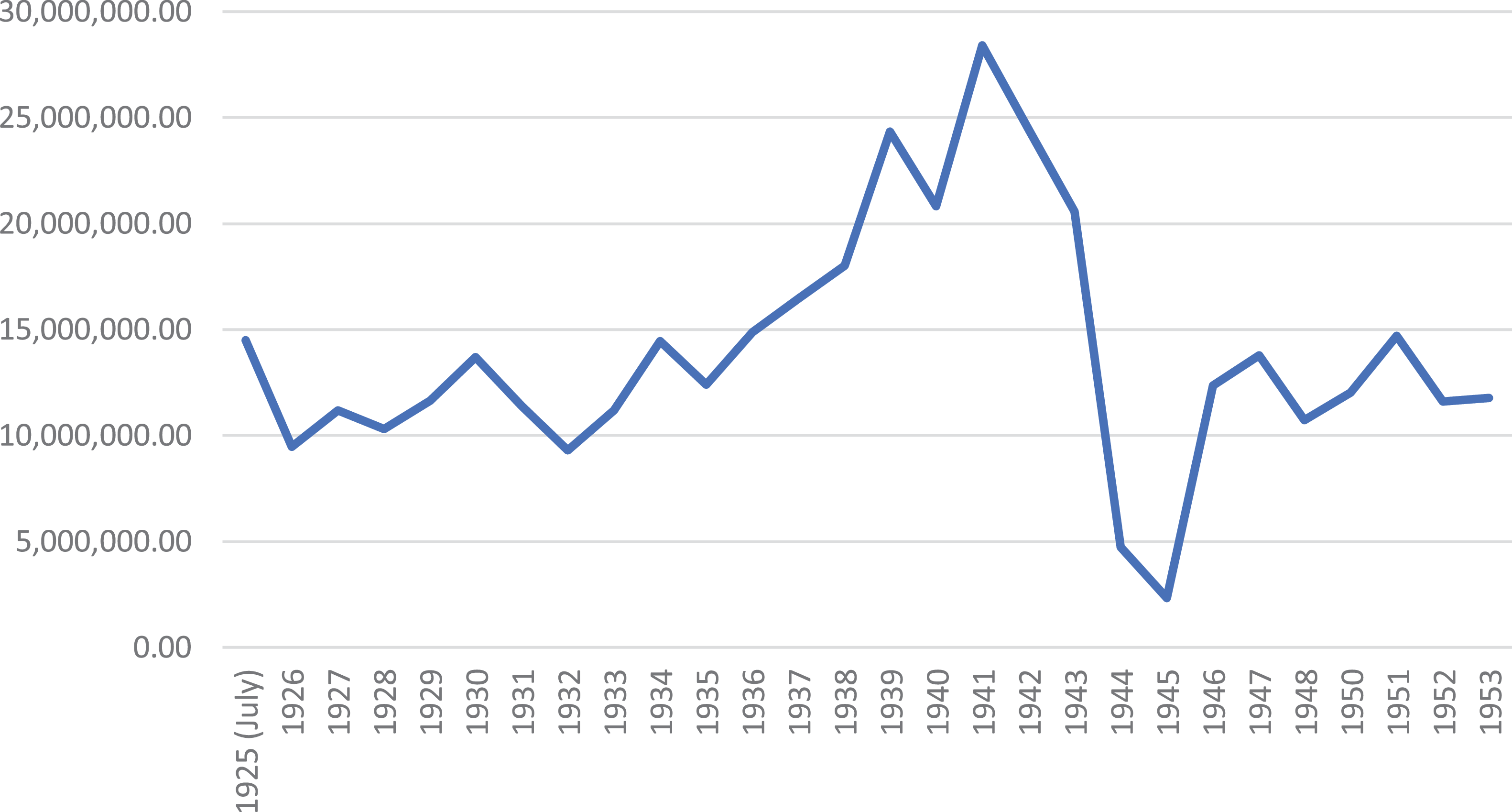
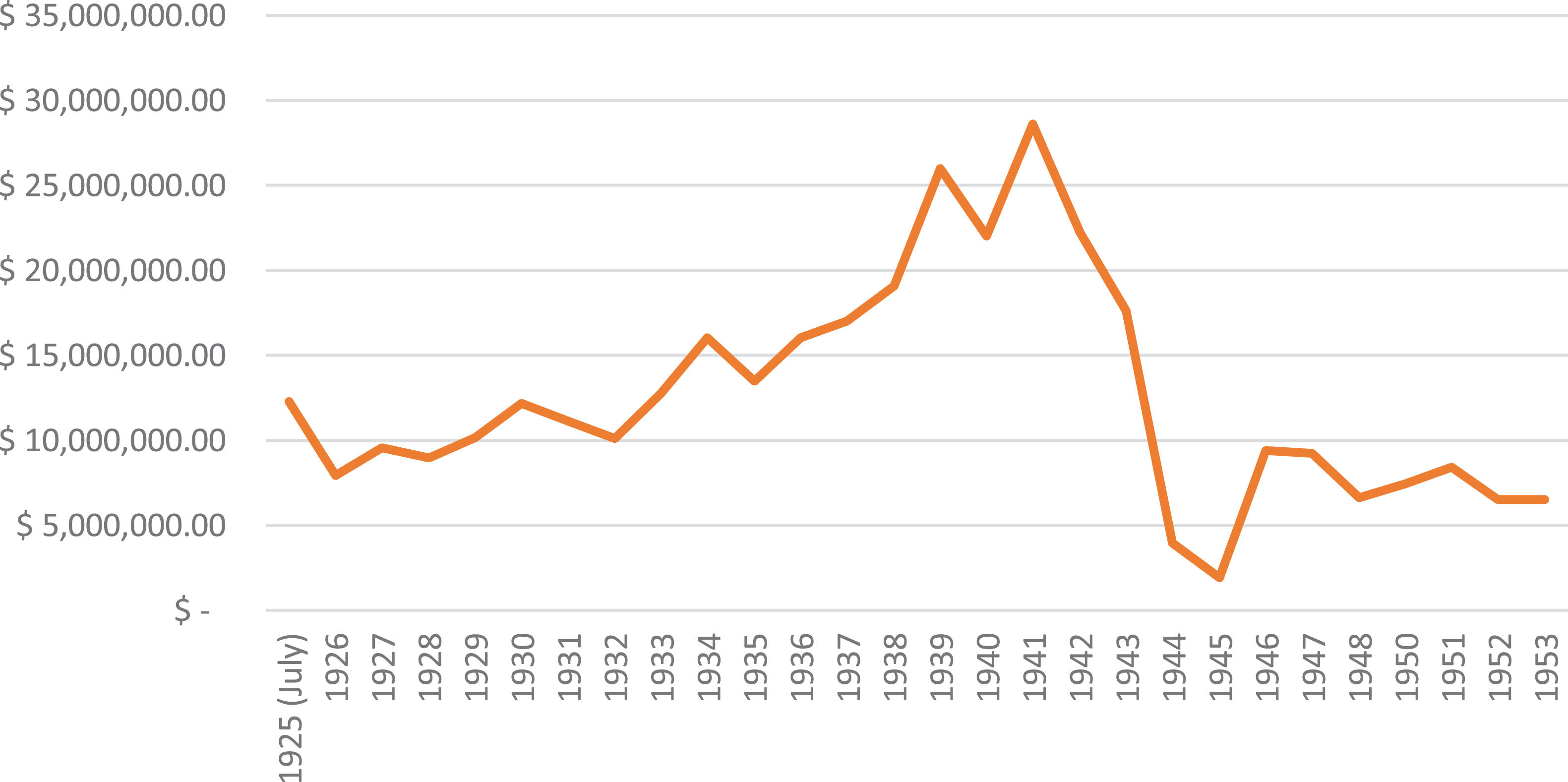
In spite of its numerous challenges both domestic and international, Martini & Rossi continued its remarkable growth in the 1920s and 1930s. Figures 3 and 4 show the value of production at Pessione between 1925 and 1953. As a result of the new laws under Mussolini, the general partnership “Martini & Rossi successors of Martini, Sola and Co.” was transformed into “Martini & Rossi Limited” in 1925. Teofilo Rossi was president and his brother Cesare was vice president, while the new position of Chief Executive Officer went to Enrico. Ernesto took over the management of the plant in Pessione. Cesare died the following year, followed by Teofilo in 1927. The third generation of the Rossi di Montelera family, represented by cousins Lando, Metello, Napoleone, and Theo, inherited the company in the 1930s, right between the two world wars. These years saw considerable investment in social projects for the company’s workers, such as the construction of a primary school in Pessione and low-cost housing for employees, but also in the expansion and strengthening of the factory itself: new cellars, new departments, new cutting-edge machinery, and further diversifications of production.Footnote 131 The sons of the four old partners made innovations in various aspects of the now multifaceted business, reflecting the various personal interests of the managers. Metello and Theo, in particular, were sports enthusiasts and pushed the marketing of the Martini & Rossi brand through sports sponsorships. In the 1920s and 1930s, for example, they made cycling the center of advertising and promotion activities by sponsoring the Gran Coppa Ciclistica Martini & Rossi in 1925, and the Giro d’Italia in 1934 and 1936. That year, the company also sponsored a series of celebrated radio concerts to promote the arts.Footnote 132
Martini & Rossi production value in Pessione, 1925–1953, in constant 1882 lire. (Source: Compiled from company records.)

Martini & Rossi production value in Pessione, 1925–1953, in 2022 USD. (Source: Compiled from company records. Value conversion by Tomas Pacheco.)

If World War I had forced a reglobalization of the business, however, the horrors of World War II brought it to a near standstill. The management of Martini & Rossi was forced to evacuate from Turin to Pessione, and reduced production drastically for the duration of the war. Many of the branches cut staff, and the decision to maintain full employment to protect employees at the Pessione plant during the conflict represented a severe financial blow to the company, all the while its railway was a constant target for Allied bombing and its warehouse frequently was the target of raids by German troops in search of alcoholic beverages during the Italian Civil War of 1943–1945.Footnote 133 Martini & Rossi’s production plant in Germany was destroyed during the war, and other facilities around Europe suffered serious damage. Despite the devastation of World War II, Martini relaunched its radio broadcasting already in 1945, maintaining the series until 1964 and contributing greatly to the rise of stars such as the American-born Greek soprano Maria Callas. The concerts were sponsored by Martini & Rossi, and introduced as well as concluded with advertisements for the company’s product in Italian, English, and French. The 1950s also marked the global relaunch of Martini & Rossi, as the company itself was transformed into a joint-stock company to adhere to Italy’s new civil code. Advertising became ever more central to company strategy at a time when the consumption of Martini cocktails increasingly became a sign of “social distinction,” with highly acclaimed and often experimental campaigns spearheaded by the likes of Andy Warhol and Armando Testa.Footnote 134
The post-war period similarly saw the creation of the Terrazze Martini, or Martini Terraces—iconic locations to host cultural events and showcase company products—beginning with that in Paris in 1948, followed by Milan, London, Brussels, Barcelona, São Paulo, and Genoa. All were hosted in prestigious high-rises of their respective cities, and the still extant Milan one, in particular, at the top of a skyscraper overlooking the city’s imposing cathedral, became a symbol of Italy’s Dolce Vita, the seat of countless cultural events, and playground for jet-set celebrities from Sean Connery and Jane Birkin to Sophia Loren and Gérard Depardieu.Footnote 135 In 1961, on the occasion of the centenary of the unification of Italy, Martini & Rossi also inaugurated a Museum of the History of Enology in Pessione, the first wine museum opened in Italy, to symbolize the company’s deep bond with the history of winemaking and with the institution of the aperitivo.Footnote 136 As the 1960s and 1970s progressed, Martini became inextricably linked to sports, and especially to motor racing. The Martini Racing Team, the flagship of the Martini & Rossi sports sponsorships, won numerous international competitions, from endurance to Formula 1 to rallies, including six constructors’ titles in the World Rally Championship won consecutively between 1987 and 1992.Footnote 137 Simultaneously, Martini & Rossi continued to serve as a patron of the arts, sponsoring major exhibitions of Picasso (1981), De Chirico, and Caravaggio (1982).Footnote 138
The post-war period also witnessed Martini & Rossi’s expansion through acquisitions. It added William Lawson’s whisky to its portfolio in the 1950s, Saint-Raphaël aperitifs in 1960, and later brands such as Offley port, Noilly Prat vermouth, La Bénédictine liqueur, and Otard cognac, transforming the firm into a diversified international spirits group. This diversification coincided with organizational centralization. As competition increasingly concentrated in a small number of global beverage companies, Martini & Rossi eventually dismantled its network of semi-autonomous affiliates and regrouped its international subsidiaries under the General Beverage Corporation, a single holding company based in Luxembourg with operational headquarters in Geneva, in 1977.Footnote 139
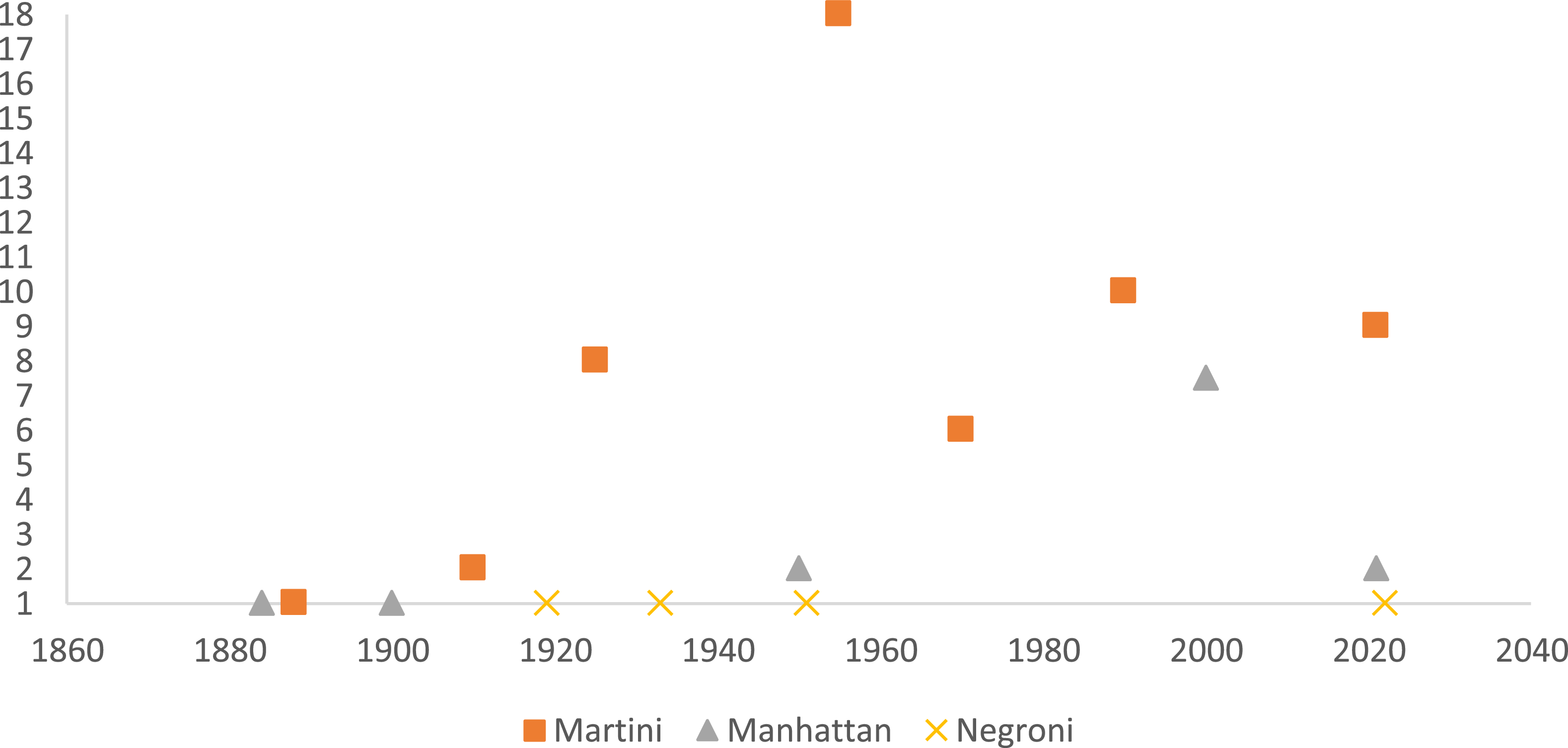
These developments uniquely allowed Martini & Rossi to survive what has been described as a “vermouth crisis” in the 1970s and 1980s, years in which young people increasingly turned to sodas, beer, and hard spirits over what some called “old-timey” drinks like vermouth.Footnote 140 By 1978, the majority of Americans who bought bottles of vermouth were “over forty-five years” of age.Footnote 141 At the same time, the vermouth content of cocktails like Martini had been declining steadily for decades. Figure 5 compares the proportions of gin, whiskey, or vodka to vermouth in cocktails. From an original half-and-half of gin and vermouth, trend-setting drinkers began to crave ever dryer drinks. In 1966, the so-called MartiniMatic allowed 3,426 random Americans to “dial a drink of their chosen strength.” Different professions opted for markedly diverse ratios of gin to vermouth: “teachers, factory workers, and office workers chose 3 to 1; salesmen, buyers, and engineers chose 4 to 1; admen chose 5 to 1; and publishers chose 7 to 1.”Footnote 142 Numerous vermouth producers closed shop, but Martini prevailed by virtue of the “umbrella brand” it had developed through its diverse advertising efforts.Footnote 143
Parts gin/whiskey/vodka to vermouth. (Source: David Wondrich and Noah Rothbaum, eds., The Oxford Companion to Spirits & Cocktails (Oxford, 2021), 171–72; “Martini [Prohibition Era]” Maine Spirits (2023), https://www.mainespirits.com/recipes/martini-prohibition-era; “Dry Martini: IBA Cocktail, The Unforgettables,” International Bartenders Association, https://iba-world.com/dry-martini/; “Vintage 50’s Rye Manhattan,” Fremont Mischief, 11 Nov. 2019, https://fremontmischief.com/vintage-50s-rye-manhattan/; O. H. Byron, The Modern Bartender’s Guide (New York, 1884), 21; Harry Johnson, The New and Improved Illustrated Bartenders’ Manual (New York, 1888), 165).

Conclusion
Although precise postwar production and export figures for Martini & Rossi are currently unavailable, it is telling that as the second wave of globalization gathered pace and the firm centralized its operations in the late twentieth century, roughly 95% of the company’s global vermouth production, now far greater in volume than ever before in the company’s history, was eventually consolidated at its historical core facility in Pessione.Footnote 144 Over the long run, Martini & Rossi thus repeatedly reconfigured the geography of its production across successive cycles of globalization. Periods of trade openness favored centralized production and export from Pessione; episodes of protectionism and market fragmentation encouraged localized production abroad; and the late-twentieth-century re-opening of global markets, together with falling transport costs and intensifying competition, once again made centralization the dominant strategy, albeit under very different technological and competitive conditions from those of the nineteenth century.
In 1987, a new distribution agreement for the United States was signed with Bacardi Imports. The two groups had many important characteristics in common: a family structure, a long-standing entrepreneurial culture, and a complementary nature of products and geographical areas of distribution. The alliance immediately proved to be strategic for jointly tackling the pitfalls of the alcoholic beverage market, conditioned by shifting dynamics of consumption as well as by the vicissitudes of the world economy. In 1993, Bacardi acquired the Martini & Rossi Group outright, creating a dynamic organization with a coordinated distribution strategy, competitive portfolio diversification, and undisputed brand recognition in the alcoholic beverage sector. At the time of the acquisition, the two companies were particularly complementary in terms of their geographical strengths: Bacardi sold 43% of its total production (28 million cases, of which about 22 million were rum) in North America, and a further 36% in South America and the Caribbean. Martini, on the other hand, now made about 83% of its turnover (31 million cases, of which 17 million were vermouth) in Europe.Footnote 145
These years also saw a resurgence in craft cocktails and artisanal drinks worldwide.Footnote 146 As Fareed Zakaria lamented already in the late 1990s, “the superdry Martini was the cocktail equivalent of Brutalist architecture, theoretically dazzling in its severity but in fact rather tasteless.”Footnote 147 The opening decades of the twenty-first century witnessed a veritable explosion of boutique vermouth manufacturers around the world, partly driven by hipster-influenced preferences for the quirky, the herbal, and the handmade, leading vermouth-heavy cocktails like the Americano and the Negroni to become global staples.Footnote 148 In light of shifting customer expectations and the emergence of greater segmentation in the vermouth market, Martini launched a new series of higher-quality Riserva vermouths in 2015 to face the new competition. In reaction to renewed interest in healthier living and more moderate drinking habits, the company similarly introduced the orange-flavored Martini Fiero—designed to be mixed fifty-fifty with tonic water—as well as, since the original versions had been discontinued with the end of Prohibition, a new series of non-alcoholic vermouths. Today, Martini is frequently described as one of the world’s “great lifestyle brands,” inexorably intertwined with images of elegant aperitivi and the Dolce Vita worldwide.Footnote 149
Considering its 160-year history, the company has been remarkably dynamic in the face of economic, geopolitical, and technological change. In terms of marketing, word-of-mouth has given way to artistic posters, racing cars, films, print and television ads, and now social media. The earliest wormwood-infused wines originally were time-consuming individual creations undertaken by priests or pharmaceutical distillers; a trained worker with an assistant could fill 700 bottles with the help of a machine during a 12-hour shift in a nineteenth-century factory, and the advent of electric bottlers in the early twentieth century got that number up to 1,000 bottles an hour. A century later, that number can easily reach 50,000.Footnote 150 At the same time, and however global its ingredients and audience, and however complex the cocktails it helped create, vermouth itself remains a fortified, herb-infused wine deeply rooted in its Piedmontese terroir.
The history of Martini & Rossi offers a unique theoretical vantage point for rethinking globalization, brand capitalism, and firm internationalization over the longue durée. Empirically, it challenges prevailing chronologies in business history by demonstrating that the creation of a truly global alcohol brand was possible decades before most scholarship acknowledges. Conceptually, the case refines the Uppsala model of internationalization, revealing the limitations of “psychic distance” and gradualism when applied to the ambitions of truly adventurous entrepreneurs. It affirms the importance of expanding Chandler’s classic dyad of strategy and structure into a triad that includes context and demonstrates how firm survival over multiple eras of capitalism hinges on the fluid adaptation of strategy and structure to external shocks. Moreover, the Martini & Rossi archives allow us to examine globalization not as a binary (global vs. national) but as a spatial spectrum across which firms actively navigate, retreat, or expand in response to regulatory and geopolitical volatility. In branding terms, the story complements Geoffrey Jones’s claim that brand heritage is a strategic asset, demonstrating how Martini & Rossi initially thrived without traditional advertising as such, relying instead on product quality, international prizes, and adventurous envoys to market by proxy. In sum, Martini & Rossi helps us theorize globalization not as a smooth diffusion but as a jagged, negotiated process, shaped by merchant agency, cultural alchemy, and infrastructural transformation, and to see firms not merely as subjects of globalization’s cycles, but as agents capable of navigating—and at times reshaping—its course.
In the classic 1962 film Dr. No, the British secret agent James Bond—once called “the human embodiment of the Martini”—famously ordered his vodka Martini “shaken not stirred.”Footnote 151 The iconic phrase is fitting also for Martini & Rossi’s fortified wine. The firm and its vermouth have been shaken by war, disease, political upheaval, shifting tariffs, and changing tastes. Over decades of technological and managerial innovations, with and against changing currents of globalization, the firm’s signature product nonetheless remains essentially unstirred, to be savored and enjoyed, as the Nabataean Agriculture suggested more than a thousand years ago, “before, during, or after the meal”—put simply, at any time at all.Footnote 152
Acknowledgments
The authors are grateful to Bacardi and Martini & Rossi for archival access and support, and to David Ager, Amy Brewsey, Robert Fredona, Isabelle Lewis, Geoffrey G. Jones, Lorenzo Manetta, Jessica Merz, Scott Northcutt, Tomas Pacheco, Anna Scudellari, and the two anonymous reviewers for the journal for important feedback and assistance.
Author biographies
Sophus A. Reinert is T. J. Dermot Dunphy Professor of Business Administration and of History at Harvard University.
Lorena Barale is an independent scholar and archivist of the Archivio Borromeo.