


INTRODUCTION
The ability of political units to generate and sustain cooperation is part of what distinguishes successful states from those that fail, communities with high levels of service provision from those that lack essential services, societies with well-functioning democratic institutions from those that underperform, and political groups that achieve power and influence from those that find themselves stuck on the sidelines. Prior research suggests that cooperative behavior is a relatively stable characteristic of a political unit—reflective of demographic, economic, and political factors that have deep historical roots—and thus unlikely to respond to short-term interventions. For example, in some accounts, the social capital that supports well-functioning local governments in Northern Italy derives from the 14th century, modern antisemitism and intragroup tensions have their roots in the medieval period, and contemporary levels of distrust in Africa relate to historical exposure to the slave trade (Nunn and Wantchekon Reference Nunn and Wantchekon2011; Putnam Reference Putnam1994; Voigtländer and Voth Reference Voigtländer and Voth2012).
Yet, over the past decade, donor agencies have embraced a variety of participatory development strategies on the belief that externally funded programs can enhance the prospects for local cooperation and effective governance and that these changes can be brought about quickly (Mansuri and Rao Reference Mansuri and Rao2012). One of the largest such aid models is known as “Community-Driven Development” (CDD), or “Community-Driven Reconstruction” (CDR) when applied in post-conflict settings. In CDD programs, the delivery of block grants is combined with efforts to build local governance capabilities. Advocates promise that CDD will improve local governance and the capacity of communities for collective action to provide and manage public goods. Despite enormous investment in these programs—the World Bank alone has spent more than $85 billion in local participatory development over the past decade—until recently there has been little empirical evidence to support any of these claims (Mansuri and Rao Reference Mansuri and Rao2012).
We present the results of a field experiment evaluating a CDR program implemented in two districts of northern Liberia, roughly from November 2006 to March 2008. The intervention, funded by the UK government and implemented by the International Rescue Committee (IRC), worked in 42 communities that were randomly sampled in the fall of 2006 from a pool of 83 eligible communities. Outcomes were measured by household surveys and by a “matching funds experiment” conducted in all 83 communities in the summer of 2008, six months after the program ended. In the matching funds experiment, treatment and control communities were invited to organize to receive up to $420 (U.S.) for a new local development project. To participate, communities needed to decide how the funds would be spent, select three community representatives to handle the funds, and participate in a contribution game to determine the total amount of the grant. In the contribution game, 24 randomly selected adults from each community were given 300 Liberian dollars each (about $5) and asked to make a private decision about how much to keep and how much to contribute to a community fund for a new development project. They had been instructed that their contributions would be matched at two different, known “interest rates.”
We find a significant causal impact of the CDR program on the collective action capacity of treatment communities. At the individual level, the impact of exposure to the CDR program was about the same as the impact of increasing the rate of return on contributions from 100% to 400% (the interest rate manipulation mentioned above).
Surprisingly, the CDR impact was concentrated entirely in one of two treatment arms that we introduced at the measurement stage, for reasons unrelated to the evaluation of the CDR program. In half of the communities, the game was played with 12 men and 12 women whereas in the other half 24 women played. The estimated CDR impact was very large in the mixed gender communities, raising average contributions from 67% to 82% of the total possible, but nonexistent in the communities where only women could contribute. In the latter, total contributions averaged about 84% of the total in both CDR and no-CDR cases.
Using behavioral and survey data and exploiting the unanticipated contrast in outcomes between the mixed and all-women experimental treatments, the body of the article systematically explores the mechanisms that might account for the estimated causal effect of CDR. This focus on mechanisms is the article’s main contribution. We argue that understanding the mechanisms that give rise to treatment effects is essential if we are to generalize the results of any given field experiment and project them to other settings.
Understanding the mechanisms through which effects may operate is especially important in light of the emergent literature in this area. Several other experimental studies of CDR programs have been completed in recent years, and already it is evident that the results are not consistent across studies (Avdeenko and Gilligan Reference Avdeenko and Gilligan2013; Beath, Christia, and Enikolopov Reference Beath, Christia and Enikolopov2013; Casey, Glennerster, and Miguel Reference Casey, Glennerster and Miguel2012; Humphreys, Sanchez de la Sierra, and van der Windt Reference Humphreys, de la Sierra and van der Windt2013). While we find evidence that CDR improved collective action capacity in Liberia, many of these studies have yielded little evidence of improvements in governance capabilities. The evidence from Afghanistan is especially intriguing (Beath, Christia, and Enikolopov Reference Beath, Christia and Enikolopov2013) as there CDR institutions seemed to function when they were specifically called upon by outside groups, but not otherwise. Do results differ due to differences in program design, program implementation, variation in social or political contexts, or due to complex interactions between these factors? Understanding why effects are observed in some places requires an understanding of mechanisms.Footnote 1
To structure our examination of mechanisms we employ a simple formal model that distinguishes possible causal paths by which CDR might have an impact. We then use survey and behavioral measures, taking advantage of the fact that results differed for mixed gender versus women-only communities, to assess the plausibility of different pathways. We find fairly strong evidence that CDR did not increase contributions in the mixed communities by directly increasing individuals’ value for public goods, trust in local leadership or foreign NGOs, or fear of punishment for not contributing. Instead, it appears that in CDR communities where it was known that both men and women could be chosen for the contribution game, community leaders engaged in greater mobilization and information-sharing efforts in the week prior to the play of the contribution game. The all-women communities did not see gains through this channel however: in the all-women areas, mobilization occurred at higher levels in both CDR and non-CDR communities. Our assessment is that the prior experience of the CDR program improved the ability of communities to solve a nontraditional, mixed gender collective action problem, whereas this problem was easier in the “all-women” communities, possibly because traditional women’s networks could be used.
If correct, this explanation suggests that the efforts of external actors to change domestic institutions and governance practices may face a problem that has not been discussed by critics of CDD and related programs.Footnote 2 Namely, new institutions and capabilities may be used by communities when outsiders require nontraditional forms of organization, but not when the problems can be addressed by preexisting structures. When community members were required to work across gender lines in the matching funds experiment, there is strong evidence that the prior experience of organizing to choose and implement a public goods project yielded significant returns in the community’s ability to act collectively. But these gains from CDR were not in evidence when the community could rely on more traditional institutional structures, such as single gender networks, to mobilize participation. This underscores the risk of designing external interventions that foster new institutions and practices which are no more effective than existing approaches, and not likely to be used given the way that communities themselves approach problems of social cooperation.
In the next sections we describe our case and our strategy for measuring causal effects and then present evidence in support of or against key mechanisms. We close with a discussion of how our results on mechanisms can help us to make sense of the disparate findings of similar CDD/CDR studies and the implications of this for policy.
COMMUNITY-DRIVEN RECONSTRUCTION IN NORTHERN LIBERIA
Between 1989 and 2003 Liberia underwent two brutal civil wars, separated only by a short period of chaotic rule by warlord Charles Taylor. With the help of international pressure, the rebel group LURD from the country’s north succeeded in displacing Taylor in 2003. A major United Nations peacekeeping operation and the election of Ellen Johnson Sirleaf as president followed. International development aid started to flow into the country, including support from the United Kingdom’s Department for International Development (DFID) to fund a $1.6 million project by the IRC for a CDR project in two districts of northern Liberia, Voinjama and Zorzor.
The CDR Program: Context and Components
The IRC project sought to support CDR programs in 42 “communities,” where “communities” were constructed as groupings of a relatively large “hub village” (which in practice ranged from roughly 30 to 600 households) and smaller neighboring “satellite” villages (usually small clusters of households).Footnote 3 The authors participated with the IRC in the identification of a set of 83 potential communities, and in designing public lotteries held in September 2006 to select 42 to receive an IRC CDR program.
Important lines of division exist both within and between communities. People of the majority ethnic group in the two districts, the Loma, mainly supported Taylor and the NPFL during the war; members of the largest minority, the Mandingo mainly supported, or at least were identified with, ULIMO and LURD. Based on our household surveys, Voinjama district is about 59% Loma and 30% Mandingo; in Zorzor, the proportions are 92% and 4%. Most communities, however, are relatively ethnically homogeneous; for example, about 50 of the 83 communities are 90% or more from one group, and in only 16 is there a minority population of at least 15%.
Within communities the region is marked by divisions based on age and gender. Traditionally the town chief is male and the town authority is dominated by elder males. Male organization has historically also been in part secret, managed through male Poro societies (see Murphy (Reference Murphy1980) for a discussion of Kpelle organization on gender and age lines).Footnote 4 Alongside this male hierarchy, women are organized through secret Sande societies that maintain their own hierarchy and that engage with issues related to women’s wellbeing; Sande leaders are reported to be able to extract financial and labor benefits from women (Bledsoe Reference Bledsoe1984) but have a lesser function in town-level administration.Footnote 5 These relations are however in flux following the shock of the war, with, perhaps, an enlargening of the role for women. In one prominent social assessment, anthropologists cautiously described some ways in which the conflict led to a weakening of the grip of traditional power structures.Footnote 6
All groups were affected by the conflict. Our baseline data record information on almost 6,000 household members living in the region in 1989. Of these, over 4% are reported to have died directly from war related violence and a further 6% suffered injury or maiming. 5% took active part in the fighting, with three fifths of these reporting that they were abducted. A similar share (4.9%) of approximately 1500 subjects we interviewed in our follow-up survey self-reported as ex-combatants. The most widespread impact, however, was one that could bear on communities’ ability to cooperate (Richards Reference Richards, Archibald, Bruce, Modad, Mulbah, Varpilah and Vincent2005): 85% of these individuals were displaced during the conflict and many were displaced multiple times, often to refugee camps in Guinea.
The IRC’s CDR program adapts for a post-conflict context the Community-Driven Development model now widely supported by the World Bank and other donors for aid programs aimed at poverty reduction. The goals are to “improve material welfare, build institutions and promote community cohesion . . .[and to facilitate] the creation of sustainable community (governance) structures and communities participating within those structures through a system responsive to community rights and needs—paying particular attention to the most vulnerable and those most impacted by war (women, youth, excombatants and vulnerables).”Footnote 7 A premise of the project is that past conflict increases tensions and distrust within communities, thus creating a need for interventions that will promote reconciliation and enhance community cohesion.Footnote 8
The program in Liberia had the following core components.Footnote 9 After the treatment set was selected in September 2006, the IRC undertook initial activities to explain the program to local communities, including meetings with chiefs and elders to solicit their cooperation on an advisory board. In each community, the IRC then oversaw the election of community development councils (CDCs), with 5 to 15 representatives (the average was 9). All adults in the community could vote, and the IRC staff encouraged though did not require the CDC to include female members (in practice, all communities had at least one and in the median case, one-third of members were women). CDCs were then empowered to oversee a community-wide process to select and implement a “quick impact” project (median value of $2,700), followed by a larger development project (median value of $12,000). Communities were also encouraged to consider using part of the total block grant (median value of about $13,000) for a “marginalized project” intended to address needs of vulnerable groups, although in practice these projects, when undertaken, were similar to the quick-impact and larger projects.
All three types of projects tended to involve construction of community facilities, such as community meeting houses and guest houses (approximately 35%), latrines (30%), and hand dug wells (15%). Very few projects (less than 5%) focused on school or health clinic construction, and almost none in agriculture, skills training and small business development, and other income-generating activities. The IRC staff helped to conduct a needs assessment with the CDC and in community meetings, but, subject to a few constraints, the “community driven” philosophy deliberately leaves project selection to the community.Footnote 10 For all projects, communities were supposed to supply labor or in-kind contributions worth 10% of project value. IRC staff also assisted the CDCs with project design and tendering bids from local contractors. CDCs managed the implementation process and continue to have responsibility for project maintenance over time.
By March 2008, construction had been completed on 55 of 131 projects in all 42 treatment communities, and only painting remained for 20 more; construction had at least begun on almost all of them.Footnote 11 Delays were ascribed mainly to an initial overestimation of the capacity of the local construction sector, and perhaps also to to what may have been an unusual level of IRC staff turnover.
Treatment Assignment and Covariate Balance
In September 2006, IRC staff randomly assigned collections of villages to treatment. The method used was block randomization, with 21 of 40 clusters of villages selected with equal probability in Voinjama and 21 of 43 communities selected with equal probability in Zorzor. Selection was implemented by IRC staff by drawing lots during public lotteries with participants from the community clusters. Reports from the IRC suggest that representatives of communities generally appreciated the process of random allocation on the grounds that it seemed both transparent and fair relative to the standard approach of selection by NGOs and government officials.
In March and April 2006, before the community boundaries were decided, we implemented a baseline survey that included 1,606 households in communities ultimately assigned to treatment or control status. The baseline data allow us to assess whether the treatment and control communities are similar on various dimensions such as material wellbeing, conflict experience, ethnic composition, as well as a large set of indicators of attitudes about governance.
In Online Appendix B, we provide the distribution in treatment and control communities of a core set of variables that are plausibly associated with collective action capacity: basic population data (number of households, persons per household), a set of three wealth indicators (two composite measures of material wellbeing and percent with primary school education), exposure to conflict (percent household members injured or killed in conflict since 1989 and share that are former combatants), a measure of ethnic heterogeneity (percent Mandingo), and a measure of rurality (percent of communities that are “quarters” of a larger town). With one exception, balance is very good; our many attitudinal indicators show excellent balance as well. An F test for the hypothesis that these variables are jointly uncorrelated with treatment has an associated p value of 0.81 indicating that we cannot reject the null hypothesis that the randomization was faithfully implemented by IRC field agents.
The variable for which balance is poor is “quarters.” Twenty-eight communities in the five largest towns, are classed as quarters—an administrative level within a town that has a chief or subchief, and more or less well-delimited boundaries. Chance allocated 10 quarters to CDR treatment and 18 to control, a somewhat skewed distribution.
In the contribution game discussed below, we found that the quarters generated markedly lower contributions, an outcome consistent with other observations suggesting that these communities were less well organized on average than more rural communities. There is disagreement on the merits of trying to “control” for variables on which there is imbalance of this form. Introducing controls does not reduce ex ante bias since bias does not depend on the realization of the randomization. Moreover, it may introduce bias if controls are selected using a “conservative” approach in which controls are introduced precisely because they lead to smaller estimated effect sizes or larger standard errors. Introducing controls may improve efficiency, although the efficiency rationale for introducing controls is weakened, not strengthened, by the failure of a balance test (Mutz and Pemantle Reference Mutz and Pemantle2011). Nevertheless, imbalance may suggest risks of conditional bias and many researchers view invariance of estimated effects to the introduction of controls as evidence of robustness. For this reason, in most analyses we report results with and without a control for “quarters” although we emphasize that our preferred specification, the unconditional estimate of treatment effects, provides an unbiased estimate.
Estimation of Effects
Unless otherwise noted, we report estimates of the average treatment effect. These estimates take account of the blocked randomization by using district as strata. In addition, strata are used to account for other treatment arms where relevant and, where noted, to account for “quarters” as a potential confound; see Online Appendix C for formulas. All analyses of CDR effects use the community as the unit of analysis since this was the level of treatment assignment (or in the analysis of heterogeneous effects, subsets of community responses are analyzed). We analyze interest rate effects at their level of assignment (individuals).
Exact p values are estimated using randomization inference (Gerber and Green Reference Gerber and Green2012) and taking account of the structure of blocking in the randomization scheme. In general, these estimates are very similar to using a t test on the difference of means without matching.
In the sections analyzing mechanisms, we often have many outcomes of interest based on responses to multiple related survey questions. This multiplicity of possible outcome measures gives rise to a well-known problem. With so many questions, an item-by-item analysis will find some differences between treatment and control groups to be “statistically significant” even if the null hypothesis of no impact is true.Footnote 12
When we have multiple measures for a construct, we address this problem following the approach of Kling, Liebman, and Katz (Reference Kling, Liebman and Katz2007) and create a set of standardized indices of outcomes on related items. Within each set of variables, we first define items so that higher values imply a positive treatment effect, we then subtract the mean for the control group and divide by the control group standard deviation. The index is then constructed as the standardized average of the standardized variables for each community; for details, see Online Appendix C. Tables 15 and 16 in the Supplementary Material shows that results are nearly identical if instead we construct measures from items using a principal components approach.
CDR IMPACT ON COLLECTIVE ACTION CAPACITY
Although panel surveys of community members in treatment and control communities can be used to assess whether the CDR program changed self-reported attitudes and opinions about community governance and institutional performance, we were concerned that CDR could lead to a change in reported responses without changing capacity or inclination for collective action. For example, the NGO’s intervention might influence people’s understanding of what they are “supposed to say” but not their willingness or ability to act and coordinate in line with expressed beliefs. For this reason, we designed a behavioral measurement strategy—a matching funds experiment—in which communities were confronted with a real-world problem of raising funds for a small-scale development project.
Starting about four months after the formal completion of the IRC project, an advance team visited each of the 83 hub towns and gained consent for a community meeting to describe a new opportunity for the community to receive funds for development. One week later, we ran a meeting in which community members were told that they could receive up to $420 to spend on a development project.Footnote 13 Receipt of funds would depend on whether the community completed a form indicating how the funds would be spent and the names of three community representatives to receive and handle the money. The specific amount received would depend on the private contribution decisions of a random sample of 24 adults who would be given about $5 each by us—the more these individuals contributed, the more we would match their anonymous contributions at a public meeting, after which the total amount raised would be handed over to the three community representatives.
One week after this protocol was explained at community meeting, a team returned to the village, collected the form, sampled 24 households, played the contribution game, and publicly announced and provided the total payout to the village. Between these two visits, the community had time to select their community representatives and potential projects, and to spread information about the game and how it should be played. On game day, detailed surveys were completed with all 24 game players (after they made their private contribution decisions), the three community representatives, and the village chief.
Game Description
In the contribution game, 24 randomly selected adults—from 24 households selected using a random walk procedure—were given three 100LD notes, worth in total about $5 U.S. or close to a week’s wages. They then chose, in private, how much to contribute to the community and how much to keep for themselves. It had been explained in the community meeting that half of the players would have their contributions multiplied by 2, while the others would be multiplied by 5, corresponding to interest rates of 100% and 400%. Thus each community had the opportunity to earn up to 25,200 LD. For this “interest rate treatment,” players were randomly assigned to the high and low rate conditions (with blocking on gender and location). Players knew their interest rate when choosing how much to contribute.Footnote 14
To be clear, note that the 24 game players were selected from the entire village, not from the set of people who attended the community meeting a week earlier. Attendance at that initial meeting varied greatly, averaging around one-quarter of the adult population of the village, with the percentage varying negatively with village size. The village chief was almost always in attendance and assistant chiefs and elders were always present. In the week between the community meeting and “game day” the village had the opportunity to mobilize to inform members not present at the meeting about the project, and to meet (if they chose to) to decide who the community representatives would be and what to do with the money raised.
Gender Composition Treatment
In addition, we ran a cross-cutting experimental treatment which (unexpectedly) will prove useful for unpacking the mechanisms linking treatment to outcomes. In a random half of the communities all 24 game players were women, while in the other half we selected 12 men and 12 women players. We implemented the gender composition assignment using a matched pair design in which units were matched based on estimated population size, conditional on CDR status. This “gender composition” treatment related only to the makeup of the players for the game, and not necessarily the set of beneficiaries of the potential development project. In verbal instructions delivered at each community meeting it was made clear that, regardless of the gender of the game players, in all communities both women and men could participate in meetings to decide on projects, serve as community representatives, and be beneficiaries of the project.
Although the CDR program had a focus on gender, and in particular aimed to strengthen their voice in these communities, we did not have clear reasons to expect a positive or negative interaction between the gender variation and the CDR treatment. Rather the gender variation, like the interest rate variation, served another function in our design: as well as being of interest in their own right, understanding these variations allows us to benchmark effects sizes attributable to the CDR intervention. There is a considerable literature pointing to the effectiveness of women’s groups and our design allows us to compare the size of program effects to the gender compositional effects.Footnote 15 As we will see, interaction effects, though not expected, turn out to be extremely strong and provide an avenue for understanding how the CDR program worked where it did work.
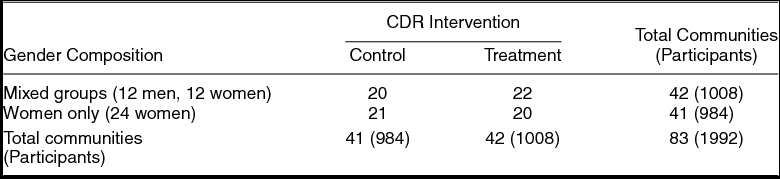
Table 1 gives the overall distribution of treatments and reports the number of communities and treatments in each condition.
Distribution of Treatments

Notes: In all communities, 12 players were randomly assigned to have a high interest rate and 12 to low. In areas with mixed groups half the men and half the women were assigned to each interest rate condition. The CDR assignment was blocked on district. The gender composition assignment was blocked using a matched pair design with matching on village size. We have data for 1979 of 1992 players, since play was stopped in one village after only 11 players participated.
Implementation of Games
Eighty-two communities successfully completed the behavioral game.Footnote 16 The average payout to villages was 20,020LD, or 79.4% of the total possible, with a standard deviation of 13.3%. Among individuals, fully two-thirds contributed the maximum amount (300LD), with the rest almost evenly divided over giving 200 (10%), 100 (12%), or 0 (11%). The average contribution was about 235LD, which is 78.3% of 300.Footnote 17
The contribution game has the structure of a public goods game, at least to the extent that players expected that funds would be spent on community projects they viewed as beneficial. Given that the communities had a week to mobilize and exhort individuals to play for community benefit and given the novelty of the situation, it is difficult to say what one should have expected in terms of average contributions. Arguably, though, contribution levels of almost 80% of the total possible represent an impressive amount of cooperation.Footnote 18
Main Effects
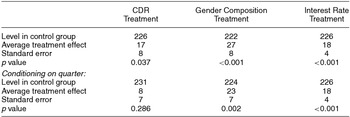
Table 2 presents estimates of the main effects of our three randomized treatments on contributions in the game. The upper half of the table shows that all three treatments had substantial impact. For the share of total payout CDR raised the average contributed from 75.8% to 82.1% of the maximum possible, a difference that is close to half the standard deviation of the payouts in our sample. Another way to scale the magnitude of the CDR effect is to note that it is about the same as the impact of raising the rate of return on individual contributions from 100% to 400%: both increased average individual contributions by about 17LD. The gender composition treatment (“all women”) had a somewhat larger positive impact, with payouts at 84% of the maximum on average versus 75% in the mixed gender communities. The lower half of the table shows estimates of average treatment effects when quarter is included in the list of strata. We see that this substantially reduces the estimated average CDR treatment effect.
Experimental Effects: Average Contributions (in Liberian dollars)

Notes: CDR and gender composition treatment effects, in Liberian dollars, are estimated at the community level; district and the other treatment form strata. For the interest rate, strata are formed by community gender groups. The p values are calculated using two tailed tests and randomization inference. Standard errors are calculated using the conservative Neyman estimator. N = 82 for the first two columns and 1,968 for the third.
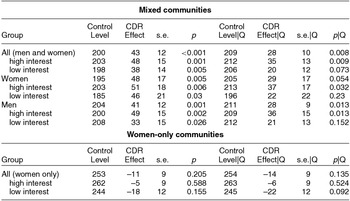
Table 3 shows the heterogeneity of the CDR treatment effect across strata, comparing the effect in mixed groups versus communities where only women played the game as well as across the interest rate conditions. We see striking differences. For every subgroup (by gender and interest rate condition) in the mixed communities the CDR program increased contributions, with an overall estimate of 43 LD on average, a very large and highly statistically significant effect that is two and half times the estimate for all communities taken together (17LD). When we condition on quarter, the estimated impact in the mixed groups declines somewhat, to about 28 LD, but this remains a large and strongly statistically significant difference. Substantively, 28 LD is about 70% of the standard deviation of average contributions across all communities. Thus, the positive estimated CDR effect in the mixed communities is not the result of lack of balance on quarters. In contrast in the “all-women” communities the estimated impact of CDR on contributions is statistically insignificant and tends negative.
Heterogeneous Effects by Gender Composition, Gender, and Interest Rate

Notes: The left section of the table gives the CDR treatment effect on individual contributions in Liberian dollars; the right section is the same but conditions on quarter. p are values calculated using randomization inference, standard errors (s.e.) calculated using the conservative Neyman estimator. The upper panel shows breakdown by gender in the mixed areas; the lower panel shows results in the women-only areas. All analyses conducted at the village level, using village averages for subgroups in question. N = 42 for the mixed communities and N = 40 for the all-women communities.
Three patterns evident from this table will be important when we turn to assess the mechanisms underlying the treatment effects.
First, the lack of a CDR effect in the all-women communities is not explained by CDR having a direct effect on men only. Table 3 gives contribution levels by player gender in the mixed groups. We see that men and women in mixed groups gave similar amounts in the control (non-CDR) communities, and responded to the CDR treatment in roughly the same way. By contrast, in the all-women communities women contributed at a high level with or without the CDR treatment. The difference is due to the composition of the group, not difference in behavior of men and women.
Second, patterns suggest that difference in CDR impact across mixed and all-women groups is not explained by a ceiling effect. Women contributed substantially more than men when they knew they were playing with other women. So one might conjecture that we do not observe a CDR impact in the all-women communities simply because it was hard to drive contributions any higher. However, if contributions in the all-women groups were close to a ceiling, then we would expect the treatment effect to be higher in the low interest condition than in the high interest rate condition. The evidence in Table 3 points in just the opposite direction: the treatment effect was more negative in situations where women were farther from the ceiling. Moreover as shown in Online Appendix E, the interest rate effect is stronger in the all-women condition, contrary to what we might expect if there were a ceiling effect.
Third we note that the CDR treatment effect is generally stronger in the high interest than in the low interest condition, although the differences are typically small (and not significant). We make use of this observation in our discussion of mechanisms below.
Despite statistical objections to the practice (Freedman Reference Freedman2008), multiple regression is often used to check whether a treatment effect remains when covariates are considered. This is indeed the case for the CDR effect in the mixed gender groups when we “control for” community size, whether the community is a quarter in a larger town, and percent Mandingo. Larger communities generated significantly lower payouts in the game, as did the more urban quarters and predominantly Mandingo communities. The estimated CDR effect in the mixed gender groups diminishes some when we control for these factors (and especially quarter, which was not well balanced), but remains substantively and statistically significant (see Online Appendix D).
MECHANISMS
Like other CDD and CDR programs, the CDR program in northern Liberia was a short-lived NGO effort to improve communities’ collective action capacity by introducing elected development councils and providing funds for community-chosen projects. Given much evidence suggesting that local-level social and political institutions are highly persistent, one would probably not expect a significant behavioral impact. Nevertheless, we found strong evidence that the CDR program substantially increased collective action in the communities where both men and women engaged in the contribution game. Given the existing literature this result is surprising. What accounts for it? By what pathways did the CDR program change collective behavior in these communities?
This question cannot be answered definitively because it is not feasible to randomly assign many variations within a complex treatment to identify mechanisms. We can, however, use our three randomized manipulations, together with the surveys of game players, community representatives, and chiefs, to draw inferences about what mechanisms are more or less likely to have been important. We argue that such efforts are essential if experimental analyses of complex governance interventions are to produce results that can have broader social science and policy relevance (see also Acemoglu Reference Acemoglu2010; Ludwig, Kling, and Mullainathan Reference Ludwig, Kling and Mullainathan2011).
It is important to note at the outset that our question is what explains the CDR effect on contributions, and not the question of why did individuals contribute in the first place. Individuals may have contributed because they put a high value on projects proposed; because they wanted to do the right thing to “bring development to their community”; from fear that despite our precautions their contribution decisions could be discovered; or due to a desire to please foreign donors who might be expected to bring more funds later. Our question instead is about the impact of the CDR program on the level of contributions.
In the end, any CDR impact on collective action in the matching funds experiment had to work by affecting the preferences and beliefs of the specific individuals randomly chosen to play the game. These effects might have occurred either as a result of their experience with the CDR program, prior to our arrival to explain the matching funds experiment, or as a result of mobilization activity and information diffusion by other community members after our first community meeting to the explain the game, during the week leading up to game day. We call the first path “direct” and the second “indirect.”
In the Online Appendix, we present a simple model of the contribution game, in which players simultaneously decide how much to contribute to a common pool, some or all of which may be spent on a public project (some might be stolen). The model identifies five preference and belief parameters and how they interact to influence contribution decisions. Each player i chooses a contribution level yi
∈ [0, 1]. y is the vector of all contributions, and
 $\hat{y}_{-i}$
is the expected contribution of people other than i. Preferences over outcomes are represented by
 \begin{equation}
u_i(y) = \mu \left(ry_i + \sum _{j \ne i}ry_j\right) - \theta y_i + 2\kappa \sqrt{(y_i+1)\hat{y}_{-i}}.
\end{equation}
The first term on the right-hand side refers to the benefits from spending on the project. The term in large parentheses is the total amount contributed (after matching), where interest rates are given by r.Footnote
19
The key parameter of interest,
 $\mu \in \mathbb {R}$
captures the rate of transformation of money raised into public goods. This reflects individuals’ values for the public project versus own cash, as well as beliefs about how much would appropriated by the “elites.”
The second term captures the individual’s net costs or benefits associated with contributing, independent of the amount raised and spent on the project. Along with the monetary cost, people may see the contribution as an obligation that they derive satisfaction, or avoidance of social sanctions, from fulfilling. Thus the parameter of interest here, θ, may be positive or negative.
The third term captures possible gains from coordination. Individuals may want to contribute more the more others are expected to contribute, either due to increasing marginal returns from the project, social preferences that involve discomfort for deviating from what most others are doing, or the presence of preferences reflecting “strong reciprocity” (Bowles and Gintis Reference Bowles and Gintis2004). For this component gains from one’s own contribution are increasing in the contributions of others at a rate governed by κ ⩾ 0.
It is straightforward to show that increases in μ and decreases in θ at least weakly increase the set of individuals who have a dominant strategy to contribute (see Online Appendix F). Further, higher interest rates should amplify the effect of factors that increase μ, the value or amount of project spending, but we should expect no such interaction for factors that work through θ. Larger κ increases the range of parameters for which individual choices depend on beliefs about others’ behavior. We analyze the individual’s decision problem under an assumption that players are unsure about others’ contributions; they contribute more the higher their expectation of what others are giving (λ), and less when their uncertainty is greater (σ, a measure of variance of their expectations of others’ average contribution).
As noted, CDR and its institutional innovations may have affected community members’ values for these five parameters directly, during the course of the program, or indirectly, by increasing mobilization and information diffusion activities by community leadership in the week before the contribution game. Because mobilization activities by leadership are endogenous to expectations about how community members will play the game, we consider an extension of the basic model in which elites choose how much effort to spend mobilizing and spreading information to influence community members. We find that elite mobilization can either offset or reinforce the effects of parameters considered above. For example, the more elites can appropriate the funds raised (lower μ), the less incentive for individuals to contribute, but the greater the elite’s mobilization effort which could work to restore or even increase contributions.Footnote
20
The main result, however, is that anything that lowers the leadership’s marginal costs for mobilizing (denoted by
 $\alpha \in \mathbb {R}$
in the model) should increase total contributions in the matching funds experiment. Thus, even if CDR had no effects on most subjects, it might have affected contributions by providing organizational experience to a cadre of community leaders and, perhaps, institutional forms that they could draw on.
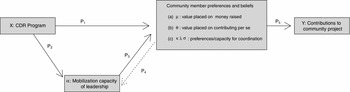
Figure 1 illustrates the several mechanisms or pathways implied by the model. As shown in the figure, the CDR program might have directly affected the beliefs and preferences of community members in such a way as to increase their contributions (P 1 → P 5). Or CDR might have affected the ability or willingness of community leaders to mobilize communities and alter their behavior (P 2 → P 3 → P 5).
Summary of Mechanisms

It is also possible that CDR increased mobilization in part by changing some individual preferences and beliefs—whether leaders’ or regular community members’—leading them to work harder at mobilization (the path P 1 → P 4 → P 3 → P 5).
Measurement of Model Parameters
Random assignment of the CDR program allows us to identify the effect of CDR on mobilization activity (P 2, or perhaps P 2 and P 1 → P 4), as well as the total effect of CDR on our measures of community member preferences and beliefs (P 1 plus P 2 → P 3).Footnote 21 We can also draw on partial correlations between our measures of mobilization, game-player preferences, beliefs, and contributions to provide suggestive evidence on some of the other paths. Finally, we can use results from our other randomizations, and in particular the fact that CDR “worked” in the communities where both men and women played the contribution game but not when only women played, to see which paths are mostly likely to be in operation.
In the following sections, we describe the ways that the CDR program might have affected each of these model parameters and describe measurement strategies to capture these effects.
Value for the Public Good: μ
There are multiple ways in which the CDR program might have affected the value individuals place on the public good produced by collective contributions. We highlight three.
Project selection effects. If more democratic methods were used to select projects for our game in CDR communities, this may have yielded projects more highly valued by the average community member and thus increased contributions. In the game player surveys, we asked respondents to rate how important they thought the projects selected were; whether they liked, didn’t like, or were indifferent to the projects chosen; how many people had “different views” about which project should be chosen; and whether they thought most people in the community would benefit from the projects chosen. We constructed a mean effects index based on these questions to estimate individual and community level values for the projects.
Trust in leaders. If CDR had the effect of reducing the scope for graft—for example, by rendering leaders more accountable to citizens—then game players could be more confident that their contributions would indeed go to the proposed project. This pathway is particularly important given the stress that donors put on improving democratic accountability as the core mechanism by which CDD and CDR programs are supposed to have good effects on governance and community wellbeing. Our game player survey asked how trustworthy respondents thought “community leaders” were in “this town” and relative to other towns in Lofa County; what share community leaders would keep for private use if they got access to funds intended for the community; whether the three community representatives would use the money raised to implement the project chosen; whether the chief and representatives would benefit more than others from the projects; and whether a concern that the money would be mishandled was a factor in the respondent’s contribution decision. These seven questions were used to construct a mean effects index of community trust in leadership.
Trust in NGOs. Third, the experience of the CDR program with the IRC could have increased trust that we would match contributed funds as stated and hand the total over to the community representatives. In the community surveys carried out immediately after completion of the IRC program (March–April 2009), we asked respondents about 12 actions they might take “to try to change the situation . . .if you had concerns about how things were going in your village.” Two of the actions offered were “appeal to local NGOs for assistance” and “appeal to the international community for assistance,” with possible responses being that this would “make things worse,” “make no difference,” “help a little,” or “help a lot.” We also asked each respondent to select from the list of actions the ones they thought would be most effective and second most effective. These questions allow us to create a measure of trust and beliefs in the efficacy of NGOs and “the international community.” Our composite index comprises questions about whether appeals to national or international NGOs would help and whether this action would be either most or second-most effective.
Value for Contributing Independent of Public Goods Outcome: θ
Captured by θ in the model, CDR could also have direct effects on individuals’ value for contributing independent of anticipated private or collective benefits from the money raised.
Income effects: If the CDR program significantly increased incomes in the community, this could lower game players’ value for cash versus public projects.Footnote 22 We asked a battery of questions in the follow-up and game player surveys about household income, assets, quality of housing materials, and access to water and land. We use these to construct a composite measures of individual and community material welfare.
Sanctioning effects: The CDR program may increase cooperation by increasing individuals’ expectation that they might be sanctioned for failing to contribute. For example, CDR could in principle have established stronger norms of cooperation and thus increased expectation of disapproval for noncompliance. Or CDR might have increased information flows about behavior. Alternatively, it is possible that CDR actually weakened the capacity to sanction, for example by weakening traditional authority structures. Two survey questions about whether game players thought others would find out what they contributed and whether this concern affected their contribution decision were used to construct a composite measure of fear of discovery, a precondition for fear of sanctioning.
Legitimacy effects from participation: If CDR increased the use of participatory procedures in community decision-making, this could lower individuals’ costs of contributing independent of their value for the project and trust in leaders, by increasing the perceived legitimacy of the action.Footnote 23 In contrast to some of the other “direct effects” listed above, this one requires at least some mobilization activity by community leaders: in order for democratic methods to be used to make community decisions, meetings must be organized and held.
We asked the game players questions about the democratic process used to select the projects and community representatives: were meetings to make these decisions organized by the chief or by community members; were the community representatives selected by a vote; were they selected in a public place; were the projects selected by a vote; were they chosen in a public meeting.Footnote 24
Coordination versus Dominant Strategy Preferences: κ, λ, σ
The CDR program might have increased collective action capacity by facilitating coordination. Changes in κ would arise if the program altered the values individuals placed on “doing one’s part” conditional on others doing so. But the program could also have increased the community’s ability to coordinate given such preferences either by altering beliefs about the likely behavior of others in a coordination problem or uncertainty about those beliefs. Such changes could arise if, for example, CDR increased information flows and as result facilitated the spread of information and common expectations about play.
In the game player survey, we asked respondents how they expected other players to choose. This allows us to construct a measure of both expectations and the accuracy of those expectations, which we use to proxy an individual’s uncertainty over the behavior of others. In addition, this measure allows us to assess the correlation between an individual’s expectation of others’ play and his or her own contribution, a possible indication of coordination preferences.
Indirect Effects (Mobilization): α
Finally, the CDR program could have increased community contributions by creating or improving the effectiveness of a cadre of community members with experience in mobilizing the broader community for collective action. Such indirect effects could produce overall effects whether or not CDR directly affected the average disposition to contribute.
We have multiple measures to assess these mobilization effects. First, the game player, community representative, and chief surveys contain items that tap different aspects of mobilization effort by community leadership. Questions about whether additional meetings were held to discuss the project, whether the respondent attended, and estimates of the number attending such meetings were used to construct an index called meetings. Questions about whether the respondent had been personally contacted about the game, about the project, about staying home on game day (so as to have a better chance of being selected), and about whether anyone asked the respondent to contribute were used to create a measure tapping efforts at contact. A measure of game player knowledge is based on questions about whether the respondent had heard of the matching funds experiment, knew the projects selected by the community and the names of the community representatives, and could answer the questions about who organized meetings and how many had attended. We also asked chiefs and the community representatives about meetings held and efforts to contact individuals, and constructed parallel “elite” measures from these.
EVIDENCE ON MECHANISMS
Effects on Community Preferences and Beliefs: μ, θ, κ, λ, σ
We begin by examining the impact of CDR on a variety of measures designed to proxy for the beliefs and preferences of community members. Random assignment allows us to identify CDR’s total causal impact via its direct and indirect paths on our measures of game player’s beliefs and preferences relevant to their contribution decisions.
We note first that the model implies that if there are effects operating through valuation of the project, μ, CDR effects should be stronger when interest rates are higher (or conversely that interest rate effects would be greater in CDR areas). If CDR increases the value of every penny that goes to the public good then this effect is enhanced when pounds are in play.Footnote 25 The results given in Table 3 provide only weak and nonsignificant support for this proposition.
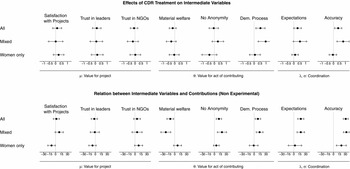
Figure 2 shows CDR impacts on the intermediate measures we identified above, providing separate estimates for mixed and all-women communities, along with (in the lower panel) the correlation between these measures and average contributions in the development project experiment (P 5).
Evidence on Mechanisms: Direct CDR Effects on Preferences and Beliefs

We find that CDR did not have an overall impact on outcomes associated with μ: satisfaction with projects, trust in community leaders, or trust in NGOs. This is consistent with our finding on the interest rate/CDR interaction.
The results on total effects on θ are more mixed. We see no effects on two measures: material welfare and perceptions of the anonymity of one’s contribution in the game, whether in the mixed or in the all-women communities. This reinforces the inference that direct effects of CDR on community member preferences regarding the value of public goods or the value of contributing are unlikely to be the pathway by which CDR had an impact on collective action. It also suggests that it is unlikely that greater mobilization due to CDR in the mixed communities worked to increase contributions through any of these intermediate variables, since we do not see the pattern of positive effects in the mixed communities and no effects in the all-women communities.
By contrast, we do see evidence, in the mixed but not all-women communities, of a total effect of CDR on our measures of whether democratic process was employed to choose projects and representatives.Footnote 26 While the CDR program did not increase trust in leaders or project satisfaction as reported by the game players, it did, in the mixed communities, cause greater use of ostensibly democratic procedures like elections to choose projects and representatives. This feature may have led to greater support for the collective endeavor. Moreover, this feature is also correlated with significantly higher average contributions in the contribution game.
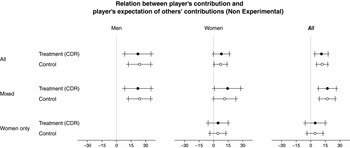
To assess whether CDR mattered by increasing the prevalence of “coordination preferences” (κ), such that people want to contribute if they think others will, we look at the correlation between game player’s contributions and their beliefs about others’ likely contributions. Figure 3 shows the estimated marginal effect of higher reported beliefs about others’ actions on one’s own contribution decision. The effects are estimated using ordinary least squares and controlling for village fixed effects, so that the results assess the relationship between an individual’s contribution and the extent to which he or she had unusually high or low beliefs about the actions of others in that particular community. We find a strong positive relationship, particularly among men, which is consistent with coordination preferences. But we see that the size of the correlation is similar in treatment and control communities. This suggests that coordination preferences existed but that their strength was not affected by exposure to CDR.
Regression Estimates for Player’s Beliefs about Other’s Average Contribution (scaled to 1 sd in control communities)

There is more support for the idea that CDR facilitated coordination conditional on players having coordination preferences—that is that CDR effects may have operated through λ or σ, expected mean contribution and variance of contributions. From the final two columns of Figure 2, we see that in the mixed communities, CDR caused players to expect other players to contribute more. Expectations are also more closely associated with actual contributions at the village level in CDR areas for the mixed gender game, suggesting that players do have reasonable knowledge regarding the likely play of their peers on which they could condition their strategy. The former effect (on levels) is not robust to conditioning on quarter though the latter (accuracy) is.
This evidence is consistent with either CDR having a direct effect on community members’ ability to coordinate, say, by increasing information sharing, or by increasing mobilization activity which got more people “on the same page.” Given that we observe these effects only in the mixed communities and that under the simplest interpretation, one would expect a direct effect on information-sharing to affect both men and women, it seems plausible that these total effects result from differential mobilization strategies. We turn to these next.
Direct versus Indirect Effects
The analysis of the last section focused on direct effects of CDR on preferences and beliefs. We now examine the case for CDR’s impact via an indirect effect through mobilization.
If CDR had an impact primarily via a large, direct effect on preferences and beliefs of both men and women in treated communities (P 1), then it is difficult to explain why we found that CDR caused a large increase in contributions in the villages where both men and women played the game but had zero (or a slightly negative estimated) impact in villages where only women played.
On the other hand, if the CDR program had a large direct impact on the preferences and beliefs of just men, then it is hard—though perhaps not impossible—to explain why CDR caused a large increase in contributions by women in the mixed groups, but not in the communities where only women played. Hypothetically, it is possible that CDR directly affected men’s preferences and beliefs so as to favor contributing, that women knew or anticipated this, and that they had coordination preferences and so wanted to match what they expected that men (and women) would do in the mixed communities. In the all-women communities, by contrast, perhaps contributions were expected to be higher regardless of CDR treatment because women were expected to be more community-minded than men, or because it was anticipated that they could more easily solve the collective action problem for some reason.Footnote 27 Player expectations about whether men or women would contribute more are broadly consistent with this latter hypothesis. We asked game players if they thought men or women would contribute more in the game, or about the same amount. 68% of women in the all-women communities thought women would give more than men (had men had a chance to play), compared to 52% of women in the mixed communities, a highly statistically significant difference. In addition, we found evidence consistent with players having coordination preferences.
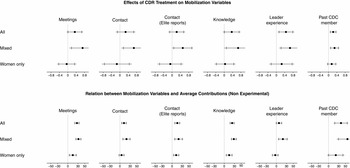
An alternative hypothesis is that CDR mattered primarily via an impact on mobilization capabilities, and that it affected the use of these capabilities in the mixed communities but not in the all-women communities. Consistent with this idea, we find strong evidence that the CDR program caused an increase in mobilization activity in the mixed communities but not in the all-women communities. Figure 4 summarizes these results. In the mixed communities, CDR treatment caused significantly greater reports of community meetings, game-player knowledge, game-player reports of contact by elites, and elites’ reports of contact with potential players.Footnote 28 By contrast, in communities where only women participated in the contribution game, CDR is not associated with more community meetings, game player knowledge, or contact efforts. Indeed levels of mobilization are similar in the all-women areas and in the mixed gender CDR areas, but lower in the mixed gender control areas (see also results in Online Appendix G).
Mobilization Activity Summary

This mechanism—mobilization activity—mirrors the pattern observed with contributions: a positive impact of CDR in mixed gender groups, and zero effect in the communities where only women could play the game. Moreover, we show in the lower panel of Figure 4 the community-level correlations between measures of mobilization activity and average contributions in the game (the path P 3 → P 5, which we note again is not identified by randomization). More mobilized communities gave significantly more in the contribution game, in both the mixed and all-women groups. Thus mobilization seems to matter everywhere, even if the CDR program only affected its extent in the mixed groups.Footnote 29
These same patterns hold at the individual level, when we compare women in the mixed groups to women in the all-women groups on their responses to the questions about community meetings, knowledge of the game and projects, and contact experience. We find generally strong positive effects of CDR treatment on women in the mixed groups, but no effects at all for women in the all-women groups (including controlling for quarter).
Mobilization effects can also be observed in the choice of leadership. Recall that communities were asked to select representatives to receive and manage the funds for the public goods project. The final columns in Figure 4 show the effect of CDR on survey responses to questions about the prior leadership activity of these representatives. According to game players, the CDR treatment is associated with significantly more experienced representatives where the game was played by a mixed gender group, but no significant difference in experience where only women were selected to play.Footnote 30 The differences may stem from the use communities made of structures put in place by the CDR program. We asked the community representatives directly “were you a member of a donor-sponsored community development council?” Since the CDR program created CDCs, we might expect to find a positive effect and indeed we do: about 68% say “yes” in the CDR communities, versus 46% in the control communities, a strongly significant difference.Footnote 31 However, when we distinguish between mixed and all-women groups, we find that the effect is larger in mixed, while smaller and statistically insignificant (though positive) in the all-women groups (final column, Figure 4).
These results suggest that CDR’s impact occurs through changes in the ability and willingness of community leaders to mobilize and share information. They also provide a partial answer to the puzzle of why the CDR program increased community collective action where both genders could participate in the contribution game, but not where only women played: CDR increased mobilization activity in the mixed communities, but not in the all-women communities, and mobilization activity is strongly associated with bigger contributions. This might be because the CDR program affected men more than women, and men mobilized women (in addition to men) when they knew that men could play the game, or women sought to match how others were expected to play. Or it might be that leaders in the mixed communities drew on skills, experience, or networks created during the CDR program, whereas leaders in the all-women communities handed off the problem of organizing to play the contribution game to (possibly more traditional) women leaders and networks that were not affected by the CDR program. We return to these possibilities below.
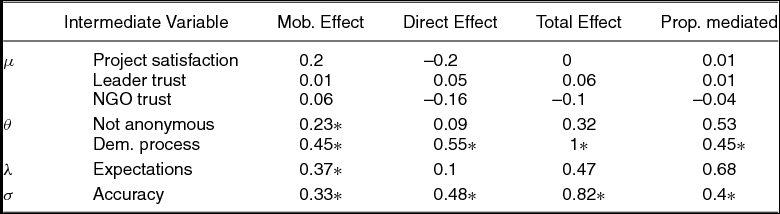
We close this analysis by considering a decomposition of CDR’s direct effects and effects via mobilization activity on these several measures of game player beliefs and preferences, using the approach of Imai et al. (Reference Imai, Keele, Tingley and Yamamoto2011). For consistent estimates, this method requires the satisfaction of an assumption that Imai et al. call “sequential ignorability.” This is a demanding assumption and we highlight that inferences from this analysis are valid only to the extent that the assumption holds.Footnote 32 The results, provided in Table 4, reinforce the view that the effects of CDR worked through a coordination mechanism and through the employment of democratic processes, and moreover that a large share of these effects operate though greater community level mobilization and not simply through direct effects on the attitudes and beliefs of citizens.Footnote 33
CDR Effects, Direct and Indirect (via Mobilization), Mixed Communities Only

Note: Effect of CDR on intermediate variables divided between a direct pathway and a pathway through mobilization measures. Intermediate variables have standard deviation of 1.
**p < .01; *p < .10
DISCUSSION AND CONCLUSIONS
A field experiment in which villages in northern Liberia were randomly assigned to receive a community-driven reconstruction program provides evidence that the introduction of new institutions and practices can alter patterns of social cooperation in a way that persists after the program’s conclusion. Villages exposed to the development program exhibit higher subsequent levels of social cooperation than those in the control group, as measured through a matching funds experiment that enables us to observe individual and community level contributions to a public good. These results suggest that changes in community capacity for collective action can take place over a short period of time; can be the product of outside intervention; and can develop without fundamental changes either to the structure of economic relations or to more macro-level political processes. However, we found strong heterogeneity in the measured effect of the CDR program. When the matching funds experiment was carried out with mixed gender groups, CDR had a very large impact; when we invited only women to participate, the estimated effects were zero or negative. These mixed results underscore the sensitivity of findings to details of measurement, but also highlight importance of specifying and assessing the mechanisms by which CDR changes political and social outcomes.
The results in Liberia stand in contrast to findings on the impact of CDR in other contexts. Three other field experiments on CDD/CDR have been carried out in recent years, each of which employed a randomized design and a behavioral approach to measuring outcomes. Together, these studies have yielded either no or mixed evidence of improvements in governance capabilities. Casey, Glennerster, and Miguel (Reference Casey, Glennerster and Miguel2012) examined a government-sponsored program in neighboring Sierra Leone and found no positive effects on community decision-making processes or collective action capacity, as measured through a series of structured community activities. Beath, Christia, and Enikolopov (Reference Beath, Christia and Enikolopov2013) studied the National Solidarity Program in Afghanistan and found few long-lasting effects on citizen engagement, confidence in government, or the extent to which communities channeled valuable resources to marginalized groups, though there is some evidence that women’s empowerment improved. Importantly however they do find evidence that the institutions created by the CDR program could produce better outcomes when called upon to do so, a point we return to below. Humphreys, Sanchez de la Sierra, and van der Windt (Reference Humphreys, de la Sierra and van der Windt2013) study a CDR program in eastern Democratic Republic of the Congo that, like the Liberia project assessed here, was administered by the IRC. They observed how communities engaged in a nonconditional cash transfer program in order to measure outcomes, and found no impact of prior exposure to CDR on community participation, community oversight, or the extent to which the resources were spent to benefit those most in need.
While it is unusual to have a set of similarly designed experiments replicated in a diversity of contexts, the heterogeneous results make it challenging to extract general knowledge from this research agenda. A common approach is to identify aspects of program design that vary and that could account for the different impacts, or to highlight aspects of the institutional context that might mediate the impact of the standard intervention. Even though CDD/CDR programs follow a common template, it is easy to identify elements of the program (e.g., program length, size of financial grants, relationship to government institutions) or the implementation (e.g., quality of the program staff, timeliness of delivery, quality of the projects) that differ across contexts. And with studies carried out in Sierra Leone, Liberia, Afghanistan, and DRC, it is almost certain that there are meaningful differences in the institutional context or measurement strategies.Footnote 34 However, this approach leaves us with many candidate explanations but little ability to test among them. We focus instead on uncovering the mechanisms through which CDD/CDR programs work (or do not work), exploiting the fact that we observe different impacts of CDR within a single experimental design in Liberia, thereby holding constant aspects of program design, implementation, and institutional context.
We examine multiple mechanisms including the idea that elections to CDCs can increase accountability and trust in local leadership; that participatory processes can lead to selection of more widely valued projects; and that the experience of working together on a CDD/CDR project can increase post-conflict reconciliation or involve marginalized community members in ways that lead to greater community cohesion. Our study finds little or no evidence that the program increased trust in community leaders, led to the selection of more highly valued projects, or caused people to put more weight on community welfare. These null findings are consistent with null outcomes on governance outcomes found in previous studies. It also appears highly unlikely that the CDR program changed individual preferences for public goods relative to income by increasing community income levels, since we find no evidence that the program had a significant impact on measures of average material wellbeing.Footnote 35
Nonetheless, we do find strong evidence that exposure to CDR caused greater mobilization efforts by leaders in the communities where both men and women could be selected to provide matching funds. In these “mixed-gender” settings, CDR treatment communities selected leaders with greater experience who ran more meetings, communicated more with village members, and imparted a greater understanding of the process. We also found some evidence that CDR led communities to use more democratic methods in the selection of community representatives and projects, and that CDR is associated with more common expectations among game players about how others in the community would act. Again, however, these CDR effects were observed only in communities where both men and women could participate in the contribution game, and not in communities where it had been announced that only women would be selected.
When we introduced the gender variation to the matching funds experiment, we conceived of it as a crosscutting manipulation distinct from the CDR treatment. However, it can also be thought of as providing two ways of measuring the impact of the CDR program. In effect, we have one measurement of the effect of the CDR program on a collective action for a mixed gender group, and one for a problem facing a women-only group. We found evidence that CDR improved collective action capacity for the former, but not the latter. What accounts for the difference?
We argue that the mechanism that can make the best sense of the data is that CDR increased the number or experience of a cadre of leaders who could be deployed to inform and mobilize the community to contribute in the matching funds challenge. Because the CDR program had mandated mixed-gender structures (the CDCs, for example), leaders in the CDR-treated, mixed gender communities may have found it natural to employ people and networks who had prior experience mobilizing collective action across gender lines. By contrast, in the all-women communities, the male leadership may have simply handed the problem off to women leaders, who, as described above, have well-developed, traditional networks and social institutions that could be used to mobilize the women of the community. Consistent with this hypothesis, it appears that more of the community representatives in the mixed-gender communities had prior experience in CDCs than in the all-women communities.
If this hypothesis is correct and if the mechanism generalizes, it suggests that the value of CDD/CDR programs might be less in their having a broad impact on the beliefs and preferences of community members about democracy, governance, or the value of inclusion, but rather in their effect on what might be called leadership capital—local leaders’ skills and experience in coordinating and mobilizing collective action for collective action problems that must be addressed by broad cross sections of a community. If leaders confront social dilemmas of this kind, prior exposure to inclusive decision-making of the form promoted by external actors may have large effects. However, because existing structures of authority are often organized around single-gender or other more narrowly constituted groups, this new leadership capital may prove redundant.
This interpretation resonates with the results on CDR in Afghanistan (Beath, Christia, and Enikolopov Reference Beath, Christia and Enikolopov2013). In that study, researchers assessed the effects of exposure to a CDR intervention on behavior in a wheat distribution exercise. They found that when communities were unconstrained in determining how wheat would be distributed, there were no improvements attributable to the CDR intervention. However, distribution improved on their measures when local development committees were formed and delegated to manage the distribution task, compared to control areas where there was neither a CDR intervention or delegation. The authors interpret the result as indicative of gains from delegation. Our results suggest instead an interpretation that points to a weakness of the CDR model: that the model may create potentially effective institutions or capabilities but not provide the incentives for communities to make use of them endogenously. This interpretation also helps square our results with the negative results of other studies, including Casey, Glennerster, and Miguel (Reference Casey, Glennerster and Miguel2012) and Humphreys, Sanchez de la Sierra, and van der Windt (Reference Humphreys, de la Sierra and van der Windt2013). Rather than posing a collective action problem that required randomly selected community members to cooperate, these studies examined behavior in more naturalistic settings that gave communities significant discretion over who should resolve the collective action challenges they faced. Our results suggest that in these cases it is possible that CDR altered capacity for some forms of mobilization but that any such gains counted for little when communities could dispense with CDR mechanisms and employ pre-existing institutional structures.
Our focus on mechanisms challenges the underlying causal model and suggests a need to reconsider the promises made by advocates of interventions like these that seek to alter the decision making processes in developing areas. We saw that exposure to participatory and inclusive decision-making through CDR does not necessarily lead individuals and communities to embrace more democratic processes, include marginalized groups, and better hold their leaders to account. Decisions that communities make about how to organize themselves depend very much on the kinds of challenges they confront. We found evidence that the leadership capital built up through CDR facilitates the mobilization of cross-community participation and engagement, but only in a context in which we decided, as outsiders, that everyone in the community had an equal role to play in addressing the challenge. In the real world, where communities themselves choose who to involve in addressing local concerns, traditional approaches to problem solving may suffice, and any benefits of CDR may only be in evidence when cross-cutting organization is required or mandated. CDD and CDR might build collective action capacity at the local level in developing countries, but capacity and skills of a sort that will only be used to improve outcomes in foreign aid projects that require nontraditional forms of organization.
The bottom line is that development practitioners must be more sensitive to the fact that, despite years of conflict, communities rarely represent an institutional tabula rasa. Any new institutions that outsiders introduce will interact and compete with pre-existing structures, which are often resilient. While more democratic or gender-balanced institutions may have appeal to external actors on normative grounds, they will not necessarily trump those institutions that are already in place, especially if they are no more effective for the kinds of challenges that communities regularly confront.
SUPPLEMENTARY MATERIALS
To view supplementary material for this article, please visit http://dx.doi.org/10.1017/S0003055415000283




Comments
No Comments have been published for this article.