Adaptive remodelling including increased left ventricular muscle thickness and heart chamber size was reported in athletes.Reference Pelliccia, Caselli and Sharma 1 A similar pattern was described in children and is known as paediatric athlete’s heart.Reference McClean, Riding and Ardern 2 Structural adaptations are accompanied by changes in myocardial strain and left ventricular rotational mechanics, but there are conflicting data regarding the presence and direction of these changes.Reference Beaumont, Grace, Richards, Hough, Oxborough and Sculthorpe 3 In general it is believed that global strain parameters remain unchanged and that left ventricular twist changes in relation to the type of sport and intensity of training.Reference Pelliccia, Caselli and Sharma 1 , Reference Beaumont, Grace, Richards, Hough, Oxborough and Sculthorpe 3 However, most data on myocardial deformation were collected in adult athletes by means of echocardiography, and not in children.Reference Beaumont, Grace, Richards, Hough, Oxborough and Sculthorpe 3 Therefore, we decided to analyse myocardial deformation and rotational mechanics by a novel cardiac MRI feature-tracking post-processing technique in pre-adolescent soccer players.Reference Rahman, Sethi and Murtaza 4
Material and methods
Subjects
We retrospectively evaluated 35 male, Caucasian soccer players aged 8–12 years. All of the participants have been engaged in regular trainings (2×90 minutes per week with 60 minute league matches on weekends) for at least 2 years during most months of the year. The findings were compared with 20 healthy male, Caucasian, and age- and body surface area-matched controls whose sport activity was limited to school classes. Comparison of left and right ventricular volume, function, and mass in both groups was presented in a separate publication.Reference Barczuk-Falęcka, Małek, Krysztofiak, Roik and Brzewski 5
Feature-tracking analysis
Cardiac MRI imaging was performed with a Siemens Magnetom Skyra 3 Tesla scanner (Siemens, Erlangen, Germany) including initial scout images, followed by cine steady-state free-precession breathhold sequences in two-, three-, and four-chamber views. Short axis was identified using the two- and four-chamber images and included the whole heart from the mitral/tricuspid valve insertion points to the apex.
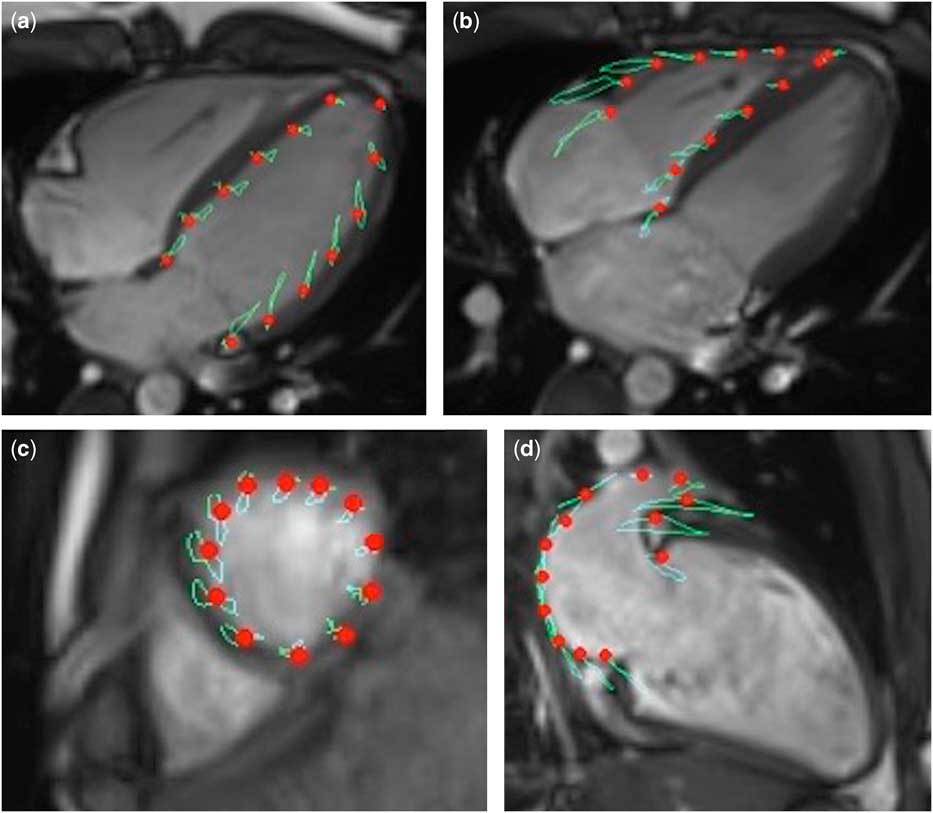
Images were then analysed with the use of dedicated software (QStrain, Mass Medis, Leiden, The Netherlands). For the purpose of analysis, endocardial borders were manually traced in end-systole and end-diastole on two-chamber, four-chamber, three-chamber views and three short-axis views and used for generation of the analysed parameters. In brief, left ventricular strains were calculated from three long-axis cines and averaged for 17 segments. Strain parameters for other chambers were based on single long-axis cines – four-chamber for right ventricle and two-chamber for left atrium – according to software specifications; see Figure 1 for examples. Left ventricular twist was calculated from three short-axis cines – basal, mid ventricular, and apical – and represented a difference between counter clockwise apical rotation – positive values – and clockwise basal rotation – negative values – expressed in degrees.
Examples of cardiac MRI feature tracking in a 12-year old soccer player: (a) left ventricle in 4-chamber view (2- and 4-chamber views not shown), (b) right ventricle in 4-chamber view, (c) left ventricle in short axis at the apical level (basal and mid-ventricular slices not shown), (d) left atrium in 2-chamber view.

Results
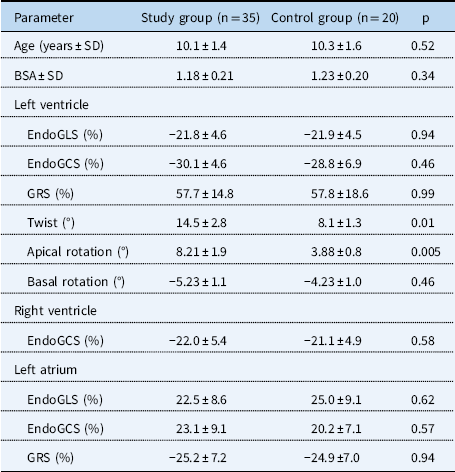
Strain analysis disclosed no differences in all global strain parameters between both studied groups and showed greater apical, but not basal, rotation and greater left ventricular twist in children athletes (p=0.005 and p=0.01, respectively) (Table 1). Analysis of the correlation between twist and indexed left and right ventricular volume – end-diastolic volume, end-systolic volume, stroke volume – and ejection fraction showed only weak positive correlation with right ventricular end-diastolic volume and right ventricular stroke volume (r=0.32, p=0.02 and r=0.28, p=0.04, respectively).
Baseline characteristics, myocardial deformation parameters, and left ventricular rotational mechanics in both studied groups.

BSA=body surface area; EndoGCS=endocardial global circumferential strain; EndoGLS=endocardial global longitudinal strain; GRS=global radial strain
Discussion
We have demonstrated by cardiac MRI feature tracking, for the first time in pre-adolescent athletes, that several years of regular intensive soccer training does not alter global strain parameters of both ventricles. This is generally in line with recently summarised data in adult athletes showing normal strain by speckle-tracking echocardiography.Reference Pelliccia, Caselli and Sharma 1 , Reference Beaumont, Grace, Richards, Hough, Oxborough and Sculthorpe 3 However, in children, there were so far only few echocardiographic studies analysing myocardial deformation in response to prolonged training. D’Ascenzi et alReference D’Ascenzi, Pelliccia and Valentini 6 found no changes in right ventricular strain in pre-adolescent competitive swimmers. Another echocardiographic study in children found lower values of global longitudinal left ventricular strain, but only in basketball players and not in other popular sport categories including football.Reference Binnetoğlu, Babaoğlu, Altun and Kayabey 7 We have supplemented the findings by demonstration of unaltered left atrial strain parameters in young athletes – an aspect that has not been analysed before.
Despite the lack of changes in strain parameters, we have shown a greater left ventricular twist in athletes, which was caused mainly by greater apical rotation with no significant changes in basal rotation. Although twist mechanics generally do not change in athletes as reported recently, similar findings to ours were reported for high-static low-dynamic athletes.Reference Beaumont, Grace, Richards, Hough, Oxborough and Sculthorpe 3 It has been hypothesised that repeated exposure to acute after load increases may lead to chronic adaptations in twist to maintain systolic function mediated by increased baseline apical rotation.Reference Beaumont, Grace, Richards, Hough, Oxborough and Sculthorpe 3 This situation may be present in soccer players in whom short sprints during training or matches may induce acute after load increase. In line with that, a study on elite adult soccer Korean players at rest also showed higher rotations, but not only in apical but also in basal segments.Reference Eun and Chae 8 Increase in apical, but not basal, rotation and in peak twist was also noted directly after exercise in an echocardiographic study in adolescent childrenReference Di Maria, Caracciolo, Prashker, Sengupta and Banerjee 9 and in adult rowers after 3 months of training.Reference Weiner, Hutter and Wang 10 On the other hand, endurance sports were related to lower twist.Reference Beaumont, Grace, Richards, Hough, Oxborough and Sculthorpe 3 This was demonstrated also in the MRI feature-tracking study in adults.Reference Swoboda, Erhayiem and McDiarmid 11
Our findings on left ventricular myocardial deformation and rotational mechanics in pre-adolescent athletes provide new data to the characteristics of paediatric athlete’s heart.
Acknowledgements
None.
Financial Support
This research received no specific grant from any funding agency or from commercial, or not-for-profit sectors.
Conflicts of Interest
None.
Ethical Standards
The authors assert that all procedures contributing to this work comply with the ethical standards of the relevant national guidelines on human experimentation and with the Helsinki Declaration of 1975, as revised in 2008, and has been approved by the Ethical Committee of Medical University of Warsaw, Poland.